An Effective Solution for Health Care
Platform Using Cloud Computing
AR.Arunachalam, Sundararajan.M, Arulselvi S
Assistant Professor, Dept. of CSE, Bharath University, Chennai, Tamil Nadu, India
Director, Research Center for Computing and Communication, Bharath University, Chennai, Tamil Nadu, India
Co-Director, Research Center for Computing and Communication, Bharath University, Tamil Nadu, India
ABSTRACT: Cloud computing is not just about data center technology. It’s more about streamlining Applications and Infrastructure systems in order to make organizations and end users more up to date, more responsive to change and more oriented to new technologies like cloud computing.
As Technologies continue to evolve, organizations and end users realize that there is no single approach towards software platforms in future. Business landscape, Market requirement and need for faster better access to Data influence new technology approaches like cloud computing .
In this view point, this paper is an approach to solve a real world problem in health care technologies, a possible solution using cloud computing platform and by providing better access to information remotely
I.INTRODUCTION
Cloud computing is a style of computing whose foundation is the delivery of services, software and processing capacity using private or public networks. The focus of cloud computing is the user experience, and the essence is to decouple the delivery of computing services from the underlying technology. Beyond the user interface, the technology behind the cloud remains invisible to the user, making cloud computing incredibly user-friendly. Cloud computing is an emerging approach to shared infrastructure in which large pools of systems are linked together in private or public networks to provide IT services.
Cloud enables the dynamic availability of IT applications and infrastructure, regardless of location. Cloud computing also yields significant cost savings in the real estate required for the data center as well as power and cooling costs, Rapid service delivery results from the ability to orchestrate the tasks to create, configure and add computing power Cloud computing can enhance information management and service management initiatives.
The rest of the paper is organized as follows . Section II describes about Cloud Computing Categories, Current architecture of a common application platform (Non - Cloud Platform) and How to build a cloud platform?. Then we explain the real world problem in health care field and also the solution in Section III. Section IV give the implementation and work flow. Finally, Section V gives the concluding remark of the whole paper.
II.CLOUD COMPUTING
A. Cloud Computing Categories
2) Attached services: Every on-premises application provides useful functions on its own. An application can sometimes enhance these by accessing application-specific services provided in the cloud. Because these services are usable only by this particular application, they can be thought of as attached to it.
One popular consumer example of this is Apple’s iTunes: The desktop application is useful for playing music on ipod and Apple devices, while an attached service allows buying new audio and video content.
3) Cloud platforms: A cloud platform provides cloud-based services for creating applications. Rather than building their own custom foundation, for example, the creators of a new SaaS application could instead build on a cloud platform. As Figure 1 shows, the direct users of a cloud platform are developers, not end users.
Figure 1: Cloud services and three broad categories.
B .Current architecture of a common application platform (Non - Cloud Platform)
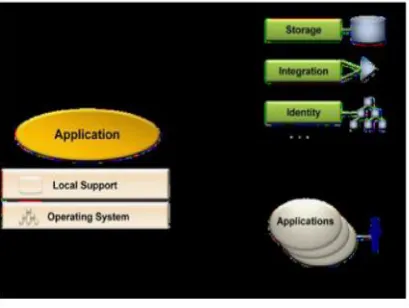
An application platform can be thought of as comprising three parts:
A foundation: Software OS platform the machine ( Laptops, computer , tablets or Smart phones) runs on
A group of infrastructure services: Local intranet ( Ex: University network, department network etc )
A set of application services: Applications ( Ex: Java/.NET applications ,ITunes , Microsoft outlook etc)
Figure 2: Example of an Application platform contains three parts.
2. Both kinds of applications can access infrastructure and application services provided on-premises and in the cloud.
3. Just as on-premises platforms support today’s applications, cloud platforms provide services for the applications we’re likely to build tomorrow.
III. A REAL WORLD PROBLEM AND SOLUTION
A. In Today’s Scenario
In today’s world health care field is more dependent on technology and new techniques for solving many everyday
problems.Every hospital has an intranet system which enables the medical professionals, doctors and Para medical professionals to share information on the patient and maintain data on each of the medical cases. For Example when a new patient is admitted in a hospital multiple layers of information is shared among different entities of a hospital. The Doctor in the hospital would look for the patient basic medical data such as blood pressure, Heart rate, Pulse rate and so on. A Lab technician would look for RBC or WBC count in blood and so on .
For example
If a new patient with a symptom of heart attack is admitted in the hospital the initial information of blood pressure , heart beat , pulse rate and symptoms are keyed in by the nurses
Post an ECG or An X-ray or a scan the patient file is updated with images and reports of the findings.
The findings are later usually reviewed by a general in house doctor and prescriptions are given
If the case is severe the specialists are required to look into the data for providing advice on the case.
In this example information of a single patient is used by multiple end users in the hospital
This information in the current world is usually stored in a in house data base and a front end application software
B. Problem
If the doctor is not available on premises and he is not able to access the information from the on premises application (Hospital’s in house Patient information software)
If the labs and Para medical professional are not located in the same premises
Information sharing is not available between various hospitals
C .Solution Using Cloud Computing
This problem can be easily solved using cloud computing.
By setting up a layer of cloud on the already existing infrastructure and the application layer
The remote access facility comes into play
The applications on the cloud layer access the information on the on premises data base and use the same servers for linking.
The end users (Doctors, Para medics or Hospital administrators) can access the data on the cloud using the Internet enabled devices such as a computer at home or hand held devices, tablets, smart phones or laptops.
IV. IMPLEMENTATION AND WORK FLOW
Cloud computing methodology uses the already existing infrastructure hence the cloud layer will provide an interface with the database and front end application layer using the internet cloud storage.
Patients data
V. CONCLUSION
Cloud platform is not yet at the center of most people’s attention. Five years from now Cloud computing will be the most sort after platform for computing in any field be it Engineering, Health care, Legal services or any technology dependant fields . The attractions of cloud-based computing, including scalability and lower costs, are very real. Many day to day problems of lack of infrastructure and information availability can be solved using this technology From application development to Software to End users expect the cloud to play an increasing role in your future. The next generation of application platforms is here.
REFERENCES
[1] Infosys resource center (http://www.infosys.com/cloud/resource-center)
[2] Jayalakshmi T., Krishnamoorthy P., Kumar G.R., Sivamani P., "The microbiological quality of fruit containing soft drinks from Chennai", Journal of Chemical and Pharmaceutical Research, ISSN : 0975 – 7384, 3(6) (2011) pp. 626-630.
[3] Kulanthaivel L., Srinivasan P., Shanmugam V., Periyasamy B.M., "Therapeutic efficacy of kaempferol against AFB1 induced experimental hepatocarcinogenesis with reference to lipid peroxidation, antioxidants and biotransformation enzymes", Biomedicine and Preventive Nutrition, ISSN : 2210-5239, 2(4) (2012) pp.252-259.
[4] Kulanthaivel L., Srinivasan P., Shanmugam V., Periyasamy B.M., "Therapeutic efficacy of kaempferol against AFB1 induced experimental hepatocarcinogenesis with reference to lipid peroxidation, antioxidants and biotransformation enzymes", Biomedicine and Preventive Nutrition, ISSN : 2210-5239, 2(4) (2012) pp.252-259.
[5] Khanaa V., Thooyamani K.P., Saravanan T., "Simulation of an all optical full adder using optical switch", Indian Journal of Science and Technology, ISSN : 0974-6846, 6(S6)(2013) pp.4733-4736.
Smart phones Cloud Application front end Cloud Layer Appli catio n Front end Hospitals Intranet End user 1
Doctors, Nurses on premises
End user 2 Technicians, Administrators Data base with Patie nts data Cloud DataBase with Access Cloud using a unique User Name / Password
Handheld devices/tablets
[8]http://www.ecoseed.org/index.php/general-reference [9] www.pcmag.com
[10] www. Internet revolution.com
[11] Jemima Daniel,The world of illusion in Tennessee William’s “The Glass Menagerie”,International Journal of Innovative Research in Science, Engineering and Technology,ISSN: 2319-8753,pp 6183-6185 ,Vol. 2, Issue 11, November 2013.
[12] Jemima Daniel,Themes of Violence, Horror, Death in Hemingway,International Journal of Innovative Research in Science, Engineering and Technology,ISSN: 2319-8753,pp 4500-4503,Vol. 2, Issue 9, September 2013.
[13] Jemima Daniel,Role of Technology in Teaching Language,International Journal of Innovative Research in Science, Engineering and Technology,ISSN: 2319-8753, pp 2287-2283,Vol. 2, Issue 6, June 2013.
[14] Jemima Daniel,Optimism in Samuel Beckett’s Waiting for Godot,International Journal of Innovative Research in Science, Engineering and Technology,ISSN: 2319-8753,pp 5467-5470,Vol. 2, Issue 10, October 2013.
[15] Jemima Daniel,Treatment of Myth in Girish Karnad`S Play the Fire and the Rain,International Journal of Innovative Research in Science, Engineering and Technology ,ISSN: 2319-8753, pp 1115-1117 ,Vol. 2, Issue 4, April 2013.