ISSN(Online): 2320-9801
ISSN (Print) : 2320-9798
I
nternational
J
ournal of
I
nnovative
R
esearch in
C
omputer
and
C
ommunication
E
ngineering
(An ISO 3297: 2007 Certified Organization)
Vol. 3, Issue 9, September 2015
A Survey on Smart E-Voting System Based
On Fingerprint Recognition
Balkrushna Bhagwatrao Kharmate, Shahebaz Shakil Shaikh, Prashant Ravindra Kangane, Tushar Anant
Lad, Prof. Ashvini Y. Bhamare
Student, Dept. of Computer, BVCOE&RI, Nashik, India
Student, Dept. of Computer, BVCOE&RI, Nashik, India
Student, Dept. of Computer, BVCOE&RI, Nashik, India
Student, Dept. of Computer, BVCOE&RI, Nashik, India
Assistant Professor, Dept. of Computer, BVCOE&RI, Nashik, India
ABSTRACT: A smart electronic voting system (EVS) is a voting system in which the election data is recorded, stored and processed totally as digital information. By using a voting application and biometric scanner. Authentication of voters, security of voting process, to secure voted data is the main goal of smart e-voting system. In many proposals, the security of the system relies mainly on the ballot box voting system. But security of data, privacy of the voters and the accuracy of the vote and increase voting percentage are also main aspects that have to be taken into consideration while building smart e-voting system. Main goal is the authentication of voters and polling data security aspects for smart e-voting systems is discussed. It ensures that vote casting cannot be altered by unauthorized person. The voter authentication in online process can be done by UIDAI data connectivity and registration through administrators and by fingerprint recognition. In online voting system finger vein sensing which enables and check appropriate voter and after it allow voter to cast him/her vote. Also the voted data and voters details can be sent to the nearby Database Administration unit in a timely manner using Internet to centralized databases. Donating a vote and counting votes with security and accuracy both are perform on electrical machine (computer) means constitutes Smart Electronic Voting System. Developing an smart E-voting system needed the use of robust voting mechanism that is relatively huge challenge for online data processing with lot of security to design. This is present a concept of smart voting system which ensures authentication of voter, authorization of user and counting the result. Approach collects information from UIDAI and uses this information to validate voter. Also the main thing is that the distance not matter in smart e voting system. The voters are donating their vote from any voting booth or place to their registered voting area. This approach is increasing the voting percentage. And helping for completely stop the fake voting with smart security.
KEYWORDS: Voting application, Finger scanner, Web server, Database server, Tomcat server, sms gateway.
I. INTRODUCTION
As in the modern world whole data are processed digitally, the computer technology users bring the increasing need for electronic services and their security. By using this new technology improving election system. By using digital technology voting systems where the election data is recorded, stored and processed totally as digital information as with security. In the past usually this information security was used mostly in defence and government sector. But now need for this type of security is growing in everyday digital data processing and usage. In computing e-services and information security it is necessary to protect that data like communications or documents (digital or physical) are more secure. Advances and data security algorithm allow pretty good privacy on smart e-voting systems. Security is a heart of smart e-voting process. Therefore design and implement secure and trusted smart e-voting system is very important. There are different types of security apply on smart e-voting system.
ISSN(Online): 2320-9801
ISSN (Print) : 2320-9798
I
nternational
J
ournal of
I
nnovative
R
esearch in
C
omputer
and
C
ommunication
E
ngineering
(An ISO 3297: 2007 Certified Organization)
Vol. 3, Issue 9, September 2015
usability and strength of security method. The authenticating voter also provide reliability with security aspects for smart e-voting systems are discussed. It ensures that vote casting cannot be given by unauthorized person. The voter authentication in smart e-voting process can be done by UIDAI and finger print recognition, sensing and showing only those content that are related to voter. The voted data and voters details can synchronise and update to the database. The criteria are registration through administrator, Identify voter and verification is done through fingerprint with connectivity with UIDAI database. And this is totally under security of such secure algorithms are provided to the system. This approach are also removing distance factor those present in current voting systems. As in smart e-voting systems the voters are cast their vote from any voting booth or place for their registered voting area.
This approach increasing the voting percentage which are also the main issue in today’s system. The vote counting and displaying result are both process digitally. And the vote time, date, information, place both information are secure in centralised database for accuracy test. And voter cast vote once their id are locked for temporary period for security purpose. Then by using smart e-voting system the fake voting totally controlled and stopped which is also main issue in current voting systems.
II. LITERATURE SURVEY
Vishal Vilas Natu [1] the current voting system is completely depends on paper work and electronics machine. There is more paper work to save the information of voter and the voter must go to ballot box by carrying voter id for authentication. Once authentication is done by election executive then voter donate their vote by using electronic machine. The machine consist of list of candidate and present multiple buttons in front of their particular name by pushing the button voter can donate their vote to candidate. To overcome this traditional election system there has to study of digital technology and their security.
Authentication in EVS:-
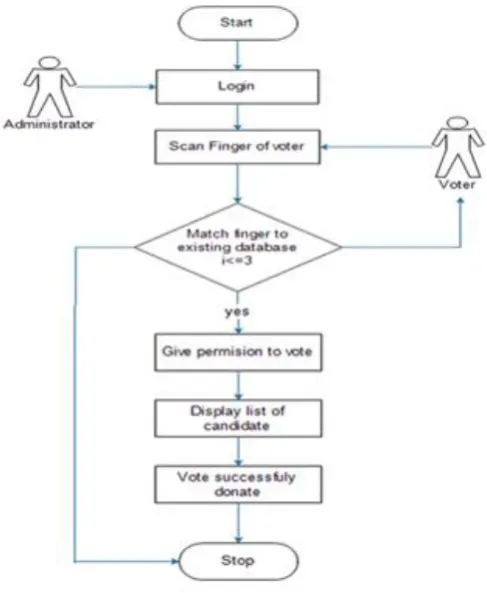
1. When the voter enters into election centre then he must be scan their finger by finger scanner device.
2. After scanning their finger then it matches to existing database of particular person if the finger is match then the system gives permission to donate vote.
3. If the finger does not match then system restrict to this person for voting.
Authentication in EVS:
1. Once authentication process is done then next step is to cast their vote. 2. The voter can vote only one time.
3. In this system there is impossible to alter vote after casting.
4. Their does not possible to eliminate validated vote and counting invalid vote.
Privacy of EVS:
1. Once voter has cast their vote then system doesn't show voting detail to anyone else. 2. Their haven't any authorities to link any ballot box to the voter who cast it.
Viredra Kumar Yadav [2], An Electronic Voting System that will automatically perform authentication, validation and counting with the help of UIDAI. The proposed electronic voting system can be implemented along with the traditional election system. The proposed an approach that will use the information provided by UIDAI in electronic voting system.
Saumya Batham [2], an approach that will use the information provided by UIDAI in smart voting system. The proposed system procedure is carried out in mainly few stages: registration, verification and validation. These stages of proposed system are illustrated.
ISSN(Online): 2320-9801
ISSN (Print) : 2320-9798
I
nternational
J
ournal of
I
nnovative
R
esearch in
C
omputer
and
C
ommunication
E
ngineering
(An ISO 3297: 2007 Certified Organization)
Vol. 3, Issue 9, September 2015
KashifHussainMemon, Dileep Kumar and Syed Muhammad Usman [4], the next generation a secure E-voting system based on biometric fingerprint method are use. There are two types of e-voting: offline and online. Online such internet and offline such electronic machine. Online and offline voting are use in references.
D.Ashok Kumar, T.Ummal Begum, [5], Department of Computer Science, Government Arts College, Trichy, India. A Comparative Study on Fingerprint Matching Algorithms for EVM. Then fingerprint are match voter can vote to candidate by using EVM. Fingerprint is secure method for EVM.
Mary Bellis [6], the history of voting machines. Mary for creating the number one online destination for information
about inventors and inventions. Her suggestion and advice is requested by outlets in media on a constant basis. Her known about the voting machine and its improve.
Jefferson D., Rubin A., Simons B., and Wagner D [7], the report is review and computer of critique and security communication in secure voting system. The web based voting system being built by Accenture. And in security the fingerprint technology are uses.
Andrew Ackerman, Professor Rafail Ostrovsky [8], the smart e-voting system has been done on fingerprints in humans. There are two fundamentally main goal that have risen from voting process (1) A person's fingerprint will not change the structure naturally after about one year after birth and (2) the fingerprints of individuals are different. Even the twins in fingerprints are not the same. In practice two humans with the same fingerprint have never been found.
III. SYSTEM DESIGN
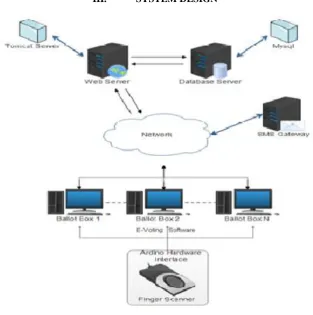
Fig. 1 Smart E-Voting System Design
ISSN(Online): 2320-9801
ISSN (Print) : 2320-9798
I
nternational
J
ournal of
I
nnovative
R
esearch in
C
omputer
and
C
ommunication
E
ngineering
(An ISO 3297: 2007 Certified Organization)
Vol. 3, Issue 9, September 2015
voter interact with voting system and donate vote. Biometric system used for the user verification and it works online. First voter are scan finger by using biometric scanner then the given data passes to the online database for verification after the data are verified the voter are allow for donate their vote. The Biometric scanner also known as Ardino hardware which is main connectivity of voter to the voting system.
The web page which front end to voter. Interactions with whole system are through this web page which provides multiple links for multiple users. Also the important data are allocated by using this web page. The multiple databases such as SQL and Tomcat which is backend of whole system are working for data gathering, sorting, listing and providing security to voted as well as voter data. The UIDAI database connectivity uses for user data verification and validation. The AES algorithm are used their for encryption. The whole data can be stored and process by under administration on the centralised database this approach are reduced data complication and duplication. There only administrator whose having authority to access the internal data by passing some security. In case of data duplication the database first finding match if duplication found discard the duplicate data and record for future use.
Middle layer is connectivity through which the whole process can be work. The connectivity of the front end to the backend is done by using middle layer which is the network layer. Network is secure and it is totally different from public domain which provides data security and hides from outer world.
The SMS Gateway is used for user satisfaction. After user donate their vote only voting satisfactorily message are forward to user by using GSM services.
The counting of the votes and finding result for every election area are process done by using centralised server which is Hub of information and data of voting systems. The output is published socially on web page after administration Permission. The whole system process done based on digitally and on network based.
ISSN(Online): 2320-9801
ISSN (Print) : 2320-9798
I
nternational
J
ournal of
I
nnovative
R
esearch in
C
omputer
and
C
ommunication
E
ngineering
(An ISO 3297: 2007 Certified Organization)
Vol. 3, Issue 9, September 2015
IV. SYSTEM ALGORITHM
A. AES Algorithm:
Encryption: Encryption is nothing but the process of applying mathematical transformations to converting
original text to encrypted text and it known as cipher text. This process is known as encryption algorithms.
Decryption:It is process reverting encrypted text into original plain text of using a decryption key getting back
the original data from the encrypted text. As similar to cryptology. The encryption key and the decryption key could be the same as in symmetric key cryptography, the key can different as in asymmetric key cryptography.
B. Types of cryptography:
Symmetric Cryptography: symmetric cryptography uses the same secret key to encrypt and decrypt its
symmetric data are requires that the private key be known by the party encrypting the data and the party decrypting the data.
Asymmetric Cryptography:asymmetric cryptography uses the both a public key and private key. Asymmetric
cryptography use to allows of your public key to anyone for distribution. Using the key they can encrypt the data they want to send securely and then person can only be decoded by secret key.
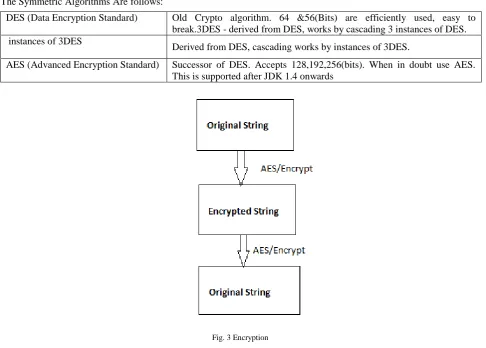
The Symmetric Algorithms Are follows:
Fig. 3 Encryption
Symmetric key encryption/decryption uses a private key in the process. A secret key with string encrypted cannot be decrypted using another secret key. This secret key is more effective if both the parties keep the key secret.
DES (Data Encryption Standard) Old Crypto algorithm. 64 &56(Bits) are efficiently used, easy to
break.3DES - derived from DES, works by cascading 3 instances of DES. instances of 3DES
Derived from DES, cascading works by instances of 3DES.
AES (Advanced Encryption Standard) Successor of DES. Accepts 128,192,256(bits). When in doubt use AES.
ISSN(Online): 2320-9801
ISSN (Print) : 2320-9798
I
nternational
J
ournal of
I
nnovative
R
esearch in
C
omputer
and
C
ommunication
E
ngineering
(An ISO 3297: 2007 Certified Organization)
Vol. 3, Issue 9, September 2015
C. Step of system algorithm is follows:
Step1. Start. Step2. Registration.
Step3. If user name and password then go to next step4 else go to previous step2. Step4. Biometric thumb recognition.
Step5. If fingerprint match then select candidate to vote else exit. Step6. Vote for candidate successful.
Step7. Confirmation message to voter. Step8. Stop.
V. MATHEMATICAL MODEL
Step1. It is polynomial type problem for smart e-voting system. Step2. S= {U, P, O, D, P}
Where,
S=system. U=Set of user.
-ex.user1.user2…………...user k 𝑛 U𝑖
𝑖=1 = {U1, U2, U3...Uk}
I=Set of inputs.
-ex. Login details, Registration etc. 𝑛𝑖=1I𝑖={I1,I2,I3...Ik}
O=Set of outputs.
-ex. Login access/device, Lock open/closed etc. 𝑛𝑖=1𝑂𝑖= {O1, O2, O3...Ok}
D=Set of device.
-ex. Ardino device, Thumb scanner etc. 𝑛 𝐷𝑖
𝑖=1 = {D1, D2, D3...Dk}
P=Set of Processing.
-ex. authentication, SMS Sending etc. 𝑛𝑖=1𝑃𝑖= {P1, P2, P3...Pk}
Step3. Venn diagram.
U I P O
VI. ADVANTAGES AND FEATURES OF SMART E-VOTING SYSTEM
New approach to modern world: The smart e-voting system is totally based on digital and secure data.
Reduces physical security: This system is minimizing the cost that is use on every election by government for
physical security. U1
U2
U3
U4
I1
I2
I3
I4
P1
P2
P3
P4
O1
O2
O3
ISSN(Online): 2320-9801
ISSN (Print) : 2320-9798
I
nternational
J
ournal of
I
nnovative
R
esearch in
C
omputer
and
C
ommunication
E
ngineering
(An ISO 3297: 2007 Certified Organization)
Vol. 3, Issue 9, September 2015
Fingerprint Validation: - fingerprint validation are stopped fake voter and stopped the corruption.
Ballot Shuffling: -The randomly orders the candidates’ names ones request of the ballot so all candidates get a
fair chance at prime name placement on the ballot.
Automated tallying: -Automated Tallying removes human feasibility from the tabulation process and makes
your election results are displayed within minutes after close of the election. With accurate and secure counting.
Secure: -The system uses modern encryption algorithms and higher security provided to voters information
and the election results.
Candidate biographies: -You may attach candidate information to the ballot so it is available information aboutthem. This information may also include a image of the candidate. For an example, see this sites sample ballot which includes candidate bio data with all information.
Uses modern technology: In the smart e-voting whole process is done digitally using electronic technology.
Secure than previous systems: The smart e-voting system is more secure and fast also secure than current
voting systems.
Best overcome on vote corruption: This approach is the best for overcome from fake voters and stopped it.
Biometric systems: The biometric systems are only authenticating the authorized voter and this is also
providing security to voting systems.
One time casting: Voter cast their vote only once. After it the voter id locked for temporary period.
Reducing duplication: By using one time casting if voter are vote double it can be rejected by centralized
system.
Centralized systems: Whole data are to be stored and process centralized.
Faster outcomes: Collecting as well as counting is faster process than previous system and result are come in
within minutes after closing voting.
Secure domain: The voting domain are totally separated from public domain than hacking or tracking not easy
for the election domain
Reducing cost: As current system are hardware based this approach are reducing hardware and its maintenance
cost
Less human security: The less physical security need for voting process.
Steps Toward Digitization: The one more step toward digital nation also helping for feature work.
UIDAI connectivity: The voters verification and validation data are taken from UIDAI database connectivity.
UIDAI provide totally centralized and verified information about voters.
GSM verification: After the process of voting for voter satisfaction the GSM verification is used.
WEB based system: The user interfaces are totally web based and it is maximum works on software.
Distance Removing: voter can be vote form any place. Form any voting booth.
VII. DISCUSSION AND OUTCOMES
To design the appropriate application for web based electronic voting system for better use in election. After analysing the current voting system, the new voting system can be design which better than current voting system that can be replaced by traditional system. Administrator is properly monitored the activities and process throughout the registration or login details. The voter can as well login and donate his vote and can also monitor his voting process. The systems can check validity and eligibility of the voter, The invalid votes and illegitimate user are block to the system. The entire votes are screening and result is generated, under validation process. The database systems are used to store screening result. This database can use to check valid voter or user any point in time. The system can reduce the cost and increase transparency and accessibility.
ISSN(Online): 2320-9801
ISSN (Print) : 2320-9798
I
nternational
J
ournal of
I
nnovative
R
esearch in
C
omputer
and
C
ommunication
E
ngineering
(An ISO 3297: 2007 Certified Organization)
Vol. 3, Issue 9, September 2015
VIII. CONCLUSION
The system is design based on latest technology is smart e-voting system. The existing system by using fingerprint recognition. Systems are providing high performance and high security to voting system. Smart e-voting system is useful for voter because voter can vote any other city to their current city. Developing Web-based Voting System using Fingerprint Recognition. Smart e-voting system may become the faster, better, and the most efficient way to administration election and counting vote as well as it consists of simple process or procedure and require a minimum election officer within the process. The system voting data are quickly transferred to the centralized databases. After the voting finishing the system display result quickly.
IX. ACKNOWLEDGEMENT
This work was supported by Pune University and BVCOE&RI, Nashik. We are very much thankful that he gave opportunity to complete this work in time to us. We would also like to thanks our Prof. C. K. Patil. Principal BVCOE&RI. Prof. H. D. Sonawane. H.O.D, Computer Department, for providing their valuable supported time throughout engineering.
REFERENCES
1. Vishal Vilas Natu “Smart-Voting using Biometric “International Journal of Emerging Technology and Advanced Engineering”, Volume 4, Issue 6, June 2014.
2. Virendra Kumar Yadav,SaumyaBatham, Mradul Jain, Shivani Sharma “An Approach to Electronic Voting System using UIDAI “,2014 International Conference on Electronics and Communication Systems.
3. Chris Roberts Biometric Technologies- fingerprint.
4. KashifHussainMemon, Dileep Kumar and Syed Muhammad Usman,Next Generation A Secure E-Voting System Based On Biometric Fingerprint Method 2011 International Conference On Information And Intelligent Computing IPCSIT Vol.18 (2011)
5. D.Ashok Kumar, T.Ummal Begum, 2011 “A Novel design of Electronic Voting System Using Fingerprint” 6. Mary Bellis. The history of voting machines. About.com:Inventors, 2000.
7. Jefferson D., Rubin A., Simons B., and Wagner D., “A Security Analysis of the Secure Electronic Registration and Voting Experiment (SERVE),” Technical Report, available at: http://www.servesecurityreport.org, last visited 2009.
8. Andrew Ackerman, Professor Rafail Ostrovsky “FINGERPRINT RECOGNITION”, 2002.
BIOGRAPHY
Balkrushna Bhagwatrao Kharmate pursuing his B.E degree from BVCOE&RI, Nashik, India. His areas of interest are Software Developer. He completed his Diploma in Aditya Polytechnic form M.S.B.T.E. University.
Prashant Ravindra Kangane pursuing his B.E degree from BVCOE&RI, Nashik, India. His areas of interest are Software Developer. He completed his Diploma in Amrutvahini Polytechnic form M.S.B.T.E. University.
Tushar Anant Lad pursuing his B.E degree from BVCOE&RI, Nashik, India. His areas of interest are Software Developer. He completed his H.S.C in Sanskardham junior college form Pune University.
Shahebaz Shakil Shaikh pursuing his B.E degree from BVCOE&RI, Nashik, India. His areas of interest are Software Developer. He completed his Diploma in MET Polytechnic form M.S.B.T.E. University.