HIGHLIGHTED ARTICLE
GENETICS | INVESTIGATION
Multiplex Conditional Mutagenesis Using
Transgenic Expression of Cas9 and sgRNAs
Linlin Yin,* Lisette A. Maddison,* Mingyu Li,* Nergis Kara,†Matthew C. LaFave,‡Gaurav K. Varshney,‡ Shawn M. Burgess,‡James G. Patton,†and Wenbiao Chen*,1 *Department of Molecular Physiology and Biophysics, Vanderbilt University School of Medicine, Nashville, Tennessee 37232, †Department of Biological Science, Vanderbilt University, Nashville, Tennessee 37240, and‡Translational and Functional Genomics Branch, National Human Genome Research Institute, National Institutes of Health, Bethesda, Maryland 20892 ORCID IDs: 0000-0003-1217-2929 (M.L.); 0000-0001-9165-041X (M.C.L.); 0000-0002-0429-1904 (G.K.V.); 0000-0003-1147-0596 (S.M.B.); 0000-0001-5749-0870 (J.G.P.); 0000-0002-0750-8275 (W.C.)
ABSTRACTDetermining the mechanism of gene function is greatly enhanced using conditional mutagenesis. However, generating engineered conditional alleles is inefficient and has only been widely used in mice. Importantly, multiplex conditional mutagenesis requires extensive breeding. Here we demonstrate a system for one-generation multiplex conditional mutagenesis in zebrafish (Danio rerio) using transgenic expression of both cas9 and multiple single guide RNAs (sgRNAs). We describefive distinct zebrafish U6
promoters for sgRNA expression and demonstrate efficient multiplex biallelic inactivation oftyrosinaseandinsulin receptor aandb, resulting in defects in pigmentation and glucose homeostasis. Furthermore, we demonstrate temporal and tissue-specific mutagenesis using transgenic expression of Cas9. Heat-shock-inducible expression ofcas9allows temporal control oftyrmutagenesis. Liver-specific expression ofcas9disruptsinsulin receptor aandb, causing fasting hypoglycemia and postprandial hyperglycemia. We also show that delivery of sgRNAs targetingascl1ainto the eye leads to impaired damage-induced photoreceptor regeneration. Ourfindings suggest that CRISPR/Cas9-based conditional mutagenesis in zebrafish is not only feasible but rapid and straightforward.
KEYWORDSCRISPR/Cas9; conditional mutagenesis; glucose homeostasis; retinal regeneration; zebrafish
C
ONDITIONAL gene inactivation is necessary for determin-ing physiological functions of genes whose conventional mutation causes embryonic lethality or multiorgan defects. It has been widely used in mice because of the availability of embryonic stem (ES) cells and large collections of both ES cell lines and animals that carry conditional alleles. The condi-tional alleles usually contain strategically placed Cre or Flp target sites in introns that permit deletion of the intervening exon(s) (Gu et al. 1994). Some conditional alleles harbor a Cre and/or Flp invertible gene trap in an intron that allows an on/off switch of transcription (Schnutgenet al.2005; Ni et al. 2012). The function or expression of these alleles is“switched” off in the presence of Cre or Flp activity. In Drosophila, conditional gene inactivation can be achieved
using RNA interference (RNAi), and genome-wide libraries of RNAi transgenes are available (Dietzlet al.2007; Niet al. 2008). For the increasingly popular zebrafish model, how-ever, only limited conditional alleles generated from invert-ible gene trapping are available (Niet al.2012). The lack of ES cells and the inefficiency of RNAi in zebrafish necessitate new approaches for targeted conditional gene inactivation.
CRISPR/Cas9 mutagenesis has been applied to many model systems from cultured cells to whole organisms (Doudna and Charpentier 2014; Hsuet al.2014). The sys-tem only requires a two-component RNA–protein complex (RNP): a single guide RNA (sgRNA) that identifies the target through base pairing and the Cas9 endonuclease that gen-erates double-strand breaks (DSBs) at the target site upon sgRNA-target base pairing. CRISPR/Cas9 mutagenesis has been widely used in zebrafish (Chang et al. 2013; Hwang et al.2013; Jaoet al.2013), where mutagenesis is usually achieved by injecting zygotes within vitrosynthesized Cas9 messenger RNA (mRNA) and sgRNA, or sgRNA–Cas9 RNP (Gagnonet al.2014; Sunget al.2014). This generates germ-line mutations as well as mosaic somatic mutations in all Copyright © 2015 by the Genetics Society of America
doi: 10.1534/genetics.115.176917
Manuscript received February 18, 2015; accepted for publication April 6, 2015; published Early Online April 8, 2015.
Supporting information is available online at www.genetics.org/lookup/suppl/ doi:10.1534/genetics.115.176917/-/DC1.
1Corresponding author: 702 Light Hall, 2215 Garland Ave., Nashville, TN 37232.
tissues. The mutagenesis in somatic cells is sufficient to cause extensive biallelic mutations and phenotypes in injected ani-mals (Jaoet al.2013). Given the effectiveness of this system, we set out to determine whether transgenic expression of cas9and sgRNA can generate biallelic mutations and whether the CRISPR system can be adopted for targeted conditional mutagenesis. Here we report tissue-specific and inducible multiplex mutagenesis in zebrafish using transgenic lines expressing Cas9 and sgRNA.
Materials and Methods
Zebrafish strains and maintenance
Zebrafish were raised in an Aquatic Habitats system on a 14-hr/10-hr light/dark cycle. Embryos were obtained from natural crossing and raised at 28.5°in an incubator with lights on a 14-hr/10-hr light/dark cycle. Animals were staged by days postfertilization (dpf) or in months of age. At 5 dpf,fish were placed on the normal rearing diet and maintained as per standard protocols until appropriate age. All procedures have been approved by the Vanderbilt University Institutional An-imal Care and Use Committee.
Plasmid construction
Transgenes were generated using the Tol2-based Multisite Gateway system (Kwanet al.2007). For Cas9-expression transgenes, the codon optimized nls-cas9-nls (Jao et al. 2013) was cloned into pME-MCS to generate pME-cas9. The broadly expressed promoters actb2 and ubi, and the HotCre promoter were cloned into p5E-MCS. pDestTol2LR was made by inserting a 1.95-kb BglII fragment containing cryaa:tagRFP into theBglII site of pDestTol2pA2. To gener-ate the sgRNA expression cassette, the U6a promoter was obtained by using U6aF1 and U6aR1 and inserted into the HindIII/PstI sites of pT7-gRNA to replace the T7 promoter (Jaoet al. 2013). The sgRNA core was then replaced with sgRNAEFto facilitate U6 guided transcription (Chen et al. 2013). A transcription stop for U6, TTTTTT, was then added at the 39end of sgRNA core by PCR. The cassette was then inserted into a miniTol2 vector to generate pT2-U6a:sgRNA (Urasakiet al.2006). OtherU6 promoters (U6b,U6c,U6d, andU6e) were amplified using primers listed inSupporting Information,Table S1and inserted into theApaI/XhoI sites in pT2-U6a-sgRNA to replace U6a.The protospacer for tyr was inserted into pT2-U6a:sgRNA by annealing tyr-F and tyr-R and ligated in the presence of BsmBI as described (Jao et al. 2013). Protospacers for EGFP, insra, and insrb were ligated in the presence of BsmBI after annealing the primer pairs listed in Table S1. To allow orderly assembly using Golden Gate ligation,BsaI sites were added via PCR on both ends of theU6:sgRNAcassettes using primers listed in Table S1. PCR products were inserted into the ApaI/XbaI sites of pLR-NN from the Golden Gate TALEN kit obtained from Addgene (Cermaket al.2011). The destination vector for theseU6x:sgRNAcassettes was madefirst by eliminating
theBsaI site in pDestTol2CG2 (Kwanet al.2007), followed by replacing the cmcl2:EGFP (AatII/KpnI) with a cryaa: mCerulean (SacII/KpnI) from phsp70l-loxP-mCherry-STOP-loxP-H2B-GFP_cryaa-cerulean to generate pDestTol2LC (Hesselson et al. 2009). Two BsaI site-containing adaptors with appropriate overhang were sequentially inserted into theNsiI/XhoI andKpnI sites of pDestTol2LC, resulting in the pGGDestTol2LC series. All relevant plasmids have been de-posited to Addgene for distribution (File S1).
Transgenesis
To generate transgenicfish, the mixture of Tol2 RNA (25 pg) and plasmid (20 pg) were injected into the cell of one-cell-stage embryos. Then injected embryos were cultured with egg water in a 28° incubator for 5 days. After prescreening for fluorescence, the positive larvae were raised in Aquatic Hab-itats system on a 14-hr/10-hr light/dark cycle until adult stage.
Semiquantitative RT-PCR analysis
Total RNA of transgenic larvae was isolated using TRIzol (Invitrogen). After treated with DNase (New England Biolabs) for 30 min, reverse transcription was performed using Moloney Murine Leukemia Virus reverse transcriptase (Prom-ega), RNase inhibitor (New England Biolabs), 2mg total RNA, oligo dT (for actin and cas9), or sgRNA specific oligo (59 -TTGCACCGACTCGGTG-39). To detect the gene expression level, PCR reactions were prepared according to GoTaq Flexi DNA Polymerase instructions (Promega). b-Actin, cas9, and sgRNA were amplified from cDNA by PCR with the primers listed inTable S1. The PCR conditions were 95°for 5 min; 22 (b-actin), 28 (sgRNA), or 30 (cas9) cycles of 30 sec at 95°, 30 sec at 60°, and 30 sec at 72°, followed by 72°for 5 min.
Heteroduplex mobility assay
DNA was isolated with 50 mM NaOH and then neutralized with 1 M TrisHCl. After amplification with GoTaq Flexi DNA Polymerase (Promega) using genotyping primers, heterodu-plex DNA was formed using the following parameters: 95°for 5 min, 95°–85°at22°/sec, 85°–25°at20.1°/sec, and hold at 16°. Samples were separated on a nondenaturing 10% poly-acrylamide gel [10% poly-acrylamide (29:1), 13TBE, 0.05% am-monium persulfate, 0.05% TEMED] and run in 13 TBE buffer. After running, the gel was stained with ethidium bro-mide (0.5 mg/ml) and imaged by Gel Doc EZ System (Bio-Rad). The percentage of signal from the unmutated amplicon in each lane was quantified by Image Lab Software (Bio-Rad) and normalized to that of wild-type lanes. The mutation rate is the complement of the normalized percentage.
Assessing mutagenesis rate using quantitative PCR analysis
Cas9 cut site to amplify both wild-type and mutant alleles, and the other with one primer encompassing the Cas9 cut site, which should only amplify the wild-type allele. qPCR was performed by Bio-Rad CFX96 Real-Time system with SYBR Green Supermix (Bio-Rad) using the following pro-gram: 40 cycles of 10 sec at 95°and 30 sec at 60°after initial denaturing for 3 min at 95°. The primer pairs are listed in Table S1.
Feeding and glucose measurement
For 5% egg yolk feeding, chicken egg yolk was separated and then diluted to 5% with 0.33Danieau buffer. The egg yolk solution was shaken every 30 min to maintain suspension. Before glucose measurement, fish were rinsed with 0.33 Danieau buffer three times. Glucose level of individual larvae was measured using Amplex Red Glucose/Glucose Oxidase Assay kit (Invitrogen). For blood glucose in adult animals, fish were either fasted overnight or fed as normal and blood was collected 30 min after the meal. Blood was collected from the dorsal aorta along the trunk of the fish as indicated in Zang et al. (2013). Blood glucose was determined as de-scribed (Liet al.2014).
Imaging
Larvae were anesthetized with 0.01% MESAB (MS-222 or tricaine) in 0.33Danieau and then mounted in 3% methyl-cellulose. Images were taken by a Zeiss Axio Imager Z1 microscope equipped with a Zeiss AxioCam MRm digital camera.
sgRNA injection and immunohistochemistry
sgRNA was synthesized by annealing a T7 promoter-contain-ing gene-specific primer ascl1asgRNA1 and ascl1asgRNA2 with sgRNA scaffold primers. The anneal oligos werefilled in with T4 DNA polymerase in the presence of 50mM dNTP (New England Biolabs). The resultant double-stranded DNA (dsDNA) was used as template for T7 RNA polymerase using a MaxiScript T7 kit (Invitrogen). The sgRNA(ascl1a)s were combined and the mixture was injected into one eye (50 ng per eye) of adultTg(actb2:cas9;LR)fish followed by electro-poration prior to light lesioning as described (Thummelet al. 2008). Collection, fixation, embedding, sectioning, and im-munohistochemistry (IHC) of injectedTg(actb2:cas9;LR)eyes were performed as described (Rajaramet al.2014).
High-throughput sequencing
Genomic DNA from individual larvae was extracted using 50 mM NaOH and then neutralized with 1 M TrisHCl. The targeted regions oftyr,insra, andinsrbwere amplified using gene-specific primer pairs with the forward primer contain-ing M13 forward promoter sequence (Table S1) and a third M13 forward promoter-based barcode primer. After amplifi -cation, PCR products were purified using a QIAquick PCR Purification kit (Qiagen) and products pooled together. The sequencing library was made from 100-ng PCR products using the Ovation Ultraflow Library system (NuGen),
quan-tified by qPCR (KAPA BioSystems). Around twenty-five mil-lion 300-bp reads were generated and the sequence data were processed using RTA version 1.18.54 and CASAVA ver-sion 1.8.2. Only about one million reads have a barcode.
Sequencing analysis
The detection of variants within 20 bp of the predicted cut site (or between two predicted cut sites) was performed by version 1.1 of the ampliconDIVider software (https://github. com/mlafave/ampliconDIVider). Briefly, ampliconDIVider first trims off nongenomic DNA and then uses novoalign to align the reads to amplicons of interest (chr15:42572556– 42572836 for tyr, chr2:37298862–37298953 for insra, and chr22:11114676–11114957 forinsrb) in version Zv9 of the zebrafish genome assembly. It loops through each sample and uses the programs bam2mpg and mpg2vcf to identify any deletions or insertions in the sample (http://research.nhgri. nih.gov/software/bam2mpg/) (Teer et al. 2010). As ampli-conDIVider was designed for germline samples, the inter-mediate BAM files were analyzed manually for variant detection in somatic samples. The scripts can be found at https://github.com/mlafave/ampliconDIVider/blob/master/ sh/yin_targeted_crispr_frameshift_count.sh. The number of wild-type reads and reads with mutations in the aforemen-tioned distance from the predicted cut site were counted for mutation rate calculation.
Results
Transgenic expression of Cas9 and sgRNA(tyr) results in hypopigmentation
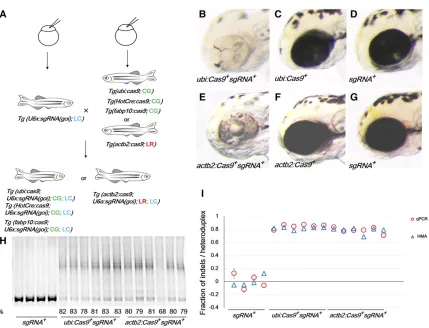
to F1’s from aTg(ubi:cas9; CG) line to identify suitable Tg(U6a:sgRNA(tyr);LC)lines. Double transgenic larvae from Tg(ubi:cas9;CG) 3Tg(U6a:sgRNA(tyr); LC)had various degrees of pigmentation in the retinal pigment epithelium (RPE) at 2 dpf (Figure 1B), while single transgenic progeny, Tg(U6a:sgRNA(tyr);LC)orTg(ubi:cas9;CG)did not show any abnormal pigmentation phenotypes (Figure 1, C and D). The line with the most severe phenotype was propagated. The Tg(U6a:sgRNA(tyr);LC)F1’s were used to identify the best Tg(actb2:cas9;LR)line from 12 founders for additional experi-ments (Figure 1E). Again, single transgenic progeny,Tg(U6a: sgRNA(tyr); LC), or Tg(actb2:cas9; LR) did not show any abnormal pigmentation phenotypes (Figure 1, F and G). To verify mutagenesis, we estimated the degree of mutagenesis in the double carrier progeny of the selected lines using an HMA where the PCR product encompassing the target region was separated on a 10% nondenaturing polyacrylamide gel followed by densitometry (Figure 1H). Heteroduplexes have
a slower mobility due to an open single-strand configuration surrounding the mismatched region (Ota et al.2013). HMA indicated that 61–90% of thetyrloci were mutated in double transgenic larvae at 5 dpf. To validate the HMA approach, we determined the mutagenesis rate in the same fish using a quantitative PCR approach that uses a primer encompassing the Cas9 cleavage site to measure a decreased presence of the wild-type allele (Yuet al.2014). As shown in Figure 1I, there was an excellent agreement between the two assays. We used HMA to determine the mutagenesis efficiency henceforth. Thus, transgenically expressed CRISPR components are suffi -cient to cause biallelic gene inactivation in zebrafish.
Development of a system for multiplex CRISPR/Cas9 mutagenesis in transgenicfish
We next tested whether multiplex mutagenesis is possible using the same transgenic approach. Multiplex CRISPR/Cas9 mutagenesis is desirable for several reasons. First, it allows
Figure 1 Efficient disruption oftyrby transgenic Cas9 and sgRNA(tyr). (A) Experimental schematic of transgenic CRISPR mutagenesis. Transgenic lines
with variouscas9expression patterns were generated, includingTg(ubi:cas9;CG)andTg(actb2:cas9;LR)with ubiquitous expression,Tg(HotCre:cas9;
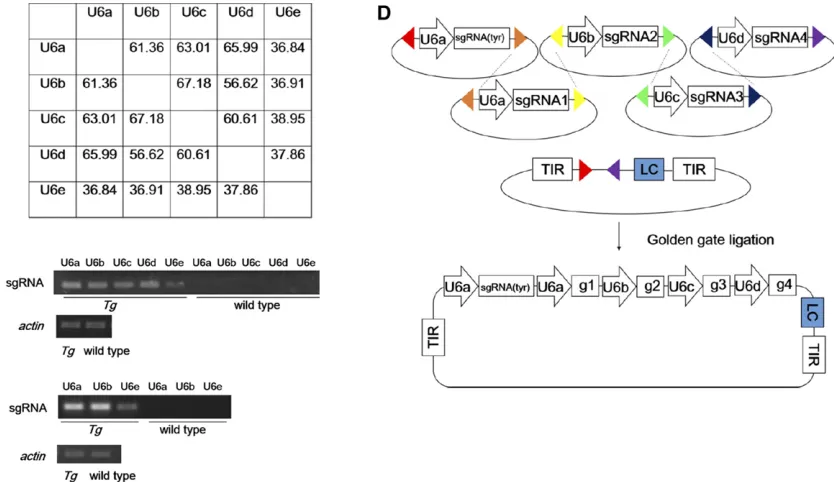
the expression of multiple sgRNAs to target the same gene, likely increasing mutagenesis. Second, it may facilitate gene– gene interaction studies. Third, by targeting related genes, it can overcome functional redundancy, a concern particularly applicable in zebrafish because of the common presence of duplicated genes. To minimize potential instability of tandem sgRNA-expressing transgenes, we sought to use distinct U6 promoters (Figure 2A). In addition to the U6a cluster on chromosome 21, three otherU6clusters have been previously described on chromosome 3 (U6e), 9 (U6b), and 11 (U6c)in zebrafish (Halbiget al.2008; Clarkeet al.2012). We identified afifthU6cluster on chromosome 6 (U6d). The promoters for theseU6genes are divergent, with sequence identity,68% in the 400-bp upstream region (Figure 2A). We obtainedU6b– U6epromoters using PCR.
We developed a Golden Gate ligation strategy to stream-line the assembly of multiple sgRNA expression cassettes. This allowed ordered assembly of up tofiveU6x:sgRNA cas-settes into a Tol2-based pGGDestTol2LC (Figure 2D,File S1). To compare the activity of the fiveU6 promoters, we used them to direct the expression ofsgRNAtargetingfive genes, atp2a2a,atp2a2b, nf1a,nf1b, anddmd, whose somatic mo-saicism is associated with human diseases (Biesecker and Spinner 2013). We assembled the expression cassettes in pGGDestTol2LC. RT-PCR analysis of each sgRNA indicated that the U6e promoter is less active while the other four promoters have similar activity (Figure 2B). To confirm that U6epromoter activity is lower, we usedU6a,U6b, andU6eto
direct expression of sgRNA against tyr, csf1r(Parichy et al. 2000), andmpv17(Krausset al.2013), key genes responsible for the three pigment cell types in zebrafish. The three cas-settes were placed in pGGDestTol2LC and the construct was injected to generate stable lines. RT-PCR analysis of the F1 also indicated that U6eis less active (Figure 2C). We there-fore chose theU6a–dpromoters for multiplex sgRNA expres-sion. SinceU6a:sgRNA(tyr)cassette could serve as a mutagenesis indicator, it may be included in the multiplex sgRNA expres-sion construct, leaving space for four additional cassettes (Figure 2D).
Inactivation of insra and insrb impairs glucose metabolism
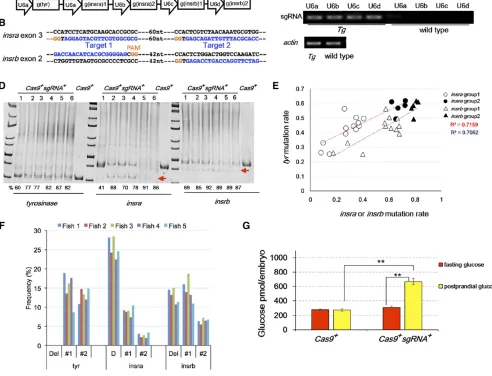
As a test case for multiplex CRISPR mutagenesis, we chose insulin receptorgenes as targets. Unlike mouse, zebrafish has twoinsulin receptorgenes,insraandinsrb(Toyoshimaet al. 2008). We targeted a region with two adjacent high-quality sgRNAs in the 59portion of each gene. The expression cas-settes for the four sgRNAs, along with that of sgRNA(tyr), were placed in pGGDestTol2LC (Figure 3A). The targets for insra sgRNAs were located in exon 3, and those forinsrb sgRNAs, exon 2 (Figure 3B). The construct was introduced into zebrafish and 14 germline transmitting founders were identified. For simplicity, we refer to these lines asTg(U6x: sgRNA(insra/b); LC). To make sure that the four U6 pro-moters had equivalent activity, we compared the levels of transcripts from each U6 promoter. Semiquantitative
Figure 2 Development of a system for multiplex CRISPR/Cas9 mutagenesis. (A) Pairwise sequence comparison of the identity of thefive zebrafish U6
promoters. (B) Semiquantitative RT-PCR analysis showing lower U6e promoter activity in embryos at 24 hpf injected withTg(U6a:sgRNA(atp2a2a);U6b: sgRNA(atp2a2b);U6c:sgRNA(nf1a);U6b:sgRNA(nf1b);U6c:sgRNA(dmd);LC). Controls were noninjected siblings at the same stage. (C) Semiquantitative RT-PCR analysis showing lower U6e promoter activity in F1Tg(U6a:sgRNA(tyr);U6b:sgRNA(fms);U6c:sgRNA(mpv17);LC)larvae at 5 dpf. Controls were
RT-PCR indicated they had similar activity in individual F1’s (Figure 3C).
To determine whether multiplex mutagenesis occurs efficiently, we crossed the 14 germline transmittingTg(U6x: sgRNA(insra/b);LC) founders toTg(actb2:cas9; LR). All Tg(U6x:sgRNA(insra/b);LC);Tg(actb2:cas9;LR)double car-riers, as identified by having both CFP and RFP signal in the lens, had visible pigmentation phenotype in the RPE, although the severity of the phenotype varied. HMA analysis of 5 dpf double carriers from the line with the most severe pigmenta-tion phenotypes confirmed efficient mutagenesis at the tyr, insra, and insrb loci (Figure 3D). Importantly, the mutation rates at tyr in hypopigmented Tg(U6x:sgRNA(insra/b); LC);
Tg(actb2:cas9; LR) larvae were comparable to those in Tg(U6a:sgRNA(tyr);LC);Tg(actb2:cas9;LR)(Figure 1H, Figure 3D), implying sufficient Cas9 activity even when multiple sgRNAs were expressed. The HMA indicated that about 70– 90% ofinsraandinsrbwere mutated in larvae exhibiting hypo-pigmentation (Figure 3D).
We selected two lines for high throughput sequencing analysis to determine the mutation spectrum and to more accurately measure the mutation rates. One line had the most severe pigmentation phenotypes while the other had modest phenotypes but high germline transmission rate. Within these lines, the severity of the pigmentation pheno-types still varied somewhat within the same clutch. We
Figure 3 Simultaneous inactivation ofinsra and insrbimpairs glucose homeostasis. (A) Schematic of the sgRNA-expressing transgene. (B) Sequence of
insraandinsrbtarget regions. (C) RT-PCR analysis indicating that four distinct U6 promoters (U6a–U6d) have similar activity in directingsgRNA(insra)and
sgRNA(insrb)expression in F1transgenic larvae at 5 dpf. Controls were nontransgenic larvae at the same stage. (D) HMA showing efficient mutagenesis
attyr,insra, andinsrbloci in double transgenic larvae (samples 1–6) at 6 dpf. Arrows indicate smallerinsraandinsrbproducts that are from alleles with deletion between the two targets. (E) Positive correlation among thetyr,insra, andinsrbmutation rate (tyr vs. insra,r2= 0.72;tyr vs. insrb,r2= 0.71).
analyzed the amplicons encompassing the three targets from twelve double carriers from the line with weak pigmentation phenotypes and five double carriers from the line with severe pigmentation phenotypes (Table S2,Table S3,Table S4, andTable S5). The mutation rate attyrdetermined by sequencing correlated with the severity of the pigmentation phenotypes. The group with severe pigmentation pheno-types had a mean mutation rate of 57.5%, while the group with modest pigmentation phenotypes had a mean mutation rate of 41.7%. In addition, the mutation rate is more vari-able in the group with modest phenotype, possibly due to subpopulations of independent germline insertions (Table S2). Nevertheless, the degree of mutagenesis in the 17 dou-ble carriers was positively correlated with each other in the same fish (insra vs. tyr,r2= 0.72;insrb vs. tyr,r2= 0.71) (Figure 3E), confirming our expectation that the severity of pigmentation phenotype may be a good predictor of the mutagenesis efficiency at the other targets. Sequence anal-ysis in insraandinsrbprovided evidence for the benefit of using two sgRNAs. In addition to increasing the mutagenesis efficiency, two sgRNAs also resulted in deletion of the in-tervening sequence, leading to a prominent product in the PCR reaction that constituted close to 30% of the indels in insra and 15% of the indels ininsrb(Figure 3F,Table S3, andTable S4). These deletions would be expected to result in complete loss of function. Sequencing analysis also revealed extremely high mosaicism, which was expected from transgenic expression of CRISPR/Cas9 since mutagenesis should occur after maternal–zygotic transition at the 1000-cell stage (Kane and Kimmel 1993). More than 3511 insra alleles were identified in an individual from which about 75,000 reads were obtained. Despite the diversity, however, a set of highly frequent alleles was found in all the individu-als. For example, the top three alleles of each locus were the same among thefish in the group with severe phenotypes and they constituted 40% of all the reads in each individual (Figure 3F). The same three alleles were also identically ranked in the other group (Table S3, Table S4, and Table S5). As expected, one of the top alleles forinsra andinsrb was from precise deletion between the two DSBs. The prev-alence of other common deletions suggested that the NHEJ repair is not random. Inspection of the DSB-flanking sequen-ces suggested that the most frequent alleles may result from microhomology-mediated repair (Figure S1), supporting pre-vious reports (Wanget al.2013; Thomaset al.2014).
Given the importance of insulin receptor in glucose homeostasis (Kitamura et al. 2003), we tested whether Tg(U6x:sgRNA(insra/b); LC); Tg(actb2:cas9; LR) double car-riers with severe pigmentation defects had defective glucose metabolism. At 6 dpf, the double carriers had similar fasting total free glucose content to single carrier siblings (Figure 3G). However, after feeding with 5% chicken egg yolk (Cartenet al. 2011; Maddison and Chen 2012, the glucose levels increased almost twofold in double carriers, but remained unchanged in single carrier siblings (n= 5,P, 0.01) (Figure 3G). Thus, transgenic expression ofcas9and sgRNA targeting insraand insrbresulted in impairment of glucose homeostasis.
Conditional CRISPR/Cas9 mutagenesis in transgenicfish
The primary impetus for the above experiments was to develop CRISPR/Cas9-based conditional mutagenesis. This can be achieved through regulated expression/availability of eithercas9orsgRNA. To temporally controlcas9expression, we generated Tg(hsp70:loxP-mCherry-STOP-loxP-cas9) lines [referred to as Tg(HotCre:cas9)], to allow heat-shock induc-tion ofcas9expression in a Cre-dependent manner (Hesselson et al. 2009). As a proof-of-principle experiment, we injected in vitrotranscribed Cre mRNA into zygotes fromTg(HotCre: cas9)3Tg(U6a:tyr(sgRNA);LC)to remove the“STOP,”and heat shocked the progeny at 6 or 24 hr postfertilization (hpf) to induce cas9. AllTg(HotCre:cas9); Tg(U6a:tyr(sgRNA);LC) double carriers had hypopigmentation phenotypes (Figure 4A). In the absence of either Cre mRNA or heat shock, no pigmentation phenotypes were detectable (Figure 4A). The degree of mutagenesis in these embryos, as determined by HMA (Figure 4B), was slightly lower than in larvae with constitutive expression ofcas9.
To spatially control Cas9 expression, we generated Tg(fabp10:cas9, CG) lines in which cas9 expression is liver specific. These fish were crossed to Tg(U6x:sgRNA(insra/b); LC)to obtain double carriers. To determine whether liver-spe-cific mutagenesis occurred in the double carriers, we assessed mutagenesis at insra and insrb loci in liver and muscle at 1 month of age. HMA indicated that close to 60% of theinsra andinsrbloci were mutated in the liver (Figure 5A). Consid-ering that hepatocytes constitute 75% of the liver at this stage (Ni et al.2012), the fraction of mutant alleles incas9 -positive cells is close to 80%, similar to that in the ubiquitous cas9 lines. We did not detect mutations in skeletal muscle, confirming tissue specificity of mutagenesis (Figure 5A).
Figure 4 Temporal-specific CRISPR/Cas9
mutagen-esis. (A) Heat-shock-inducible tyrinactivation. Cre RNA was injected into one-cell-stage embryos from
Tg(HotCre:cas9) 3 Tg(U6a:sgRNA(tyr); LC). Unin-jected embryos were used as controls. The embryos were heat shocked at 6 or 24 hpf. Pigmentation phenotypes were induced in Cre RNA-injected dou-ble carriers (top) but not uninjected doudou-ble carriers (bottom). Images were taken at 5 dpf. (B) HMA results oftyrlocus in Cre RNA-injected, heat-shocked
Insulin signaling in liver promotes glycogen synthesis and suppresses gluconeogenesis. Loss ofinsra/bfunction in the liver impairs glucose homeostasis. In mice with liver-specific disruption of insulin receptor (LIRKO), fasting blood glucose levels are lower and fed blood glucose levels are higher at 6 months of age due to impaired glycogen storage and weak-ened suppression of gluconeogenesis, respectively (Michael et al. 2000). To test whether the CRISPR/Cas9-mediated liver mutagenesis is sufficient to impair glucose metabolism, we determined fasting and postprandial blood glucose in 3-month-old Tg(fabp10:cas9, CG); Tg(U6x:sgRNA(insra/b); LC) fish. Fasting and postprandial glucose levels were mea-sured a week apart in the same group of fish. Compared to wild-type controls, the Tg(fabp10:cas9, CG); Tg(U6x:sgRNA (insra/b);LC)fish had lower fasting glucose levels (27.366 4.15 vs. 37.53 6 2.24 mg/dl, P , 0.037), but markedly higher postprandial glucose (190.97 6 29.70 vs. 59.01 6 11.50 mg/dl,P,0.001) (Figure 5B). Thus, the phenotypes in the Cre-mediated, conditional LIRKO mouse were reca-pitulated using liver-specific inactivation of insulin receptor genes in zebrafish using CRISPR/Cas9.
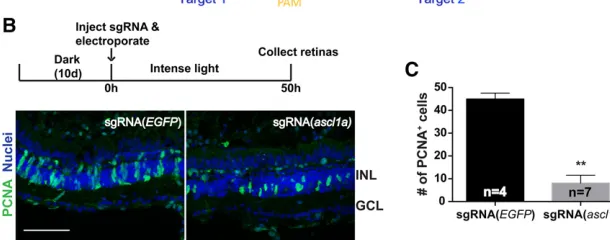
The tissue specificity of mutagenesis may also be achieved by targeted delivery of sgRNAs. To test this possibility, we targetedascl1athat is essential for Müller glia dedifferenti-ation and retina regenerdedifferenti-ation in zebrafish (Ramachandran et al.2010). Two sgRNAs targetingascl1awere synthesized in vitro(Figure 6A) and delivered into one eye of dark-adap-tedTg(actb2:cas9: LR)adults by injection followed by electro-poration. After a 48-hr exposure to constant, high-intensity light to induce photoreceptor degeneration and Müller glia proliferation, the number of proliferating cells in both eyes was assessed using PCNA immunofluorescence. The number of PCNA+progenitor cells in the inner nuclear layer of the sgRNA(ascl1a)-exposed retina was decreased byfivefold, to a mean of,9 compared to an average of.45 in the sgRNA (EGFP)-injected control retinas (P,0.01) (Figure 6, B and C). The data indicate that spatial- and temporal-specific mu-tagenesis can be achieved by controlling eithercas9 expres-sion or sgRNA delivery.
Discussion
Spatially and temporally controlled gene inactivation is critical for understanding detailed gene function. We show
here that the recently developed CRISPR mutagenesis can be adopted for controlled mutagenesis in zebrafish.
Our data indicate that transgenically expressedcas9and sgRNA can cause biallelic gene inactivation in somatic cells in a controllable fashion. Although CRISPR mutagenesis us-ing stable transgenic lines expressus-ing bothcas9and sgRNA have been used for generating both germline and somatic mutations in nonvertebrate models such as Caenorhabditis elegansandDrosophila melanogaster(Portet al.2014; Shen et al. 2014; Xue et al. 2014), it has not been reported in vertebrates until our manuscript was being revised (Ablain et al. 2015). A Cas9 knock-in mouse line has been used to achieve tissue-specific mutagenesis (Platt et al. 2014; Swiechet al.2015). However, in those reports, sgRNA was delivered by virus or nanoparticles rather than a transgenic approach. Although viral and nanoparticle delivery of sgRNA has many advantages, not every tissue/organ is ac-cessible by this approach. Even in acac-cessible tissues/organs, not all cells are equally targeted. For zebrafish, a reliable method of virus- or nanoparticle-mediated gene expression is not available. However, we achieved retinal-specific inac-tivation ofascl1ausing targeted injection of sgRNA followed by electroporation. Other methods, such as lipofection (Ando and Okamoto 2006; Chang et al. 2014), may also be used for targeted delivery of sgRNA, though specificity and accessibility remain a concern. Transgenic lines with spatial and temporal control ofcas9expression are a better choice for achieving desired control of mutagenesis in so-matic cells. Although it requires the availability of suitable cas9lines, the high efficiency of transgenesis and the avail-ability of many characterized tissue-specific promoters in zebrafish make this a straightforward and efficient process. The collection of Gal4 enhancer trap lines may also be used to direct UAS-driven tissue-specific expression ofcas9(Scott et al.2007; Kawakamiet al.2010). Several inducible expres-sion systems, such at heat shock (Halloran et al. 2000), tetracycline (Knopf et al. 2010), and RU468 (Emelyanov and Parinov 2008) have been successfully adapted into zebrafish and could be used to achieve spatial and temporal control ofcas9expression. OurTg(HotCre:cas9)lines should provide both spatial and temporal control (Hesselsonet al. 2009).
Conditional CRISPR mutagenesis may be a viable alter-native to Cre/Flp-dependent conventional approaches. The
Figure 5 Liver-specific CRISPR/Cas9 mutagenesis of
insra and insrb impairs glucose homeostasis. (A) HMA results indicating liver-specific mutagenesis. Liver and muscle from 1-month-oldTg(fabp10:cas9; CG);
(U6x:sgRNA(insra/b); LC)fish were analyzed. (B) Im-paired glucose metabolism in Tg(fabp10:cas9; CG);
observed indel frequency caused by cas9 is comparable to the recombination frequency induced by Cre/Flp. A major advantage of conditional CRISPR mutagenesis is that it does not require a preengineered conditional allele. Although a large collection of conditional alleles is available in mice (Skarneset al.2011), in general a conditional allele is time consuming to generate. Another advantage of conditional CRISPR mutagenesis is that only two elements, cas9 and sgRNA, need to be bred together for conditional CRISPR mutagenesis, compared to three (two mutant alleles and a Cre/Flp transgene) for the conventional approach. This will decrease at least one generation of breeding. Finally, conditional CRISPR mutagenesis can target multiple genes simultaneously, while conventional conditional mutagenesis requires extensive breeding to achieve multiplex mutagene-sis. Although conditional CRISPR mutagenesis does require the generation of sgRNA-expressing lines, this is much easier than generating an engineered conditional allele. The dis-advantage of conditional CRISPR mutagenesis is that the mutations are very heterogeneous, while precise mutations are generated with the conventional approach. This can lead to a significant decrease of bialllelic inactivation if the tar-geted region is tolerant of in-frame deletions. In such a sce-nario, only about two of three indels may be loss of function, resulting in biallelic inactivation in only four of nine cases. An advantage of our system is that it allows for targeting multiple sites in a single gene. If two distant sites are cho-sen, independent mutagenesis at each site would decrease the frequency of potentially hypomorphic small in-frame indels from one in three to one in nine. The deletion of the intervening sequence should further lower the frequency of hypomorphic alleles. If only one sgRNA is used for a gene, it is critical to target functionally important regions of a gene for conditional CRISPR mutagenesis so that even in-frame deletions result in severe loss of function.
We found that the phenotype severity induced by CRISPR/ Cas9-mediated somatic mutagenesis is not uniform among siblings. The major cause may be individual difference in mutation rates. This could be due to different levels of cas9 or sgRNA expression since some of our transgenic fish carry more than one transgene insertion. Nevertheless, similar variation has been observed in flies when each of the transgenes is a single insertion at a defined genomic locus
(Portet al.2014). Another cause may be the heterogeneity of the mutations. The mutated fish are highly mosaic at the target sites with some indels impairing function more than others. Individual animals likely have a different complement of mutations from each other, leading to phenotypic variation. There is a high degree of correlation among the indel frequencies at different targets within the same fish. This suggests that the level of mutagenesis of one target can serve as an indicator for the rest. For ubiquitous mutagenesis,tyris a good indicator target because of its restricted expression in pigmented cells and its easily visible phenotype due to bial-lelic inactivation. This allows easy identification of mutant fish. In addition, hypopigmentation minimizes the interference of fluorescence detection, facilitating fluorescent marker-based genetic or chemical screens for modifiers of mutant phenotype. For tissue-specific gene inactivation, however, other easily scorable markers need to be developed.
Taken together, ourfindings demonstrate that transgenic expression of cas9 and sgRNA is sufficient to generate extensive biallelic somatic mutations for functional analysis. The mutagenesis may be multiplexed for increased effi -ciency, eliminating redundancy, and/or analyzing gene– gene interaction. Multiplex conditional mutagenesis can be achieved by inducible or tissue-specific expression of cas9 or by tissue-specific delivery of sgRNAs.
Acknowledgments
We thank Amanda Goodrich and Corey Guthrie of the Vanderbilt University Medical Center Zebrafish Facility for expert care of zebrafish; and Baishali Maskeri, Alice Young, and Robert Blakesley of National Institutes of Health Intra-mural Sequencing Center for providing sequencing data. This work was supported by the Vanderbilt Diabetes Research and Training Center, the NIH (DK088686 to W.C., R01 EY024354 to J.G.P., and intramural research grants to S.M.B.), and the American Diabetes Association (1-13-BS-027 to W.C.).
Literature Cited
Ablain, J., E. M. Durand, S. Yang, Y. Zhou, and L. I. Zon, 2015 A CRISPR/Cas9 vector system for tissue-specific gene disruption in zebrafish. Dev. Cell 32: 756–764.
Figure 6 Retinal-specific CRISPR/Cas9 mutagenesis of
ascl1aby targeted delivery of sgRNA suppresses dam-age-induced regeneration. (A) Sequence ofascl1a tar-get regions. (B) Fewer proliferative cells were detected inTg(actb2:cas9;LR)retinas aftersgRNA(ascl1a) injec-tion than sgRNA(EGFP)-injected retinas. Bar, 60mm. (C) Quantification of B. A significant decrease of PCNA+cells was observed (mean6SE, nonparametric
Ando, H., and H. Okamoto, 2006 Efficient transfection strategy for the spatiotemporal control of gene expression in zebrafish. Mar. Biotechnol. (NY) 8: 295–303.
Biesecker, L. G., and N. B. Spinner, 2013 A genomic view of mo-saicism and human disease. Nat. Rev. Genet. 14: 307–320. Boonanuntanasarn, S., S. Panyim, and G. Yoshizaki, 2008
Char-acterization and organization of the U6 snRNA gene in zebrafish and usage of their promoters to express short hairpin RNA. Mar. Genomics 1: 115–121.
Carten, J. D., M. K. Bradford, and S. A. Farber, 2011 Visualizing digestive organ morphology and function using differential fatty acid metabolism in live zebrafish. Dev. Biol. 360: 276–285. Cermak, T., E. L. Doyle, M. Christian, L. Wang, Y. Zhang et al.,
2011 Efficient design and assembly of custom TALEN and other TAL effector-based constructs for DNA targeting. Nucleic Acids Res. 39: e82.
Chang, N., C. Sun, L. Gao, D. Zhu, X. Xu et al., 2013 Genome editing with RNA-guided Cas9 nuclease in zebrafish embryos. Cell Res. 23: 465–472.
Chang, T. Y., P. Shi, J. D. Steinmeyer, I. Chatnuntawech, P. Tillberg et al., 2014 Organ-targeted high-throughput in vivo biologics screen identifies materials for RNA delivery. Integr Biol (Camb) 6: 926–934.
Chen, B., L. A. Gilbert, B. A. Cimini, J. Schnitzbauer, W. Zhang et al., 2013 Dynamic imaging of genomic loci in living human cells by an optimized CRISPR/Cas system. Cell 155: 1479–1491. Clarke, B. D., D. M. Cummins, K. A. McColl, A. C. Ward, and T. J. Doran, 2012 Characterization of zebrafish polymerase III pro-moters for the expression of short-hairpin RNA interference molecules. Zebrafish 10: 472–479.
Dietzl, G., D. Chen, F. Schnorrer, K. C. Su, Y. Barinova et al., 2007 A genome-wide transgenic RNAi library for conditional gene inactivation in Drosophila. Nature 448: 151–156. Doudna, J. A., and E. Charpentier, 2014 Genome editing. The
new frontier of genome engineering with CRISPR-Cas9. Science 346: 1258096.
Emelyanov, A., and S. Parinov, 2008 Mifepristone-inducible LexPR system to drive and control gene expression in transgenic zebrafish. Dev. Biol. 320: 113–121.
Gagnon, J. A., E. Valen, S. B. Thyme, P. Huang, L. Ahkmetovaet al., 2014 Efficient mutagenesis by Cas9 protein-mediated oligonu-cleotide insertion and large-scale assessment of single-guide RNAs. PLoS ONE 9: e98186.
Gu, H., J. D. Marth, P. C. Orban, H. Mossmann, and K. Rajewsky, 1994 Deletion of a DNA polymerase beta gene segment in T cells using cell type-specific gene targeting. Science 265: 103–106.
Halbig, K. M., A. C. Lekven, and G. R. Kunkel, 2008 Zebrafish U6 small nuclear RNA gene promoters contain a SPH element in an unusual location. Gene 421: 89–94.
Halloran, M. C., M. Sato-Maeda, J. T. Warren, F. Su, Z. Leleet al., 2000 Laser-induced gene expression in specific cells of trans-genic zebrafish. Development 127: 1953–1960.
Hesselson, D., R. M. Anderson, M. Beinat, and D. Y. Stainier, 2009 Distinct populations of quiescent and proliferative pan-creatic {beta}-cells identified by HOTcre mediated labeling. Proc. Natl. Acad. Sci. USA 106: 14896–14901.
Higashijima, S., H. Okamoto, N. Ueno, Y. Hotta, and G. Eguchi, 1997 High-frequency generation of transgenic zebrafish which reliably express GFP in whole muscles or the whole body by using promoters of zebrafish origin. Dev. Biol. 192: 289–299. Hsu, P. D., E. S. Lander, and F. Zhang, 2014 Development and
applications of CRISPR-Cas9 for genome engineering. Cell 157: 1262–1278.
Hwang, W. Y., Y. Fu, D. Reyon, M. L. Maeder, S. Q. Tsai et al., 2013 Efficient genome editing in zebrafish using a CRISPR-Cas system. Nat. Biotechnol. 31: 227–229.
Jao, L. E., S. R. Wente, and W. Chen, 2013 Efficient multiplex biallelic zebrafish genome editing using a CRISPR nuclease sys-tem. Proc. Natl. Acad. Sci. USA 110: 13904–13909.
Kane, D. A., and C. B. Kimmel, 1993 The zebrafish midblastula transition. Development 119: 447–456.
Kawakami, K., G. Abe, T. Asada, K. Asakawa, R. Fukuda et al., 2010 zTrap: zebrafish gene trap and enhancer trap database. BMC Dev. Biol. 10: 105.
Kitamura, T., C. R. Kahn, and D. Accili, 2003 Insulin receptor knockout mice. Annu. Rev. Physiol. 65: 313–332.
Knopf, F., K. Schnabel, C. Haase, K. Pfeifer, K. Anastassiadiset al., 2010 Dually inducible TetON systems for tissue-specific con-ditional gene expression in zebrafish. Proc. Natl. Acad. Sci. USA 107: 19933–19938.
Krauss, J., P. Astrinidis, H. G. Frohnhofer, B. Walderich, and C. Nusslein-Volhard, 2013 transparent, a gene affecting stripe formation in Zebrafish, encodes the mitochondrial protein Mpv17 that is required for iridophore survival. Biol. Open 2: 703–710.
Kwan, K. M., E. Fujimoto, C. Grabher, B. D. Mangum, M. E. Hardy et al., 2007 The Tol2kit: a multisite gateway-based construc-tion kit for Tol2 transposon transgenesis constructs. Dev. Dyn. 236: 3088–3099.
Li, M., L. A. Maddison, P. Page-McCaw, and W. Chen, 2014 Overnutrition induces beta-cell differentiation through prolonged activation of beta cells in zebrafish larvae. Am. J. Physiol. Endocrinol. Metab. 306: E799–807.
Maddison, L. A., and W. Chen, 2012 Nutrient excess stimulates beta-cell neogenesis in zebrafish. Diabetes 61: 2517–2524. Michael, M. D., R. N. Kulkarni, C. Postic, S. F. Previs, G. I. Shulman
et al., 2000 Loss of insulin signaling in hepatocytes leads to severe insulin resistance and progressive hepatic dysfunction. Mol. Cell 6: 87–97.
Mosimann, C., C. K. Kaufman, P. Li, E. K. Pugach, O. J. Tamplin et al., 2011 Ubiquitous transgene expression and Cre-based recombination driven by the ubiquitin promoter in zebrafish. Development 138: 169–177.
Ni, J. Q., M. Markstein, R. Binari, B. Pfeiffer, L. P. Liu et al., 2008 Vector and parameters for targeted transgenic RNA in-terference in Drosophila melanogaster. Nat. Methods 5: 49–51. Ni, T. T., J. Lu, M. Zhu, L. A. Maddison, K. L. Boyd et al., 2012 Conditional control of gene function by an invertible gene trap in zebrafish. Proc. Natl. Acad. Sci. USA 109: 15389–15394. Ota, S., Y. Hisano, M. Muraki, K. Hoshijima, T. J. Dahlem et al., 2013 Efficient identification of TALEN-mediated genome mod-ifications using heteroduplex mobility assays. Genes Cells 18: 450–458.
Parichy, D. M., D. G. Ransom, B. Paw, L. I. Zon, and S. L. Johnson, 2000 An orthologue of the kit-related gene fms is required for development of neural crest-derived xanthophores and a sub-population of adult melanocytes in the zebrafish, Danio rerio. Development 127: 3031–3044.
Platt, R. J., S. Chen, Y. Zhou, M. J. Yim, L. Swiech et al., 2014 CRISPR-Cas9 knockin mice for genome editing and can-cer modeling. Cell 159: 440–455.
Port, F., H. M. Chen, T. Lee, and S. L. Bullock, 2014 Optimized CRISPR/Cas tools for efficient germline and somatic genome engineering in Drosophila. Proc. Natl. Acad. Sci. USA 111: E2967–E2976.
Rajaram, K., E. R. Summerbell, and J. G. Patton, 2014 Technical brief: constant intense light exposure to lesion and initiate regeneration in normally pigmented zebrafish. Mol. Vis. 20: 1075–1084.
Schnutgen, F., S. De-Zolt, P. Van Sloun, M. Hollatz, T. Flosset al., 2005 Genomewide production of multipurpose alleles for the functional analysis of the mouse genome. Proc. Natl. Acad. Sci. USA 102: 7221–7226.
Scott, E. K., L. Mason, A. B. Arrenberg, L. Ziv, N. J. Gosse et al., 2007 Targeting neural circuitry in zebrafish using GAL4 en-hancer trapping. Nat. Methods 4: 323–326.
Searle, A. G., 1990 Comparative genetics of albinism. Ophthalmic Paediatr. Genet. 11: 159–164.
Shen, Z., X. Zhang, Y. Chai, Z. Zhu, P. Yiet al., 2014 Conditional knockouts generated by engineered CRISPR-Cas9 endonuclease reveal the roles of coronin in C. elegans neural development. Dev. Cell 30: 625–636.
Skarnes, W. C., B. Rosen, A. P. West, M. Koutsourakis, W. Bushell et al., 2011 A conditional knockout resource for the genome-wide study of mouse gene function. Nature 474: 337–342. Sung, Y. H., J. M. Kim, H. T. Kim, J. Lee, J. Jeon et al.,
2014 Highly efficient gene knockout in mice and zebrafish with RNA-guided endonucleases. Genome Res. 24: 125–131. Swiech, L., M. Heidenreich, A. Banerjee, N. Habib, Y. Li et al.,
2015 In vivo interrogation of gene function in the mammalian brain using CRISPR-Cas9. Nat. Biotechnol. 33: 102–106. Teer, J. K., L. L. Bonnycastle, P. S. Chines, N. F. Hansen, N. Aoyama
et al., 2010 Systematic comparison of three genomic enrich-ment methods for massively parallel DNA sequencing. Genome Res. 20: 1420–1431.
Thomas, H. R., S. M. Percival, B. K. Yoder, and J. M. Parant, 2014 High-throughput genome editing and phenotyping
facil-itated by high resolution melting curve analysis. PLoS ONE 9: e114632.
Thummel, R., S. C. Kassen, J. E. Montgomery, J. M. Enright, and D. R. Hyde, 2008 Inhibition of Muller glial cell division blocks regeneration of the light-damaged zebrafish retina. Dev. Neuro-biol. 68: 392–408.
Toyoshima, Y., C. Monson, C. Duan, Y. Wu, C. Gao et al., 2008 The role of insulin receptor signaling in zebrafish em-bryogenesis. Endocrinology 149: 5996–6005.
Urasaki, A., G. Morvan, and K. Kawakami, 2006 Functional dis-section of the Tol2 transposable element identified the minimal cis-sequence and a highly repetitive sequence in the subterminal region essential for transposition. Genetics 174: 639–649. Wang, H., H. Yang, C. S. Shivalila, M. M. Dawlaty, A. W. Cheng
et al., 2013 One-step generation of mice carrying mutations in multiple genes by CRISPR/Cas-mediated genome engineering. Cell 153: 910–918.
Xue, Z., M. Wu, K. Wen, M. Ren, L. Longet al., 2014 CRISPR/ Cas9 mediates efficient conditional mutagenesis in Drosophila. G3 (Bethesda) 4: 2167–2173.
Yu, C., Y. Zhang, S. Yao, and Y. Wei, 2014 A PCR based protocol for detecting indel mutations induced by TALENs and CRISPR/ Cas9 in zebrafish. PLoS ONE 9: e98282.
Zang, L., Y. Shimada, Y. Nishimura, T. Tanaka, and N. Nishimura, 2013 A novel, reliable method for repeated blood collection from aquariumfish. Zebrafish 10: 425–432.
GENETICS
Supporting Information www.genetics.org/lookup/suppl/doi:10.1534/genetics.115.176917/-/DC1
Multiplex Conditional Mutagenesis Using
Transgenic Expression of Cas9 and sgRNAs
Linlin Yin, Lisette A. Maddison, Mingyu Li, Nergis Kara, Matthew C. LaFave, Gaurav K. Varshney, Shawn M. Burgess, James G. Patton, and Wenbiao Chen
Figure S1 Alignment of top 5 alleles of the 3 loci in Tg(actb2:cas9; (U6x:sgRNA(insra/b) fish. The mutant alleles are
arranged according to their frequency with the top being the most frequent. Protospacers and PAM are highlighted in
yellow and cyan in the wild‐type sequence, respectively. Micro‐homology pairs are labelled by the same types of
underline, or in bold in the wild‐type sequence. Red letter in the mutant allele indicates insertion. Dashes in the
mutant alleles indicate deletion.
Tables S1‐S5
Available for download as Excel files at www.genetics.org/lookup/suppl/doi:10.1534/genetics.115.176917/‐/DC1
Table S1. List of primers use in the study.
Table S2. Mutation rates at the three loci calculated based on high throughput sequencing data.
Table S3. Alleles and read counts of insra locus identified in the 17 double carriers. “D” denotes deletion. “I” denotes
insertion. “C” denotes deletion and insertion. The first number indicates the position at which InDel occurs. The
second number is the number of nucleotides of insertion or deletion in the allele.
Table S4. Alleles and read counts of insrb locus identified in the 17 double carriers.