Scholarship@Western
Scholarship@Western
Electronic Thesis and Dissertation Repository
1-6-2016 12:00 AM
Dynamically Testing Graphical User Interfaces
Dynamically Testing Graphical User Interfaces
Santo Carino
The University of Western Ontario
Supervisor James Andrews
The University of Western Ontario Graduate Program in Computer Science
A thesis submitted in partial fulfillment of the requirements for the degree in Doctor of Philosophy
© Santo Carino 2016
Follow this and additional works at: https://ir.lib.uwo.ca/etd
Part of the Software Engineering Commons
Recommended Citation Recommended Citation
Carino, Santo, "Dynamically Testing Graphical User Interfaces" (2016). Electronic Thesis and Dissertation Repository. 3476.
https://ir.lib.uwo.ca/etd/3476
This Dissertation/Thesis is brought to you for free and open access by Scholarship@Western. It has been accepted for inclusion in Electronic Thesis and Dissertation Repository by an authorized administrator of
Software test generation for GUIs is a hard problem. The goal of this thesis is to investigate
different methods for dynamically generating tests for GUIs. We introduce the concept of an
event-pair graph, which is used to represent and measure test suites, and show how it can be
used to generate tests and measure GUI coverage. Before we can begin generating tests, we
first want to determine which is better: a small test suite with a few long tests or a large test
suite with many short tests. Therefore, we designed and conducted a study to determine which
is more effective. We found that moderate to long tests perform better than short tests. We
then move on to discuss seven test generation algorithms. Two are based on random selection,
two are based on greedy selection, one is based on Q-Learning, and the last two are based on
ant colony optimization. We conducted a study in order to compare the performance of each
algorithm. We measured code coverage, GUI coverage, time to run, and faults found. The
results show that the greedy algorithms performed the best. Finally, we conducted a study in
order to determine if any of the GUI coverage metrics can be used to predict code coverage,
and we conducted a study to determine if any of the coverage metrics can be used to predict
the faults found. The results show that event pairs are good at predicting code coverage, and
that predicting faults is difficult.
Keywords: dynamic GUI testing, event-pair graphs, test length effectiveness
I would like to thank my advisor, Dr. Jamie Andrews, for his mentorship over the course of
my career in academia. As an advisor, Jamie has always let me explore the research areas that
interest me the most. Along the way, he has challenged my ideas and my methods to ensure
that they were correct and to keep me on track to succeed. I am a better researcher for his
efforts and I am grateful for his guidance.
I would also like to thank my family and friends for their constant support in my efforts
to earn a doctorate. They laid the foundation on which I could build my career and they have
supported me through all my successes and failures. The success they have achieved in their
own lives drives me to work harder and to improve myself. I am lucky to have them as support
and I am grateful for everything they have given me.
Abstract i
Acknowlegements ii
List of Figures vi
List of Tables viii
1 Introduction 1
1.1 Testing . . . 2
1.2 GUI Testing . . . 3
1.3 GUI Testing Architectures . . . 4
1.3.1 Static Model Architecture . . . 4
1.3.2 Dynamic Model Architecture . . . 5
1.3.3 Static vs. Dynamic . . . 6
1.4 Contributions of Thesis . . . 7
1.4.1 Event-pair Graphs . . . 7
1.4.2 GUI Test Length Effectiveness . . . 8
1.4.3 GUI Test Generation Algorithms and Analysis . . . 8
1.4.4 GUI Test Suite Adequacy Criteria . . . 9
1.5 Thesis Organization . . . 9
2 Background and Related Work 10 2.1 Testing Techniques . . . 10
2.1.1 Random Testing . . . 10
2.1.2 Search-based Testing . . . 13
2.2 Q-Learning . . . 14
2.3 Ant Colony Optimization . . . 15
2.3.1 Ant System . . . 16
2.3.2 Ant-Q . . . 17
2.4 GUI Test Case Generation . . . 18
2.4.1 Static Testing . . . 19
2.4.2 Dynamic Testing . . . 21
2.5 Test Case Length Effectiveness . . . 24
2.5.1 Test Length for Non-GUI Testing . . . 24
2.5.2 Test Length for GUI Testing . . . 25
3 Graphical User Interfaces 29
3.1 GUI Structure . . . 29
3.2 GUI State . . . 33
3.2.1 Modal Windows . . . 33
3.3 Event-flow Graphs . . . 34
3.4 Event-pair Graphs . . . 36
3.4.1 Constructing XEPGs . . . 38
3.5 Summary . . . 41
4 Test Length Effectiveness for GUIs 42 4.1 Motivation . . . 42
4.2 Test Case Generation . . . 43
4.3 Test Length Selection . . . 43
4.4 Experimentation and Analysis . . . 44
4.4.1 Code Coverage . . . 44
4.4.2 Uncaught Exceptions . . . 47
4.4.3 Running Time . . . 47
4.5 Summary . . . 51
5 Dynamic GUI Test Generators 52 5.1 System Architecture . . . 52
5.2 Random Test Generator . . . 58
5.2.1 Random Selection . . . 58
5.2.2 Random Minimum Selection . . . 59
5.3 Greedy Test Generator . . . 59
5.3.1 Event-pair Greedy Selection . . . 61
5.3.2 Distance Reduction Greedy Selection . . . 63
5.4 Q-Learning Test Generator . . . 68
5.4.1 Calculating State Change . . . 68
5.4.2 Parameter Tuning . . . 71
5.5 Ant Colony Optimization Test Generators . . . 73
5.5.1 Event Selection . . . 74
5.5.2 Pheromone Update . . . 75
5.5.3 Parameter Tuning . . . 76
5.6 Summary . . . 82
6 Comparing Test Generators 84 6.1 Experiment Setup . . . 84
6.2 Code Coverage . . . 86
6.2.1 Statement Coverage . . . 86
6.2.2 Branch Coverage . . . 87
6.3 Event Metrics . . . 91
6.3.3 Event-1-pair Coverage . . . 93
6.4 Error Metrics . . . 95
6.5 Cost . . . 97
6.6 Fitness Function Evaluation . . . 100
6.7 Lessons Learned . . . 102
6.8 Summary . . . 103
7 Test Adequacy Criteria 104 7.1 Results Analysis . . . 104
7.1.1 Coverage Analysis . . . 104
7.1.2 Exception Analysis . . . 106
7.2 Summary . . . 108
8 Conclusion 110 8.1 Summary of Contributions . . . 110
8.2 Future Work . . . 112
Bibliography 113
Curriculum Vitae 118
1.1 Address Book Application . . . 3
1.2 Static Architecture. . . 5
1.3 Dynamic Architecture. . . 6
3.1 Address Book Hierarchy . . . 32
3.2 Modal Window Example . . . 34
3.3 Non-Modal Window Example . . . 35
3.4 Address Book EFG . . . 36
3.5 Address Book XEPG . . . 37
3.6 Updated Address Book XEPG . . . 41
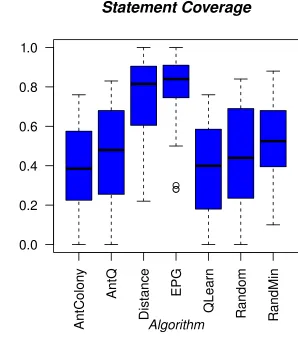
4.1 Statement Coverage . . . 46
4.2 Branch Coverage . . . 46
4.3 Average Errors Found . . . 48
4.4 Run Time . . . 50
4.5 Cost Accumulation . . . 50
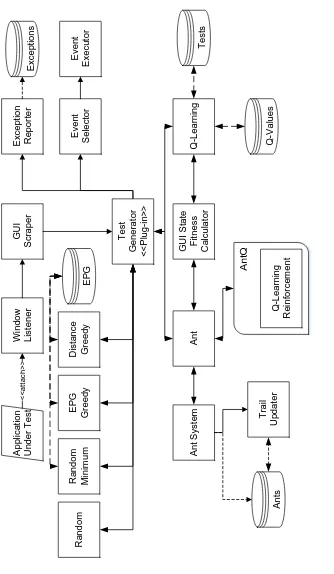
5.1 System Architecture . . . 53
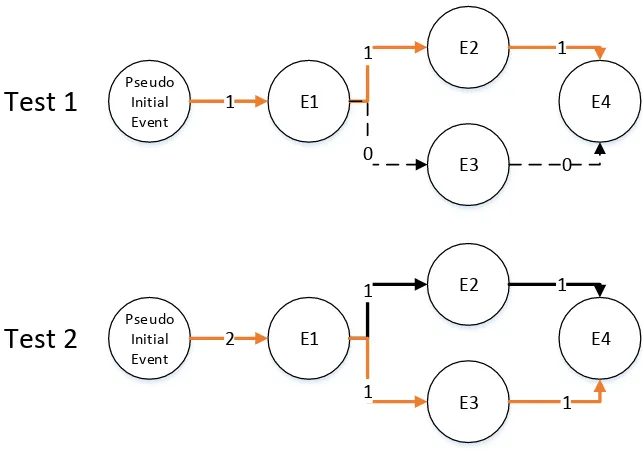
5.2 Random Minimum Example with Two Tests . . . 61
5.3 Initial State with Uncovered Edges . . . 63
5.4 Resulting EPG After Test 1: E1, E2, E5 . . . 64
5.5 Test Two’s Path . . . 64
5.6 Distance Example: Current EPG . . . 67
5.7 Distance Example: Test Case with Two Options . . . 67
6.1 Statement Coverage . . . 87
6.2 ArgoUML Cov. Increase . . . 88
6.3 Buddi Cov. Increase . . . 88
6.4 Gantt Project Cov. Increase . . . 88
6.5 TerpS. Cov. Increase . . . 88
6.6 TerpWord Cov. Increase . . . 88
6.7 TimeSlot Cov. Increase . . . 88
6.8 Branch Coverage . . . 90
6.9 Event Coverage . . . 92
6.10 Event-pair Coverage . . . 94
6.11 Event-1-pair Coverage . . . 96
6.12 Unique Uncaught Exceptions . . . 98
6.15 Buddi Scatter . . . 101
6.16 Gantt Project Scatter . . . 101
6.17 TerpSpreadsheet Scatter . . . 101
6.18 TerpWord Scatter . . . 101
6.19 TimeSlot Scatter . . . 101
7.1 Statement vs. Events . . . 107
7.2 Branch vs. Events . . . 107
7.3 Statement vs. EPs . . . 107
7.4 Branch vs. EPs . . . 107
7.5 Statement vs. E1Ps . . . 107
7.6 Branch vs. E1Ps . . . 107
7.7 Exceptions vs. Statements . . . 109
7.8 Exceptions vs. Branches . . . 109
7.9 Exceptions vs. Events . . . 109
7.10 Exceptions vs. EPs . . . 109
7.11 Exceptions vs. E1Ps . . . 109
3.1 Java Swing Containers . . . 31
3.2 Java Swing Widgets . . . 31
3.3 Test Case Event Pairs . . . 38
4.1 Test Suite Size and Length Selection . . . 43
4.2 Application Summary . . . 44
4.3 Coverage Analysis . . . 45
4.4 Unique Uncaught Exceptions - Total(Average) . . . 47
4.5 Unique Uncaught Exceptions . . . 48
4.6 Time to Run (Hours) . . . 49
5.1 Component Filters . . . 55
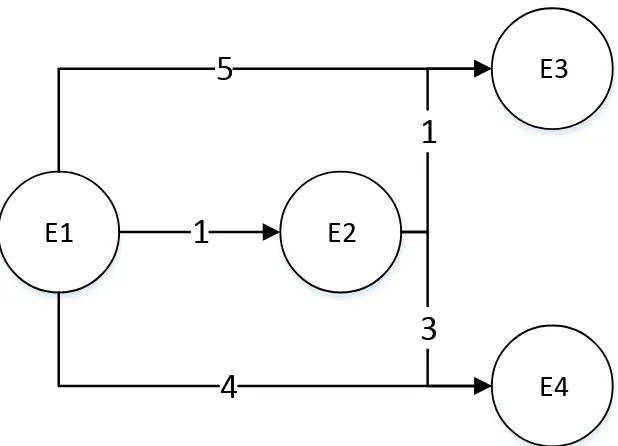
5.2 Distance Reduction Example . . . 66
5.3 Q-Learning Parameter Tuning - Largest mean in bold . . . 73
5.4 Ant System Parameter Tuning - Largest mean in bold . . . 81
5.5 AntQ Parameter Tuning - Largest mean in bold . . . 82
6.1 Application Summary . . . 85
6.2 Test Suite Details . . . 86
6.3 Statement Coverage . . . 89
6.4 Branch Coverage . . . 89
6.5 Event Coverage . . . 91
6.6 Event-pair Coverage . . . 93
6.7 Event-1-pair Coverage . . . 95
6.8 Unique Uncaught Exceptions - Average (Total) . . . 97
6.9 Cost (Hours) . . . 98
6.10 Fitness Function Evaluation . . . 100
Introduction
Software testing is an integral part of the software development life-cycle. It encompasses
many different methodologies and is applicable at multiple points in the life-cycle. Testing
can even be used as a development methodology, which is known as test-driven development
[11]. Software testing can be broken down into its many types, such as unit testing, integration
testing, system testing, and regression testing. Each type of testing contains its own methods
and best practices as each type of testing has different goals. For example, unit testing’s goal
is to ensure that a unit of code works as intended, can handle proper and improper inputs, and
meets the specified requirements, whereas system testing looks at how the system works as a
whole, with all units working together.
Though each type of testing differs in terms of their scope, the overall goal is the same:
to find errors in the system and ensure proper functionality. Myers defines testing as follows:
“Testing is the process of executing a program with the intent of finding errors”[51]. He goes
on to state: “An unsuccessful test case is one that causes a program to produce the correct
results without finding any errors.”
The importance of proper testing cannot be overstated. A 2002 report determined that the
cost of inadequate software testing infastructure cost developers and users $59.5 billion [30].
In extreme and rare circumstances, the failure of proper testing procedures can lead to loss of
life [40]. Though such examples are uncommon, they support the notion that testing is a vital
process.
As testing has expanded, the idea of automated test generation arose. Tools such as Java
PathFinder [63], Pex [61], and DART [31] were created to automatically test applications.
Furthermore, as graphical user interfaces (GUI) have become commonplace, the need for
au-tomated GUI test generation became apparent. Typical GUI testing involves manually writing
test cases using libraries such as Selenium [57], which allow the test to interact with an
inter-face. Another method of testing is a capture/replay system [37], where a tester records their
interactions with a GUI and plays the recording back at a later time. Both manually written tests
and capture/replay systems are still in use today. However, both methods of testing are slow,
expensive, and brittle to changes in the interface. This lead to automated GUI test generation
using systems such as GUITAR [52] that allow for automatic GUI test generation.
In this thesis we investigate dynamic GUI test generation algorithms. Dynamic GUI
test-ing systems allow for real-time testtest-ing of applications through their user interface. We are
interested in creating efficient algorithms that are able to thoroughly test a system in terms of
achieving high levels of code coverage, as well as finding possible bugs.
1.1
Testing
Algorithm 1Add two values and return the result functionAdd(a, b)
result← a+b returnresult end function
Here we describe a typical testing method, called unit testing, in order to better understand
the concept. Algorithm 1 shows an addition method that returns the sum of two values provided
as input parameters. We can test this method by providing two input values and asserting the
er-Figure 1.1: Address Book Application
ent classes of values, such as negative numbers, positive and negative numbers combined, or
extreme values, such as the maximum integer value for 32 bit machines. Any failed assertion
is either an indication of a bug in the application under test (AUT), or within the test. The
developer or test engineer would have to investigate the cause of the failure.
1.2
GUI Testing
GUI testing differs from traditional testing in that we do not invoke methods directly; instead
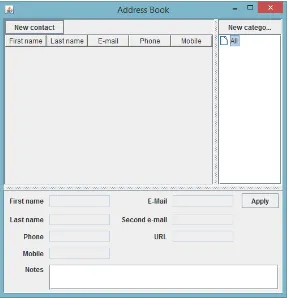
we interact with the application through its interface. Figure 1.1 shows a simple address book
application. In order to test the application, we would execute a series of events. For example,
a test case may be as follows: {New Contact, First Name, Last Name}. The test case would result in the New Contact button being clicked, and then the First Name and Last Name text
we determine if the test passes or fails. In the case of GUI testing, there are generally two types
of oracles. The first type of oracle involves checking the correctness of the GUI state [43], and
the second type of oracle involves checking for crashes, hangs, and thrown exceptions. The
issue with the former oracle is that it requires agolden statein which to compare to. Creating
the golden state is a time-consuming process as it has to be verified manually. The latter oracle
is simpler, and any failures can indicate a fault in the code; however, it tells us nothing about
whether or not the state is correct.
1.3
GUI Testing Architectures
There are two distinct types of GUI testing architectures: static and dynamic. A static testing
system attempts to discover the structure of the GUI before generating tests offline, whereas a
dynamic testing system will make decisions in real time as the GUI is being explored. Both
architectures have their merits, and we discuss them in this section.
1.3.1
Static Model Architecture
Figure 1.2 shows a basic architecture for a static GUI testing system. Depending on the system,
the specific architecture would differ, but many systems have a similar structure. The
architec-ture contains three main components, the GUI Ripper, Test Generator,and Test Runner. The
AUT is passed to the GUI Ripper, which parses the GUI hierarchy and extracts its structure.
The structure of the GUI is stored in a file in a specific format, typically XML. The GUI model
is then fed to the Test Generator, which generates sequences of events based on the GUI model
and stores them in files. Each test case is stored in its own file. The Test Generator uses a
custom algorithm when selecting which events to place in each test case. For example, it could
attempt to cover all GUI events or all paths of length two. The last phase of testing is when the
tests are run against the AUT. The test cases are passed to the Test Runner, which attempts to
GUI Ripper Application
Under Test
GUI Model
Test Generator Test
Cases
Test Runner
Application Under
Test
Figure 1.2: Static Architecture.
1.3.2
Dynamic Model Architecture
A typical dynamic model architecture is shown in Figure 1.3. Like the static model architecture,
the dynamic architecture contains three main components: GUI Ripper, Event Selector, and
Event Executor. The GUI Ripper, though it shares the same name as the static version, works
differently. In the static model, the GUI Ripper parses the entire hierarchy, whereas in the
dynamic model, the Ripper only parses the available widgets. We define an available widget
as one that is accessible to the user in the AUT’s current state. The dynamic system executes
events in real time, so only those events which can be immediately executed are of interest.
The GUI Ripper extracts the available events and passes them to the Event Selector. The Event
Selector is the core of the system as it contains a specific event selection algorithm, such as
random selection or greedy selection. Once an event has been selected for execution, it is
passed to the Event Executor. The Event Executor determines the type of event being run, such
as a button click or text input, and runs the event on the AUT. The AUT accepts the event,
reacts, and the new GUI state is ripped by the GUI Ripper. This continues until some criterion
Application Under
Test
GUI Ripper Events
Event Selector Event
Executor
Figure 1.3: Dynamic Architecture.
1.3.3
Static vs. Dynamic
Both static and dynamic architectures have their merits. Static systems allow for the GUI to be
ripped and explored offline. It is possible that static analysis can be performed on the structure,
or it can even be modified by hand to ensure correctness. Furthermore, test generation can
aim to cover specific targets, such as full event coverage or n-way testing, where n is some
path length. The main fault with the static architecture is the existence of infeasible test cases
[68]. That is, a test case can contain a sequence of events that is not possible to run on the
AUT, as some widget to be interacted with is not accessible. For example, we can imagine
an application with a save mechanism such that the user must clickFilethenSave; however,
the application only allows theSavebutton to be clicked when a change has been made. The
GUI model would show a connection,File → S ave, and since the requirement that a change
must be made cannot be represented as the model encompasses all possible interactions, it is
possible that a generated test will contain the transition fromFile toSave without meeting the condition. This will cause the test to fail prematurely. In Memon’s dissertation in which he
describes GUITAR [44], he reports that 19.3% of generated tests are infeasible. Huang et al.
[35] created a method of repairing broken tests using a genetic algorithm; however, the process
can take days to run. Another issue with static testing is that the GUI ripper may not fully
The benefit of dynamic testing is that all tests are feasible, as only those widgets which
are available are selected for execution. Furthermore, as the GUI model is being discovered,
its representation is updated and stored as it would be in the static architecture. Of course,
the model may not be complete as there is no guarantee that the test algorithm will find all
available windows and tabs. Since dynamic testing is shown to be powerful at testing GUIs,
and since it does not suffer from infeasible test cases, we chose to research and implement a
dynamic testing system.
1.4
Contributions of Thesis
The goal of this thesis is to investigate dynamic GUI testing algorithms and their effectiveness.
In this section we discuss the specific contributions made.
1.4.1
Event-pair Graphs
We introduce and describe event-pair graphs (EPG), which are influenced by event-flow graphs
(EFGs) [45]. EFGs represent an AUT’s GUI event model and are generated by GUITAR. They
are an example of the GUI Model of Figure 1.2. EPGs are used to represent event relationships
for events that have been executed within the same test case. They can be used as both an input
to a test generator and a method of evaluation. A test generator may use an EPG to determine
which pairs of events have not been executed together and then test those events. Once the
testing is complete, the EPG can be used to determine how many pairs of events were actually
tested. We investigate whether the use of EPGs is an effective form of test generation and
whether or not it is a good measure of test suite quality. Our research questions are as follows.
• Are EPGs an effective form of test generation when compared to random selection and
other forms of testing?
such as code coverage?
1.4.2
GUI Test Length E
ff
ectiveness
Before we can begin running our algorithms to generate GUI test cases, we first need to know
how long to make our test cases, as the length of a test may impact its effectiveness. We
investigate the effect test length has on GUI test suite performance and show that moderate to
long test cases perform better than short test cases in both their ability to cover code and find
faults. Since GUI testing is an expensive process, determining a good test length is vital to the
process as it can save hundreds of hours of work. Furthermore, a specific test length may have
the ability to find more faults. Our research question is as follows.
• Is it better for a test suite to consist of many short tests or a few long tests?
1.4.3
GUI Test Generation Algorithms and Analysis
The heart of this thesis is the investigation of various types of GUI test generation algorithms.
We design and analyze multiple algorithms including random selection, greedy selection,
Q-Learning, and ant colony optimization. These algorithms were chosen as they represent a wide
array of algorithm types. Random and greedy selection are easy to implement and are effective
at testing GUIs; Q-Learning is a behavorial reinforcement learning techinque that has been
shown to be effective when applied to GUIs; and ant colony optimization is a search-based
technique that we applied to the GUI domain as it has been shown to be good at finding paths
through a graph.
We first discuss each algorithm in detail and then we compare their effectiveness. We look
at how much code coverage is achieved, the number of faults found, and the number of covered
events. Though multiple GUI test generation systems have been created, few have been tested
against one another. It is often the case that a dynamic GUI test generator is compared to a
of algorithm is superior to the others. Our research questions are as follows.
• Are we able to generate tests that perform better than random selection?
• Are any of the techniques described better than the rest?
1.4.4
GUI Test Suite Adequacy Criteria
We investigate what makes a GUI test suite good. In non-GUI testing, a tester may want to
exercise all conditions, exercise all definition/use pairs, or simply cover all statements. With
GUI testing, we want to know which coverage goals lead to a high number of faults found.
For instance, we may want to execute each GUI event at least once, or we may want to cover
all event pairs. We study the effects that each type of coverage metric has in relation to faults
found and code covered. Our research questions are as follows.
• Is there at least one factor that can be used to predict the quality of a test suite in terms of the number of faults found, such as event coverage or statement coverage?
• Is there a relationship between GUI coverage and statement and branch coverage?
1.5
Thesis Organization
Chapter 2 looks at the background and related work in regards to both testing and GUI
test-ing. Chapter 3 looks at the structure of GUIs, and event-flow graphs and event-pair graphs. In
Chapter 4 we present our study on effectiveness of test length on GUI test suite performance.
Chapter 5 describes and analyses multiple GUI test generators. We look at generators in the
form of random selection, greedy selection, Q-Learning, and ant colony optimization. In
Chap-ter 6 we compare and contrast the results of the different test generators in order to determine
if one is superior to the rest. In Chapter 7 we investigate test adequacy criteria. Finally, we
Background and Related Work
In this chapter we will look at a variety of test generation techniques for both GUI and
non-GUI systems. We will also look at Q-Learning, which is a behavioral reinforcement learning
technique, as well as ant colony optimization. Finally, we look at what makes a test suite
adequate.
2.1
Testing Techniques
In this section we look at two main testing techniques that have inspired research in GUI
testing: random testing and search-based testing. There exist a variety of testing techniques,
such as symbolic execution [38] [67] [20] and concolic testing [58] [2]; however, we focus on
the methods studied in this thesis.
2.1.1
Random Testing
A variety of testing systems that employ random testing have been created. Claessen and
Hughes [19] created QuickCheck to test properties of Haskell programs using random inputs.
Godefroid et al. [31] created DART, which combines random testing and dynamic analysis to
explore program paths. Ciupa et al. [18] designed and created ARTOO, which uses adaptive
random testing, and applied it to object oriented software.
Hamlet [33] argues for the importance of random testing when specific requirements are
met. He states that random testing is often dismissed and that random testing of an application
describes testing that is done in haste, which is the opposite of systematic testing. Systematic
methods often attempt to meet some minimum standard, such as 80% path coverage, which he
argues does not have a scientific basis, but rather it is based on the intuition that 80%
cover-age of something is better than nothing. He believes that if random testing was the standard
in which systematic approaches were tested against, it could help practitioners write better
standards or improve the systematic methods. He ends by stating that the application of
ran-dom testing requires three criteria: the test is at the system level, there exists an operational
profile (a quantative representation of how a system will be used) and the ability to generate
representative pseudorandom values, and there exists an effective oracle, which is a method of
determining whether a test passes or fails.
Hamlet’s three requirements can be applied to random testing for GUIs. GUI testing is a
form of system testing so it meets the first requirement. The second requirement states that an
operational profile is required. For GUI testing, an operational profile would be the measure
of how often each event is executed, and the distribution of any input values. This information
could be obtained by creating usage profiles for multiple users. The third requirement can also
apply to GUI testing. A common oracle is to check for hangs, crashes and thrown exceptions.
Of course the main issue with this type of oracle is that it ignores the semantics of the system.
However, an oracle dealing with expected outputs could be manually written or described if
necessary. Automatically generating such an oracle is not yet possible.
Duran and Ntafos [27] evaluated random testing in order to determine the method’s eff
ec-tiveness. For their first set of experiments, they ran random tests on various programs such as
SIN, SORT and BINARY SEARCH, and found that random testing performed well in finding
bugs. They ran more experiments on five applications, comparing the results to branch testing
the triangle classification programs (determining, based on the three length values, whether the
values form a triangle), random testing performed worse. This is due to the fact that the random
algorithm failed to generate triangles with two or three equal sides. In the four other programs,
random testing performed better than branch testing and better than the required pairs testing
for one program. The authors concluded by stating that random testing has been shown to be a
cost effective method of testing and that it is able to both find errors and achieve good levels of
code coverage. However, they state that random testing should be paired with tests for special
cases.
Pacheco et al. [53] developed Randoop, which is a feedback-directed random test generator.
Randoop is often used as a baseline for comparison by other researchers. It works by
incre-mentally building test cases based on previously generated tests. When a test is generated,
it is executed and compared against a set of filters and contracts. These determine if the test
is illegal, redundant, contract-violating, or useful for future tests. The system uses contracts
to determine if a test passes. The contracts used detect whatever exceptions are thrown, and
compare an object to itself using theequals method, thehashcode method, and thetoS tring
method. The authors compared Randoop to systematic and undirected random testing on four
non-trivial applications and found that Randoop outperformed both techniques in terms of
cov-erage and error detection.
Arcuri et al. [6] examined the current state of random testing research, and proved theorems
in regards to such things as the number of random tests needed to be run in order to achieve
the desired target results. The theorems put forth by the authors, and supported by empirical
evaluations, determine the minimum number of tests required to meet target goals, determine
how random testing can scale better than some types of partition testing, and finally, determine
predictability of random testing in relation to the distribution of the testing targets. The authors
state that in the case of black-box testing, when an automated oracle is available, random
testing is a viable option. They conclude by stating that the results in the current literature are
The evidence suggets that random testing is effective in terms of finding bugs and achieving
high levels of code coverage. This gives us confidence that, when applied to GUI testing,
random testing may be an effective form of testing.
2.1.2
Search-based Testing
Search-based software testing is a subset of search-based software engineering. The idea is
to use a search algorithm, such as a genetic algorithm [48] or hill climbing [56], in order to
solve an engineering problem. Harman and Jones [34] argued for the effectiveness of these
techniques and discussed the ingredients for reformulation and evaluation criteria for
search-based software engineering. Reformulating software engineering as search-search-based software
engineering requires three things: a representation of the problem which is open to symbolic
manipulation, a fitness function, and a set of manipulation operators. The authors discussed
how best to evaluate search-based methods. They suggested creating a base line comparison
by using random search and they state, “to achieve a measure of base line acceptability, a
metaheuristic technique must out-perform a purely random search.” Furthermore, they state
that any algorithm worthy of consideration needs to outperform random search.
An example of such a system is EvoSuite [28], which is a test generation technique that
takes an evolutionary approach to generating whole test suites. The system generates whole
test suites as candidate solutions. The test suites are evolved through crossover and mutation
operators. Crossover occurs by exchanging test cases between test suites. Mutation can occur
at the test suite level or at the test case level. Mutation at the test suite level involves adding new
tests, whereas mutation at the test case level involves adding, deleting, or changing statements.
The fitness function used to evaluate a test suite is the overall branch distance. The authors
used mutation testing to evaluate their generated test suites. A mutant that goes undiscovered
indicates a deficiency with the solution.
Arcuri and Yao [7] studied the application of search-based techniques on object-oriented
annealing [39], a genetic algorithm, and a memetic algorithm [50]. The fitness function of their
algorithms is defined as branch distance. They compared their algorithms on seven container
classes, such as Stack and Vector. They found that the memetic algorithm performed best in all
situations except for the vector class.
Search-based software testing has shown to be a viable method for testing; however, it still
requires a lot more research. In terms of GUI testing, we can apply search-based methods as
the GUI, represented as a graph, can be explored using various search techniques.
2.2
Q-Learning
Q-Learning [64] [1] is a form of reinforcement learning for model-free systems. Agents within
a Q-Learning environment are able to find optimal paths in a Markov decision process [55] (a
framework for modeling decision making with partly stochastic outcomes) by determining the
reward for actions taken in a system, which does not require a model of the system beforehand.
The process works by having agents execute each action in each state and evaluate those actions
based on the resulting reward or penalty. By attempting each action in each state, the agent
learns which actions are best. The result of taking an actionain statesis calculated as follows:
Q(s,a)= Q(s,a)+α[reward(s,a)+γmax
a0 Q(δ(s,a),a 0
)−Q(s,a)] (2.1)
whereαis the learning rate,γis the discount factor,reward(s,a) is the reward of taking action
ain state s,δ(s,a) is the state reached by executing the actionafrom states, andQ(δ(s,a),a0)
indicates the Q-value associated with the actiona0 when executed from the state δ(s,a). The
learning rate determines how much influence the newly acquired information will have on
the Q-value. The rate is set in the range [0,1]. A value of one will only consider the new
information, whereas a value closer to zero will favour the current information. The discount
factor determines the importance of the current reward versus the new reward. A value close to
reward value is the fitness of taking an actionais state s. The reward values are determined by
the engineer beforehand.
Q-Learning is used by Mariani et al. [41] in their system, AutoBlackTest. The reward
function is the amount of change that occurs in the GUI state. The more change that occurs,
the higher the reward. Q-Learning is applicable to dynamic GUI testing, as the model of the
GUI is unknown until it is explored. Furthermore, the actions are generally deterministic and
can be represented as a Markovian decision process. We implement our own version of this
system as one of our dynamic testing algorithms.
2.3
Ant Colony Optimization
Ant colony optimization (ACO) [26] is a technique for finding good paths in a graph. Most
notably, it has been applied to the travelling salesman problem [25]. Since GUIs are represented
as graphs, and since we want to find good paths through the GUI in order to test it, it follows
that ACO might be a good technique for GUI testing.
ACO is based on the observation of real ants [21]. Ants, searching for a food source, explore
randomly while leaving a trail of pheromones behind. Over time, as more ants discover and
follow the same path, more pheromone is deposited on the path causing the colony to converge
towards a single path to the food source. Furthermore, the pheromones evaporate over time
and so the less travelled paths become less desirable. This idea was adapted to solving existing
search problems, such as the travelling salesman problem, as it was recognized that the ants
will often choose the more efficient paths.
The basic algorithm works by releasing ants at different nodes in the graph. Each ant
traverses the graph, visiting each node once, and returning to its initial node. Once the ants
have completed their tours, the edges of the graph are updated based on the quality of each
ant’s tour. We look at and implement two ant systems in our dynamic testing environment, the
2.3.1
Ant System
The Ant System discussed here is the original proposed system and all equations are taken
from [22]. Ant systems work by releasing a generation of ants to explore the graph. After each
ant in a generation has completed its tour, the pheromone value of each edge is updated. The
valueτi jrepresents the pheromone on the edge going from vertexito vertex j, and is updated
as follows:
τi j = (1−ρ)·τi j+ m X
k=1
∆τk
i j (2.2)
whereρis the evaporation rate,mis the number of ants, and∆τki j is the quantity of pheromone
laid on edge (i,j) by antk:
∆τk i j =
Q/Lk if any antkused edge (i,j) in its tour
0 otherwise
(2.3)
whereQis a constant, andLkis the length of the tour constructed by antk.
As ants are exploring the graph, they decide the next vertex to visit through a stochastic
mechanism. When an antk is in vertexi, the probability of going to vertex jis calculated as
follows:
pki j = τα
i j·η
β
i j
P
cil∈N(sp)ταil·η
β
il
ifci j ∈N(sp)
0 otherwise
(2.4)
where sp is the ant’s current solution (initially empty and then extended every time a new
component is selected), N(sp) is the set of feasible components; that is, the nodes reachable
fromiand still unvisited (not insp). The parametersαandβcontrol the relative importance of
ηi j =
1 di j
(2.5)
wheredi jis the distance betwen vertexiand j. The heuristic value is used to give an advantage
to shorter edges.
Further improvements were made to ACO, such as with the MAX-MIN ant system [60],
which restricts the pheromone values of an edge to a predefined range. Furthermore, future ant
systems introduced the concept of only reducing the edges that were traversed by an ant, rather
than reducing all edges.
2.3.2
Ant-Q
One variant of ACO is called Ant-Q [23] [24], which combines ACO with Q-Learning. As each
ant traverses the graph it updates each edge it touches using Q-Learning reinforcement. After
each ant in a generation has completed its tour, the edges traversed by the ants are updated
using ACO. The edges are updated using the following equation:
AQ(r,s)= (1−α)·AQ(r,s)+α· ∆AQ(r,s)+γ· Max
z∈N(sp)AQ(s,z)
!
(2.6)
whereAQ(r,s) is the Ant-Q-value. The αandγ are the learning step and the discount factor,
respectively. The ∆AQ value, which represents the amount of pheromone to deposit, is zero
except after each ant has completed its tour. ∆AQis calculated as follows:
∆AQ(r,s)=
W
Lkib if (r,s)∈ tour done by agentkib
0 otherwise
(2.7)
whereW is a constant,kibis the ant with the best tour for this iteration, andLkibis the length of the tour. This equation uses the best ant in the iteration; however, it is also possible to use the
global best ant, which is the best ant from any iteration. The authors found that the iteration
When an ant is in stater, it selects the next state susing the pseudo-random proportional
selection rule:
s=
max
u∈N(sp){AQ(r,u)
α·HE(r,u)β} ifq≤ q 0
P otherwise
(2.8)
where α and β provide weights to both the AQ values and the heuristic value (HE), q is a
random value in the range [0,1],q0 (0≤q0 ≤ 1) is a parameter that determines the probability
of making a random choice, andPis the probability selection rule stated in equation 2.4.
The major difference between the Ant System and Ant-Q in regards to their update policy is
that the Ant System takes into account the tour of allmants when updating the edges, whereas
Ant-Q only takes into account the iteration or global best ant. Furthermore, the Ant System
updatesalledges, whereas Ant-Q only updates edges that were traversed by an ant.
We implement both ant systems in our GUI test generators. However, we modify them to
fit our needs. For example, we are not looking for a single best path through the graph, but
rather many good paths; therefore when updating the edge values in our Ant-Q system, we use
the result of all the ants and not only the iteration best. The specifics of each system will be
discussed in Chapter 5.
2.4
GUI Test Case Generation
As mentioned in the introduction, there are two main methods of generating GUI test cases.
The first method involves ripping a model of the GUI and generating tests. The second method
involves dynamically ripping the GUI state and executing events. We look at both types of
2.4.1
Static Testing
Static testing has received a great deal of attention from the research community. The tool
most commonly used in the reseach is GUITAR [52], which works similarily to the static
model described in Chapter 1. GUITAR rips a GUI into a directed graph, called an
event-flow graph (EFG), and generates tests by exploring different paths through the EFG. An EFG
represents the flow of events through a GUI. The vertices of the graph represent GUI events,
and the edges represent dependencies. For example, if there exists an edge<e1,e2>, then event
e2can be executed after evente1. GUITAR runs the generated test cases on the AUT.
Various techniques for generating tests have been investigated. Brooks and Memon [12]
created usage profiles of users’ interactions with a system and then developed a probabilistic
model based on the profiles. The test generator uses the model to create test cases that
repre-sent interactions that a user is most likely to execute. The results showed that the generated
tests were at most 22% of the size of of tests that were generated from the original profiles.
Furthermore, the tests were able to find more faults per test than the tests based on the profiles
alone.
Memon et al. [46] used a goal-driven approach to generate test cases for GUIs. The authors
usedplanning, which is a method borrowed from artificial intelligence. The idea is to give the
planner a set of operators, an initial state, and a goal state. The planner can then produce a
sequence of operators that will transform the initial state to the goal state. The system requires
manual intervention by the tester. The tester has to set the preconditions and effects of the
hierarchical operators. Furthermore, the tester has to create the initial states and goal states.
With this information the planner can generate sequences of actions to change the initial states
into the goal states. The authors showed the systems viability by generating tests on Microsoft’s
WordPad.
Yuan et al. [68] explored the idea of incorporating event context into GUI test generation.
By context they mean the combination of events, the sequence length, and the position of events
testing. The authors created a new event graph, called an event-interaction graph (EIG), which
is based on EFGs. An EIG is similar to an EFG, except that EIGs exclude system events,
such as those events that open menus. Instead, they combine the system event with the target
event, thus reducing the size of the graph and gaining the ability to generate more meaningful
tests. Tests are generated by taking a combinatorial approach using covering arrays to generate
combinations of events. The authors also defined new coverage criteria, such ast-cover, which
states that a test suite is t-cover-adequateif it covers all possible event-t-tuples. They tested
their system on eight applications and were able to find new bugs.
Yuan and Memon [70] used GUITAR to generate test cases using GUI run-time state
feed-back. The system generates a seed test suite, which is generated based on a ripped EIG. When
the test suite is run, they capture the event-semantic interaction (ESI) relationships, which is
the effect a GUI event has on all other events. A semantic relationship occurs when the
exe-cution of an event changes the properties of some other widget. Based on these relationships,
the authors proposed a new graph called the event-semantic interaction graph. Tests can then
be generated by walking the graph and outputting the event sequences. They conducted two
studies on eight applications and found that the test suites based on ESI relationships found
more faults than their code-, event-, and event-interaction-graph counterparts.
Memon and Soffa [47] addressed the problem of regression testing for GUI testing. When
a system changes its interface, many of the GUI tests will break. The authors researched the
number of broken tests that occur, as well as how to repair said tests. They represent the
GUI using a GUI control-flow graph (G-CFG). A G-CFG is created for both the original and
updated application. The two graphs are compared in order to determine which test cases
are broken. The G-CFG is then used to repair the broken test cases by replacing infeasible
events with feasible ones. The authors evaluated their system by manually creating tests using
a capture/replay system for both Adobe Reader and MicroSoft WordPad. The results showed
that they are able to repair a high number of broken tests.
dependancy graph (EDG). The authors extracted the event handlers for each event. They used
a static analyzer on the extracted bytecode and determined a write/read relationship between
the events. For example, evente1may write to a variable calledtextand evente2may read and
use that variable. The EDG is used to represent such relationships. Furthermore, the EDG is
used in conjunction with the EFG to construct test cases. The edges in the EDG only represent
a write/read relationship, and so the EFG is used to connect the events within a single test.
The authors generated sequences of tests for four applications and were able to find previously
unknown bugs.
We can see from the literature that static GUI testing has had a lot of focus. A variety of
test generation techniques have been devised, as well as test coverage criteria. Much of this
work influences the research conducted in dynamic testing, such as how to best represent the
GUI in a graph.
2.4.2
Dynamic Testing
A variety of dynamic testing techniques have been researched that make use of metaheuristic
search techniques such as ant colony optimization, genetic algorithms, and Q-Learning.
Bauersfeld et al. [10] developed an ant colony system for testing GUIs that uses Method
Call Trees (MCT) as a fitness function. A MCT is a tree structure that represents the flow of
method calls during an application’s runtime. The idea is that calling a method from different
points in the application can lead to better code coverage and result in more bugs being found.
For instance, if a methodm1() is called by both methodsm2() andm3(), it is preferable to have
methodm1() called from both methods, as the context in which a method is called affects its
behaviour. The authors build MCTs by instrumenting the AUT and logging the entry and exit
points of each method. This data allows them to automatically create a MCT. Furthermore,
the authors were able to combine multiple MCTs from different runs into a single MCT. The
system tests an application by use of ants. Each ant represents a test case and a set number
explored by the ants are updated depending on the size of the MCT generated by each ant.
Paths that generated larger MCTs would receive more pheromones and therefore would be
favoured in future test cases. The ant system was compared to random selection. The results
showed that the method is able to generate tests that result in large MCTs compared to random
selection. However, the authors do not report on the code coverage or faults found.
Gross et al. [32] developed EXSYST as a method to automatically test GUIs. The authors
conducted a study to show how non-GUI test generators find false faults. False faults are
created by non-GUI test generators by placing the system in an invalid state, which would
normally be disallowed by the interface. They generated tests using Randoop [53] and showed
that all the faults found are false. This is due to the fact that Randoop bypasses the implicit
constraints of the system imposed by the GUI. EXSYST uses a genetic algorithm based on
EvoSuite [28] that attempts to generate test cases that achieve high levels of code coverage. The
system uses branch distance as a fitness function. Branch distance evaluates how far a predicate
is from obtaining its opposite value [4]. The system generates a set number of test suites by
randomly walking through the GUI. It then uses a genetic algorithm to perform crossover and
mutation at both the test suite level and the test level. Crossover happens by splitting each test
suite at a random point and exchanging the test cases. Care is taken to ensure that the test suite
sizes remain constant so that no test suite is larger than another. Mutation occurs by either
adding test cases or mutating an existing test case. The test cases can be mutated by a delete,
change, or insert operation. For each action in a test case, there is a chance it is removed. As
well, there is a chance that the parameters of an operation are randomly changed. Finally, there
is a random probability that a random action is inserted at any point in the test case. Mutating a
test case can cause the test to break, as the sequence of actions is not guaranteed to be correct.
The system creates a model of the GUI in memory and updates it as the tests are executed. The
model can also be used to repair broken test cases; however, it is not guaranteed to work in all
cases. If a test is executed and it is determined that the test is infeasible, the test is halted and
out of five cases EXSYST was able to achieve higher levels of code coverage.
Mariani et al. [41] developed AutoBlackTest on top of IBM Functional Tester to test GUIs.
AutoBlackTest uses Q-Learning to find good paths through a GUI. The system uses a custom
fitness function that calculates the ratio of change between two GUI states and uses the result
to determine good event sequences. The function works by capturing the GUI state before an
event is executed, executing the event, capturing the resulting state and calculating the diff
er-ence between the two states. Events that result in a large state change will be favoured in future
selections. The system uses Q-Learning to assign weights, called Q-values, to edges based
on the fitness function. Q-values are calculated based on two values: the reward of an action
(fitness) and the best Q-value of a successor edge. Every time an event is executed, its edge
is updated using both values. AutoBlackTest uses an-greedy selection process, which states
that a random action is selected with probability and the action with the highest Q-value is
selected with probability 1-. The authors conducted experiments to determine the best value
and found that a value of 0.8 resulted in the highest code coverage–that is, random actions
occur 80% of the time. The system was compared to GUITAR and was shown to cover more
code and find more bugs.
One problem with many of the dynamic testing systems discussed in this section is that they
are compared to non-GUI testing systems or to model-based systems. Bauersfeld et al. [10]
compared their ant colony system to dynamic random selection; however, they only reported
on the size of the method call trees and not on the faults found or code covered. Gross et
al. [32] compared EXSYST against GUITAR, Randoop, and EvoSuite. GUITAR is a
model-based system, and both Randoop and EvoSuite are non-GUI testing systems. Mariani et al.
[41] compared AutoBlackTest against GUITAR as well. It would be beneficial to compare
dynamic testing algorithms against one another, as well as compare them against pure random
selection. Testing against random selection is important as random testing represents a base
line for comparison. One goal of this thesis is to compare multiple algorithms against each
2.5
Test Case Length E
ff
ectiveness
Test length can have a significant impact on the effectiveness of a test suite. Research has
been conducted on the effect of test length in regards to code coverage and faults found in both
traditional testing and GUI testing. We conducted our own study on the effect of test length on
GUI test suites, which is discussed in Chapter 4.
2.5.1
Test Length for Non-GUI Testing
Some research has been conducted on the effect of test length on test length performance for
traditional software testing. Fraser and Gargantini [29] ran experiments to study the effects of
length on specification-based test case generation. The authors wanted to know two things:
the influence test length has on fault-finding capabilites and the influence of test length on
computational cost. They ran experiments on two subject applications, the Safety Injection
System and the Cruise Control model. They used the NuSMV [17] model checker to generate
tests. The techniques used to generate tests are mutation testing, transition pair coverage,
modified condition decision coverage, pairwise testing, and random testing. The authors ran
thousands of test suites and report on some of their results. Overall they found that there
are special cases that need to be considered when determining the length, but that in general
having fewer longer test cases is preferable to many short test cases. Increasing the test length
can reduce the overall test suite size and length and increase the fault finding capabilities.
Arcuri [5] conducted experiments on six Java containers using four test generation
algo-rhtms: random search, hill climbing, an evolutionary algorithm, and a genetic algorithm. Each
algorithm attempts to cover all possible branches in a class. His goal was to show that difficult
software testing benchmarks can be made trivial by using longer test sequences and that choice
of length is important for software testing. The author ran 52 000 experiments and found that in
general longer tests perform better and that in some instances some of the branches are
conditions in which longer test sequences are generally better and the second gives conditions
in which they are not; however, it does not mean they are any worse.
Andrews et al. [3] addressed the issue of test length for random testing. Their goal was to
show how test length can significantly impact the effectiveness of random testing in terms of the
number of failures discovered as well as the length of the failing trace. The authors performed
an empirical study on five applications, as well as a case study of a JPL flight software system.
They found that test length has a major influence on the effectiveness of random testing for
interactive programs. Furthermore, changing the test length can have an effect on the number
of failures found by an order of magnitude.
These studies indicate that test length is an important variable in software testing and that
long test cases generally perform better than short test cases. This work influenced our own,
which we discuss in Chapter 4.
2.5.2
Test Length for GUI Testing
Little research has been conducted for GUI test length effectiveness. Xie and Memon [65]
studied the effect of increasing both test suite size and test length on fault finding effectiveness.
The authors looked for faults in the GUI state by comparing the test results to a golden state
that was previously created. They conducted experiments using GUITAR and generated test
suites of increasing size where each test suite consisted of test cases of similar size and with
the same event composition. The authors conducted an ANOVA analysis and found that there
was a statistically significant difference in faults found when test suite size is increased. The
authors attributed this difference to the fact that events are executed multiple times with diff
er-ent preceding ever-ents. The authors also investigated whether increasing the length of individual
test cases has a significant effect on finding faults. They conducted an experiment using test
lengths ranging from 2 to 20, where each test suite contained the same number of tests. The
results show that increasing the test length did not result in a statistically significant difference
cases cannot find.
One issue with this study is that GUITAR employs the concept of “reaching steps” as it
generates test cases. A reaching step is simply an event that is required to be executed so
that the AUT reaches a specific state so that the test can begin. GUITAR generates tests by
selecting any path of a specified length in the EFG and then works backwards, adding the
required events, until it reaches an initial event. Therefore, a test of lengthncan consist ofm
reaching steps, which results in a true length ofn+m. So although they are comparing length
2 to length 4, etc., it is likely that the length 2 tests contain many reaching steps and thus have
a longer length.
Bae et al. [9] conducted a study to compare model-based and dynamic event
extraction-based GUI testing techniques. The authors created a system called GUITester that is able to
test systems using both a model-based approach and a dynamic approach. GUITester can rip
and create EFGs similarily to GUITAR, as well as make decisions in real time. The authors
compared the two approaches on five subject applications using a variety of test lengths and test
suite sizes, totaling 104 test suites. Their results showed that the dynamic system outperformed
the model-based system in terms of code coverage on all AUTs. The code coverage increased
when the test length increased; however, the returns were diminishing. Furthermore, the results
showed that the number of nonexecutable test cases for the model-based approach grew rapidly
as the test lengths were increased; in one case 77.2% of all length 100 tests were nonexecutable.
This high failure rate may explain why the previous paper discussed by Xie and Memon found
no improvement with longer test cases.
2.6
Test Adequacy Criteria
In this section we look at what makes a test suite adequate. It is important to test practioners
to know what to optimize. Should test suites aim to cover a lot of code, cover definition/use
will look at the current research conducted in this area of testing in regards to both traditional
testing and GUI testing. This complements our own work as we study test adequacy criteria in
this thesis.
Test adequacy criteria were studied by Hutchins et al. [36]. They conducted an empirical
study on the effectiveness of both the all-edges (all paths in the application’s control flow
graph) and all-DUs coverage criteria. They ran experiments on 130 faulty programs based
on seven moderately sized programs. They generated seven thousand tests for each program
and studied the relationship between coverage and fault detection. They found that test suites
that achieved 90% code coverage achieved significantly better results than other test suites of
the same size. Furthermore, they saw more improvement as coverage increased from 90% to
100%. However, they found that having 100% coverage itself is not always indicative of a test
suite’s effectiveness.
In regards to GUI testing, Strecker and Memon [59] conducted experiments on two subject
applications in order to determine which factors results in high fault coverage. The authors
looked at six variables: the length of a test case, the number of events (size), length two event
coverage, length three event coverage, mutant type, branch points, and statement coverage.
They seeded faults into both applications using a mutant generator and generated test cases
using GUITAR; they limited the length of the tests to 20 events. For the first application, called
FreeMind, it was found that statement-coverage-adequate test suites were the dominant factor
in detecting faults. For the second application, called CrosswordSage, three factors were found
to contribute to the faults found: the mutant type, statement-coverage-adequate test suites, and
length three event coverage, as well as the interaction between the mutation type and statement
coverage. The results validated the use of statement coverage as measure of test adequacy.
This work inspires our own study into test adequacy. Our study differs from these as we
used a dynamic test generator rather than a model-based test generator. We are interested in
studying both white- and black-box criteria. For white-box criteria, we look at statement and
and event-1-pair coverage.
2.7
Summary
In this chapter we looked at the current literature for both GUI and non-GUI testing practices.
We looked at the effectiveness of both random and search-based software testing for non-GUI
testing and discussed how it could be applied to GUI testing. Following that, we looked at the
state of model-based testing, most notably the use of GUITAR, and how it has been used to test
GUIs. We then looked at various dynamic testing systems where each one applies a different
test generation technique ranging from evolutionary algorithms to Q-Learning. We discussed
studies on test length for non-GUI testing and showed how the research indicates that longer
tests are generally more effective than shorter tests. The research conducted on test length for
model-based GUI testing found no notable increase in faults found as the length increased.
The study conducted comparing the model-based system to the dynamic system found that
increasing the length results in more code coverage. We also discussed two techniques for
exploring a graph: Q-Learning and ant colony optimization, which we use as test generators
later in this thesis. Finally, we discussed the current work in test adequacy criteria that showed
the types of coverage criteria that have a significant impact on the number of faults found in an
Graphical User Interfaces
In this chapter we look at the structure of graphical user interfaces in order to better understand
how they can be tested. First we look at the definition of a GUI and its core components. We
describe how a GUI is constructed in a hierarchy and the type of components a GUI can consist
of. Following that, we look at the concept of a GUI state and the concept of modality. We then
look at two ways GUIs can be represented as graphs. The first method is to represent GUIs in
an event-flow graph and the second method is to represent GUIs in an event-pair graph. We
discuss both graphs in detail and discuss their uses and differences.
3.1
GUI Structure
A GUI is created in a hierarchical structure. The structure consists of containers and widgets.
A container is a bounding structure that surrounds widgets. Table 3.1 shows some of the
important Java Swing containers. A widget is any object with which a user can interact. Table
3.2 displays a list of some of the widgets for Java Swing and their respective actions. We
formally define GUIs as follows.
Definition Agraphical user interface (GUI) consists of a set of containers and widgets, ar-ranged in a hierarchy, which users can interact with by executing events. GUIs generate and
consume events based on a user’s actions.
Definition Aneventis a combination of a user action, such as a mouse click, and a widget. Events are generated by users acting on GUI widgets.
GUIs are event-based applications. That is, they respond to actions from a user or from
another system, and generate events. Events tell the system that an action has taken place.
There are different types of actions, such as mouse clicks, keyboard input, and touch input.
Each widget within a GUI responds to specific actions. A button can respond to a mouse
click, as well as keyboard input, such as when it is in focus and the user pressesEnter. Some
widgets, such as tables, have more complex inputs. A table can have multiple rows selected
or multiple columns selected; the entire table can be selected; as well, values can be input into
individual cells. Events are consumed by the system by means of an event handler. An event
handler is a special interface built into GUI applications that allows for events to be captured
and consumed. In Java, event handlers are added to a widget and the widget can start listening
for events. The following code snippet is an example of adding an event handler (called Action
Listener) to a Java button.
myButton.addActionListener(new ActionListener() { public void actionPerformed(ActionEvent e) {
doSomethingInteresting(); }
});
When the button is clicked, the actionPerformed() method is called. Each widget in the
GUI has to implement its own event handler. Furthermore, widgets can implement multiple
event handlers, such as how to handle both a key press and key release.
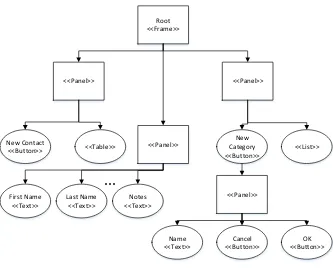
As an example of a GUI hierarchy, Figure 3.1 shows the hierarchy for the Address Book
Table 3.1: Java Swing Containers
Containers Frame Window Panel Tab Pane Menubar Popup Menu
Table 3.2: Java Swing Widgets
Widget Events
Button Click
MenuItem Click
CheckBox Click
RadioButton Click
ComboBox SelectIndex
TextComponent SetText
Slider SetValue
Spinner Click
Label Click
List SelectRow, SelectRows, ExpandRow
Tree SelectRow, SelectRows, ExpandRow
Root <<Frame>>
<<Panel>>
<<Panel>>
<<Panel>>
New Contact
<<Button>> <<Table>>
New Category <<Button>>
<<List>>
Cancel <<Button>> Name
<<Text>>
OK <<Button>> First Name
<<Text>>
Last Name <<Text>>
Notes <<Text>>
<<Panel>>
...
Figure 3.1: Address Book Hierarchy
Panels can be added to the frame, which themselves can contain more panels. Furthermore,
widgets are stored in panels and arranged in some order. When ripping a GUI, either using a
static or dynamic system, the hierarchy is explored in a depth-first or breadth-first fashion until
all branches have been traversed.
In order to test a GUI system, we have to execute events on the application under test
(AUT). We can execute events programmatically or we can use a robot class to emulate mouse
and keyboard inputs. Executing an event programmatically involves calling provided methods,
such as thedoClick() method provided by Java Swing to click a button. Using a robot class,
we can tell the machine to move the cursor to specific coordinates and press a mouse button,
or we can focus on a specific text box and send keyboard signals. One drawback to using the
robot class is that the tests can be fragile since they rely on specific coordinates. As well, the
3.2
GUI State
A GUI stateS is composed of a set of widgets{w1,w2, . . . ,wn}, where each widgetW is
com-posed of a set of properties{p1,p2, . . . ,pn}. Each propertyPis assigned a valueV. Therefore,
we define a GUI state as follows.
Definition Thestateof a GUI is the composition of all widgetsW, where each widget has a set of propertiesP, and where each property has a fixed valueV. A stateS1is equal to a stateS2if
they both contain the same number of widgets, and the properties of each widget are equal for
both states.
The concept of a GUI state is important for GUI oracles. When testing GUIs, there are two
types of oracles: implicit oracles and GUI state oracles [43]. Implicit oracles only take into
account hangs, crashes, and thrown exceptions, whereas state oracles look at the state of the
GUI in order to determine if a bug has been found. In order for a state oracle to be implemented,
a perfect (golden) state must be created first. The golden state represents the correct state of the
GUI after a set number of events have been executed and it is to be used for comparison when
testing. Creating the golden state is labour intensive as it has to be verified manually. When
testing the system, the new state is compared to the golden state. Any differences between the
two states is considered a bug and warrants an investigation.
3.2.1
Modal Windows
An important characteristic of GUIs is the concept of modal windows. A modal window is one
that captures the focus of the system and does not allow users to interact with GUI widgets
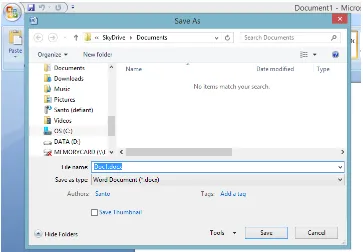
outside of itself. An example of a modal window is the Savedialog shown in Figure 3.2. A
non-modal window is shown in Figure 3.3, which is aFind/Replacewindow. The modality of
a window can be determined during the ripping process by checking the window’s properties.
When we generate tests, we have to take into account whether a window is modal. Since we