Scholarship@Western
Scholarship@Western
Electronic Thesis and Dissertation Repository
8-23-2017 1:30 PM
An Internet-Wide Analysis of Diffie-Hellman Key Exchange and
An Internet-Wide Analysis of Diffie-Hellman Key Exchange and
X.509 Certificates in TLS
X.509 Certificates in TLS
Kristen Dorey
The University of Western Ontario
Supervisor
Dr. Aleksander Essex
The University of Western Ontario
Graduate Program in Electrical and Computer Engineering
A thesis submitted in partial fulfillment of the requirements for the degree in Master of Engineering Science
© Kristen Dorey 2017
Follow this and additional works at: https://ir.lib.uwo.ca/etd
Recommended Citation Recommended Citation
Dorey, Kristen, "An Internet-Wide Analysis of Diffie-Hellman Key Exchange and X.509 Certificates in TLS" (2017). Electronic Thesis and Dissertation Repository. 4792.
https://ir.lib.uwo.ca/etd/4792
This Dissertation/Thesis is brought to you for free and open access by Scholarship@Western. It has been accepted for inclusion in Electronic Thesis and Dissertation Repository by an authorized administrator of
Abstract
Transport Layer Security (TLS) is a mature cryptographic protocol, but has flexibility dur-ing implementation which can introduce exploitable flaws. New vulnerabilities are routinely discovered that affect the security of TLS implementations.
We discovered that discrete logarithm implementations have poor parameter validation, and we mathematically constructed a deniable backdoor to exploit this flaw in the finite field Diffie-Hellman key exchange. We described attack vectors an attacker could use to position this backdoor, and outlined a man-in-the-middle attack that exploits the backdoor to force Diffie-Hellman use during the TLS connection.
We conducted an Internet-wide survey of ephemeral finite field Diffie-Hellman (DHE) across TLS and STARTTLS, finding hundreds of potentially backdoored DHE parameters and partially recovering the private DHE key in some cases. Disclosures were made to companies using these parameters, resulting in a public security advisory and discussions with the CTO of a billion-dollar company.
We conducted a second Internet-wide survey investigating X.509 certificate name mismatch errors, finding approximately 70 million websites invalidated by these errors and additionally discovering over 1000 websites made inaccessible due to a combination of forced HTTPS and mismatch errors. We determined that name mismatch errors occur largely due to certificate mismanagement by web hosting and content delivery network companies. Further research into TLS implementations is necessary to encourage the use of more secure parameters.
Keywords: Transport Layer Security, discrete logarithm problem, Diffie-Hellman, small subgroup attack, X.509 certificate, name mismatch error
I want to thank my supervisor, Aleksander Essex, for his unfailingly positive support and for routinely teaching me something new about software. Thank you for taking a chance on me.
I also want to thank my family, friends, and Whisper Lab members for providing much appreciated support and fun in equal measures. You are all awesome.
Co-Authorship Statement
In this thesis, Section 2.4.4, Chapter 3, and Chapter 4 were adapted from Dorey et al.’s arti-cle “Indiscreet Logs: Diffie-Hellman Backdoors in TLS”, which was co-authored by Nicholas Chang-Fong and Aleksander Essex.
Nicholas Chang-Fong and Aleksander Essex provided the initial idea for the article. Alek-sander Essex additionally contributed to multiple areas: finding related work in Section 2.4.4, providing the idea behind and additionally conducting the testing in Sections 3.2-3.3, providing the mathematical concepts and constructions in Section 3.4, providing the information behind Section 4.3.1, providing the idea behind and additionally conducting the testing in Section 4.3.2, creating the attack described in Section 4.4, and contributing ideas in Sections 4.5-4.7.
Abstract i
Acknowlegements ii
Co-Authorship Statement iii
List of Figures vii
List of Tables ix
List of Appendices x
List of Abbreviations, Symbols, and Nomenclature xi
1 Introduction 1
1.1 Motivation . . . 2
1.2 Contributions . . . 2
1.3 Organization of Thesis . . . 3
2 Background 4 2.1 Network Security . . . 4
2.2 Transport Layer Security . . . 4
2.2.1 What is Transport Layer Security? . . . 4
2.2.2 TLS Handshake Protocol . . . 6
2.2.3 TLS Handshake Messages . . . 6
2.2.4 Applications of TLS . . . 11
2.3 Secure Shell . . . 12
2.4 Diffie-Hellman . . . 13
2.4.1 Public-Key Key Exchange . . . 13
2.4.2 Cryptography . . . 14
2.4.4 Related Work . . . 19
2.5 X.509 v3 Certificates . . . 21
2.5.1 The Need for Certificates . . . 21
2.5.2 Chain of Trust . . . 22
2.5.3 Certificate Fields and Extensions . . . 23
2.5.4 Related Work . . . 27
3 Diffie-Hellman Backdoors: Mathematical Construction 29 3.1 Overview . . . 29
3.2 Parameter Hygiene in DL Implementations . . . 30
3.2.1 Missing Validation Checks . . . 30
3.2.2 Working inZ∗pwith Generator of Order 2q . . . 31
3.3 Successful Connections with Weak Parameters . . . 32
3.3.1 Connections with OpenSSH . . . 32
3.3.2 Connections with Browsers . . . 33
3.4 Backdoor Construction . . . 35
3.4.1 Related Constructions . . . 36
3.4.2 Our Backdoor Construction . . . 37
4 Diffie-Hellman Backdoors: TLS and STARTTLS Presence 40 4.1 Overview . . . 40
4.2 Composite DHE Moduli . . . 41
4.2.1 Overview of Affected Protocols and Countries . . . 41
4.2.2 Composite Moduli Used By Web Servers . . . 43
4.2.3 Composite Moduli Used By Mail Servers . . . 46
4.3 Other DHE Parameter Investigation . . . 47
4.3.1 Non-Safe Prime Moduli Used By Web Servers . . . 47
4.3.2 DHE Moduli Factorization . . . 48
4.3.3 Survey of Open-source Projects . . . 49
4.4 Man-in-the-Middle Attack . . . 49
4.4.1 Forcing DHE in TLS . . . 50
4.4.2 Attack Limitations in SSH . . . 50
4.5 Attack Vectors . . . 52
4.5.1 Attacking the Server . . . 52
4.5.2 Attacking the Application . . . 53
4.5.3 Attacking the Network . . . 54
4.6.3 Disclosure to Blue Coat Systems . . . 55
4.6.4 Disclosure to Other Companies . . . 56
4.6.5 Company Responses . . . 56
4.7 Mitigation Strategies . . . 57
5 X.509 Certificate Name Mismatch Errors 59 5.1 Overview . . . 59
5.2 Methodology . . . 59
5.2.1 Terminology . . . 60
5.2.2 Domain Set Selection . . . 60
5.2.3 Obtaining Name Mismatch Errors . . . 61
5.2.4 Potential False Positives and Negatives . . . 62
5.3 Name Mismatch Error Survey . . . 63
5.3.1 Percentage of Domains with Name Mismatch Errors . . . 63
5.3.2 Categories of Domains with Name Mismatch Errors . . . 64
5.3.3 HSTS Domains with Name Mismatch Errors . . . 68
6 Conclusion and Future Work 71
Bibliography 73
Appendix A Permission to Reproduce Article Material 79
Appendix B Companies Found in Connection to Name Mismatch Errors 80
Curriculum Vitae 82
List of Figures
1.1 The Green Padlock Icon.Examples of the green padlock for Google Chrome and Mozilla Firefox. . . 1 2.1 The TLS Handshake. The TLS Handshake Protocol can be broken into four
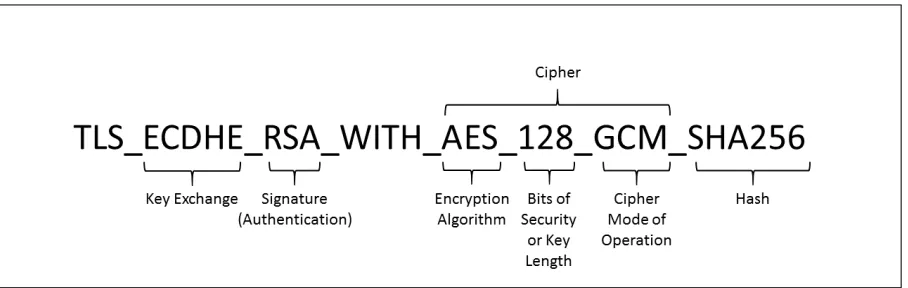
phases [79]. . . 7 2.2 A TLS cipher suite. An example cipher suite supported by Chrome 57. . . 8 2.3 Diffie-Hellman Key Exchange. The finite field Diffie-Hellman key exchange
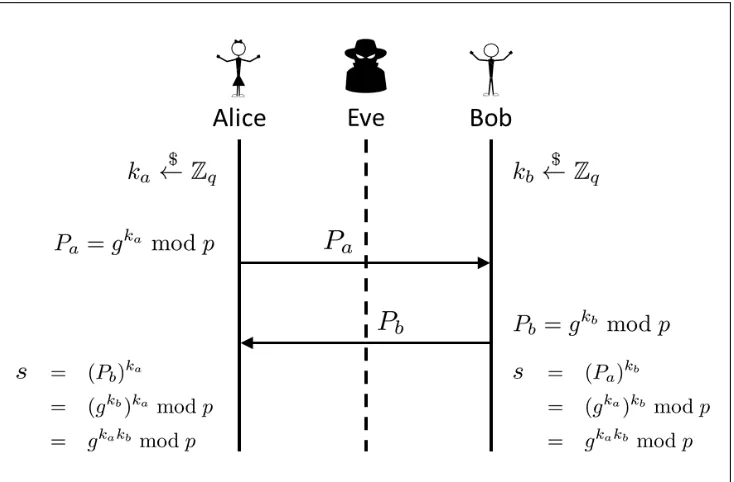
involves two parties exchanging public keys and computing a shared secret. . . 18 2.4 Certificate Trust Hierarchy. A chain of trust using Facebook and Twitter as
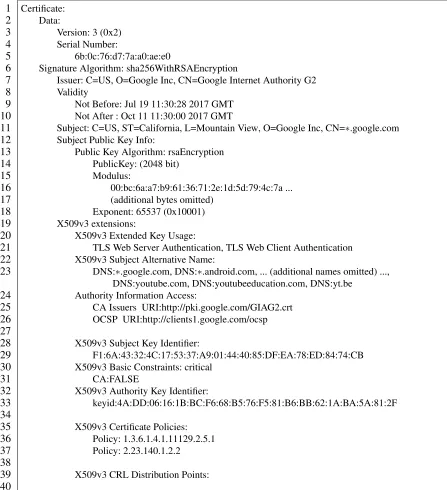
examples. . . 24 2.5 X.509 Certificate. An example X.509 certificate of google.com obtained
using OpenSSL’ss_client. . . 25 3.1 Two-bit Security in TLS. A successful DHE connection in Chrome using a
generator of order 3. During this run the generator happened to equal the public DHE key, indicating the private DHE key was congruent to 1 mod 3. . . 35 4.1 512-bit Modulus Factorization. Factorization of the 512-bit composite
mod-ulus found in SMTP. . . 48 4.2 904-bit Modulus Factorization. Factorization of the 904-bit composite
mod-ulus found in HTTPS. . . 49 4.3 Forcing DHE in TLS. A man-in-the-middle with the ability to exploit weak
or backdoored parameters can force the parties to select a DHE cipher suite against their natural preferences. . . 51 5.1 Name Error Decision Tree.Name mismatch errors were decided based on the
input domain’s structure. . . 70 A.1 License from ISOC. The License section of the copyright form filled out
is displayed. . . 79
List of Tables
3.1 OpenSSHmodulifile. One modulus is a valid safe prime (ostensibly) gener-ated by developers. The other is a smooth composite allowing efficient discrete logarithms. OpenSSH will successfully connect with either. . . 33 4.1 Composite DHE Moduli. The frequency, affected protocols, and other
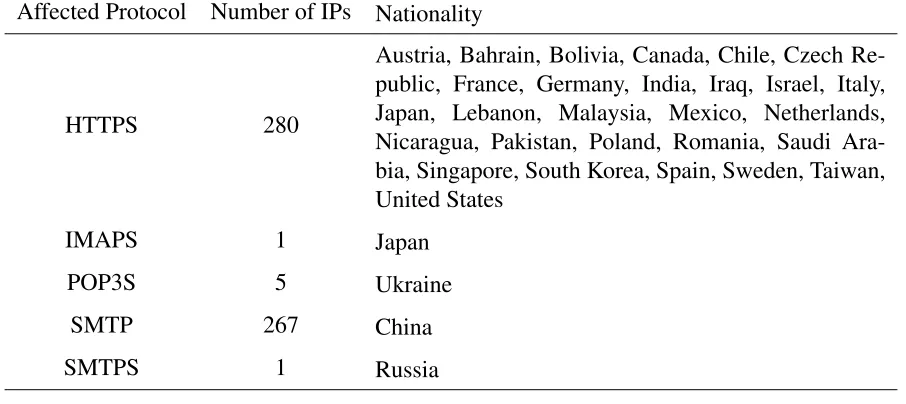
prop-erties of the composite DHE moduli used in the wild. . . 42 4.2 Protocols and Countries. Composite DHE moduli by protocol and country. . . 43 4.3 Web Servers.Types of web servers using composite DHE moduli. . . 45 4.4 Non-Safe Prime DHE Moduli.The distribution and sources of non-safe DHE
moduli. . . 47 5.1 Domains Supporting HTTPS.The percentage of domains supporting HTTPS
from each domain set. . . 63 5.2 Domains With Name Mismatch Errors. The percentage of HTTPS-enabled
domains with a name mismatch error. . . 64 5.3 Name Mismatch Errors Categorization, May 2017 (Base). The percentage
of name mismatch errors from the May 2017 scan of base domains that could be categorized. . . 65 5.4 Name Mismatch Errors Categorization, June 2017 (Base). The percentage
of name mismatch errors from the June 2017 scan of base domains that could be categorized. . . 65 5.5 Name Mismatch Errors Categorization, June 2017 (www). The percentage
of name mismatch errors from the June 2017 scan of www subdomains that could be categorized. . . 66
Appendix A Permission to Reproduce Article Material . . . 79 Appendix B Companies Found in Connection to Name Mismatch Errors . . . 80
List of Abbreviations, Symbols, and
Nomenclature
A1 A1 Telekom Austria
AES Advanced Encryption Standard AWS Amazon Web Services
BCP Banco de Crédito
CA Certification/certificate authority
CDH Computational Diffie-Hellman assumption CDN Content delivery network
CIRA Canadian Internet Registration Authority CN Common name
CNA CVE Numbering Authority
CNRS Centre national de la recherche scientifique CRT Chinese remainder theorem
CVE Common Vulnerabilities and Exposures, and the informal name for a CVE identifier CVSS Common Vulnerability Scoring System
CZDS Centralized Zone Data Service
DDH Decisional Diffie-Hellman assumption DER Deutsche Reisebüro
DL Discrete logarithm
DLP Discrete logarithm problem DN Distinguished name
DNS Domain Name System
DROWN Decrypting RSA using Obsolete and Weakened eNcryption DSA Digital Signature Algorithm
ECDHE Elliptic Curve Diffie-Hellman (ephemeral) ECDSA Elliptic Curve Digital Signature Algorithm FQDN Fully Qualified Domain Name
GCM Galois/Counter Mode
GNFS Generalized number field sieve GPG GNU Privacy Guard
HSTS HTTP Strict Transport Security HTTP Hypertext Transfer Protocol
HTTPS HTTP Secure or HTTP over SSL/TLS IETF Internet Engineering Task Force
IMAP Internet Message Access Protocol IMAPS IMAP Secure or IMAP over SSL/TLS IP address Internet Protocol address
IPSec Internet Protocol Security IPv4 Internet Protocol version 4 LAN Local area network
MAC Message authentication code
MITM Man-in-the-middle MODP Modular Exponential
NIST National Institute of Standards and Technology NS Nederlandse Spoorwegen
NVD U.S. National Vulnerability Database OSI Open Systems Interconnection PGP Pretty Good Privacy
PKI Public-key infrastructure
POODLE Padding Oracle On Downgraded Legacy Encryption POP Post Office Protocol
POP3 Post Office Protocol (version 3)
POP3S POP3 Secure or POP3 over SSL/TLS PRF Pseudorandom function
PRNG Pseudorandom number generator RFC Request for Comments
RSA Rivest-Shamir-Adleman cryptosystem SAN Subject alternative name
SCU Santa Clara University SHA-2 Secure Hash Algorithm 2 SMTP Simple Mail Transfer Protocol
SMTPS SMTP Secure or SMTP over SSL/TLS SNI Server Name Indication
SSH Secure Shell
SSL Secure Sockets Layer
TCP Transmission Control Protocol TLD Top-Level Domain
TLS Transport Layer Security
UNED Universidad Nacional de Educación a Distancia UPS United Parcel Service
VPN Virtual Private Network WPA2 Wi-Fi Protected Access II
XMPP Extensible Messaging and Presence Protocol
Chapter 1
Introduction
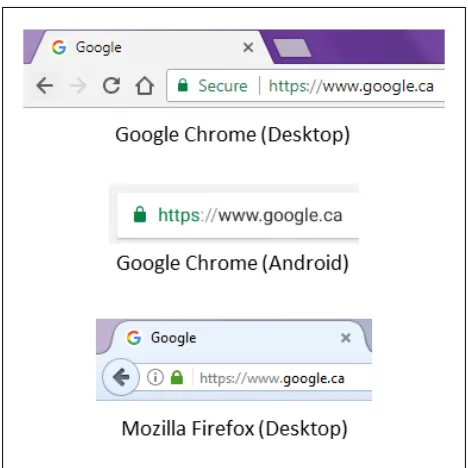
Simply put, if you use the Internet, you have used Transport Layer Security (TLS). The green padlock icon (Figure 1.1) displayed in the browser on your desktop or cellphone shows that TLS is used by that website. Most users unknowingly entrust TLS to secure services such as online banking, email, and internet voting – without it, an attacker can see your banking information, obtain your email passwords, or see who you voted for in an online election. New vulnerabilities such as Logjam [8] and DROWN (Decrypting RSA using Obsolete and Weakened eNcryption) [12] are routinely discovered that could undermine the security of those systems.
Figure 1.1: The Green Padlock Icon.Examples of the green padlock for Google Chrome and Mozilla Firefox.
also provide insight into the less travelled corners of the Internet. In the last few years, Internet-wide scanning has become easier and more popular with application-layer scanners such as ZGrab [36]. With this wealth of data, there are aspects of current TLS deployment that remain uninvestigated. This thesis demonstrates a new vulnerability in the implementation of TLS and additionally presents a survey of a well-known TLS misconfiguration.
1.1
Motivation
TLS is mature and makes excellent use of cryptography to provide security, but implementa-tions of TLS are open to interpretation which can introduce vulnerabilities [8, 12, 81, 38]. This work aims to make TLS implementations more secure: we demonstrate that it only takes one weak spot for an entire implementation to become vulnerable, and we encourage implementa-tions to follow best practices even when an attack is not immediately evident.
1.2
Contributions
This thesis makes five contributions to the study of TLS implementations, of which the first four were published at the 2017 Network and Distributed System Security Symposium [35]:
1. We outline a method for mathematically constructing a backdoor that remains deniable while exploiting poor parameter validation in discrete logarithm implementations. 2. We conducted an Internet-wide survey of ephemeral Diffie-Hellman (DHE) support,
un-covering hundreds of TLS- and STARTTLS-enabled web and mail servers using com-posite moduli. These potentially backdoored parameters were found across a range of protocols – including HTTPS, SMTP, SMTPS, IMAPS, and POP3S – and spanned over 30 countries and a diverse set of organizations. In some cases, we were able to recover large portions of the private DHE key. We additionally found 1.6 million servers offering non-safe prime groups of unknown order.
1.3. ORGANIZATION OFTHESIS 3 4. We disclosed the potentially backdoored parameters to 17 companies, resulting in a pub-lic security advisory (CVE-2016-5774) and conference calls with the CTO of a billion-dollar company. The organizations we spoke to declined to explain how composite mod-uli came to be used in their DHE configurations.
5. We conducted an Internet-wide survey of X.509 certificates invalidated by name mis-match errors, uncovering approximately 70 million websites with this error. We catego-rized these errors and determined that web hosting or content delivery network (CDN) companies were the most common cause. We additionally found over 1000 websites with this error that forced HTTPS use, making their websites inaccessible.
1.3
Organization of Thesis
The remainder of this thesis is organized into five chapters:
• Chapter 2 details the Transport Layer Security (TLS) protocol and its uses. It further discusses two aspects of TLS: the finite field Diffie-Hellman key exchange in terms of its purpose, cryptographic operations, and methodology; and X.509 certificates in terms of their purpose, trust hierarchy, structure, and invalidating errors.
• Chapter 3outlines and demonstrates the lack of parameter validation found in discrete logarithm implementations, and explains the construction of a backdoor that exploits this weakness.
• Chapter 4 describes an Internet-wide survey into potentially backdoored parameters across TLS and STARTTLS; presents a man-in-the-middle attack to force DHE use, which requires an attacker to first position the backdoor through attack vectors we de-scribe; and details vulnerability disclosures.
• Chapter 5describes an Internet-wide survey into certificate-invalidating name mismatch errors, and outlines the impact of these errors on websites that force HTTPS use.
Background
A version of § 2.4.4 has been published as part of [35].
2.1
Network Security
When considering the security of communications over a network, the network can be concep-tualized as layers that are secured separately [80, 67]. There are seven layers defined by the Open Systems Interconnection (OSI) model: physical (the lowest layer), data link, network,
transport, session, presentation, andapplication. Security requirements differ across layers, meaning only some layers have security protocols and those protocols vary. For example, in the data link layer, a wireless local area network (LAN) such as Wi-Fi can be secured through the Wi-Fi Protected Access II (WPA2) protocol. In the network layer, a Virtual Private Network (VPN) can be secured through Internet Protocol Security (IPSec). In the transport layer, which provides end-to-end communication between applications on network-connected hosts, a pro-tocol such as the Transmission Control Propro-tocol (TCP) can be secured with confidentiality, integrity, and authenticity through Transport Layer Security (TLS).
2.2
Transport Layer Security
In this section, we discuss the goals, subprotocols, and applications of Transport Layer Security (TLS) protocol.
2.2.1
What is Transport Layer Security?
The Transport Layer Security (TLS) protocol is a cryptographic protocol used to secure com-munication at the transport layer of a network. TLS 1.2 [33] was finalized in 2008, and TLS
2.2. TRANSPORT LAYERSECURITY 5 1.3 [72] is currently a draft. TLS provides a security and proficiency upgrade to the Secure Sockets Layer (SSL), which had its final version SSL 3.0 deprecated in 2015 [15] after crit-ical security vulnerabilities were discovered. For example, the fix for the POODLE attack (Padding Oracle On Downgraded Legacy Encryption) [64] required extensions, which are only possible in TLS 1.0 and above. Despite this, SSL 3.0 is still used in a few HTTPS connections today [52].
Goals of TLS. RFC 5426 [33] specifies four goals for TLS in order of importance: crypto-graphic security for connections, interoperability between different applications, extensibility for future expansions, and relative efficiency for cryptographic operations. Expanding the first goal, TLS is intended to secure communicating applications by supplying confidentiality, in-tegrity, and authenticity to the connection. Confidentiality is provided through encryption, and protects against eavesdropping and also data theft from either server or client. Integrity is pro-vided through message authentication codes, and protects against data, memory, and message traffic modification. Finally, authenticity is provided through digital signatures, certificates, and public key cryptography. It protects against impersonation and data forgery [79].
Uses of TLS. TLS is placed above the transport layer, but does not fit neatly into an OSI model layer. It can therefore be used with any application protocol. Common application protocols used include Hypertext Transfer Protocol (HTTP) for communicating on the World Wide Web; Simple Mail Transfer Protocol (SMTP) for transmitting email; Internet Message Access Protocol (IMAP) and Post Office Protocol (POP) for retrieving email; and Extensible Messaging and Presence Protocol (XMPP) for instant messaging [78]. These protocols are discussed further in § 2.2.4. The freedom to choose application protocols means that their TLS implementations are not specified, enabling different interpretations and providing openings for vulnerable configurations. The remainder of § 2.2 discusses the inner workings of TLS to provide context for the vulnerability discussions in Chapter 4 and Chapter 5.
Layers of TLS. There are two layers to TLS: the TLS Record Protocol, and the TLS Hand-shake Protocol which also contains subprotocols. The first layer is the TLS Record Protocol, placed above the transport layer. The TLS Record Protocol takes higher-layer data that needs to be transmitted, divides it into blocks, and potentially compresses the data. A message au-thentication code (MAC – not to be confused with a Media Access Control address) is then added to the record, followed by encrypting the data based on the previously negotiated cipher and sending the final product to the transport layer [33].
It has three subprotocols: the Change Cipher Spec Protocol, used for changing previously ne-gotiated ciphers during the handshake; the Alert Protocol, used for sending warning messages as information or fatal messages to terminate the connection; and the Handshake Protocol. The Handshake Protocol is used by a client, such as a browser, and a server to determine cryp-tographic keys that enable secure communication between the parties. For simplicity, further references to the Handshake Protocol refer to the subprotocol.
2.2.2
TLS Handshake Protocol
Handshake Types. In general, there are three types of the TLS Handshake: abbreviated handshake, and full handshake with or without client authentication [76]. The abbreviated handshake is the most common method, and is done when resuming a session created from a previous full handshake. The main advantage to abbreviating a handshake using already negotiated security parameters is the computational cost reduction. The full handshake can be seen with client authentication if the server has been successfully authenticated. However, client authentication is not often done; instead, a client is usually authenticated through a user-name and password [44]. This section expands upon the full handshake with optional client authentication for completeness.
Overview of Full Handshake. The full TLS Handshake consists ofHellomessages; cer-tificate requests, receipts, and verifications; key exchanges; and Finished messages [33]. The handshake sequence, illustrated in Figure 2.1, consists of a maximum of eleven messages in specific order: client hello, server hello, server certificate, server key exchange, certificate request, server hello done, client certificate, client key exchange, certificate verify, client fin-ished, and server finished. The Change Cipher Spec messages are part of the Change Cipher Spec Protocol, not the Handshake Protocol, but their placement is related to the handshake sequence as explained in § 2.2.3.
2.2.3
TLS Handshake Messages
(1) Client Hello. To initiate a TLS connection, the client sends a ClientHello to the server. We focus on four important aspects of theClientHello:
A. List of supported cipher suites. A cipher suite in TLS 1.2 and below, seen in Figure 2.2, defines the algorithms used in the rest of the handshake:
2.2. TRANSPORT LAYERSECURITY 7
Figure 2.1: The TLS Handshake. The TLS Handshake Protocol can be broken into four phases [79].
by Galois/Counter Mode (GCM), for security and efficiency respectively. ii. Key Exchange. A client and server exchange keys that are later used to derive
the encryption and message authentication code (MAC) keys for the connec-tion. Key exchange is described later in this secconnec-tion.
iii. Authentication/Signature. Public keys exchanged may be signed to prove their authenticity, depending on the key exchange method. Signature verifica-tion is confirmed through certificates.
B. Random bytes. The included random bytes (ClientHello.random) are used later during key generation to produce unique encryption and authentication keys for the TLS connection. Some of these bytes are epoch time – the number of seconds since January 1, 1970. Unique keys are needed to prevent replay attacks, where an attacker saves data from a previous connection and resends it to one party, producing a valid connection.
C. TLS version. The client includes its desired TLS version in theClientHello, which is the highest version it supports.
D. Session identifier.The session identifier is used if reusing security parameters from a previous session (see abbreviated handshake from § 2.2.2).
Figure 2.2:A TLS cipher suite. An example cipher suite supported by Chrome 57. (2) Server Hello. After the ClientHello, the server must respond with its
Server-Hello. It is structured similar to the ClientHello; for example, it also contains
random bytesServerHello.random. However, in general theServerHello con-tains the server’s selections rather than options. For example, the server usually picks its most preferred cipher suite that the client also supports.
2.2. TRANSPORT LAYERSECURITY 9 Privacy (PGP). X.509 certificates are explained further in § 2.5. Among other fields, these certificates contain the server’s public key, which is used for server authentication through encryption or signature verification depending on the key exchange algorithm. (4) Server Key Exchange. A server’s certificate chain, or theServerHelloif no
Cer-tificate message was sent, is typically followed by the ServerKeyExchange.
This message is required if the client needs additional information to generate the pre-master secret. The prepre-master secret is explained later in theClientKeyExchange. Key exchange finishes server authentication that started with the server’s certificate. Key exchange algorithms requiring ServerKeyExchange include ephemeral finite field Diffie-Hellman (DHE) and ephemeral Elliptic Curve Diffie-Hellman (ECDHE) [23], where ephemeral means the DHE/ECDHE keys are used only once. Using Rivest-Shamir-Adleman (RSA) or fixed/static Diffie-Hellman for key exchange does not re-quire aServerKeyExchangemessage since the client obtains the public parameters needed for premaster secret generation from the server’s certificate [67]. For RSA, server authentication is finished by encrypting the premaster secret with the server’s public key from its certificate – the server is authenticated since it must use the corresponding pri-vate key to decrypt.
Definition. (Ephemeral.) A key is ephemeral if it is used only once.
If aServerKeyExchangemessage is sent, it contains the DHE or ECDHE
parame-ters (see § 2.4) along with a signature of those parameparame-ters. The server creates the signa-ture by hashing the parameters with theClientHelloandServerHellorandoms, then encrypting the hash with the private key that matches the public key on the server’s certificate. The client uses that public key, previously obtained through the server’s cer-tificate, to verify the signature – the server is authenticated since it must have used the corresponding private key to sign the parameters.
(5) Certificate Request.This step is the first in client authentication, which is not frequently done in the TLS handshake. Client authentication is different than server authentication; it still depends upon certificates but signs previously exchanged messages instead of key exchange parameters. Client authentication is expanded upon in the client’s
Cer-tificate and CertificateVerify. A server previously authenticated with its
certificate and key exchange can send aCertificateRequestto the client after the
ServerKeyExchange. If there was noServerKeyExchange, this message is sent
(6) Server Hello Done. A server must send an empty ServerHelloDone message to inform the client that it has sent all of its handshake messages. It does not respond again until it is time for itsFinished message. After receiving theServerHelloDone, the client should check the acceptability of theServerHellomessage and the validity of the server’s certificate chain if one exists.
(7) Client Certificate. This is the second step in client authentication, and therefore it is not often done. If the server has previously sent aCertificateRequest, the client must respond with a Certificate message. A server may choose to continue the handshake even if the Certificate message contains no certificates. The client’s
Certificatemessage follows the same format as the server’sCertificate
mes-sage – one of its fields is the client’s public key, used in client authentication. This message must also be compatible with the specifications outlined in the server’s
Cer-tificateRequest.
(8) Client Key Exchange. A client’s certificate chain, or the ServerHelloDone if no
Certificate message was sent, must be followed by theClientKeyExchange.
This message ensures both parties have the premaster secret pre_master_secret, although the exact message depends on the key exchange algorithm. For example, with DHE or ECDHE key exchange, the client sends its public DHE or ECDHE parameters so that the server can compute the premaster secret. In RSA key exchange, the client computes the premaster secret itself and sends it to the server after encrypting it with the public key from the server’s certificate.
The premaster secret with the addition of the random bytes from the ClientHello
andServerHelloare used to generate the 48-byte master secret [33]:
master_secret = PRF(pre_master_secret, "master secret", ClientHello.random + ServerHello.random)
The master secretmaster_secretthen generates the key block [33]:
key_block = PRF(master_secret, "key expansion", ServerHello.random + ClientHello.random);
2.2. TRANSPORT LAYERSECURITY 11 (9) Certificate Verify. This is the last step in client authentication, and as such it is not often done. If a client has sent a certificate with signing capabilities, it must complete its authentication to the server with a CertificateVerifymessage following the
ClientKeyExchange. Therefore this message must always be sent except when
fixed/static Diffie-Hellman was used for key exchange. The CertificateVerify
message is a signed hash of previously exchanged handshake messages from
Clien-tHelloto beforeCertificateVerify. Similar to server authentication, the server
uses the public key previously obtained through the client’s certificate to verify the sig-nature – the client is authenticated since it must have used the corresponding private key to sign the messages. After this message is received by the server, the parties are ready to exchangeFinishedmessages.
(10) Client Finished. Before the client sends itsFinished message, it sends a
Change-CipherSpecmessage that is part of the Change Cipher Spec Protocol. This message
indicates that the client has enough information use an encrypted connection with its generated keys. The client then sends its Finished message which is secured with the previously negotiated algorithms. TheFinished message is a hash of all previ-ously exchanged messages from theClientHello to before the client’sFinished
message. It verifies that the key exchange and authentication(s) were done properly. (11) Server Finished. After verifying the client’s Finished message, the server sends a
ChangeCipherSpecmessage similar to the client. It then sends its ownFinished
message, which is of the same format as the client’s except that the hash also includes the client’sFinishedmessage. After the client has verified the server’s message, the two parties can now exchange application data.
2.2.4
Applications of TLS
As mentioned in § 2.2.1, common application protocols protected by TLS include the Hy-pertext Transfer Protocol (HTTP), Simple Mail Transfer Protocol (SMTP), Internet Message Access Protocol (IMAP), and Post Office Protocol (POP). The application of TLS with these protocols is explained further in this section.
An example use of HTTPS is to secure password transmission on login pages, and in fact some websites drop the HTTPS connection for HTTP after this user authentication. More gen-erally, many websites simply do not use HTTPS. Since HTTP communicates information over unencrypted channels, an attacker can easily view information passed along the connection. By contrast, an attacker wanting information from a site secured with HTTPS needs to con-duct a man-in-the-middle (MITM) attack to gain information about or modify the connection. One such attack is HTTPS stripping [60], which can be prevented by forcing HTTPS-only use through HTTP Strict Transport Security (HSTS).
HSTS. HTTP Strict Transport Security (HSTS) [50] is a mechanism introduced recently that allows websites to specify that they should only be accessed through HTTPS. Two important attacks that HSTS prevents are HTTPS stripping [60] and attacks using invalid certificates, by forcing HTTPS use and disabling user circumvention respectively. HSTS can be implemented in two ways: setting the Strict-Transport-Security header in the HTTP response (activates when the website is accessed over HTTPS), or submitting the website to a HSTS preload list. Chrome has a HSTS preload list, and many major browsers such as Firefox have HSTS preload lists adapted from it [76].
SMTP and SMTPS. The Simple Mail Transfer Protocol (SMTP) is used for transmitting email from the email sender to its final server destination. SMTP can use TLS directly, called SMTP Secure or SMTP over SSL/TLS (SMTPS), or through the STARTTLS extension [51]. STARTTLS upgrades an existing connection to be secure over TLS, and so works over the same port as the unsecured protocol. By contrast, the protocol over TLS is used over a separate encrypted port.
IMAP/S and POP3/S. Both the Internet Message Access Protocol (IMAP) and Post Office Protocol version 3 (POP3) are used by email clients to retrieve email from an email server [79]. Similar to SMTP, either can use TLS directly (IMAPS and POP3S) or through the STARTTLS extension.
2.3
Secure Shell
2.4. DIFFIE-HELLMAN 13 commonly used to secure HTTP while SSH is known for securing remote logins. Most impor-tantly for this discussion, SSH can use Diffie-Hellman for key exchange [87] similar to TLS. A major implementation of SSH is OpenSSH,1which we discuss briefly in § 4.4.2.
2.4
Diffie-Hellman
The current primary key exchange algorithm used in TLS is ephemeral Diffie-Hellman over fi-nite fields (DHE) or elliptic curves (ECDHE). We say Diffie-Hellman is used over fifi-nite fields to distinguish it from elliptic curves; this terminology is widely used [8, 13, 42, 45]. At the time of writing, telemetry data shows that three key exchange methods are used in TLS handshakes: ECDHE accounts for 90-92%, RSA for 8-9%, and DHE for 0.01-1% [65]. Despite this, we show in § 4.2.2 that DHE is still widely supported; for example in HTTPS, DHE cipher suites were supported by 25% of servers. This section discusses the need for key exchange algo-rithms, the cryptography behind finite field Diffie-Hellman key exchange, and the related work in this area.
2.4.1
Public-Key Key Exchange
In § 2.2.3, the concept of key exchange was introduced as a step in the TLS handshake. It was assumed in that section that if a client and server wanted to communicate, they could securely transmit the keys needed to do so. In reality, during the TLS handshake the client and server are communicating over an insecure network, yet need a secure way to transfer keys.
The two types of key cryptography used in TLS are symmetric-key cryptography and public-key cryptography (also known as asymmetric-key cryptography). Symmetric-key cryp-tography is frequently used in encryption, where it uses the same key for encrypting plaintext (i.e. unencrypted information) and decrypting ciphertext (i.e. encrypted information). In TLS, symmetric keys are used for encryption/decryption and MACs; for example, the AES encryp-tion scheme uses symmetric-key cryptography. Unfortunately, symmetric-key cryptography does not solve the problem of first having to securely communicate the key between parties, which is why in TLS symmetric keys are only used internally by the client and server.
The secure key transfer problem of symmetric-key cryptography is why public-key cryp-tography was invented. Before public-key crypcryp-tography, transferring keys securely was done by physical methods such as face-to-face meetings. This method had its own problems such as potential key loss or tampering en route. A secure key transfer method was needed, one which
allowed two parties to compute a shared secret such that no observer of the transfer could re-cover the shared secret. Each party has a different key pair: a public key (able to be exchanged over an insecure channel) and a private key (kept secret).
Definition. (Key pair.) A key pair, used in public-key key exchange, consists of a public key that can be exchanged over an insecure channel and a private key that is known only to the party who generated it.
The shared secret is computed separately by both parties using their own private key and the other’s public key. Diffie and Hellman were the first to publicly propose such a method [34], and it was considered a major advance in secure communication since entities who had never met could now communicate securely. Their public-key key exchange protocol is called the Diffie-Hellman key exchange. The cryptography behind the Diffie-Hellman key exchange is discussed in § 2.4.2, and the actual protocol is discussed in § 2.4.3.
2.4.2
Cryptography
The cryptography behind the finite field Diffie-Hellman key exchange is discussed in this sec-tion.
Groups. A group {G,∗} is a set of elements G such that a pair of elements (a,b) can be combined to form another element (a∗b)through a binary operation, ∗, such as addition or multiplication [63]. For the purposes of this discussion, multiplication is the most relevant binary operation. The groupGneeds to have four properties:
• Closure. For any two elements a,b in G, G must also contain the combined element
(a∗b).
• Associative. For any three elements a,b,c in G, combining two of the elements with the remaining element should always produce the same result. For example,a∗(b∗c) = (a∗b)∗c.
• Existence of Identity Element. Gincludes an identity elemente, which for multiplica-tion of real numbers is 1. When combining the identity element with any other element, it always equals the second element. For example,a∗e=e∗a=a.
• Existence of Inverse Element. Each elementainGhas a corresponding inverse element
a−1. When the two are combined, the result is the identity element e. For example,
2.4. DIFFIE-HELLMAN 15 The groupGis considered an abelian group if it has an additional property:
• Commutative.For any two elementsa,binG, combining the two elements in a different order should not change the result. For example,a∗b=b∗a.
Abelian groups are important to the definition of a field, where fields are fundamental to dis-crete logarithms and therefore Diffie-Hellman. A field F is a set of elements with binary operations of addition – under which F forms an abelian group – and multiplication, among other properties. For the purposes of this discussion, multiplication is the most relevant binary operation; under multiplication, the non-zero elements of the field form an abelian group [79]. A finite field possesses an order equal to the finite number of elements in it, so finite fields are more useful in cryptography than infinite fields. This order must equal pn, wherenis the positive integer that a prime pis raised to. This discussion is restricted to the case ofn=1, or a finite field with order p. This type of field is the set of integersZp={0,1, ...,p−1}, where
the elements can be multiplied modulo p. A similar field can be defined for other primes; for example, with primeq there existsZq={0,1, ...,q−1}. All integers in Zpexcept 0 are
rel-atively prime to p, since the only common positive integer factor between pand each integer is 1. This property means that a multiplicative inverse exists for every integer inZpexcept 0.
This set of invertible elements is Z∗p={1, ...,p−1}, also called the multiplicative group of numbers modulo p. It is used to define a cyclic groupGq.
Cyclic Groups. A cyclic group is an abelian groupGwhere there exists an element ginG, i.e. g∈G, such that for all elements a∈G there exists an integer i such that gi=a where
gi=g∗g∗...∗g i-times. The elementgis called a generator because repeated applications of the binary operation toggenerate the set of elements. The finite cyclic groupGqof orderqis
a subgroup ofZ∗p, meaning it has only some of the elements from Z∗p. Ifqis prime, then all
elements ofGqare generators. In general, p=rq+1 whereris an integer andqis also prime.
If pis a safe prime, this means thatr=2 so p=2q+1.
Definition. (Safe prime.) A safe prime, ps, is a prime of the form ps=2q+1, whereqis also
prime.
Definition. (Safe prime group.) A safe prime group, Gq, is the q-order subgroup of Z∗ps (the
multiplicative group of numbers modulops), where psis a safe prime of the formps=2q+1.
Definition. (Non-safe prime.) A non-safe prime,pn, is any prime that is not a safe prime.
Definition. (Composite.) A composite number,n, is any positive integer that is not prime. The elements inGqare generated by the generatorg, which is also a group element. Not every
group element is a generator; an element is only a generator if using the binary operation, ∗, on itself repeatedly generates all group elements.
Definition. (Generator.) A generator, g, generates the q-order subgroup Gq if the subgroup Gq={g,g2,g3, ...,gq}, wheregq=g0=1.
The concepts of generators, moduli, andGqare used to shape the discrete logarithm problem.
Discrete Logarithms over Finite Fields. The discrete logarithm (DL) of an element a of
Gq is defined as k where a=gk mod p. The discrete logarithm problem (DLP) is therefore
attempting to solve fork, given a modulus p and generator gof Gq which has an element a
and orderq. The DLP is computationally hard when the order qis large and is not smooth, meaning it cannot be factored into smaller primes.
Definition. (Discrete logarithm problem.) The discrete logarithm problem (DLP) involves attempting to solve fork, wherea=gk mod pfor a prime,p, and a generator,g, of theq-order subgroupGqwhich has an element,a.
Definition. (Smooth number.) Ab-smooth number,sn, is an integer that can be factored into a sequence of primes such thatsn= p1p2...pn, where pi≤b for some boundb. Informally,
the term “smooth” number is used to describe a “small” b. In this thesis, we meanbis small enough such that solving the discrete logarithm in subgroups of order pi≤bis efficient. The current recommended key lengths by the National Institute of Standards and Technology (NIST) are|p|≥2048 bits and|q|≥224 bits [14]. The hardness of the DLP makes it the basis for DL implementations such as the Diffie-Hellman key exchange.
2.4.3
Diffie-Hellman Key Exchange
2.4. DIFFIE-HELLMAN 17
Attacker Definitions. We have used the term “attacker” briefly, but the remainder of this chapter along with Chapters 3 and 4 require more specific definitions of “attacker”. We take three attacker definitions used in cryptography:
• Eve: Eve is a passive attacker/eavesdropper, who is able to listen to communicated mes-sages but is unable to change them;
• Mallory: Mallory is a malicious and active attacker who can change communicated messages;
• Heidi: Heidi is a malicious designer of cryptography parameters [42]. We additionally use Heidi to choose attack targets for installing her designed parameters.
These attacker names are used throughout this work.
Finite Field Diffie-Hellman Key Exchange. The finite field Diffie-Hellman key exchange is outlined in Figure 2.3. It starts with two users Alice (A) and Bob (B), who in TLS would be the client and server. An eavesdropper, Eve (E), can see any public parameters communicated between Alice and Bob. Alice and Bob agree upon a generatorgofGqand a modulus p, where
their choices should ensure that the DLP is hard. These choices are called Diffie-Hellman domain parameters.
Definition. (Diffie-Hellman domain parameters.) Diffie-Hellman domain parameters (or sim-ply DHE parameters) are modulus p(should be prime) and generatorgof aq-order subgroup
Gq.
We use the notationa←−$ Sto denote a value asampled uniformly at random from setS. The parties independently choose a random integer from Zq, i.e. ka
$
←−Zq andkb $
←−Zq for Alice
and Bob respectively, where ka is known only to Alice and kb is known only to Bob. These integers act as the private DHE keys in the exchange. Alice then calculates her public DHE key:
Pa = gka mod p.
Bob does a similar process to calculate his public DHE key:
Pa is sent to Bob andPb is sent to Alice. Now that both parties have the other’s public DHE key, they can compute the Diffie-Hellman shared secret,s. Alice computess:
s = (Pb)ka
= (gkb)ka mod p
= gkakb mod p.
Bob computessindependently of Alice:
s = (Pa)kb
= (gka)kb mod p
= gkakb mod p.
Both parties end up with the same shared secret. This result is possible due to the commutative property discussed in § 2.4.2. Although Eve is able to see p,g,Pa,andPb, she cannot calculate
sif the DLP is hard. The Diffie-Hellman shared secret becomes the premaster secret used in the TLS key generation (see § 2.2.3).
Figure 2.3: Diffie-Hellman Key Exchange. The finite field Diffie-Hellman key exchange involves two parties exchanging public keys and computing a shared secret.
2.4. DIFFIE-HELLMAN 19 chosen Diffie-Hellman domain parameters should satisfy these assumptions, ensuring the key exchange is theoretically secure.
Definition. (Computational Diffie-Hellman (CDH) assumption.) The CDH assumption states that given a random set of Diffie-Hellman domain parametershp,q,giforming Gq, and
ele-mentshga,gbiinGq, it is computationally intractable to findgab.
Definition. (Decisional Diffie-Hellman (DDH) assumption.) The DDH assumption states that given given a random set of Diffie-Hellman domain parametershp,q,giformingGq, and
ele-mentshga,gb,gciinGq, it is computationally intractable to recognize a difference betweengab
andgc.
Backdoors. A backdoor is a way to bypass security mechanisms, such as encryption and authentication from a cryptosystem. Although it can refer to a bypass installed for legitimate reasons such as troubleshooting, it is more often secretly exploited or installed by malicious designer Heidi. For the purposes of this work, a backdoor refers to amaliciously installed back-door. We discuss creating, finding, and installing backdoors in Diffie-Hellman in Chapters 3 and 4.
2.4.4
Related Work
Inadequate DHE Parameter Validation. As mentioned in § 2.4.2, the discrete logarithm problem is hard for subgroups that are sufficiently large and not smooth. Not following these guidelines results in insecure implementations, which has been known for decades [59, 11, 82]. Despite this, many popular discrete logarithm implementations do little or no parameter valida-tion, which will be discussed further in § 3.2. Valenta et al. [81] published work independently but concurrently to our paper [35], and it contained many similar results about the weak Diffie-Hellman parameters used in HTTPS and other protocols. Whereas our paper focuses on the possibility of backdoors stemming from small subgroups of hidden order, their work focuses on how the lack of parameter checking can be exploited in the context of Digital Signature Algorithm (DSA) style groups.
Diffie-Hellman parameters as Diffie-Hellman parameters. Despite recovering the premaster secret, this attack is very limited as explicit Elliptic Curve Diffie-Hellman curves are not sup-ported in the majority of TLS implementations due to their open-source nature.
Backdoors Based on Subgroups of Smooth Order. Our work with Diffie-Hellman dis-cusses the possible existence of backdoor discrete logarithm groups (see § 4.2 and § 4.3). Henry and Goldberg [49] solved the discrete logarithm in some smooth order groups using a parallelized implementation of the Pollard’s rho algorithm [70], and concluded that their im-plementation could be used to create a backdoor DL group.
In addition to Valenta et al. [81], Wong [85] recently published concurrent but independent work to us. Wong found composite DHE moduli over HTTPS in the wild, but our work reports on considerably more moduli across a wider range of protocols. In addition, the exploitation by Wong required both the client and server to prefer a DHE cipher suite, which limits the attack potential since current telemetry data [65] indicates DHE key exchanges account for at most 1% of TLS handshakes. In § 4.4.1 we describe how an attacker can exploit backdoored parameters to force a DHE cipher suite to be selected if both parties support it. Additionally we explain how one of Wong’s backdoor constructions could be reversed in less operations than he expected. We also conducted a number of vulnerability disclosures and discuss vendor responses in § 4.6.
Backdoors Based on Number Field Sieves. In addition to work on backdoors based on smooth order subgroups, there has also been work on backdoors based on number field sieves. Lenstra [56] and Gordon [46] observed that even if it was established that a particular group had a sufficiently large prime order and that all relevant values were members of the group, it is not necessarily sufficient to ensure the hardness of the discrete logarithm problem if pwas maliciously chosen to be “nice” in the context of the generalized number field sieve. Here, a backdoored prime modulus could be constructed using a polynomial of low-degree and con-strained coefficients for the purposes of greatly accelerating the sieving and descent steps of a generalized number field sieve (GNFS). Given only p, a verifier would need to deduce this polynomial in order to establish the existence of a backdoor. This approach to building back-doored Diffie-Hellman parameters was previously considered too computationally intensive to perform in practice.
2.5. X.509 V3 CERTIFICATES 21 private DHE keys from export strength (512-bit) groups.
2.5
X.509 v3 Certificates
As mentioned in § 2.2.3, X.509 v3 certificates are used for server authentication in TLS. This section discusses the need for certificates, the trust hierarchy of certificate chains, certificate generation and issuance, fields and extensions in a certificate, and the related work in this area.
2.5.1
The Need for Certificates
MITM Attacks on Diffie-Hellman. In § 2.4.3, we outlined how Diffie-Hellman key ex-change could be used to securely compute a shared secret between parties Alice and Bob. It was assumed in that section that an eavesdropper, Eve, could not calculate the shared secret if the DLP was hard. However, that scenario does not stop Eve from establishing a Diffie-Hellman key exchange with both Alice and Bob.
First, Eve would intercept Alice’s attempt to set up a key exchange with Bob, and complete a Diffie-Hellman key exchange with Alice such that their shared secret issae. Eve would then initiate a Diffie-Hellman key exchange with Bob such that their shared secret is sbe. Since a shared secret is the basis for secure communication, Eve can now intercept Alice’s messages to Bob, undo the security withsae, then redo the security withsbebefore forwarding the messages to Bob. The same idea applies with Bob’s messages to Alice. To prevent this MITM attack from happening, DHE parameters need to be signed as mentioned in § 2.2.3.
Digital Signatures. In § 2.2.3, we explained that DHE parameters are signed with the server’s private key (corresponding to the public key on the server’s certificate) before they are sent to the client. A digital signature scheme consists of three parts:
1. Key Generation. Key generation involves randomly generating a key pair (private signing key and associated public verification key). In TLS, the server is the one to generate a key pair.
2. Signing Algorithm. The message to be signed is hashed. The hash value is given to the signature algorithm along with the private signing key to produce a digital signature. In TLS with Diffie-Hellman, the DHE parameters with signature are sent to the client. 3. Signature Verification.The party who receives the signature verifies it with the public
Common signature schemes used in TLS are RSA and the Elliptic Curve Digital Signature Algorithm (ECDSA). While digital signature schemes prevents the MITM attack on Diffie-Hellman described previously, there is still a problem of confirming that the public verification key is from the server. Public-key certificates were created to solve this problem.
Certifying Public Verification Keys. A public-key certificate, or simply certificate, is used to certify the ownership of a public key such as a public verification key. In general, a X.509 v3 certificate [28] consists of a public key and identifying information about the owner of the public key, and it is signed by a trusted third party who issued the certificate [79]. In TLS, the client uses a certificate to attest to the authenticity of the public verification key. This attestation confirms that the key comes from the server, which means the signature and therefore the DHE parameters are also from the server. In the next sections, we discuss X.509 v3 certificates in more detail.
2.5.2
Chain of Trust
Public-Key Infrastructure. In the context of the Internet, X.509 certificates form the basis for a public-key infrastructure (PKI) to securely and efficiently certify public key owners as explained in § 2.5.1. This PKI establishes a trust hierarchy between a trusted third party (a certification/certificate authority, or CA), and an end entity who needs the certificate.
Chain of Trust. In the TLS Handshake, server certificates are typically arranged in a hier-archical chain. This chain of trust is demonstrated in Figure 2.4 using Facebook2 and Twit-ter3 as examples. The italicized names are the common names of each certificate (discussed in § 2.5.3). The trust chain contains three types of certificates:
A. Root Certificate. A certificate chain starts with a certificate from a trusted root CA [17]; clients come already installed with a list of root CAs to trust by default. Certificates from root CAs are aptly called root certificates. The specific list of root certificates trusted de-pends on the browser and operating system. For example, using Chrome on Windows employs the Microsoft root certificate store (shipped with Windows), but using Firefox on Windows employs the Mozilla store (shipped with Firefox). The root certificate store is also called the trust store. Root certificates are self-signed, meaning the certificate is issued by the same authority as its subject. This practice is only acceptable with root
2.5. X.509 V3 CERTIFICATES 23 certificates because they exist at the top of the trust chain and so cannot be signed by another authority [67].
Definition. (Self-signed certificate.) A self-signed certificate is one where the certificate’s issuer is also its subject.
B. Intermediate Certificate. The second part of the certificate chain is one or more in-termediate certificates. An inin-termediate certificate, from an inin-termediate or subordinate CA, is trusted because its issuer is a root CA [67]. The purpose of an intermediate cer-tificate is to decrease the possibility of root cercer-tificate compromise by providing another layer of protection. There may be multiple intermediate certificates in a chain, but the last one is responsible for issuing a certificate to the end entity the requires it.
C. Leaf Certificate. The final certificate in the chain is the leaf, or end-entity, certificate. This certificate is the one issued to the end user or system, which for our purposes is a domain owner. Leaf certificates are discussed further in § 2.5.3.
2.5.3
Certificate Fields and Extensions
This section focuses on the fields and extensions present in X.509 v3 certificates, specifically leaf certificates. An example certificate from google.com, seen in Figure 2.5, is used to illustrate common fields and extensions.
Certificate Fields. X.509 certificate fields outline the basic structure of the certificate. We restrict our discussion to relevant fields.
(1) Version. See line 3 of Figure 2.5. The version field indicates which version of X.509 is used. At the time of writing, this is normally version 3.
(2) Issuer. See line 7 of Figure 2.5. The issuer field contains information about the certifi-cate’s issuer, collectively called the distinguished name (DN) of the issuer [76]. A DN is made up of attributes; common attributes include country, organization, and common name. Common names are explained in the subject field.
Figure 2.4: Certificate Trust Hierarchy. A chain of trust using Facebook and Twitter as examples.
(4) Subject. See line 11 of Figure 2.5. The subject field contains the DN of the certificate’s subject, which is the entity that has the private key that pairs with the public key on the certificate [28]. The subject’s DN contains the same possible attributes as the issuer’s DN.
A relevant attribute for our research is the common name (CN). The common name at-tribute is a Fully Qualified Domain Name (FQDN), which is a complete domain name (i.e. specifies an exact host on the Internet, see § 5.2.1). It can contain a wildcard (see § 5.2.1), meaning FQDN contains an asterisk (*) at the far left [71]. As an exam-ple, the common name*.google.comcoverswww.google.combut does not cover
test.www.google.com. Wildcards are implemented to allow a domain owner to
re-quire less certificates, but can be confusing for a user connecting to a domain that is not exactly specified by the certificate.
2.5. X.509 V3 CERTIFICATES 25
1 Certificate:
2 Data:
3 Version: 3 (0x2)
4 Serial Number:
5 6b:0c:76:d7:7a:a0:ae:e0
6 Signature Algorithm: sha256WithRSAEncryption
7 Issuer: C=US, O=Google Inc, CN=Google Internet Authority G2
8 Validity
9 Not Before: Jul 19 11:30:28 2017 GMT
10 Not After : Oct 11 11:30:00 2017 GMT
11 Subject: C=US, ST=California, L=Mountain View, O=Google Inc, CN=∗.google.com
12 Subject Public Key Info:
13 Public Key Algorithm: rsaEncryption
14 PublicKey: (2048 bit)
15 Modulus:
16 00:bc:6a:a7:b9:61:36:71:2e:1d:5d:79:4c:7a ...
17 (additional bytes omitted)
18 Exponent: 65537 (0x10001)
19 X509v3 extensions:
20 X509v3 Extended Key Usage:
21 TLS Web Server Authentication, TLS Web Client Authentication
22 X509v3 Subject Alternative Name:
23 DNS:∗.google.com, DNS:∗.android.com, ... (additional names omitted) ..., DNS:youtube.com, DNS:youtubeeducation.com, DNS:yt.be
24 Authority Information Access:
25 CA Issuers URI:http://pki.google.com/GIAG2.crt
26 OCSP URI:http://clients1.google.com/ocsp
27
28 X509v3 Subject Key Identifier:
29 F1:6A:43:32:4C:17:53:37:A9:01:44:40:85:DF:EA:78:ED:84:74:CB
30 X509v3 Basic Constraints: critical
31 CA:FALSE
32 X509v3 Authority Key Identifier:
33 keyid:4A:DD:06:16:1B:BC:F6:68:B5:76:F5:81:B6:BB:62:1A:BA:5A:81:2F
34
35 X509v3 Certificate Policies:
36 Policy: 1.3.6.1.4.1.11129.2.5.1
37 Policy: 2.23.140.1.2.2
38
39 X509v3 CRL Distribution Points:
40
41 Full Name:
42 URI:http://pki.google.com/GIAG2.crl
43
44 Signature Algorithm: sha256WithRSAEncryption
45 04:3f:93:00:57:f0:c1:e5:0f:5e:f2:7f:fa:91:d0:30:62:f0 ...
46 (additional bytes omitted)
such as*.example.com.
(5) Subject Public Key Info. See line 12 of Figure 2.5. The public key field contains the public key of the subject and its associated algorithm, along with domain parameters if needed.
Certificate Extensions. X.509 certificate extensions are possible in version 3 certificates, and were created to add more options to the basic structure. We restrict our discussion to relevant extensions.
(1) Subject Alternative Name. See line 22 of Figure 2.5. When a certificate needs to be valid for more domains than the common name specifies, the subject alternative name (SAN) extension is used. In the example above, the certificate forgoogle.comcovers additional domains such asyoutube.com.
Definition. (Subject alternative name.) The subject alternative name (SAN) extension is used in a certificate if it needs to cover more domains than the one(s) specified in the CN.
Server Name Indication. Server Name Indication (SNI) was created since name-based vir-tual hosting allowed for multiple websites at one Internet Protocol (IP) address, but makes use of the HTTP header that happens after the TLS handshake. In the case where multiple HTTPS websites are hosted on a server using one IP address, they must all use one certificate unless SNI is used. SNI is an extension to TLS [39] that is frequently used by browsers to specify the website to connect with before the TLS handshake, which allows a web server to have multiple certificates on one IP address. SNI is now almost universally adopted; a recent study by Content Delivery Network (CDN) provider Akamai4showed that 99% of HTTPS requests over Akamai’s network are done by clients supporting SNI [66].
Certificate Errors. If a user connects to a website and the browser detects a problem with the certificate, the browser will display a certificate error. Generally the user has the option to ignore the error and continue to the website, and recent studies show that between 33% and 56% of users do ignore the warning [10, 41]. If the website uses HSTS, users are not permitted to click through the warning as explained in § 2.2.4.
We focus the discussion on two certificate errors which make the certificate invalid: self-signed certificates and name mismatch errors. Self-self-signed certificates are needed for root cer-tificates (see § 2.5.2), but are not considered valid for leaf cercer-tificates. A name mismatch error
2.5. X.509 V3 CERTIFICATES 27 occurs when the user accesses a website over HTTPS and the website is not covered by the cer-tificate. More specifically, the website must be present in the CN and/or SAN of the certificate, either as an exact match or as a wildcard match.
Definition. (Name mismatch error.) A name mismatch error is one type of error that invalidates a certificate. This error occurs when none of the names in the CN and SAN of the accessed website’s certificate cover that website through an exact or wildcard match.
We now discuss the related work in the area of name mismatch errors.
2.5.4
Related Work
X.509 Certificates from Internet-Wide Scans. Holz et al. [53] conducted various active scans, including of the IPv4 (IP version 4) space, along with passive scans of a research net-work to investigate X.509 certificates in HTTPS. One of their findings was that around 80% of the investigated certificates had name mismatch errors, but did not investigate further beyond a few unusual names in the CN and self-signed certificates. A similar study by Eckersley and Burns [40] had been done the year prior, albeit on a slightly smaller scale. Taking all domains from sets such as .com, .net, .org domains, Risti´c [75] scanned 119 million domains to investi-gate their certificate configurations. However, to narrow the investigation, he did not examine certificates with name mismatch errors.
Over approximately a year, Durumeric et al. [37] conducted 110 scans of the IPv4 space to study the behaviour of CAs, and as a side effect discovered some unusual names in the CN and SAN similar to Holz et al. [53]. More recently, VanderSloot et al. [83] used multiple measurement techniques to create the most comprehensive HTTPS certificate list possible. Their data sets included IPv4 scans and all domains from .com, .net, and .org. They determined that IPv4 scanning alone misses approximately 65% of websites because many sites require SNI.
TLS Configurations from Specific Website Groups. Some recent related work has also focused on narrowed website groups within HTTPS. SSL Pulse5, a follow-up project to Risti´c’s 2010 survey [75], outlines TLS implementation issues for approximately 150 000 popular sites every month. It does not examine name mismatch errors. Kranch et al. [55] found basic errors in many sites’ HSTS implementations, surveying sites on HSTS preload lists and in the Alexa6 Top Million list. Liang et al. [58] investigated sites from the Alexa Top Million list that had ties to one of 20 CDNs, and found many issues with HTTPS implementation by CDNs.
Chapter 3
Diffie-Hellman Backdoors: Mathematical
Construction
A version of this chapter has been published as part of [35].
3.1
Overview
In § 2.4.3, we explained the Diffie-Hellman key exchange is a discrete logarithm implemen-tation, with its security depending on the selection of Diffie-Hellman parameters, hp,q,gi. In § 2.4.2, we clarified that the discrete logarithm problem (DLP) is computationally hard when the orderqis sufficiently large and not smooth. Validating Diffie-Hellman parameters is necessary to ensure DLP hardness; if the DLP is efficient, the Diffie-Hellman key exchange is insecure which undermines the entire security of the TLS connection.
In this chapter, we found that many discrete logarithm implementations perform little or no validation on Diffie-Hellman parameters. We demonstrate this lack of validation by success-fully connecting to implementations using DL, such as Chrome, with optimally weak param-eters (i.e. paramparam-eters for which the DLP is efficient). We then investigated weak paramparam-eters further in the context ofbackdoors: an attacker could construct backdoored Diffie-Hellman pa-rameters so that the DLP is both efficient andappearsto be inefficient. We outline a backdoor construction that would accomplish these goals and contrast it with Wong’s [85] concurrent but independent backdoor proposal.
This chapter contains three sections: the parameter hygiene of discrete logarithm imple-mentations, including poor validation techniques and unnecessary information leaking, is dis-cussed in § 3.2; demonstrations showing poor validation in practice is disdis-cussed in § 3.3; and backdoor constructions are discussed in § 3.4.
3.2
Parameter Hygiene in DL Implementations
In this section, we discuss the poor parameter hygiene found in discrete logarithm (DL) im-plementations, including a lack of validation checking and a tendency to work in a group that breaks the DDH assumption defined in § 2.4.3.
3.2.1
Missing Validation Checks
Verifying the validity of the domain parameters is sufficient to detect the kinds of weakened or backdoored parameters considered by this thesis. However, most of the software implementa-tions we examined skip one or more validity checks:
• Length: Check that|p|and|q|are sufficiently large (i.e.|p|≥2048 bits,|q|≥224 bits as per current NIST guidelines [14]);
• Primality: Check pandqare both prime;1
• Group Order: Check q|(p−1). No mechanism is provided in TLS to communicate group order [32, 72];
• Group Membership: Check any asserted group element (i.e. generator g, public key, etc.) is an elementaof the groupGq. Specifically, check 1<a<p−1 andaqmod p=1.
Note a= p−1 is explicitly excluded by the associated NIST standard [13], since it always only has an order of 2, regardless of the choice of p. Safe prime groups working inZ∗ps can omit the exponentiation by the group size, since all elements 1<a< ps−1 are part of this group.
Most finite-field based DL implementations we examined inherently treat domain parameters as trusted. Many of the necessary checks (e.g. primality, group membership, etc.) are done when the parameters are generated, but at no point thereafter. As an example, recall the digital signature scheme outlined in § 2.5.1 – the OpenSSL implementation of the Digital Signature Algorithm (DSA) does not check parameters during key generation, signing, or verification and we were able to construct accepted universal forgeries with maliciously constructed pa-rameters. This would not pose a problem in most cases since usually the signer is expected to generate their own parameters, but this strategy does not always work out.
One related example arose in OpenSSL when using non-safe prime groups (i.e. X9.42 groups [1]) in Diffie-Hellman key exchanges, where the server’s private Diffie-Hellman key was reused (in fixed/static Diffie-Hellman modes) or when exponents were reused across more
![Figure 2.1: The TLS Handshake. The TLS Handshake Protocol can be broken into fourphases [79].](https://thumb-us.123doks.com/thumbv2/123dok_us/1957085.1257814/22.612.92.548.72.457/figure-tls-handshake-tls-handshake-protocol-broken-fourphases.webp)