A Study of Power and Energy Aware Routing
Technologies in Wireless Sensor Network
Roshani Kushavaha, Umesh kumar Chourasiya, Mahesh Gour
Department of Computer Science and Technology (M.Tech.)
Lakshmi Narayan College of Technology & Science. R.G.P.V. university Bhopal M.P. India
Abstract: -Wireless Sensor Network (WSN) is advanced technology of mobile Ad-hoc network deployed to perform a number of useful tasks. Sensors are low battery powered node used to sense some specific kinds of data or information. Data can be of any type such as humidity, temperature, pressure, air pollutions, vibration etc. Wireless network are capable to perform multipath routing in short distance to save energy and a power of particular node because network’s nodes contains less battery power and energy. Sensor nodes are very small and fitted in large network area which can be static or movable so it is not easily possible to charge them frequently. For better performance of a network by saving the communication and processing power is only to increase node’s life time. Power or energy consumptions are main issues for routing data packet in the network. Every power aware routing methods or algorithms has aim to maximize the minimum battery power of the node and minimize the total transmission and communication power which is needed to reach information to the destination node. Mainly WSN works on a large scale network area in which sensor nodes are deployed geographically. Reason Behind to develop the separate protocols for WSN is that user can not deploy directly MANET routing protocol in WSN. To save the power of sensor nodes many technologies were developed. Study of these technologies, algorithms and methods are introduced in this paper.
Key points:-Mobile AD-hoc Network, WSN, Routing Protocol, Power Aware Routing.
I. INTRODUCTION
Now a day’s moving technology is on demand in the other word person can not only work from office but also from outside the office, which provide flexibility in working scenario. This is the main reason of development from wired LANs to wireless LANs (WLANs). Wired LANs are those which provide high bit rate to fulfill requirements of bandwidth consuming application like video conferences, streaming video, downloading high bit rate movies, pictures etc. within a second.
Ad-hoc Sensor Network or wireless Sensor Network is the combination of hundreds and thousands of small and tiny sensors [1]. These tiny sensor nodes have ability to either communicate with one to another sensor or direct communication with the base station (BS) connected externally. Sensor nodes have small size also have poor battery power used to communicate in small area of short distance. According to their functionality sensors can be of same type or different. Sensors are the nodes which perform some kinds of task such as sensing of specific type of data, data processing, and communicating components. A sensor network is made with the combination of many sensors that are densely used to deploy inside the geographic environment, this area in which sensors are deployed and connected with each other called sensor field as shown in Fig.1. The place where sensor nodes are fitted need not be
structured or predefined. Sensor network protocols and algorithms must have the capabilities of self structuring. Sensors have processing ability at the local level to carry out simple data computations and send only the required and partially processed data in data communication process.
Fig. 1: Sensor Node Scattered in a Sensor field A. Application of Sensor Network [2]:-
• Sensor nodes are used in the military application, for guidance the system of intelligent missiles, and finding of attacks by weapons, such as nuclear, biological or chemical.
• For environmental monitoring application Sensors are used for example in forest fire and air and water pollution.
• Sensors can be fit in patient body for diagnosis and monitoring.
• Now a day’s a smart sensor nodes are using into appliances at home, such as ovens, refrigerators, and vacuum cleaners which can be communicate with each other or can be a central controlled.
B. Classification of Routing Protocols in WSN:-
Routing is the method to find the path or Route from source to destination for sending data. As we know sensor nodes are energy constrained so in power aware routing techniques has follows some rules and protocols in data communication process to save energy of sensor nodes, perform better scalability, better performance, and high throughput with less delay in communication.
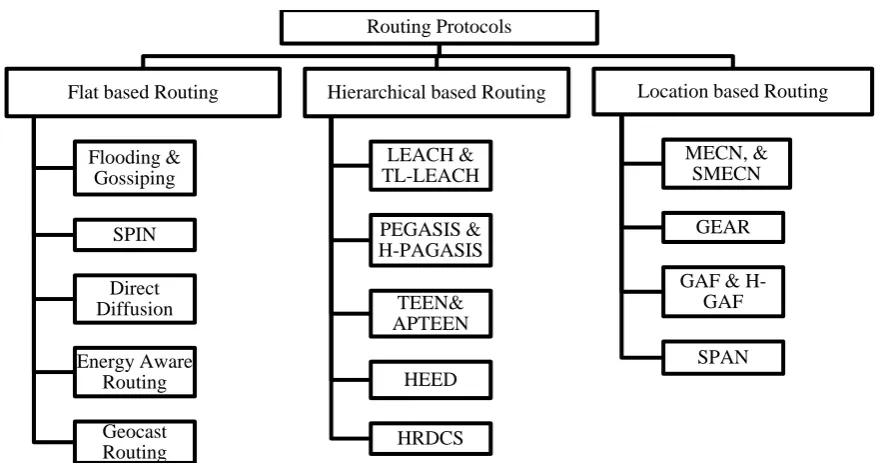
There are mainly three basic types of Routing Protocols [3], [4], [5] defined in wireless sensor network:-
1. Flat based 2. Hieratical based 3. Location based
Fig. 2: Classification of Routing Protocols in WSN
C. Introduction about protocols:-
Flat based Routing:-All Nodes situated in the network
structure are equal in some manner and working functionality are same for different nodes. To assign global identifier to each node in wireless sensor network is not possible in this type of routing because network consist dense deployment of sensor nodes and dynamic environment of wireless network. Flat based routing protocols are given following-
1. Flooding & Gossiping: - In flooding mechanism
source node send a broadcast message which consist maximum hop count number to destination node. This message received by each node between source to destination and each node broadcast this message if maximum hop count is not reached and also that node is not destination node. Flooding does not maintain any complex topology and route discovery algorithm in the network. Flooding has some disadvantages given
following-• Implosion:-Duplicate message arrive to the same
node.
• Overlap:-Same event sensed by more than one node.
• Resource blindness:-Because of redundant
transmission of data packets it reduces the network lifetime.
Gossiping is an enhanced version of flooding in which
nodes do not broadcast message to all node but send a packet to selected node only it solves the problem of implosion but time taken to propagate message throughout network is large. Gossiping consist lower overhead then flooding.
2. SPIN:-SPIN protocol called Sensor Protocol for
Information via Negotiation. SPIN protocol is introduced to reduce the flooding protocol problem like overlap and implosion via negotiation, This protocol also prolong the network lifetime by introducing threshold based resource aware operation. SPIN protocol sends directly Meta data which contain
original data instead of sending raw data for establishment of network connection. SPIN send three types of messages to node which is interested in network for communication. Messages are ADV, REQ and DATA. SPIN broadcast ADV message containing meta data describing the original data to its neighbour node and if neighbour node interested in data then it reply with REQ message for data. And communication will start by sending data. This process will continuous till destination node will not receive original data. SPIN works on data-centric approach.
3. Direct Diffusion:-In direct diffusion protocol nodes
perform individual operation instead of all operations performed by base station. In this protocol Request and queries for data sensed by node generated by sensor node itself instead of all request and queries generated by base station. In direct diffusion technique interest gradient parameter is used. Data comes on each sensor node is named by one or more attributes value and if other node is interested in this attribute then that node will express their interest. This attribute is nothing but a set of description for the data.
4. Energy Aware Routing:-An efficient method to
minimize the energy cost for communication and for increasing the network lifetime energy aware routing protocol is introduced. In energy aware routing protocol data transmission is done by selecting multiple optimal paths instead of transmitting from one optimal path. Probability function decides the path for data transmission.
5. Energy efficient Geocast Routing:-Geocast routing
protocol is based on operation in which packets are delivered to a group of nodes situated in geographical area within a specified limit. One of the routing protocol come in this category is I-min protocol in which with the specified probability function higher residual energy node is selected even if this is far away from destination and source node.
Routing Protocols
Flat based Routing
Flooding & Gossiping
SPIN
Direct Diffusion
Energy Aware Routing
Geocast Routing
Hierarchical based Routing
LEACH & TL-LEACH
PEGASIS & H-PAGASIS
TEEN& APTEEN
HEED
HRDCS
Location based Routing
MECN, & SMECN
GEAR
GAF & H-GAF
Hierarchical based Routing (Clustering):-It is a point to point routing mechanism which is responsible for guaranteed delivery of data. Large network is divided into number of clusters. These cluster nodes communicate with each other. Given following protocols comes in this category-
1. LEACH & TL-LEACH:-LEACH protocol is also
called Low-Energy Adaptive clustering Hierarchy. This is the first developed protocol based on clustering method. Protocol works on probability function each node has a probability to select cluster head. Because every node has equal probability to select cluster head in each round cluster head change. TL-LEACH is advanced protocol of LEACH known as Two Level LEACH protocol in which cluster head is divided into two part first one is known as primary cluster head and second one is known as secondary cluster head. It reduces the number of nodes that transmits the data to the base station so energy dissipation is low as compare to LEACH. One disadvantage of LEACH is that it takes more energy for formation of cluster head. TL-LEACH reduces the energy dissipation in some limit as compare to LEACH.
2. PEGASIS & H-PAGASIS:-PEGASIS stand for
Power Efficient Gathering in Sensor Information System. This protocol in an improvement on LEACH protocol based on optimal chain based protocol. LEACH protocol works on clustering technology but PEGASIS construct a chain of nodes in which each nodes communicate only with his neighbour node close to it. So it reduces the amount of energy used per round. For constructing chain of nodes greedy method is used.
PEGASIS works much better as compare with
LEACH but time taken for transmission of data is higher which prolonged the network lifetime.
H-PEGASIS (Hierarchical PEGASIS) is an improvement on PEGASIS which allow concurrent transmission of data when nodes are not adjacent.
3. TEEN& APTEEN:-TEEN protocol is known as
Threshold Sensitive Energy Efficient Sensor Network Protocol first developed for reactive networks. This protocol used for temperature sensing application. This protocol is developed to increase the energy efficiency in wireless sensor network. TEEN is developed for reactive network. Transmission in TEEN mainly depends on two parameters are hard threshold value and soft threshold value.
APTEEN (Adaptive Threshold Sensitive Energy Efficient Sensor Network Protocol) is an extension of TEEN. In APTEEN when cluster head is decided it broadcast all the parameters such as threshold values, count time and attributes to all over the nodes. The working performance of APTEEN lies between LEACH and TEEN protocol. Both protocol have one disadvantages that algorithm contains overhead and complexity when forming cluster.
4. HEED: - HEED protocol works on remaining energy
of each sensor node in the network. Protocol works on energy efficiently in the network. Cluster head
selection is based on parameter of remaining energy of sensor node. HEED protocol implemented on tiny-OS. Node degree or average distance is used as a parameter. Two sensor nodes has same remaining energy in the network after one transmission has been done. In the HEED protocol it is calculated that clustering and data aggregation at least double the lifetime in the wireless sensor network. In HEED if Cluster node is near to the base station then node directly communicate with the base station and discharge quickly and energy is wasted that is used for formation cluster head.
5. HRDCS: - A hybrid relative distance based cluster
scheme in wireless sensor networks which save the energy efficiently. Energy efficiency has great importance in this protocol. In HRDCS node construct the cluster for data collection and transmission in the network. Cluster head selected on the basis of transmission range from the base station. HRDCS works on distance between CH and BS and energy used at the time of cluster head construction.
Location based Routing:-For static network most of the
time there is no need to concern about exact location information ofanynode but in mobile network like wireless sensor network in which sensor nodes are movable then its compulsory to keep the information about their locations. Location information contains distance between two different nodes for routing data. Distance is calculated on the basis of signal strength so that energy consumption is calculated. Following types of protocol comes in this category-
1. MECN & SMECN:-A location based routing protocol
MECN (Minimum Energy Communication Network) as name implies works by using minimum energy for wireless sensor network and by utilizing low power GPS. This protocol is designed for mobile network by keeping the location information but it is best work for sensor network because sensor nodes are not mobile. MECN transmit data through relay region which consist nodes in a surrounding area. In place of direct transmission, transmission through relay region node saves the energy of node. MECN is self-reconfiguration protocol which dynamically solves the nodes failure and self adjust the deployment of new sensors.
SMECN (small minimum energy communication network) is improvement on MECN. In MECN network is assumed to be a fully connected but in SMECN a sub network from the network is constructed for efficient utilization of energy. But finding sub network from small network increase the overhead.
2. GEAR:-Geographical Energy Aware Routing is an
data packet to forward towards the targeted nodes only this technique helps for balancing the energy consumption for forwarding data packets and increase the network lifetime.
3. GAF & H-GAF: - GAF protocol is defined as
geographical adaptive fidelity protocol. This protocol works on this method in which from large number of sensor nodes only few nodes are selected for transmission of data and other nodes are sleep so the
network size become small when transmit data and saves nodes battery when nodes not participating in communication.
H-GAF (hierarchical geographical adaptive fidelity) is an improved version of GAF which saves much more energy as compare to GAF. HGAF saves the battery power and node energy by enlarging the cell size and layered structure of GAF.
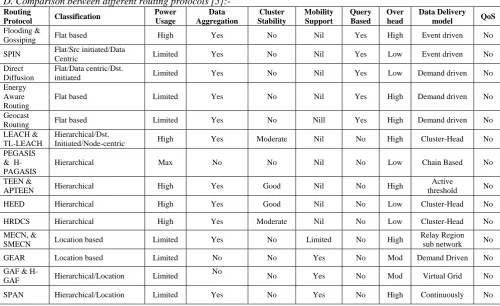
D. Comparison between different routing protocols [5]:-
Routing
Protocol Classification
Power Usage
Data Aggregation
Cluster Stability
Mobility Support
Query Based
Over head
Data Delivery model QoS Flooding &
Gossiping Flat based High Yes No Nil Yes High Event driven No
SPIN Flat/Src initiated/Data
Centric Limited Yes No Nil Yes Low Event driven No
Direct Diffusion
Flat/Data centric/Dst.
initiated Limited Yes No Nil Yes Low Demand driven No
Energy Aware Routing
Flat based Limited Yes No Nil Yes High Demand driven No
Geocast
Routing Flat based Limited Yes No Nill Yes High Demand driven No
LEACH & TL-LEACH
Hierarchical/Dst.
Initiated/Node-centric High Yes Moderate Nil No High Cluster-Head No
PEGASIS & H-PAGASIS
Hierarchical Max No No Nil No Low Chain Based No
TEEN &
APTEEN Hierarchical High Yes Good Nil No High
Active
threshold No
HEED Hierarchical High Yes Good Nil No Low Cluster-Head No
HRDCS Hierarchical High Yes Moderate Nil No Low Cluster-Head No
MECN, &
SMECN Location based Limited Yes No Limited No High
Relay Region sub network No
GEAR Location based Limited No No Yes No Mod Demand Driven No
GAF &
H-GAF Hierarchical/Location Limited
No
No Yes No Mod Virtual Grid No
SPAN Hierarchical/Location Limited Yes No Yes No High Continuously No
Table no. 1 Comparison between the different routing protocols in WSN
E. Power aware routing metrics [6]:-
To save energy of sensor node for making network lifetime greater some metrics or parameters are considered to being improved by using some protocol or algorithms. These parameters are as given following:-
• Energy consumption per packet of any node should be minimal.
• Network connectivity should be maximizing for each node.
• Variance in node power levels should be minimum. • Cost per packet should be minimum.
• Communication delay should be minimum.
II. RELATED WORK
Patel Dhaval et. al. [7] has proposed an algorithm to
improve the performance of routing protocol based on on-demand. AODV protocol was protocol used to implement this approach in place of DSR protocol because AODV removes unnecessary information quickly and perform better with extra load. This approach mainly based on, to
find neighbouring nodes with proper routing path to the destination. Source node finds the energy level of other nodes by broadcasting the message. A threshold value by default defined used for comparison with energy level of other nodes, if any node contains energy level higher then threshold value is selected with less distance. It uses both distance and energy metric.
S. Yessad et. al. [8] and Samira Yessad et. al. [9] has
just from one parameter that is N sent in NFTM (number forwarding table message) message.
Shah Ahsanul Haque et. al. [10] has proposed a method in
which large numbers of heterogeneous nodes are consider for communication via radio signals. Each cluster formed by sensor node has one cluster head which is the storage node. Storage node is capable for storing and processing data and information. Sensor nodes select their cluster head and cluster according to the energy level and distance. This method work with wireless environment and does not consider the mobility of nodes. Method includes four steps:-
• Network model • Cluster Head Selection • Cluster Construction • Sensing Scenario • Data transfer
I Sakthidevi et. al. [11] has proposed a Fuzzy Based Trust Aware Routing Framework (FBTARF) for improvement in security of dynamic WSN .FBTARF also provides energy efficient routing and reliable trust provided by using fuzzification methods. Fuzzy based methods consider multiple constraints which provide better security and energy conservation. It also provides effective and efficient routing in dynamic WSN.
Nikhil Marriwala et. al. [12] has introduced a modified
LEACH protocol which performs some modification in simple LEACH protocol. Simple LEACH protocol is based on clustering method in which clusters-Head are formed randomly. LEACH protocol divided WSN data into several clusters, each cluster select a cluster-head which aggregate data coming from the cluster nodes, process it and send it to the base station. LEACH uses a random selection process in place of fix method. Modified LEACH works on fix manner which increase the WSN lifetime. In modified LEACH protocol cluster head is choose on the bases of its maximum residual energy and minimum distance from the sensor nodes.
W. Chee-Wah Tan et. al. [13] has proposed a heuristic
scheme Power and Mobility Aware Routing or PMAR protocol. This is able to control packet flooding during route discovery and link breakage because of node mobility. PMAR works like an optimization in static network PMAR able to reduce the network overheads.
Yang wenguo et. al. [14] has introduced a tuning
transmission radii solution scheme for the purpose of energy conservation for solution, a semi grid network is constructed as an application and routing algorithm designed which tries to calculate the uniform of nodes energy consumption and then result is compared.
Tseng-Yi Chen et. al. [15] has proposed two energy
efficient geographic routing algorithm (EEGRA) for WSN. It is based on geographic routing. Geographic routing algorithms have a low computation and storage requirement which fits for WSN environments. To measure the power consumption SINR (Signal to Interference and Noise Routing) was used.
Xia Li et. al. [16] has introduced an AECRP (Adaptive
Energy Efficient Clustering Routing Protocol). Basic concept of AECRP is based on LEACH but AECRP works
on particle swarm clustering method which uses improved particle swarm optimization (PSO) method. Clustering works by using two approaches-
1. Choosing cluster heads. 2. Self organization clustering.
Choosing the clustering head is a core part of clustering algorithm. This is based on improved PSO algorithm. Evaluation function is designed whose independent variable calculated by remaining energy of nodes, the distribution within a cluster and among clusters. The particle whose evaluation function is large will be better for selection. So node whose energy is high or sufficient and position is appropriate can be selected as a cluster head.
Y. Khan et. al. [17] has proposed Location Aware
Permanent CH (LPCH) and User Defined Location Aware Permanent CH (UDLPCH). Both protocols work on clustering method. Physically network field is divided into two reasons in LPCH. Nodes are selected equally randomly in each reason for deploying in network. Initially protocol works on LEACH protocol for first round CH are selected according to LEACH algorithm. Numbers of CH are constant from first to last round. This increases the network stability and also gives greater throughput.
UDLPCH is same as LPCH but differ in that, From starting or initial round user can define optimal number of CH’s in each reason. In case of UDLPCH greater stability period and throughput obtained as compare to LPCH.
Md Nafees Rahman et. al. [18] has proposed a concept of
Relay Node in conjunction with PSO based algorithm. In multi-hop network communication the data collected from different sensor nodes in the network reach to the sink node through the nodes those are near from the sink node, because these nodes send and receive data frequently so it’s greater possibility that they will die soon, because they pass a huge amount of data.
In this paper a simple concept of relay node proposed which improved the network lifetime. Relay node collect data from different sensor nodes and send it to the Sink node, so it reduces the data traffic of sensor nodes especially for those nodes which are near to the sink. Hence energy consumption of sensor nodes decreases and lifetime increases of the network. To find the optimal location from relay node to sink node is done by using PSO- particle swarm optimization algorithm.
Shobha Poojary et. al. [19] has introduced the scheme of
routing protocol for wireless multimedia sensor network (WMSN) the proposed algorithm called Multipath Data Transfer (MPDT). MPDT introduced technique to select multiple path from source to destination to transmit data in selected multiple paths. Protocol immune from some specific attacks also. Protocol works on basically in two parts –
1. Route set-up phase: - In which if multiple paths
available then a path is set using maximum residual energy.
2. Data Transmission phase: - To transfer data from
H. Y. Bohari et. al. [20] has proposed an algorithm in which distance is calculated from each of its neighbours from source to destination and also calculate minimum energy required to send the data packet which contained appropriate additional information. Higher energy node is selected with minimum distance compared by threshold value for routing data packet from selected path. Distance between two nodes in earth surface is calculated by its longitude and latitude coordinates.
III. CONCLUSION AND FUTURE WORK
Many researchers introduced routing techniques as discussed above for improvement in different parameters related to network node for example Energy, Delay, Throughput, Bandwidths, Transmission time. Routing with energy awareness is latest topic in the research to increase the network lifetime and performance. Sensor network can not adopt only single protocol globally so need to design a protocol which satisfies all conditions and parameters. In future we are going to improve Routing Algorithm with considering power aware metrics for example-delay, transmission time ,link cost and energy aware parameters to increase the node’s lifetime, reliability of data, increase the throughput, higher packet delivery ratio.
REFERENCES
[1] Ian F. Akyildiz, Weilian Su, Yogesh Sankarasubramaniam, and Erdal Cayirci –“A survey on sensor network” IEEE Communications Magazine August 2002.
[2] C.Siva Ram Murthy and B.S. Manoj, Ad hoc Wireless Network, 2nd, Ed. Pearson, Twenty First Impressions, 2013.
[3] Rajashree.V.Biradar , V.C .Patil , Dr. S. R. Sawant , Dr. R. R. Mudholkar,” Classification And Comparison Of Routing Protocols In Wireless Sensor Networks,” Special Issue on Ubiquitous Computing Security Systems.
[4] Jyoti Saraswat, Neha Rathi & Partha Pratim Bhattacharya,” Techniques to Enhance Lifetime of Wireless Sensor Networks: A
Survey,” Global Journal of Computer Science and Technology
Network, Web & Security Volume 12 Issue 14 Version 1.0 Year 2012.
[5] Sitender Kumar ,Arvind Kumar, Rohit kumar vishwkarma,” A Survey on Routing Protocol for WirelessSensor Network,” International Journal of Advanced Research in Computer Engineering & Technology (IJARCET) Volume 2, Issue 2, February 2013.
[6] Karamvir Kaur, Inderdeep Kaur Aulakh, “Power Aware Metrics and
Routing Techniques in MANETs”, IEEE 2011.
[7] Patel Dhaval , Rana Arpit ,”Power Aware Routing Protocol to Extend Life-Time of MANET,” International Journal of Engineering
Research & Technology (IJERT) Vol. 1 Issue 10, ISSN: 2278-0181, December- 2012.
[8] S. Yessad, L. Bouallouche-Medjkoune, and D. Assani, ”proposition and evaluation of a novel routing protocol for wireless sensor networks,”International Workshop on Verification and Evaluation of Computer and Communication Systems VECoS’11, Tunis, Tunisie, Sep 15-17, 2011.
[9] Samira Yessad, Nassima Tazarart, Lyes Bakli, Louiza Medjkoune-Bouallouche and Djamil Aissani,” Balanced Energy Efficient
Routing Protocol for WSN,” the 2nd International Conference on
Communication and Information Technology(ICCIT) ,IEEE 2012. [10] Shah Ahsanul Haque,Syed Mahfuzul Aziz,” Storage Node Based
Routing protocol for Wireless Sensor Network,” Seventh International Conference on Sensing Technology ,IEEE 2013. [11] I.Sakthidevi, E.Srievidhyajanani,”Secured Fuzzy Based Routing
Framework for Dynamic Wireless Sensor Networks,” International Conference on Circuits, Power and Computing Technologies [ICCPCT-2013] ,IEEE 2013.
[12] Nikhil Marriwala, Priyanka Rathee,”An Approach to Increase the
Wireless Sensor Network Lifetime,”World Congress on Information
and Communication Technologies, IEEE 2012.
[13] W. Chee-Wah Tan , S.K. Bose ,T.-H. Cheng,” Power and mobility aware routing in wireless ad hoc Networks,” Published in IET (The Institution of Engineering and Technology 2012) Communications Received on 20th June 2011 Revised on 17th February 2012 . [14] Yang wenguo, Guo Tiande,” The Non-uniform Property of Energy
Consumption and its Solution to the Wireless Sensor Network,” Second International Workshop on Education Technology and Computer Science, IEEE 2010.
[15] Tseng-Yi Chen, Hsin-Wen Wei, Che-Rung Lee, Fu-Nan Huang, Tsan-sheng Hsu, Wei-Kuan Shih,” EEGRA: Energy Efficient Geographic Routing Algorithms for Wireless Sensor Network,” International Symposium on Pervasive Systems, Algorithms and Networks, IEEE 2012.
[16] Xia Li, Wang Gang, Liu Zongqi, Zhang Yanyan,” An energy-efficient routing protocol based on particle swarm clustering
algorithm and inter-cluster routing algorithm for WSN,” 25th
Chinese Control and Decision Conference (CCDC) IEEE 2013. [17] Y. Khan, N. Javaid, M. J. Khan_, Y. Ahmad, M. H. Zubair, S. A.
Shah,” LPCH and UDLPCH: Location-aware Routing Techniques in WSNs,” Eighth International Conference on Broadband, Wireless Computing, Communication and Applications, IEEE 2013.
[18] Md Nafees Rahman, M A Matin ,” Efficient Algorithm for Prolonging Network Lifetime of Wireless Sensor Networks,” TSINGHUA SCIENCE AND TECHNOLOGY ISSNll 1007-0214ll01/12llVolume 16, Number 6, December 2011.
[19] Shobha Poojary, Manohara Pai M M,”Multipath Data Transfer in Wireless Multimedia Sensor Network,” ,2010 International Conference on Broadband, Wireless Computing, Communication and Applications, IEEE 2010.