Performance Evaluation and Improvement of
Boiler Efficiency
G.V.Nagamani
1, N. Jashuva
21Associate Professor & Head , Department of Mechanical Engineering, Global College of Engineering, Science &
Technology, Kadapa, A.P., India.
2M.Tech, Department of Mechanical Engineering, Global College of Engineering Kadapa, A.P., India
ABSTRACT: performance preventive measures for corrosion of heating elements has been studied, and also air heater
leakage, corrected gas outlet temperature and finally gas efficiency has been calculated .Air pre-heater is a heat transfer surface in which air temperature is raised bytransferring heat from other media such as flue gas .Hot air is necessary for rapid combustion in the furnace and also for drying coal in milling plants. So an essential boiler accessory which serves this purpose is air pre-heater. The air pre-heater are not essential for operation of steam generator, but they are used where a study of cost indicates that money can be saved or efficient combustion can be obtained by their use. The decision for its adoption can be made when the financial advantages is weighed against the capital cost of heater in the present paper we have taken up the operation and performance analysis of LJUNGSTROM AIRPREHEATER27VITM 1900 of 2x210 MW capacity Rayalaseema Thermal Power Plant, Kalamala and compare with Rothemuhle air pre-heater.
KEYWORDS: Thermal power plant, energy, air pre heater, Rothemuhle air pre-heater
1. INTRODUCTON
The place where the heat energy of fuel is converted into Electrical Energy is called Thermal Power Plant.
Energy Conversion: This part of the lesion outlines the various conversion processes whichare carried out at power
station indicating where possible the efficiency of the conversion process or in other words, indicating how successful the operation is of converting one form of energy into another. Remember, energy cannot be destroyed, but its conversion incurs difficulties, which results in not all the energy being usefully converted
Chemical Energy to Heat Energy: Chemical energy is stored in coal is converted into heat bythe process known as
combustion. The carbon and other combustible elements in coal are made to unite with Oxygen of air in furnaces. This process converts chemical energy into heat energy. Many pieces of equipment are used for this first conversion, including chain grate stroke, pulverized fuel furnaces, forced and induced draught fans, chimney stacks and many other items of boiler house plant.
II. WORKING PRINCIPLE
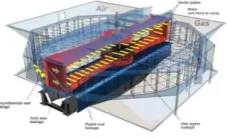
connections at both ends and is adequately sealed by radial and axial sealing members forming an air passage through one half of the pre-heater and a gas passage through the other. As the rotor slowly revolves the mass of the elements alternatively through the air and gas passage, heat is absorbed by the element surfaces passing through the hot gas stream. These are the same surfaces are carried through the air stream. They released the stored up heat thus increasing the temperature of the incoming combustion or process air.
Figure 1: 3-D View of Ljungstrom Air pre-heater
The Ljungstrom air pre-heater is more widely used than any other type of heat exchanger for comparable service. The reasons for this world wide acceptance are its proven performance and reliability, effective leakage control, and its adaptability to most, any fuel burning process. It is both designed and built to operate over extend periods with durable, uninterrupted service. Simplicity of design also makes it easy and economical to maintain while in operation and at scheduled outages.
Applications of Air Pre-Heaters: Available in a broad range of sizes, arrangements and materials, LJUNGSTROM
Air pre-heaters are custom engineer to meet the specific requirements and operating conditions of a variety of applications.
Electric power generating plants
Fluidized bed and marine boilers
Package and large industrial boilers
Hydro-carbon and chemical processes
Flue gas and other re heating systems
Heat transfer surface
III. IMPROVEMENT IN THERMAL PERFORMANCE
Soft Touch Seal: A new concept has been developed to minimize the seal leak. As an introduction, this „Soft Touch
Seal‟ is provided for hot end radial seal only. This can be extended to axial seal also. Soft touch seal has flexile end that cannot escape air from one basket to another basket. That can be reduces the percentage of air leak to flue gas. Heat transfer is effectively utilized from flue gas to Primary Air and Secondary Air.
Double Sealing: In double sealing an additional radial and axial seals are introduced alongwith the existing seals. This
will reduce the overall leakage y 1.5% to 2% recently even triple seals have been introduced.
Figure 2: Incorporation of soft touch seal Figure 3: View of soft touch seal Diaphragm Plate Protection
Sheets: In the conventional air pre-heater, the hot end of thediaphragm plate is exposed to the gas flow. Due to
erosive ash particles, the diaphragm plate edges erode fast. In course of time, the erosion extends to the radial seal fixing hole, thereby distributing the fixing and setting of radial seals. The diaphragm plate edge can e protected by the erosive resistant cover plates with the change of seals, these protective sheets also can be changed.
Figure 4: Installation of soft touch seal
Figure 5: Before and After sealing
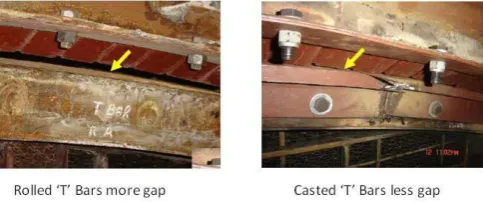
After setting it gives more leakage through bypass seal. Whatever correction is made at site could not control the radius variations. The cast „T‟ bars keep the radius with controlled dimension, thus reducing the leakage across bypass seals.
Figure 7: Reducing gaps by casted T-Bars
can be changed to 0.8 mm DU profile. This will increase the heat transfer area, thereby reducing the flue as outlet temperature. It is calculated that by changing the profile as suggested, the as outlet temperature will decrease by 40C, that means 0.2% improvement in efficiency. This change has already been incorporated in the current design. Still some of the air pre-heaters are operating with cold end NF6 profile. This can be changed.
New Profiles: A highly efficient element profiles are available to improve the thermalperformance. Case Study-I is
presented to show the performance changes with the introduction of new profiles. With the introduction of new profile, the gas outlet temperature can be achieved to 135.60C.
Figure 8: Change of profiles
IV. OVERHAULING OF THE PLANT AFTER INCORPORATING SOFT SEALS:
OVERHAUL PERIOD - (15/11/2012 - 15/12/2012)
S.No. PARAMETERSUNITS BEFORE OVERHAUL AFTER OVERHAUL
APH-A APH-B APH-A APH-B
1. UNITLOAD MW 205 - 210 -
2. Fuel T/hr 115.3 - 113 -
consumption
3. PD fan current amps 198 178 181 188
4. FD fan current amps 171 164 157 141
5. ID fan current amps 278 311 236 238
4.1 Profits Gained After Overhauling
A) Cost saving per hour:
1. Fuel saving = 115.3 - 113 = 2.3 T/Hr
2. Assuming coal cost as = Rs 2000 per MT
3. Cost saving per hour = 2000 X 2.3 = Rs 4600
4. Cost of fuel saving per year = 4600X24X365 = Rs 40, 29,600
B) Cost benefit due to fan loading:
1. Total fan loading before overhauling = 1300 amps
2. Total fan loading after overhauling = 1141 amps
3. Total saving in current = 159 amps
4. Power saved = 1.73 X 3.3 X 159 X 0.86
= 782.00KWhr = 0.782MWhr
5. Energy saved per year = 6,850,320
6. Power cost = Rs 2.60 per unit
7. Saving per year = 6850320 X 2.60 = Rs 1,78,10,832
C) Total savings per year = 4,02,96,000 + 1,78,10,832
V. COMPARING LJUNGSTROM WITH ROTHEMUHLE
Calculations of Ljungstrom air pre-heater
The method determines air pre-heater as per this procedure is the volumetric method this is an empirical approximation of air heaters leakage with an accuracy of + / - 1%.
AL = (O(2gl−O2ge))×0.9 ×100 21 −O2gl
Collected Data:
AL – Air heater leakage
O2gl – Percentage of O2 in gas entering air heater: 3.5
O2ge – Percentage of O2 in as leaving air heater: 5.0
Secondary air (SA) leaving air heater = 2990c
Primary air (PA) leaving air heater = 3040c
Calculations:
Air leakage AL = ((5.0−3.5))×0.9 ×100 = 8.437 % 21 −5.0
Gas Side Efficiency:
The gas efficiency is defined as the ratio of the temperature drop. Corrected leakage to the temperature head, expressed as a percentage. Temperature drop is obtained y subtracting the corrected gas outlet temperature from the gas inlet temperature. Temperature head is obtained y subtracting air inlet temperature from the gas inlet temperature. The corrected gas outlet temperature is defined as outlet gas temperature calculated for „no air heater leakage‟ and is given y following equation.
(Tgl −Tae )
+Tgl Tgnl = AL ×C
pa
(100 ×C pg )
Collected Data:
Tgnl – Gas outlet temperature corrected for no leakage.
Cpa – The mean specific heat between temperature Tae and Tgl = 1.023 KJ / kg 0k Cpg - The mean
specific heat between temperature Tgl and Tae = 1.109 KJ / kg 0k Tae – Temperature of air entering air
heater = 400c
Tge – Temperature of gas entering air heater = 3310c Tgl –
X- Ratio: Ratio of heat capacity of air passing through the air heater to the heat capacity offlue gas passing through the air heater.
X-Ratio (Xr.) = Gas Side Efficiency / Air Side Efficiency
Air Side Efficiency (SA & PA): Ratio of air temperature gain across the air heater correctedfrom no leakage to the
temperature head.
(Tal −Tae )
×100 Air Side Efficiency =
(T −T )
g e a e Collected Data:
Tae – Temperature of air entering air heater = 400c
Tal – Temperature of air leaving air heater = 302 0
c
Tge – Temperature of gas entering air heater = 3310c
Calculations:
(Tal −Tae )
×100
(302 − 40)
×100 = 90.03%
Air Side Efficiency = =
(331 −
(Tge −Tae ) 40)
X-Ratio (Xr.) = Gas Side Efficiency / Air Side Efficiency X r =
57.77
= 0.641
90.03
Gas leaving temperature without leakage Tgl =Tge − X r (Tal −Tae )
= 331 – 0.641 (302 – 40) = 163.050c
Pre heater Air side efficiency (SA & PA):
(Tge
(331−163.05) −Tae )
Air side efficiency (SA & PA)=
×100 =
×100 = 57.71%
(Tge (331−40)
−T
VI. CONCLUSIONS
The Thermal performance of the air preheater is improved
Load on the fans are reduced thus power consumption is reduced and cost is reduced
Fuel consumption is also reduced, thus fuel is saved and cost is reduced
By comparing Rothemuhle with Ljungstrom air leakages are more, gas side efficiency and air side efficiencies
are less in Rothemuhle air pre-heater
The Thermal performance of the Ljungstrom air pre-heater is better than Rothemuhle
REFERENCES
1. Driscoll, J.M. et. al, “ASME Performance Test Codes Test Code for Air Heaters”, USA, 1968. 2. Hewitt, G.F., Shires, G.L. and Bott, T.R., “Process Heat Transfer”, Boca Raton, CRC Press, USA, 1994. 3. Incropera, F.P. and Dewitt, D.P., “Introduction to Heat Transfer”, 4thedition, John Wiley & Sons Inc., USA, 2002.
4. Shah, R.K., Sekulic, D.P., “Fundamentals of Heat Exchanger Design”, John Wiley & Sons Inc., Canada, 2003. 5. Juangjandee, P. and Sucharitakul, T., “Performance Evaluation of Cross-Flow Heat
6. Exchanger in Coal-Fired Power Plant under Particulate Condition”, 18th Conference of Mechanical Engineering Network of Thailand, Khon Kaen University, Thailand, 2004.
7. Juangjandee, P. and Sucharitakul, T., “Performance Evaluation of Leakage Cross-Flow
8. Heat Exchanger in Coal-Fired Power Plant”, 19th Conference of Mechanical Engineering Network of Thailand, Phuket, Thailand, 2005.
9. Juangjandee, P. and Sucharitakul, T., “Effect of High Ash Content Lignite on Cross-Flow Heat Exchanger Performance in Mae Moh Lignite-Fired Power Plant”, HAPUA Fuel Procurement & Utilisation Forum, Kuala Lumpur, Malaysia, 2006.
10. Juangjandee, P. and Sucharitakul, T., “Air Heater Performance and Enhancement