New Impossible Differential Search Tool from
Design and Cryptanalysis Aspects
Yu Sasaki and Yosuke Todo NTT Secure Platform Laboratories
3-9-11 Midori-cho, Musashino-shi, Tokyo 180-8585 Japan {sasaki.yu,todo.yosuke}@lab.ntt.co.jp
Abstract. In this paper, a new tool searching for impossible differentials
against symmetric-key primitives is presented. Compared to the previous tools, our tool can detect any contradiction between input and output differences, and it can take into account the property inside the S-box when its size is small e.g. 4 bits. In addition, several techniques are proposed to evaluate 8-bit S-box. With this tool, the number of rounds of impossible differentials are improved from the previous best results by 1 round forMidori128,Lilliput, and Minalpher. The tool also finds new impossible differentials of ARIA and MIBS. We manually verify the impossibility of the searched results, which reveals new structural properties of those designs.
Our tool can be implemented only by slightly modifying the previous dif-ferential search tool using Mixed Integer Linear Programming (MILP), while the previous tools need to be implemented independently of the dif-ferential search tools. This motivates us to discuss the usage of our tool particular for the design process. With this tool, the maximum num-ber of rounds of impossible differentials can be proven under reasonable assumptions and the tool is applied to various concrete designs.
Key words: symmetric-key, impossible differential, mixed integer linear
programming,Midori,Lilliput, Minalpher, ARIA, MIBS
1
Introduction
Designing symmetric-key primitives becomes more and more complicated to si-multaneously satisfy various goals such as security against many notions, effi-ciency in high-end software, low-implementation cost in hardware, and so on.
differential cryptanalysis and linear cryptanalysis, automated tools have been well-developed. In particular, evaluating the lower bound of the number of active S-boxes with mixed-integer-linear programming (MILP) is becoming popular in the design of SPN primitives [1]. Meanwhile, automated tools for other cryptana-lytic approaches are not as sophisticated as differential and linear cryptanalysis. Impossible differential cryptanalysis [2, 3] is one of the most major and ef-fective cryptanalytic approaches. In short, for a target function F, it reveals a pair of input and output differences (∆i, ∆o) that cannot be connected. Namely, two input valuesx, x′ satisfyingx⊕x′ =∆i never satisfyF(x)⊕F(x′) = ∆o. Because an ideally designed function should not have this property, the detection of (∆i, ∆o) immediately leads to a distinguishing attack. The most important part of the attack is finding such a distinguisher. In particular, the attacker aims to maximize the number of rounds.
Such (∆i, ∆o) are detected by themiss-in-the-middle approach [4] and Kim et al. [5] presented the first automated tool calledU-method. Suppose that one wants to examine if (∆i, ∆o) is impossible. First it propagates∆i in forwards (withF) byrf rounds, and checks if the difference of each word is known active, active, inactive, or unknown. Then, it propagates ∆o in backwards (withF−1) byrb rounds and checks the same information. Finally, it finds contradiction in the middle, detecting that (∆i, ∆o) is impossible forrf+rb rounds.
Several researches extended theU-method, e.g. UID-method by Luo et al. [6, 7] or some extension by Wu and Wang [8]. Those detect more complicated con-tradiction than theU-method. Although some advancement was made, usability of the previous tools are limited as explained below.
– To be as generic as possible, the recent tools consider complicated differential impact through the linear layer, which requires more sensitive implementa-tion. Even with this effort, only particular contradictions can be analyzed. – Most of the previous tools cannot take into account differential property
inside the S-box. Several analysis against a particular S-box in a particu-lar primitive may analyze its differential property [9, 10], however such an analysis cannot be extended to a generic tool.
– Most of the previous tools for impossible differential cryptanalysis cannot be used to evaluate other cryptanalytic approaches, e.g. differential and linear cryptanalysis. Derbez and Fouque proposed a tool for the meet-in-the-middle attack that can also be used for impossible differential cryptanalysis [11]. However, it cannot find better impossible pairs compared to [5, 6, 8].
Our Contributions. In this paper, we propose a new automated tool to find impossible differentials. Our tool is based on the previous tool for (standard) differential cryptanalysis with MILP.
output differences to (∆i, ∆o). Due to the added constraints, the lower bound of the number of active S-boxes usually increases. In some case, (∆i, ∆o) cannot be satisfied, thus the MILP solver returns an error code implying that no solution exists. In other words,∆iand∆oare impossible pairs. We can examine various pairs of (∆i, ∆o) to enlarge the search space.
Our tool leads to stronger cryptanalytic results than the previous tools owing to the following advantages.
Analyzing inside S-boxes: The previous differential-bound search using MILP [12] can model the possible differential propagation patterns in the differen-tial distribution table (DDT) of the S-box. Our tool inherits this advantage. Thus impossible differentials taking into account DDT can be found. Arbitrary Contradiction: The MILP solver automatically judges whether or
not the solution exists. Thus, the attacker does not have to predict the mech-anism of contradiction in advance, which significantly increases the versatil-ity of the tool.
Multi-Purpose Tool: We convert the previous MILP-based differential search into impossible differential search by just adding constraints to fix input and output differences. Thus only with a single tool, security against differential cryptanalysis and impossible differential cryptanalysis can be evaluated. This feature is especially useful for future primitive designers who need to evaluate both cryptanalysis.
Arbitrary S-box Mode: MILP requires too many inequalities to represent differential propagations in DDT of 8-bit S-boxes. Thus, the tool is infea-sible for 8-bit S-boxes in a straightforward manner. Here, we introduce an arbitrary S-box where impossible differentials for the arbitrary S-box is al-ways valid for arbitrary S-box choice. The arbitrary S-box can be described efficiently, which enables us to evaluate 8-bit S-boxes.
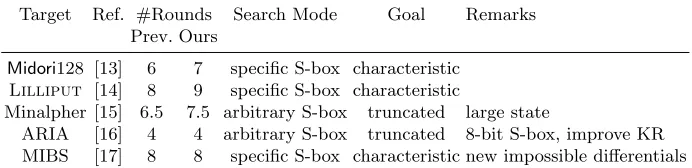
Quick Search for Truncated Impossible Differential: A single pair of in-put and outin-put differences can be impossible for more rounds than truncated differentials. Meanwhile, evaluating all the pairs is infeasible and the search range is often limited to single-active word. Here we present a technique to make the search fast only by aiming truncated impossible differentials. We apply the proposed tool to various designs. The results improving the existing impossible differentials are summarized in Table 1. Although one of the advantages of the tool is that the attacker can detect impossible differ-entials without analyzing contradicting reasons, we manually analyze why the detected (∆i, ∆o) is impossible. The manual verification not only demonstrates the correctness of the tool, but also reveals the structural properties of the tar-get designs that have not been known before. We believe that the contradicting reasons analyzed in this paper for Midori128,Lilliput, and Minalpher lead to new understanding about their designs.
Table 1.Application Results. ‘KR’ denotes ‘key recovery.’
Target Ref. #Rounds Search Mode Goal Remarks Prev. Ours
Midori128 [13] 6 7 specific S-box characteristic
Lilliput [14] 8 9 specific S-box characteristic
Minalpher [15] 6.5 7.5 arbitrary S-box truncated large state
ARIA [16] 4 4 arbitrary S-box truncated 8-bit S-box, improve KR MIBS [17] 8 8 specific S-box characteristic new impossible differentials We also list all 8-round impossible differentials of RECTANGLE [10] in Appendix F.
the arbitrary S-box mode, we can easily check whether (∆i, ∆o) is dependent on the S-box. If it is dependent on the S-box, it may be prevented by replacing the S-box. If it is independent, it needs to modify the linear layer to prevent it.
Moreover, because it catches any contradiction, the tool provides a certain level of provable security about the existence of impossible differentials with rea-sonable assumptions and rearea-sonable search range. In details, provable security can be discussed when a single word is active in the input and output differ-ences, and we can set two-level of the assumption; 1) S-box is public and each subkey is chosen independently and uniformly at random and 2) keyed S-box is used and for each key the S-box is chosen uniformly at random. We apply the tool to various designs to prove the maximum number of rounds of impossible differentials. Finally, we propose an optimal pick technique which dramatically reduces the execution time only when the tool is used for obtaining the proof.
Paper Outline. Notations and related work are introduced in Sect. 2. Frame-work of our tool is introduced in Sect. 3. Application on various designs improv-ing previous impossible differentials are shown in Sect. 4. A technique to reduce the search complexity is explained in Sect. 5. Advantages of our tool in the de-sign process are explained in Sect. 6. Our research is partially overlapped with [18]. The relationship between [18] and this paper is explained in Appendix A.
2
Related Work
2.1 Terminologies in Impossible Differential Cryptanalysis
– We call a pair of input and output differences (∆i, ∆o) that cannot be con-nected animpossible differential characteristicor impossible characteristic. – We call a pair of a closed set of input differences and a closed set of output
differences in which any pair cannot be connected as atruncated impossible differential.
2.2 Differential Search with Mixed Integer Linear Programming
Here we explain an automated tool for differential cryptanalysis, not impossible differential cryptanalysis, which will be a base of our tool.
Mouha et al. [1] showed that the problem to search for the minimum num-ber of active S-boxes can be modeled with mixed integer linear programming (MILP). The approach is now very popular for designing a new primitive. For example, resistance against differential and linear cryptanalysis of Skinny [19] recently proposed at CRYPTO 2016 was evaluated by MILP.
The approach by Mouha et al. [1] is effective for evaluating word-oriented ciphers, while several ciphers are not word-oriented. For example, PRESENT [20] applies 4-bit S-box, then the bit-permutation moves four bits from a single S-box to four different S-boxes. In order to apply MILP to such a structure, Sun et al. [12] developed a method to model all possible differential propagations bit by bit even for the S-box.
Modeling Differential Propagations with MILP. We explain how to model valid differential propagations of PRESENT in bitwise. Note that one round of PRESENT consists of subkey addition, S-box applications, and bit-permutation. At first, binary variables to represent active or inactive of each bit are defined for all rounds; x0, x1, . . . , x63 are for 64 bits in the plaintext,x64, x65, . . . , x127 are for 64 bits after round 1, x128, x129, . . . , x191 are for 64 bits after round 2, and so on. Each variable takes ‘1’ if the bit has the difference, and takes ‘0’ otherwise. Then, the constraint to ensure at least 1 active bit is added, which can be written as ‘x0+x1 +· · ·+x63 ≥ 1.’ Finally, constraints to be valid differential propagations are added. Here, the bit-permutation only changes the order of variables and subkey addition can be ignored because it does not change the difference. The following denotes the variables involved in the first round, in which a 64-bit plaintext difference x0, . . . , x63are updated tox64, . . . , x127.
x0, x1, x2, x3 x4, x5, x6, x7 x8, x9, x10, x11 x12, x13, x14, x15
· · · x60, x61, x62, x63
S-box −→
x64, x68, x72, x76 x80, x84, x88, x92 x96, x100, x104, x108 x112, x116, x120, x124
· · ·
x115, x119, x123, x127
BitPerm −→
x64, x65, x66, x67 x68, x69, x70, x71 x72, x73, x74, x75 x76, x77, x78, x79
· · ·
x124, x125, x126, x127
The most difficult part is describing all possible propagation patterns for 16 S-boxes, e.g.x0, x1, x2, x3−→x64, x68, x72, x76, with a system of linear inequal-ities. Sun et al. [12] showed two approaches to solve the problem.
Fact 1 Linear inequalities to constrain input and output variables of the S-box only to valid patterns can be generated by using either the computation tool called SageMath or several logical operations.
and the choice of SageMath and logical operations does not impact to our tool. Meanwhile, the following limitation of those approaches should be noted. Fact 2 Both of SageMath and the logical operations can be used only when the S-box size is small.
In our computational environment, both methods can be feasible only up to 5-bit S-box. No method is known to model bigger S-box, e.g. 8-bit S-box.
MILP returns a solution of the system optimizing a given objective function. In differential cryptanalysis, the attacker’s goal is minimizing the number of active S-boxes, which can be defined as “Minimize∑i(x4i∨x4i+1∨x4i+2∨x4i+3).” The system can be solved by the MILP solver to find the optimal solution. We use Gurobi Optimizer [22] as the MILP solver.
2.3 Impossible Differential Search with MILP
Cui et al. have recently posted their work to Cryptology ePrint Archive pre-senting that impossible differentials (and zero-correlation approximations) can be searched with MILP [18]. Although we have independently reached the same idea and used it to evaluate a lot of designs, the work by Cui et al. became the first article to report the impossible differential search tool based on MILP. Comparison between [18] and this work will be explained in Appendix A. We explain [18] in details because we use the same idea in this work.
The impossible differential search with MILP heavily relies on the previous differential bound search with MILP. As explained in Sect. 2.2, in the differential bound search, users describe all possible differential propagations and then run the MILP solver to find the best solution. This can be converted to check if a specific pair of input and output differences, (∆i, ∆o), is impossible or not by adding constraints to fix input and output differences to (∆i, ∆o). Due to those additional constraints, the MILP solver may not be able to find the solution, thus returns some error code indicating thatthe system is infeasible, which tells that (∆i, ∆o) is an impossible differential characteristic.
Example 1 Let p0, p1, . . . , pb−1 and c0, c1, . . . , cb−1 be variables that represent active/inactive of plaintext bits and ciphertext bits, respectively, where b is the block size. To test if(∆i, ∆o) = (0x1,0x1)is impossible, the MILP solver should run with the following constraints added.
p0= 1, p1= 0, c2= 0, . . . , pb−1= 0, c0= 1, c1= 0, c2= 0, . . . , cb−1= 0.
To find truncated impossible differentials, Cui et al. iterated the search for one pair many times by changing input and output differences. Because testing all possible pairs is computationally infeasible, Cui et al. limit the differences to be some subset, e.g. single-active word.
3
Composite Framework for Differential and Impossible
Differential Searches
Our basic idea is the same as Cui et al. [18], which runs the MILP solver with fully specified input and output differences and checks if the system is infeasible or not. This enables the following improvements compared to the previous tools. Analyzing inside S-boxes: This property is also well advertised in [18]. Re-garding small S-box, up to 5-bit S-box in our computational environment, all possible differential propagations through S-box can be modeled with MILP. Hence impossible differential characteristics considering the differen-tial property of S-box can be identified.
Arbitrary Contradiction: Whether the system is infeasible or not is auto-matically judged by the MILP solver. Hence, the attackers do not need to predict contradicting reasons. The tool can catch any contradiction, which significantly reduces the attackers’ task. Note that this feature is not focused in [18], and we present several extending techniques based on this feature. Both properties have huge potential to find new impossible characteristics, thus the number of attacked rounds may be extended. Actually, in Sect. 4 we show several applications detecting new characteristics that seem impossible to find with by-hand analysis or previous search tools.
Note that running time of our tool for a single pair of input and output differ-ences is significantly shorter than the differential search. This can be explained that the solver can stop only by detecting one characteristic. In the previous dif-ferential bound search, the bottleneck of the tool is increasing the lower bound. Finding some upper bound (some solution of the system) is usually fast.
Limitations. While it is very effective against primitives using 4- or 5-bit S-box, it is important to discuss limitations of this approach.
1. The idea cannot be applied to larger S-boxes, thus Cui et al. left application to 8-bit S-boxes open. Moreover, though it is not mentioned in [18], applying this idea to primitives with a large block size, say 256 bits or 512 bits, is computationally hard even if the S-box size is small.
2. The MILP solver checks if a given input and output differences are impossible to solve. We iterate this test for various input and output differences. To keep the computation time practical, as suggested by [18], the choices of input and output differences must be limited to a reasonable subset, i.e. only one active word. Actually, searching for impossible characteristics with two-active words is computationally infeasible.
Algorithm 1Generating System of Inequalities in Previous Differential Search
Require:number of roundsr, system of inequalities for S-boxes and linear layer
Ensure:system of inequalities
1: Write an objective function.A
2: Write constraints ensuring at least 1 active bit in input.B 3: forround = 1 tordo
4: Write constraints for the S-boxes.C 5: Write constraints for the linear layer.
6: end for
1. For large S-boxes and large block sizes, we stop modeling the differential property precisely, instead analyzing an imaginary S-box, called arbitrary S-box, in which differential propagations of any S-box become a subset of the ones in the arbitrary S-box. The arbitrary S-box can be modeled very efficiently, which allows to analyze large primitives including 8-bit S-box. 2. The tool for a single pair of (∆i, ∆o) can be extended to truncated
differen-tials by simply running it for multiple pairs. However, this limits the search range only to 1 active word. We show a technique to make the tool more efficient only by aiming truncated impossible differentials, which can be im-plemented only by changing the constraints of input and output differences.
3.1 Composite Framework
Another remarkable advantage of our tool is that users can switch differential-bound search and impossible-differential search very easily. This helps primitive designers, generally required to evaluate the resistance against both of differential and impossible differential cryptanalysis. Here we introduce our framework to generate system of inequalities depending on the target to evaluate.
Most of the symmetric-key primitives can be described as an iteration of the round function consisting of the non-linear and linear layers. We explain our tool by following this structure. Our tool focuses on the primitive whose non-linear layer is the parallel application of S-boxes. The tool relies on the previous MILP-based differential search that models differential propagations in bitwise [12, 23, 21]. Here, we recall how a system of inequalities is generated in previous work.
First, the number of rounds,r, is fixed. Then, an objective function, e.g. min-imizing the number of active S-boxes, is defined. It also constrains the system so that at least one S-box is activated. The remaining is writing constraints for the valid differential propagations through the S-boxes and linear layer forrrounds, which can be done with [12, 23, 21]. The procedure is summarized in Algorithm 1. Underlines in Algorithm 1 will be later referred by Algorithm 2.
Algorithm 2Generating System of Inequalities in Composite Framework
Require: number of rounds r, system of inequalities for S-boxes and linear
layer, GOAL ∈ {DB, ID}, MODE ∈ {SPECFIC, ARBITRARY}, and OBJECT ∈ {TRUNCATED,CHARACTERISTIC}
Ensure:system of inequalities
/* Lines 1–5 correspond to A in Alg. 1. */ 1: if GOAL = DBthen
2: Write an objective function.
3: else if GOAL = IDthen
4: Leave an objective function empty.
5: end if
/* Lines 6–14 correspond to B in Alg. 1. */ 6: if GOAL = DBthen
7: Write constraints ensuring at least 1 active bit in input.
8: else if GOAL = IDthen
9: if OBJECT = CHARACTERISTICthen
10: Fully specify active or inactive for each input and output bit.
11: else if OBJECT = TRUNCATEDthen
12: Specify input and output difference in a truncated level.
13: end if
14: end if
15: forround = 1 tordo
/* Lines 16–20 correspond to C in Alg. 1. */ 16: if TARGET = ID and MODE = ARBITRARYthen
17: Write constraints for the differentially ideal S-box. 18: else
19: Write constraints for the S-boxes as in specification.
20: end if
21: Write constraints for the linear layer.
22: end for
users need to modify only two parts; make the objective function empty and specify input and output differences.
For impossible differentials, the users can further choose several search modes specified in the parameter “MODE”. To be more precise, the S-boxes can be fixed to particular ones (SPECIFIC) or can be treated as more general ones (ARBITRARY).
The users can also choose which of truncated differential (TRUNCATED) or a single impossible differential characteristic (CHARACTERISTIC) is searched as a parameter “OBJECT”.
Hereafter, we explain details of impossible differential search (“GOAL=ID”). We first explain how to search impossible differential characteristics (“OBJECT =CHARACTERISTIC”) with the specific S-box mode and the arbitrary S-box mode in Sect. 3.2 and 3.3, respectively. We then explain the case of truncated impossible differential (“OBJECT=TRUNCATED”) in Sect. 3.4.
3.2 Specific S-box Mode for Impossible Characteristic
In the specific S-box mode, the users derive the differential distribution table (DDT) from the actual S-boxes, and construct the MILP model to describe all valid differential propagations by using the existing method [12, 23, 21]. Then differences in all input and output bits are constrained to the target pair. The analysis is iterated for various input and output differences chosen from a rea-sonable subset, i.e. only one word is active.
The specific S-box mode can maximize the number of rounds of impossible differentials. Thus the attackers may prefer to choose this mode.
Impact of Key Schedule. The tool does not take into account the key sched-ule, thus we need a careful discussion about the impact of its omission.
The search by MILP describes a system of inequalities for the entire rounds by iterating a system of one-round differential propagation. Thus all valid prop-agations for one round are also valid in the evaluation of multiple rounds inde-pendently of the propagation in neighboring rounds and subkey values. This is true only if all subkeys are independent and chosen uniformly at random, which is not true in practical designs with a particular key schedule.
In summary, what the MILP simulates is the worst-case scenario (for the at-tackers). Namely, even if some differential propagations cannot occur for multiple rounds, the tool regards it possible, which leads to the following observation. Observation 1 Impossible differential characteristics found in the specific S-box mode are always impossible independently of the choice of key schedule.
3.3 Arbitrary S-box Mode for Impossible Characteristic
In the arbitrary S-box mode, we assume an imaginary S-box in which any non-zero input difference can be propagated to any non-non-zero output difference. Then, a set of valid differential propagations of any bijective S-box can be a subset of the one in the arbitrary S-box. DDT for the 4-bit arbitrary S-box is shown in Table 13 in Appendix H.
(resp. input bit) is 0, namely
i0+i1+· · ·+in−1−o0≥0, o0+o1+· · ·+on−1−i0≥0, i0+i1+· · ·+in−1−o1≥0, o0+o1+· · ·+on−1−i1≥0,
· · · · · ·
i0+i1+· · ·+in−1−on−1≥0, o0+o1+· · ·+on−1−in−1≥0. The advantage of the arbitrary S-box compared to the specific S-box is ef-ficiency owing to a small number of constrains to describe differential propaga-tions. The arbitrary S-box mode is useful in the following two cases.
8-bit S-boxes: There is no known method to describe differential propagations of 8-bit S-boxes in MILP. Here by using the arbitrary S-box, the tool can be applied to 8-bit S-boxes.
Large Block Size: Even if the S-box size is small, say 4 bits, it is computa-tionally hard to evaluate a large block size, say 256 bits. Again the arbitrary S-box enables analysis.
Note that, differently from the specific S-box mode, the analysis can no longer exploit properties inside the S-box. However, the analysis can still exploit another advantage that the tool catches any contradiction, and this advantage is often big enough to find new impossible differential characteristics. Actually, we found new characteristics of ARIA (8-bit S-boxes) [16] and of Minalpher (4-bit S-box, 256-bit block) [15], which will be explained in Sect. 4.
Similarly to Sect. 3.2, MILP simulates the worst-case scenario. Namely, even if some differential propagations cannot occur for some specific S-box, the tool regards it possible.
Observation 2 Impossible differential characteristics found in the arbitrary S-box mode are always impossible independently of the choice of S-S-box and key schedule.
3.4 Searching for Truncated Impossible Differential
The tool for a single characteristic can be extended to truncated differentials by simply running the tool for multiple pairs of input and output differences. How-ever, this approach easily becomes computational infeasible when the number of active words is more than 1. Actually, searching for two active words is already too heavy. Letnandc be the number of S-boxes per round and the size of each S-box, respectively. Then, the number of pairs of input and output differences with 1-active word is (n·(2c−1))2, which is O(n2·22c), while one with two active words is((n2)·(22c−1))2, which isO(n4·24c). Generally fordinput active words andd′ output active words, the number of pairs to test is given by
With n= 16 and c = 4, which is a popular choice for lightweight ciphers, we need to evaluate 216pairs for single-active word (d=d′ = 1) while 232pairs for 2-active words (d=d′= 2).
Here, we show a technique to make the tool more efficient only by aiming truncated impossible differentials in both of the specific S-box and the arbitrary S-box modes. Let i0, i1, . . . , in−1 and o0, o1, . . . , on−1 be variables to represent active or inactive ofninput and noutput bits to truncate. Then, we write the following constraint (along with constraints fixing the other bits to 0):
i0+i1+· · ·+in−1≥1, o0+o1+· · ·+on−1≥1.
Note that if there exists at least one solution satisfying the constraints, the tool returns that the system is feasible. Hence, the truncated impossible differential search is less accurate than the impossible characteristic search, while execution time is significantly reduced. Compared to Eq. (1), 1 inequality is enough for each active word position. Thus the number of pairs to test is given by
O(nd+d′), (2)
which enables to evaluate multiple active words differences. Actually, we searched for truncated impossible differentials on ARIA [16] with this technique. Then, we found new truncated impossible differentials withd= 2 active input words andd′= 5 output active words, which will be explained in Sect. 4.3.
4
Applications from Cryptanalysis Aspect
4.1 Midori128
Midoriis a low energy block cipher designed by Banik et al. in 2015 [13]. Mi-doriprovides two different block lengths;Midori64 andMidori128 have 64-bit and 128-bit block lengths, respectively. Both ciphers accept 128-bit secret key.
Specification. Midori128 uses the SPN structure with AES-like state. The state is arranged in a 4×4 matrix as
S =
s0s4 s8 s12 s1s5 s9 s13 s2s6s10s14 s3s7s11s15
. (3)
The bit length of every cellsi is 8 bits.
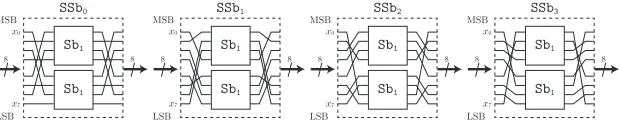
The round function consists ofSubCell,ShuffleCell,MixColumn, andKeyAdd. InSubCell, 8-bit S-boxesSSb0,SSb1,SSb2, andSSb3are used andsi←SSbi mod 4(si) where 0≤i≤15. Four 8-bit S-boxes SSbi are constructed by 4-bit S-boxSb1, whereSb1 is defined as follows.
x 0 1 2 3 4 5 6 7 8 9 A B C D E F
Sb1 SSb0 Sb1 MSB LSB x0 x7 8 8 Sb1 SSb1 Sb1 MSB LSB x0 x7 8 8 Sb1 SSb2 Sb1 MSB LSB x0 x7 8 8 Sb1 SSb3 Sb1 MSB LSB x0 x7 8 8
Fig. 1.SSb0,SSb1,SSb2, andSSb3
Then,SSbiare constructed asSSbi=p−i 1◦(Sb1∥Sb1)◦pi, where twoSb1are ap-plied to top and bottom halves in (Sb1∥Sb1). Note thatSSbiis involution, and we later show that impossible differentials are improved by exploiting this property. Figure 1 shows the specification ofSSbi. InShuffleCell, each cell is permuted as (s0, s1, . . . , s15) ← (s0, s10, s5, s15, s14, s4, s11, s1, s9, s3, s12, s6, s7, s13, s2, s8).
InMixColumns, the following multiplication
si si+1 si+2 si+3
=
0 1 1 1 1 0 1 1 1 1 0 1 1 1 1 0
si si+1 si+2 si+3
is applied fori= 0,4,8,12. InKeyAdd, thei-thn-bit round key is XORed with a state. The number of rounds of Midori128 is 20. Moreover, only SubCell is applied in the final round function.
Previous Cryptanalysis. Several third-party cryptanalyses have been pro-posed, and the full-round Midori64 was broken by the invariant subspace at-tack [24] and nonlinear invariant atat-tack [25] under the weak-key setting. On the other hand, there are no cryptanalysis against full-roundMidori128. Regarding the impossible differential attack onMidori128, the designers found 6-round im-possible differentials such that only one cell is active in the input and output [13]. Then, Zhen et al. found 6-round impossible differentials that are advantageous for the key recovery but the number of rounds is not increased [26].
Configurations for the Tool. The block size of Midori128 is 128 bits and the S-boxes size is 8 bits. However, since the 8-bit S-boxes are represented as concatenation of two 4-bit S-boxes, we can regard that there are thirty-two 4-bit S-boxes in each round. The search space for impossible differential characteristics is large, hence we run our tool in the arbitrary S-box mode.
Table 2.7-Round Truncated Impossible Differentials againstMidori128
ID ∆P ∆C Remarks
001T (0α100,0000,0000,0000) (0β100,0000,0000,0000) manually verified
002T (0β100,0000,0000,0000) (0α100,0000,0000,0000) manually verified
003T (0000, α0000,0000,0000) (0000, β0000,0000,0000)
004T (0000, β0000,0000,0000) (0000, α0000,0000,0000)
005T (0000,0α100,0000,0000) (0000,0β100,0000,0000)
006T (0000,0β100,0000,0000) (0000,0α100,0000,0000)
007T (0000,0000, α0000,0000) (0000,0000, β0000,0000)
008T (0000,0000, β0000,0000) (0000,0000, α0000,0000)
009T (0000,0000,0α100,0000) (0000,0000,0β100,0000)
010T (0000,0000,0β100,0000) (0000,0000,0α100,0000)
011T (0000,0000,0000, α0000) (0000,0000,0000, β0000)
012T (0000,0000,0000, β0000) (0000,0000,0000, α0000)
We limit the input and output differences to 1 active nibble. The number of such input differences is 32, and we have the same number of output differences. In the end, we run MILP for 32∗32 = 1024 pairs of input and output differences.
List of 7-Round Truncated Impossible Differentials. We ran our tool with the above configuration. The tool required about 0.03 seconds par pair and it took about 0.5 minutes to test 1024 pairs.
As a result, our tool found 12 truncated impossible differentials for 7 rounds, which improves the previous best result by 1 round. We list 12 truncated im-possible differentials in Table 2. Note thatαiis active in 4 bits where the active bits go to top four bits afterpi is applied, whileβi is active in 4 bits where the active bits go to bottom four bits afterpiis applied. Every truncated impossible differential consists of 152= 225 impossible differential characteristics.
Manual Verification of ID001T and ID002T. Although one of the major advantages of the tool is that the attacker does not have to analyze the reason of contradiction, we would like to verify the reason. The analysis reveals a new structural property of Midori128 exploiting the involution ofSSbi, which seems to be useful for future analysis. We first prove ID001T.
Theorem 1. The input difference(0α100,0000,0000,0000)cannot propagate to the output difference(0β100,0000,0000,0000)after 7 rounds ofMidori128, where only top four bits of p1(α1)and bottom four bits ofp1(β1) are active.
Proof. In Fig. 2, the input difference is propagated in forwards by 3.5 rounds, and the output difference is propagated in backwards by 3 rounds.
SubCell ShuffleCell MixColumn KeyAdd
SubCell ShuffleCell MixColumn KeyAdd
SubCell ShuffleCell MixColumn KeyAdd
SubCell ? ? ? ? ? ? ? ? ? ? ? ? ? ? ? ? ? ? ? ? ? ? ? ? ? ? ? ? ? ? ShuffleCell contradiction inactive active unknown (*,*,0,0,0,0,*,*) (0,0,*,*,*,*,0,0) MixColumn KeyAdd
SubCell ShuffleCell MixColumn KeyAdd
SubCell ShuffleCell MixColumn KeyAdd
SubCell ? ? ? ? ? ? ? ? ? ? ? ? ? ? ? ? ? ? ? ? ?
Fig. 2.7-Round Truncated Impossible Differential of Midori128; ID001T
are active and inactive, respectively. In SubCellin the first round, SSb1(α1) = p−11◦(Sb1∥Sb1)◦p1(α1) is computed. (Sb1∥Sb1) preserves that only top 4 bits are active, and active bit positions go back to αi after the application of p−11. The position of the active byte moves from s1 to s7 by ShuffleCell, then is diffused tos4,s5, ands6byMixColumns. S-boxes are applied in the second round again, butSSb0 andSSb2do not preserve the form ofα1due to the different bit permutationsp0andp2. Therefore, onlys5 preserves the differential form ofα1. Similar analysis is continued during the 3.5-round forward propagation.
The differential form of β1 is (0,0,∗,∗,∗,∗,0,0). With the same reason as α1, the differential form of β1 is preserved after the computation ofSSb−11(β1), and 1 byte preserves the differenceβ1 after 3 round decryption.
On one hand, from the forward 3.5-round propagation, only top half ofp1(s5) is active and bottom half is inactive. On the other hand, from the 3-round back-ward propagation, only bottom half of p1(s5) is active and top half is inactive. This is a contradiction, therefore ID001T is manually verified. ⊓⊔
Table 3.S-box inLilliput(Hex) x 0 1 2 3 4 5 6 7 8 9 A B C D E F S(x)4 8 7 1 9 3 2 E 0 B 6 F A 5 D C
Table 4.Nibble Permutation (Decimal)
x 0 1 2 3 4 5 6 7 8 9 10 11 12 13 14 15 π(x) 13 9 14 8 10 11 12 15 4 5 3 1 2 6 0 7
4.2 Lilliput
Lilliput is a lightweight block cipher designed by Berger et al. in 2015 [14]
in which the block size and the key size are 64 bits and 80 bits, respectively.
Lilliputadopts an extended generalized Feistel network (EGFN) [27].
Specification. A 64-bit plaintext is loaded to a 64-bit stateX0, which is divided into sixteen 4-bit nibbles,X15∥0 X14∥ · · · ∥0 X00. The round function,RF, takes as input a previous state Xj and a 32-bit subkey SKj ≜SK7∥j SK6j∥ · · ·SK0j and updates the state toXj+1 with three operationsF,L, andP.
Non-linear layer F: Copy the right half of the state, XOR the subkey, apply an S-box to each nibble, finally XOR the results to the left half of the state. Namely,X8+j i ←X8+j i⊕S(X7j−i⊕SKij), i = 0,1, . . . . ,7, where S(·) is a 4-bit S-box defined in Table 3.
Linear layer L: Update the left half of the state with several XORs. X15j ←X15j ⊕X7j⊕X6j⊕X5j⊕X4j⊕X3j⊕X2j⊕X1j,
X15j −i←X15j−i⊕X7j fori= 1,2, . . . ,6.
Permutation layer P: Permute nibble positions withπdefined in Table 4. The round function is iterated 30 times in which the permutationπis omitted in the last round. Because we are discussing distinguishers in which several rounds will be added for the key recovery, we do not omit the last permutation. The illustration of the round function can be seen in Fig. 5.
Previous Impossible Differential. The designers searched for truncated im-possible differentials withU-method [5] and found two 8-round truncated impos-sible differentials, e.g. the input difference (0,0,0,0,0,0,0, α,0,0,0,0,0,0,0,0) is incompatible with the output difference (0,0,0, β,0,0,0,0,0,0,0,0,0,0,0,0). We stress that the designers searched for them independently of the S-box choice.
Configurations for the Tool. Because both of the block size and the S-box size are small inLilliput, we run our tool in the specific S-box mode to maximize the number of rounds of the distinguisher. In our experiment, we limited the input and output differences to only 1 active nibble.
Table 5.9-Round Impossible Differential Characteristics againstLilliput
ID (∆L0, ∆R0) (∆L9, ∆R9) Remarks
001 - 015 (0000000α,00000000) (00000000,00000α00) manually verified 016 - 030 (000000α0,00000000) (00000000,00α00000)
031 - 045 (000000α0,00000000) (00000000,0000000α)
· · · · · · · · · · · ·
181 - 195 (000α0000,00000000) (00000000,0000000α)
196 (00000020,00000000) (00000000,00000200) manually verified 197 (00000030,00000000) (00000000,00000300) manually verified 198 (00000080,00000000) (00000000,00000800) manually verified 199 (00000090,00000000) (00000000,00000900) manually verified 200 (000000e0,00000000) (00000000,00000e00) manually verified 201 (000000f0,00000000) (00000000,00000f00) manually verified 202 (00007000,00000000) (00000000,00000700)
203 (0000e000,00000000) (00000000,00000e00)
204 - 216 (000β0000,00000000) (00000000,000000β0) manually verified 217 (00010000,00000000) (00000000,00000050)
The number of such input differences is 8∗15 = 120, where 8 is for the active nibble position and 15 is for non-zero difference in the active nibble. The number of output differences is the same. In the end, we run MILP for 120∗120 = 14400 pairs of input and output differences.
List of 9-Round Impossible Differential Characteristics. We ran our tool with the above configuration. The tool required about 0.2 seconds par pair and it took about 1 hour to test 14400 pairs.
As a result, we found 217 impossible differential characteristics for 9 rounds, which improves the previous best result by 1 round. We list a part of 217 im-possible characteristics in Table 5. The complete list is available in Table B in Appendix B. Note that αin the impossible characteristics with ID 001 to 195 can be any non-zero value but must be the same between input and output. β in ID 204 to 216 can be 1,2,3,4,5,6,7,8,9,10,11,14, or 15.
Manual Verification of ID196 to ID201. Because some of detected im-possible characteristics exploit the property of DDT, the analysis is completely different from the previous truncated impossible differentials. Verifying ID001– ID015 is relatively simple (but cannot be detected by the previous tools), which actually does not use the property inside the S-box.1The proof of ID001–ID015 is given in Appendix C, and we expect ID016–ID195 can be proven similarly.
1
000 0 00 0 0000 0000
00 0 0
0 0 0
0000 0000 00 0 0000
0000 000 000 000
0 ???????
???? ???? 0
0 00 0 00 0
0000 0000 0000 0 00
0 0 0
0 0 0 0 00 0 000
000 0000 0000 0000
: 13, 9, 14, 8, 10, 11, 12, 15, 4, 5, 3, 1, 2, 6, 0, 7
00 0 0
0 0
: 13, 9, 14, 8, 10, 11, 12, 15, 4, 5, 3, 1, 2, 6, 0, 7 0
[ − ]
[ − ] [ − ]
: 13, 9, 14, 8, 10, 11, 12, 15, 4, 5, 3, 1, 2, 6, 0, 7 0000 0000
[ − ]
[ − ] [!
− !
]
["−"]
[#−#] [$− $]
: 13, 9, 14, 8, 10, 11, 12, 15, 4, 5, 3, 1, 2, 6, 0, 7 0
: 13, 9, 14, 8, 10, 11, 12, 15, 4, 5, 3, 1, 2, 6, 0, 7
00 0
0 0 0
: 13, 9, 14, 8, 10, 11, 12, 15, 4, 5, 3, 1, 2, 6, 0, 7 000 0000
["− "]
[#−#]
[ − ]
: 13, 9, 14, 8, 10, 11, 12, 15, 4, 5, 3, 1, 2, 6, 0, 7 00 0 0000
: 13, 9, 14, 8, 10, 11, 12, 15, 4, 5, 3, 1, 2, 6, 0, 7 000 0 00 0
: 13, 9, 14, 8, 10, 11, 12, 15, 4, 5, 3, 1, 2, 6, 0, 7 ??? ???
?
0 0
0 0
0 0
000 0
0 0 0
0 00 0 00 0
0 0
Fig. 3.9-Round Impossible Differential Characteristic of Lilliput; ID196–201
ID196–ID201 essentially exploit the differential property of the S-box. Here, we explain the details of the contradicting reasons of ID196–ID201.
Theorem 2. The input difference(000000α0,00000000)cannot propagate to the output difference (00000000,00000α00) after 9 rounds of Lilliput, where α∈ {2,3,8,9, e, f}.
Proof. In Fig. 3, the input (resp. output) difference is propagated in forwards (resp. backwards) by 4 rounds. We first focus on the forward propagation.
- In the second round, we denote byβthe output difference of the active S-box. Note thatβ may or may not be equal toα.
1. We focus onX4
8⊕S(X74) =X45in the fifth round, in which∆X84=∆X45=α, which eventually leads to∆X4
7 = 0 (red lines in Fig. 3). 2. We then focus onX4
11⊕S(X44)⊕X74=X15, in which∆X114 =∆X15=αand ∆X4
7 = 0. Hence,∆X44= 0. Similarly,∆X24= 0 (blue in Fig. 3). 3. We focus on X3
8⊕S(X73) =X44 in the fourth round, in which∆X83=β and ∆X4
4 = 0. Hence∆S(X73) must beβ while∆X73=α⊕β (green in Fig. 3). Considering thatβ is originally defined as an output difference of the S-box whose input difference isα, we have the following necessary condition for this 9-round characteristic to be possible.
∃β, x, y:
{
S(x)⊕S(x⊕α) =β
S(y)⊕S(y⊕α⊕β) =β (4) Whether this condition is satisfied or not depends on the S-box, especially on its DDT, which is shown in Table 14 in Appendix forLilliput.
Whenα = 9, β can be 3,7,8,9, c, e, f for the first equation in (4). Then, (α⊕β, β) can be computed as (a,3),(e,7),(1,8),(0,9),(5, c),(7, e),(6, f). The second equation in (4) constrains that one of them must be a valid propagation. From DDT in Table 14, all of them cannot occur, which proves that the 9-round characteristic in Fig. 3 is impossible whenα= 9. Note that the condition (4) can be satisfied whenα̸= 0,9.
4. We then further focus on X3
12⊕S(X33)⊕X73 = X24 in the fourth round. ∆X3
12 = ∆X24 = 0 and ∆X73 = α⊕β, which derives ∆S(X33) = α⊕β. Meanwhile, ∆X33 = α (yellow in Fig. 3). Thus besides (4), we obtain the following necessary condition.
∃z:S(z)⊕S(z⊕α) =α⊕β (5)
To avoid redundancy, we omit listing all candidates, but from DDT condi-tions (4) and (5) cannot be satisfied simultaneously whenα∈ {2,3, e, f}. 5. To prove the caseα= 8, we further proceed the analysis. Because it requires
too much details, we write the full proof in Appendix D.
With the above argument, Theorem 2 is proven. ⊓⊔
Remarks. We would like to emphasize once again that the advantage of our tool is that we can obtain a list of all impossible differential characteristics without considering the contradicting reason. We also manually verified ID204 to ID216, while we could not catch the contradicting reason for ID202, ID203, and ID217 by hand. In particular, ID217 is the only pair that the difference of active nibbles in the input and output are different. We leave their verification open.
4.3 ARIA
Standards (KATS) and is described by RFC5794 and RFC6209. ARIA uses Substitution-Permutation Network (SPN) structure, and the state is represented by 16 bytes. The round function consists of Substitution layerSLand Diffusion layerDL. Appendix H.3 shows the specification of ARIA.
Previous Cryptanalysis. Wu et al. proposed a truncated impossible differen-tial on 4.5-round ARIA ((DL◦SL)4◦DL) as
(0,0,0, a, a,0, a,0, a, a,0,0,0, a, a,0)−−−→4̸.5R (0, h,0,0,0,0,0,0, h, h, h,0,0,0, h,0),
whereaandhdenote any non-zero difference. Based on it, they attacked 6-round ARIA (SL◦(DL◦SL)5) [28]. Then, Li et al. showed new truncated impossible differentials on 4.5-round ARIA and the data-time tradeoff for the attack on 6-round ARIA [29]. One of Li’s truncated impossible differentials improved Wu’s by reducing the number of active output bytes to 4 from 5, implying that the number of involved subkeys is less, and the time complexity is improved. However, the data complexity is greater than the time complexity. The total complexity is not very improved. Another Li’s truncated impossible differential is
(0, b,0, a⊕b, a⊕b,0, a,0, a, a⊕b, b,0,0, a, a⊕b, b)
̸
4.5R
−−−→(0, h,0,0,0, h,0,0,0,0,0,0, h,0, h,0),
where a,b, andhdenote any non-zero difference. This contributes to reducing the data complexity because the number of independent non-zero differences increases. Unfortunately, the number of involved subkeys increases to 14, and the time complexity is greater than the data complexity. In the end, the total complexity is not very improved.
4.5-Round Truncated Impossible Differentials. We ran our tool with the above configuration. As a result, we found a truncated impossible differential as
(a,0,0,0,0,0,0, a,0, a,0, a, a,0, a,0)−−→DL (0, a,0,0, a,0,0,0,0,0,0,0,0,0,0,0)
̸
3.5R
−−−→(h, g,0,0,0,0,0, h⊕g,0, h⊕g,0, g,0,0,0,0) DL
−−→(h⊕g,0,0,0, h⊕g, h, h,0,0, h,0,0,0, g,0, g)
wherea,h, andgare non-zero differences. The number of involved subkeys is 13, and it decreases by one byte from that of Li’s truncated impossible differentials. It implies that we can improve the time complexity of their key recovery attack.
4.4 Minalpher
Minalpher is an authenticated encryption scheme designed by Sasaki et al. in 2015 [15]. Minalpher uses 256-bit core permutation called Minalpher-P, which is based on Substitution-Permutation Network (SPN) structure using 4-bit S-boxes. Appendix H.4 shows the specification of Minalpher-P.
Previous Cryptanalysis. The designers found 6.5-round truncated impossi-ble differentials by using the U-method by Kim et al. These are the longest impossible differentials discovered by theU-method.
Configurations for the Tool. While the S-boxes size is 4 bits, the block size, i.e., 256 bits, is very large. Therefore, we run our tool in the arbitrary S-box mode aiming truncated impossible differentials with 1 active nibble in the input and output differences. The number of such differences is 64 for both of input and output. In the end, we run MILP for 64∗64 = 4096 pairs.
List of 7.5-Round Truncated Impossible Differentials. The tool required about a few seconds per pair. As a result, our experiment found 1152 trun-cated impossible differentials for 7.5 rounds, which improves the previous best truncated impossible differentials by 1 round. We list 1152 truncated impossible differentials in supporting material, and Table 6 shows several examples. Col-umn ∆P shows the position of the active nibble in plaintext, and column ∆C shows the position of the active nibble in ciphertext. Every truncated impossible differential consists of 152= 225 impossible differential characteristics.
4.5 MIBS
Table 6.7.5-Round Truncated Impossible Differentials of Minalpher-P
ID ∆P ∆C Remarks
0001T A[0][0] A[0][2] manually verified 0002T A[0][0] A[0][3]
0003T A[0][0] A[0][4] 0004T A[0][0] A[0][5]
.
.. ... ...
1152T B[3][7] B[3][7]
Previous Cryptanalysis. Bay et al. found two 8-round truncated impossible differentials [30]. Then, Wu and Wang found four additional 8-round truncated impossible differentials [8].
Configurations for the Tool. The block size of MIBS is 64 bits and the S-boxes size is 4 bits. Therefore, we run our tool in the specific S-box mode to maximize the number of rounds of the distinguisher. In our experiment, we limited the input and output differences to only 1 active nibble.
Considering the Feistel network, the number of differences we need to test is exactly the same as the case of Lilliput in Sect. 4.2. Thus we run MILP for 120×120 = 14400 pairs of input and output differences.
List of 8-Round Impossible Differential Characteristics. The tool re-quired about 7.7 seconds par pair using single core and it took about 30 hours to test 14400 pairs.
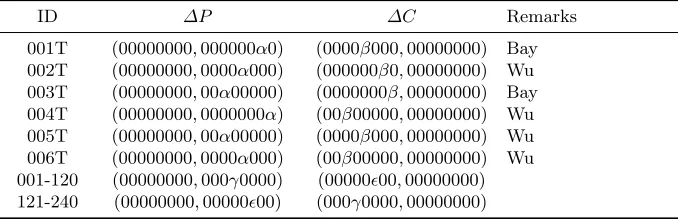
Our tool found six 8-round truncated impossible differentials, which are the same as results by Wu’s method. However, our method additionally found 2×120 impossible differential characteristics, which are not nibble-oriented truncated impossible differentials. We list all impossible differentials in Table 7, where α and β are any non-zero value. ID001–ID240 are impossible differential charac-teristics that our tool newly found. If the differences (γ, ϵ) takes differences that are shown byxin Table 8, the pairs of input and output differences is impossible differential characteristics.
5
Differential Possibility Equivalence Technique
In Sect. 4.1, we searched for all truncated impossible differentials with one active nibble. However, sinceShuffleCelland MixColumninMidori128 are byte-wise operations, we should search for all impossible characteristics with one active byte if possible. Moreover, the search in Sect 4.1 never exploited the property of
Table 7.8-Round Impossible Differential Characteristics against MIBS
ID ∆P ∆C Remarks
001T (00000000,000000α0) (0000β000,00000000) Bay 002T (00000000,0000α000) (000000β0,00000000) Wu 003T (00000000,00α00000) (0000000β,00000000) Bay 004T (00000000,0000000α) (00β00000,00000000) Wu 005T (00000000,00α00000) (0000β000,00000000) Wu 006T (00000000,0000α000) (00β00000,00000000) Wu 001-120 (00000000,000γ0000) (00000ϵ00,00000000) 121-240 (00000000,00000ϵ00) (000γ0000,00000000)
Table 8.Pairs of Impossible Differences Found by Our Tool for MIBS
ϵ
1 2 3 4 5 6 7 8 9 a b c d e f 1 x x x 0 x x 0 0 0 x 0 0 x 0 x 2 0 x 0 x x x 0 x x 0 0 0 x x 0 3 x 0 x x 0 0 0 x x x 0 0 0 x x 4 x x 0 x 0 0 0 0 0 x x x x x 0 5 x 0 0 0 x x 0 x x x x x 0 0 0 6 x 0 x x 0 x x 0 x 0 x 0 x 0 0 γ 7 0 0 0 0 0 x x x 0 x x 0 x x x 8 x x x 0 x 0 x x 0 0 x 0 0 x 0 9 0 x x 0 0 x x 0 x x 0 x 0 x 0 a 0 x 0 x x 0 x 0 x x x 0 0 0 x b x 0 0 0 x 0 x 0 x 0 0 x x x x c 0 0 x x x 0 x x 0 x 0 x x 0 0 d 0 0 x x x x 0 0 0 0 x x 0 x x e 0 x x 0 0 0 0 x x 0 x x x 0 x f x x 0 x 0 x x x 0 0 0 x 0 0 x
S
S
S
S
S
S
0
0
0
0
0
0
o
0
0
o
R rounds
c c
Fig. 4.Differential Possibility Equivalence Technique
5.1 Procedure of Differential Possibility Equivalence Technique
The differential possibility equivalence technique is useful technique to reduce the number of MILP instances that our tool has to solve.2 Figure 4 shows the outline of the technique. Assuming that we search for impossible differential characteristics in which the first words of plaintexts and ciphertexts are active, we want to evaluate (2c−1)2 pairs of input and output differences. First, we solve one MILP instance and obtain that (∆i → ∆′i → ∆′o → ∆o) is possible differential characteristic for one tuple of (∆i, ∆′i, ∆′o, ∆o). Next, we evaluate a set I whose elements are all ∆ such that ∆ → ∆′i is possible. Similarly, we evaluate a setO whose elements are all∆ such that∆′o→∆is possible. Then, pairs in (I × O) are always possible differential characteristics via (∆′i, ∆′o). Therefore, we do not need to evaluate all pairs in (I × O) using MILP. Since the numbers of elements in I andO are 2c/2 on average, we can efficiently reduce the number of MILP instances that our tool has to solve.
We estimate the effectiveness of differential possibility equivalence technique. Theorem 3. Let n and c be the number of S-boxes per round and the size of each S-box, respectively. Our tool aims to find impossible differential withdinput active words andd′ output active words. Then, the number of trials that we have to solve MILP instances is2d+d′((d+d′) log
e(2c−1) +O(1))on average. The proof of theorem 3 is shown in Appendix G. Accurately, we can more effi-ciently collectN input and output differences than the estimation by Theorem 3 because every trial can always choose a pair without duplication. On the other hand, this error is not serious becauseN′ differences are evaluated in the same time in one trial.
We searched for impossible differential characteristics with one active byte on Midori128 by using the differential possibility equivalence technique. In our experiment, this technique reduces the number of MILP instances that our tool has to solve from 224to 546865≈219. As a result, we found two new impossible differential characteristics, which are shown in Table 9. The total time that our 2 The motivation of the differential possibility equivalence technique is quite different
Table 9.7-Round Impossible Differential Characteristics againstMidori128
ID ∆P ∆C
Position Value Position Value
001 s1 0x04 s8 0x43
002 s1 0x0C s8 0x43
tool evaluates all impossible differential characteristics with one active byte is about 24 days in single core.
6
Applications from Design Aspect
6.1 Design Tool using Specific S-box Mode
Let us discuss using the tool for the design process of new primitives. Attack tools can always be used to evaluate how many rounds are attacked after the design is completed. Here we want to discuss a more interactive process. In many SPN-based designs, the designers evaluate many candidates with MILP and pick up the best choice. For example, the designers of Midori chose an almost-MDS matrix forMixColumn, and tested all parameters forShuffleCell. Similarly, the designers of Skinny tested all light non-MDS matrices for MixColumns and the designers of Minalpher tested all parameters of aShiftRows-like operation.
To run our tool in the specific S-box mode, S-boxes must be fixed in advance. This situation occurs when the choice of S-boxes has a high priority in the design. For example,Midori[13] chose the S-box with the lowest depth, and FIDES [31] and PICARO [32] chose the S-box that can be masked easily.
In our tool, all the components but for key schedule are simulated. Therefore, when we assume that subkeys are XORed to all words of the state before S-boxes, the tool can provide a certain level of proof, which is detailed below.
Observation 3 Suppose that the tool does not find any impossible differential characteristic for r rounds after testing all paired input and output differences in a certain subset in the specific S-box mode. Then, the number of rounds of the longest impossible differential satisfying those input and output differences is at most r−1 by assuming that all subkeys are independent and chosen uniformly at random.
Proof. Suppose that the tool can find specific differential propagations for given input and output differences. We now assume subkeys are XORed to all words of the state. Therefore, the output difference of any S-box are computed as
∆o=S(x⊕sk)⊕S(x⊕sk⊕∆i),
independent and chosen uniformly at random. Since ∆o can take all possible output differences in DDT, the differential propagations that the tool finds are
always valid in this assumption. ⊓⊔
If we can verify that all input and output differences with one active word are possible in the specific S-box mode, we say that the cipher is secure against im-possible differential with one active word under thesubkey uniform assumption.
Remarks about Proof in [18]. Cui et al. claimed that the tool can be used to prove the longest impossible differentials under the condition that input and output differences belong to the tested subset. After evaluating several ciphers, they claimed that“we proof that the longest impossible differentials for LBlock, TWINE and Piccolo ciphers are really 14, 14 and 7 rounds respectively.” Unfor-tunately, Cui et al. are misinterpreting what the tool does.
In the evaluation with MILP, all valid propagations for one round are also valid in the evaluation of multiple rounds irrespectively of the propagation in neighboring rounds and subkey values. This is true only if all subkeys are in-dependent and chosen uniformly at random. Therefore, even if no impossible differential is found for r rounds by MILP, it cannot ensure the non-existence forrrounds for real ciphers with particular key schedule.
6.2 Design Tool using Arbitrary S-box Mode
The arbitrary S-box mode is also useful for the design tool. When we run our tool in the specific S-box mode for the design tool, S-boxes must be fixed in advance. Meanwhile, if the choice of the linear layer has a higher priority, we would like to recommend the arbitrary S-box mode. The arbitrary S-box mode have two advantages: it can be executed before S-boxes are not specified and is generally more efficient than the specific S-box mode. In addition, the arbitrary S-box mode leads to several benefit to the designers.
Evaluating Linear Layer: The designers often test many choices of the S-boxes and of the linear layer. Because exhaustively testing all combinations is infeasible, the designers need to evaluate them independently. The arbitrary S-box mode finds impossible differential characteristics that are independent from the choice of the S-box, which makes possible to evaluate the security of the linear layer. In addition, the arbitrary S-box mode enables the designers to proceed the design of S-boxes and the design linear layer in parallel, which can shorten the design period.
Actually, impossible differential characteristics ID001–ID195 ofLilliputcan be found by both the specific and arbitrary S-box modes, but the others ID196– ID217 can be found only by the specific S-box mode. Thus, we can immediately know ID001–ID195 are impossible differential characteristics independent of the choice of the S-box and cannot be prevented by replacing the S-box.
Similarly to Sect. 6.1, the fact that no impossible differential is found gives a certain level of security proof as follows.
Observation 4 Suppose that the tool does not find any impossible differential characteristic for r rounds after testing all paired input and output differences in a certain subset in the arbitrary S-box mode. Then, the number of rounds of the longest impossible differential satisfying those input and output differences is at most r1 by assuming that all S-boxes are keyed bijective S-boxes that are independent and chosen uniformly at random.
If we can verify that all pairs of input and output differences with one active word are possible in the arbitrary S-box mode, we say that the cipher is secure against impossible differential with one active word under thekeyed (uniform) bijective S-boxes assumption.
6.3 Optimal Pick Technique; Application to MIBS
When ciphers have heavy diffusion layer, MILP solver requires too much time to verify whether or not a given pair of input and output differences is possible. For example, suppose that we evaluate resistance of MIBS against 9-round impossible differential. As discussed in Sect. 4.5, we need to test 14400 pairs of input and output differences. However, the tool could not finish the evaluation of 1 pair even after a couple of hours. Proving the security of 9-round MIBS with the direct application of our tool is infeasible.
Table 10.Provable Security against Impossible Differentials
Target #Rounds Assumption Remarks
Midori128
8 subkey uniform 1 active byte 8 keyed bijective 4-bit S-boxes 1 active byte 7 keyed bijective 8-bit S-boxes 1 active byte
Lilliput 10 subkey uniform 1 active nibble Minalpher 9.5 keyed bijective S-boxes 1 active nibble ARIA 5 keyed bijective S-boxes 1 active byte
MIBS 9 subkey uniform 1 active nibble
SIMON 12 subkey uniform 1 active bit
TWINE 15 subkey uniform 1 active nibble LBlock 15 subkey uniform 1 active nibble Piccolo 8 subkey uniform 1 active nibble RECTANGLE 9 subkey uniform 1 active nibble Skinny-64 12 subkey uniform 1 active nibble
Midori64 7 subkey uniform 1 active nibble
CLEFIA 10 keyed bijective 8-bit S-boxes 1 active byte
choice of constrainedbbits, we give up searching for thebbits, and test another b bits by expecting that the newbbits are easy to compute.
In application to 9-round MIBS, for pairs of input and output differences (X0, X9) we used the optimal pick technique with the following strategy.
– Four nibbles inX4 are additionally constrained (b= 16).
– For all 216 choices of additional constraints, we evaluate whether or not it is possible to satisfy (X0, X4, X9). If the execution time reaches 10 seconds, we stop the evaluation and proceed the next additional constraints.
– Once we find an additional constraint X4 satisfying the input and output differences (X0, X9), we return that the pair (X0, X9) is possible.
The second strategy is the essence of the optimal pick technique. The execution time of the MILP solver becomes too long for some choice ofX4, and the second strategy allows us to escape from the unlucky choice. As a result, we successfully proved that there is no 9-round impossible differential characteristics with one active nibble under the subkey uniform assumption. Note that the optimal pick technique only can be used for the proving approach, i.e. it cannot be used to find impossible differential characteristics because we terminate the MILP search when the execution time reaches 10 seconds.
6.4 List of Evaluated Designs
there are no impossible differential characteristics within the parameters of in-put and outin-put differences in Remark column. For example, if we regard SSbi in Midori128 as keyed 8-bit bijective S-boxes, we proved that there are no 7-round impossible differential characteristics with 1 active byte. However, if we exploit the structure ofSSbi and regardSb1 as keyed 4-bit bijective S-boxes, 7-round impossible characteristics can be found as explained in Sect. 4.1. In such an assumption, we proved that there are no 8-round impossible differential char-acteristics with 1 active byte. Moreover, 8 rounds are also secure in the subkey uniform assumption.
References
1. Mouha, N., Wang, Q., Gu, D., Preneel, B.: Differential and linear cryptanalysis using mixed-integer linear programming. In Wu, C., Yung, M., Lin, D., eds.: Inscrypt 2011. Volume 7537 of LNCS., Springer (2011) 57–76
2. Knudsen, L.: DEAL - a 128-bit block cipher. Technical report no. 151. Department of Informatics, University of Bergen, Norway (1998)
3. Biham, E., Biryukov, A., Shamir, A.: Cryptanalysis of skipjack reduced to 31 rounds using impossible differentials. In Stern, J., ed.: EUROCRYPT ’99. Volume 1592 of LNCS., Springer (1999) 12–23
4. Biryukov, A.: Miss-in-the-middle attack. In van Tilborg, H.C.A., ed.: Encyclopedia of Cryptography and Security. Springer (2005)
5. Kim, J., Hong, S., Sung, J., Lee, C., Lee, S.: Impossible differential cryptanalysis for block cipher structures. In Johansson, T., Maitra, S., eds.: INDOCRYPT 2003. Volume 2904 of LNCS., Springer (2003) 82–96
6. Luo, Y., Wu, Z., Lai, X., Gong, G.: A unified method for finding impossible dif-ferentials of block cipher structures. Cryptology ePrint Archive, Report 2009/627 (2009)
7. Luo, Y., Lai, X., Wu, Z., Gong, G.: A unified method for finding impossible differentials of block cipher structures. Inf. Sci.263(2014) 211–220
8. Wu, S., Wang, M.: Automatic search of truncated impossible differentials for word-oriented block ciphers. In Galbraith, S.D., Nandi, M., eds.: INDOCRYPT 2012. Volume 7668 of LNCS., Springer (2012) 283–302
9. Tezcan, C.: Improbable differential attacks on present using undisturbed bits. J. Computational Applied Mathematics259(2014) 503–511
10. Zhang, W., Bao, Z., Lin, D., Rijmen, V., Yang, B., Verbauwhede, I.: Rectangle: A bit-slice lightweight block cipher suitable for multiple platforms. Cryptology ePrint Archive, Report 2014/084 (2014)http://eprint.iacr.org/2014/084. 11. Derbez, P., Fouque, P.: Automatic search of meet-in-the-middle and impossible
differential attacks. In Robshaw, M., Katz, J., eds.: CRYPTO 2016, Part II. Volume 9815 of LNCS., Springer (2016) 157–184
12. Sun, S., Hu, L., Wang, P., Qiao, K., Ma, X., Song, L.: Automatic security evaluation and (related-key) differential characteristic search: Application to simon, present, lblock, DES(L) and other bit-oriented block ciphers. In Sarkar, P., Iwata, T., eds.: ASIACRYPT 2014 Part I. Volume 8873 of LNCS., Springer (2014) 158–178 13. Banik, S., Bogdanov, A., Isobe, T., Shibutani, K., Hiwatari, H., Akishita, T.,