ISSN (Print) : 2320 – 3765 ISSN (Online): 2278 – 8875
I
nternational
J
ournal of
A
dvanced
R
esearch in
E
lectrical,
E
lectronics and
I
nstrumentation
E
ngineering
(An ISO 3297: 2007 Certified Organization)
Vol. 3, Issue 8, August2014
Test the S27 Benchmark Circuit by Using Built
In Self Test and Test Pattern Generation
S.Nagaraju1, Ch.N.L.Sujatha2, J.S.S.Ramaraju3
1
M.Tech ECE Pursuing, Bhimavaram Institute of Engineering & Technology, West Godavari, A.P, India 2
Assistant Professor, Department of ECE, Bhimavaram Institute of Engineering & Technology, West Godavari, A.P, India 3
Assistant Professor, Department of ECE, Bhimavaram Institute of Engineering & Technology(BVRM), West Godavari,
A.P, India
ABSTRACT: - In the proposed method we are test the S27 sequential circuit by using Built in Self Test.This paper describes an on-chip test generation method for functional broadside tests. The hardware was base on the application of primary input sequences initial from a well-known reachable state, therefore using the circuit to produce additional reachable states. Random primary enter sequences were changed to avoid repeated synchronization and thus defer varied sets of reachable states. Functional broadside tests are two-pattern scan based tests that avoid over testing by ensuring that a circuit traverses only reachable states in the functional clock cycles of a check. These consist of the input vectors and the equivalent responses. They check for proper operation of a verified design by testing the internal chip nodes. Useful tests cover a very high percentage of modeled faults in logic circuits and their generation is the main topic of this method. Often, functional vectors are understood as verification vectors, these are used to verify whether the hardware actually matches its specification. Though, in the ATE world, any one vectors applied are understood to be functional fault coverage vectors applied during developing test. This paper show the on chip test Generation for a bench mark circuit using simple fixed hardware design with small no of parameters altered in the design for the generation of no of patterns. If the patterns of the input test vector results a fault simulation then circuit test is going to fail.
I.INTRODUCTION
Over testing due to the application of two-patterns can-based tests was described in [1]–[3]. Over testing is related to the detection of delay faults under non-functional operation situation. One of the reasons for these non-functional operation conditions is the following. When an arbitrary state is used as a scan-in state, a two-pattern test can take the circuit through state-transitions that cannot occur during functional operation. As a result, slow paths that cannot be sensitized during functional operation may cause the circuit to fail [1]. In addition, current demands that are higher than those possible during functional operation may cause voltage drops that will slow the circuit and cause it to fail [2], [3]. In both cases, the circuit will operate correctly during functional operation.
Functional broadside tests [4] ensure that the scan-in state is a state that the circuit can enter during functional operation, or a reachable state. As broadside tests [5], they operate the circuit in functional mode for two clock cycles after an initial state is scanned in. This results in the application of a two-pattern test.
ISSN (Print) : 2320 – 3765 ISSN (Online): 2278 – 8875
I
nternational
J
ournal of
A
dvanced
R
esearch in
E
lectrical,
E
lectronics and
I
nstrumentation
E
ngineering
(An ISO 3297: 2007 Certified Organization)
Vol. 3, Issue 8, August2014
Test generation procedures for functional and pseudo-functional scan-based tests were described in [4] and [6]–[13]. The procedures generate test sets offline for application from an external tester. Functional scan-based tests use only reachable states as scan-in states. Pseudo-functional scan-based tests use functional constraints to avoid unreachable states that are captured by the constraints.
This work considers the on-chip (or built-in) generation of functional broadside tests. On-chip test generation reduces the test data volume and facilitates at-speed test application. On-chip test generation methods for delay faults, such as the ones described in [14] and [15], do not impose any constraints on the states used as scan-in states. Experimental results indicate that an arbitrary state used as a scan-in state is unlikely to be a reachable state [4]. The on-chip test generation method from [16] applies pseudo-functional scan-based tests. Such tests are not sufficient for avoiding unreachable states as scan-in states. The on-chip test generation process described in this work guarantees that only reachable states will be used.
It should be noted that the delay fault coverage achievable using functional broadside tests is, in general, lower than that achievable using arbitrary broadside tests as in [14], [15] or pseudo-functional broadside tests as in [16]. This is due to the fact that functional broadside tests avoid unreachable scan-instates, which are allowed by the methods described in [14]– [16]. However, the tests that are needed for achieving this higher fault coverage are also ones that can cause over testing. They can also dissipate more power than possible during functional operation.
Only functional broadside tests are considered in this work. Under the proposed on-chip test generation method, the circuit is used for generating reachable states during test application.
This alleviates the need to compute reachable states or functional constraints by an offline process as in [4], [6]–[13] and [16]. The underlying observation is related to one of the methods used in [4] for offline test generation, and is the following.
If a primary input sequence A is applied in functional mode starting from a reachable state, all the states traversed under A are reachable states. Any one of these states can be used as the initial state for the application of a functional broadside test. By generating A on-chip and ensuring that it takes the circuit through a varied set of reachable states, the on-chip test generation process is able to achieve high transition fault coverage using functional broadside tests based on A. It should be noted that, for the detection of a set of faults F, at most |F| different reachable states are required. This number is typically only a small fraction of the number of all the reachable states of the circuit. Thus, the primary input sequence A does not need to take the circuit through all its reachable states, but only through a sufficiently large number relative to |F|, in order to be effective for the detection of target faults.
The hardware used in this paper for generating the primary input sequence A consists of a linear-feedback shift-register (LFSR) as a random source [17], and of a small number of gates (almost six gates are needed for every one of the benchmark circuits considered). The gates are used for modifying the random sequence in order to avoid cases where the sequence takes the circuit into the same or similar reachable states repeatedly. This is referred to as repeated synchronization [18]. In addition, the on-chip test generation hardware consists of a single gate that is used for determining which tests based on will be applied to the circuit. The result is a simple and fixed hardware structure, which is tailored to a given circuit only through the following parameters.
1) The number of LFSR bits.
2) The length of the primary input sequence.
3) The specific gates used for modifying the LFSR sequence into the sequence.
4) The specific gate used for selecting the functional broadside tests that will be applied to the circuit based on. 5) Seeds for the LFSR in order to generate several primary input sequences and several subsets of tests.
ISSN (Print) : 2320 – 3765 ISSN (Online): 2278 – 8875
I
nternational
J
ournal of
A
dvanced
R
esearch in
E
lectrical,
E
lectronics and
I
nstrumentation
E
ngineering
(An ISO 3297: 2007 Certified Organization)
Vol. 3, Issue 8, August2014
II. BLOCK DIAGRAM OF LFSR RESEEDING SCHEME
Fig: Simple BIST circuitry.
Linear feedback shift register (LSFR) is a shift register whose input bit is a linear function of its previous state. The only linear function of single bits is XOR, thus it is a shift register whose input bit is driven by the exclusive-or (XOR) of some bits of the overall shift register value flops. The initial value of the LFSR is called the seed, and the operation of the register is deterministic, the stream of values produced by the register is completely determined by its current (or previous) state. The seed is used to generate a test pattern and their corresponding test cube. The LFSR length, r, is at least smax+20 where smax is the maximum number of specified bits in any test cube. The r-bit LFSR is initialized with a starting r-bit seed. This initial seed is used to generate the first test cube by running the LFSR for m clock cycles (where m is the scan length) to fill the scan chains.
III. BROADSIDE TESTS IN PARTIAL-SCAN CIRCUITS
ISSN (Print) : 2320 – 3765 ISSN (Online): 2278 – 8875
I
nternational
J
ournal of
A
dvanced
R
esearch in
E
lectrical,
E
lectronics and
I
nstrumentation
E
ngineering
(An ISO 3297: 2007 Certified Organization)
Vol. 3, Issue 8, August2014
IV. PESUDO RANDOM TEST GENERATION
The three primary goals were:
(a) to develop a battery of statistical tests to detect non randomness in binary sequences constructed using random number generators and pseudorandom number generators utilized in cryptographic applications,
(b) To produce documentation and a software implementation of these tests, and
(c) To provide guidance in the use and application of these tests. Pseudorandom- generate patterns that appear to be random but are in fact deterministic (repeatable).Linear Feedback Shift Register (LFSR) Weighted pseudo-random test generation Adaptive pseudo-random test generation
2.3.1 Algorithmic Test Generation
List primary inputs controlling location where a fault should be detected.
Determine primary input conditions to activate a fault and to sensitize the primary outputs such that the fault can be observed.
2.3.2 Linear Feedback Shift Registers (LFSRs)
Efficient design for Test Pattern Generators & Output Response Analyzers (also used in CRC) FFs plus a few XOR gates better than counter
• Fewer gates
• Higher clock frequency
• Two types of LFSRs External Feedback, Internal Feedback • Higher clock frequency
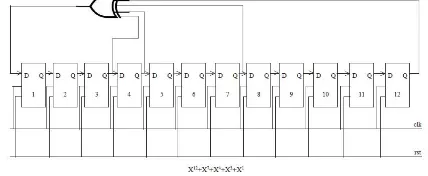
An LFSR generates periodic sequence must start in a non-zero state, The maximum length of an LFSR sequence is 2n -1 does not generate all 0s pattern (gets stuck in that state)The characteristic polynomial of an LFSR generating maximum-length sequence is a primitive polynomial A maximum-maximum-length sequence is pseudo-random: number of 1s =number of 0s + 1 same number of runs of consecutive 0s and 1s 1/2 of the runs have length1 1/4 of the runs have length 2 (as long as fractions result in integral numbers of runs).
Figure 1.5 LFSR 12bit circuit
OUTPUT OF LFSR
u LFSR(u)
0 101 011 100 100
1 010 101 110 010
2 001 010 111 001
3 100 101 011 100
ISSN (Print) : 2320 – 3765 ISSN (Online): 2278 – 8875
I
nternational
J
ournal of
A
dvanced
R
esearch in
E
lectrical,
E
lectronics and
I
nstrumentation
E
ngineering
(An ISO 3297: 2007 Certified Organization)
Vol. 3, Issue 8, August2014
5 001 001 010 111
6 100 100 101 011
7 110 010 010 101
8 111 001 001 010
9 011 100 100 101
10 101 110 010 010
11 010 111 001 010
12 001 011 100 101
13 100 101 110 010
14 010 010 111 001
15 101 001 011 100
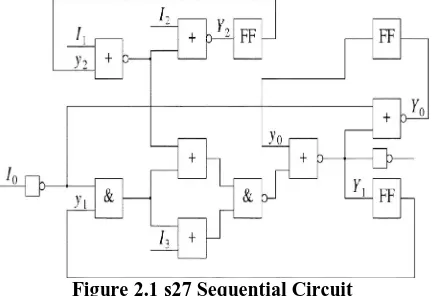
V. SEQUENTIAL BENCHMARK CIRCUIT s27
• Logic Gates are taken at Primary input combination in (2^4=16).
• S27 circuit have three scan circuits (f/f „s) and then its scan inputs are 2^3=8. • S_a_0 fault generates at logic gate (a3).
• Scan-in-state input are s0, s1, s2 and it’s scanned out denoted as s.
• LFSR register values initially at “1010”. Circuit considered above, let 000xx 00, 1x01x01,0x1xx 01, 11x00 00, 10111 10. We note that is unspecified in the two un scanned state variables. This implies that can be used as a scan-in state instead of and the first two patterns of the test can be omitted. The resulting test would be 0x1x 01.In the scan-in state of this test, we can specify the value of arbitrarily. Suppose that is specified to 1, and suppose that this causes the value of in to be specified to 0.We obtain 011xx 01, 11000 00, 10111 10. The last three states traversed under are 0x1xx, 11x00 and 10111. With more specified values under, more faults are likely to be detected. In general, to obtain a shorter test from a given test of length, we consider we search for the highest time unit such that has unspecified values on all the un scanned since is selected such that it is unspecified on the un scanned state variables. For a full-scan circuit, all the tests will be of length two. This is due to the fact that all the states are fully-specified.
ISSN (Print) : 2320 – 3765 ISSN (Online): 2278 – 8875
I
nternational
J
ournal of
A
dvanced
R
esearch in
E
lectrical,
E
lectronics and
I
nstrumentation
E
ngineering
(An ISO 3297: 2007 Certified Organization)
Vol. 3, Issue 8, August2014
Applying test vectors as input to the s27 bench mark sequential circuit.
I0, I1, I2, I3 are the input of this circuit.
Output of s27 benchmark
u Lfsr(u) I value o/p of s27
0 101 011 100 100 1 0 0 1 X
1 010 101 110 010 1 1 1 0 X
2 001 010 111 001 0 0 1 0 X
3 100 101 011 100 1 1 0 1 1
4 010 010 101 110 1 0 0 1 1
5 001 001 010 111 0 0 0 1 1
6 100 100 101 011 1 1 0 0 0
7 110 010 010 101 1 0 0 1 0
8 111 001 001 010 1 0 0 0 0
9 011 100 100 101 1 1 0 1 0
10 101 110 010 010 1 1 0 0 0
11 010 111 001 001 1 1 0 0 0
12 101 011 100 100 1 0 0 1 0
13 010 101 110 010 1 1 1 0 0
14 001 010 111 001 0 0 1 0 0
15 100 101 011 100 1 1 0 1 1
VI. RESULT ANALYIS
ISSN (Print) : 2320 – 3765 ISSN (Online): 2278 – 8875
I
nternational
J
ournal of
A
dvanced
R
esearch in
E
lectrical,
E
lectronics and
I
nstrumentation
E
ngineering
(An ISO 3297: 2007 Certified Organization)
Vol. 3, Issue 8, August2014
ISSN (Print) : 2320 – 3765 ISSN (Online): 2278 – 8875
I
nternational
J
ournal of
A
dvanced
R
esearch in
E
lectrical,
E
lectronics and
I
nstrumentation
E
ngineering
(An ISO 3297: 2007 Certified Organization)
Vol. 3, Issue 8, August2014
Design summary
Output waveform
VII. CONCLUSION
The presence of delay-inducing defects is causing increasing concern in the semiconductor industry today. To test for such delay-inducing defects, scan-based transition fault testing techniques are being implemented. On-chip test generation has the advantage
It reduces test data volume
Facilitates at-speed test application.
Achieves high fault coverage.
The hardware used in this paper for generating the primary input sequence A consists of a linear-feedback
shift-register (LFSR) as a random source and of a small number of gates.
ISSN (Print) : 2320 – 3765 ISSN (Online): 2278 – 8875
I
nternational
J
ournal of
A
dvanced
R
esearch in
E
lectrical,
E
lectronics and
I
nstrumentation
E
ngineering
(An ISO 3297: 2007 Certified Organization)
Vol. 3, Issue 8, August2014
1.J. Rearick, “Too much delay fault coverage is a bad thing,” in Proc. Int.Test Conf., Oct. 2001, pp. 624–633.
2. J. Saxena, K. M. Butler, V. B. Jayaram, S. Kundu, N. V. Arvind, P.Sreeprakash, and M. Hachinger, “A case study of IR-drop in structuredat-speed testing,” in Proc. Int. Test
Conf., 2003, pp. 1098–1104.
3. Pomeranz, “On the generation of scanbased test sets with reachablestates for testing under functional operation conditions,” in Proc. Des. Autom. Conf., Jun. 2004, pp. 928–933.
4. Y.-C Lin, F. Lu, K. Yang, and K.-TCheng, “Constraint extraction forpseudofunctional scan-based delay testing,” in Proc.Asia South Pacific Des. Autom. Conf., Jan.2005, pp. 166–171.
5. Z. Zhang, S. M. Reddy, and I.Pomeranz, “On generating pseudo-functionaldelay fault tests for scan designs,” in Proc. Int.Symp. Defect Fault Toler. VLSI Syst., Oct.2005, pp. 398–405.
6. Pomeranz and S. M. Reddy,“Generation of functional broadside tests fortransition faults,” IEEE Trans. Comput.-AidedDes. Integr. Circuits Syst., vol. 25, no. 10, pp.2207–2218, Oct.
[7] Y.-C. Lin, F. Lu, K. Yang, and K.-T. Cheng, “Constraint extraction for pseudo-functional scan-based delay testing,” in Proc. Asia South Pacific Design Autom. Conf., 2005, pp. 166–171.
[8] Z. Zhang, S.M. Reddy, and I. Pomeranz, “On generating pseudo-functional delay fault tests for scan designs,” in Proc. Int. Symp. Defect Fault Toler. VLSI Syst., 2005, pp. 398–405.
[9] I. Polian and F. Fujiwara, “Functional constraints vs. test compression in scan-based delay testing,” in Proc. Design, Autom. Test Euro. Conf., 2006, pp. 1–6.
[10] M. Syal et al., “Astudy of implication based pseudo functional testing,” in Proc. Int. Test Conf., 2006, pp. 1–10.
[11] A. Jas, Y.-S. Chan, andY.-S. Chang, “An approach tominimizing functional constraints,” in Proc. Defect Fault Toler. VLSI Syst., 2006, pp. 215–226. [12] H. Lee, I. Pomeranz, and S. M. Reddy, “On complete functional broadside tests for transition faults,” IEEE Trans. Comput.-Aided Design Integr. Circuits Syst., pp. 583–587, 2008.
[13] I. Pomeranz and S. M. Reddy, “On reset based functional broadside tests,” in Proc. Design Autom. Test Euro. Conf., 2010, pp. 1438–1443.
[14] H. Lee, I. Pomeranz, and S.M. Reddy, “Scan BIST targeting transition faults using a Markov source,” in Proc. Int. Symp. Quality Electron. Design, 2004, pp. 497–502.