Triangular Routing In Mobile IP for Future
Generation Internet
Anurag Dhyani1, Preeti Mishra2
Research Scholar, Dept. of ECE, G.I.T.M, Lucknow, Uttar Pradesh, India1
Assistant Professor, Dept. of ECE, S.R.I.M.T, Lucknow, Uttar Pradesh, India2
ABSTRACT: - Internet is known as the group of interconnected networks. The number of applications and services through the Internet is increasing exponentially globally. Arrival of smart handheld devices put Internet in the pockets of the users. The work described in the paper attempts to provide the various challenges for the Fu-Gen Internet like IP mobility. Whenever any mobile host disconnect from one network or changes its access point and moved to another access point or connected to another network then simultaneously mobile host gets a new IP address then previous session was disconnected. This mobile nature of mobile host is known as mobility. The primary requirement for the mobile host is to remain connected even in case of change in IP address. To control IP mobility during changing network access point some methods like route optimization have been also proposed which compensates the problem of triangular routing in mobile IP. Mobility for the mobile hosts are very essential and it needs to be energy efficient too. Although some methods like route optimization have been discussed which is not able to provide energy efficient mobility so further we need some energy efficient solution. However, to deploy IPTV services with a full quality of service (QoS) guarantee, many underlying technologies must be further studied. This paper described some of the probable solution for the energy efficient mobility for the Fu-Gen Internet networks. There is enough scope for doing further research work in the area of energy efficient mobility.
KEYWORDS-: IPTV, QoS, VoD, FTP, TCP, VNL.
I. INTRODUCTION
The favoured name for this is Internet. Whether you wish to seek out the newest money news, flick through library catalogues, exchange data with colleagues or to take part a full of life political dialogue, the web is the tool that may take you on the far side telephones, faxes and isolated computers to a burgeoning networked data frontier. The Internet supplements the standard tools you employ to assemble data, knowledge Graphics, News and correspond with others. Used skillfully, the web shrinks the globe and brings data, expertise and data on nearly each subject thinkable straight to your pc. The Internet links area unit laptop network everywhere the planet so users will share resources and communicate with one another. It was projected nearly a decade ago that the future generation Internet (Fu-Gen internet) aimed to develop breakthrough merchandise and systems created manifest through the Internet [1]. NGI (Next generation Internet) becoming popular and of more and more devices becoming IP supported and connected to the Internet networks [2] and accessible across the various geographical locations and ranges. The Internet has changed a lot since last two decades, now it is providing new real time applications like audio and video streaming.
(VNL) rollouts of its Home Choice video, triple play service over DSL use a Cisco Internet Protocol next-generation network (IP NGN) solution in the United Kingdom (UK).
The Fu-gen Internet should be fully secure [3], able to provide good quality of service [4] with improved data rate. It should protect the rights of the citizen of any country in the Internet. It should also apply certain policies for people how, when and where they can access their information. Next generation Internet should be design in such a way that it supports energy en efficient mobility for devices like laptops, PDA, smart phones.
1.1 Mobility issues in Fu-Gen Internet
Due to the arrival of IP connectivity enabled devices such as smart cell phones, PDA or handheld devices, that has changed our thinking for the Internet. To understand the current trends in IP connectivity and the future aspects we have to look at the transition towards the IP mobility in the telephony over the last 20 years [5]. Generally these IP address is fixed according to the network geographical location. However there are some technical challenges for making mobile networking worldwide accepted. During this time duration mobile networking had just begun. In Mobile networking all the computing activities remain connected even when there is change in Internet access point for computing device at any instance.
So here in this paper we will discuss the technical challenges present in the mobility for the Fu-Gen Internet, the most fundamental one was which we have mentioned earlier is Internet protocol(IP) mobility. Changing mobile address makes transparent IP mobility impossible [5].The necessity of mobility support in Internet because of following reasons.
a. Proliferation of wireless devices: - Due to the proliferation of mobile devices, cell phones, laptops, PDA. Due to this users remain connected to the Internet any time anywhere. Internet lacks largely to provide mobility support effectively.
b. Reachability:- For peer-to-peer applications host will need to be reachable.
II. RELATED WORK
The original Internet was intended as host centric and was alleged that its infrastructure is such that two host can easily communicate with each other. The unusual design of internet is presumed to be a system having motionless end host in surroundings which is friendly for universities and all other government agencies. The host centric design system of present Internet do not recognize the data and end-users and as an integral independent existence. Now, the whole scenario of internet is changed. Now the primary means of communication inside and between the organizations.
The original design of internet was simple and elegant. Increasing pressure of changing design and abrupt rise in popularity, the internet design has to incorporate some standard as well as non standard extensions , which made, the design much more complicated and attributed a huge disarray is trying to define underlying principles.
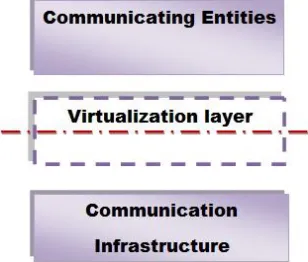
In Data-centric view of internet, a data requester views the abstracts of information or service coming from. The archetype of the transport layer becomes a problem for many mobile applications. The security model is also a concern in the present model of internet.The two part abstract model of communication stack is shown in figure 1.
The bottom part of the infrastructure performs the actual physical connection between two communicating bodies and the upper part provides end-to-end logical connection between two communicating bodies. Between upper and bottom part, there should be a layer which is used to maintain the logical connections and locates to physical connections. This layer acts as a virtual layer which is used to compute any type of end-to-end connection over the structure.
opportunities. In parallel, a revolving point is coming in communications networks with the progressive foreword of virtualization and of software based network functionalities to offer the necessary suppleness and reactivity.
Figure 1: Two Part Abstract Model
Many applications entail that the network be further data centric and that it should move away from its novel host centric design. Data centric view abstracts a data requestor from having to be acquainted with where the data comes from PONA (“Policy Oriented Naming Architecture) provides a broad architecture which allows us to implement data-centric, host-data-centric, and user-centric Internet structural design. In this approach each realm can put into effect of its own policies on the traffic while also giving services to its members. PONA entities can assign proxies to symbolize them still when the object is away or inactive (for energy efficiency).
The protocol stack for internet network consists of an infrastructure which consists of two major parts: on the bottom part is the infrastructure of the network and services and data on the top. The role of new infrastructure of the internetwork is to provide the unique points of attachment to the network. These points of attachments are uniquely identified by the locators (or addresses).the new infrastructure has the protocols which are used to find the most likely paths from one address to another. The change in IP will make it more efficient.
Internet Protocol Television (IPTV) will be the killer appliance for the next-generation Internet and will offer exhilarating new profits opportunities for service providers. However, to deploy IPTV services with a full excellence of service (QoS) reassurance, many essential technologies must be advance studied. This article serves as a survey of IPTV services and the essential technologies. Technical challenges also are acknowledged.
Internet Protocol television (IPTV) provides digital television services over Internet Protocol (IP) for inhabited and industry users at a lower cost. These IPTV services embrace commercial grade multicasting TV, voice over IP (VoIP), video on demand (VoD), triple play, and Web/email access, well outside habitual cable television services. IPTV is a union of communication, computing, and content [10], as well as an amalgamation of broadcasting and telecommunication. IPTV has a different infrastructure from TV services, which use a push allegory in which all the content is pushed to the users [10]. IP infrastructure is based on individual choices, combining push and pull, depending on people’s requirements and benefit [10]. Therefore, IPTV has two-way interactive communications involving operators and users, for example, streaming control functions such as pause, forward, rewind, and so on, which conventional cable television services be deficient in.
III. IP MOBILITY
a. Physical/Link layer
This layer provide Fast and seamless mobility, but limited to one single technology (e.g., 2G and 2.5G cellular networks [39], or IEEE802.11b [6]). The physical and link layers will report current channel conditions and link properties severally to higher layers, which might then adapt to mobility-incurred problems, particularly, the network non uniformity.
b. Network layer
It is the only common layer, therefore only one solution is required, but it is tricky to do it optimally. It
handles the IP handoff management and support forterminal mobility.
c. Transport layer
It would require different solutions for the mobility at each transport protocol (e.g., mSCTP [7]).The transport layer, by providing reliable end-to-end knowledge delivery, will decrease the packet ratio attributable to the fallible wireless channels and therefore the user’s quality.
d. Application layer
Some applications already provide mobility support, but again every application would require to provide mobility support (e.g., SIP). It takes care of high level mobility task.
3.1 Mobile IP
As we have discussed in section 3.1 Mobility means any active connection remains active regardless of any movements and that particular host always remain connected to the Internet network. Such scenario can be seen in case of smart phones which itself work as a portable computer in the modern era of the technology where it remains connected as they move from one place or one access point to another place or access point.
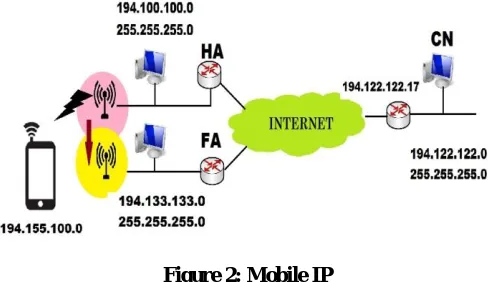
Generally wireless hosts are mobile in nature, which changes their location with respect to time. This mobile nature of host may connect host to different networks at different point of time. Here the mobility problem is starts as shown in the given figure 2.
Figure 2: Mobile IP
keep receiver and send packet data. Although Changing the IP address of the mobile node (for a topologically correct one) solves the problem of connectivity, but some issues are there in this.
1. Any open connections would need to be restarted.
2. If the mobile node has any domain name then every time we have to update the DNS.
3.2 Mobile IP Features
a. User can move any where any time and remain connected with Internet by using mobile devices such as smart
phones.
b. We can easily connect our device automatically with nearby routers without any wired connections (such as
Ethernet).
c. It is fully secured and equipped with user authentication feature so no unauthorized user can ever access the
internet.
d. To support these mobile IP feature we only need mobility aware routers in network.
3.3 Functions of Mobile IP
Over all function of mobile IP is divided into three systems.
a. Agent Discovery System
In the agent discovery mobility agents provides their availability over links for which they can provide services. The basic operation involves receiving the agent advertisement message from the FA. A MN can also send agent solicitation message to get the information about approaching mobile agents.
b. Registration
This function comes into picture when ever mobile node goes away from the home then in that case it has to register with foreign agent with an address CoA(care of address). MN get register with this CoA with the help of it’s HA. Further HA updating the binding updates by combining current CoA of MN with its permanent IP address.
c. Information Transfer
When mobile node goes away from the home network to another network then this function takes care of the packet data transfer to the mobile node.
IV. PROBLEMS AND LIMITATIONS a. Lack of efficiency
There are solutions proposed for Mobile IP but they do not seem to have solved all issues in IPv4.
b. Drawbacks
Figure 3: Triangular Routing V. PROPOSED WORK
We have three possible solutions to make the mobility energy efficient [9].
a. Energy efficient mobility using Network power weights
This approach is based on the fact that it only considers the paths which are having the minimum power consumption.
Figure 4: Network with power weights
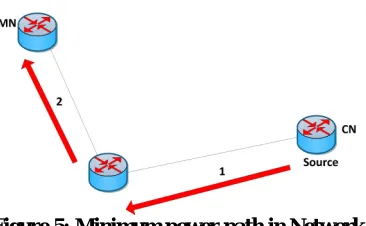
To find the minimum power consumption path in a network firstly consider a network N which is having N(V; E) where V is the set of routers and E is the set of links. Assuming the individual weights of links we can apply Dijkstra algorithm and find out the minimum power travelled path from correspondent node (CN) to Mobile node(MN) as shown in the figure 5.
Figure 5: Minimum power path in Network
b. Energy efficient mobility using Network Energy Consumption
In the previous approach we have considered the power consumption by the individual links and then further calculated minimum power consuming path in a Internet network using Dijkstra algorithm.
Figure 6: Minimum Energy consumption path in Network
This amount of power is denoted by Pmin. The current approach is quite associated with the last approach and here we
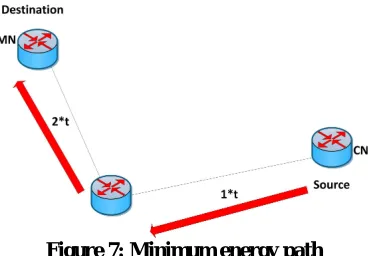
shall try to calculate the ET Total energy consumption in given network. Since we know that every link have certain latency so we will consider the work. Since we know that every link has certain latency so we will consider the latency for each and individual link in the given network which is denoted by t.
Figure 7: Minimum energy path
The latency for the different links can be different , the amount of total energy consumption in given network is calculated by multiplying Pmin and Latency(t).
Total Energy consumption (ET) = (Pmin * Latency ) = Pmin*t
c. Energy efficiency using traffic management
This approach seems to be a efficient method to provide energy efficient mobility for the Fu-Gen Internet. Let us consider a given network N which is having N(V; E) where V is the set of routers and E is the set of links. Assuming this Internet network as a network of a particular city which is normally consist of two areas one is suburban and another is urban. In these two areas we have certain routers for handling data traffic.
Whole approach can be summarize as.
(a) Consider routers state high (loaded) and low (unloaded) and then on and off them according to the requirement of data packet transfer during peak hours.
(b) Total energy ET changes to ET' because some of the routers goes to low power mode.
VI. CONCLUSION
In this paper initially we present the challenges for the Fu-Gen Internet then we discussed the operation of mobile IP. Then we have discussed the mobility challenges for the Mobile IP and route optimization. The problem of triangular routing is resolved by route optimization but this is also unable to provide energy efficient mobility In the Internet network where each and every component put some contribution in the overall power consumption of the network. Finally by this method we cannot talk about the energy efficiency for the mobility. In the third approach we proposed a traffic management based method where we have present a solution to get energy efficient mobility where the traffic allocation is priority based. So we proposed some of the possible solutions for energy efficient mobility. First two methods based on the link based minimum power and energy calculation but they are now energy efficient because network always remains in ON state and networks components likes routers, switches consumes certain amount of power consistently. Although we have smart routers now a day which consumes less amount of power.
REFERENCES
[1] Anthony M Rutkowski. Understanding next generation internet. Communications Magazine, IEEE, 37(9):99{102, 1999.
[2] Wen Tong, Edward Sich, Peiying Zhu, and J Costa. True broadband multimedia experience. Microwave Magazine, IEEE, 9(4):64-71, 2008. [3] Steven Michael Bellovin, David D Clark, Adrian Perrig, and Dawn Song. A clean-slate design for the next-generation secure internet. 2006. [4] Zheng Wang. Internet QoS: architectures and mechanisms for quality of service. Morgan Kaufmann, 2001.
[5] Charles E. Perkins. Mobile networking through mobile ip. Internet Computing, IEEE, 2(1):58-69, 1998.
[6] Kalle Ahmavaara, Henry Haverinen, and Roman Pichna. Interworking architecture between 3gpp and wlan systems. Communications Magazine, IEEE, 41(11):74-81, 2003.
[7] Seok Jon Koh, Hee Young Jung, and Jae Hong Min. Transport layer internet mobility based on msctp. Advanced Communication Technology, ICACT, 1:329-333, 2004.
[8] Jukka Manner, Markku Kojo, T Suihko, P Eardley, and D Wisely. Mobility related terminology. Technical report, RFC 3753, June, 2004. [9] Maruti Gupta and Suresh Singh. Greening of the internet. In Proceedings of the 2003 conference on Applications, technologies, architectures, and
protocols for computer communications, pages 1926. ACM, 2003.
[10] Norman Abramson. Development of the aloha net. Information Theory, IEEE Transactions on, 31(2):119-123, 1985.
BIOGRAPHY
Mr. Anurag Dhyani done his B.Tech in Electronics & Communication Engineering. He is having 5+ years of teaching experience and his area of interest is wireless communication and antenna design and applications.