Signature Schemes
Michel Abdalla, Fabrice Ben Hamouda, and David Pointcheval Departement d’Informatique, ´Ecole normale sup´erieure, Paris, France. {Michel.Abdalla,Fabrice.Ben.Hamouda,David.Pointcheval}@ens.fr
http://www.di.ens.fr/users/{mabdalla,fbenhamo,pointche}
Abstract. In this paper, we revisit the security of factoring-based sig-nature schemes built via the Fiat-Shamir transform and show that they can admit tighter reductions to certain decisional complexity assump-tions such as the quadratic-residuosity, the high-residuosity, and the φ-hiding assumptions. We do so by proving that the underlying identifi-cation schemes used in these schemes are a particular case of the lossy identification notion recently introduced by Abdallaet al.at Eurocrypt 2012. Next, we show how to extend these results to the forward-security setting based on ideas from the Itkis-Reyzin forward-secure signature scheme. Unlike the original Itkis-Reyzin scheme, our construction can be instantiated under different decisional complexity assumptions and has a much tighter security reduction. Finally, we show that the tighter secu-rity reductions provided by our proof methodology can result in concrete efficiency gains in practice, both in the standard and forward-security setting, as long as the use of stronger security assumptions is deemed acceptable. All of our results hold in the random oracle model.
1
Introduction
A common paradigm for constructing signature schemes is to apply the Fiat-Shamir transform [9] to a secure three-move canonical identification protocol. In these protocols, the prover first sends a commitment to the verifier, which in turn chooses a random string from the challenge space and sends it back to the prover. Upon receiving the challenge, the prover sends a response to the verifier, which decides whether or not to accept based on the conversation transcript and the public key. To obtain the corresponding signature scheme, one simply makes the signing and verification algorithms non-interactive by computing the challenge as the hash of the message and the commitment. As shown by Abdallaet al.in [1], the resulting signature scheme can be proven secure in the random oracle model as long as the identification scheme is secure against passive adversaries and the commitment has large enough min-entropy. Unfortunately, the reduction to the security of the identification scheme is not tight and loses a factor qh, whereqh denotes the number of queries to the random oracle.
If one assumes additional properties about the identification scheme, one can avoid impossibility results such as those in [10,27,31] and obtain a signature
c
scheme with a tighter proof of security. For instance, in [22], Micali and Reyzin introduced a new method for converting identification schemes into signature schemes, known as the “swap method”, in which they reverse the roles of the commitment and challenge. More precisely, in their transform, the challenge is chosen uniformly at random from the challenge space and the commitment is computed as the hash of the message and the challenge. Although they only provided a tight security proof for the modified version of Micali’s signature scheme [20], their method generalizes to any scheme in which the prover can compute the response given only the challenge and the commitment, such as the factoring-based schemes in [8,9,12,24,25]. This is due to the fact that the prover in these schemes possesses a trapdoor (such as the factorization of the modulus in the public key) which allows it to compute the response. On the other hand, their method does not apply to discrete-log-based identification schemes in which the prover needs to know the discrete log with respect to the commitment when computing the response, such as in [30].
In 2003, Katz and Wang [17] showed that tighter security reductions can be obtained even with respect to the Fiat-Shamir transform, by relying on a proof of membership rather than a proof of knowledge. In particular, using this idea, they proposed a signature scheme with a tight security reduction to the hard-ness of the DDH problem. They also informally mentioned that one could obtain similar results based on the quadratic-residuosity problem by relying on a proof that shows that a set of elements inZ∗
N are all quadratic residues. This result was recently extended to other settings by Abdallaet al.[3], who presented three new signature schemes based on the hardness of the short exponent discrete log problem [28,32], on the worst-case hardness of the shortest vector problem in ideal lattices [18,29], and on the hardness of the Subset Sum problem [14,23]. Additionally, they also formalized the intuition in [17] by introducing the notion of lossy identification schemes and showing that any such schemes can be trans-formed into a signature scheme via the Fiat-Shamir transform while preserving the tightness of the reduction.
Tight security from lossy identification.In light of these recent results, we revisit in this paper the security of factoring-based signature schemes built via the Fiat-Shamir transform. Even though the swap method from [22] could be applied in this setting (resulting in a slightly different scheme), our first con-tribution is to show that these signature schemes admit tight security reductions to certain decisional complexity assumptions such as the quadratic-residuosity, the high-residuosity [26], and theφ-hiding [6] assumptions. We do so by showing that the underlying identification schemes used in these schemes are a particular case of a lossy identification scheme [3]. As shown in Section 4.1 in the case of the Guillou-Quisquater signature scheme [12], our tighter security reduction can result in concrete efficiency gains with respect to the swap method. However, this comes at the cost of relying on a stronger security assumption, namely the φ-hiding [6] assumption.
built via the Fiat-Shamir transform does not need to know the factorization of the modulus in order to be able to compute the response. Using this crucial fact, the second main contribution of this paper is to extend our results to the forward-security setting. To achieve this goal, we first introduce in Section 3 the notion of lossy key-evolving identification schemes and show how the latter can be turned into forward-secure signature schemes using a generalized version of the Fiat-Shamir transform. As in the case of standard signature schemes, this transformation does not incur a loss of factor of qh in the security reduction. Nevertheless, we remark that the reduction is not entirely tight as we lose a factorT corresponding to the total number of time periods.
After introducing the notion of lossy key-evolving identification schemes, we show in Section 4.2 that a variant of the Itkis-Reyzin forward-secure signature scheme [15] (which can be seen as an extension of the Guillou-Quisquater scheme to the forward-security setting) admits a much tighter security reduction, albeit to a stronger assumption, namely theφ-hiding assumption.
Concrete security.As in the case of standard signature schemes, the tighter security reductions provided by our proof methodology can result in concrete efficiency gains in practice. More specifically, as we show in Section 5, our variant of the Itkis-Reyzin scheme outperforms the original scheme for most concrete choices of parameters.
Generic factoring-based signatures and forward-secure signatures. As an additional contribution, we show in Section 6 that all the above-mentioned schemes can be seen as straightforward instantiations of a generic factoring-based forward-secure signature scheme. This enables us to not only easily prove the security properties of these schemes, but to also design a new forward-secure scheme based on a new assumption, the 2t-strong-residuosity.
Organization. After recalling some definitions in Section 2, we introduce the notion of key-evolving lossy identification scheme and show how to transform such a scheme into a forward-secure signature scheme in Section 3. Then, in Section 4, we apply our security proof methodology to two cases: the Guillou-Quisquater scheme and its extension to the forward-secure case (i.e., our variant of the Itkis-Reyzin scheme). In Section 5, we compare this second scheme with the original Itkis-Reyzin scheme and the MMM scheme by Malkin, Micciancio and Miner [19]. Finally, we introduce our generic lossy key-evolving identification scheme and show various instantiations of it in Section 6.
2
Definitions
2.1 Notation and Conventions
uniformly at random fromS. If Ais an algorithm, then y ← A(x) denotes the assignment to y of the output of A on input x, and if A is randomized, then y ← A$ (x) denotes that the output of an execution of A(x) with fresh coins assigned toy. Unless otherwise indicated, an algorithm may be randomized. We denote byk∈Nthe security parameter. LetPdenote the set of primes andP`e denote the set of primes of length`e. All our schemes are in the random oracle model [5].
2.2 Complexity Assumptions
The security of the signature schemes being analyzed in this paper will be based on decisional assumptions over composite-order groups: the e-residuosity as-sumption, the φ-hiding assumption and a new assumption called the strong-2t-residuosity. We also need to recall the strong-RSA assumption to be able to compare our scheme with the Itkis-Reyzin scheme [15].
LetN be the product of distinct large primesp1andp2. We call suchN an
RSA modulus. Informally, thee-residuosity assumption states that the prob-lem of deciding whether a given eprob-lement y in Z∗N is an e-residue or not is in-tractable without knowing the factorization of N. Remember that an element y ∈ Z∗N is said to be an e-residue if there exists an elementx∈Z∗N such that y =xemodN. If e= 2, this assumption is called thequadratic-residuosity assumption. Furthermore, if we extend it to N = e2, with e an RSA
modu-lus, this is called thehigh-residuosityassumption [26]. Likewise, theφ-hiding
assumption, introduced by Cachin, Micali, and Stadler in [6], states that it is hard for an adversary to tell whether a prime numberedivides the order of the group Z∗N or not. Next, we introduce the strong-2t-residuosity assumption that states that it is hard for an adversary to decide whether a given elementy inZ∗N is a 2t-residue or is even not a 2-residue, when 2tdividesp1−1 andp2−1.
Finally, the strong-RSAassumption states that, given an element y ∈Z∗N, it is hard for an adversary to find an integere ≥2 and an element x∈Z∗N such that y=xemodN.
For each of these assumptions, the underlying problem is said to be (t, ε )-hard, if no adversary running in time at most t is able to solve the problem with probability at leastε. Formal descriptions of the assumptions can be found in the full version [2].
2.3 Forward-Secure Signature Schemes
Formally, a key-evolving signature scheme is defined by a tuple of algorithms
FS
= (KG,Sign,Ver,Update) and a message space M, providing the following functionality. Via (pk,sk) ←$ KG(1k,1T), a user can run the probabilistic key generation algorithmKGto obtain a pair (pk,sk1) of public and secret keys fora given security parameterk and a given total number of periodsT.sk1 is the
secret key associated with time period 1. Via ski+1←Update(ski), the user in possession of the secret keyski associated with time periodi≤T can generate a secret keyski+1associated with time periodi+ 1. By convention,skT+1=⊥.
Viahσ, ii $
←Sign(ski,M), the user in possession of the secret keyski associated with time period i≤ T can generate a signature hσ, ii for a message M ∈ M
for period i. Finally, via d ←Ver(pk,hσ, ii,M), one can run the deterministic verification algorithm to check if σ is a valid signature for a message M ∈ M
for period i and public key pk, where d = 1 if the signature is correct and 0 otherwise. For correctness, it is required that for all honestly generated keys (sk1, . . . ,skT) and for all messages M ∈ M,Ver(pk,Sign(ski,M),M) = 1 holds with all but negligible probability.
Informally, a key-evolving signature scheme is existentially forward-se-cure under adaptive chosen-message attack (EUF-CMA), if it is infeasible for an adversary —also called forger— to forge a signatureσ∗ on a messageM∗ for a time period i∗, even with access to the secret key for a period i > i∗ (and thus to all the subsequent secret keys; this periodiis called the breakin period) and to signed messages of his choice for any period (via a signing oracle), as long as he has not requested a signature on M∗ for period i∗ to the signing oracle. This notion is a generalization of the existential unforgeability under adaptive chosen-message attacks (EUF-CMA for signature schemes) [11] to key-evolving signature scheme and a slightly stronger variant of the definition in [4]. In particular, we do not restrict the adversary to only perform signing queries with respect to the current time period.
In the remainder of the paper, we also use a stronger notion:forward secu-rity(SUF-CMA). In this notion, the forger is allowed to produce a signatureσ∗ on a messageM∗for a periodi∗, such that the triple (M∗, i∗, σ∗) is different from all the triples produced by the signing oracle. More formally, a key-evolving sig-nature scheme is (t, qh, qs, ε)-(existentially)-forward-secure if no adversary run-ning in time at most t and making at most qh queries to the random oracle andqsqueries to the signing oracle can break the (existential) forward security with probability at leastε. All the formal security notions and the comparison with [4], together with other security notions (used for detailed comparisons), can be found in the full version [2].
3
Lossy Key-Evolving Identification and Signature
Schemes
can be transformed to tightly secure signature scheme, and key-evolving identi-fication schemes [4], which can be transformed to forward-secure signature via a generalized Fiat-Shamir transform (not necessarily tight, and under some con-ditions). Although this new primitive is not very useful for practical real-world applications, it is a tool that will enable us to construct forward-secure signa-tures with tight reductions, via the generalized Fiat-Shamir transform described in Section 3.2.
3.1 Lossy Key-Evolving Identification Scheme
The operation of a key-evolving identification scheme is divided into time periods 1, . . . , T, where a different secret is used in each time period, and such that the secret key for a periodi+1 can be computed from the secret key for the periodi. The public key remains the same in every time period. In this paper, a key-evolving identification scheme is a three-move protocol in which the prover first sends a commitment cmt to the verifier, then the verifier sends achallenge
ch uniformly at random, and finally the prover answers by a response rsp. The verifier’s final decision is a deterministic function of the conversation with the prover (the triple (cmt,ch,rsp)), of the public key, and of the index of the current time period.
Informally, a lossy key-evolving identification scheme hasT+1 kinds of public keys: normal public keys, which are used in the real protocol, andi-lossy public keys, fori∈ {1, . . . , T}, which are such that no prover (even not computationally bounded) should be able to make the verifier accept for the period iwith non-negligible probability. Furthermore, for each periodi, it is possible to generate a i-lossy public key, such that the latter is indistinguishable from a normal public key even if the adversary is given access to any secret key for periodi0> i.
More formally, a lossy key-evolving identification scheme
ID
is defined by a tuple (KG,LKG,Update,Prove, `c,Ver) such that:• KGis the normal key generation algorithm which takes as input the security parameter k and the number of periods T and outputs a pair (pk,sk1)
containing the public key and the prover’s secret key for the first period.
• LKGis the lossy key generation algorithm which takes as input the security parameterk and the number of periodsT and a periodiand outputs a pair (pk,ski+1) containing ai-lossy public keypk and a prover’s secret key for
periodi+ 1 (skT+1=⊥).
• Updateis the deterministic secret key update algorithm which takes as input a secret keyski for periodiand outputs a secret keyski+1 for periodi+ 1
if ski is a secret key for some period i < T, and ⊥ otherwise. We write
Updatej the function Updatecomposedj times with itself (Updatej(ski) is a secret keyski+j for periodi+j, ifi+j≤T).
• Proveis the prover algorithm which takes as input the secret key for the current period, the current conversation transcript (and the current state
the verifier, and the next state (if needed). We suppose that any secret key
ski for periodi always containsi, and soiis not an input ofProve.
• `c is a polynomial; `c(k) (often simply denoted `c) is the length of the challenge sent by the verifier.
• Veris the deterministic verification algorithm which takes as input the con-versation transcript and the periodiand outputs 1 to indicate acceptance, and 0 otherwise.
A randomized transcript generation oracleTrIDpk,ski,k is associated to each
ID
,k, and (pk,ski).TrIDpk,ski,k takes no inputs and returns a random transcript of an “honest” execution for periodi. More precisely, the transcript generation oracle
TrIDpk,sk
i,k is defined as follows: functionTrIDpk,sk
i,k
(cmt,st)←$ Prove(ski) ; ch $
← {0,1}`c ; rsp←$ Prove(sk
i,cmt,ch,st) return (cmt,ch,rsp)
An identification scheme is said to be lossy if it has the following properties: (1) Completeness of normal keys.
ID
is said to be complete, if forev-ery period i, every security parameter k and all honestly generated keys (pk,sk1)
$
← KG(1k), Ver(pk,cmt,ch,rsp, i) = 1 holds with probability 1
when (cmt,ch,rsp)←$ TrpkID,ski,k(), withski =Update i−1(sk
1).
(2) Simulatability of transcripts.Let (pk,sk1) be the output ofKG(1k) for
a security parameterk, andskibe the output ofUpdatei−1(sk1). Then,
ID
is said to be ε-simulatable if there exists a probabilistic polynomial time algorithmTre
ID
pk,i,kwith no access to any secret key, which can generate
tran-scripts{(cmt,ch,rsp)} whose distribution is statistically indistinguishable from the transcripts output by TrIDpk,sk
i,k, where ε is an upper-bound for the statistical distance. Whenε= 0, then
ID
is said to be simulatable. (3) Indistinguishability of keys. Consider the two following experimentsExpindID,-kkeys,i -real(Di) andExpindID,-kkeys,i -lossy(Di) (i∈ {1, . . . , T}):
ExpindID,-kkeys,i -real(Di) (pk,sk1)
$
←KG(1k,1T)
ski+1
$
←Updatei(sk1)
returnDi(pk,ski+1)
ExpindID,-kkeys,i -lossy(Di) (pk,ski+1)
$
←LKG(1k,1T, i) returnDi(pk,ski+1)
Dis said to (t, ε)-solve the key-indistinguishability problem for periodi if it runs in timet and
Pr
h
ExpindID,-kkeys,i -real(Di) = 1
i
−PrhExpindID,-kkeys,i -lossy(Di) = 1
i ≥ε.
Furthermore, we say that
ID
is (t, ε)-key-indistinguishable, if, for anyi, no algorithm (t, ε)-solves the key-indistinguishability problem for periodi. (4) Lossiness.LetIi be an impersonator for periodi(i∈ {1, . . . , T}),stbe itsKG(1k,1T)
(pk,sk1)
$
←KG(1k,1T) return (pk,sk1)
Update(ski)
sk←Update(ski) returnsk
Sign(ski,M)
(cmt,st)←$ Prove(ski)
ch←H(hcmt,M, ii)
rsp←$ Prove(ski,cmt,ch,st) σ←(cmt,rsp)
returnhσ, ii
Ver(pk,hσ, ii,M) (cmt,rsp)←σ
ch←H(hcmt,M, ii) d←Ver(pk,cmt,ch,rsp, i) returnd
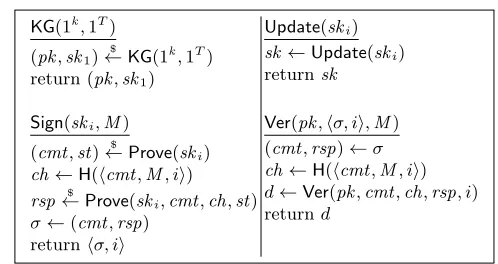
Fig. 1.Generalized Fiat-Shamir transform for forward-secure signature
ExplosID-,kimp,i -pa(Ii) (pk,ski+1)
$
←LKG(1k,1T, i) ; (cmt,st) $
←Ii(pk,ski+1)
ch← {$ 0,1}`c;rsp←$ I
i(ch,st) returnVer(pk,cmt,ch,rsp, i)
The impersonator Ii is said toε-solve the impersonation problem with respect to i-lossy public keys if PrhExplosID-,kimp,i -pa(Ii) = 1
i
≥ ε. Further-more,
ID
is said to beε-lossy if, for any periodi∈ {1, . . . , T}, no (compu-tationally unrestricted) algorithmε-solves the impersonation problem with respect toi-lossy keys.We remark that, for T = 1, a key-evolving lossy identification scheme be-comes a standard lossy identification scheme1, described in [3].
Finally, we say that
ID
isresponse-uniqueif for all normal public keyspkor for all lossy keyspk, for all periodsi∈ {1, . . . , T}, for all messages M, for all bit stringscmt2, and for all challengesch, there exists at most one responsersp
such thatVer(pk,cmt,ch,rsp, i) = 1.
3.2 Generalized Fiat-Shamir Transform
The forward-secure signature schemes considered in this paper are built from a key-evolving identification scheme via a straightforward generalization of the Fiat-Shamir transform [9], depicted in Fig. 1. More precisely, the signature for periodiis just the signature obtained from a Fiat-Shamir transform with secret key ski = Updatei−1(sk1) (with the period i included in the random oracle
input).
1
Contrary to the definition of lossiness given in [3], the impersonatorI1does not have
access to an oracleTre
ID
pk,1,k inExp
los-imp-pa
ID,k,1 (I1). However, we remark that this has
no impact on the security definition as the execution ofTre
ID
pk,1,k does not require any
secret information.
2
Let
FS
[ID
] = (KG,Sign,Ver) be the signature scheme obtained via this gen-eralized Fiat-Shamir transform. The following theorem is a generalization of (a special case of) Theorem 1 in [3], where we assume perfect completeness.Theorem 1. Let
ID
= (KG,LKG,Update,Prove, `c,Ver)be a key-evolving lossyidentification scheme whose commitment space has min-entropy at least β (for every periodi), letHbe a random oracle, and let
FS
[ID
] = (KG,Sign,Ver)be the signature scheme obtained via the generalized Fiat-Shamir transform. IfID
isεs -simulatable, complete,(t0, εk)-key-indistinguishable, andε`-lossy, thenFS
[ID
]is(t, qh, qs, ε)-existentially-forward-secure in the random oracle model for:
ε=T (εk+ (qh+ 1)ε`) +qsεs+ (qh+ 1)qs/2β t≈t0−(qstSim−Sign+ (T−1)tUpdate)
where tSim−Sign denotes the average time of a query to the simulated transcript
function Tre
ID
pk,i,k andtUpdatedenotes the average time of a query to Update.
Fur-thermore, if
ID
is response-unique,FS
[ID
]is also (t, qh, qs, ε)-forward-secure.Actually, if we choose T = 1 in the previous theorem, we get a slightly improved special case of Theorem 1 in [3], since the forward security for T = 1 is exactly the strong unforgeability for a signature scheme. The proof of this theorem can be found in the full version [2] and is very similar to the proof in [3], except that we need to guess the periodi∗of the signature output by the adversary, in order to choose the correct lossy key. That is why we lose a factor T in the reduction.
Remark 2. As in the standard Fiat-Shamir transform, the signature obtained via the generalized transform consists of a commitment-response pair. However, in all schemes proposed in this paper, the commitment can be recovered from the challenge and the response. Hence, since the challenge is often shorter than the commitment, it is generally better to use the challenge-response pair as the signature in our schemes. Obviously, this change does not affect the security of our schemes.
4
Tighter Security Reductions for Guillou-Quisquater-like
Schemes
Prover Verifier
Input:ski= (N, e, S) Input:pk= (N, e, U)
R←$ Z∗N
Y ←RemodN Y
-c
c
$
← {0, . . . ,c−1} Z←R·ScmodN Z
-ifZ /∈Z∗N orZe6=Y ·Uc return reject
return accept
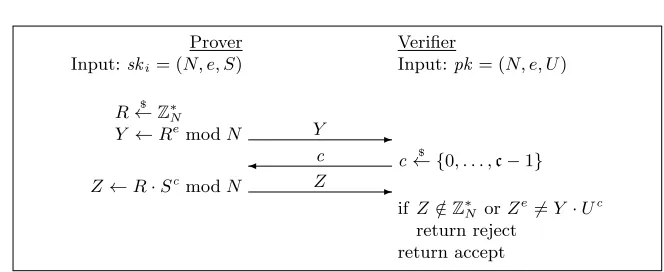
Fig. 2.Description of the GQ identification scheme (U =SemodN).
4.1 Guillou-Quisquater Scheme
Let us describe the identification scheme corresponding to the GQ signature scheme, before presenting our tight reduction and comparing it with the swap method.
Scheme.LetN be a product of two distinct`N-bit primesp1, p2 and letebe a
`e-bit prime, coprime withφ(N) = (p1−1)(p2−1), chosen uniformly at random.
LetS be an element chosen uniformly at random inZ∗N and letU =SemodN. Letc= 2`e. The public key ispk= (N, e, U) and the secret key issk= (N, e, S). The goal of the identification scheme is to proveU is ae-residue. The iden-tification scheme is depicted in Fig. 2 and works as follows. First, the prover chooses a random element R ∈ Z∗N, computes Y ← R
emodN. It sends Y to the verifier, which in turn choosesc∈ {0, . . . ,c−1}and returns it to the prover. Upon receiving c, the prover computesZ←R·Sc modN and sends this value
to the verifier. Finally, the verifier checks whetherZ ∈Z∗N andZ
e=Y ·Uc and
accepts only in this case3.
Security. The previous proofs of the GQ schemes looses a factor qh in the reduction. In this paragraph, we prove the previously described identification scheme
ID
is a lossy identification scheme, under theφ-hiding assumption. This yields a security proof of the strong unforgeability of the GQ scheme, with a tight reduction to this assumption.The algorithm LKG chooses e and N = p1p2 such that e divides p1−1,
instead of being coprime withφ(N), and choosesU uniformly at random among the non-e-residue moduloN. In the full version [2], we show that ifU is chosen uniformly at random in Z∗N, it is not ane-residue with probability 1−1/e and that it is possible to efficiently check whether U is an e-residue or not if the factorization ofN is known: U is ae-residue if and only if, for anyk∈ {1,2},e does not dividepk−1 orU(pk−1)/e= 1 modpk.
3
The proof that
ID
is complete follows immediately from the fact that, if U = SemodN, an honest execution of the protocol will always result in acceptance asZe= (R·Sc)e=Re·(Se)c=Y ·Uc.Thesimulatabilityof
ID
follows from the fact that, givenpk= (N, e, U), we can easily generate transcripts whose distribution is perfectly indistinguishable from the transcripts output by an honest execution of the protocol. This is done by choosingZ uniformly at random inZ∗N andc uniformly at random in{0, . . . ,c−1}, and setting Y =Ze/Uc.
Let us prove thekey indistinguishability. The distribution of normal pub-lic keys is indistinguishable from the one whereedividesφ(N) andU is chosen uniformly at random, according to theφ-hiding assumption. And in this latter distribution,U is not a e-residue with probability 1−1/e, so this distribution is statistically close to the distribution of lossy keys. Therefore,
ID
is key indis-tinguishable.To show that
ID
is lossy, we note that, when the public key is lossy, for every element Y chosen by the adversary, there exists only one value of c ∈ {0, . . . ,c−1} for which there exists a responseZ which is considered valid by the verifier. To see why, assume for the sake of contradiction that there exist two different valuesc1andc2in{0, . . . ,c−1}for which there exists a valid response.Denote by Z1 and Z2 one of the valid responses in each case. Without loss of
generality, assume that c1 <c2. Since Z1e=Y ·Uc1 and Z2e=Y ·Uc2, we have
that (Z2/Z1)e=Uc2−c1. Asc2−c1 is a positive number smaller than 2`e, it is
coprime with e(since eis a prime ande≥2`e). Therefore, according to Bezout theorem, there exists two integers u, vsuch that: ue+v(c2−c1) = 1. So:
U =Uue+v(c2−c1)= (Uu)e(Uc2−c1)v= (Uu(Z
2/Z1)v)e
andU is ae-residue, which is impossible. This means that the probability that a valid responseZi exists in the case whereU is not ae-residue is at most 1/c. It follows that
ID
is 1/c-lossy.4.2 Variant of the Itkis-Reyzin Scheme
Scheme. The idea of this forward-secure extension of the GQ scheme consists in using a differentefor each period. More precisely, lete1, . . . , eT beT distinct
`e-bit primes chosen uniformly at random. Let fi = ei+1. . . eT, fT = 1 and
E =e1. . . eT. Let S be an element chosen uniformly at random inZ∗N and let U =SEmodN. Let Si =SE/ei andS0
i =S
E/fi. Then the public key ispk = (N, e1, . . . , eT, U) and the secret key for periodiis ski = (N, ei, . . . , eT, Si, Si0). We remark we can easily compute ski+1 from ski, since Si+1 =S0
fi+1 i modN andS0i+1=S0
ei+1
i modN.
For periodi, the identification scheme works exactly as the previous one with public keypk= (N, ei, U) and secret keysk = (N, ei, Si).
For the sake of simplicity, in this naive description of the scheme, we store the exponentse1, . . . , eT in the public key and in the secret key. Therefore, the keys are linear inT, the number of periods. It is possible to have constant-size key, either by using fixed exponents, or by computing the exponents using a random oracle. This will be discussed in Section 5.1.
Security.The security proof is similar to the one for the previous scheme, with the main difference being the description of the lossy key generation algorithm
LKG. More precisely, on input (1k,1T, i), the algorithm LKG generates ei and N =p1p2 such thatei divides p1−1, instead of being coprime withφ(N), and
chooses U0 uniformly at random among the non-ei-residues modulo N. Then it chooses T −1 distinct random`e-bit primes e1, . . . , ei−1, ei+1, . . . , eT, and sets
U = U0ei+1···eT modN, Si
+1 = U0ei+2···eT modN and Si0+1 = U0
ei+1modN. The public key is pk = (N, e1, . . . , eT, U) and the secret key for period i+ 1 is
ski+1 = (N, ei+1, . . . , eT, Si+1, Si0+1) (or ⊥if i=T). We remark that, since U0
is a non-ei-residue,U is also a non-ei-residue and so the public keypk isi-lossy.
5
Analysis of our Variant of the Itkis-Reyzin Scheme
In this section, we analyze our variant of the IR scheme and compare it with the original IR scheme [15] and the MMM scheme [19].
5.1 Computation of the exponents e1, . . . , eT
As explained before, storing the exponentse1, . . . , eT in the keys is not a good idea since the key size becomes linear inT. Since we neede1, . . . , eT to be random primes to be able to do the reduction of key indistinguishability to theφ-hiding assumption, we can use a second random oracleH0which outputs prime numbers of length`e, and setei=H0(i).
Table 1.Choice of parameters
k qh qs `e εp `N
80 280 230 123 2−80 ≥1248
128 2128 246 171 2−128 ≥3248
get a prime number. One can prove that it behaves like a random oracle uniform over all primes, and that we can program it efficiently (property which is needed for the security reductions).
We finally remark that, we can always storeeiin the secret key for periodi. The secret key length is increased only by a small amount and the signing algo-rithm becomes faster, since it does not need to recompute ei.
5.2 Choice of Parameters
In order to be able to compare the original IR scheme with our scheme, we need to choose various parameters. In Table 1, we show our choice of parameters for two security levels:k = 80 bits andk = 128 bits. When choosing these parameters, we considered a value of T = 220, as it enables to update the key every hour
for up to 120 years (please refer to the full version [2] for more details). In both cases, εp denotes the maximum error probability of the probabilistic primality test used in the random oracle for primes numbersH0, whereasqh andqsspecify the maximum number of queries to the random oracle and to the signing oracle, respectively, in the forward-security game. In the sequel, all the parameters are fixed except the length `N of the modulus.
5.3 Comparison with Existing Schemes
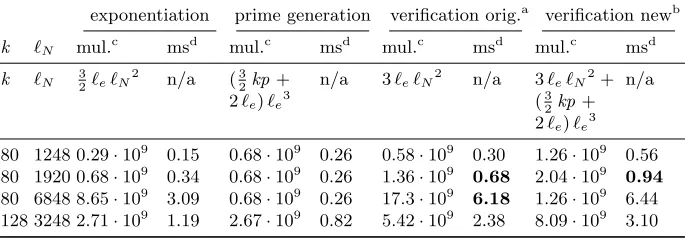
Comparison with the Itkis-Reyzin scheme.In this section, we compare the original IR scheme without optimization with our scheme (in whichei is stored in the secret keyski, as in the IR scheme). The original IR scheme is very close to our scheme. The only differences are that the IR scheme requires that the factorsp1 andp2of the modulusN are safe primes4and that IR signatures for
periodi contain the used exponent ei. Therefore the IR verification algorithm does not need to recompute the exponent, and is faster. In order to prevent an adversary from using an exponent for the breakin period to sign messages for an older period, the exponent has to be in a different set for each period. The security of the scheme comes from the strong-RSA assumption. Unfortunately, we cannot use such an optimization with our security reduction for our scheme, because we need to know which exponent the adversary will use to make the key lossy for this exponent. However, we remark in the full version [2] that the other optimizations of the original IR scheme can also be applied to our scheme.
4
Table 2.Time of verification algorithm (using parameters of Table 1)
exponentiation prime generation verification orig.a verification newb
k `N mul.c msd mul.c msd mul.c msd mul.c msd
k `N 32`e`N2 n/a (32kp+ 2`e)`e3
n/a 3`e`N2 n/a 3`e`N2+ (3
2kp +
2`e)`e3 n/a
80 1248 0.29·109 0.15 0.68·109 0.26 0.58·109 0.30 1.26·109 0.56
80 1920 0.68·109 0.34 0.68·109 0.26 1.36·109 0.68 2.04·109 0.94 80 6848 8.65·109 3.09 0.68·109 0.26 17.3·109 6.18 1.26·109 6.44
128 3248 2.71·109 1.19 2.67·109 0.82 5.42·109 2.38 8.09·109 3.10
a
verification time of the original scheme (also equal to the signature time for both schemes), estimated using the time of the two exponentiations.
b
verification time of our scheme, estimated using the time of the two exponentiations and of the prime generation.
c
approximate theoretical complexity (see the full version [2]).
dtime on an Intel Core i5 750 (2.67 GHz), using GMP version 5.0.4 (http://gmplib.
org, a pseudo-random number generator is used as a random oracle.
Let us now compare the two schemes with the same security parameters (k, `e, `N), before analyzing the exact security. We first remark that for the same security parameters, our key generation algorithm is slightly faster since it does not require safe primes; and our signing and key update algorithms are as fast as the IR ones. The key and signature lengths of the signatures are nearly the same as the IR ones (IR signatures are only`e-bits longer than our signatures). The real difference is the verification time since our verification algorithm needs to recompute the ei, contrary to the IR scheme. Verification consists of two exponentiations (moduloN with a`e-bit exponent) for the original scheme and two exponentiations and an evaluation of the random prime oracle (roughly equivalent to a random prime generation) for our scheme.
Let us now focus on the exact security of the two schemes. As explained by Kakvi and Kiltz in [16], the best known attacks against the φ-hiding problems are the factorization of N. Let us also consider it is true for the strong RSA problem (since it just strengthens our result if it is not the case). As shown in the full version [2], with our choice of parameters, if we want k = 80 bits of security, we need to choose a modulo length `N such that the factorization is
k+ log2(T) = 100-bit hard (for our scheme) andk + log2(T qh) = 180-bit hard (for the original scheme). This corresponds to about`N ≈1920 and`N ≈6848 respectively, according to Ecrypt II [7]. In this case, according to Table 2, our verification algorithm is about 6 times faster (0.94ms vs 6.18ms) and our signing algorithm is about 9 times faster (0.68ms vs 6.18ms). And our scheme generates 3.5 times shorter signatures.
to fix the number of periodsT. However, in the security proof, we have to bound the number of periods T the adversary can use (as query for the oracles Sign
andBreakin). Its forward security can be reduced to the strong unforgeability of the underlying signature scheme with a loss of a factorT.
If we want to compare the MMM scheme with our variant of the IR scheme, the fairest solution is to instantiate the MMM scheme with the GQ scheme. Then we can use our tight reduction of the GQ scheme to the φ-hiding problem, to prove that the resulting MMM scheme is forward-secure with a relatively tight (losing only a factor T) reduction to the φ-hiding problem. In this setting, the MMM scheme and our scheme have approximatively the same proven security. And the comparison of the MMM scheme with our scheme is roughly the same as the comparison in [19] between the IR scheme and the MMM scheme (which did not take into account the tightness of the reduction).
Very roughly, we can say that the MMM key generation and key update algorithms are faster (about T times faster). However, MMM private keys are longer. And, even if MMM public keys are shorter (more than 30 times for
k = 80, `N = 1248), in most cases, it is not really useful since signatures with the MMM scheme are about four times longer than signatures with our scheme (4`N+ (log(k) + logT)kcompared to`N+k), and also about twice as long as the sum of the length of a public key of our scheme and a signature. Therefore, since the public key is used for verification, the total memory needed to store input data needed for the verification of a signature with the MMM scheme is still twice the amount of the one needed with our scheme. Furthermore, our scheme outperforms the MMM scheme with respect to verification time (considering Table 2, since the MMM verification algorithm verifies two classical GQ signa-tures). This means that, if verification time, signing time, and signature size are critical (for example, if verification or signing has to be performed on a smart-card), our scheme is better than the MMM scheme. And, even more generally, if key updates are not performed often and ifT can be bounded by a reasonable constant (for example, if keys are updated each day and are expected to last 3 years,T = 210, and key update time is not really a problem), our scheme is also better than the MMM scheme.
6
Generic Factoring-Based Forward-Secure Signature
Scheme
Prover Verifier
ski= (N, e1, . . . , eT, pk= (N, e1, . . . , eT,
S1,i, . . . , S`,i, . . .) U1, . . . , U`)
forj= 1, . . . , ` Rj←$ Z∗N Yj←Rei
j modN Y1, . . . , Y` -c1, . . . ,c`
c1, . . . ,c` $
← {0, . . . ,c−1}` forj= 1, . . . , `
Zj←Rj·Scj
j,imodN Z1, . . . , Z`
-forj= 1, . . . , ` if Zj∈/Z∗N orZ
ei
j 6=Yj·U
cj j return reject
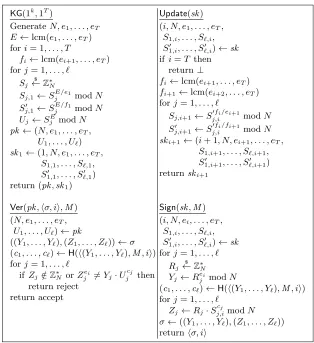
return accept
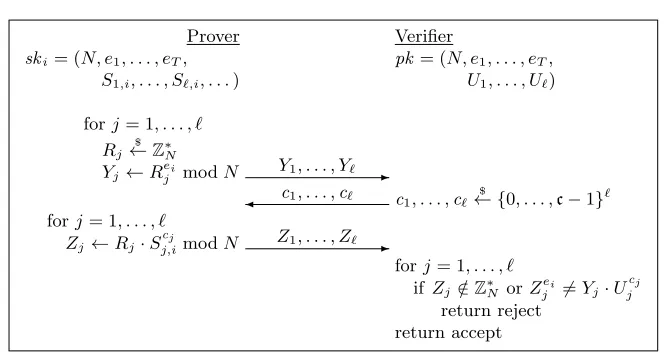
Fig. 3.Description of the generic identification schemeIDfor proving that the elements U1, . . . , U`inpk are allei-residues (for eachj∈ {1, . . . , `},Uj=S
ei
j,imodN).
6.1 Generic Factoring-Based Forward-Secure Signature Scheme
Let ` be a security parameter, let N be a product of large primes, and let e1, . . . , eT beT integers andE be the least common multiple of e1, . . . , eT. Let S1, . . . , S` be a set of elements in Z∗N
` and let U
1, . . . , U` ∈Z∗N
` be the set of elements containing the correspondingE-powers. That is, for eachj∈ {1, . . . , `}, Uj =SEj modN. The public key is pk = (N, e1, . . . , eT, U1, . . . , U`) (as for our variant of the IR scheme, we can use a random oracle to avoid storing the exponents in the keys, as explained in Section 5.1). Letfi be the least common multiple of ei+1, . . . , eT for each i ∈ {1, . . . , T} (fT = 1) and letSj,i =S
E/ei j and Sj,i0 =SE/fi
j , for each 1≤i≤T and each 1≤j ≤`. Then, the secret key for period 1 ≤ i ≤ T is ski = (i, N, ei, . . . , eT, S1,i, . . . , S`,i, S10,i, . . . , S`,i0 ). We remark that it is possible to compute ski+1 from ski by computing: Sj,i+1 =
S0fi/ei+1
j,i modN andSj,i0 +1=S 0fi/fi+1
j,i modN.
The identification scheme is depicted in Fig. 3 and is a straightforward exten-sion of the one of our variant of the IR scheme in Section 4.2. For periodi, its goal is to prove that the elementsU1, . . . , U`are allei-residues, and works as follows. First, the prover chooses an elementRj∈Z∗N and computesYj ←RejimodN, forj∈ {1, . . . , `}. It then sendsY1, . . . , Y`to the verifier, which in turn chooses
c1, . . . ,c`∈ {0, . . . ,c−1}`and returns it to the prover. Upon receivingc1, . . . ,c`, the prover computesZj←Rj·S
cj
j,imodN forj ∈ {1, . . . , `}and sends these val-ues to the verifier. Finally, the verifier checks whetherZj∈Z∗N andZ
ei
j =Yj·U
cj j forj ∈ {1, . . . , `}and accepts only if this is the case. The corresponding factoring-based forward-secure signature scheme is depicted in Fig. 4.
KG(1k,1T)
GenerateN, e1, . . . , eT
E←lcm(e1, . . . , eT)
fori= 1, . . . , T
fi←lcm(ei+1, . . . , eT)
forj= 1, . . . , ` Sj←$ Z∗N
Sj,1←SjE/e1modN Sj,01←S
E/f1 j modN Uj←SjEmodN
pk ←(N, e1, . . . , eT,
U1, . . . , U`) sk1←(1, N, e1, . . . , eT,
S1,1, . . . , S`,1,
S10,1, . . . , S`,01)
return (pk,sk1)
Update(sk) (i, N, e1, . . . , eT,
S1,i, . . . , S`,i,
S01,i, . . . , S
0 `,i)←sk
if i=T then return⊥
fi←lcm(ei+1, . . . , eT)
fi+1←lcm(ei+2, . . . , eT)
forj= 1, . . . , ` Sj,i+1←S
0fi/ei+1 j,i modN Sj,i0 +1←S
0fi/fi+1 j,i modN
ski+1←(i+ 1, N, ei+1, . . . , eT,
S1,i+1, . . . , S`,i+1,
S10,i+1, . . . , S`,i0 +1)
returnski+1
Ver(pk,hσ, ii,M) (N, e1, . . . , eT,
U1, . . . , U`)←pk
((Y1, . . . , Y`),(Z1, . . . , Z`))←σ
(c1, . . . ,c`)←H(h(Y1, . . . , Y`),M, ii)
forj= 1, . . . , ` ifZj∈/Z∗N orZ
ei
j 6=Yj·U
cj j then return reject
return accept
Sign(sk,M) (i, N, ei, . . . , eT,
S1,i, . . . , S`,i,
S01,i, . . . , S 0 `,i)←sk forj= 1, . . . , `
Rj←$ Z∗N Yj←Rei
j modN
(c1, . . . ,c`)←H(h(Y1, . . . , Y`),M, ii)
forj= 1, . . . , ` Zj←Rj·Scj
j,imodN σ←((Y1, . . . , Y`),(Z1, . . . , Z`))
returnhσ, ii
Fig. 4.Factoring-based forward-secure signature scheme
Condition 3. There exists a normal key generation algorithm KG and a lossy key generation algorithm LKG which takes as input the security parameter and the periodi and outputs a pair(pk,sk0i+1)such that, for everyi∈ {1, . . . , T}:
• (pk,sk0i+1)is indistinguishable from a pair(pk,ski+1)generated byKGand
icalls to Update(to get ski+1 from sk1);
• for all c∈ {0, . . . ,c−1}, none of U1, . . . , U` is a e0(e,c, N)-residue, where
e0(e,c, N)is:
e0(e,c, N) = gcd i∈{1,...,m}
e∧(pki i −p
ki−1 i )
c∧e∧(pki i −p
ki−1 i )
e0i,
with N = pk1
1 . . . pkmm the prime decomposition of N and e0i the greatest
divisor ofecoprime withpki i −p
ki−1
i , and wherea∧bis the greatest common
divisor (gcd) ofa andb.
6.2 Some Instantiations
In addition to the GQ scheme and our variant of the IR scheme, there are other possible instantiations of our generic scheme.
Quadratic-Residuosity-Based Signature Scheme. The case where e = c = 2 and T = 1 is an important instantiation of the generic scheme as it coincides with the quadratic-residuosity-based scheme informally suggested by Katz and Wang in [17]. This scheme is existentially unforgeable based on the hardness of the quadratic-residuosity problem as long as ` is large enough to make the termqh/2` negligible.
2t
-Root Signature Scheme by Ong and Schnorr.The case wheree=c= 2t, ` = 1, and T = 1 coincides with the 2t-root identification scheme by Ong and Schnorr [25]. If N =p1p2 is an RSA modulus such that 2t divides p1−1
andp2−1, this scheme is existentially unforgeable based on the hardness of the
strong-2t-residuosity problem as long astis large enough to make the termqh/2t negligible.
Paillier Signature Scheme. The case where ` = 1, T = 1, and e = p1p2
is an RSA modulus, N = e2 = p2
1p22 and c ≤ min(p1, p2) coincides with the
Paillier signature scheme [26]. This scheme is existentially unforgeable based on the hardness of the high-residuosity problem of [26].
2t-Root Forward-Secure Signature Scheme. The case in which ei = 2t(T−i+1)withta positive integer andc= 2iis a generalization of the quadratic-residuosity-based scheme and the 2t-root scheme. In this case,f
i =ei, and we do not need to store S10,i. If N = p1p2 is an RSA modulus such that 2tT
di-videsp1−1 and p2−1, this scheme is existentially forward-secure based on the
hardness of a variant of the strong-2tT-assumption, as long as the exponentst and`are large enough to make the termqh/2t`negligible. Although this scheme appears to be new, it is of limited interest as its public key and secret key sizes are linear in the numberT of time periods.
Proof details for the above instantiations can be found in the full version [2].
Acknowledgments
We would like to thank Mihir Bellare and Eike Kiltz for their helpful comments on a preliminary version of this paper and the anonymous referees of PKC 2013 for their valuable input.
This work was supported in part by the French ANR-10-SEGI-015 PRINCE Project and in part by the European Commission through the FP7-ICT-2011-EU-Brazil Program under Contract 288349 SecFuNet and the ICT Program under Contract ICT-2007-216676 ECRYPT II.
References
forward-security. In: Knudsen, L.R. (ed.) EUROCRYPT 2002. LNCS, vol. 2332, pp. 418–433. Springer (Apr / May 2002)
2. Abdalla, M., Ben Hamouda, F., Pointcheval, D.: Tighter reductions for forward-secure signature schemes. In: PKC 2013. LNCS, Springer (2013), full version avail-able from the webpage of the authors.
3. Abdalla, M., Fouque, P.A., Lyubashevsky, V., Tibouchi, M.: Tightly-secure signa-tures from lossy identification schemes. In: Pointcheval, D., Johansson, T. (eds.) EUROCRYPT 2012. LNCS, vol. 7237, pp. 572–590. Springer (Apr 2012)
4. Bellare, M., Miner, S.K.: A forward-secure digital signature scheme. In: Wiener, M.J. (ed.) CRYPTO’99. LNCS, vol. 1666, pp. 431–448. Springer (Aug 1999) 5. Bellare, M., Rogaway, P.: Random oracles are practical: A paradigm for designing
efficient protocols. In: Ashby, V. (ed.) ACM CCS 93. pp. 62–73. ACM Press (Nov 1993)
6. Cachin, C., Micali, S., Stadler, M.: Computationally private information retrieval with polylogarithmic communication. In: Stern, J. (ed.) EUROCRYPT’99. LNCS, vol. 1592, pp. 402–414. Springer (May 1999)
7. ECRYPT II yearly report on algorithms and keysizes (2011)
8. Feige, U., Fiat, A., Shamir, A.: Zero-knowledge proofs of identity. Journal of Cryp-tology 1(2), 77–94 (1988)
9. Fiat, A., Shamir, A.: How to prove yourself: Practical solutions to identification and signature problems. In: Odlyzko, A.M. (ed.) CRYPTO’86. LNCS, vol. 263, pp. 186–194. Springer (Aug 1987)
10. Garg, S., Bhaskar, R., Lokam, S.V.: Improved bounds on security reductions for discrete log based signatures. In: Wagner, D. (ed.) CRYPTO 2008. LNCS, vol. 5157, pp. 93–107. Springer (Aug 2008)
11. Goldwasser, S., Micali, S., Rivest, R.L.: A “paradoxical” solution to the signa-ture problem (abstract) (impromptu talk). In: Blakley, G.R., Chaum, D. (eds.) CRYPTO’84. LNCS, vol. 196, p. 467. Springer (Aug 1985)
12. Guillou, L.C., Quisquater, J.J.: A “paradoxical” indentity-based signature scheme resulting from zero-knowledge. In: Goldwasser, S. (ed.) CRYPTO’88. LNCS, vol. 403, pp. 216–231. Springer (Aug 1990)
13. Hohenberger, S., Waters, B.: Short and stateless signatures from the RSA assump-tion. In: Halevi, S. (ed.) CRYPTO 2009. LNCS, vol. 5677, pp. 654–670. Springer (Aug 2009)
14. Impagliazzo, R., Naor, M.: Efficient cryptographic schemes provably as secure as subset sum. Journal of Cryptology 9(4), 199–216 (1996)
15. Itkis, G., Reyzin, L.: Forward-secure signatures with optimal signing and verifying. In: Kilian, J. (ed.) CRYPTO 2001. LNCS, vol. 2139, pp. 332–354. Springer (Aug 2001)
16. Kakvi, S.A., Kiltz, E.: Optimal security proofs for full domain hash, revisited. In: Pointcheval, D., Johansson, T. (eds.) EUROCRYPT 2012. LNCS, vol. 7237, pp. 537–553. Springer (Apr 2012)
17. Katz, J., Wang, N.: Efficiency improvements for signature schemes with tight se-curity reductions. In: Jajodia, S., Atluri, V., Jaeger, T. (eds.) ACM CCS 03. pp. 155–164. ACM Press (Oct 2003)
18. Lyubashevsky, V., Micciancio, D.: Generalized compact Knapsacks are collision resistant. In: Bugliesi, M., Preneel, B., Sassone, V., Wegener, I. (eds.) ICALP 2006, Part II. LNCS, vol. 4052, pp. 144–155. Springer (Jul 2006)
20. Micali, S.: A secure and efficient digital signature algorithm. Technical Memo MIT/LCS/TM-501b, Massachusetts Institute of Technology, Laboratory for Com-puter Science (Apr 1994)
21. Micali, S., Reyzin, L.: Improving the exact security of digital signature schemes. In: Baumgart, R. (ed.) CQRE’99. LNCS, vol. 1740, pp. 167–182. Springer (Nov / Dec 1999)
22. Micali, S., Reyzin, L.: Improving the exact security of digital signature schemes. Journal of Cryptology 15(1), 1–18 (2002), full version of [21]
23. Micciancio, D., Mol, P.: Pseudorandom knapsacks and the sample complexity of LWE search-to-decision reductions. In: Rogaway, P. (ed.) CRYPTO 2011. LNCS, vol. 6841, pp. 465–484. Springer (Aug 2011)
24. Ohta, K., Okamoto, T.: A modification of the Fiat-Shamir scheme. In: Goldwasser, S. (ed.) CRYPTO’88. LNCS, vol. 403, pp. 232–243. Springer (Aug 1990)
25. Ong, H., Schnorr, C.P.: Fast signature generation with a Fiat-Shamir-like scheme. In: Damg˚ard, I. (ed.) EUROCRYPT’90. LNCS, vol. 473, pp. 432–440. Springer (May 1990)
26. Paillier, P.: Public-key cryptosystems based on composite degree residuosity classes. In: Stern, J. (ed.) EUROCRYPT’99. LNCS, vol. 1592, pp. 223–238. Springer (May 1999)
27. Paillier, P., Vergnaud, D.: Discrete-log-based signatures may not be equivalent to discrete log. In: Roy, B.K. (ed.) ASIACRYPT 2005. LNCS, vol. 3788, pp. 1–20. Springer (Dec 2005)
28. Patel, S., Sundaram, G.S.: An efficient discrete log pseudo random generator. In: Krawczyk, H. (ed.) CRYPTO’98. LNCS, vol. 1462, pp. 304–317. Springer (Aug 1998)
29. Peikert, C., Rosen, A.: Efficient collision-resistant hashing from worst-case assump-tions on cyclic lattices. In: Halevi, S., Rabin, T. (eds.) TCC 2006. LNCS, vol. 3876, pp. 145–166. Springer (Mar 2006)
30. Schnorr, C.P.: Efficient identification and signatures for smart cards (abstract) (rump session). In: Quisquater, J.J., Vandewalle, J. (eds.) EUROCRYPT’89. LNCS, vol. 434, pp. 688–689. Springer (Apr 1990)
31. Seurin, Y.: On the exact security of schnorr-type signatures in the random oracle model. In: Pointcheval, D., Johansson, T. (eds.) EUROCRYPT 2012. LNCS, vol. 7237, pp. 554–571. Springer (Apr 2012)