Inner Product Masking Revisited
?Josep Balasch1, Sebastian Faust2, and Benedikt Gierlichs1 1
KU Leuven Dept. Electrical Engineering-ESAT/COSIC and iMinds Kasteelpark Arenberg 10, B-3001 Leuven-Heverlee, Belgium
EPFL Lausanne, Switzerland and Ruhr-University Bochum
Abstract. Masking is a popular countermeasure against side channel attacks. Many practical works use Boolean masking because of its sim-plicity, ease of implementation and comparably low performance over-head. Some recent works have explored masking schemes with higher algebraic complexity and have shown that they provide more security than Boolean masking at the cost of higher overheads. In particular, masking based on the inner product was shown to be practical, albeit not efficient, for a small security parameter, and at the same time prov-able secure in the domain of leakage resilient cryptography for a large security parameter. In this work we explore a security versus efficiency tradeoff and provide an improved and tweaked inner product masking. Our practical security evaluation shows that it is less secure than the original inner product masking but more secure than Boolean masking. Our performance evaluation shows that our scheme is only four times slower than Boolean masking and more than two times faster than the original inner product masking. Besides the practical security analysis we prove the security of our scheme and its masked operations in the threshold probing model.
1
Introduction
Side-channel attacks (SCA) are a well-known threat to embedded security. They allow to perform key recovery attacks on cryptographic implementations by ana-lyzing physical properties present in embedded devices. Examples are execution time [22], power consumption [23] or electromagnetic emanations [16, 30]. SCA exploit the fact that these measurable quantities are statistically dependent on the intermediate variables being processed in the implementation. One of the most popular and well-studied countermeasures for block ciphers are data ran-domization techniques, commonly known as masking [5, 19]. These aim to conceal all intermediate variables of a cryptographic computation with random data.
?cIACR 2015. This article is the final version submitted by the authors to the IACR
The core principle of higher-order masking is to split any sensitive variableS
intonrandom and secret shares. The way in which such a splitting is made deter-mines themasking type or themasking function. Typical examples are Boolean masking (S =S1+. . .+Sn) or multiplicative masking (S =S1×. . .×Sn). A masking scheme additionally defines a set of operations to process thenshares while preserving the correctness of computations and ensuring that intermediate values remain independent of the sensitive variables. Thesecurity order dof a masking scheme is defined as the smallest number of d+ 1 intermediate values that, considered jointly, are not independent of a sensitive variable S. While a
d-th order masking scheme can always be broken by ad+ 1-th order SCA that exploits the leakage ofd+ 1 intermediate values in the protected implementation jointly, the design of higher-order masking countermeasures is of practical inter-est due to two main reasons. First, the data complexity of applying a d+ 1-th order SCA grows exponentially on d given a sufficient amount of noise [5, 27, 11]. And second, the computational complexity of searching for thed+ 1 leakage points grows combinatorially in the attack order [32].
1.1 Related Work
Ishai, Sahai and Wagner [21] were first to introduce a higher-order Boolean masking scheme tailored to hardware contexts by showing how to protect a circuit overF2composed of NOT and AND gates. They also proved the security of their construction against an adversary capable of probing d wires of the protected circuit. The framework introduced in [21] (commonly known as the ISW probing model) provides a sound basis to determine the security of higher-order masking schemes, as security againstdprobes directly implies d-th order SCA resistance [7]. Ishaiet al. proved their construction secure in the probing model forn≥2d+ 1.
Rivain and Prouff [33] extended the ideas of [21] to any finite field. They devised a series of provable secure operations in the masked domain and applied them to efficiently secure AES implementations in software contexts. To protect the most complex part of AES, namely the nonlinear part of the S-box, they employed a power function devised to minimize the number of costly multipli-cations. Although the original claim in [33] was that n = d+ 1 shares could provide d-th order provable security, Coron et al. [9] have shown that in fact
n≥2d+ 1 shares are necessary. Despite this, the Boolean scheme due to Rivain and Prouff remains one of the most efficient generic higher-order constructions in the literature.
Generic higher-order countermeasures using other types of masking have also been investigated. Because of their higher algebraic complexity, observation of the shares results in significantly less information leakage than for the Boolean type given the same security orderdand low levels of noise. Along these lines, von Willich [37] proposedaffine masking in which variables are encoded asS0= mask1×S+mask2. Fumaroliet al.[15] analyzed this type of masking and showed how it can be used to secure AES software implementations, in which the S-box is protected by means of table re-computation. The authors achieve performance results that are comparable to those of Boolean masking, but the affine masking construction has not been generalized to higher security ordersd >1.
Another proposal for a different type of masking is polynomial masking. Independently introduced by Prouff and Roche [29] as well as by Goubin and Martinelli [18], it employs Shamir’s secret-sharing [34] and secure multi-party computation techniques [2]. In particular, a sensitive variableS is associated to a polynomial of degreedof the formPS(X) =S+Pdi=1ai×Xiwhere theaiare random secret coefficients. An encoding of a variableSis performed by selecting
ndistinct nonzero elementsαiand evaluatingSi=PS(αi) for i= 1, . . . , n. The variable S is then represented in the masked domain as the combination of n
pairs (αi, Si), of which only theSiare secret. The variableScan be reconstructed asS=Pn
i=1Si×βi, where the coefficientsβi are computed from the publicαi. Although based on the same masking type, the schemes due to Prouff and Roche [29] and by Goubin and Martinelli [18] have notable differences. In partic-ular, the construction of [29] is specifically designed to proved-th order security in the presence of glitches [24], while the construction of [18] is designed to achieve “classical”d-th order SCA resistance. Both schemes use an algorithm to compute the product of two masked variables that is based on the secure multi-party computation scheme due to Ben-Oret al.[2], and that requiresn≥2d+ 1. The authors of [18] additionally propose a more efficient algorithm that reduces the number of required shares to n ≥ d+ 1. Despite this improvement, the complexity of both multiplication algorithms is O(n3) in the number of shares, as opposed to e.g. Boolean masking which achieves O(n2). A recent work by Coron et al. [8] has improved this complexity to ˜O(n2) by using DFT for fast polynomial evaluation.
A different approach is followed by Balaschet al.[1]. They introduceIP mask-ing based on the inner product construction of Dziembowski and Faust [12]. A masked variable is represented by 2n shares in the form of two random vec-tors (L,R) of n elements each such that S equals the inner product of L and R. The authors propose an efficient multiplication algorithm with complexity O(n2), thus similar to Boolean constructions, while achieving significantly less information leakage than other types of masking at the same security order d
for low noise levels. Despite these advantages, the addition and refreshing algo-rithms are more complex (larger constant terms) than their counterparts in the Boolean and polynomial masking schemes.
faster multiplication routine of the polynomial masking construction of Goubin and Martinelli [18]. Similarly, a first-order leakage in the refresh and addition operations of IP Masking [1] has been pointed out by Prouff et al. [28]. And the polynomial masking scheme by Prouff and Roche [29] has been shown to be rather demanding when implemented in hardware [25], mostly due to its se-curity guarantees even in the presence of glitches. Eventually, and despite their potential, higher-order countermeasures based on masking constructions other than Boolean do not appear to be ready for practical applications.
1.2 Our Contributions
In this work, we develop several improvements to the original IP masking scheme proposed in [1].
New IP masking scheme. Our first contribution is to introduce a few tweaks in the definition of the masking function that result in significant performance im-provements. Similar to the original IP masking, a masked variable is represented by 2nshares in the form of two vectors (L,R). Our first change is to letLbe a public value, allowing us to reduce the number of secret shares from 2nton. As a result we fixLto a constant value in such a way that all variables involved in computations are masked under the same L, but differentR. Additionally, we require that the first public element ofL is L1 = 1. The combination of these changes results in great efficiency improvements for all operations in the masked domain. In particular, the complexity of the addition and refreshing algorithms becomes comparable to those of Boolean and polynomial masking schemes. An important side benefit of our tweaks is that the first-order leakage identified in [28] on the refresh and addition algorithms no longer applies.
Practical security analysis. Our second contribution is to evaluate the impact of our tweaks and compare the security of the new masking type with other higher-order masking functions. We use the mutual information between the secret variable and the leakage of all shares of its masked representation as figure of merit. Our evaluation shows that our new masking function leaks more than IP masking, which is expected becauseLis now public, but it leaks roughly one order of magnitude less than Boolean masking with the same security order
d. It also leaks similar to polynomial masking with the same security orderd.
Efficient implementation. Finally, our fourth contribution is to determine the performance of our masking scheme in securing a block cipher implementation. Similar to [1], we opt to protect a software implementation of AES-128 on an embedded 8-bit controller and we compare our results to otherd-th order mask-ing schemes. The results show that our improved construction allows to halve the execution time with respect to the original IP masking scheme, and to reduce the gap with Boolean masking from approximately a factor 10 to a factor 4.
2
Notation
In the following we denote byK a field of characteristic 2 and we represent field elements with upper-case letters. For instance,S∈F28denotes an element in the AES field GF(28). Let X,Y represent two vectors over Kn. Field elements in vectors are addressed with subindexi, e.g.XiandYi, respectively. The standard inner product function overK is denoted ashX,Yi=P
iXi×Yi.
The matrixAˆ=X×Y over Kn×n is defined as the tensor product of two vectors X and Y. Field elements in a matrix are addressed as Ai,j, where i andjrepresent row and column position, respectively. IfAˆ,Bˆare matrices over Kn×n, then we denote by hAˆ,Biˆ the inner product of matrices when we view
them as vectors ofn2 field elements, i.e.P i
P
jAi,j×Bi,j. For an integernwe denote by [n] the set{1, . . . , n}.
3
Our Construction
Our scheme improves on the IP masking by Balaschet al.[1] based on the inner product construction of Dziembowski and Faust [12]. A variable S ∈ K in IP masking is encoded by using two vectors (L,R) ofnelements withL← K\{0}n andR← Kn. Note that the elements of the vectorLare by definition different than zero.
before system roll-out during device personalization, e.g. in parallel with key generation. The sub-routine randNonZero() returns a nonzero element in the field K. More precisely, it samples uniformly at random fromK\{0}.
Algorithm 1Setup the masking scheme: (L,L)ˆ ←IPSetupn(K) Input:field descriptionK
Output:random vectorLand tensor productLˆ=L×L 1: L1= 1;
2: fori= 2 tondo
3: Li←randNonZero(K); 4: end for
5: fori= 1 tondo
6: forj= 1 tondo
7: Li,j=Li×Lj; 8: end for
9: end for
Algorithm 2 depicts the steps to convert a variableS ∈ Kinto the masked domain. This routine, denoted by IPMaskL, is parametrized by a vector L
re-sulting from executing IPSetupn. The sub-routine rand() returns a randomly selected element in the field K. This function is called n−1 times in order to set the values ofR2. . . Rn. The valueR1 is then computed in order to obtain a valid masking ofS under the inner product construction.
Algorithm 2Masking a variable:R←IPMaskL(S)
Input:variableS∈ K
Output:vectorRsuch thatS=hL,Ri
1: fori= 2 tondo
2: Ri←rand(K); 3: end for
4: R1=S+Pni=2Li×Ri
3.1 Operations in the Masked Domain
We propose three main algorithms of our masking construction: IPRefreshL,
IPAddL and IPMultL,Lˆ. For an implementation of the AES (as detailed in
Sect. 6) it is advantageous to further have a dedicated squaring routine in the masked domain. For this reason we also propose an additionalIPSquareL algo-rithm.
The routineIPRefreshLis depicted in Algorithm 3. It consists of two steps.
ofAto Rto obtain a fresh vectorR0. The correctness of the algorithm is easy to prove:
hL,R0i=hL,R+Ai=hL,Ri+hL,Ai=hL,Ri+ 0 =hL,Ri.
Algorithm 3Refresh vector:R0←IPRefreshL(R)
Input:vectorR
Output:vectorR0such thathL,Ri=hL,R0i
1: A∈RKn s.t.hA,Li= 0 2: R0=R+A
The routineIPAddLis illustrated in Algorithm 4. Because all variables in our
construction are masked with a common vectorL, the output vectorT can be simply obtained by adding the input vectorsR andQ.
Algorithm 4Add masked values:T ←IPAddL(R,Q)
Input:vectorsRandQ
Output:vectorTsuch thathL,Ti=hL,Ri+hL,Qi
1: T=R+Q
Note that theIPAddL algorithm is similar to that of Boolean masking
con-structions, yet our type of masking has higher algebraic complexity. This im-provement is a direct consequence of lettingLbe a public and constant param-eter.
The multiplication routine IPMultL,Lˆ depicted in Algorithm 5 is the most involved operation. Our starting point is the masked multiplication of [1], albeit with some efficiency improvements. First, since both input operands are masked under the same vector L, the computation of the matrix Lˆ is not dependent on the input operands. Consequently, we can save n2 field multiplications by pre-computing this matrix duringIPSetupn. And second, because the first com-ponent ofLis set toL1= 1, a constantb can be added to a masking (L,R) by simply computing the new masking as (L,(R1+b, R2, . . . , Rn)).
Algorithm 5Multiply masked values:T ←IPMultL,Lˆ(R,Q)
Input:vectorsRandQ
Output:vectorTsuch thathL,Ti=hL,Ri×hL,Qi
1: Aˆ∈RKn×ns.t.hLˆ,Aˆi= 0 2: Rˆ=R×Q
3: Bˆ=Rˆ⊕Aˆ 4: b=Pn
i=2
Pn
In order to keep thed-th order security forn= 2d+ 1 throughout the whole execution of IPMultL,Lˆ, it is important that operations in lines 1 and 4 are computed in a certain way as depicted in Table 1. In particular, the intermediate values∆j are calculated by aggregating the intermediate products of elements in matrices Aˆ and Lˆ in a column-wise fashion. In contrast, the values βi are computed by processing the elements of the matricesLˆandBˆrow by row. This important difference in the way we compute the sums is crucial for the security proof and, in fact, crucial for the actual security of our scheme.
Line 1:Aˆ∈RKn×ns.t.hLˆ,Aˆi= 0 Line 4:b=Pni=2
Pn
j=1Li,j×Bi,j //Random sampling //Row-wise processing
for(i, j)6= (n, n)do β1= 0
Ai,j←rand(K) fori= 2 tondo
end βi=βi−1+Pnj=1Li,j×Bi,j
//Column-wise processing end
∆0= 0 b=βn
forj= 1 ton−1do
∆j=∆j−1+Pni=1Ai,j×Li,j
end
An,n= (∆n−1+Pin=1−1Ai,n×Li,n)×L−n,n1
Table 1.Detailed description of operations inIPMultL,Lˆ.
For illustration purposes, consider a setting where the operations in line 1 and line 4 ofIPMultL,Lˆare computed row-wise. Let us also assume that all elements in LareLi= 1. Under these circumstances, the following attack would apply:
1. The adversary learns the value ∆2=P n j=1A2,j 2. The adversary learnsβ2=P
n
j=1A2,j +Q2×Rj=∆2+Q2hL,Ri 3. The adversary learnsQ2
Assuming thatQ26= 0 the above attack indeed recovers completely the secret valuehL,Ri. Notice that the attack even applies whenLi6= 1 but in this case the bias in the leaky distribution decreases with the number of shares. We prevent this attack by computing the intermediate values∆j as a sum of elements in a column, andβi as a sum of elements in a row. This approach effectively results in a “mixing” of the random shares and enables a security proof.
Algorithm 6Square masked variable:T ←IPSquareL(R) Input:vectorR
Output:vectorR0such thathL,Ti=hL,Ri×hL,Ri fori= 1 tondo
Ti←(Ri)2×Li;
end for
4
Practical Evaluation
In this section we evaluate the information leakage of our improved IP masking scheme and compare it to that of other masking schemes that can be imple-mented at any order, e.g. Boolean masking, polynomial masking and the original IP masking. We follow the common approach to focus the analysis on the type of masking, i.e. to analyze the leakage of the shares of one masked variable. In practice, the leakage of the operations in the masked domain depends a lot on their (secure) implementation and on the target platform, for instance a table lookup in software versus combinational logic in hardware. We abstract from such practical issues to be able to provide a fair and meaningful comparison.
4.1 Attack Order
We begin the evaluation by deriving the minimum order for an attack against our type of masking. We say that a masking function is d-th order SCA secure, if every tuple of dor less shares is independent of the masked variable.
It is easy to see that the masking function of our improved scheme isd-th order SCA secure for n =d+ 1. If we choose all elements in L equal to 1 the argument is exactly the same as for Boolean masking. It uses the same number of uniformly distributed secret shares. If we choose anyLigreater than 1 we just need to observe that the field multiplicationLi×Ri does not introduce biases, i.e. for uniformly distributedRi the output is uniformly distributed. Recall that all elements inL are nonzero by definition.
4.2 Information Leakage
It remains to explore the security versus efficiency tradeoff of our improved scheme. It is known that a more complex algebraic relation between the shares and the masked variable provides less information leakage. We hence expect our type of masking to leak less information than the Boolean type whenever at least oneLi is unequal to 1 (since the field multiplicationLi×Ri adds diffusion) but more than the original IP masking sinceLis public.
random and secret shares, and can theoretically be broken by a d+ 1-th order SCA. Due to the similar representations of variables in the masked domain, we expect our masking function and the polynomial type to provide comparable information leakage.
We compare our type of masking with Boolean masking, polynomial masking (all of security orderdusingn=d+ 1 secret shares) and, for completeness, with the original IP masking (of security orderd= 1 usingn= 4 secret shares).
Following previous work [1, 18, 29, 35, 36] we use the mutual information be-tween a variable and the leakage of all shares of its masked representation as criterion for the comparison. We estimate the mutual information using com-puter simulations.
We evaluate our improved IP masking ford = 1 (L1 = 1, L2 = 255) and for d = 2 (L1 = 1, L2 = 15, L3 = 233). Boolean masking uses d+ 1 shares (M1, . . . , Md, V) where theMi∈R F28 and V is computed such thatS =M1+
. . .+Md+V holds. We evaluate Boolean masking ford∈ {1,2,3}. Polynomial masking uses d+ 1 public coefficients (α1, . . . , αd+1) with αi ∈R F28 \ {0} and pairwise distinct, andd+ 1 shares (S1, . . . , Sd+1) with Si =PS(αi)∈F28 [29]. We evaluate polynomial masking for d= 1 (α1 = 3, α2 = 7) andd = 2 (α1 = 13, α2 = 240, α3 = 163). For the original IP masking we set d = 1 and let
R2∈RF28 andL1, L2∈RF28\ {0} such thatS=L1×R1+L2×R2.
We model the relation between a share and its physical leakage as usual in the literature: each share leaks its Hamming weight, each share leaks independently of all other shares, and each leakage is affected by independent Gaussian noise. In summary, we model the leakage of our improved scheme as
Leak(L,R) = (HW(R1) +n1, . . . ,HW(Rd+1) +nd+1), the leakage of boolean masking as
Leak(M1, . . . , Md, V) = (HW(M1) +n1, . . . ,HW(Md) +nd,HW(V) +nd+1), the leakage of polynomial masking as
Leak(S1, . . . , Sd+1) = (HW(S1) +n1, . . . ,HW(Sd+1) +nd+1) and the leakage of the original IP masking as
Leak(L,R) = (HW(L1) +n1,HW(R1) +n2,HW(L2) +n3,HW(R2) +n4), where the ni are independent Gaussian variables with mean zero and stan-dard deviationσ. The mutual information between the secret variable and the leaked information is then I(S; Leak(L,R)), I(S; Leak(M1, . . . , Md, V), and
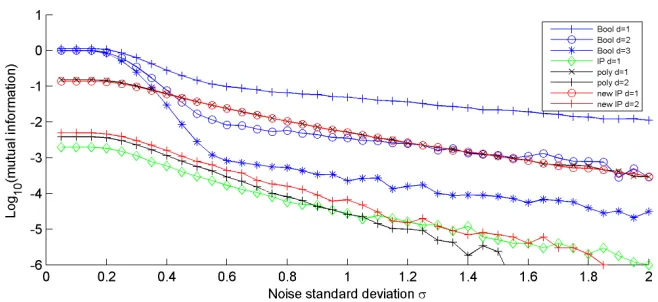
Fig. 1.Mutual information (log10) over increasing noise standard deviationσfor dif-ferent masking functions.
Figure 1 shows plots of the mutual information (in log10scale) betweenSand the information leaked by all shares of its masked representation, over increasing noise levels σ, for all masking types considered.
The results are in line with our expectations. Our improved IP masking leaks more information than the original IP masking (in the improved scheme Lis public), which illustrates the security versus efficiency tradeoff. But it leaks less than Boolean masking with the same number of shares, which is due to the more complex algebraic relation between the shares and the secret variable. The difference is particularly pronounced for low levels of noise and it seems to increase with increasing security order d. Finally, our improved IP masking and polynomial masking leak comparably. We attribute this to their similar representation of variables in the masked domain.
5
Security Proof in the Probing Model
We start our security analysis with a proof in the so-called probing model intro-duced by Ishai, Sahai and Wagner [21]. Recall that our masking scheme has the form (L,R), whereLis public andRis secret and random inKn forn∈
N
be-ing the security parameter. We will show that our construction is secure against any dprobing adversary, where we assume thatn= 2d+ 1. That is, an adver-sary that can learn up to darbitrary intermediate values computed during the execution of the masked scheme will not learn anything about the underlying secrets. Let in the following denote byP the set of intermediate values that the adversary is probing.
As a first step we show that our masking function is indeed secure against an (n−1)-probing adversary. We use the notationAn−1(IPMaskL(S)) to describe
Lemma 1. For any two secretsS, S0 ∈ Kand any (n−1)-probing adversaryA we have
An−1(S) =An−1(S0),
where L was sampled as specified by the setup algorithm and S ←IPMaskL(S)
andS0←IPMaskL(S0).
Proof. Notice that in our scheme the vector L is public and hence does not contribute to the security against probing attacks. Further, recall that allLi6= 0, and hence all values ofR contribute to the security of the masking. The proof follows by the fact that given L with all components 6= 0 the vector R is a perfect random additive (n−1) out ofnsecret sharing scheme. More precisely, letI ⊂[n] be the subset of indices for whichAn−1 learns Ri, i.e., for all i∈ I we have that An−1 probesRi. As|I|< n there exists at least onej ∈[n] such that j /∈ I. Hence, for any value S ∈ K, any choice of Land any Ri such that
i∈ I there existsRj such thatS=hL,Ri. ut
5.1 Security of Masked Operations
We now show the security of the different operations presented in Section 3. Informally, we will show that any subset of wiresP with size|P| ≤dis indepen-dent of the underlying masked values, i.e., the probesP given to the adversary will not help the adversary in breaking the security guarantee of the underly-ing scheme. To this end, we will prove the security for any masked operation individually and then show that also a combination of such masked operations remains secure if the adversary obtains at mostdprobes in the entire circuit.
The proof is easy for the masked addition operation: probes at the inputs and outputs directly translate to probes at the underlying masked value. We will show security for the masked squaring and masked multiplication operation. The proof of the masked multiplication is rather tedious since simulating the intermediate values just from the encoded inputs and outputs of the masked operations requires careful bookkeeping.
We will denote by Ad(Operation(X,Y)) the output of an adversary that probes up to dvalues in the execution of the operationOperation when run on masked inputs X andY. Notice thatAd may also probe the output produced
by Operation, i.e., Z←Operation(X,Y). As an example let Operation be the
IPMultL,Lˆ(Q,R) operation on inputsQandR. The adversary may learn up to
Security of the masked squaring operation. It is simple to show security of the squaring algorithm presented in Algorithm 6 in the probing model, whered < n.
Lemma 2. Letnbe the security parameter and letd < n, then for anyd-probing adversaryAdand anyR∈ KandR←IPMaskL(R), there exists a subsetI ⊂[n]
with |I| ≤dand a simulator Sim(R|I)such that:
Ad(IPSquareL(R))≡Sim(R|I).
Proof. We start by a description of how to build the setI, which initially is set toI ={}. For each probe of the formRi,(Ri)2or (Ri)2×Li add the indexito I. Since the adversary can make at mostdprobes, we clearly have|I| ≤d. Given the setRIandL(which is public and hence the simulator has access to it), it is easy to simulate all probes in IPSquareL(R) in a perfect way and in particular consistent with probes on the real execution of the squaring algorithm. ut
Security of masked multiplication. We prove the security of Algorithm 5 in the
d-probing model, wheren≥2d+ 1.
Lemma 3. For anyQ, R∈ KletQ←IPMaskL(Q)andR←IPMaskL(R). Let
nbe the security parameter and letdbe such that2d < n, then for anyd-probing adversaryAdthat learns at mostdprobes on intermediate values produced during the masked multiplication IPMultL,Lˆ(Q,R), there exists a subset I ⊂ [n] with |I| ≤2dand a simulator Sim(Q|I,R|I)such that:
Ad(IPMultL,Lˆ(Q,R))≡Sim(Q|I,R|I).
Proof. To simplify the analysis we assume thatLis given in its entirety a-priori to the adversary. We show that the entire distribution of the multiplication al-gorithm can be simulated by having access to at most 2d shares of Q and R, respectively. Since by Lemma 1 seeing 2d shares of Q and R respectively, is independent of the masked secret this proves the security of the masked mul-tiplication operation. The set that keeps track of what values are revealed of Q,Ris calledI. Moreover, we keep track of two setsT andU that are needed to keep the simulation consistent.T keeps tuples (i, j)⊂[n]×[n] of pairs that correspond to the values of Ai,j which are revealed during a probing attack, while U represents the values (i, j) of Bi,j that are revealed by the attack. To simplify our analysis, we will be rather generous to the adversary and usually give him much more values than what are revealed during the actual probe of the particular intermediate value. Below we describe how to build the setI.
A. Building the sets I,U,T: In this step we initialize the sets that later are needed for the simulation.
1. Initially, we set the setsI,U,T to the empty set{}.
3. Probes of the formBi,jor sums of the formPjLi,j×Bi,j:We distinguish two cases:
(a) Fori >1: Add the index (i,1), . . . ,(i, n) to the setU. (b) Fori= 1: Add the index (i, j) to the setU.
The above two cases capture the fact that for rowi = 1 of the matrix
ˆ
Bwe do not compute the sum of valuesB1,j, i.e., of the first row of the matrixB. Additionally, for each such (ˆ i, j) that has been added toU: if (i, j) is inT, then addi, j toI.
4. Probes of the formQi, RjandQi×Rj:For probes of the formQiresp.Rj addi resp.j to I. For a probe of the formQi×Rj add the indices i, j toI.
Given the above description of the the setsI,T and U, we can now define the simulatorSimI,T,U(R|I,Q|I).
B. Sampling variables independently of probes: We start by sampling some of the values a-priori before we answer the actual probing queries. We will later take care that all probes are answered consistently with the values sampled in this initial step.
1. Chooseβ2, . . . , βnuniformly at random. Notice that this allows to com-pute all the potential values that appear in the sum when computing the valueb– including the valueb.
2. Sample∆1, . . . , ∆n−1uniformly at random and set∆0=∆n= 0.
C. Simulating the probes: We next show how to answer the probing queries of the adversary given all values {Qi}i∈I and {Ri}i∈I, and the values ∆i,
βj sampled in Step B.
1. Probes of the form β2, . . . , βn and sums thereof: These values have been fixed in Step B1 and hence probes on these values can easily be answered from the above sampled values.
2. Probes on the sampling ofAi,j:Notice that this involves the individual valuesAi,j as well as sub-sums of values in the columns with the appro-priate values∆i. If (1, i), . . . ,(n, i) are in T then sample A1,i, . . . , An,i uniformly at random such thatP
jLj,i×Aj,i=∆i+∆i−1. Given the above sampled values and the values ∆i sampled in Step B2, we can answer any probe of the adversary.
3. Probes of the form Qi, Rj and Qi×Rj: Given access to {Qi}i∈I and {Ri}i∈I we can easily simulate the probes in a consistent way.
4. Probes of Bi,j, or when i >1 of sums thereof: To answer these probes, we sample the values ofBi,j in the following way:
(a) If (i, j) is not inU then leave the valuesBi,j un-assigned.
We will show below that (1) the simulation has the same distribution as the real execution of the masked multiplication operation (second claim below), and (2) we argue that the size of the setI has always cardinality|I| ≤ 2d (first claim below). Putting these two claims together proves the lemma.
In the following analysis we denote byuthe number of probes corresponding to Step A2, byv the number of probes corresponding to Step A3 and bywthe number of probes corresponding to Step A4.
Claim. Let n ∈ N be the security parameters andd be the number of probes such that 2d < n. Then, |I| ≤2d.
Proof. Observe that the simulator adds elements to I only in Step A3 and Step A4. As each probe in Step A4 leads to adding at most two elements to I and w ≤d, this directly implies |I| ≤2dif probes appear only in Step A4. It remains to analyze the number of elements we add toI for each probe done in Step A3. The analysis for Step A3 is a little more involved as the number of elements added to I depends on both u(number of probes in Step A2) and v
(number of probes in Step A3). Recall that for each probe of Step A2 that is within thei-th column we add all indices (1, i), . . . ,(n, i) to T that correspond to the elements in the i-th column of the matrix A, while for each probe inˆ Step A3 we add all indices (i,1), . . . ,(i, n) to U that correspond to the i-th row of the matrix Bˆ (except for the first row, but this does not matter for the rest of the analysis). Furthermore, recall that eachBi,j is computed fromAi,j. Depending on the values added toT andU, in Step A3 we will add alli, jto I where (i, j) is an “intersection” between the columns and rows mentioned above. Unfortunately, it is easy to see that forucolumns and v=d−u−w rows we may have more than 2d intersections.3 The good news is, however, that many elements will be added multiple times to I, hence not increasing the size ofI.
More precisely, for a query in thei-th row from Step A3, we add the index
i into the setI. Additionally, for each such query we add index of the column at which we have an intersection from a query in the j-th column. The main observation is that for each row the indices added by the intersections with the columns are the same. In other words, for eachithe tuples (i, j) have the same second component, and hence we add at mostu+v≤dindices toI in Step A3. Combining it with the probes from Step A4, we add u+v+ 2welements toI. Sinceu+v+w≤d, we get that|I| ≤2d, which proves the claim. ut
The next claim shows that the sampling of the simulator produces the same view as ad-probing adversary obtains in a real attack against the masked multiplica-tion operamultiplica-tion.
Claim. For anyQ, R∈ KletQ←IPMaskL(Q) andR←IPMaskL(R), we have:
Ad(IPMultL,Lˆ(Q,R))≡Sim(Q|I,R|I),
with parameters defined as in the statement of the lemma.
3
Proof. By the last claim we have |I| ≤2d. We compare the way in which the probes are answered by the simulator in Steps B and C with the real attack against the execution of the masked multiplication.
Step B: The joint distribution of values sampled at this step in the simulation is identically distributed with the real experiment even given all these values to the adversary. This is easy to see for theβi values as they are just sums of random valuesAi,j. Moreover, for the∆j values we observe that the first row is never used in computingβi (sincei >1), and hence all∆j forj < n can be chosen uniformly at random (they can essentially be made consistent with the view of the adversary by choosingA1,j appropriately. The value∆n is fixed to 0 as we requirehAˆ,Liˆ = 0.
Step C2: In Step B2 we sampled ∆1, . . . ∆n−1 uniformly at random and in Step C2 we sample each column (A1,i, . . . , An,i) of the matrixAˆuniformly at random such that ∆i+∆i−1 =Pj∈[n]Lj,i×Aj,i. This implies that all
Ai,j for j ∈ [n] are chosen uniformly at random4. For the last column of the matrix we require that∆n+∆n−1=∆n−1=Pj∈[n]Lj,n×Aj,n, which
guarantees thathAˆ,Liˆ = 0 as required by the protocol. It remains to show that the choice of theAi,j values produced by the simulator is consistent with the simulator’s choice of the valuesβi.
To this end observe that after a probing attack at mostu≤d columns of the matrixAˆhave been assigned, i.e., the values in n−dcolumns remain un-assigned. Asβi =a+PjAi,j for some fixed valuea=Qi×Li×R the value βi is distributed uniformly at random even given all values ∆i and all valuesAi,j that haven been assigned previously. Notice that this is the case since (a) there is at least one column in the matrixAˆthat has not been assigned yet, and (b) the scheme never computesP
jA1,j asβ1is not needed for the computation. More precisely, letj∗be the column that is unassigned after the assignment of the values above, then eachβi is perfectly hidden by
Ai,j∗ and we can chooseA1,j∗ in such a way that the column is consistent
with∆j∗. This concludes the analysis of Step C2.
Step C3: To answer the queries onQi, Rj andQi×Rj we use the values given in {Qi}i∈I and {Ri}i∈I. To argue that this gives us the right distribution (independent ofQ and R), we first recall that by the last claim |I| ≤2d. Notice that these values will always be consistent with the previously as-signed values since eachβi is still blinded by at least one un-assigned value
Ai,j∗. Moreover, probes of this form (by itself) do not reveal any additional
information aboutA.ˆ5
Step C4: We can ignore the values sampled in Step C4a as these values re-main un-assigned, i.e., they are never directly probed nor are they used in the computation of other probes. The values sampled in Step C4b can be computed from the values that have been assigned previously (since (i, j) was inU andT which implies thati, j ∈ I), and, hence will not affect the
4
At this step we also require thatLi,j6= 0 as required by our scheme.
5
joint distribution. Notice that in this step we will always only fix a subset of theBi,j elements in thei-th row, because there are at mostu≤dprobes in Step A2 (which lead to adding tuples (i, j) toT). The remaining values for thei-th row are chosen as defined in Step C4c. That is, in the simulation we choose these values uniformly at random such thatβi =PjLi,j×Bi,j taking into account the previously assigned values forBi,j from Step C4b. By the requirement given in Step C4c our choice ofBi,j is consistent with the choice ofβi.
It remains to argue why the simulator’s choice is also consistent with the matrixAˆas sampled in Step C2 and with∆1, . . . , ∆n. To this end, observe that the simulator only samples Bi,j according to Step C4c ifAi,j has not been revealed previously (i.e., it was in a column ofAˆthat has never been probed). Hence, indeedBi,j is uniformly distributed (since it is blinded by the random and unknown valueAi,j). Finally, it remains to argue that the choice of Bi,j is also consistent with the choice of ∆j from Step B. Recall that for valuesBi,j for which (i, j)∈ U, but not inT this implies that the
j-th row has not been queried. Moreover, we know sincev ≤dthere are at leastn−v > d rows that have not been probed. Hence, there exists some
Bk,j andAk,j that have not been assigned during the experiment (i.e., they belong to Step C4a). Such valuesAk,j were never used in the experiment and can always be chosen such that the total sum is consistent with∆j.
The above description concludes the proof. ut
Putting together the above two claims we obtain the statement of the lemma. u t
This completes the analysis of the security of individual masked operations. In the next section we briefly argue about security of masked composed algorithms.
5.2 Security of General Masked Computation
In Section 5.1 we showed that an adversary that probes up to d intermediate values in the computation of the basic masked operation will not be able to learn anything about the underlying sensitive information. We are now interested in what happens to the security when multiple of such operations are combined to carry out some more complicated computation such as the AES encryption algorithm. In other words, we let the adversary learn d intermediate values of the computation carried out by the masked AES algorithm (or any other masked algorithm). Notice that this in particular requires that, e.g., learningd1 values in a masked multiplication cannot be exploited together with d2 values learnt from a consecutive masked squaring algorithm as long as d1+d2≤d.
algorithm. If the adversary probesd1 intermediate values in the multiplication operation, then it is easy to see that the simulation described in Lemma 3 de-pends on at most 2d1shares ofT. Moreover, the masked multiplication operation guarantees that even given QandR entirely, the output T is a uniformly and independently chosen maskings ofQ×R. This means that for the simulation of the adjacent squaring algorithm the simulator starts with a masking of which 2d1 shares are already known. Since according to Lemma 2 the simulator requires
d2 elements of its inputs to simulate the probes in the squaring operation, the simulator will learn additionallyd2elements ofT. Since 2d1+d2< nthis shows security of the simple composed circuit consisting of a multiplication followed by a masked squaring operation. The above argument can easily be extended to arbitrary complicated masked algorithms consisting of many masked operations. Another difficulty occurs when the adversary can run the masked algorithm multiple times and in each execution he may observedintermediate values. For instance, one may think of a masked AES algorithm running with a masked key
K. Notice that this setting is different from the setting of composed masked com-putation described above since now the adversary can observe qdintermediate values, whereqis the number of executions that the masked algorithm is run. As in earlier work [21, 7] the problem of a continuous probing adversary, i.e., an ad-versary that learns up todintermediate values in each execution of the masked AES algorithm, can be addressed by a key refresh algorithm. If (L,R) denotes the masking of a key byte of the AES, then the masking of this key byte can be refreshed by running the Algorithm 3ntimes consecutively. In other words, the key refresh algorithm takes as input R0 :=R and for i = 1, . . . nproceeds as follows: ComputeRi=IPRefreshL(Ri−1) and outputR0=Rn. Clearly, since we execute IPRefreshL n times and the adversary can probe only d < n
in-termediate values there must exist at least one execution ofIPRefreshL(Ri−1) that does not leak at all. Hence the mask ofRis completely refreshed. This en-ables us to transform our result to a continuous probing adversary without any additional loss, when in each execution the adversary can learn up to dvalues (where 2d < n).
We notice that the fact thatIPRefreshLis repeated multiple times to refresh
the masking of the key is not only an artefact of the security proof. In fact, it is easy to show that for natural implementations of IPRefreshL the scheme
becomes insecure. To illustrate this, we present a simple attack against a more efficient key refresh algorithm that executes IPRefreshL only a single time.
For simplicity, let us assume that L = (1, . . . ,1), i.e., the vector is the all-1 vector. Notice that in this case the inner product masking function is identical to the Boolean masking used, e.g., in [33]. Let us assume thatAis sampled in IPRefreshLin the following way:
1. Lett0= 0. Fori= 1, . . . , n−1 repeat the following: (a) SampleAi uniformly at random inK
(b) Computeti=ti−1+Ai.
Consider a masked implementation of the AES that at the end of the execu-tion refreshes its key shares by applying a single execuexecu-tion of the IPRefreshL
algorithm. We now describe an attack that allows to recover the key with only 2 probes in each execution of the masked AES implementation. Notice that we consider the full probing model [7], where the adversary can move its probes between consecutive rounds of execution. Our attack does not apply in the re-stricted probing model [7]. We denote by Ki the masking of the key k at the beginning of the i-th round, i.e., for all i we have hL,Kii = k. We have K0 being the initially shared key. Moreover, we denote by Ai the vector that is used in the i-th execution of the masked AES implementation for refreshing, i.e.,Ki=Ki−1+Ai.
1. First execution of the masked AES:ProbeK0
1 andA01. Notice that this allows us to computeK1
1.
2. In thei-th execution of the masked AES:ProbeKi
i andtii−1.
We will now describe how to compute kfrom the above described probes. Sup-pose at the beginning of the i-th round (i.e., before carrying out the probes in this round) the adversary knows Pi−1
j=1K i−1
j . We show how with the probes described above he can compute Pi
j=1K i
j. To this end, notice that:
i X
j=1
Kji = i−1 X
j=1
Kji−1+tii−1+Kii,
where the second and the third term the adversary knows from the probes in thei-th round and the first term he knows by assumption. Hence, by induction it is easy to argue that the above attack allows to recover the secret keyk.
6
Performance Evaluation
We have applied our masking scheme to protect a software implementation of AES-128 encryption. For illustrative purposes we have opted to develop two implementations employing n = 2 and n = 3 shares, respectively. This choice not only enables a better comparison with other higher-order schemes, but also allows us to gain insight into how the performance scales with an increasing number of shares.
Our target platform is a legacy AVR ATMega163 microcontroller. This device has an 8-bit architecture and offers 32 general purpose registers, 1 024 bytes of internal SRAM and 16 KBytes of Flash memory. Our implementation is aimed for speed. To this end, we have written all operations in assembly code and made use of lookup tables whenever possible.
Because this method contains a conditional statement, i.e. check if any of the operands equals zero, realizing it with a constant flow of instructions requires in our implementation 22 cycles. Field squaring - as well as raisings to the power of four and sixteen - are implemented by means of lookup tables. Our platform does not have internal support for generating random numbers, as opposed to e.g. JavaCard smart cards. For the sake of completeness and testing, random numbers are provided externally and stored in memory.
The public parametersL andLˆ are initialized at setup time and kept con-stant for each execution of the cipher. Consequently, they are hardcoded in Flash memory. Note that for n = 2, there exist 28 possible vectors A orthog-onal to L satisfying hA,Li = 0. These vectors can be as well precomputed during initialization and stored in Flash memory as a look-up tableT satisfying
T(A2) =A1 =L2×A2. DuringIPRefreshL, a value A2 is picked at random and the corresponding value A1 is looked up as T(A2). This allows to improve the efficiency ofIPRefreshLat the cost of storing 256 bytes in Flash memory.
The main difficulty of applying our masking scheme (and any other) to AES consists in efficiently masking its nonlinear part, i.e. the SubBytes transforma-tion. In software contexts it is common to implement this transformation by means of a lookup table. While there exist techniques in the literature to pro-tect table lookups at higher-order, e.g. [7], these are rather costly in terms of performance and storage. Alternatively, one can compute the fullSubBytesstep by using the following equation overF28 for a given input state byteX:
SubBytes[X] ={05} ×X254+{09} ×X253+{f9} ×X251+{25} ×X247+ {f4} ×X239+X223+{b5} ×X191+{8f} ×X127+{63}. This equation involves multiple field operations (particularly costly multipli-cations) in order to calculate the different powers of X. It is therefore not very suitable if one aims for an efficient implementation. We therefore follow a dif-ferent path as already done in [1], i.e. we carry out both steps of theSubBytes transformation (inverse and affine transformation) separately. Specifically, we first compute the field inverse by using the following power function:
Inverse[X] =X254= (X2×X)4×(X2×X)16×(X2×X)4×X2.
As discussed in [33], this equation can be efficiently carried out with only 4 multiplications and 7 squarings. For the affine transformation (linear only inF2) we employ the following equation overF28:
AffTrans[X] ={05} ×X128+{09} ×X64+{f9} ×X32+{25} ×X16+ {f4} ×X8+{01} ×X4+{b5} ×X2+{8f} ×X+{63}, requiring 7 squarings, 8 additions, and 7 multiplications with a constant. The MixCol transformation operates on the AES state column-by-column. In particular, each of the bytes in the 0≤j≤3 columns is replaced as:
s01,j =s0,j+{02} ×s1,j+{03} ×s2,j+s3,j
s02,j =s0,j+s1,j× {02}+s2,j+{03} ×s3,j
s03,j ={03} ×s0,j+s1,j+s2,j+{02} ×s3,j.
From these equations it follows that this step can be implemented using a total of 12 masked additions and 8 masked multiplications by a constant, for each column. In [10], the authors of AES suggest a more efficient way to com-pute theMixColstep by using the so-calledxtime tables. Such technique takes advantage of the fact that field addition is more efficient than field multipli-cation in general purpose processors. Due to this, they suggest an alternative approach that requires 15 additions and 4 multiplications by 02, which can be simply performed as table lookups. We employ this technique to compute the MixColtransformation.
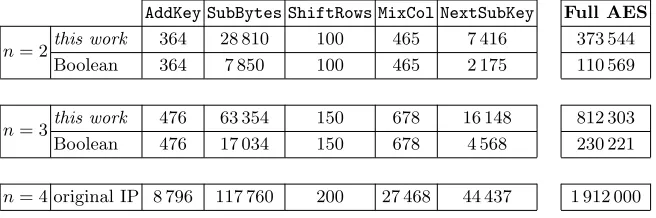
The performance of our protected AES-128 implementation is given in Ta-ble 2 for n = 2 and n = 3 secret shares. We have also implemented Boolean masking as proposed in [33] with the same number of secret shares. In order to enable a fair comparison, all implementations are developed on the same plat-form and follow the same optimization strategy. Finally, we also provide the results given in [1] for the original IP masking usingn= 4 secret shares. Recall that the original IP masking was developed to provide security orderd= 1 for
n= 4, the same as our new scheme and Boolean masking for n= 3.
The performance results presented in Table 2 are given in clock cycles. The rightmost column shows the execution time of a full AES-128 encryption includ-ing key schedule, while the other columns depict the performances achieved for each AES building block.
Table 2.Performance evaluation (in clock cycles) of protected AES implementations. This work and Boolean with n = 2 secret shares (top); this work and Boolean with
n= 3 secret shares (middle); original IP masking withn= 4 secret shares (bottom).
AddKey SubBytes ShiftRows MixCol NextSubKey Full AES
n= 2this work 364 28 810 100 465 7 416 373 544
Boolean 364 7 850 100 465 2 175 110 569
n= 3this work 476 63 354 150 678 16 148 812 303
Boolean 476 17 034 150 678 4 568 230 221
n= 4 original IP 8 796 117 760 200 27 468 44 437 1 912 000
involve significantly less field operations than in [1]. On the implementation side, this reduction in complexity enables a better usage of the register file, i.e. the number of memory accesses to load/store intermediate results can be significantly reduced.
When compared to Boolean masking for the same security level, our scheme still performs slower. The difference is not entirely due to the operations in the masked domain, but rather to the way the AES affine transformation is de-fined. Because this operation is linear inF2, protecting it with Boolean masking requires only a matrix multiplication (table lookup) followed by an XOR opera-tion. In contrast, and due to the higher algebraic complexity of the inner product construction, our implementation needs to compute the more complex formula defined over F28. Despite this limitation, our results manage to bridge the gap from approximately a factor 10 to a factor 4. This result makes our proposal an interesting alternative to secure implementations at higher orders.
7
Discussion
In this section we discuss further relevant properties of our improved IP masking scheme and touch on ideas for future work.
Similarities and differences with polynomial masking. A direct consequence of our tweaks is that some characteristics of our construction become closer to those of polynomial masking. In particular, variables in both schemes are encoded using 2nshares (Li, Ri) and (αi, Si) respectively, withnshares being public and
nshares being secret. The decoding sequences of a masked variableSfollow the same pattern of operations, e.g.S =hL,Ri=P
iLi×Ri and S=Piβi×Si. We note, however, that the latter is not a consequence of our simplifications. The same sequence was already used in [1]. In contrast, a direct effect of our tweaks is that the information leakage of encoded secrets using the mutual information as figure of merit becomes comparable.
Despite these high-level similarities, the low-level constructions proposed in this work to carry out operations in the masked domain are different from those proposed in [18, 29]. The only exception is the addition algorithm, in which the secret sharesRi (Si, respectively) of the input operands are added element-wise to obtain the secret shares of the output. We note that this is also the same for other constructions based on e.g. Boolean masking. The most notable differences can be found in the steps followed to compute the product of two masked vari-ables. In addition, the asymptotic complexity of our multiplication algorithm is O(n2) rather thanO(n3) as presented in [18, 29] or ˜O(n2) as described in [8]. Asymptotic improvements are possible using more efficient protocols from mul-tiparty computation – in particular, techniques from mulmul-tiparty computation using packed secret sharing [14, 20], which results overall in quasi-linear com-plexity (for large and parallelizable computation).
Shamir’s secret-sharing [34], while our construction is inspired by work on leak-age resilient cryptography [12]. This difference is for instance prominently re-flected in the procedures to mask a variable. In polynomial masking the secret shares are obtained by polynomial evaluationSi =PS(αi) of the public shares
αi, which is different from the procedure described in IPSetupn. Another dif-ference is that the public parameters αi of polynomial masking must be both distinct and nonzero, while for IP masking only the latter requirement applies, i.e. severalLican have the same value.
Bounded leakage model. We notice that we do not prove the security of our construction in the bounded independent leakage model as done in the work of Balasch et al. [1]. Instead, the goal of the current work is to develop an efficient higher-order masking scheme that exhibits higher algebraic complexity than Boolean masking and prove its security in the ISW probing model. Note that it is still possible to provide a scheme secure in the independent leakage model even if the vectorLis public but random. The technical reason for this is that the inner product is a strong extractor, i.e. security holdseven if one part is revealed completely.
The only requirement we need is that the leakage functions are chosen a-priori and independently ofL, which allows us to rely on the fact that the inner product function over finite fields is a strong extractor [31].6 While this may slightly improve the bounds, for small field size, we would still require a large number of shares which may be unrealistic for practical settings. In addition, we would have to make slight changes to the construction, e.g. to our optimized squaring algorithm, to prevent simultaneous access to the two halves (L,R) of the IP encoding (which becomes insecure under bounded independent leakages).
Resistance against glitches. The original scheme in [1] achieves provable secu-rity in the presence of glitches only when the security parameternis large. In fact, the proof for glitch resistance follows directly from security in the bounded independent leakage model. However, the construction in this work is proven se-cure in the probing model, whichdoes notautomatically imply glitch resistance. Hence we do not claim that our construction is provable secure in the presence of glitches, in contrast to e.g. the polynomial masking scheme by Prouff and Roche [29] and the Threshold Implementation scheme by Nikova et al. [26, 3].
Future work. An interesting question for future work is if the ideas from [9] can be applied in order to gain a factor 2, i.e. it may be feasible to achieve security againstdprobes whend=n−1 in the restricted model.
Acknowledgments. Benedikt Gierlichs is a Postdoctoral Fellow of the Fund for Scientific Research - Flanders (FWO). This work has been funded in parts
6 We notice that a similar non-adaptive leakage model was considered in [13, 39].
by the Research Council KU Leuven: GOA TENSE (GOA/11/007). Sebastian Faust received funding from the Marie Curie IEF/FP7 project GAPS, grant number: 626467.
We thank Stefan Dziembowski for many useful discussions on the inner product encoding and the anonymous reviewers of Eurocrypt 2015 for helpful feedback that helped to improve the presentation of our work.
References
1. J. Balasch, S. Faust, B. Gierlichs, and I. Verbauwhede. Theory and Practice of a Leakage Resilient Masking Scheme. In X. Wang and K. Sako, editors,Advances in Cryptology - ASIACRYPT 2012, volume 7658 ofLNCS, pages 758–775. Springer, 2012.
2. M. Ben-Or, S. Goldwasser, and A. Wigderson. Completeness theorems for non-cryptographic fault-tolerant distributed computation (extended abstract). In J. Si-mon, editor,Symposium on Theory of Computing - STOC 1988, pages 1–10. ACM, 1988.
3. B. Bilgin, B. Gierlichs, S. Nikova, V. Nikov, and V. Rijmen. Higher-order threshold implementations. In P. Sarkar and T. Iwata, editors, Advances in Cryptology -ASIACRYPT 2014, volume 8874 ofLNCS, pages 326–343. Springer, 2014. 4. C. Carlet, L. Goubin, E. Prouff, M. Quisquater, and M. Rivain. Higher-Order
Masking Schemes for S-Boxes. In A. Canteaut, editor,Fast Software Encryption -FSE 2012, volume 7549 ofLNCS, pages 366–384. Springer, 2012.
5. S. Chari, C. S. Jutla, J. R. Rao, and P. Rohatgi. Towards Sound Approaches to Counteract Power-Analysis Attacks. In M. J. Wiener, editor, Advances in Cryp-tology - CRYPTO ’99, volume 1666 ofLNCS, pages 398–412. Springer, 1999. 6. S. Chari, J. R. Rao, and P. Rohatgi. Template Attacks. In B. S. Kaliski Jr., C¸ . K.
Ko¸c, and C. Paar, editors,Cryptographic Hardware and Embedded Systems - CHES 2002, volume 2523 ofLNCS, pages 13–28. Springer, 2002.
7. J. Coron. Higher Order Masking of Look-Up Tables. In P. Q. Nguyen and E. Os-wald, editors,Advances in Cryptology - EUROCRYPT 2014, volume 8441 ofLNCS, pages 441–458. Springer, 2014.
8. J. Coron, E. Prouff, and T. Roche. On the Use of Shamir’s Secret Sharing against Side-Channel Analysis. In S. Mangard, editor,Smart Card Research and Advanced Applications - CARDIS 2012, volume 7771 ofLNCS, pages 77–90. Springer, 2013. 9. J.-S. Coron, E. Prouff, M. Rivain, and T. Roche. Higher-Order Side Channel Security and Mask Refreshing. In S. Moriai, editor, Fast Software Encryption -FSE 2013, volume 8424 ofLNCS, pages 410–424. Springer, 2013.
10. J. Daemen and V. Rijmen. The Design of Rijndael: AES - The Advanced Encryp-tion Standard. Information Security and Cryptography. Springer, 2002.
11. A. Duc, S. Dziembowski, and S. Faust. Unifying leakage models: From probing attacks to noisy leakage. In P. Q. Nguyen and E. Oswald, editors, Advances in Cryptology - EUROCRYPT 2014, volume 8441 ofLNCS, pages 441–458. Springer, 2014.
13. S. Faust, K. Pietrzak, and J. Schipper. Practical leakage-resilient symmetric cryp-tography. In E. Prouff and P. Schaumont, editors, Cryptographic Hardware and Embedded Systems - CHES 2012, volume 7428 ofLNCS, pages 213–232. Springer, 2012.
14. M. K. Franklin and M. Yung. Communication complexity of secure computation (extended abstract). In S. R. Kosaraju, M. Fellows, A. Wigderson, and J. A. Ellis, editors,Proceedings of the 24th Annual ACM Symposium on Theory of Computing, May 4-6, 1992, Victoria, British Columbia, Canada, pages 699–710. ACM, 1992. 15. G. Fumaroli, A. Martinelli, E. Prouff, and M. Rivain. Affine Masking against
Higher-Order Side Channel Analysis. In A. Biryukov, G. Gong, and D. R. Stinson, editors,Selected Areas in Cryptography - SAC 2010, volume 6544 ofLNCS, pages 262–280. Springer, 2011.
16. K. Gandolfi, C. Mourtel, and F. Olivier. Electromagnetic Analysis: Concrete Re-sults. In C¸ . K. Ko¸c, D. Naccache, and C. Paar, editors,Cryptographic Hardware and Embedded Systems - CHES 2001, volume 2162 ofLNCS, pages 251–261. Springer, 2001.
17. L. Genelle, E. Prouff, and M. Quisquater. Thwarting Higher-Order Side Channel Analysis with Additive and Multiplicative Maskings. In B. Preneel and T. Takagi, editors, Cryptographic Hardware and Embedded Systems - CHES 2011, volume 6917 ofLNCS, pages 240–255. Springer, 2011.
18. L. Goubin and A. Martinelli. Protecting AES with Shamir’s Secret Sharing Scheme. In B. Preneel and T. Takagi, editors,Cryptographic Hardware and Embedded Sys-tems - CHES 2011, volume 6917 ofLNCS, pages 79–94. Springer, 2011.
19. L. Goubin and J. Patarin. DES and Differential Power Analysis (The “Duplica-tion” Method). In C¸ . K. Ko¸c and C. Paar, editors,Cryptographic Hardware and Embedded Systems - CHES’99, volume 1717 of LNCS, pages 158–172. Springer, 1999.
20. V. Grosso, F. Standaert, and S. Faust. Masking vs. multiparty computation: how large is the gap for AES? J. Cryptographic Engineering, 4(1):47–57, 2014. 21. Y. Ishai, A. Sahai, and D. Wagner. Private Circuits: Securing Hardware against
Probing Attacks. In D. Boneh, editor,Advances in Cryptology - CRYPTO 2003, volume 2729 ofLNCS, pages 463–481. Springer, 2003.
22. P. C. Kocher. Timing Attacks on Implementations of Diffie-Hellman, RSA, DSS, and Other Systems. In N. Koblitz, editor,Advances in Cryptology - CRYPTO ’96, volume 1109 ofLNCS, pages 104–113. Springer, 1996.
23. P. C. Kocher, J. Jaffe, and B. Jun. Differential Power Analysis. In M. J. Wiener, editor,Advances in Cryptology - CRYPTO ’99, volume 1666 ofLNCS, pages 388– 397. Springer, 1999.
24. S. Mangard, T. Popp, and B. M. Gammel. Side-Channel Leakage of Masked CMOS Gates. In A. Menezes, editor,Topics in Cryptology - CT-RSA 2005, volume 3376 ofLNCS, pages 351–365. Springer, 2005.
25. A. Moradi and O. Mischke. On the Simplicity of Converting Leakages from Mul-tivariate to Univariate - (Case Study of a Glitch-Resistant Masking Scheme). In G. Bertoni and J. Coron, editors,Cryptographic Hardware and Embedded Systems - CHES 2013, volume 8086 ofLNCS, pages 1–20. Springer, 2013.
26. S. Nikova, V. Rijmen, and M. Schl¨affer. Secure hardware implementation of non-linear functions in the presence of glitches. J. Cryptology, 24(2):292–321, 2011. 27. E. Prouff and M. Rivain. Masking against side-channel attacks: A formal security
28. E. Prouff, M. Rivain, and T. Roche. On the Practical Security of a Leakage Resilient Masking Scheme. In J. Benaloh, editor,Topics in Cryptology - CT-RSA 2014, volume 8366 ofLNCS, pages 169–182. Springer, 2014.
29. E. Prouff and T. Roche. Higher-Order Glitches Free Implementation of the AES Using Secure Multi-party Computation Protocols. In B. Preneel and T. Takagi, editors, Cryptographic Hardware and Embedded Systems - CHES 2011, volume 6917 ofLNCS, pages 63–78. Springer, 2011.
30. J.-J. Quisquater and D. Samyde. ElectroMagnetic Analysis (EMA): Measures and Counter-Measures for Smart Cards. In I. Attali and T. P. Jensen, editors,Smart Card Programming and Security - E-smart 2001, volume 2140 of LNCS, pages 200–210. Springer, 2001.
31. A. Rao. An Exposition of Bourgain’s 2-Source Extractor. Electronic Colloquium on Computational Complexity - ECCC, 14(034), 2007.
32. O. Reparaz, B. Gierlichs, and I. Verbauwhede. Selecting time samples for mul-tivariate DPA attacks. In E. Prouff and P. Schaumont, editors, Cryptographic Hardware and Embedded Systems - CHES 2012, volume 7428 ofLNCS, pages 155– 174. Springer, 2012.
33. M. Rivain and E. Prouff. Provably Secure Higher-Order Masking of AES. In S. Mangard and F.-X. Standaert, editors,Cryptographic Hardware and Embedded Systems - CHES 2010, volume 6225 ofLNCS, pages 413–427. Springer, 2010. 34. A. Shamir. How to Share a Secret. Communications of the ACM, 22(11):612–613,
1979.
35. F.-X. Standaert, T. Malkin, and M. Yung. A Unified Framework for the Analysis of Side-Channel Key Recovery Attacks. In A. Joux, editor,Advances in Cryptology - EUROCRYPT 2009, volume 5479 ofLNCS, pages 443–461. Springer, 2009. 36. F.-X. Standaert, N. Veyrat-Charvillon, E. Oswald, B. Gierlichs, M. Medwed,
M. Kasper, and S. Mangard. The World Is Not Enough: Another Look on Second-Order DPA. In M. Abe, editor, Advances in Cryptology - ASIACRYPT 2010, volume 6477 ofLNCS, pages 112–129. Springer, 2010.
37. M. von Willich. A Technique with an Information-Theoretic Basis for Protecting Secret Data from Differential Power Attacks. In B. Honary, editor,Cryptography and Coding, volume 2260 ofLNCS, pages 44–62. Springer, 2001.
38. E. D. Win, A. Bosselaers, S. Vandenberghe, P. D. Gersem, and J. Vandewalle. A Fast Software Implementation for Arithmetic Operations in GF(2n). In K. Kim and T. Matsumoto, editors, Advances in Cryptology - ASIACRYPT ’96, volume 1163 ofLNCS, pages 65–76. Springer, 1996.