Online request scheduling subject to a percentile
response time SLA in a distributed cloud
Keerthana Boloor
∗ ‡, Rada Chirkova
† ‡, Timo Salo
‡, and Yannis Viniotis
∗ ‡∗Department of Electrical and Computer Engineering, NC State University, Raleigh, North Carolina 27695 †Department of Computer Science, NC State University, Raleigh, North Carolina 27695
‡IBM Software Group, RTP, North Carolina 27709
[email protected],[email protected],[email protected],[email protected]
Abstract—We consider geographically distributed data centers forming a collectively managed cloud computing system hosting multiple applications, each subject to Service Level Agreements (SLA). The Service Level Agreements for each application require the response time of a certain percentile of the input requests to be less than a specified value, with the non-conforming requests being charged a penalty. We present a novel approach of heuristics based request scheduling at each server in each of the geographically distributed data centers, to globally minimize the penalty charged to the cloud computing system. We evaluate two variants of our heuristic-based approach, one based on the simulated annealing method of neighborhood searches and another based on gi-FIFO scheduling, which has been analytically proven to be the best schedule for percentile goals in a single machine, multi-class problem. We also compare our approaches with FIFO scheduling.
I. Introduction and motivation
Deployment of on-demand e-business applications in large cloud computing systems is getting increasingly pervasive. The significant reduction of the total cost of ownership by deploying web-based applications in massive data centers is resulting in many businesses opting to host their applications in a cloud. The e-business applications with implementations usually based on service oriented architectures tend to be global in scale and require deployments in geographically distributed data centers for scalability and survivability [1] [2]. Most enterprise applications hosted by a cloud computing system provider are associated with a Service Level Agree-ment (SLA), which specifies terms and conditions of the service provided by the cloud for the application [3]. With the applications deployed across multiple data centers, there is a need for resource allocation and request scheduling techniques for the satisfaction of the SLA of each application, globally, across the geographically distributed data centers.
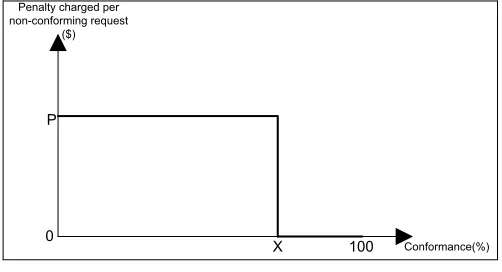
Typically, SLAs for business applications specify (among other constraints) certain guarantees in terms of the fraction of requests serviced, as opposed to average-performance cri-terion. Thus, many service level agreements are designed to provide specific percentile-based performance goals. Recent business trends in cloud computing systems have shown increasing adoption of fixed-step percentile SLAs, where a certain fraction of service requests for a hosted application is required to have a specific response time [4]. As geographi-cally distributed data centers, each having a large number of
P
X 100
Penalty charged per non-conforming request
($)
Conformance(%) 0
Fig. 1: Example percentile SLA.
servers, form a cloud computing system, this percentile SLA has to be respected globally across all the servers among all the data centers.
In this paper we consider the single-step percentile SLA,
where the fraction of service requests to be executed within a certain response time is specified, along with the penalty charged on the cloud on the non-conformance of the percentile requirement. The formal description of the SLA we consider is as follows:LetX%be the fraction of requests of a particular application which need to have a response time less than
consideration the global conformance of the percentile single-step SLAs for all classes of applications.
In this paper we propose a novel Online algorithm for the scheduling of requests at the end servers of the data centers of a cloud. We perform extensive evaluations to demonstrate that the algorithm provides optimum schedules that globally minimize the total penalty in the cloud. To the best of our knowledge, this is the first effort towards considering
global conformance of percentile SLAsand utilizing a Online approach for scheduling of service requests at each of the end servers to collectively minimize the penalty.
Resource management techniques for cloud computing sys-tems have been researched extensively. However, none so far have dealt with request scheduling in geographically dis-tributed data centers or with global conformance to percentile SLAs. In [3] the authors derive a closed-form expression for average response time in terms of scheduling and routing of requests for a single data center. They use tabu search for optimum solutions based on a step-wise SLA, with penalties alloted for steps of response time and not percentiles. Authors of [4] also consider step-wise percentile SLAs and propose scheduling algorithms for a single database server; in this work we propose a distributed solution. Authors of [5] pro-vide an analytical solution for resource optimization subject to percentile response time, by modeling the system as an overtake-free open tandem queuing network with feedback. They provide closed-form expressions of the probability dis-tribution function of the response time. In contrast, we provide a heuristic-based scheduling algorithm for global conformance in a distributed data center topology.
In summary, our contributions in this paper are as follows:
• We identify the need for SLA-based, penalty-minimizing request scheduling at end servers of a cloud computing system with geographically distributed data centers.
• We propose an Online request scheduling algorithm for
geographically distributed data centers hosting multiple classes of requests, aiming to minimize the penalty charged on the cloud computing system.
• We propose and evaluate two heuristic-based variants of our algorithm, one based on Simulated Annealing [6] and another based on the gi-FIFO schedule, which has been mathematically proven in [7] to be the most suitable for percentile SLAs for a single server serving multiple classes.
The paper is organized as follows. In Section II, we de-scribe the topology of the cloud computing system under consideration. In Section III, we explain our heuristic-based scheduling algorithm. In Section IV, we evaluate our algorithm and compare it with alternatives.
II. Problem formulation
A. System model
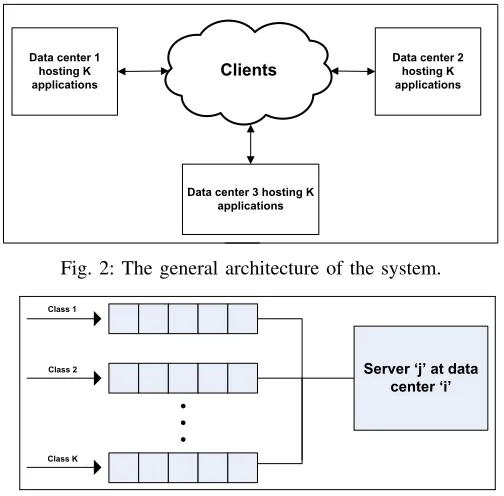
The general architecture of the system is shown in Fig. 2. The following are the key elements of the system:
• Clients. These are nodes that generate the service re-quests forwarded to the servers at the different data
Data center 1 hosting K
applications Clients
Data center 3 hosting K applications
Data center 2 hosting K applications
Fig. 2: The general architecture of the system.
Server ‘j’ at data center ‘i’
Class 1
Class 2
Class K
Fig. 3: Model of an end-server in a data center.
centers of the cloud. The clients are represented as the internet cloud in Fig. 2.
• Data centers and hosted applications. A data center is a cluster of a large number of networked computing resources. In the topology considered, multiple geograph-ically distributed data centers form the cloud computing system with each data center hosting the same set of applications as shown in Fig. 2. Each data center receives web service requests for applications from clients. An application’s web service end points are replicated in all the data centers, i.e., any data center is capable of serving a request for any application. Each application is identified by a class. So if the cloud hosts K applications, there are K classes of requests to be served by the data centers.
• Model of resources in a data center.Each data center
has a number of servers (resources) for processing the web service requests. A server processes a single request to completion each time. A request being processed cannot be preempted. Requests arriving when the server is busy are queued. Each server in a data center can process a request of any class (application). So each server in the data center is modeled as serving multiple single-class queues, each queue holding requests of a particular class as shown in Fig 3.
percentile constraints of the application should be met at the global cloud system level.
The service requests for different applications from the clients can be routed to any end server at any data center in the cloud. The routing of service requests to the different servers is based on cloud management policies depending on load of individual servers, proximity to databases etc. (We do not consider the problem of routing the service requests to the servers.) The new requests are queued for scheduling at the servers. The most common scheduling principle in a non-preemptive system is the First-in-First-out (FIFO) policy. In FIFO, some requests can be delayed beyond the constraints specified in the SLA and incur penalties. Requests of different classes when delayed, incur different penalties, based on the current number of requests that conform to the response-time constraint mentioned in the SLA. The local scheduling policy at each end server should be such that the cloud globally minimizes the penalty. There is a need for a dynamic scheduling policy which schedules new requests at end servers, to adhere to the SLAs specified for each class of service request and thus minimizing the penalty incurred globally.
B. Problem statement
We want to schedule the incoming service requests of different classes locally at the servers in the geographically distributed data centers so as to minimize the total global penalty incurred.
More specifically, we want to determine a scheduling algo-rithm that provides the minimum in equation 1 below:
min X
1≤j≤K
penj (1)
wherepenjis the penalty charged for non-conformance of the
requests of classj as described by Fig. 1 for the entire cloud.
III. Online scheduling algorithm for global percentile SLA conformance
In this paper, we propose a distributed, measurement based policy to schedule requests queued at individual servers lo-cated in each data center in the cloud. There are two basic ideas behind the proposed scheduling policy. The first is that, for the scheduling at each server to be based on the current global SLA conformance, we propose periodic updates of conformance levels of each application between the geograph-ically distributed data centers so that each data center is aware of the current global conformance at periodic intervals. The second is the calculation of penalty incurred by each arriving request, which is charged, if it does not meet the response time constraint; this calculation (see Algorithm 3) is done adaptively, based on the current global non-conformance of the class of the request, which is the fraction of requests of the class which have not met the response time specified in the SLA(1−cck). The aim is to ensure that incoming requests of
classes with higher current conformance with respect to their SLA are assigned a lower penalty and vice versa.
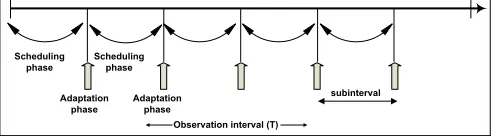
1) Algorithm description: The observation interval (T secs) during which the SLA has to be met is divided into several subintervals, the number of which is configurable. The observation interval is applicable to the entire distributed cloud i.e the observation interval is the duration for which the equation 1 has to be minimal. This can repeat indefinitely or a set number of times configurable by the cloud administrator. The subintervals start and end at the same instant in all the data centers (synchronization). Each subinterval is partitioned into a “scheduling phase” and an “adaptation phase”, as shown in Fig. 4 and formalized in Algorithm 1. The two phases are explained in detail in Algorithms 2 and 3.
Adaptation phaseIn the adaptation phase, described in Al-gorithm 2, each data center exchanges its current conformance levels of all classes with other data centers in the cloud, and each data center calculates the updated conformance levels for all the classes. This updated current conformance level (cck
in Algorithm 2 and 3) is used in individual request-penalty calculations during the scheduling phase.
Scheduling phaseIn the scheduling phase, run at each server, shown in Algorithm 3, each arriving request at end-server is assigned a penalty and scheduled. We calculate the effect of delaying the recently arrived request on the current non-conformance, so the numerator and denominator in equa-tion (A) of Algorithm 3 are both incremented by one request. If delaying this request causes the non-conformance to increase beyond that given in the SLA, then the request is assigned a penalty pk, else it is assigned a penalty of 0. This penalty
assignment (paj) is performed at each end server, upon arrival
n being the number of requests queued. However, depending on the number of iterations, all the schedules may not occur. In last insertion, a new neighbor is generated by inserting the recently arrived request in different positions of the schedule leading to a total of (n−1)schedules.
Aheuristic similar to simulated annealing is Tabu Search [10]. Tabu search prevents the occurrence of local optima in any neighborhood search. In tabu search, a search for the optimum solution is carried out in a similar manner as in simulated annealing, in addition, a tabu list is maintained which holds a configurable number of past traversed schedules. The currently found schedule is compared to the list and if it is found, it is discarded and a new schedule is obtained in its place. The two variants of neighborhood search proposed for simulated annealing can be utilized for Tabu search as well.
Our second method of scheduling the arriving request at each end sever is the gi-FIFOpolicy [7], which is described as follows: First, choose the request class with the highest penalty; then, amongst all the queued requests of the chosen class, choose one with maximum waiting time but which results in a response time less than or equal to r. If no such request exists, choose the request with higher waiting time resulting in a response time greater thanr.
The gi-FIFO policy was shown to maximize delay per-centiles in single-server systems [7]. In Section IV, we com-pare the two variants of simulated annealing,Tabu search with pairwise interchange and gi-FIFO and FIFO policies with respect to minimizing penalty in our system.
2) Assumptions: In formulating the algorithm we have made the following assumptions:
• The latency in exchanging messages between the
geo-graphically distributed clusters is negligible when com-pared to the request inter-arrival and service times.
• The time required for updates of the status of an arriving
request, to propagate to all servers in the data center is negligible compared to the service request inter-arrival and service times.
• The processing time of a service request at a server is known on its arrival.
• The data-centers are synchronized and so the subintervals start and end at the same instant at all data-centers.
00:00 06:00
Scheduling phase
Scheduling phase
Adaptation
phase Adaptation phase
Observation interval (T)
subinterval
Fig. 4: Periodic scheduling and adaptation at each data center.
IV. Evaluation
In this paper, we center our evaluation (performed via simulations) on the following questions. The first question we
Algorithm 1Online scheduling algorithm for global penalty mini-mization.
Input:
• Length of observation interval: T
• Number of subintervals: Z
Output: Minimization of Equation 1. forz= 1toZ do
Scheduling phase as in Algorithm 3 Adaptation phase as in Algorithm 2 end for
Algorithm 2Adaptation phase at datacenterd, calculating updated global conformance levels.
Input:
• Number of geographically distributed data centers: N
• Number of classes of service requests: K
• Number of requests serviced of class k in data center
l in current subinterval: Xslk ∀k ∈ {1, . . . , K} ∀l ∈
{1, . . . , N}
• Number of requests classkin data center l which met the required response time in current subinterval:Xrlk • Total number of requests serviced of class k from the start of the observation interval as measured by d:Xk • Current conformance of classk in cloud as calculated
by data centerd:cck
Output:Updated current global conformance calculated by
d:cck ∀k∈ {1, . . . , K}
fork= 1 toK do
temp= 0
temp2 =Xk
fori= 1to(d−1)andi= (d+ 1) toN do
temp=temp+Xrik
Xk =Xk+Xsik /*Get updates from all other data centers*/
end for
cck = (cck∗temp2+temp)/Xk /*Updated conformance level*/
end for
Algorithm 3 During scheduling phase: A requestjarrives at end-serversfor service.
Input:
• Number of servers in each data center: ml ∀l ∈
{1, . . . , N}
• Request j of class k arrived at queue of server s at data centerl ∀k∈ {1, . . . , K},∀s∈ {1, . . . , ml},∀l∈
{1, . . . , N}
• Penalty per request of class k on non-conformance as per SLA:pk ∀k∈ {1, . . . , K}
• Required global conformance of class k as per SLA:
ck ∀k∈ {1, . . . , K}
• Required response time conformance of classkas per
SLA:rk ∀k∈ {1, . . . , K}
• Number of requests queued at serversat data centerl
at timet:qls
Output: Penalty applied for newly arrived requestj in the schedule if it does not meet rk: paj
if qls = 0and server s is freethen
Dispatch requestj for processing at end-servers
Depending if request j met the response time, update the conformance for class k.
else
nonconf = ((1−cck)∗Xk+ 1)/(Xk+ 1) (A)
ifnonconf >(1−ck)then
paj=pk /*non-conformance high,pkpenalty assigned toj*/
else
paj= 0 /*non-conformance low, 0 penalty assigned toj*/
end if
Insert requestj charged with penaltypaj in the queue
of end servers
Apply heuristics for scheduling the request as in Algo-rithm 4.
end if
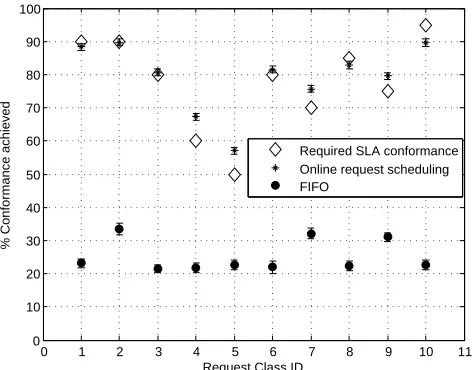
the SLA whereas conformance levels in FIFO is much lower than that in the SLA.
The estimation of nonconformance in equation (A) in Al-gorithm 3 (and the corresponding penalty prediction for each individual request) is a key element of our scheduling policy. Therefore, the second question we wanted to answer is “Does the scheduling algorithm adapt the penalty assigned to an incoming request according to the current conformance of its class?” In the same configuration as in the first experiment, consider, for example, two classes with differing conformance requirements. Fig. 7 is a typical depiction of the penalty charged to an incoming request for both classes for a small time window. As can be seen in Fig. 7, the penalty for the class with higher conformance requirement was constantly higher, indicating the desired adaptation feature.
Intuitively, since our algorithm attempts to minimize the total penalty as expressed in Equation 1, it must ensure that classes with higher pk penalty values are scheduled “sooner”
than classes with lower such values. So the third question
Algorithm 4 Simulated Annealing/gi-FIFO based optimum sched-ule for requests queued at server.
Input:
• Number of requests queued at server sat datacenter l
at timet: n∀s∈ {1, . . . , ml},∀l∈ {1, . . . , N} • Process time of requestj:Pj ∀j∈ {1, . . . , n} • Starting time of request j:xj ∀j ∈ {1, . . . , n} • Penalty charged if request j is scheduled at time xj:
pnj(xj)
• If scheduling the requestj of classkat timexj causes
the response time of j to be less than or equal to rk,
thenpnj(xj) = 0, otherwisepnj(xj) =paj /*pajcan be
either0orpkdepending on the current conformance of classkas assigned
in Algorithm 3*/
• X: { x|xj1=t andxj z+1=xj z+Pj z, z= 1, ..., n
for some permutationj1, ..., jn of 1, ..., n} (B)
We have to obtain optimum schedule of the n requests queued whereminx∈XP1≤j≤npnj(xj) (C)
Output: Most optimum schedule of requests queued at servers
SA: Use current schedule as starting seed schedule
iterations= 0
repeat
penalty = Compute penalty with current schedule new schedule = pairwise interchange or last insertion delta = Penalty of new schedule - penalty
if delta <0 then
f inal penalty=penalty+delta
Final schedule = new schedule end if
current schedule = new schedule
iterations+ +
untiliterations < M AXIT ERAT ION
OR
Apply gi-FIFO policy for the requests queued
we pose is “Does the Online scheduling algorithm favor requests with higher penalty?” To answer this we simulated the algorithm with the same cloud computing configuration as mentioned before but with just two classes of service requests, class one with penalty of 0.9$ for each non-conforming request and class two with penalty of 0.1$ for each non-conforming request, with a cut-off conformance of 90% and the same response time requirement for both. The input request rates for the two classes are the same. We ran the simulation multiple times varying the input request rate each time and the results in Fig. 8 show that the requests for class one are favoured over requests of class two by our scheduling algorithm, thus scheduling the requests with higher penalty ahead of requests with lower penalty but FIFO scheduling favours requests of both classes equally.
0 1 2 3 4 5 6 7 8 9 10 11 0
10 20 30 40 50 60 70 80 90 100
Request Class ID
% Conformance achieved
Required SLA conformance Online request scheduling FIFO
Fig. 5: Typical comparison of FIFO and simulated annealing.
100 200 300 400 500 600 700
10−2 10−1 100 101
102 103
104
Request rate
Penalty incurred ($)
FIFO scheduling Online request scheduling
Fig. 6: Total penalty incurred in FIFO and Online schedules with varying input rates.
achieved by the periodic adaptation phase as shown in Fig. 4. So “Is the algorithm distributed in nature?” is our next question. In the same configuration as in the first experiment, consider, for example, two clusters, one with large number of resources and another with small number of resources. Results in Fig. 9 show that the locally calculated current conformance
cck values, at data center with low resources increase after
considering the global value.
The next question is centered around the approximating variants proposed: “Which variant of our algorithm (among last insertion, pairwise interchange simulated annealing, tabu search and gi-FIFO) obtains schedules with lower penalty?” Our simulations did not reveal a clear winner; in general, pairwise interchange performed better than the other two (and so we simulate only pairwise interchange variant of Tabu search). A typical result from our run is shown in Fig. 10. In this figure, we compute the total penalty as a function of request rates for both pairwise interchange and gi-FIFO with very stringent SLA criterion, and when the system is stressed where even at lower request rates, the penalty incurred is high. As we can see, at lower request rates (lesser
250 300 350 400 450 500
0 0.5 1 1.5
Arriving request
Penalty assigned ($)
Request class with required SLA conformance 90%
250 300 350 400 450 500
0 0.5 1 1.5
Arriving request
Penalty assigned ($)
Request class with required SLA conformance 50%
Fig. 7: Penalty assigned to each incoming request for two classes with different conformance requirements.
0 100 200 300 400 500 600 700 800 900 1000
0 10 20 30 40 50 60 70 80 90 100
Request rate
% Conformance achieved
Online request scheduling − class penalty 0.9$ Online request scheduling − class penalty 0.1$ FIFO − class penalty 0.9$
FIFO − class penalty 0.1$
Fig. 8: Adaptation of algorithm to favor requests with higher penalty, each run with varying input request rate.
0 1 2 3 4 5 6 7 8 9 10 11 0
20 40 60 80 100
Request class ID
% Conformance calculated
% Conformance calculation after adaptation phase % Conformance calculation before adaptation phase
Fig. 9: Conformance calculated by datacenter with low re-sources before and after adaptation phase.
0 200 400 600 800 1000 1200
0 0.5 1 1.5 2
x 104
Request rate
Total penalty in $
Pairwise interchange giFIFO
Fig. 10: Comparison of gi-FIFO and pairwise interchange under high stress and stringent conformance values.
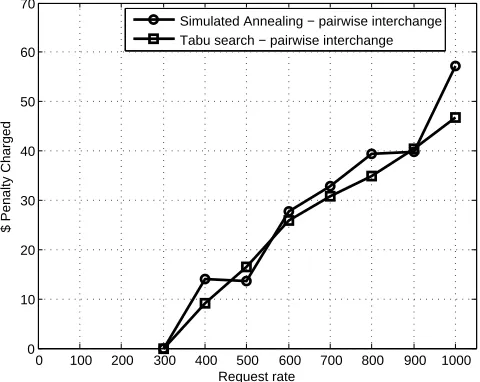
as shown in Fig. 10. Also shown in Fig. 11 is that Tabu search with pairwise interchange performs as well as simulated annealing with pairwise interchange gaining on the latter for some classes. This is expected as in Tabu search we can expect to obtain a number of schedules more than that in simulated annealing owing to the tabu list where a configurable past number of schedules are stored and each new schedule is checked against that list and if there is any match, the schedule is discarded and another schedule is obtained in its place. We also compare the penalties obtained with simulated annealing and tabu search both employing pairwise interchange with varying input rates in Fig. 12. As shown, Tabu search and simulated annealing result in low penalties for almost all of the input rates, with Tabu performing a shade better in most cases. However in a few cases the penalty incurred in Tabu search is slightly less than that in simulated annealing and we attribute this to our implementation of dynamic list sizes, where, if requests queued are very less in number, we do not perform comparison with the tabu list in tabu search and so, the variation is due to the randomness in the input rates and schedule selection in the two simulation runs.
With simulations we have found that pairwise interchange
0 1 2 3 4 5 6 7 8 9 10
10 20 30 40 50 60 70 80 90 100
Request Class ID
% Conformance achieved Pairwise interchange Last insertion giFIFO Tabu
Required conformance
Fig. 11: Comparison of simulated annealing based pairwise interchange, last insertion and gi-FIFO.
0 100 200 300 400 500 600 700 800 900 1000 0
10 20 30 40 50 60 70
Request rate
$ Penalty Charged
Simulated Annealing − pairwise interchange Tabu search − pairwise interchange
Fig. 12: Comparison of total penalty in simulated annealing based pairwise interchange and tabu search based pairwise interchange.
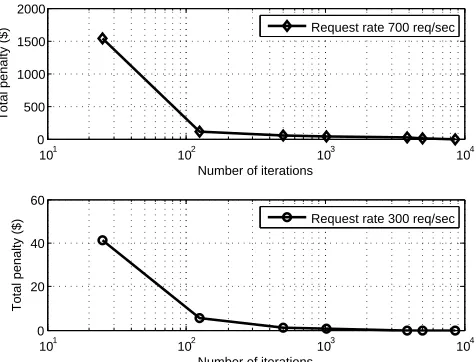
with Tabu search or simulated annealing performs the best among all other variants. The pairwise interchange algorithm finds the optimum schedules over a set number of iterations. So our next question is “How do the heuristic-based variants of the algorithm perform with varying iterations?”. To answer this, we evaluated pairwise interchange based Tabu search with a set number of iterations for two different request rates, results in Fig. 13. As expected, as the number of iterations increase, the total penalty decreases, also the minimum iterations required for the total penalty to be zero is higher for higher input rate.
V. Conclusion and future work
101 102 103 104 0
500 1000 1500 2000
Number of iterations
Total penalty ($)
Request rate 700 req/sec
101 102 103 104
0 20 40 60
Number of iterations
Total penalty ($)
Request rate 300 req/sec
Fig. 13: Total penalty obtained in tabu search pairwise inter-change with varying iterations for two input request rates.
for economic penalties if percentile targets are not met. We proposed a novel, distributed request scheduling scheme that aims to minimize the total penalty charged on the cloud. We implemented and evaluated two variants of a heuristic algo-rithm, one based on simulated annealing and another on gi-FIFO scheduling. Our evaluation has shown that our methods far outperform the commonly deployed FIFO scheduling.
Our future work involves expanding the scope of the problem to include (a) on-demand routing of the requests to appropriate resources, (b) dynamic resource management of the servers in a distributed cloud for both the single-step and multi-step percentile SLA and (c) minimization of response time and power consumption-based penalties with multi-tier applications in a distributed cloud computing system.
REFERENCES
[1] “Geographically distributed system for catastrophic recovery,” in
LISA’02: Proceedings of the 16th USENIX conference on System
admin-istration. Berkeley,CA,USA: USENIX Association, 2002, pp. 47–64.
[2] B. F. Cooper, R. Ramakrishnan, U. Srivastava, A. Silberstein, H.-A. Bohannon, Philip andJacobsen, N. Puz, D. Weaver, and R. Yerneni, “Pnuts: Yahoo!’s hosted data serving platform,” Proc. VLDB Endow., vol. 1, no. 2, pp. 1277–1288, 2008.
[3] L. Zhang and D. Ardagna, “Sla based profit optimization in autonomic computing systems,” inICSOC ’04: Proceedings of the 2nd international
conference on Service oriented computing. New York,NY,USA: ACM,
2004, pp. 173–182.
[4] D. Gmach, S. Krompass, A. Scholz, M. Wimmer, and A. Kemper, “Adaptive quality of service management for enterprise services,”ACM
Trans. Web, vol. 2, no. 1, pp. 1–46, 2008.
[5] K. Xiong and H. Perros, “Sla-based service composition in enterprise computing,” in 16th International Workshop on Quality of Service,
IWQoS. Washington,DC,USA: IEEE Computer Society, 2008, pp. 30–
39.
[6] N. S. Cave, Alex and A. Kouzani, “Schedule evaluation: simulation optimization for process scheduling through simulated annealing,” in
WSC ’02: Proceedings of the 34th conference on Winter simulation.
Winter Simulation Conference, 2002, pp. 1909–1913.
[7] N. Agarwal and I. Viniotis, “Performance space of a gi/g/1 queueing system under a percentile goal criterion,” inMASCOTS ’95: Proceedings of the 3rd International Workshop on Modeling, Analysis, and Simulation
of Computer and Telecommunication Systems. Washington,DC,USA:
IEEE Computer Society, 1995, pp. 53–57.
[8] E. J. Anderson and C. N. Potts, “Online scheduling of a single machine to minimize total weighted completion time,”Math. Oper. Res., vol. 29, no. 3, pp. 686–697, 2004.
[9] M. L. Fisher and A. M. Krieger, “Analysis of a linearization heuristic for single-machine scheduling to maximize profit,”Mathematical
Pro-gramming, vol. 28, no. 2, pp. 218–225, 1984.