Supplier Selection in Construction Industry
using AHP Integrated with TOPSIS Method:
A Case study
Sangeetha S.1, Anila P. V.2
P.G. Student, Department of Civil Engineering, SNGCE, Kadayiruppu, Kerala, India1
Assistant Professor, Department of Civil Engineering, SNGCE, Kadayiruppu, Kerala, India2
ABSTRACT: In construction industry, various parties constituting the supply chain come together for the completion of a single project. The companies which can manage their supply chain efficiently will outperform in the global market. Supplier is a key component of supply chain since construction materials constitute over 50% of the total cost of a project. So selecting the right supplier is an important strategic decision which should be well defined. Also various criterias which affect the supply chain management were studied and their importance in supplier selection were studied through Questionnaire survey. On the basis of the RRI values, the various factors which play an important role in supplier selection in construction industry were also studied. The effect of supplier selection using the Multi Criteria Decision Making technique, AHP integrated with TOPSIS method is studied by implementing it in a real working environment. The study results showed that AHP integrated with TOPSIS method is an efficient technique for choosing the best supplier of raw materials which is most suitable for a particular construction project depending on the priority of criterias or demands of the organization.
KEYWORDS: Construction industry, MCDM, AHP, TOPSIS, supplier selection, criterias
I. INTRODUCTION
The term “Supply Chain Management” implies the integration of activities to procure raw materials, transform them into intermediate goods and final products, and delivers to the customer.In today’s highly competitive environment, an effective supplier selection process is very important to the success of any construction organization. The cost of raw materials and component parts constitutes the main cost of a product, such that in some cases it can account for over 50% of the total project cost. In such circumstances decision making of purchasing management can play a key role in cost reduction. In supply chain the coordination between manufacturers and suppliers is the most important and critical link in the channel of distribution. Once a supplier becomes part of a well-managed and established supply chain, this relationship will have a lasting effect on the competitiveness of the entire supply chain. Because of this, supplier selection problem has become one of the most important issues for establishing an effective supply chain system. Selection of the right supplier is a complicated process by the fact that numerous criteria must be considered in the decision making process. Researches also indicates that supplier selection process has direct impact on performance of an organization. As the organization becomes more and more dependent on their suppliers, the direct and indirect consequences of poor decision making becomes more critical. The nature of their demand may be complex and unstructured.
II. RELATED WORK
MCDM techniques when applied helps the selection of optimum supplier in relatively short time on the basis of the required criteria desired by the purchaser. Traditionally, selection of suppliers was often based on the criterion of price. The cheapest supplier is usually selected without taking into consideration the additional costs or other criterias this supplier may introduce in the chain of the purchasing organization. Various authors have clearly defined the need of considering more than one criteria to select the optimum supplier. Also many authors have studied and described number of criterias which affect supplychain management in construction industry. They also have cited the importance of using MCDM techniques in reduction of cost and increase in the sales. Optimum suppliers are chosen on basis of final rank obtained after applying MCDM techniques.
III.METHODOLOGY
In the first phase the problem of supplier selection was defined and on the basis of the literature review done, various criteria related to the supplier selection problems are identified and listed. The next phase was data collection. In this study, the data collection methods adopted are by using questionnaire survey and personal interview. In the phase of questionnaire survey, questionnaires will be distributed among the purchase managers of different construction firms and the respondents are asked to rank the criteria’s in the questionnaire according to their priority using Likert scale. Key Criteria’s were then chosen for the study. The suppliers were then evaluated on the basis of these key criteria’s chosen using AHP integrated with TOPSIS method using the data obtained from the proposed case study. The important steps involved in AHP integrated with TOPSIS method are:
1: Define criteria and sub-criteria that are most affecting in supplier selection problem. 2: Construct pairwise comparison matrix of criteria (Using AHP).
3: Determination of criteria weights (Using AHP).
4: Evaluation of alternatives (normalized decision matrix) using TOPSIS method. 5: Determine positive and negative ideal solution using TOPSIS.
6: Determination of best alternative. (Using TOPSIS method). 7: Select the best alternative.
IV.CRITERIAS USED FOR THE STUDY
Traditionally cost and quality were only criterias considered for the selection of right supplier. But now, few more interactive and interdependent selection criterias have been increasingly used by the manufacturers. Thirty nine criterias which affect the supplier selection were considered for the study on the basis of the literatures reviewed were:
Price
Quality
Delivery time
Repair service
Warranties
Safety
History
Reliability
Environment degradation
Position
Management
Commitment
Attitude
Long term relation
Experience
Testing certificate
Financial position
Geographic location
Innovation
Customer satisfaction
Proper communication
Urgent delivery
Service time
Discount
After sales service
Mode of delivery
Product durability
Hazard
Billing accuracy
Product development
Process improvement
Desire
Honesty
Inventory
Flexibility
Culture
Quality standards
V. DATA COLLECTION
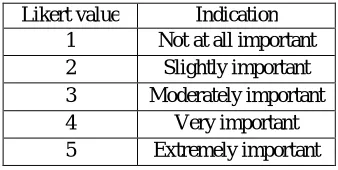
Questionnaire has been used as the main method of data collection for this study to allow for feedback from a large number of respondents, where it is impractical to collect feedback using other more resource intensive methods. The scale used for the measurement is Likert scale.
Likert value Indication 1 Not at all important 2 Slightly important 3 Moderately important 4 Very important 5 Extremely important
Table 1. Five point Likert Scale
VI.DATA ANALYSIS
Cronbach's alpha is the most commonly used when you have multiple Likert questions in a survey/questionnaire that form a scale and you wish to determine if the scale and the questionnaire is reliable.After the collection of Questionnaires required for the study, data was analysed using the Statistical Package for Social Science (SPSS). A Cronbach Alpha value of 0.939 was obtained and hence the response obtained can be concluded as highly reliable
VII. RELATIVE RANKING INDEX OF CRITERIAS USED IN THE STUDY
The criterias were ranked on the basis of the response obtained from Questionnaire survey using Relative Ranking Index (RRI) method.The RRI technique is used for comparison between the importance levels of variables and derived from the Likert scales which represent the level of importance of variables chosen by respondents which need to be transformed into a Relative Rank Index that has a value of one or less. The RRI can be calculated using the following equation:
RRI = (∑ )………….. (1)
Where, i- 1,2...n, li =Likert scale (l1 is the least important and ln is the most important) and xi = the frequency of the ith
response.
22 Criterias with RRI value of 0.675 or more were considered as Key criterias used for the further study.
VIII. IMPLEMENTATION OF AHP INTEGRATED WITH TOPSIS METHOD IN THE PROPOSED CASE STUDY
For the implementation of AHP integrated with TOPSIS method in the given case study, two sets of data were collected. This data was further used to evaluate the supplier alternatives of various materials. Three supplier alternatives for raw materials, cement, sand, steel and coarse aggregate were chosen for the study. Data was collected through personal interview with the purchase manager/ store keeper of the proposed site. Suppliers were evaluated and compared based on a 9 point Saaty’s scale (Table 2).In the first set of data, each suppliers were evaluated on the basis of each of the key criterias considered for the study. The second set of data were pair wise comparison matrices wherein each suppliers were compared with each other for each individual criterias. The matrices were also found to be consistent in the consistency check.
After the input data required for the implementation of AHP integrated with TOPSIS method were collected, the method was implemented.
IX.RESULTS AND DISCUSSION
The final result obtained after applying the MCDM technique in the given case study is shown in Table 2. The best alternatives were chosen for each of the four raw materials -: Cement, Sand, Steel and Coarse aggregate.
Material Best alternative chosen Cement Supplier 1
Steel Supplier 1 Sand Supplier 1 Coarse aggregate Supplier 1
So for each material, considering the organization/ construction company’s priority and importance for each of the key criteria, the best alternative was chosen. Thus the application of Multi Criteria Decision Making techniques helps in choosing the right supplier with due consideration of a number of criterias. Overall cost, time and efficiency of supplier selection process can be improved, hence making it suitable for practical application in construction industry.
X. CONCLUSION
In this work, 39 criterias which affects the supplier selection process were identified and the effect and relative importance of these criterias on the supplier selection process was studied by conducting a Questionnaire survey. The key criterias chosen for the further study were identified using Relative Ranking Index method. AHP integrated with TOPSIS method was implemented using the data obtained from a real working environment. For all the four materials considered, Supplier 1 was found to be the best supplier when applied to the cement, sand, steel and coarse aggregate suppliers. Hence, it can be concluded that AHP integrated with TOPSIS technique can be effectively executed in construction industry to find out the best supplier with due consideration to various criterias and their priorities which can enable the efficient and smooth functioning of supply chain. Advantages of applying this method are that it overcomes most of the disadvantages of AHP and TOPSIS methods and it is more accurate compared to both the methods. Disadvantages of AHP integrated with TOPSIS method is that it isa time consuming and complex technique.
REFERENCES
[1] KamleshNanaji, “Supplier Selection Process in the construction material purchasing system”, International Journal of Engineering Science and Research Technology,Vol.4, pp.670 - 680, 2015.
[2] Mani V., Rajat Agarwal, Vinay Sharma, “Supplier Selection using Social sustainability: AHP based approach in India”, International Strategic Management, Vol.2, pp.98-112, 2014.
[3] Shpend IMERI, “Performance criteria for vendor selection – a literature review”, Management Research and Practice,Vol.5, pp.2067 - 2462 2013.
[4] Om Pal, Amit Kumar Gupta, R. K. Garg, “Supplier selection criteria and methods in supply chain”,World Academy of Science, Engineering and Technology, Vol.7, No.10,pp.1395 – 1401, 2013
[5] Manoj Sharma, “Multi attribute decision making techniques”, International Journal of Research in Management, Science and Technology, Vol.1, pp.49 – 51, 2013
[6] S. Patil, Prof. P.S. Adavi, “A Survey Study Of Supplier Selection Issues In Construction Supply Chain”, International Journal on Engineering Research and Application,Vol.2, No.5, pp.1806 - 1809, 2012
[7] Ruth Mwakali, “Factors affecting selection of optimal suppliers in procurement management”,International Journal of humanities and Social Science,Vol.2, No.10, pp.189 - 193, 2012
[8] Reza AllahayariSoeini, LalehTashakor, JavadTashakoriBafghi, Mohammad Mokhtari, Amin Vakili, “Supplier selection based on multiple criteria” ,International Journal on new comp. architecture and their applications, pp.258 - 273, Vol.2, 2012
[9] Omid Jadidi, FatemehFirouzi, Enzo Baglieri,“TOPSIS method for supplier selection problem.”,International Scholarly and Scientific Research and Innovation, Vol.4, pp.815-817, 2011.
[10] Pema WangchenBhutia, Ruben Phipon, “Application of AHP and TOPSIS for supplier selection”,IOSR Journal of Engineering, Vol.2, No.10, pp.43-50, 2012.
[11] S. Thiruchelvam, J. E. Tookey, “Evolving trends of supplier selection criteria and methods”,International Journal of Automotive and Mechanical Engineering, Vol.4,pp.437-454, 2011