Research activities on High Temperature Gas-cooled Reactors (HTRs) in the 5 th
EURATOM RTD Framework Programme
J. Martin-Bermejo, M. Hugon, G. Van Goethem European Commission, DG RESEARCH
ABSTRACT
One of the areas of research of the "nuclear fission" key action of the 5 th EURATOM RTD Framework Programme (FP5) is "Safety and efficiency of future systems". The main objective of this area is to investigate and evaluate new or revisited concepts (both reactors and alternative fuels) for nuclear energy that offer potential longer term benefits in terms of cost, safety, waste management, use of fissile material, less risk of diversion and sustainability. After the first call for proposals of FP5, several projects related to High Temperature Gas-cooled Reactors (HTRs) were retained by the European Commission (EC) services. They address important issues such as HTR fuel technology, HTR fuel cycle and HTR materials. In the second call for proposals (deadline January 2001) other important HTR-related aspects not covered by the first call (e.g. power conversion systems, system analysis, licensing) are addressed. These projects will be the initial "kernel" of the European Network on "High Temperature Reactor Technology" (HTR-TN) recently set up by 18 EU organisations.
INTRODUCTION
The Fifth Framework Programme sets out the priorities for the European Union's research, technological development and demonstration activities for the period 1998-2002 [1]. These priorities have been identified on the basis of a set of common criteria reflecting the major concerns of increasing industrial competitiveness and the quality of life for European citizens.
The Fifth Framework Programme differs considerably from its predecessors. It has been conceived to help solve problems and to respond to major socio-economic challenges facing Europe. To maximise its impact, it focuses on a limited number of research areas combining technological, industrial, economic, social and cultural aspects. Management procedures have been streamlined with an emphasis on simplifying the process and systematically involving key players in research.
The Fifth Framework Programme has two distinct parts: the European Community framework programme covering research, technological development and demonstration activities; and the Euratom framework programme covering research and training (RT) activities in the nuclear sector. A budget of 14,960 million Euro has been agreed for the period up to the year 2002 of which 13,700 million Euro is foreseen for the implementation of the European Community section of Fifth Framework Programme and 1,260 million Euro have been allocated to the Euratom programme.
In practice, this Programme is implemented either via indirect actions co-ordinated by Directorate General
RESEARCH of the European Commission (EC) or via direct actions under the responsibility of the Joint Research Centre (JRC) of the EC. The "indirect actions" consist mainly of research co-sponsored by DG RESEARCH but carried out by external public and private organisations as multi-partner projects. The direct RTD actions comprise normally research of an institutional character that is carried out directly by the JRC using their unique expertise and facilities.
THE 5 TM EURATOM FRAMEWORK PROGRAMME (1998-2002)
Overview
The strategic goal of the 5 ~ EURATOM framework programme for research and training activities (FP5) is to help exploit the full potential of nuclear energy in a sustainable manner, by making current technologies even safer and more economical and by exploring promising new concepts. The specific programme (indirect actions) comprise two "key actions", controlled thermonuclear fusion and nuclear fission, generic research on radiological sciences, and support for research infrastructure.
The budget breakdown of the 5 th EURATOM specific programme is as follows: - Key action 1: controlled thermonuclear fusion EURO 788 million - Key action 2: nuclear fission EURO 142 million - Generic R&D activities on radiological sciences EURO 39 million - Support for research infrastructures EURO 10 million
- Joint Research Centre (Direct actions) EURO 281 million
The Key Action "Nuclear Fission"
The main objectives of this key action are to enhance the safety of Europe's nuclear installations and improve the competitiveness of Europe's industry. Within these broader objectives, the more detailed aims are to protect workers and the public from radiation and ensure safe and effective management and final disposal of radioactive waste, to explore more innovative concepts that are sustainable and have potential longer term economic, safety, health and environmental benefits and to contribute towards maintaining a high level of expertise and competence on nuclear technology and safety.
Research will focus on issues that currently hinder the fuller exploitation of nuclear energy (e.g., cost, safety, waste disposal, public attitudes) and aim to demonstrate the availability of practical solutions to the outstanding scientific and technical problems and public concerns. It should bring together at the research stage different stakeholders sharing common strategic objectives. It covers four principal areas of research:
- Operational safety of existing installations
- Safety of the fuel cycle
- Safety and efficiency of future systems
- Radiation protection.
Their objectives and main priorities are briefly described below:
a) - Operational safety o f existing installations
The objectives are to provide improved and innovative tools and methods for maintaining and enhancing the safety of existing installations, for achieving evolutionary improvements in their design and operation and for improving the competitiveness of Europe's nuclear industry. Three top research priorities have been identified:
- Plant life extension and management - Severe accident management
- Evolutionary concepts.
b) - Safety o f the fuel cycle
The objective is to develop a sound basis for policy choices on the management and disposal of spent fuel and high-level and long-lived radioactive wastes and on decommissioning and to build a common understanding and consensus on the key issues. Three top research priorities have been identified:
- Waste and spent fuel management and disposal - Partitioning and transmutation
- Decommissioning of nuclear installations.
c) - Safety and efficiency o f future systems
The objective is to investigate and evaluate new and updated concepts for nuclear energy that offer potential longer term benefits from the points of view of cost, safety, waste management, use of fissile material, less risk of diversion and sustainability. Innovative or revisited reactor concepts, and innovative fuels and fuel cycles have been identified as the top research priorities.
d) - Radiation protection
The objectives are to help operators and safety authorities to protect workers, the public and the environment during operations in the nuclear fuel cycle, to manage nuclear accidents and radiological emergencies and to restore contaminated environments. Four top research priorities have been identified:
- Governance (assessment and management) of risk - Monitoring and assessment of occupational exposure - Off-site emergency management
- Restoration and long-term management of contaminated environments.
Selection of Projects in FP5
Proposals for "indirect" actions under the specific programme were invited by the EC via calls for proposals with fixed deadlines. Up to date there have been two of these calls for proposals with deadlines 17 June 1999 and 4 October 1999, and with a total funding of 103 Million Euro. A third call will be made this year for another 50 ME with a deadline 22 January 2001. The details of the expected research areas and priorities are given in the Work Programme, which is updated annually and is available on the CORDIS website (www.cordis.lu/fp5-euratom).
In the first calls all the priority areas have been addressed. After the evaluation of the proposals received, a number of research contracts covering the objectives of the above-mentioned areas has been successfully negotiated by the EC and different EU organisations (see table 1).
Table 1. Results of Euratom FP5 first call for proposals
Research Area
Operational Safety of existing installations
Safety of fuel cycle
Safety and efficiency of future systems
Radiation protection
Radiological Sciences
Support for Research Infrastructures
Total
Proposals received
113
72
12
34
88
13
Projects accepted
39
36
10
39
10
332 142
Commission funding (Million EURO)
27
37
26
104
The research will be implemented through: shared-cost actions (the main mechanism for the key action), support for networks and databases, training fellowships, concerted actions and accompanying measures. These indirect actions are managed and co-ordinated by Unit J-4 ("Nuclear fission and radiation protection") of Directorate J ("Preserving the ecosystem II") within DG RESEARCH. The actual work is carried out by laboratories and research bodies, utilities, engineering companies, regulatory authorities, small and medium-sized businesses. On the other side, the principal end- users of the results are nuclear power stations, national regulatory authorities and the industry sector in general.
SAFETY AND E F F I C I E N C Y OF F U T U R E SYSTEMS
This is a newly identified research area for FP5 with the objectives of assessing new and updated concepts for nuclear energy that offer potential longer term benefits in terms of safety, economy, waste management, use of fissile material, less risk of diversion and sustainability. It covers two sub-areas, namely "Innovative or revisited reactor concepts" and "Innovative fuels and fuel cycles. Relevant work had been undertaken previously, in particular in the cluster of projects "INNO" of area A ("Exploring Innovative Approaches") of the specific programme on Nuclear Fission Safety in the Euratom 4 th Framework Programme (1994-1998).
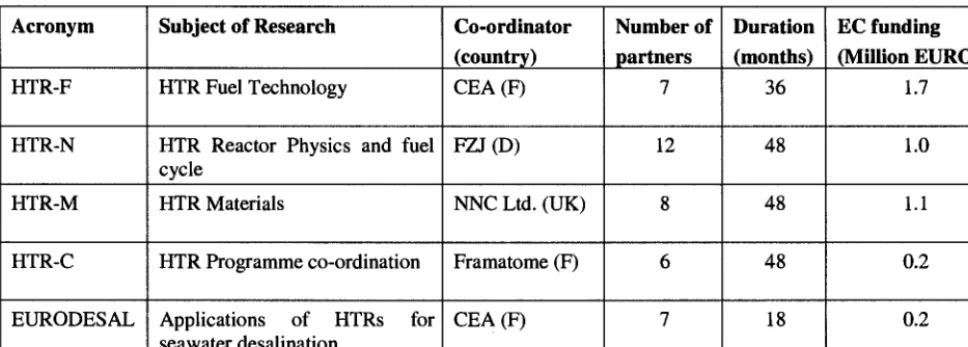
After a first call for proposals in 1999, 12 proposals were received in this area, requesting about 3 times more than the available budget. As a result of the external evaluation of these proposals 7 of them were selected for funding by the Commission services. In view of the proposals received and the available budget, the approach adopted by the Commission services was to support a sound and consistent cluster of research on HTR (4 proposals) and some individual proposals related to different reactor concepts and applications. All the contracts have been successfully negotiated and the list of HTR related projects is shown in table 2 below.
Table 2. On going HTR-related research projects in Euratom FP5 Acronym HTR-F HTR-N HTR-M HTR-C EURODESAL
Subject of Research
HTR Fuel Technology
HTR Reactor Physics and fuel cycle
Co-ordinator
(country)
CEA (F)
FZJ (D) Number of partners Duration (months) 36 48 HTR Materials
HTR Programme co-ordination
Applications of HTRs for seawater desalination
NNC Ltd. (UK)
Framatome (F)
CEA (F)
12
48
48
18
EC funding
(Million EURO)
1.7
1.0
1.1
0.2
0.2
RESEARCH ON HTRs IN EURATOM FP5
A number of HTRs were developed through the 1960's and 1970's (i.e. Peach Bottom and Fort St Vrain in the US, AVR and THTR in Germany, and Dragon in the UK) but then abandoned. However, its inherent safety features, its potential for use in high temperature industrial processes and the possibility of using direct cycle gas turbines has kept the concept alive. In fact, there is renewed interest in other parts of the world (Japan, China, South Africa, Russia) and their potential for deployment later on in Europe is now being re-considered. However, a full development programme will require a large, fairly long - term effort for which a more proactive public R&D strategy might be necessary.
Current
EC-sponsored Projects
The five HTR-related projects selected by the EC form a consistent and structured cluster covering both fundamental research and technological aspects.
This section describes the objectives as well as the main experimental and analytical activities foreseen within the above-mentioned projects. Around 25 different organisations, representing research centres, universities, regulators, utilities and vendors from 9 EU member states are involved.
Project HTR-F
This project is a "shared-cost" action to be carried out by a consortium of seven organisations (CEA, bTM, JRC- IAM, JRC-ITU, BNFL, Framatome and NRG) under the co-ordination of CEA. The duration foreseen is 36 months.
The objectives of the H T R - F project are: (i) to restore (and improve) the fuel fabrication capability in Europe, (ii) to qualify the fuel at high burn up with a high reliability and (iii) to study innovative fuels that can be used for applications different from former HTR designs. The Work Programme includes the following activities:
- to collect data from the various types of fuels tested in the past in European reactors (e.g. HFR, THTR, DRAGON, OSIRIS, SILOE, etc.) and to analyse them in order to better understand the fuel behaviour and performance under irradiation
- to define experimental programmes (in-pile and out-of-pile) in order to qualify the fuel particle behaviour under irradiation and high temperatures. A first irradiation test is planned in the HFR reactor on pebbles from the last German high quality fuel production with the objective to reach a burn-up of 200 000 MWd/t. Concerning the heat- up tests, the Cold Finger Furnace (KUFA) facility, in which temperatures can reach up to 1800 ~°C, will be transferred from J01ich (FZJ) to Karlsruhe (JRC/ITU) where it will be commissioned after having tested one irradiated pebble.
- to model the thermal and mechanical behaviour of coated fuel under irradiation and to validate it against the experimental results available. The models in existing codes (e.g. PANAMA, FRESCO, COCONUT, etc) will be used to develop a common European code.
- to review the existing technologies for fabrication of kernels and coated particles, to fabricate first batches of U- bearing kernels and coated particles, to characterise them and to study alternative coating materials (e.g. ZrC and TIN). Kernels and particles will be fabricated in different laboratories (two at CEA and one at JRC/ITU) and the first coatings tests will be performed on simulated and depleted uranium kernels.
Project HTR-N
This project is a "shared-cost" action to be carried out by a consortium of 12 organisations (FZJ, Ansaldo, CEA, Subatech, Framatome, NNC Ltd., NRG, JRC-ITU, Siemens, and the Universities of Delft, Pisa and Stuttgart) under the co-ordination of FZJ. The duration foreseen is 48 months.
The main objectives of the HTR-N project are: to provide numerical nuclear physics tools (and check the availability of nuclear data) for the analysis and design of innovative HTR cores, to investigate different fuel cycles that can minimise the generation of long-lived actinides and optimise the Pu-burning capabilities, and to analyse the HTR- specific waste and the disposal behaviour of spent fuel. The Work Programme includes the following activities:
- to validate present core physics code packages for innovative HTR concepts (of both prismatic block and pebble bed types) against tests of Japan's High Temperature Test Reactor (HTTR) and to use these codes to predict the first criticality of China's HTR- 10 experimental reactor
- to evaluate the impact of nuclear data uncertainties on the calculation of reactor reactivity and mass balances
(particularly for high burn-up). Sensitivity analyses will be performed by different methods on the basis of today's available data sets (ENDF/B-VI, JEFF-3, JENDL 3.2/3).
- to study selected variations of the two main reactor concepts (i.e. hexagonal block type and pebble-bed) and their associated loading schemes and fuel cycles (i.e. the static batch-loaded cores and continuously loaded cores) in order to assess burn-up increase, waste minimisation capabilities, economics and safety.
- to analyse the HTR operational and decommissioning waste streams for both prismatic block and pebble bed types and to compare them with the waste stream of LWR.
- to perform different tests (e.g. corrosion, leaching, dissolution) with fuel kernels such as UO2 and (Th,U)O2 and
coating materials of different compositions (e.g. SiC, PyC) in order to evaluate and generate the data needed to model the geo-chemical behaviour of the spent fuel under different final disposal conditions, i.e. salt brines, clay water and granite.
Project HTR-M
This project is a "shared-cost" action to be carried out by a consortium of 8 organisations (NNC Ltd., Framatome, CEA, NRG, FZJ, Siemens, Empresarios Agrupados and JRC-IAM) under the co-ordination of NNC Ltd. The duration foreseen is 48 months.
The objectives of the HTR-M project are to provide materials data for key components of the development of HTR technology in Europe including: reactor pressure vessel (RPV), high temperature areas (internal structures and turbine) and graphite structures. The Work Programme consists of the following basic activities:
- review of RPV materials, focusing on previous HTRs in order to set up a materials property database on design
properties. Specific mechanical tests will be performed on RPV welded joints (Framatome facilities) and irradiated specimens (Petten HFR) covering tensile, creep and/or compact tension fracture.
- compilation of existing data about materials for reactor internals having a high potential interest, selection of the
most promising grades for further R&D efforts, and development and testing of available alloys. Mechanical and creep tests will be performed at CEA on candidate materials at temperatures up to 1100°C with focus on the control rod cladding.
- compilation of existing data about turbine disk and blade materials, selection of the most promising grades for
further R&D efforts, and development and testing of available alloys. Tensile and creep tests (in air and vacuum) from 850°C up to 1300° C and fatigue testing at 1000° C will be performed at facilities at CEA while creep and creep/fatigue tests in Helium will be performed at JRC.
- review the state of the art on graphite properties in order to set up a suitable database and perform oxidation tests at
high temperatures on: (i) a fuel matrix graphite to obtain kinetic data for advanced oxidation (THERA facility at FZJ) and (ii) advanced carbon-based materials to obtain oxidation resistance in steam and in air respectively (INDEX facility at FZJ).
Project HTR-C
This project is a "concerted action" to be carried out by a consortium of 6 organisations (Framatome, FZJ, CEA, NNC Ltd., NRG, and JRC) under the co-ordination of Framatome. The duration foreseen is 48 months.
in the world. In order to promote and disseminate the achievements of the EC-sponsored projects, HTR-C will organise presentations in international conferences.
Project EURODESAL
This is a "concerted action" to be carried out by a consortium of 7 organisations (CEA, CANDESAL, Empresarios Agrupados, Framatome, IRRADIARE, and the University of Rome) under the co-ordination of CEA. The duration foreseen is 18 months.
The aim of this project is basically to assess the technical and economical feasibility of the production of potable or irrigating water through seawater desalination with innovative nuclear reactors (with emphasis on HTRs). The expected outcome is a thorough strategic study built on the available experience which should identify the main safety, technological and economic issues related to the coupling of the nuclear and non-nuclear systems. A preliminary economic evaluation should also permit a comparison with "competitor" energy sources (i.e. fossil and renewables).
Future calls for proposals
A second call for proposals was published in October 2000 with a deadline in January 2001. In the area of Safety and Efficiency of Future Systems this call targeted on complementary R&D activities on HTRs with emphasis on the items not covered by the first call (e.g. power conversion systems, system analysis, licensing, public acceptability). The EC also expected proposals for strategy studies and/or thematic networks for the assessment of applications of nuclear energy other than generation of electricity such as process heat and hydrogen production. The indicative budget available for this area in this second call was of 6 Million EURO.
Six proposals dealing with HTRs were submitted before the deadline of the second call and considered "eligible". Three of these proposals address HTR aspects not covered in the first call: licensing issues (HTR-L), systems analysis (HTR-S) and power conversion systems (HTR-E). The other three (HTR-F1, HTR-N 1, HTR-M1) are an extension of the HTR-F, HTR-M, and HTR-N projects that contain complementary activities which was not possible to address in the first call due to budget and scheduling constraints.
• HTR-E addresses the innovative key components, systems and equipment like turbine, core catcher, active and
permanent magnetic bearings, rotating seals, sliding parts (tribology) and the helium purification system. The programme contains design studies, experiments (e.g. at the magnetic bearing test facility at Zittau, thermal- hydraulics test on core catchers at CEA or tribological investigations at Framatome).
• HTR-S covers the whole field of software for safety assessment and system analysis. The scope of the programme is: (i) adoption of available system codes to the Brayton cycle and verification with data from the only large-sized helium gas turbine facility in the world (i.e. EVO); (ii) simulation of an air ingress accident in the NACOK facility in relevant scale and under realistic conditions and extrapolation of the results to recent HTR designs; (iii) improvement of codes to better model fission product deposition and remobilization as well as the formation and behaviour of graphite.
• HTR-L proposes a safety approach for a licensing framework specific to Modular High Temperature Reactors and a classification for the design basis operating conditions and associated acceptance criteria. Special attention is put on the confinement requirements and the rules for system, structure and component classification as well as a component qualification level being compatible with economical targets.
• HTR-F global objective is the qualification of coated fuel particles (LEU) at very high burn-up and high temperatures with a high reliability. It complements the HTR-F project by enabling to complete the irradiation of the German pebbles in the HFR in Petten, to carry out their post irradiation examination (PIE) and to perform heat- up tests under accident conditions in the new KUFA facility at ITU (Karlsruhe). The code modelling the thermal and mechanical behaviour of the coated fuel particles to be developed in HTR-F should be validated in HTR-F1. The production of coated particles and kernels should start at CEA and ITU.
H T R - M I complements HTR-M, as it concentrates on the long-term testing of the materials for the turbine and irradiation tests for the HTR graphite components. Special attention is put on the fact that previous graphites are no longer available because the coke used as the raw material has either run out and the manufacturer's experience lost, or production techniques and equipment do no longer exist. The programme includes verification of models describing the graphite behaviour under irradiation and screening tests of recent graphite qualities.
These proposals have been evaluated by independent experts who have given their advice to the Commission services. Following this advice the Commission services will select the resulting portfolio of proposals to be negotiated taking into account the objectives of the area and the budget constraints. As soon as the negotiations are successfully completed the contracts will be signed and the new projects will start and will be clustered with the on-going projects accepted in the first call (HTR-F, HTR-M, HTR-N and HTR-C).
THE "HIGH TEMPERATURE REACTOR TECHNOLOGY NETWORK" (HTR-TN)
In the beginning of 2000, fifteen EU organisations signed a multi-partner collaboration agreement to set up a European Network on "High Temperature Reactor Technology" hereinafter referred to as the "HTR-TN". The agreement does not involve cash flow between the members and all contributions are made in kind. The operating agent and the manager of this network is the JRC-IAM (Petten) and the rest of the partners are: Ansaldo (I), Belgatom (B), BNFL (UK), Empresarios Agrupados (E), Framatome (F), FZJ (D), b'ZR (D), IKE (D), University of Zittau (D), Delft University (NL), NNC (UK), NRG (NL) and Siemens (D). Many of these organisations had already been working together in the "INNOHTR" Concerted Action of the Euratom FP4 (contract FI4I-CT97-0015).
The general objective of this network is to co-ordinate and manage the expertise and resources of the participant organisations in developing advanced technologies for modern HTRs, in order to support the design of these reactors. The primary focus will be to recover and make available to the European nuclear industry the data and the know-how accumulated in the past in Europe and possibly in other parts of the world. The Network should also work on the consolidation of the unique safety approach and of the specific spent fuel disposal characteristics of HTR, providing data, tools and methodologies which could be available for the safety assessment of European Safety Authorities. The EC-sponsored projects mentioned above will be the initial "kernel" from which the HTRTN will depart.
The activities of this network started officially in April 2000 at the kick-off meeting held in Petten (The Netherlands). During this meeting the Steering Committee of the network was constituted and different task groups were set up in order to implement the agreement. Six technical task groups were created to address the following areas: components technology, system and applications studies, material performance evaluation, safety and licensing, fuel testing, physics and fuel cycle including waste. In addition to these technical task groups some "horizontal" task groups were also formed to cover aspects such as strategies for future common projects, internal and external communications, and international relationships.
At the second Steering Committee meeting of the HTR-TN held in Brussels on November 2000 three new organisations, Balcke-Diirr (D), COGEMA (F) and VTT (FI) joined HTR-TN. The network remains open for further partners or associates from Europe and elsewhere. An HTR-TN web page is being tested by the network members using the <<CIRCA>> server of the JRC (http:/www.jrc.nl/htr-tn).
CONCLUSIONS
At present, there is renewed interest in different countries of the world (Japan, China, South Africa, Russia) on High Temperature Gas-cooled Reactors (HTRs). Their potential for deployment later on in Europe is also being re- considered. Its inherent safety features, its potential for use in high temperature industrial processes and the possibility of using direct cycle gas turbines has made of HTRs a very attractive concept in the current socio-economic and political environment. However, a full development programme will require a large, fairly long-term effort for which a more proactive public R&D strategy might be necessary.
The research activities, implemented mainly through shared-cost actions, concerted actions and networks, are managed by Unit J-4 ("Nuclear fission and radiation protection") of Directorate J ("Preserving the ecosystem II") within
DG RESEARCH. The actual work is carried out by laboratories and research centres, utilities, engineering companies,
regulatory authorities, and universities. This enforced collaboration of organisations of different EU member states contributes to improve the consistency of the research fabric within the EU so that optimal use can be made of the available resources in the present and the future Euratom Framework Programmes.
A European Network on "High Temperature Reactor Technology ("HTR-TN") has been set up by eighteen EU organisations having the JRC-IAM (Petten) as the operating agent. The general objective of this network is to co- ordinate and manage the expertise and resources of the participant organisations in developing advanced technologies for modern HTRs, in order to support the design of these reactors. The primary focus will be to recover and make available to the European nuclear industry the data and the know-how accumulated in the past in Europe and possibly in other parts of the world. The agreement does not involve cash flow between the members and all contributions are made in kind. The EC-sponsored projects in Euratom FP5 mentioned above will be the initial "kernel" from which the HTRTN will depart.
REFERENCES