2D Shape Image Retrieval System Based on
the Characterization of the Image
Mostafizur Rahman1, Muzameel Ahmed2
P. G Student, VTU Belgaum, Dept. of ISE, DSCE, Bengaluru, Affiliated VTU, India1
Research Scholar, JAIN University, Bengaluru, India 2
Associate Professor, Dept. of ISE, DSCE, Bengaluru, Affiliated VTU, India2
ABSTRACT: Now a days shape recognition has got more importance because of its wide range of application and use. Each and every day researchers are coming out with their new innovative ideas and executions, but still it is a open problem for the researchers. In the proposed method, 2D shape characterization technique is explained using Content Based Image Retrieval (CBIR) system. CBIR is the effective method towards identifying the similar shaped images based on the 3 factors. First one is morphological filters which make use of operations like erosion, dilation, opening and closing to find the similar images. In the next method contours of the images playa a major role in identifying the match. Third method is the combination one, which combines the above two methods to find the similar images from the large database. Support Vector Machines (SVM) classifier is used to find the accuracy of the matched objects.
Experimental results show the good accuracy rate.
KEYWORDS: shape characterization, Content Based Image Retrieval (CBIR) system, morphological filters, Support Vector Machines (SVM), K-Means classifier.
I. INTRODUCTION
A 2 dimensional image is represented as f(x, y) where x and y are the intensity values in x and y directions respectively and f is the 2 dimensional function which represents the digital image. This image is captured by digital cameras, mobile phones, etc. After capturing the image there is a need for enhancing the image because picture might not be clear or presence of noise. To eliminate all these and to get the high quality, the image has to be processed. Digital image processing is done using digital computers. Digital image processing is the process of converting the image into digital form and applying some processes to enhance its quality for the better future use.
Digital image processing has many types. Some of them are satellite image processing, medical image processing, document image processing, biometric image processing etc. in satellite image processing images are captured using satellites and process it to know about the weather information, tsunami, hurricanes etc. medical images are processed in medical image processing. These contain x ray images, emi images etc. document image processing is the process of converting the image into digital document form for the future use.
The object or body having external surface or outline of specific form or figure is called as shape. A 2 Dimensional (2D) shape is a shape that has two dimensions. Main difference between one dimensional shape and two dimensional shape is, in one dimensional we can move only in forward and backward directions. Ex: line.
But in two dimensional it is possible to move in any directions on a flat surface. Plane is a best example for two dimensional shape.
Examples for two dimensional (2D) shapes are: triangles, squares, circles, etc examples for three dimensional (3D) shapes are: pyramids, cubes, spheres, etc
Although several works have been taken place under the CBIR system still this field is a open problem for the research people. Here we are using morphological filters, deformable model and combination method for identifying the similar shaped images.. The remaining of the paper is organized as follows. Literature survey is discussed in section 2. Section 3 deals with the proposed method. Experimental results are shown in section 4. In the Section 5 conclusions are drawn.
A. Motivation
In this era of digital world competition has become the essential part of our life. In the same way shapes have their own existence. Its not so easy to recognize the similar shaped images manually. It requires lot of time and patience. For avoiding this, there is a need for strong and effective shape based retrieval system for the images. Proposed method of Content-based image retrieval (CBIR) system helps to identify the similar shaped images. In earlier days 2D shape characterization using CBIR system was done only for gray scale image mode, but in our project we have extended it for RGB images.
II. LITERATURE SURVEY
Laurent D. Cohen et al [1] proposed finite element methods for active contour models and balloons. For the experiment author has taken 2D and 3D images. Proposed model can be applied to segment the magnetic resonance images. For solving the minimization problem two approaches are stated. First one is to defining the 3D surface as the series of 2D planar curves. In the second method comparing the finite element methods with the finite difference methods.
Madeena Sultana et al [2] presented a hybrid method for identifying the similar shaped images from the large database. Hybrid method consists of weighted combination of color histogram, moment parameters and distance. For the experiment author has taken 200 trademark images. This weighted combination technique consists of color and shape features. Gaussian noise is added to the input image for checking the accuracy. Since proposed method uses combination of methods, yields in performance degradation.
Larry S. Davis [3] described relaxation techniques for shape matching. Based on the angle of the image shape is determined. Description of the angle includes sharpness of the angle, magnitude of the angle etc. it is easy to find out convex and concave images by using on which side of the curve the object interior lies. This relaxation technique includes association graph and its derived line graph. Through which similar shapes are identified.
Marie-Pierre Dubuisson Jolly et al [4] proposed a segmentation algorithm using deformable templates for differentiate the moving vehicle and background vehicles. Polygonal template is defined for characterizing the general model of a vehicle. Author proposed a probability density function to check whether the deformable models are within the moving area or not. Metropolis algorithm is used to solve the segmentation problem. Experiment is conducted on 405 images. 91.9% accuracy rate is obtained.
Anil K Jain et al [5] described the object matching technique using deformable templates. This deformable template gives the prior knowledge about the object shape. A Bayesian scheme is used to find the match between this object and deformable template. Bayesian scheme contains the edge information of the image. Deformable model consists of prototype template which describes the shape of the class, parametric transformation sets and probability distribution.
Maichael Kass et all [6] stated a new technique to recognize the edge contours of the image. “Snake” is the active contour method which is used to find the edge contours like lines, edges and subjective contours. This method solves the problem which was present in the older methods of finding the edges. Snake gives the number of widely separated local minima for the future calculation. Also helps to reduce the energy minimization problem.
problem of translation, rotation and scaling of images. This is done by normalizing the Zernike moment values. Reconstructed image is compared with the original one. Orthogonality property simplifies the work of reconstructing the image. For the experiment author has taken variety of dataset. Among that 26- class character dataset achieved 99% accuracy.
Chahab Nastar et al [8] described the efficient method for nonrigid motion analysis. Physically based deformable surfaces are used to approximate the non rigid motion of the object contour. This non rigid motion analysis gives the spatial smoothing of the surface. Deformation spectrum is used for comparison. Fourier analysis on time signal gives the temporal smoothing data. In the proposed method author has used 4D data for the experiment. Automatic diagnosis of heart disease and in the motion compression fields this method is most applicable.
III. PROPOSED METHOD
Content Based Image Retrieval (CBIR) system is used in the proposed method of 2D shape retrieval system. CBIR is the two stage image retrieval system. In the first step similar shaped images are extracted using morphological operations. In the second step deformable models are used to find the contour part of the image. There are 4 modules in the Kannada offline handwritten word recognition process.
Content-based image retrieval (CBIR)
Content-based image retrieval (CBIR) is also called as content-based visual information retrieval (CBVIR) and query by image content (QBIC). This is mainly used to overcome the problem of image retrieval in the large database. CBIR is the computer vision technique. Traditional concept-based approach is the opposite of content based image retrieval.
In content-based system similar shaped images are searched based on the content of the image rather than its metadata. Metadata searches for tags, keywords and descriptions present in the image. The term "content" in the CBIR system refers to the shapes, textures, colors, or any other information that can be extracted from the image. CBIR system is very efficient. Since it is mainly focuses on the quality and completeness. It is very difficult to search for the images in the large database based on the keyword entered. Sometime machine cannot give the desired results similar to the keywords. Hence this metadata based image retrieval is not accurate and not well defined also.
Initially query image has to be selected. In the next step features of query image has to be extracted. The first feature is to find the histogram of the image. Next feature finds the correlogram of the image which checks whether the pixels present in the image are valid or not. The last feature which finds the color moment of the image with the help of mean and standard deviation. These features are stored and compared with the features of images present in the database.
In the proposed method we have used mainly 3 methods to identify the similar shaped images. They are
Fig 1: 2D shape characterization using CBIR system
A. Morphological filters
This is the first most method in the proposed CBIR system. Morphological filters are used to identify the similar shaped images based on the shape of the images. Here we are going to find the distance between the objects in each image. The image with the shorter distance will be selected as the similar shaped images. This is based on the following morphological operations. They are
Erosion Dilation Opening Closing
B. Deformable model
The second method in the proposed method to identify the similar images is by using deformable model. Contour parts of the images are the important factor in the deformable model. It is calculated using the following steps.
Steps in deformable model method are
Step 1: Initially find the Euclidian distance between the objects in the image. Step 2: Find the standardized Euclidian distance.
Step 3: calculate the pair wise distance between two sets of observations.
Step 4: Sort them according to the smallest distance.
Step 5: Images with the shorter distance to the query image is selected.
C. Combination method
Combination method is the last method in CBIR system. As the name says “combination” which combines the first two methods to recognize the similar shaped images. Images obtained using morphological filters and deformable model are combined and displayed as the output for the query image.
Gabor wavelet
Support Vector Machines (SVM)
Support Vector Machines (SVM) is the most commonly used classifier. It has the ability to identify the image for which it has not been trained. Here SVM is used find the accuracy of the images obtained using the CBIR system.
Steps to be followed while identifying the accuracy using SVM
Training stage
Step 1: Query image (X,Y) is represented in the vector format.
Step 2: Each vector gets the label and stored in the class.
Step 3: Two classes are created to differentiate the patterns using the following equation,
f(x) = WTx+b
Where b is the bias value and W is the normal vector.
Testing stage
In the testing stage need to check for which class the query image belongs.
Step 1: Hyper plane is created to differentiate the two classes based on the following equation
wx+b= 0
Step 2: Two more hyper planes are created to support this main hyper plane using
wx+b= 1 and wx+b= -1
Vectors which intersect at these hyper planes are called as support vectors.
Step 3: These hyper planes are used to find the distance to the database image and tells under which class it falls.
Step 4: in the last step number of similar shaped images are counted and accuracy is calculated.
IV. EXPERIMENTAL RESULTS
Experiments are conducted and discussed in this chapter. Numbers of experiments are conducted to evaluate the proposed 2D shape image retrieval system based on the characterization the image. These experiments are performed on the color images.
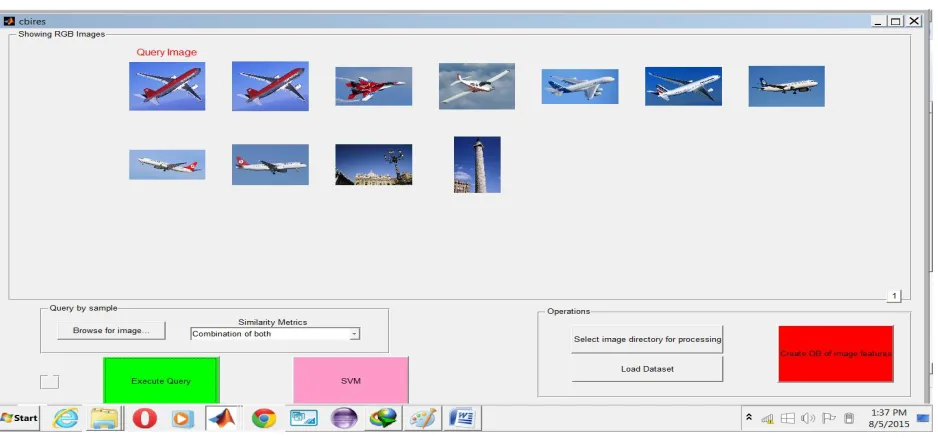
We have created the dataset of 500 color images. All are of gpg format. Initially the query image is to be selected. Similar shaped images are identified based on the 3 methods of CBIR system. First method is the morphological filters which find the similar images based on the operations such as erosion, dilation, opening, and closing.
Fig 2: Snapshot of the result of combination method
Fig 3: Snapshot of the result showing the accuray using SVM classifier.
V. CONCLUSION
REFERENCES
[1] Laurent D. Cohen and Isaac Cohen, “Finite-Element Methods for Active Contour Models and Balloons for 2-D and 3-D Images”, IEEE Transaction on Pattern Recognition and Machine Intelligence, vol 15, no. 11, November 1993
[2] Madeena Sultana and Mohammad Shorif Uddin, “Trademark Recognition Using a Weighted Combination of Different Image Features”, International Journal of Computer Theory and Engineering, Vol. 4, No. 6, December 2012
[3] LARRY S. DAVIS, “Shape Matching Using Relaxation Techniques”, IEEE Transaction on Pattern Recognition and machine intelligence, vol. pami-1, January 1979
[4] Marie-Pierre Dubuisson Jolly, Sridhar Lakshmanan, and Ani1 K. Jain, “Vehicle Segmentation and Classification Using Deformable Templates”, IEEE transactions on patern analysis and machine intelligence, vol. 18, NO. 3, MARCH 1996
[5] Anil K Jain, Yu Zong, Shridhar Lakshmanan, “Object matching using deformable templates”, IEEE Transaction on Pattern Recognition and machine intelligence, vol 18, no 3, march 1996.
[6] Maichel Kass, Andew Witkin, Demetri Terzopolous, “Snakes: Active contour models”, International journals of computer vision, 321-331 (1998).
[7] Alireza Khotanzad and Yaw Hua Hong, “ Invariant Image Recognition by Zernike Moments” IEEE Transaction on Pattern Recognition and machine intelligence, vol 2 no 5, may 1990.
[8] Chahab Nastar and Nicholas Ayache, “Frequency Based Nonrigid Motion Analysis: Application to Four Dimensional Medical Images” IEEE transactions on pattern analysis and machine intelligence, vol. 18, NO. 11, NOVEMBER 1996.
[9] Alex Pentland and StaI Sclaroff, “Closed-Form Solutions for Physically Based Shape Modeling and Recognition”, IEEE transactions on pattern analysis and machine intelligence, vol. 13, NO. 7, JULY 1991.
[10] Remi Ronfard, “Region based strategies for active contour models”, International journal of computer vision, 13:2, 229-251, (1994)
[11] Demetri Terzopolous, Andrew Witkin, Maichel Kass, “Constraints on deformable models: Recovering 3D shapes and non rigid motion”, artificial intelligence, Recommended by AAAI-87 program committee.
[12] J. M. Fuertes, M. Lucena, N. Perez De La Blanca, J. Fdez-valdivia, M. Guevara, “2D shape characterization for an image retrieval system”, Department de Inform ´atica. Escuela Polit´ecnica Superior de Ja´en Universidad de Ja´en Avda. Madrid 35 23071 - Ja´en SPAIN
[13] Alex P Pentland, ”Automatic extraction of deformable part models”, International journal of computer vision 4, 107-126, (1990).
[14] Cho Hauk Teh, Ronald Te Chin, “On image analysis by the methods of moments”, IEEE Trans. on Pattern Recognition and Machine Intelligence, vol 10, no 4, july 1988.