A Control Lyapunov Function Approach for
Nonlinear Web Winding System
N. Rabbah
1, N. Machkour
2, M. Zegrari
2Assistant Professor, Department of Electrical Engineering, Research Group of Modeling, Control and Embedded
Systems, ENSAM of Casablanca, Hassan II University, Casablanca, Morocco1
Assistant Professor, Department of Electrical Engineering, Research Group of Renewable Energy and Sustainable
Development, ENSAM of Casablanca, Hassan II University, Casablanca, Morocco2
ABSTRACT: The aim of this paper is to design a law control of a nonlinear web winding system using the Lyapunov stability theory. The Lyapunov function is a powerful tool for the stability analysis of nonlinear dynamic systems. This system knows several constraints such as the thermal effects caused by the frictions, and the mechanical effects provoked by metal elongation, that generates dysfunctions due to the influence of the process conditions. In the following, we give the concept of the Lyapunov's Direct Method, and we discuss its application to design a control that reduces the coupling influence between the drive speed and traction forces on cold rolling system for a precise thickness, with the best possible regularity by using the control Lyapunov function. The resulting control system is simulated and the numerical results are quoted and discussed.
KEYWORDS: Web Winding System (WWS), Web Tension, Nonlinear Control, Control Lyapunov Functions (CLF), Cold Rolling Mill (CRM).
I. INTRODUCTION
The web winding system dynamics (WWS) is described by its strongly nonlinear behavior. In all cases of winding or unwinding a web material, there is the flatness problem. Given the complexity of the system due to the nonlinearity and strong coupling between the speed and web tension, the researchers directed themselves increasingly to the techniques of nonlinear control. Our goal is to design a control law using Lyapunov theory. The Lyapunov function is a powerful tool for analyzing the stability of dynamic systems. Artstein [1] and Sontag [2] respectively have considered the stabilization and control systems have extended the concept of the Lyapunov function to that of the control Lyapunov function (CLF). They have shown that a nonlinear system can be stabilized by a state feedback, if and only if it ensures a CLF. Besides, Sontag [3] dealt stabilization systems refines and presented a universal feedback scheme using the CLF. These achievements have greatly motivated the search on the CLF which has been widely adopted in various design issues and control.
Our work is to present the concept of the CLF applied to WWS in connection to get a better understanding of regularity and industrial problems during rolling.
The paper is organized as follows. In Section 2 the Lyapunov direct method used in winding control design is introduced. The web winding model is described in Section 3, with a brief description of the system. A detailed description of winding control design methodology is in Section 4. In Section 5 the control system performances are evaluated using simulation of the web winding model. The last section concludes the paper.
II. THEORETICALBACKGROUND
In the following we brief introduce the concept of Lyapunov's direct method [4, 5] and then discuss how to apply it for designing stable control systems.
: 𝑥 = 𝑓 𝑥 + 𝑔𝑖 𝑥 . 𝑢𝑖 𝑥 𝑥𝜖𝑛, 𝑢𝜖𝑚 𝑚
𝑖=1
𝑦 = 𝑥 𝑥𝜖𝑛
Definition 1. (𝑥𝑐, 𝑢𝑐) is the equilibrium point of the dynamic system described by a set of nonlinear equations:𝑥 = 𝑓 𝑥 + 𝑔 𝑥 . 𝑢
if once 𝑥(𝑡) is equal to𝑥𝑐, it remains 𝑥𝑐 for all future time. Mathematically this means that 𝑥𝑐 satisfies:𝑓 𝑥𝑐 +
𝑔 𝑥𝑐 . 𝑢𝑐=0
In many practical problems we are not concerned with stability around an equilibrium point, but rather whether a system trajectory 𝑥(𝑡) will remain close to its original trajectory 𝑥𝑐(𝑡)if slightly perturbed away from it. This kind of stability problem can be transformed into an equivalent problem, where we study the stability of the perturbation dynamics with respect to the equilibrium point. The Lyapunov theorem for global stability allows concluding the stability of a system by examining the variations of a single scalar function.
Theorem 1. [6] Assume that there exists a scalar function V of the state𝑥, with continuous first order derivatives such that:
( ) 0
( ) 0 if and only if ) ( ) 0 if and only if
0
) ( ) ( ), ( ), 1, ,
n
c c n
k f
V x x
V x x x
i dV x x x
V
x t
ii Q x f x ad g x k j
,
of rank n x xcThen: 𝜂 𝑥 = −𝑅(𝑥)𝜕𝑉
𝜕𝑡𝑔(𝑥)return the system globally asymptotically stable (GAS) in𝑥 = 𝑥
𝑐. 𝑅(𝑥)is the strictly positive definite function. This theorem is based on the La Salle’s theorem [7].
Then the equilibrium point at 𝑥 = 𝑥𝑐 is globally asymptotically stable.
The time derivative 𝑉 (𝑥) along the system trajectory 𝑥(𝑡)can be calculated as follows:
1 2
1 2
( )
( ) n
n x
x x
dV x V V V
V x
dt x t x t x t
The Lyapunov's direct method can be used in control design problems, where our task is to find an appropriate control law for a given plant. The control design procedure requires hypothesizing a Lyapunov function candidate and then finding the control law to make this candidate a real Lyapunov function, namely:
1. For given dynamic system 𝑥 = 𝑓 𝑥 + 𝑔 𝑥 . 𝑢 find an appropriate LFC 𝑉(𝑥)that is an explicit function of the control variables.
2. Select the control law that maximizes the negative value of 𝑉 (𝑥) at all points along the system trajectory𝑥(𝑡). 3. Select locally available signals to execute the chosen control law.
III.MATHEMATICAL WWS MODEL
1. WWS description and Mathematical model
The web system is very important in a rolling mill, because its parameters determine the strip quality. Among its parameters, we quote:
2. The entry and exit velocities ensured by the winders motors, and the work rolls velocity (Fig.1). 3. The pressure force or the variations between the work rolls and their parallelism.
The variation of the exit strip flatness evolves because of the thermal dilation of the cylinders [8, 9], but also due to the elasticity forces [10]. To avoid this phenomenon, the traction forces are applied to limit the elasticity of the rolled material.
The thickness control is ensured by programmable automats, which are called AGC (Automatic Gauge Control system) [11]. Their goal is to maintain the strip thickness uniform in spite of the acting factors to change it. Considering the complexity of the Cold Rolling Mill System (CRM), the modeling and the control of the WWS should be studied to minimize the flatness defaults. With this intention, we start with the development of a mathematical model describing the dynamic behavior of the system.
Fig.1 Interactions between the components of the cold rolling system.
Fig.2 Synoptic model of the web winding system
2. Global model
The mathematical model of the WWS is given as follows [12]:
𝑑𝑇1
𝑑𝑡 = − 𝑉2
𝐿 𝑇1+ 𝐸𝑆
𝐿 𝑉2− 𝐸𝑆
𝐿 𝑉1 𝑑𝑇3
𝑑𝑡 = − 𝑉2
𝐿 𝑇3− 𝐸𝑆
𝐿 𝑉2+ 𝐸𝑆
𝐿 𝑉3 𝑑𝑉1(𝑡)
𝑑𝑡 = − 1 𝜏𝑒𝑚 1
𝑉1 𝑡 +
𝑔𝑟12
𝐽1
𝑇1+
𝑟1
𝜏𝑒𝑚 1. 𝑘1
. 𝑈1(𝑡)
𝑑𝑉2(𝑡)
𝑑𝑡 = − 1 𝜏𝑒𝑚 2
𝑉2 𝑡 −
𝑔𝑟22
𝐽2
(𝑇1− 𝑇3) +
𝑟2
𝜏𝑒𝑚 2. 𝑘2
. 𝑈2(𝑡)
𝑑𝑉3(𝑡)
𝑑𝑡 = − 1 𝜏𝑒𝑚 3
𝑉3 𝑡 −
𝑔𝑟32
𝐽3
𝑇3+
𝑟3
𝜏𝑒𝑚 3. 𝑘3
. 𝑈3(𝑡)
with:
V
2(
t
)
2(
t
).
r
2(
t
)
Let us consider the definite nonlinear model by the state representation (E) which can be put in the general form of the nonlinear affine control system:
(E) :
p m ny
x
h
y
u
x
u
x
g
x
f
x
)
(
).
(
)
(
with :
V
1T
1V
2T
3V
3
y
T
1V
2T
3
u
U
1U
2U
3
.
x
T
T
T
𝑓 𝑥 =
𝑔𝑟12 𝐽1 𝑥2−
1 𝜏𝑒𝑚 1𝑥1
−1
𝐿𝑥2𝑥3− 𝐸𝑆
𝐿 𝑥1+ 𝐸𝑆
𝐿𝑥3
−𝑔𝑟22
𝐽2 𝑥2+
𝑔𝑟22 𝐽2 𝑥4−
1 𝜏𝑒𝑚 2𝑥3
−1
𝐿𝑥3𝑥4− 𝐸𝑆
𝐿 𝑥3+ 𝐸𝑆
𝐿𝑥5
−𝑔𝑟32
𝐽3 𝑥4−
1 𝜏𝑒𝑚 3𝑥5
𝑥 = 𝑥2
𝑥3
𝑥4
𝑔 𝑥 = 𝑔1, 𝑔2, 𝑔3 = 𝑟1
𝜏𝑒𝑚 1.𝑘1 0 0
0 0 0 0 𝑟2
𝜏𝑒𝑚 2.𝑘2 0
0 0 0 0 0 𝑟3
𝜏𝑒𝑚 3.𝑘3 (1)
Let us note that it is a nonlinear model affine control system [14]. The whole of the equilibrium points drawn by following expression𝑓 𝑥𝑐 + 𝑔 𝑥𝑐 . 𝑢𝑐= 0, are defined by:
2
1 3
4
5 3
1 1 1
1
1 2 3 3 2
1 1
2 2 2 2 2 2
2
2 3 2 4
2 2 2
3 3 3 3
3 3 4 3 4
3 3
2 3 4
.
;
.
;
. .
.
1
.
.
.
;
.
.
.
.
.
.
.
;
. .
.
1
.
.
.
;
,
,
are uns
c
c c
c
c c
c c c c em c
c c em c em c
c c c c em c
c c c
ES
x
x
x
ES
ES
x
x
x
ES
g r k
k
u
x
x
x
x
r
ES
J
g r k
g r k
k
u
x
x
x
r
J
J
k
g r k
u
x
x
x
x
r
ES
J
x
x
x
pecified.
IV.CONTROLDESIGN
The web control design is based on the decentralized and centralized control principle [15, 16]. More specifically, the local stabilizing control is designed using only the isolated subsystem state variables.
Consider the web winding model in general form:
𝑥 = 𝑓 𝑥 + 𝑔 𝑥 . 𝑢 (3) The control design consists of the following steps:
1. For the winding system described by the equation (3), the Lyapunov function candidates𝑉(𝑥) are chosen in as simple form as possible.
2. The winders control law is proposed so that the following condition is satisfied:𝑑𝑉 (𝑡) 𝑑𝑡 ≤ 0 i.e. 𝑔𝑟𝑎𝑑 𝑉(𝑥) 𝑇 𝑓 𝑥 + 𝑔 𝑥 . 𝑢(𝑥) ≤ 0 (4)
where the control 𝑢(𝑥)is designed using the linearization principle:
𝑢 𝑥 = 𝑢𝑐+ 𝑢 𝑥 (5)
The 𝑢𝑐term in equation (5) defines the operating point with designed control mentioned previously. The 𝑢 (𝑥)control is chosen so that the system state 𝑥(𝑡) tends towards set point𝑥𝑐.
By introducing the control expression (5), we obtain the following form: 𝑥 = 𝑓 𝑥 + 𝑔 𝑥 . 𝑢 (𝑥), with:𝑓 𝑥 = 𝑓 𝑥 + 𝑔 𝑥 . 𝑢𝑐.
3. The higher hierarchical level control can be derived using the information from winding system, but in a considerably reduced form. The main design principle is to reduce the influence of the coupling between web velocities and the web tractions exerted on dynamic system. The best solution is to design the control in the form:
𝑢 𝑥 = −𝑅(𝑥)𝜕𝑉
𝜕𝑥𝑔(𝑥) (6)
Then the dynamical system is globally asymptotically stable in the equilibrium point at the𝑥 = 𝑥𝑐. The web winding control design is based on the Lyapunov theory of stability. Let us choose the following Lyapunov function candidate:
𝑉 𝑥 =𝐶1
2 𝑥1− 𝑥1 𝑐 2+𝐶2
2 𝑥3− 𝑥3 𝑐 2+𝐶3
2 𝑥5− 𝑥5
𝑐 2 (7)
where C1, C2 and C3 are the positive constants.
𝑉 𝑥𝑐 = 0and 𝑉(𝑥) > 0 (8) for all 𝑥𝑖𝜖 −∞; +∞ 𝑖 = 1, 2, … , 5.
The Lyapunov function gradients must be continuous functions:
(𝑔𝑟𝑎𝑑 𝑉)𝑇= 𝐶1. 𝑥
1− 𝑥1𝑐 0 𝐶2. 𝑥3− 𝑥3𝑐 0 𝐶3. (𝑥5− 𝑥5𝑐) (9) Moreover the Lyapunov function candidate (7) is required to satisfy the theorem 1:
𝑑𝑉
𝑑𝑡 = (𝑔𝑟𝑎𝑑 𝑉) 𝑇 𝑑𝑥
𝑑𝑡 = 𝐶1. 𝑥1− 𝑥1 𝑐 𝑥
1 + 𝐶2. 𝑥3− 𝑥3𝑐 𝑥3 + 𝐶3. 𝑥5− 𝑥5𝑐 𝑥5(10.a) 𝑑𝑉
𝑑𝑡 = 𝜕𝑉 𝜕𝑥𝑓 𝑥 +
𝜕𝑉
𝜕𝑥𝑔 𝑥 . 𝑢 (𝑥) (10.b) By application to the theorem 1, we quote that:𝜕𝑉
𝜕𝑥𝑓 𝑥 = 0 ∀ 𝑥 𝜖 𝑛
. However:
𝑑𝑉 𝑑𝑡 =
𝜕𝑉
𝜕𝑥𝑔 𝑥 . 𝑢 𝑥 = −𝑅 𝑥 . 𝜕𝑉 𝜕𝑥𝑔 𝑥
2
≤ 0 (11) Thus, we can deduce the control 𝑢 (𝑥) as follows:
1 1 1
1 1 1 1 1
1 1
3 3 2
2 2 2 2 3
2 2
5 5 3
3 3 3 3 5
3 3
1.( ).
( ) ( )
.
2.( ).
( ) ( )
.
3.( ).
( ) ( )
.
c em
c em
c em
C x x r
V
u x R g x R x
x k
C x x r
V
u x R g x R x
x k
C x x r
V
u x R g x R x
x k
and the global CLF of a web winding system is given as :
𝑢𝑖 𝑥 = 𝑢𝑖𝑐+ 𝑢 𝑥 𝑖 = 1, 2, 3.𝑖 (13)
V. SIMULATION AND RESULTS DISCUSSION
This section presents the temporal evolution of the exit variables by using the CLF quoted previously.
Fig. 3 for C1=C2=C3= 1, (a) Web velocities response (b) Web tensions response through the WWS.
Figure 3(a) and 3(b) illustrate the tensions and winding velocity through the WWS for C1=C2=C3=1. The velocity trajectory is similar to a 1st order system, with a response time of 5 seconds. But, we note that trajectory is further from the reference imposed (20m/s). The upstream and downstream web tensions (or traction forces) manifest some undesirable oscillations (disturbances) which are cancelled at 5 seconds.
(12)
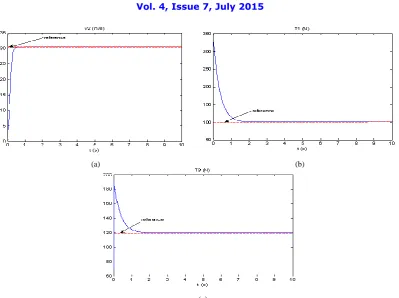
Fig. 4 for C1=100, C2=400, C3=500 , (a) Web velocities response,(b) Upstream web tension response, (c) Downstream web tension response through the WWS.
Contrary to the case of C1=100, C2=400 and C3=500, we observe, in figure 4(a), the perfect follow-up of the reference velocity (=30 m/s). The same, the upstream (fig.4(b)) and downstream (fig.4(c)) web tensions converge directly after 2 seconds, towards their reference, without having any oscillation (disturbance)
The outputs of the system follow perfectly their imposed reference trajectories. Obviously, more dynamics of the reference trajectory will be fast, more the control will be strong. It is important to recall that the dynamics of the reference trajectory is dependent of the design parameters.
A first observation relates to the sensitivity to the disturbances. This phenomenon is much accentuated in the case of the traction forces (T1 and T3). The second observation relates to the parameters (C1, C2, and C3) which can take various values. They were introduced during development of the control law. These parameters make it possible to change the regulation dynamics. However, there are restrictions on the values which they can take. These parameters must necessarily be always positive and no null. These conditions rise directly from the Lyapunov theorems.
VI. CONCLUSION
The paper describes an application of the approach of Lyapunov for a nonlinear MIMO system. The good choice of CLF cancels the nonlinearity and allows a very good follow-up of the references trajectories.
Finally, we have illustrated our control strategy by some numerical simulation results. Future works will consist in evaluating the robustness of our class of control laws with respect to some perturbations, such as the friction. But also, the lack of information about some the output system parameters requires the development of an observer to estimate the unmeasurable states.
(a) (b)
REFERENCES
[1] Artstein, Z., "Stabilization with relaxed controls", Nonlinear Analysis, Vol.7, Issue 11, pp.1163-1173, 1983.
[2] Sontag, E.D., "A Lyapunov-like characterization of asymptotic controllability", SIAM J. Control and Optimization, Vol.21, Issue 3, pp.462-471, 1983.
[3] Sontag, E.D., "A 'universal' construction of Artstein's Theorem on nonlineal stabilization", Systems and Control Letters, Vol.13, Issue 2, pp.117-123, 1989.
[4] Machowski, J.,Bialek, J.W., and Bumby, J.R.,"Power System Dynamics and Stability", John Wiley & Sons, Chichester, 1997. [5] Slotine J.E.,and Li, W.,"Applied Non-linear Control", Prentice-Hall, Englewood Cliffs, New Jersey, 1991.
[6] Jurdjevic, V., andQuinn J.P.,"Controllability and stability". Journal of differential equations, Vol.28, Issue 3, pp.381-389, 1978. [7] La Salle, J. P.,"Stability theory for ordinary differential equations", Journal of differential equations, Vol.4, Issue 1, pp.57-65, 1968. [8] El Hamzaoui, M., Rabbah, N, Sekkaki, A., and Bensassi, B.,"Gestion à base de politique de nombre de passes d’un métal à Travers un
laminoir quarto-réversible". Premières Journées de Télécommunications, d’ElectroniqueetElectrotechnique (PJTEE2006) à Oujda - Maroc, le 25-26 may 2006.
[9] Rabbah, N, and Bensassi, B.,"Modélisation et simulation d’un système de laminage à froid quarto réversible". RencontreNationale des JeunesChercheurs de Physique (RNJCP06), Casablanca - Maroc, 18-19 december 2006.
[10] Schmitz,A., and Herman, J. C.,"Modélisation du laminage à froid des aciers. Etude des aspects métallurgiques. Analyse par la méthode des tranches", CRMFacultéPolytechnique de Mons, pp. 37-43, 16-17 may 1995.
[11] Ueno,T., andSorao,K.,"Improvement of Accuracy for Gauge and Elongation Control by Dynamic Process Control Simulator", Control Applications,2004. Proceedings of the 2004 IEEE International Conference, Vol.2, pp.896 – 901, 2004.
[12] Rabbah, N, and Bensassi, B.,"Modelling and simulation of web winding system of a reversible rolling mill", International Conference on Applied Simulation and Modelling (ASM2007), Palma de Mallorca - Espagne, August 2007.
[13] Montmitonnet,P., Marsault,N., and al. "Un modèle de lubrification en régime mixte du laminage". Revue de Métallurgie-CIT/Science etGénie des Matériaux, Vol.98, pp.423-433, May 2001.
[14] Claveau,F., "Contribution à l'Analyse et la CommandeStructurée des GrandsSystèmes", Université de Nantes et EcoleCentrale de Nantes, Doctoral thesis, Nantes, France, December 2005.
[15] Isidori, A., "Nonlinear Control System: An Introduction", Lecture Notes in Control and Information Sciences, Springer Verlag,1989. [16] Benlatreche, A. A.,"Contribution à la commanderobuste H∞ de systèmes à grandeéchelled’enroulement de bandesflexibles",