18th International Conference on Structural Mechanics in Reactor Technology (SMiRT 18) Beijing, China, August 7-12, 2005 SMiRT 18-G05-7
STACKING SEQUENCE OPTIMIZATION OF LAMINATED PANELS FOR
MAXIMUM STRENGTH USING GENETIC ALGORITHM
Mahmood Shakeri Akbar Alibeiglou
Amir kabir University of technology Bu Ali Sina University
Tehran / Iran Hamedan / Iran
Phone: 98-216405844
Fax: 98-216419736
E-mail: [email protected]
Abedin Morowat
Amir kabir University of technology / Tehran, Iran
ABSTRACT
Optimal design of anisotropic laminated cylindrical panels for maximum strength is sought. The strength of the panel is defined as design objective which is optimized using Genetic Algorithm method. The Tsai-Hill failure theory is implemented as strength criterion. Finite element method is used to obtain the stress field for the anisotropic panel. The panel is simply-support at all edges and it's outer surface under radial pressure. Finally numerical results are presented for 4, 6 and 8 layered panel.
Keywords: Genetic Algorithm, Strength, Multilayered , Pannel, Composite
1. INTRODUCTION
Due to their high strength to weight ratio and the possibility of tailoring their stiffness by selecting fiber orientations the use of composite materials has obtained great importance, and the optimization of composite laminates has received growing attention in the last decades. Traditionally the optimization problem of composite laminates has been defined as a continuous design problem and solved using gradient based techniques. However because of manufacturing considerations the orientations of the fibers in plies are typically confined within a discrete set, for example (0°, 45°,-45°, 90°). Recent studies have shown that genetic algorithms (GAs) are highly suitable for the solution of the composite laminate design problems, with discrete design variables. The solution of such problems by GA is possible because the method does not require gradient or Hessian information (Gantovink,2002). Various authors have investigated the use of GAs for optimizing composite structures. A minimum thickness design for plates with discrete ply angles subject to strength and buckling constraints was considered in the study by Kogiso et al (1994), where a genetic algorithm search technique was used to achieve the optimal design. Byon (1998) optimized hybrid thick-walled cylindrical shells under external pressure , and Nagendra (1996), used a GA to design stiffened composite panels. Chen and Karunaratne (2002) optimized the stacking sequence design of composite laminates using genetic algorithms. The stacking sequence optimization of composite laminates for maximum strength is important in reduction of weight and cost. For this reason several authors have considered the optimization of composite laminates for maximum strength. Optimization of a thick walled pipe on the basis of Young’s modulus of the material was carried out by Kalinnikov (1998). An analytical approach for predicting the probabilistic ultimate strength after initial failure of carbon fiber helical wound cylinders under internal pressure was used by Uemura (1981). Fukunaga (1988) considered the use of optimum design of graphite/epoxy laminated composite pressure vessels under stiffness and strength considerations based upon membrane theory. An analysis based on membrane theory of shells of laminated cylindrical pressure vessels subject to strength criterion was also carried out by Adali (1993). Walker and Smith (2003) studied a procedure to select the optimal fiber orientations and determine the maximum load carrying capacity of laminated composite cylindrical shells.
In this paper design of anisotropic laminated cylindrical panel for maximum strength under uniform transverse loading is described. Each lamina is assumed to have orthotropic material property. Cylindrical panel is simply supported at four sides and has finite length. A normal traction,
σ
z=
q
0, is loaded on the outer surface with the inner surface free from traction. Stress field is obtained using finite element method and the Tsai-Hill criterion is used as the failure criterion.2. FINITE ELEMENT FORMULATION
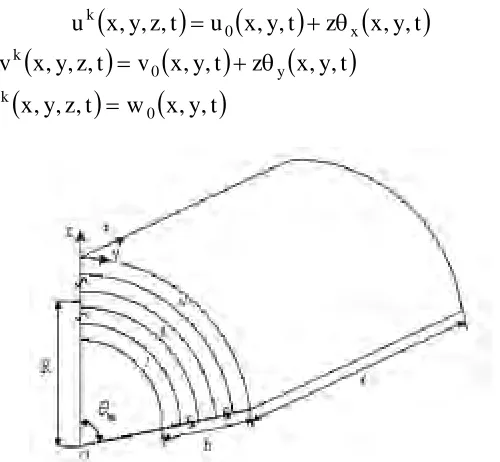
Consider a laminated cylindrical panel composed of N orthotropic layers as shown in figure (1). Since the material axes does not coincide with the geometric axes, so in general the panel has one plane of elastic symmetry. The constitutive equation of
K
th layer, taking shear deformation into account, is;(1)
k
yz xz xy yy xx
55 45
45 44 33 23 13
23 22 12
13 12 11
yz xz xy yy xx
C
C
0
0
0
C
C
0
0
0
0
0
C
C
C
0
0
C
C
C
0
0
C
C
C
γ
γ
γ
ε
ε
=
τ
τ
τ
σ
σ
where
C
ij is the transformed stiffness matrix.Three dimensional stress field is obtained by using variable finite element method (FEM). In-plane and transverse displacement for the ktk layer, based on first-order shear deformation theory (FSDT), are as the follow;
(
x
,
y
,
z
,
t
)
u
(
x
,
y
,
t
)
z
(
x
,
y
,
t
)
u
k=
0+
θ
x
v
k(
x
,
y
,
z
,
t
)
=
v
0(
x
,
y
,
t
)
+
z
θ
y(
x
,
y
,
t
)
(2)
w
k(
x
,
y
,
z
,
t
)
=
w
0(
x
,
y
,
t
)
Fig. 1 Geometry and coordinate system of laminated panel
Where;
u
0,ν
0,
w
0 are the displacements of a point on the middle surface andθ
x,
θ
y are the rotations of normal to the reference surface about the y- and x- axes, respectively.The strain tensor in terms of middle-surface deformation and rotations of normal for kth layer are as,
{ }
(3)(
)
(
)
(
)
(
)
(
)
+
−
+
+
+
+
+
+
=
γ
γ
γ
ε
ε
=
ε
R
/
z
1
/
R
/
v
w
v
w
u
v
R
/
z
1
/
u
R
/
z
1
/
R
/
w
v
u
k k y , k z , k x , k z , k x , k y , k k y , k x , yz xz xy yy xxUsing the kinematics given in equation (2), equation(3) can be rewritten as;
{ }
ε
=
[ ]
Z
{ }
ε
=
[
Z
1Z
2Z
3]
{
ε
1ε
2ε
3}
T (4) where[ ]
+
+
=
0
0
0
0
0
0
0
0
1
R
z
1
1
0
0
0
0
R
z
1
1
0
0
0
0
1
Z
1[ ]
+
+
=
0
0
0
0
0
0
0
0
z
R
z
1
z
0
0
0
0
R
z
1
z
0
0
0
0
z
Z
2[ ]
+
+
=
R
z
1
z
R
z
1
1
1
0
0
0
0
1
0
0
0
0
0
0
0
0
0
0
0
0
Z
3{ }
+
=
ε
x , 0 y , 0 0 y , 0 x , 0 1v
u
R
/
w
v
u
{ }
{ }
θ
θ
θ
θ
=
ε
x , y y , x y , y x , x 2
θ
−
−
θ
+
θ
=
ε
R
/
R
/
v
w
w
y 0 y , 0 y x , 0 x 3In the present finite element approach, a Lagrange shell element with nine second order nodes is used, in which there are five degrees of freedom
{ } {
δ
ie=
u
i0,
v
i0,
w
0i,
θ
ix,
θ
iy}
T per node. The total potential energy,π
of the panel is
π
=
U
+
V
(5)where U is the strain energy function and V is the potential energy due to external loads which are defined as the following respectively:
∫∫
{ } { }
∑ ∫
+
×
ε
σ
=
=+
dz
dxdy
R
z
1
2
1
U
n 1 k h h T 1 kk ;
V
=
∫∫
{ } { }
d
s
dxdy
T
(6)
where;
{ }
d
T=
{
u
0υ
0w
0θ
xθ
y}
,{ } {
s
=
0
0
q
0
0
}
T,q = uniform distributed applied load on outer surface of the panel,
h
kandh
k+1= z coordinates of laminate corresponding to the inner and outer surfaces of the kth layer Using Eqs.(1) and (4), strain energy can be written as;
∫∫
(
{ }
[ ]
[ ]
[ ]
{ }
)
∑ ∫
+
×
ε
ε
=
=
+
dz
dxdy
R
z
1
Z
C
Z
2
1
U
n1 k
h h
k T T
1 k
k (7)
The interpolation function of displacement field is defined as
{ }
d
5×1=
[ ]
H
5×45{ }
δ
e 45×1;
{ }
ε
12×1=
[ ]
B
12×45{ }
δ
e 45×1 (8) Where;{ } { } { } { }
δ
e=
{
δ
1e Tδ
e2 TΚ
δ
9e T}
;[ ]
H
and[ ]
B
are the interpolation and strain displacement matrices, respectively.After minimizing the potential energy, the stiffness matrix and load vector can be expressed as;
[ ]
(
{ }
[ ]
[ ]
[ ]
{ }
)
dz
dx
dy
R
z
1
B
Z
C
Z
B
K
n1 k
h h
k T T
e k1
k
∫∫
∑ ∫
+
×
=
= +
{ }
f
e=
∫∫
[ ]
H
Tw{ }
q
dxdy
(9) The coefficient of stiffness matrix involved in governing equation (9) can be rewritten as the product of term having thickness coordinate z alone and term containing x and y. Assembling the matrices in equations (9) in the general matrix, the generalized finite element equation is derived as;
[ ]
K
G{ }
δ
G=
[ ]
f
G (10)where
[ ]
K
45Gx45,[ ]
F
G45x1and{ }
δ
Gare the global stiffness, force and displacement matrices respectively Finally, matrix equation (10) can be solved by using the standard methods.3. GENETIC ALGORITHM
Genetic algorithm (GA) is a search algorithm based on the mechanism of natural selection and natural genetics [13]. In this approach, one starts with a set of designs (population). From this set, new and better designs are reproduced using the fittest members of the set. Each design must be represented by a finite length string (chromosome). Usually, binary strings have been used for this purpose. In this paper the binary decoding is used for increasing the convergence rate. In the genetic algorithm the reproduction, crossover and mutation operations are used.
The primary objective of the reproduction is to make duplicates of good solutions (viz. have a higher fitness) and eliminate bad solutions in a population. The roulette wheel method is widely used for the implementation of reproduction, for this purpose, the wheel is divided into M (population size) slices, where the size of each is marked in proportion to the fitness of each population member. When the wheel is spun (simulated by using a random number generator between 0 and 1, where the circumference of the wheel is normalized to be 1), those solutions that occupy larger slices of the wheel have a better chance to be chosen as parent designs. Tournament method is alternative for reproduction. In this way string population are compared with each other, and the string with high fitness value is chosen and inserted in the parent population instead of the worth one. After reproducing the parent, the cross over operation is used to produce the new population.
In almost all crossover operators, two strings are picked from the population at random and some portions of the strings are exchanged between the strings to create two new strings. In a single-point crossover operator, this is performed by randomly choosing a crossing site along the string and by exchanging all bits on the right side of crossing site, In two point crossover, two point along the string are selected and the other portion of this two point are replaced with each other. In uniform cross over , some portion along the string is selected randomly and the gen of these two point is replaced with each other. In this paper uniform crossover is used.
The need for mutation is to keep diversity in the population, and prevent the existing population from seeking local maxima. Without mutation operation it is not possible to generate new population. Mutation operation selects position along the string randomly and replace it with the randomly selected number.
4. OPTIMIZATION PROBLEM
The aim of this study is to maximize strength ratio Q of laminated composite panel by altering ply orientation for a given thickness of layer. The ply orientation angles of composite laminates are taken as design variables. The strength ratio Q is defined by the Tsai-Hill failure criterion:
1 2 12 2
2 1 2 2 2 1
R
X
Y
X
Q
−
σ
+
σ
σ
−
σ
+
σ
=
(11)where; = normal and shear stresses along the fiber and perpendicular to the fiber direction. = normal and shear yield stresses along the fiber and perpendicular to it's direction.
nd a
, 2 12
1 σ σ
σ
S nd a Y , X
To find the strength ratio,(Q), the principal stresses are compute at the nods of each elements and the strength ratio is obtained for each elements. The maximum strength ratio is selected as the strength ratio of the panels. Here, the strength ratio are determined from the finite element solution of the problem, and are used to determine the value of the fitness parameter by the GA.
5. NUMERICAL RESULTS
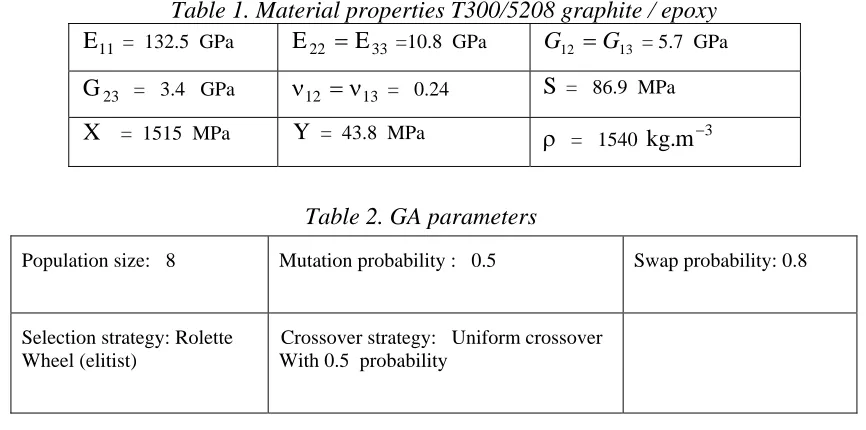
Optimum design of symmetric laminated cylindrical panel subjected to the uniformly distributed load in the outer surface and simply supported edges using the GA has been performed. Material properties of composite and GA parameters are given in tables 1 and 2 respectively. Geometric dimensions of panel are;
1
R
L
Lb
;
3
;
10
H
R
S
;
1
R
m c m
c
c
=
×
θ
=
π
=
θ
=
=
=
Where;
R
c= mid radiusθ
m= angular spanLb
= aspect ratioS
= mid radius to thickness ratioH
= thickness of the panelGoverning differential equation are solved using FEM and the stresses obtained are needed in the GA process. The strength and ply angle are the objective function and design variable respectively. The discrete set of ply angles is specified between -90 and 90 deg. With increment 5deg.. Optimum stacking sequence will be achieved after 100 iteration of GA process without any change in objective function quantity.
Table 1. Material properties T300/5208 graphite / epoxy
11
E
= 132.5 GPaE
22=
E
33 =10.8 GPaG
12=
G
13 = 5.7 GPa23
G
= 3.4 GPaν
12=
ν
13 = 0.24S
= 86.9 MPaX
= 1515 MPaY
= 43.8 MPaρ
= 1540 3m
.
kg
−Table 2. GA parameters
Population size: 8 Mutation probability : 0.5 Swap probability: 0.8
Selection strategy: Rolette Wheel (elitist)
Crossover strategy: Uniform crossover With 0.5 probability
Table 3. initial population and the optimum stacking sequence for four layered panel
Initial population Best angles Best fitness
[
20
45
] [
s,
85
−
20
] [
s,
35
−
15
] [
s,
−
90
30
]
s[
−
85
30
] [
s,
55
20
] [
s,
−
70
−
45
] [
s,
−
90
−
50
]
s17.3487
[
80
40
] [
s,
−
20
60
] [
s,
−
70
−
10
] [
s,
25
−
20
]
s[
15
−
80
] [
s,
−
30
5
] [
s,
−
25
−
90
] [
s,
−
20
45
]
s17.3487
[
20
45
] [
s,
85
−
20
] [
s,
35
−
15
] [
s,
−
90
30
]
s[
55
20
] [
s,
−
70
−
45
] [
s,
−
90
−
50
] [
s,
−
85
30
]
s17.3487
[
25
−
55
]
s[
25
−
55
]
s[
25
−
55
]
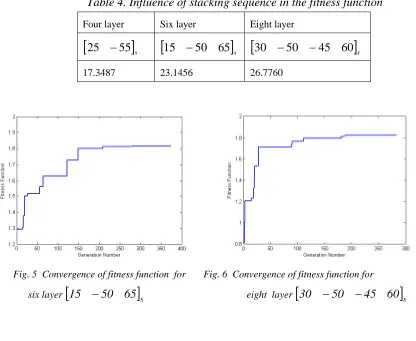
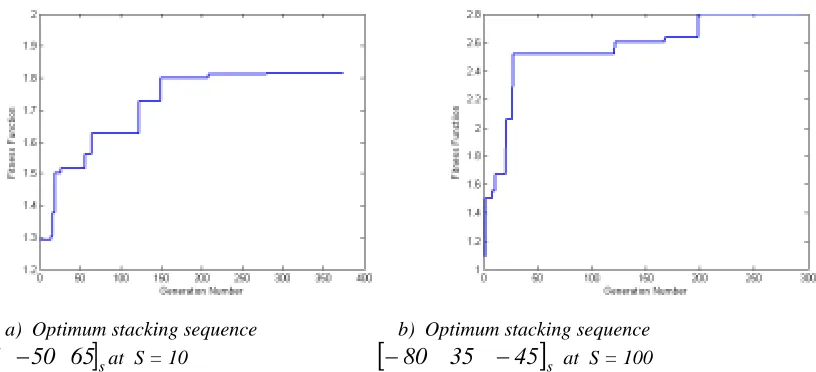
sThree sets of initial populations (table 3.) are shown in figures 4-a,b and c. According to the these figures, after 100 iterations the magnitude of fitness function , 17.3487, does not change, and the related stacking sequence is [ 25, -25]s which is chosen as the optimum one. The number and kind of initial population can only change the time of convergence for objective function and not it's magnitude. The best angles for stacking sequence from among the searching domain with different sets of initial population is written in table 3 also. Table 4 shows the optimum sequence lay-up with the related objective functions for 4, 6 and 8 layered panel. According to figures 5 and 6 , increasing the number of layer with constant thickness causes to increasing the stiffness of panel, and rate of increasing the objective function decreases with increasing the number of layer. Also, when the number of layer in an individual lay-up increases, the number of iteration for convergence of fitness function is increased. Figure 7
shows the influence of
H
R
c=
S
in the iteration process for optimum design of 6 layered panel. The process in thickpanel will converge very fast rather than the thin case.
a) first group of initial population for four b) second group of initial population for four layered panel
layered panel
a) Third group of initial population for four layered panel
Fig. 4 Influence of initial population in the Convergence of fitness function
Table 4. Influence of stacking sequence in the fitness function
Four layer Six layer Eight layer
15
−
[
30
−
50
−
45
60
]
s17.3487 23.1456 26.7760
[
25
−
55
]
s[
50
65
]
s
Fig. 5 Convergence of fitness function for Fig. 6 Convergence of fitness function for
six layer
[
15
−
50
65
]
s eight layer[
30
−
50
−
45
60
]
s
a) Optimum stacking sequence b) Optimum stacking sequence
at S = 10
[
15
−
50
65
]
s[
−
80
35
−
45
]
s at S = 100Fig. 7 Influence of S in the Convergence of fitness function
6. CONCLUSIONS
The genetic algorithm method is used easily to find the optimum stacking sequence of panel for maximum strength without auxiliary information such as derivatives of the objective function or an initial guessing point regarding the strength. The design constraint implemented is based on the Tsai-Hill failure. In this study the acceptable final result is defined as the result which is repeated for one hundred generations. This number can be chosen so as to achieve more accurate results, if needed. The total iterated number of generations depends on the initial selected population. A suitable selection can reduce the number of generation, and the time of analysis.
REFERENCES
Adali S, Summers EB, Verijenko V., (1993), "Optimisation of laminated cylindrical pressure vessels under strength criterion", Compos Struct, pp.305–12.
Byon D., (1998), "Optimizing lamination of hybrid thick walled cylindrical shells under external pressure by using genetic algorithm", J Thermoplast Compos Mater, Vol.11, No.5, 417.
Chen HP, Karunaratne R., (2002), "Optimum stacking sequence design of composite laminates using genetic algorithms", In: International SAMPE Symposium and Exhibition: [Proceeding], vol. 47, pp. 1402-14.
Fukunaga H, T-W Chou, (1988), "Simplified design techniques for laminated cylindrical pressure vessels under stiffness and strength constraints", Compos Mater, pp. pp.1156–69.
Gantovink VB, Gurdal Z, Watson LT., (2002), "A genetic algorithm with memory for optimal design of laminated sandwich composite panels", Compos Struct, Vol.58 pp.513-520.
Kogiso N, Watson LT, Gurdal Z, Haftka RT, (1994),"Genetic algorithms with local improvement for composite laminate design", Struct Optim, Vol.7, pp.207-18.
Kalinnikov AE, Korlyakov SV., (1988), "Optimization of the stress–strain state of a thick-walled pipe on the basis of Young’s modulus of the material", Problemy Prochnosti, Vol.2 pp.88–91.
Nagendra S., (1996), "Improvwd genetic algorithm for the design of stiffened composite panels", Compos Struct, Vol.58, No.3, 543.
Uemura M, Fukunaga H., (1981), "Probabilistic burst strength of filament wound cylinders under internal pressure", Compos Mater, pp. 462–79.
Walker M, Smith R., (2003), "A methodology to design fiber reinforced laminated composite structures for maximum strength", Compos Struct Part B, Vol.34, pp.209–214.