ISSN 2286-4822 www.euacademic.org
Impact Factor: 3.4546 (UIF) DRJI Value: 5.9 (B+)
A correlation study of multiple intelligence and
school achievement at primary level
Dr. PARESH B. ACHARYA
Assistant Professor Shri I.J.Patel M.Ed. Course Mogri, Anand, India
Abstract:
The study explored the relationship of multiple intelligences to the academic achievement of primary level students of Anand town. Data were obtained from 97students who were enrolled for the 2014 – 15 in the primary schools of Anand city. Participants responded to the standardized Multiple Intelligences inventory (MII), a developed by Prof. K. S. Likhia, which was personally administered by the researcher. It contains 35 items with 7questions each representing the seven intelligences namely: verbal-linguistic, logical-mathematical, bodily-kinesthetic, musical, visual-spatial, intrapersonal and interpersonal. The statistical analyses of the study employed Pearson correlation. Findings from this study suggest that in a learning environment where multiple intelligences may not be actively used, there is a tendency to have weak and negative correlation between multiple intelligences and different subjects academic achievement.
Key words: Multiple intelligences (MI), academic achievement.
Introduction:
“All students can learn and succeed, but Not all on the same day in the same way” -William G. Spady
intelligence theory were proposed in the early 1980s by Gardner in which he suggests that "the traditional notion of intelligence as measured by I.Q testing is far too limited, and there are not just two ways to be intelligent, but many ways"(Gardner, 1983, p.51). According to this theory, people are different in their different aspects of intelligence. This difference causes differences in people's performance on different tasks, as well as different aspects of a special task. The heart of MI theory rests on individualization and recognition of divergent abilities and personal differences. Gardner, viewed ''intelligence as the ability to solve problems or to create products that are valued in one or more cultural setting''. (Gardner & Hatch, 1989, pp. 4-9). This definition challenged the traditional psychological view of intelligence as a single capacity that drives logical and mathematical thought He asserts that the intelligences are eight types and they are not meant to be reflections of emotions, personality or sensory acuity, rather, each of the intelligence considered computational capacity the ability to process certain kinds of information in the process of solving a problem or fashioning a product. Academic achievement is dependent upon and academic intelligence and MI of the learner. Demographic variation plays a very important role in determining human behavior, through this study an attempt was made to uncover the role of demographic variable as gender in determining the level of academic achievement and the relationships with multiple intelligence.
Research review:
academic subject areas. IKiz and Çakar (2010) studied the relationship between multiple intelligences and the academic achievement levels. Academic achievement scores turned out to be related to students' multiple intelligences. Results also contribute awareness to the self knowledge and self-efficacy of the students and to developing programs to improve their academic achievement. Carroll, et al., (2009) examined the structural relations among self-efficacy, and academic aspirations. The results showed that academic self-efficacy and self-regulatory efficacy had a strong relationship with academic achievement. However, a negative relationship between social self-efficacy and academic achievement was reported. According to Newby-Fraser and Schlebusch (1997), self-efficacy has a significant negative correlation with level of stress. However, Nikoopour, et al., (2012) concluded that all subcontracts of trait EI were moderate predictors of self-efficacy. In an attempt to investigate the effect of emotional intelligence and self-efficacy beliefs on high school students' achievement, Yazici, Seyis and Altun (2011) found gender, age and self-efficacy as the major predictors of learners' academic achievement. Young (2003) suggested a new approach to improving mathematics achievement by the integration of MIT and self-efficacy theory. He claimed that learning through intellectual strengths increases students' mathematics achievement both directly from their increased understanding and indirectly by raising students' self-efficacy for mathematics.
Objective of the study:
1. To find the measure level of multiple intelligence of upper primary school students.
2. To study the correlation between multiple intelligence and academic achievement.
The area of the present research is the intelligence and sub-area is intelligence. Also present research is the operational type research as well as correlation quantitative research.
Hypothesis of the study:
H01: There will be no linear relation between multiple
intelligence and academic achievement of total students.
H02: There will be no linear relation between multiple
intelligence and academic achievement of girls.
H03: There will be no linear relation between multiple
intelligence and academic achievement of boys.
Limitations of the study:
This study limited to the Anand city only (Gujarat state).The student of standard 5 of Guajarati medium school. Continuous variable multiple intelligence and academic achievement, discrete variable was gender. Here standard 5 students was controlled variable.
Method
Participants:
For present study researcher select anand city. The total students of school of upper primary of anand city were the population. The sample was selected by randomly. A researcher was select randomly one school and out of total classes randomly selects two classes. Total sample was 97. Out of them 60 boys and 37 girls. (The age group of the student was 10 to 11.)
Instrument: For the study the measurement of multiple intelligence, simple multiple intelligence inventory (MII) developed by prof.K.S.Likhia. It measured seven dimensions of Gardner‟s MI theory. It comprised a set of 35 statements with 5 statements for assessing each of the intelligences. For the measurement of academic achievement the result of last semesters were taken as a students‟ achievement score.
Procedure: Prof. K. S. Likhia‟s MII was administered on 97 participants. The participants were required to complete inventory by choosing among 4 alternatives, ranging from strongly agree to strongly disagree. For strongly agree give 4 and strongly disagree give 1.maximum scores will be 20 and minimum scores 5 of each intelligence. Total scores on each subscale MII is called MII of the students. Also academic achievement of the students collected from the schools. Both scores were continuous type data. To find correlation researcher use person‟s correlation techniques.
Result and discussion
Table 1: Results of descriptive statistics of intelligence type of multiple intelligence:
N Range Minimum Maximum Mean
Std.
Deviation Variance Skewness Kurtosis
Statistic Statistic Statistic Statistic Statistic
Std.
Error Statistic Statistic Statistic Std. Error Statistic
Std. Error
LINGUISTIC 97 8.00 10.00 18.00 14.0412 .15981 1.57399 2.477 .062 .245 -.249 .485
MATHEMATICAL 97 12.00 8.00 20.00 15.1031 .26803 2.63978 6.968 -.440 .245 .051 .485
MUSICAL 97 11.00 9.00 20.00 14.4330 .27138 2.67281 7.144 .298 .245 -.648 .485
BODILY-KINESTHETIC 97 9.00 11.00 20.00 16.5567 .21185 2.08651 4.354 -.401 .245 -.468 .485
SPATIAL 97 10.00 8.00 18.00 13.5258 .21692 2.13645 4.564 -.478 .245 .202 .485
INTERPERSONAL 97 9.00 11.00 20.00 15.5464 .23677 2.33194 5.438 .174 .245 -.637 .485
INTRAPERSONAL 97 15.00 5.00 20.00 12.7938 .29925 2.94724 8.686 .139 .245 -.281 .485
Valid N (list wise) 97
had low. Linguistic, interpersonal, intrapersonal have positive and nearer to zero Skewness other have negative. Mathematical and spatial intelligence type have positive and nearer to zero kurtosis other have negative.
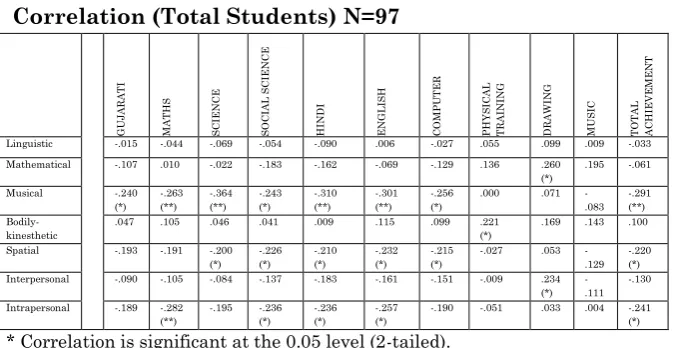
In order to answer the first hypothesis, a Pearson product-moment correlation coefficient was computed. There are a number of issues associated with the use of correlation coefficient. Before calculating the correlation coefficients, initial analyses were performed to ensure no violation of the assumptions of normality, linearity and homoscedasticity. Afterwards, correlation analyses were used to describe the strength and direction of the linear relationships between any types of the Multiple Intelligences and academic achievements. The results are presented in Table 2.
Table 2
Correlation (Total Students) N=97
G U JA R A TI M A THS S C IE N C E S O C IA L S C IE N C E HIN D I E N G LIS H C O M PU TE R PHY S IC A L TR A IN IN G D R A W IN G M U S IC TO TA L A C HIE V E M E N T
Linguistic -.015 -.044 -.069 -.054 -.090 .006 -.027 .055 .099 .009 -.033
Mathematical -.107 .010 -.022 -.183 -.162 -.069 -.129 .136 .260
(*)
.195 -.061
Musical -.240
(*) -.263 (**) -.364 (**) -.243 (*) -.310 (**) -.301 (**) -.256 (*)
.000 .071
-.083 -.291 (**)
Bodily-kinesthetic
.047 .105 .046 .041 .009 .115 .099 .221
(*)
.169 .143 .100
Spatial -.193 -.191 -.200
(*) -.226 (*) -.210 (*) -.232 (*) -.215 (*)
-.027 .053
-.129 -.220 (*)
Interpersonal -.090 -.105 -.084 -.137 -.183 -.161 -.151 -.009 .234
(*) -.111
-.130
Intrapersonal -.189 -.282
(**)
-.195 -.236 (*)
-.236 (*)
-.257 (*)
-.190 -.051 .033 .004 -.241
(*)
* Correlation is significant at the 0.05 level (2-tailed). ** Correlation is significant at the 0.01 level (2-tailed).
interpersonal intelligence and drawing academic achievement (r = .234, n = 97, 0.05 level of sig.). However, there were no significant correlations between the other intelligence types and the students‟ different subject achievements. Therefore, as presented in Table 2, there was a medium correlation between the mathematical type intelligence and drawing academic achievement, bodily kinesthetic type‟s intelligence and physical training academic achievement, the interpersonal type of intelligence and drawing academic achievement suggesting quite a moderate relationship between the two variables. Based on the observed results, it can be concluded that among the seven intelligence types only three type mathematical type intelligence and drawing academic achievement, bodily kinesthetic types intelligence and physical training academic achievement, the interpersonal type of intelligence and drawing academic achievement had a significant correlation with the academic achievement. As a result, H01 as there are not any
significant relationships between any types of the multiple intelligences and different subjects achievements is rejected with regard to the mathematical, bodily kinesthetic and interpersonal type of intelligence.
Table 3
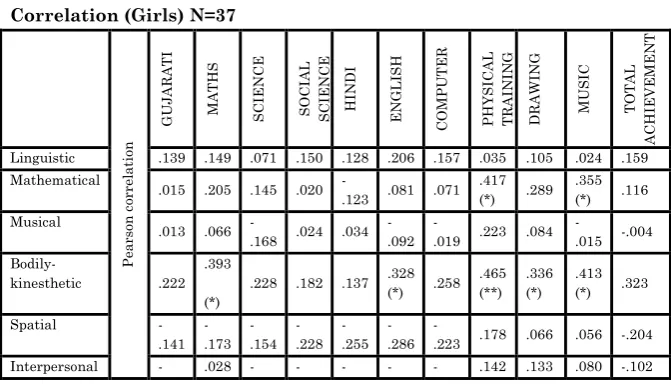
Correlation (Girls) N=37
P ea rson c or rel at ion GU JA RA T I M AT H S S CI ENCE S OCI AL S CI ENCE H IN DI ENG L IS H COM P U T ER P H YS ICA L T RA IN IN G DRAW IN G M U S IC T OT AL AC H IEV EM E N T
Linguistic .139 .149 .071 .150 .128 .206 .157 .035 .105 .024 .159 Mathematical
.015 .205 .145 .020
-.123 .081 .071 .417 (*) .289
.355 (*) .116 Musical
.013 .066
-.168 .024 .034 -.092
-.019 .223 .084
-.015 -.004
Bodily-kinesthetic .222 .393 (*)
.228 .182 .137 .328 (*) .258
.465 (**)
.336 (*)
.413 (*) .323
Spatial -.141 -.173 -.154 -.228 -.255 -.286
.167 .027 .178 .290 .143 .070 Intrapersonal
-.174
-.194
-.077
-.236
-.340 (*)
-.233
-.195 .163 .042 .158 -.200
* Correlation is significant at the 0.05 level (2-tailed). ** Correlation is significant at the 0.01 level (2-tailed).
The results of the correlation coefficient for girls in Table 3 revealed that there was a positive significant correlation between the mathematical intelligence and their physical training academic achievement (r = .417, n = 37, 0.05 level of sig.) also with music academic achievement (r = .355, n = 37,
0.05 level of sig.) respectively. Bodily kinesthetic intelligence and Math‟s academic achievement (r = .393, n = 37, 0.05 level of sig.), English academic achievement (r = .328, n = 37, 0.05 level of sig.), physical training academic achievement (r = .465, n = 37, 0.01 level of sig.), drawing academic achievement (r = .336,
n = 37, 0.05 level of sig.), music academic achievement (r = .413,
n = 37, 0.05 level of sig.) respectively. The intrapersonal intelligence and Hindi academic achievement (r = .413, n = 37,
0.05 level of sig.) respectively. However, there were no significant correlations between the other intelligence types and the students‟ different subject achievements. Therefore, as presented in Table 3, there was a medium correlation between the mathematical intelligence and their physical training academic achievement, music academic achievement. Bodily kinesthetic intelligence and Math‟s academic achievement, English academic achievement, physical training academic achievement, physical training academic achievement, drawing
academic achievement, music academic achievement.
academic achievement, physical training academic achievement, physical training academic achievement, drawing
academic achievement, music academic achievement.
Intrapersonal intelligence and Hindi academic achievement had a significant correlation with the academic achievement. As a result, H02 as there are not any significant relationships
between any types of the multiple intelligences and different subjects achievements is rejected with regard to the mathematical, bodily kinesthetic and interpersonal type of intelligence.
Table 4
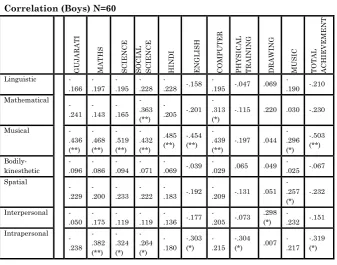
Correlation (Boys) N=60
GUJA RA T I M AT H S S CI ENCE S OCI AL S CI ENCE H IN DI ENG L IS H COM P U T ER P H YS ICA L T RA IN IN G DRAW IN G M U S IC T OT AL AC H IEV EM E N T
Linguistic -.166 -.197 -.195 -.228
-.228 -.158
-.195 -.047 .069
-.190 -.210 Mathematical -.241 -.143 -.165 -.363 (**)
-.205 -.201 -.313 (*)
-.115 .220 .030 -.230
Musical -.436 (**) -.468 (**) -.519 (**) -.432 (**) .485 (**) -.454 (**) -.439 (**)
-.197 .044 -.296 (*) -.503 (**) Bodily-kinesthetic -.096 -.086 -.094 -.071
-.069 -.039
-.029 .065 .049
-.025 -.067 Spatial -.229 -.200 -.233 -.222
-.183 -.192
-.209 -.131 .051 -.257 (*)
-.232
Interpersonal -.050 -.175 -.119 -.119
-.136 -.177
-.205 -.073 .298 (*)
-.232 -.151 Intrapersonal -.238 -.382 (**) -.324 (*) -.264 (*) -.180 -.303 (*) -.215 -.304 (*) .007
-.217
-.319 (*)
n = 60, 0.05 level of sig.)Musical intelligence and Guajarati academic achievement (r = -.436, n = 60, 0.01 level of sig.) Musical intelligence and maths academic achievement (r = - .519, n = 60, 0.01 level of sig.), musical intelligence and social science academic achievement (r = -.485, n = 60, 0.01 level of sig.) musical intelligence and Hindi academic achievement (r = - .485, n = 60, 0.05 level of sig.) musical intelligence and English academic achievement (r = - .454, n = 60, 0.05 level of sig.) Musical intelligence and English academic achievement (r = - .454, n = 60, 0.05 level of sig.), musical intelligence and computer academic achievement (r = - .439, n = 60, 0.05 level of sig.) .), musical intelligence and music academic achievement (r
= - .257, n = 60, 0.05 level of sig.) musical intelligence and total academic achievement (r = - .503, n = 60, 0.05 level of sig.) the spatial intelligence and music academic achievement (r = .234,
n = 60, 0.05 level of sig.). the intrapersonal intelligence and math‟s academic achievement (r = - .382, n = 60, 0.05 level of sig.) the intrapersonal intelligence and science academic achievement (r = - .324, n = 60, 0.05 level of sig.) the intrapersonal intelligence and social science academic achievement (r = - .264, n = 60, 0.05 level of sig.) the intrapersonal intelligence and English academic achievement (r = - .303, n = 60, 0.05 level of sig.) the intrapersonal intelligence and physical training academic achievement (r = - .304, n = 60, 0.05 level of sig.) the intrapersonal intelligence and total achievement academic achievement (r = - .319, n = 60,
0.05 level of sig.). However, there were no significant correlations between the other intelligence types and the students‟ different subject achievements. Therefore, as presented in Table 4, there was a medium correlation between the interpersonal type intelligence and drawing academic achievement As a result, H03 as there are not any significant
Generally, for all the students it is discovered that there are some significant negative correlations between students‟
multiple intelligences and their academic achievement. Positive correlation between the mathematical intelligence and their drawing academic achievement , bodily kinesthetic intelligence and physical training academic achievement, the interpersonal intelligence and drawing academic achievement in total sample ,while mathematical intelligence and their physical training academic achievement ,also with music academic achievement respectively. Bodily kinesthetic intelligence and Math‟s academic achievement, English academic achievement, physical
training academic achievement, drawing academic
achievement, music academic achievement respectively, intrapersonal intelligence and Hindi academic in girls sample respectively and the interpersonal intelligence and their drawing academic achievement .The strengths between these relationships are all quite weak. On the other hand, the multiple intelligences for linguistic in total sample, linguistic, musical spatial interpersonal in girls sample, linguistic and bodily kinesthetic in boys sample do not show any significant relationship with academic achievement.
Conclusion:
language and different subjects as they become properly aware of the issue. Having adjusted at utilizing their intelligences efficiently through practice and experience, the learners can easily learn autonomously.
REFERENCE:
Anderson, R. N., Greene, M. L., & Loewen, P. S. (1988). Relationships among teachers‟ and students‟ thinking skills, sense of efficacy, and student achievement. The Alberta Journal ofEducational Research, 34, 148–165. Ames, C., & Archer, J. (1988). Achievement goals in classroom:
Students‟ learning strategies and motivation processes.
Journal of Educational Psychology, 80 (3), 160-167.
BAŞ. Gökhan, Ömer BEYHA. (2010). Effects of multiple
intelligences supported project- based learning on
students‟ achievement levels and attitudes towards English lesson. International Electronic Journal of Elementary Education.Vol. 2, Issue 3, July, 2010.
Carroll, A., Houghton, S., Wood, R., Unsworth, K., Hattie, J., Gordon, L., & Bower, J. (2009). Self-efficacy and academic achievement in Australian high school
students: The mediating effects of academic
aspirations and delinquency. Journal of Adolescence,
32 (4), 797-817.
Elliott, A. J. (1999). Approach and avoidance motivation and achievement goals. Educational Psychologist, 34 (3),
169-189.
Gardner, H. (1983). Frames of mind: The theory of multiple intelligences, New York: Basic Books.
IKiZ, F. E., & ÇAKAR, F .S. (2010). The Relationship between Multiple Intelligences and academic achievements of second grade students. Mehmet Akif Ersoy Üniversitesi SosyalBilimler Enstitüsü Dergisi, 2(3), 83-92.
Majid P.M. and others (2012).the relationship between students “strengths in multiple intelligences and their achievement in learning English language. Journal of language teaching and research, Vol 3,No.4(2012),677-686.doi:10.4304/jltr.3.4.677-686.
McMahon, S. D., & Rose, D. S. (2004). Multiple intelligences and reading achievement: an examination of the Teele Inventory of Multiple Intelligences. The Journal of Experimental Education, 73(1), 41-52.
Mohsenpour, M., Hejazi, E., & Kiamanesh, A.R. (2008). The role of self-efficacy, achievement goals, learning strategies and persistence in math achievement of 11th
grade high schools students in Tehran. Quarterly
Journal of Educational Innovations, 24, 153- 171.
Schunk, D. H. (1981). Modeling and attributional effects on children's achievement: A self-efficacy analysis. Journal of Educational Psychology, 73, 93-105. Retrieved from http://libres.uncg.edu/ir/uncg/f/D_Schunk_Modeling_198 1.pdf
Uchat D. A. (1997) theoretical and practical basis in selecting research problem.(1st edition) Rajkot: Paras Prakashan, Shant‟, 3.Tagore Nagar, Near Amin Marg.
Uchat, D.A. & Others (1998). How will you prepare the research report? Rajkot: Nijjijan Psycho Centre.