International Journal of Research (IJR) Vol-1, Issue-10 November 2014 ISSN 2348-6848
Seismic Analysis by Base Isolation-Spring System
Prasunn Yadav ; Vijay Chauhan ; Rohit Kumar ; Yogender & Deepak Kumar
Department of Civil Engineering, Dronacharya college of engineering, Khentawas, Farrukhnagar, Gurgaon-123506,India
Email: [email protected], [email protected] , [email protected] ,
[email protected] , [email protected] .
ABSTRACT
Coping of seismicity by base isolation-spring system. This transcript deals with the prevention of the structure from earthquake waves or seismic waves by isolating the base of the structure by using set of highly tensed collapsed springs. Usually the structure is laid on the ground with proper foundations. But in this technique the base of the structure i.e., just above the foundation is being isolated. So that it might not be affected by seismic waves. This technique utilizes set of high tensile collapsed springs which are designed as per to the load being coming or developed by the structure. This spring system is being installed just above the sub-structure (structure=sub-structure+ super structure) so as to prevent the super-structured unit. Isolation with the help of a spring system can be effective in many ways as it can reduce up to 80 to 85% of the risk, i.e. being developed by the seismic waves and prevent the structure from damage. In this paper, the present behavior of the spring isolation system is being analyzed and the advancement in this system is also being discussed. On the basis of authors study the modernization of the whole picture has been described in the paper. The results of the extensive mathematical and scientific analysis, minimizes the damage from the disaster and protecting the superstructure from the heavy damage and saving many lives.
Keywords:
Base isolation; Spring System; P- waves; Plate tectonics; Seismic waves; Retrofit; calamity
1. INTRODUCTION
International Journal of Research (IJR) Vol-1, Issue-10 November 2014 ISSN 2348-6848 forces which the building undergoes[2]. Major
working of this whole unit has been explained
further in the paper scientifically and
numerically.
1.1 Introductory to nature of seismic waves
Seismic waves are waves of energy that travel through the Earth's layers, and are a result of an earthquake, explosion, or a volcano that imparts low-frequency acoustic energy. Many other natural and anthropogenic sources create low amplitude waves commonly referred to as ambient vibrations. Seismic waves are studied by geophysicists called seismologists. The second type of deformation, dynamic motions, are essentially sound waves radiated from the earthquake as it ruptures. While most of the plate-tectonic energy driving fault ruptures is taken up by static deformation, up to 10% may dissipate immediately in the form of seismic waves[3]. The mechanical properties of the rocks that seismic waves travel through quickly organize the waves into two types:-
1. Compression waves, also known as
primary or P waves.
2. Shear waves, also known as secondary or
S waves.
When an earthquake fault ruptures, it causes two types of deformation: static; and dynamic. Static deformation is the permanent displacement of the ground due to the event. The earthquake cycle progresses from a fault that is not under
stress, to a stressed fault as the plate
tectonic motions driving the fault slowly proceed, to rupture during an earthquake and a
newly-relaxed but deformed state[4].
Typically, someone will build a straight reference line such as a road, railroad, pole line, or fence line across the fault while it is in the pre-rupture stressed state. After the earthquake, the formerly stright line is distorted into a shape having
increasing displacement near the fault, a process known as elastic rebound.
Figure1. S Wave
2. BASE ISOLATION SYSTEM
2.1 Knowing of base isolation system
International Journal of Research (IJR) Vol-1, Issue-10 November 2014 ISSN 2348-6848
Figure4.
Figure3. Base isolation system
2.2 Current data of base isolation system
The first proof of architects using the principal of base isolation for earthquake protection was discovered in Pasargadae, a city in ancient Persia, now Iran : it goes back to sixth century BC[6]. It works by having a wide and deep stone and mortar foundation , smoothed at the top, upon which a second foundation is built of wide, smoothed stones which are linked together, forming a plate that slides back and forth over the lower foundation in case of an earthquake, leaving the structure safe. This technology can be used both for new structural design and seismic retrofit. In process of seismic retrofit, some of the most prominent U.S. monuments, example Pasadena City Hall, San Francisco City Hall, Salt Lake City and County Building or LA City Hall were mounted on base isolation systems.
3. PHILOSOPHY BEHIND SEISMIC ISOLATION SYSTEM
The dynamic characteristics of a base isolated building can be modeled as a linear 2DOF spring mass system shown in fig.4. The
spring kb represents the stiffness characteristics of a linear base isolator and the spring k represents the stiffness of the structure above the base isolator. The equations of motion, obtained from the equilibrium equations on each mass, are[7]
mbÿ1+k(y1-y2)+kb(y1-xg)=0………(i) mÿ2+K(y2-y1)=0………..(ii)
If the relative displacement between the masses and the support are defined to be,
x1=y1-xg………(iii) x2=y2-yg………(iv)
it then follows from substituting Eq. (iii) into Eq. (i)
mbẍ1-kx2+9(k=kb)x1=-mbẍg………(v)
mẍ2+kx2-kx1=-mẍg……….(vi)
Consider the special case where mb is very small and is assumed to be zero. Therefore, Eq.(v) becomes,
International Journal of Research (IJR) Vol-1, Issue-10 November 2014 ISSN 2348-6848
Solving for x1in terms of x2 in Eq.(vii) gives
……….(viii)
The displacement x1 is the displacement of the base isolator relative to the ground. Eq. 2.8 gives the value of x1 in terms of x2 and
the ratio of the stiffness of the isolator to the structure. Note that if kb goes toward infinity(i.e. it becomes very stiff), then x1 goes
towards zero. Also, if kb is equal to one half of x2.
Substituting Eq. (viii) into Eq. (vi) gives the equation of the motion for the spring mass system:
……….(ix)
One very important effect of the pressure of base isolator, seen in Eq. (ix), is the modification of the natural frequency of vibration of the system. For the example, the natural frequency of vibration of this spring mass system is,
………..(x)
Where, , and c1 is the base isolated natural frequency of vibration coefficient
Fig shows that if the natural frequency of vibration is to be 50%,33%,and 25% of its fixed base value (i.e. , then the ratio of (kb/k) must be 33%,12.5%,and 6.7% respectively.
4. PRESENT ISOLATION SYSTEM
The present isolation system deals with the single spring system, it consists of a single high tensile collapsed spring foundationed on the ground beneath the base of the structure. Various desired numbers of the springs are placed and fixed. The reinforced concrete slab is placed on this system and structure is established on this slab. When the seismic waves originate, the tectonic plates vibrate with each other resulting in an earthquake. These continuous vibrations of the ground result in activation of the springs and the energy produced by these vibrations is resisted by the system[8].
Hence the structure is prevented from the damage. But continuous motion of all the springs can lead to more damage the structure. So to prevent the failure of the structure.
International Journal of Research (IJR) Vol-1, Issue-10 November 2014 ISSN 2348-6848
5. ADVANCED ISOLATION SYSTEM
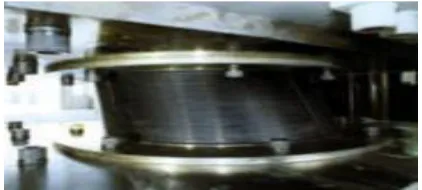
To prevent the structure from damage, lead me to research on this system and after many failures the best one which come out was the use of set of equi-stiffness unit of springs. In this system we use a set of springs that are placed with each other one with other and packed in a framework of steel. This unit is similarly placed as placed in the present isolation system. When the seismic waves effect the structure the vibrations can be uniformly distributed throughout the whole system and up to 80 to 85% of the loss of energy of the waves can be measured with this system. And the structure can be easily stabilized. As shown in figure4 and5.
6. CONCLUSION
The paper looks into a new dimension of using various base isolation techniques and also improving the futuristic vision of the society. The present status of the system of using the tension spring collapsed can be replaced by a set of equi-stiffness unit of springs that can be installed beneath the structure. This lead to the proper balance of the structure with respect to the single spring isolation system. The structure would be able to maintain its balanced form and also it would reduce the seismic waves intensity which are being produced at the time of earthquake or in other approach this system can be proved a much better way than single spring base isolation system. This system can be used for heavy loads. In future this set of equi-stiffness unit of springs would be very effective to its approach and would change the infrastructure of the whole society. Thus this paper has come up with an exhaustive research and advancement of the base isolation techniques by using set of equi-stiffness unit of springs. The technique has major potential to reduce the impact of uncertainties related tom seismic conditions and save ourself. At last “ Initial implementation of the
new technology coincided with the romantic era of earthquake engineering and public relations associated with the dreams of „beating the quake ”.
REFERENCES
1. Conference on earthquake, DRONTECH
2013
2. Dr. Robert Stoneley (1894 - 1976),
Emeritus Professor of Seismology,
Cambridge.
3. ADB meeting (conference on world
infrastructure) 2013.
4. International journal of engg. Research and
technology ISSN 0974-3154,
VOLUME6,NUMBER4.
5. Gary C. Hart and Kevin Wong (2000)
“Structural Dynamics for Structural
Engineers”,John Wiley & Sons, Inc., New York.
6. Lu, L. Y., Lin, T. K., & Yeh, S. W. (2010).
Experiment and analysis of a leverage‐type
stiffness‐controllable isolation system for
seismic engineering. Earthquake
Engineering & Structural Dynamics,
39(15), 1711-1736.
7. Paz, M. (1997). Structural dynamics:
theory and computation. Springer.
8. Lu, L. Y., Chu, S. Y., Yeh, S. W., & Peng,
C. H. (2011). Modeling and experimental verification of a variable-stiffness isolation system using a leverage mechanism.
Journal of Vibration and Control,