ISSN 2286-4822 www.euacademic.org
Impact Factor: 3.4546 (UIF)
DRJI Value: 5.9 (B+)
Development of Educational Waqf:
A Case Study of Palestine
RA‟FAT T. AL-JALLAD Finance Department, An-Najah National University Nablus, Palestine MAHMOOD IRSHED Islamic Banking Department, An-Najah National University
Nablus, Palestine
Abstract:
There has been a revival of interest in utilizing Wqaf or Islamic endowment structures by organizations across various jurisdictions as
a mean to obtain long-term financing. Awaqf institutions have
Keywords: Waqf, Cash Waqf, Waqf Shares Model, Corporate Cash Waqf Model, Deposit Product Model.
1. INTRODUCTION
There has been a revival of interest in utilizing Waqf or Islamic endowment structures by organizations across various jurisdictions. The institution of Waqf is a perpetual charity in the Islamic system (Nurrachmi, 2012). Awqaf institutions have historically been instrumental in providing various public services such as education, health and municipal services among others, leading to major economic and social contributions in the various territories of their establishment. At the same time, the Islamic financial institutions have an increasing role to be in Awqaf organizations and assets. Awqaf organizations have utilized Islamic modes of finance to obtain financing through, for example, Sukuk issuance.
Waqf (or habs), the plural is Awqaf; is an Arabic word, which means preventing something from movement. Literally the word means cessation or detention. In Shari‟ah it refers to the act of making a property invulnerable to any disposition that leads to transfer of ownership, and donating the usufruct of that property to beneficiaries. The Waqf property can neither be sold, nor inherited, nor donated to anyone. After declared as Waqf, these properties are owned by Allah and not the donor. The beneficiaries can benefit from the proceeds of the dedicated property (Yusuff Jelili, 2016)
Awqaf is a legal and religious institution where a person dedicates some of his properties for a religious or charitable purpose. Historically, Waqf for religious purposes is the largest recipient for Waqf assets, whereas education comes the second largest recipient,
which led to many positive outcomes, such as free education(Farhah binti Saifuddin, 2014).
achieve four main economic and social objective as follows(Shahedur, Chowdhury, Ghazali, & Ibrahim, 2011):
1. Generating growth
2. Income stream in perpetuity 3. Social redistributive attributes 4. Provision of public services
The latest statistics show that 96.3% of the population of Palestine is literate. Literacy Rate of Persons (15 Years and Over) in Palestine by Age Groups and Sex, 1995, 1997, 2000-2013‟(UNDP, 2015). Loan fund for Undergraduates in Palestine has been established in 2001 by the Ministry of Higher Education to offer benevolent loans to undergraduate students who are in need. The sources of financing of the fund is based on donations are received from the numerous international and regional organizations. These donations are characterized by high volatility, which lead to instability of the amount of loans extended as Chart 1 presents.
Figure 1: Value of Extended Loans by Loan Fund for Undergraduates in Palestine (2007-2017)
In this paper we aim to investigate the potential of introducing Waqf Sukuk as a mechanism of fostering high education and providing sustainable education Waqf through:
Exploring the different structures of cash Waqf
Research Problem
The main research problem of this paper is whether the cash Waqf financial institution (CWM) can be implemented in Palestine to offer education services?
Research Questions
This paper aims to tackle the research problem through answering a set of research questions:
1) What is the institutional framework of cash Waqf organization in Palestine?
2) What is the legal status of cash Waqf organization in Palestine?
3) What are the proposed model of educational cash Waqf model that can be implemented by Palestinian higher education organizations?
The paper is organized as follows. Section 2 discusses the nature of Waqf in general and highlights the cash Waqf as one type of Waqf. The various models of cash Waqf are discussed. Section 3 argues that that the Cash Waqf Financial Institution Model is the best model for the Palestinian education organizations. Section 4 concludes the paper.
2. LITERATURE REVIEW
2.1. WAQF
Waqf is defined as a confinement of a property (immovable or movable) from the ownership and the dedication of its usufruct to charitable purposes. Islam has encourage the giving of sadaqat that maintain the generation of benefits to its recipients. Waqf is created through the transfer of an asset that have feature of perpetuity on a permanent basis. Therefore, Waqf is a binding commitment. The legality of Waqf has been emphasized by Quran, the Sunnah (Prophetic traditions) and Ijma‟a (consensus of Muslim jurists).
1) Waqif (Donor)
The donor (waqif) can be a natural or legal person. The donor (waqif) must be legally eligible to dispose of their property. Waqf is the decision of a person whose legal competence is restricted because insanity is invalid, except when they declare their property as Waqf for themselves as long as they are alive. The validity of the Waqf decision of a person whose legal competence is restricted because of indebtedness depends on the position of their creditors. When the creditors refrain from confirming the Waqf of the indebted person, the Waqf becomes invalid(CIZAKCA, 1993a).
2) Beneficiary of the Waqf
The Waqf should be made only for Shari‟ah compliant purposes. As well, the Waqf can also be made for the benefit of the rich. It is not necessary that the Waqf beneficiary should be present at the time of declaring the Waqf. In case where the beneficiary of the Waqf is no longer existent, the benefits of the Waqf should go to charity.
3) Form of the Waqf:
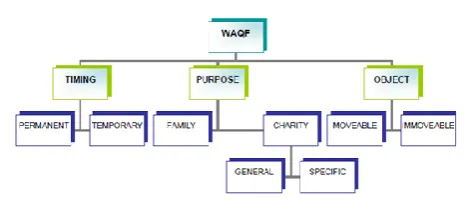
The form of Waqf includes only ‘offer’ and it does not necessitate „acceptance‟. If someone offers a property as Waqf, it is accepted even if a legally competent beneficiary rejects the Waqf that has been earmarked for them. In case of rejection by the beneficiary, the Waqf shall still remain valid and the share of the rejecting beneficiary should go to charitable purposes. Awaqf can be formed verbally, in writing, or in any form of disposition which is normally considered as indicating it. A Waqf can be declared as effective starting from a future date, as when the donor declares their property to become Waqf starting from the following year. In principle, Waqf should be eternal. Nevertheless, temporary Waqf is also permissible when the donor desires to get back their property after a specific period.
Figure 2: Categories of Waqf in Islamic Jurisprudence
Muslim jurists have agreed on three features of Waqf (Ibrahim & Ibrahim, 2014):
Irrovocability: Waqf cannot revoke the dedication if the property has already been declared as Waqf. Accordingly, the Waqf property will continue to benefit the beneficiaries and at the same time the founder will continue to get rewards from Allah even after death. However, Imam Abu Hanifah is of the opinion that the founder of the Waqf has the right to return the Waqf property to their ownership and can also sell it (i.e. the Waqf property is revocable by its Waqif,).
Perpetuity: The majority of Muslim jurists believe that the Waqf must be perpetual once it is created. This is to ensure that no confiscation of Waqf property will take place either by the government or by individuals and those regular and continual areas such as mosques, hospitals, orphanages, schools, etc., of the Muslim society will stay there forever.
Inalienability: The property of Waqf is transferred to Allah, although the usufruct derived from it can benefit man. All Muslim jurists agree that no one can ever become the owner to alienate it and that Waqf property is thus in nature, like a „frozen asset‟. It cannot be the subject of any sale, disposition, mortgage, gift, inheritance, or any alienation whatsoever.
2.2. Cash Waqf
was controversy on the legality of Cash Waqf among the Shariah scholars but thousands of Cash Waqf continued to be endowed. In particular, Cash Waqf was supported by the Ottoman Sultans, because funds were financed in the expansion of Islam in Europe (CIZAKCA, 1993b).
Contemporary Fatwa authorities at the international level including International Islamic Fiqh Academy under the Organization of Islamic Corporation (OIC) and the Accounting and Auditing Organization for Islamic Financial Institutions (AAOIFI) has allowed cash Waqf as follows: "Waqf is permissible in money. The income generated from utilization of the money is to be spent, while retaining the principal amount(Ahmed, 2007). The utilization may include, for instance, Shari‟ah based lending as well as permissible and safe investments like Mudarabah where the profit share owned by the Waqf goes to beneficiaries”. The Fatwa Committee of the National Council for the Religion of Islam of Malaysia has also confirmed the legality of Cash Waqf as follows: “In Islam, performing Waqf in the form of cash is allowed” (CIZAKCA, 1993a).
In brief Waqf is transferring personal properties into public properties. Sadeq (2002) mentioned in his paper that Waqf asset cannot be disposed, its ownership cannot be transferred, only its benefits are to be used for the specific purpose(s), which is (are) mainly charitable in nature, and It is a voluntary charity characterized by perpetuity(Man & Salihu, 2011).
played important role. Further, during that time cash Waqf has a function as a capital distribution for the borrowers who were mostly come small consumers(CIZAKCA, 1993b).
The awareness of people, government regulatory framework and the management of Waqf institutions are primary indicators of the allocation of cash Waqf remains an obstacle of Waqf development in Indonesia (Al-Salahat, 2005). According to Siswantoro & Dewi (2002) the main constraint to raise a cash Waqf is its unpopularity of cash Waqf among Muslims in Indonesia. There are at least two reasons why the Waqf institution in Indonesia has not been effective. First, the government does not perceive that Waqf fund can be potential source of income to support high economy growth. Second, most Indonesian people still assume that Waqf is only limited in the form of fixed assets such as land and building, without knowing that actually there is cash Waqf that is based on cash certification, as other variety of Waqf (Siswantoro & Dewi, 2002).
The cash Waqf is a special type of endowment which differed from the ordinary real estate Waqf in that its original capital, asl al-mal or corpus, consisted purely or partially, of cash (CIZAKCA, 1993b).
Many Muslim countries has been practiced the current application of cash Waqf including Malaysia (Mohsin, 2009). Among the current application of cash Waqf was the application of Waqf shares model, Waqf takaful model, direct cash Waqf model, mobile cash Waqf model, corporate cash Waqf model, deposit cash Waqf model, co-operative cash Waqf model and Waqf mutual fund model (Mohsin, 2009).
everybody can contribute to cash Waqf. In addition, Waqf through cash money could generate more funds, which could be used to develop assets such as undeveloped Waqf land and other abandoned land for business and agricultural purposes(Duasa, 2016).
It has been said that cash Waqf has a big potential that could be used as a financial tools for a development of Muslim countries. In fact, the historical factor have proof that cash Waqf has contributed a lot to the development of Muslim societies. The cash Waqf system has provided throughout the Islamic history all the essential services at no cost to the state, historical indicate that the real exiting potential lies in the cash Waqf (CIZAKCA, 1995). Research has revealed that in the Ottoman economy, more than a quarter of the cash Waqf established in the city of Bursa survived for more than a century and 81% of these surviving Waqf owed their resilience to capital enhancement realized either by reinvestment of profit or receiving further donations from various other smaller cash Waqf (CIZAKCA, 1993a)
2.3. Cash Waqf Models
A number of cash Waqf models have been practices by the Muslim countries. These models can be grouped under the following(Hassan, Abdul-Rahman, & Yazid, 2018):
1) Waqf Shares Model (WSM)
2) Corporate Cash Waqf Model (CCWM) 3) Deposit Product Model (DPM)
4) Cooperative Model (COM)
5) Waqf Mutual Fund Model (WMFM) 6) Wakalah with Waqf Model (WWM)
2.3.1. Waqf Shares Model (Public Waqf )
Under this model, the shareholders (Waqif) buy buy Waqf shares (cash Waqif certificates) from a specified Waqf institutions. In return, the Waqif endow the shares to the religious institution which acts as the Waqf Mutawali (manager). The revenues generated from the use of the endowed funds are used for charitable purposes.
2.3.2. Waqf Taqkaful Model
accounts: Participants account (PA) and Participants special account. The profit that are accumulated from investing the amounts allocated to the participants account will be paid to the beneficiaries specified in the Waqf declaration form upon the death of the waqif or the maturity of the plan.
2.3.3. Deposit Product Model (DPM)
The Waqif deposits a stated sum of money into a cash Waqf based account. The bank manages the account on behalf of the waqif based on a mudarab contract. The resulting profits will be used for charitable purposes specified by the Waqif.
2.3.4. Cooperative Model (COM)
This model represent a hybrid model of Waqf concept and Ta‟wan concept. This model has been introduced in 1992 to provide the basic needs of each district. Under this model, citizens of each district endow cash to a cash Waqf fund in their district. The District Cash Waqf institution (mutawali) manages the funds and the generated profits are used to finance development project in the district(Tutuko, Hudaifah, & Zulfakar, 2017).
2.3.5. Waqf Mutual Fund Model (WMFM)
According to this model the investors (Waqif) buys shares in mutual funds that specify that the specific percentage of the annual return to be directed to charity projects. The mutual fund is to invest the contributed capital in a portfolio of low risk financial securities (fixed income).
2.3.6. Wakalah with Waqf Model (WWM)
Company would take this donation on behalf of the Waqf fund as administrator of the fund and deposit this in the fund. The donations received from the participants, seeking Takaful protection, would also be a part of this fund and the combined amount will be used for investment and the profits earned would again be deposited into the same fund. As per Waqf principles, a member (donor) can also benefit from the Waqf fund(Shahedur et al., 2011).
3. PROPOSED MODEL TO EDUCATIONAL CASH WAQF IN
PALESTINE
Based on the analysis of the institutional framework in Palestine, we recommend the Cash Waqf financial institution framework. Under this model an independent institution is assigned the responsibility to management the cash Waqf operations. This Waqf Administration Body (WAB) is a special purpose entity (SPE) that will be incorporated as non-for profit entity(Mannan, 2000). It is main function is to issue certificates to the donor in different denomination - small, medium and high. Lastly, the certificate will be offer to individual, institution and company to raise fund. At the same time, its main duty is to manage the accumulated cash Waqf through development of an investment management institution. The institution is to invest the accumulated contributions in Shari‟ah compliant investment vehicles generate continuous and regular income that enables it to perform its educational development activities, which include:
A. Students‟ loans: The investment income generated from investing capital will partially will be used to grant students‟ loans to undergraduate as well as graduate students.
B. Scientific research: Part of the investment income will be allocate to the scientific research in different areas. As well, this part includes participation in the equity seed capital for the projects that are established by students.
Exhibit 3: Propoed Cash Waqf Financial Institution Model
This model is most appropriate for the development of educational Waqf that serves multiple purposes such as granting students‟ loans, supporting the scientific research projects, and the development of the infrastructure of the university. The success of this cash Waqf scheme depends on two major factors(Che Zuina Ismail, 2014):
1) Stakeholders Management: The Waqf fund need to develop a very transparent policies and procedures in dealing with all its stakeholders with a particular emphasis is on the founders (Al Waqif). The proposer governance mechanisms including a well-established and diversed board of trustees. The stakeholder‟s management guarantees the continuous flow of funds to the Waqf that increases the funds under management by the Waqf operations.
4. CONCLUSION
Palestinian higher Education Organizations can benefit from Waqf organization to develop its infrastructure and its operations. Cash Waqf offers a new scheme of Waqf through which these institutions can raise flexible funds to use it in building an income producing investment portfolio. A number of cash Waqf scheme have been proposed. However, we found that the most appropriate model that fits that the nature of the Palestinian institutional framework is the Cash Waqf financial institution scheme. This model offers the flexibility needed to decide on the investment opportunities and at the same time guarantees the good governance practices through the existence of the special purpose vehicle.
REFERENCES
1. Ahmed, H. (2007). Waqf-Based Microfinance: Realizing The Social
Role Of Islamic Finance. International Seminar on “Integrating
Awqaf in the Islamic Financial Sector”, Singapore , March 6-7, 2007.
2. Al-Salahat, S. (2005). Fundamental Considerations for the
Development and Investment Nature of Waqf. Articles published in the Journal of King Abdulaziz University: Islamic Economics., 18(2), 47-82.
3. Alias, M. H., Johari, F., & Sabri, H. (2013). Waqf Development Financing in Higher Education: Challenges and the Way Forward.
4. Azri Ahmad, S. b. M., Mohd Asyran Safwan bin Kamaruzaman.
(2012). Education Development Through Waqf. 3rd International
Conference on Islam and Higher Education (3rd ICIHE),1st – 2nd October 2012,.
5. Che Zuina Ismail, S. M., Nor Jawanees Ahmad Hanafiah. (2014).
Challenges and Prospects of Cash Waqf Development in Malaysia.
Journal of Basic and Applied Scientific Research, 4(2), 340-348.
6. CIZAKCA, M. (1993a). Learning from the Past: Cash Waqfs and
Venture Capital. New Horizon (London, UK), 18-19.
7. CIZAKCA, M. (1993b). Relevance of the Ottoman Cash Waqfs to
Modern Islamic Economics. New Horizon, (London), 20, 7-9.
8. CIZAKCA, M. (1995). Cash Waqfs of Bursa,1555-1823. Journal of the
Economic and Social History of the Orient, 35, 313-354.
9. Duasa, J., & Thaker, M. (2016). A Cash Waqf Investment Model: An
Journal of Islamic Monetary Economics and Finance, 1(2), 161-188. doi: https://doi.org/10.21098/jimf.v1i2.533
10. Farhah binti Saifuddin, S. K., Refik Polat,Yahya Fidan,Omer
Kayadibi. (2014). The Role of Cash Waqf in Poverty Alleviation: Case
of Malaysia. Proceeding - Kuala Lumpur International Business,
Economics and Law Conference 4 (KLIBEL4),31 May – 1 June 2014, 1.
11. Hassan, N., Abdul-Rahman, A., & Yazid, Z. (2018). Developing a New
Framework of Waqf Management. International Journal of Academic
Research in Business and Social Sciences, 8(2), 287-305.
12. Ibrahim, D., & Ibrahim, H. (2014). The Role of Corporate Waqf in the Development of Islamic Finance.
13. Khademolhoseini, M. (2012). Cash Waqf a New Financial Instrument
for Financing Issues: An Analysis of Structure and Islamic
Justification of its Commercialization. Tehran: Imam Sadiq
University.
14. Man, M. Z., & Salihu, A. A. (2011). New Dimension in the Mobilization of Waqf Funds for Educational Development \\ Kuwait Chapter of Arabian Journal of Business and Management Review .- 2011, Vol. 1, No. 1: American University.
15. Mannan, M. A. (2000). Cash-Waqf Certificate - Global Opportunities
for Developing the Social Capital Market in 21st - Century Voluntary- Sector Banking. Paper presented at the Proceedings of the Third Harvard University Forum on Islamic Finance, Cambridge, M.A., USA.
16. Nurrachmi, R. (2012). The Implication of Cash Waqf in the Society.
University Library of Munich, Germany.
17. Sahari, Z., & Aziz, M. R. A. (2013). An Exploratory Study On Instruments Of Waqf Financing.
18. Shahedur, M., Chowdhury, R., Ghazali, M. F., & Ibrahim, M. (2011).
Economics of Cash WAQF management in Malaysia: A proposed Cash WAQF model for practitioners and future researchers (Vol. 5).
19. Tutuko, B., Hudaifah, A., & Zulfakar, A. (2017). Structuring Model for Corporate Productive Cash-Waqf in Indonesia (A Case Study for PT. Semen Indonesia). Journal of Islamic Finance, 6, 163-173.
20. UNDP. (2015). The 2014 Palestine Human Development Report:
Development For Empowerment. In U. N. D. P. (UNDP) (Ed.). 21. Yusuff Jelili, A. (2016). Commercialization of cash waqf in Negeria: