Electronic Thesis and Dissertation Repository
3-7-2014 12:00 AM
Food Ontology and Distribution: Ethical Perception and the Food
Food Ontology and Distribution: Ethical Perception and the Food
Object
Object
Siobhan M. Watters
The University of Western Ontario
Supervisor Dr. Regna Darnell
The University of Western Ontario
Graduate Program in Theory and Criticism
A thesis submitted in partial fulfillment of the requirements for the degree in Master of Arts © Siobhan M. Watters 2014
Follow this and additional works at: https://ir.lib.uwo.ca/etd
Part of the Ethics and Political Philosophy Commons
Recommended Citation Recommended Citation
Watters, Siobhan M., "Food Ontology and Distribution: Ethical Perception and the Food Object" (2014). Electronic Thesis and Dissertation Repository. 1920.
https://ir.lib.uwo.ca/etd/1920
This Dissertation/Thesis is brought to you for free and open access by Scholarship@Western. It has been accepted for inclusion in Electronic Thesis and Dissertation Repository by an authorized administrator of
(Thesis format: Monograph)
by
Siobhan Mildred Watters
Graduate Program in Theory and Criticism
A thesis submitted in partial fulfillment of the requirements for the degree of
Master of Arts
The School of Graduate and Postdoctoral Studies The University of Western Ontario
London, Ontario, Canada
© Siobhan Mildred Watters 2013
ii
Abstract
In predominantly service and information-based economies, the pivotal role food plays in the maintenance of life has arguably become neglected as an object of ethical and political contemplation. We often fail to realize that the incarceration of food by the commodity form degrades the food object itself as well as guaranteeing continued dependency on the wage. In a generalized commodity society, labour power is the only thing a person has to sell in order to buy her bread. This leaves us vulnerable in the event of an environmental crisis because we do not have direct access to food sources.
The capitalist mode of distribution forms the limits of possibility for humans and other beings. This thesis argues that, without direct access to the means of subsistence, the subject is limited in her movement and interactions with others, except where the universal equivalent grants her access to go.
Keywords
iii
Acknowledgments
Since beginning my Master’s degree at the University of Western Ontario, I have met and worked with a number of people who have inflected or inspired this work. The Centre for the Study of Theory and Criticism provides an excellent environment for interdisciplinary projects of the kind I have pursued. I credit Drs. Michael Gardiner and Stephen Lofts for introducing me to the philosophy of
phenomenology, which informs my understanding of ethics as they are outlined here. I thank my supervisor, Dr. Regna Darnell, for first pushing me to consider where the boundaries of life fall, and thus began my interest in outlining the being of food in its human and nonhuman contexts. In my affiliation with the Faculty of Information and Media Studies as a teaching assistant, and through public lectures, I was introduced to theorists and methods that are now central to my analysis: Paul Virilio, posthumanism, and political economy among them. I thank Jussi Parikka, John Durham Peters, and Bernd Frohmann for engaging and encouraging my inquiring mind with their lectures and seminars. I thank Drs. Nick Dyer-Witheford and Carole Farber for joining my examining committee along with Dr. Gardiner—all of whom I greatly respect and from whom I know I will receive considerate and constructive critique. A special thanks to Melanie Caldwell Clark for making life a little easier for all graduate students at the Centre.
During my time at Western, I’ve met many colleagues who, in addition to uttering those numberless phrases that must have turned my brain about and in the direction I am now going, have also become confidants, caretakers, and
commiserators—friends, of a true kind. I wish I could list every person here who has acted these roles, but must limit myself to the following: Kate Lawless, Eileen Wennekers, Amy Wuest, Svitlana Matvienko, Will Samson, Dru Farro, Casey Beal, Karen Dewart McEwen, Anca Radu, Conan Masterson, Sarah Warren, Danielle Taschereau Mamers, and my closest collaborator, Atle Mikkola Kjøsen.
iv
Table of Contents
Abstract ... ii
Acknowledgments ... iii
Table of Contents ... iv
Introduction ... 1
Chapter 1: Ethical Perception and the Food Object ... 15
1.1 Introduction ... 15
1.2 Food and Bodies Under Capital ... 21
1.3 Actor-Network Theory and Phenomenology ... 27
1.4 Food and an Ethics of Perception ... 29
1.5 Conclusion ... 41
Chapter 2: Food and Ethics in Distribution ... 43
2.1 Introduction ... 43
2.2 Marx’s Concept of Distribution ... 47
2.3 The Social ... 49
2.4 Distributed Ethics ... 54
2.5 The Fetish and Social Reproduction ... 64
2.6 Conclusion ... 74
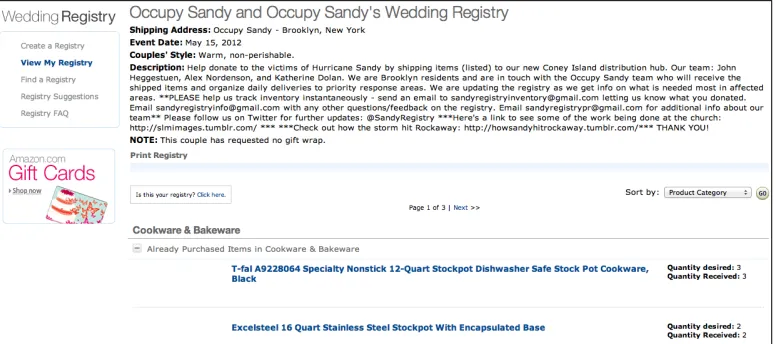
Chapter 3: Mutual Aid and Distribution in Occupy Sandy ... 75
3.1 Introduction ... 75
3.2 Occupy Sandy ... 82
3.3 Occupy Sandy Logistics ... 86
3.4 The Failure of FEMA ... 94
3.5 Conclusion ... 99
Afterword ... 102
Appendix: Permission to quote from Katherine Ramos ... 107
Works Cited ... 108
Introduction
This is a both a humanist and nonhuman study of the human relationship to food. To complete this study, I must approach the subject from several viewpoints, and I nest these viewpoints under the headings of ontology and distribution.
I am a humanist in that I am first concerned with the human relation to food. But I must interrogate this relationship in its binary form if I am to have any success in developing an ethical stance on the primacy of food. What we have is a Cartesian, anthropocentric category of ‘human’ and whatever stands against it as ‘food.’ I became curious about this being1 of food and also its epistemological significance, because they are materially intertwined. What falls into this category is both broad and heterogeneous. Of course the need for nutrition or metabolic fuel is shared among nonhumans as well, but sustenance for humans—our understanding of its production, its properties, its necessity—is not a factor of knowledge alone. This is an ontology because the objects subject to human epistemology are modified using this knowledge; their being, temporality, or substance is altered, as is true of the bodies of cows,
chickens, and genetically modified seeds used in industrial agriculture and food production. What we need to recognize is that the human also alters with these ontological and physiological shifts in the matter we eat.
Since I have outed myself as a humanist, it should come as no surprise that I engage the category of the human. However, I do endeavour to take an ontological view of the human that includes other beings in its being—Jane Bennett’s vibrant materialism (2010) and Latour’s actor-network theory (1999; 2005) contribute significantly to this discussion. Ontologies often form hierarchies, and the human has typically held a high place in those systems; actor-network theory, which is Bennett’s starting point as well as Latour’s, levels the ground of understanding, so that we see nonhuman actants standing side by side with the human, affecting and affected by actants in multiple directions. The animal we call human, and the contingent body to
1 My use of the term ‘being’ contains with it both the sense of a static and self-identical object, as
which we give that name, owes its being equally to all the nonhuman beings with which it relates—as a lake’s edge necessarily becomes the margins of both the water and concept it contains. In particular, I refer to nonhuman bodies that work within the human to make it move, think, and create: food occupies as significant a role in the reproduction of bodies as is often given to sexual reproduction alone. The work the body does from the moment it takes in food continues hours and days afterwards. The temporality of this process grounds our being as much as our phenomenological experience of horizons and the life-constituting light.
Transactions of one body with another continue ceaselessly. However, this reading can take an altogether tractionless view, offering little in the way of potential application. I do not go as far as to dissolve the beings into one another, so that we can no longer see the inequities that do exist between humans and other humans, and between humans and nonhumans; this would not be an ethical position. In this, I hope to avoid incurring a similar critique often stated about actor-network theory, that its attempt to level the ground of being (or becoming) effaces the world of structures that maintain dominant and exploitative relations, such as the wage relationship.
* * *
ethics that I outline here in its relationship to food. After all, Marx’s Capital is written primarily from the perspective of this nonhuman other, capital, describing the world of humans and objects and their social relationships as an unconscious means to its ends. Peter Kropotkin criticizes the tendency to read economic conditions from this point of view:
If you open the works of an economist you will find that he begins with PRODUCTION, the analysis of means employed nowadays for the creation of wealth; division of labour, manufacture, machinery,
accumulation of capital. From Adam Smith to Marx, all have proceeded along these lines. Only in the latter parts of their books do they treat of CONSUMPTION, that is to say, of the means necessary to satisfy the needs of individuals. ([1892] 2007:201)
However, this ‘backwards’ reading is deliberate on Marx’s part, as he engages in an immanent critique of the political economy that precedes him. It is only when he tells the tale of capital’s development that we understand how unethical the wage paradigm is, that with the loss of common land (primitive accumulation), the human also lost its autonomy and ethical potential. Human needs are not the starting point of capital, though the human is the principal subject of the labour process.2
It is no surprise that one of the first economists, the Physiocrat Francois de Quesnay,3 modeled his perfect economy on the efficient and unheeded circulation of the human body. He was a physician before a state economist, interested particularly in the blood circulatory system (Bragg et al. 2013). The body, however, is not without its weakness; nor are the elements of capitalist production immune to breakdown. Still, from the point of view of capital, the ideal is the machine without an off switch, which runs consistently without event. While Quesnay was interested in setting up an
economic program that would bring France back from the depression of its imperial contraction (having lost its war with Britain on several fronts) (Bragg et al. 2013), the impetus to make the process more efficient, in order to amass wealth, has led to the privileging of the machinery’s health over the human.
2 The Capitalist conception of labour “bear[s] the unmistakable stamp of belonging to a social formation
in which the process of production has mastery over man, instead of the opposite” ([1867] 1976:174-5).
3 Quesnay is known for positioning agriculture and the land as the eminent means to wealth for the state
(1756). He advocated for food production to be directed primarily to the domestic market, where the most primordial need and the absence of competition would keep the country and sovereign
The Cartesian mentality that has allowed our soil and nutritional sources to be treated as universal, profit-yielding stuff, has seen the human disappear into a machine as one use-value among others, unable to move freely without access to a wage. We may believe we make choices with the purchases we make, but that vision is
complicated. Consider how labeling can obscure more than it reveals about the products we eat, as I will discuss with reference to the horsemeat scandal in Europe, but also how the ingredients that are in many food commodities were added because they were found to be profitable, not because of need. As Kropotkin suggests, in the management of economies, the needs of production outweigh the needs of individual consumption. As a result, we have had little choice about the composition of our food for decades.
When advancements in agricultural techniques resulted in record yields of corn (Hauter 2012:34,157), corn became a near-universal commodity for production. Corn (historically, a general term for all grains) has long been appreciated for its
convertibility and as an input in the production of commodities. Adam Smith noted that commodities “frequently contai[n] the price of a great quantity of rude
produce…corn, which could with difficulty be carried abroad in its own shape, is in this manner virtually exported in that of the complete manufacture” ([1776]
1986:506). Not only is corn a product for direct human consumption,4 it has also become a prolific source of feed in industrial meat production; a filler and preservative for processed food products; and is more and more produced for biofuels. With so many applications, corn’s ubiquity in the marketplace and production can be explained as socially necessary,5 but also particularly convenient in its abundance for
multiplying the points of exchange as a substrate for value,6 i.e., as various
commodities (Marx [1867] 1976:293). It is a commodity crop, like wheat or soybeans, overproduced to provide a cheap input for several sectors of industry. When we are
4I.e., in the sphere of consumption (individual).
5The act of exchange, according to Marx, validates the abstraction of labour as value ([1867]
1976:150-1). By extension, the concrete labour, and all the unethical forms that may take, is validated as well. We unknowingly validate the exploitation of workers, the method of extraction of raw materials, however those materials are used in production, and how the products are distributed to consumer marketplaces.
6 ‘Value’ is one of the most ambiguous terms I use here, perhaps only surpassed by ‘being.’ In this
advertised ‘grain-fed’ beef (or chicken, and now fish), we are presented with an attribute of current food products as if it is a virtue in itself. Corn feed was imposed on animals that do not naturally digest the substance in order to produce mass amounts of meat commodities (Hauter 2012:157). It is one of countless examples of tastes we are led to believe we have formed on our own when, really, we are responding to a new, value-producing7 technique of which we were not conscious.
When it comes to the capitalist mode of production, I agree with Marshall McLuhan that the medium is the massage;8 the physical changes that occur in the development of industrial techniques introduce new modes of symbolic and physiological consumption, a tangible pressure experienced by bodies in both the realm of individual consumption and productive consumption.9 The way we are massaged into rationalizing our modes of production and consumption, Virilio says, is a matter of repetition.
[T]his recurrence of events—these proofs—are the basis of a reason that sees that which repeats as truth. The narrative material can only function by being repeated one hundred times. Through repetition, it eliminates chance and makes the Reason in these stories a war machine that deploys its forces by multiplying them. (Virilio [1977] 2006:91).
This describes aptly the model of production itself—rationalized, efficient, and rote— implying need of something because it is routinely produced. It also characterizes how the mode of production is validated by consumers who knowingly buy what is
marketed to them as necessary and yet unknowingly and collectively justify the means used to produce that particular commodity. And what is not repeated for us, amid all the claims of a product’s necessity, is that the ‘value-added’ techniques used in its production are developed merely as a means of accumulating surplus value.
The impetus to produce mass quantities of standardized, hyper-processed food products also drives down the value of labour power all along the production and supply chain. The labour power of the traditional, small-scale farmer has exponentially
7 ‘Value,’ here and in the context of ‘value-added’ does not refer to Marx’s definition of the term. It is
rather a general term used by economists.
8 “All media work us over completely…they leave no part of us untouched, unaffected, unaltered. The
medium is the massage. Any understanding of social and cultural change is impossible without a knowledge of the way media work as environments” (McLuhan [1967] 2001:26)
decreased in price (Hauter 2012:33). Family farms are disappearing into industrial farming operations, with farmers forced into franchise-type relationships with national global conglomerates. In this vertically integrated industry, value accumulates at the top and for a few, while very little value and great risk is distributed to farmers and workers alike (Hauter 2012; Schlosser 2005). The demand for efficient mass production has put slaughterhouse workers under unbelievable mental and bodily stress with the acceleration of production lines. Their working life is passed in
repetitive, acute motions that leave them prone to injury and even death (working with sharp blades,10 fast moving equipment, and toxic substances), but also without the ability to act in any true sense of the word. The repetition of the high-risk environment in which these people work is hardly rational at all, that is, from an ethical point of view.
The effects of capital operate through material infrastructures—from the topographies of supply chains to the nonreproductive genetically modified seeds of Monsanto (Hauter 2012:253)—and while this refers to a distribution of the means of production and commodities, it also forms limits of possibility for humans and other beings. I will not be the first to view the human as so much material running through a
machine—images of Pink Floyd’s The Wall and those evoked by Allen Ginsberg’s
Moloch in Howl11 come to mind—but the metaphor is less representative and more reality when we take the actor-network approach to the human and its food under
10 “[T]he rate of these cumulative trauma injuries in the meatpacking industry is far higher that the rate
in any other American industry. It is roughly thirty-three times higher than the national average…Many slaughterhouse workers make a knife cut every two or three seconds, which adds up to about 10,000 cuts in an eight-hour shift” (Schlosser 2005:173).
11 “What sphinx of cement and aluminum bashed open their skulls and ate up their brains and
imagination? Moloch! Solitude! Filth! Ugliness! Ashcans and unobtainable dollars! Children screaming under the stairways! Boys sobbing in armies! Old men weeping in the parks! Moloch! Moloch!
capital. This is where my determinism lies. Latour (2005:207) uses the metaphor of computer ‘plug-ins’ to describe how possibilities of being are distributed to actants in their movement among and through other actants. I take this, but also Latour’s own focus on the hardware of social events, i.e., bodies that have been programmed and that run subprograms and program other bodies (1999:209), as support for a reading of capital as a very real machine and humans as its unconscious linkages.12
Without the ability for people or workers to act contingently, outside of the bottom line, capital is poised to circulate and accumulate most efficiently. I connect the events culminating in this lack of autonomy, which I equate to a lack of ethics, to the dis-ability of people to seek their own subsistence directly.13 In short, I refer to primitive accumulation (Marx [1867] 1976). The loss of common land became the means to limit or quell resistance to the totalizing regime of property and wage dominance. Hunger could now be held over every person’s head.
It was poverty that created the first capitalist; because, before
accumulating ‘surplus value,’ of which we hear so much, men had to be sufficiently destitute to consent to sell their labour, so as not to die of hunger. (Kropotkin [1892] 2007:198)
It may not seem correct to say there is a direct relationship between, on one side, an inability to seek out or produce food directly, and a lack of ethics on the other. But you would think differently if I said that the wage labourer lacks the means of
self-production. Without access to the means of production for the most necessary items for a worker’s reproduction, her survival, the subject is far more limited in her movement and the way she interacts with others in the system, except where the universal equivalent grants her access to go. In this way, both the human and her food sources fall under an ‘inhuman’ and also unethical power.
12This is a play on Marx’s description of humans as the conscious linkages of capital’s machinery
([1939] 1973:692), though he opens up the question of just how conscious the human is in his discussion of the commodity fetish ([1867] 1976:92).
13 Also consider the correlation of the de-skilling of workers with the increase of automation in the
Were we to regain some autonomy within this generalized commodity
society,14 we would be freer to form an entirely different perception of the objects we
take for our food. We require a new relationship to our needs and how we fulfill them. Perception is something I am concerned with, because the way in which this system is experienced tells us something about the ethics we lack. Phenomenology, in a sense, is a call to our limits. Virilio, and Martin Heidegger before him, fear what we have lost in the movement of projection—our telluric limits have been tested,
penetrated, and disregarded. Phenomena such as acceleration (Virilio [1977] 2006; [1995] 2008b) and enframing (Heidegger [1954] 2008b) have created a world that seeks to float away from the mysterious earth that grounds it, and has left the human divested of its horizons. The image of Icarus leaving his ground and in flight is, in this sense, a posthuman vision. I have found it illuminating to read about other orders of being, pre- or noncapitalist, that maintain an arguably more ethical or ecological bond with nonhumans because the ground is primary to the human’s existence. David Graeber’s discussion of the place of food in the historical Maori gift economy reveals a more ‘lateral’ hierarchy than a generalized commodity society exhibits, because it includes the land and natural systems, though they are often represented by
deterministic powers like gods. The hierarchy forms the totality in which the subject reproduces herself. In the example of the Maori, but likewise capitalism, one’s perception of self and purpose is part of this totality, which is reproduced daily through social behaviours and cultural techniques.
In the totality of capital, the system and its subject are reproduced through exchange. Some totalities constitute a more ethical relationship between humans and nonhumans, but all operate through certain opacity. Maurice Godelier describes the opacity of social reproduction within so-called gift economies in The Enigma of the Gift (1999), but the description is also consistent with the opacity of the commodity fetish—where a supersensuous relationship among all commodities obscures the concrete reality of their production. The commodity fetish is helped along by the
14Generalized commodity society is an abstract concept; no pure, entirely generalized commodity
subsequent opacity created by the distances and automation of production that food objects undergo. This obscuration belies our unfree existence under the commodity form—which even our bodily capacity takes on—but also the spectacular form,15 which further impedes our ethical perception and movement in the world.
The need for food is one principle that grounds an ethical community, for who can be free that cannot eat, and who can be ethical that must first address the pain of hunger? We must ask the larger question of where to locate an ethics in a system that sees the world only for exchange-value? If an ethics is not possible under capital, when or where is an ethics possible? I argue that these moments can best be glimpsed in times of rupture, for example, in the wake of natural disaster.
* * *
The incarceration of food by the commodity form guarantees our continued dependency on the wage. “For turn where he [sic] will, he can find no better conditions. Everything has become private property, and he must accept, or die of hunger” (Kropotkin [1892] 2007:60). In a generalized commodity society, labour power is the only thing we have to sell in order to buy our bread. Labour power—the metabolic capacity to labour16—is but one commodity among others. If there is no market for an individual’s labour, then she loses the ability to command other commodities, putting her at the mercy of state or charitable redistribution, if those mechanisms even exist. Rather, as Kropotkin states, welfare institutions are an effect
and aspect of life under capital, encompassing “the idea of ‘wounding first and healing
afterwards’!” ([1892] 2007:199). Likewise, Amartya Sen describes “social security
provisions” as “essentially supplementations of the processes of market exchange and
production” (1982:6).
The generalized commodity society is one where all necessaries of life are subsumed under the commodity form. Harry Cleaver states further that “the
15 This will be elaborated on in chapter 1 in terms of Guy Debord’s The Society of the Spectacle ([1967]
2008).
16I collapse physical and mental capacity to labour into this one category, for any form of work requires
generalized imposition of the commodity-form has meant that forced work has
become the fundamental means of organizing society—of social control” (2000:82). In noncapitalist societies or mixed economies, the trade of labour power for a wage is not ubiquitous, nor the only means of meeting one’s needs; subsistence farming may still exist, for example. Where the market subsumes subsistence economies, people lose the securities of land and traditional social techniques and become vulnerable to the fluctuation of neoliberalizing economic policy and commodity prices, especially when the price of labour power falls below its value.17 A certain technological bias also mediates between the (newly minted) wage worker and the satisfaction of their needs. Regardless if the food a farm labourer produces is socially necessary—or immediately necessary for the person cultivating it—if it can be produced efficiently, consistently, and in great numbers, the need of the food itself does not determine how it is
produced. Chemical agents, antibiotics, unsanitary and dangerous work conditions are forgone conclusions in a branch of production whose internal impetus is to drive consumption for the sake of exchange. When we are chided for purchasing industrially produced meats or GMO fruit, it is an illusory critique that forgets that we are driven to exchange for all necessities in life and that the wage form precludes the vast
majority of people from making ethical decisions about what food they eat, and a great deal otherwise.
Because we do not own the means of food production, and because we must maintain our bodies in times of social and economic upheaval, Kropotkin saw the ‘conquest of bread’ as the first step of any revolutionary moment: “the Revolution could not triumph unless those who fought on its side were fed” ([1892] 2007:70). In the absence of sustained militant resistance to capital in North America, ecological disasters offer an indirect perspective on how the initial revolutionary moment could manifest and be maintained. I have turned to anarchist theory because it bears with it a language that best captures what we lack as workers under capital: the ability to self-organize and self-manage (Bookchin [1972] 1975; 1986), which are capacities we
17 “The ultimate or minimum limit of the value of labour-power is formed by the value of the
require to be ethical. We also lack the means to self-reproduce both our metabolic and ethical potential because of the inequitable distribution of the means of production, but also because we are subject to a system that conditions the way we form relationships with other bodies. Emotions and behaviours are regulated in and outside of the workplace to ensure the constant circulation of capital. I will discuss this in chapter 1 in relation to Virilio’s concept of the ethics of perception.
While Kropotkin first gave me the ethical frame with which to pursue the topic of food distribution, the direction of this project was also inspired by Virilio’s
assertion that “ecological defense”—and by extension, disaster—are “the last truly political stakes of civilian populations” ([1978] 1990:91). Events such as hurricanes and earthquakes may afford moments of popular resistance and ecological defense, because without them, we have not the means to even recognize or address our plight.18 “The time of the intellectual having influence is over. Who has an influence? It is the climate” (Virilio 2008a:66). Natural disasters can foreground for us the inhuman scale at which food distribution operates and its extreme centralization, setting us up for a greater catastrophe owing to the inability for individuals to engage the system on a human level. By taking up food distribution in crisis, I do not
emphasize a particular aspect of distribution, but rather focus on the culmination of consequences of our present model of distributed food production. As Virilio ([2005] 2011) asserts, the accident reveals the substance, and such events tell us that a crisis has been in the making all along.
When Thomas Hobbes (1651) proposed the ideal form of the state as a massive body, with a central figure (the sovereign) as the head and source of authority, he could not predict that the distribution of commodities would take on a similar, centralized form; the meatpacking industry is particularly illustrative of this (Hauter 2012; Schlosser 2005). In the case of the American food market, as Evan Fraser and Andrew Rimas (2010) describe it, Hobbes’ image of the Leviathan seems complete, with the circulation of food energies coursing to and from central locations (like California)—vital organs—to the cities that do the walking and talking of the nation.
18Following the 2011 Japanese tsunami and the subsequent radiation leak at the Fukushima Nuclear
But in this (lack of) distribution of nutritional sources across North America, the potential for disaster is manifold. Should one vital organ fail, due to drought or an earthquake, the whole body will suffer.
We experienced the threat of this very recently in the summer of 2012, when drought affected crop yields across North America, particularly corn and subsequently livestock production. After six months of record warm temperatures, by July 2012, over 1,300 counties in 31 U.S. States had been labeled disaster areas (Schwartz 2012). On the other hand, we are seeing disaster crop up with the mass deaths of honeybees, a primary pollinator in agriculture, whose population has been devastated with the introduction of insecticides, chemical fertilizers, and genetically modified seeds. Certain strains of genetically modified seeds, while more resistant to drought and bearing higher yields, present a danger because they cannot reproduce and can destroy the reproductive capacities of other seeds if the strains are mixed (Dowty and Wallace 2010:61). “What is ‘incapable’ or, at any rate, incapacitated, is the environment and its properties” (Virilio [1995] 2008b:128). We run the risk of compromising the ability to meet our basic needs. Built environments in the food industry foster the potential for foodborne illness, as well as our inability to ward off illness, through the
application of antibiotics in large quantities to the animals we eat. In Fast Food Nation, Eric Schlosser tells us that “[a] single fast food hamburger now
contains meat from dozens or even hundreds of different cattle” (2002:204). The flesh of one sick animal, or its waste, can travel far and wide because of the nature of industrial food production.
Today large slaughterhouses and grinders dominate the nationwide production of ground beef. A modern processing plant can produce 800,000 pounds of hamburger a day, meat that will be shipped throughout the United States. A single animal infected with E. coli O157:H7 can contaminate 32,000 pounds of that ground beef. (Schlosser 2002:204)
These conditions are the making of the sort of ‘global accidents’ that Virilio ([2005] 2011) predicts will be our constant companion in the 21st century. According to
I begin chapter 1 with a look at the European horsemeat scandal of spring 2013, an event that encompasses several of the issues pursued in chapters 1 and 2. Primarily, it introduces the problems of scale and visibility that we face with the vastness of our global food distribution system, and the current methods of food production. Virilio and Bookchin form the theoretical basis of a study of the human in its relationship to the immense scale of food distribution networks, while Virilio provides the concepts I use to discuss the violence done to bodies (human and nonhuman) with the imposition of the commodity form. To facilitate this line of reasoning, I speak of food as it figures into Marx’s concept of use-value—which is the material form of the commodity. In chapter 1, I also introduce Bennett’s vibrant materiality and Latour’s actor-network theory (ANT). Their alternative, posthuman methods of engaging the object offers us a more ethical way of viewing food, one less prone to imposing on objects the way that the commodity form is imposed on
nonhumans in production and also humans, in the form of labour power. Finally, I tie the preceding arguments to the crisis of perception that the intervention of
technologies in communication and commodity production creates in the human, and argue that we are significantly limited in our ethical potential as a result. I employ Virilio and Heidegger’s phenomenology in this task, as well as Guy Debord’s theory of the spectacle.
In chapter 2, I revisit ANT in a more focused discussion of the capitalist mode of production, but more specifically, the capitalist mode of distribution. Beginning with the historical events Marx describes as capital’s primitive accumulation, I discuss the incongruity of ethical potential and the wage paradigm, arguing that wage
Latour may wish to decentralize the human, and divest the social of its ideological descriptions, ANT is still amenable to the task of describing the inequities perpetuated in the capitalist mode of production if one focuses on its material infrastructure. The focus on objects culminates in a discussion of the fetish in its precapitalist,
spectacular, and technological incarnations.
The first two chapters of this thesis describe our current dilemma under
Chapter 1: Ethical Perception and the Food Object
1.1 Introduction
What does it mean when you put your trust, not only in a company that promises to produce what it says it produces, but also the material you put in your mouth…and it betrays you? Consider the recent horsemeat scandal in Europe, where nearly 200 beef products sold in the market were found to contain horsemeat, a ratio of 1 in 20 products (Voice of America 2013).19 The European Commissioner for Health and Consumer Policy, Tonio Borg, called the scandal a case of “fraud against the consumer” (Voice of America 2013). The cognitive dissonance in this case was far more unsettling than the more suspect claims to wholesomeness on grocery store packaging. The package read BEEF, but the body ate horse. The body likely only knew it for its different fat or caloric content. The mind, on the other hand, was misled. The shock stemmed not only from this feeling of betrayal, but the knowledge for some that what they were ingesting was not food as they define it. Horses occupy that liminal category of food, like dogs or cats: a companion and useful beast of burden, but also considered food in countries like France and Switzerland (Recknagel 2013). Even though Canadians may not identify themselves as horse-eaters, over 100,000 horses are slaughtered for meat in Canada, predominantly for consumption in Europe (Cameron 2010). The global scale of food production breaks down cultural barriers like this all the time,20 sometimes unintentionally, as in the case of the
19“What began as a product recall 33 days ago when equine DNA was found in value Tesco and
Iceland beef burgers has become an international scandal that has led to allegations of criminal activity and exposed the mind-boggling complexity of our food supply chain…What the current situation has exposed is that supermarket suppliers use a vast network of secondary suppliers to source their meat. Some of these are ‘official’ and audited by supermarkets while some are not. For example, Findus, whose frozen lasagnas were withdrawn from shelves after some were found to contain 100pc
horsemeat, was supplied the products by French company Comigel. However, Comigel said it ordered the meat from a separate supplier called Spanghero via one of its subsidiaries in Luxemburg. Spanghero said it got the meat from a Romanian supplier. The lasagna ‘food trail’ includes other suppliers or agents in Cyprus and Holland. Findus and Spanghero are preparing to take legal action against people further down the supply chain” (Hall 2013).
20 The uniform taste of McDonald’s fries was sacred enough to the company that they would mislead
numerous grocery stores that carried compromised beef products without knowing their actual contents.
When grocery stores consider their bottom line, they know that a constant supply of staples is needed. For one, they know that consistency and constancy give the shopper the sort of security a fully stocked grocery store represents. It also means that no one walks away empty-handed—whether because of failed crops, or even in the off-season—and no opportunity for revenue is missed. For someone along the way from producer to retailer, it was worth mislabeling horsemeat as beef in order to meet the high demand from corporate grocers.21
The food industry has long known that processed meat is susceptible to fraud. While it is relatively easy to verify whole cuts of meat taken from a carcass, this is not the case for the bits left behind. These are gathered up and shipped out to thousands of outlets for processing into lower-value products. (The Financial Times 2013, February 15)
Labeling in more than one way is less about epistemology than it is spectacle, especially when you can only take for granted what is listed and shown on the packaging—unable to squeeze or smell the object—it exists as a call. Not a call to care,22 but a call to purchase. And what about products that do not pass into consumer markets, that are not perused, but rather shipped en masse to school and prison
populations (Schlosser 2005:219)? The ethical concern of hungry children and the knowledge that full bellies improve focus and learning makes the provision of school lunch programs an easy policy decision (Bennett 2010:41). Food is not only a horizon of cultural interaction, but forms a ground for being. Insecurity or lack in this regard can mean a deficient body, in both symbolic and real terms; hunger is an experience of the real23 as well as the proximity of need to all of us. Both Kropotkin ([1902]
21“A hard-hitting report by MPs on Thursday said that the scale of contamination in the supermarket
meat supply chain was “breathtaking”. The cross-party Environment, Food and Rural Affairs
Committee said that consumers had been “cynically and systematically duped”, as “elements in the food chain” had pursued profits by substituting beef for cheaper horsemeat” (Hall 2013)
22 A discussion of the concept of ‘care’ will follow in this chapter.
23 This is a reference to the Lacanian categories: the real, symbolic, and imaginary. I do not use ‘the
2006:159)24 and Marx ([1867] 1976:358-9)25 trace a historical thread that sees the
production of food for human consumption pass from the jurisdiction of moral codes, where the responsibility for making unadulterated and quality products fell on the producer, to the jurisdiction of capital’s value, where the quality of a food product matters little so long as it reaps value in exchange.26 The school lunch program starts from the principal of need, exactly what Kropotkin believes all human endeavour should be grounded in, but a different principle drives the production of food itself. For years, there was no oversight of American school lunch programs, until hundreds of children fell ill and it was learned that children were receiving the lowest grade meat the industry produced.27
To illustrate how something as important as a child’s health could be compromised so, let me discuss briefly food as a value, and the concept of use-value in Marx’s theory of capital.
The product—the property of the capitalist—is a use-value, as yarn, for example, or boots. But although boots are, to some extent, the basis of social progress, and our capitalist is decidedly in favour of progress, he does not manufacture boots for their own sake. Use-value is not [the thing desired for its own sake] in the production of commodities. Use-values are produced by capitalists only because and in so far as they are the material substratum of exchange value, are the bearers of exchange-value…[The capitalist’s] aim is to produce not only a use-value, but value; and not just value, but also surplus value. (Marx [1867] 1976:293)
As Marx describes in the first volume of Capital, use-value exists as a medium for the accumulation of surplus value. The particular qualities of a use-value or its production
24“An idea of ‘justice’ to the community, of ‘right’ towards both producer and consumer which would
seem so extravagant now, penetrated production and exchange…Wood, leather or thread which are used by the artisan must be ‘right’; bread must be baked ‘in justice,’ and so on…the medieval artisan did not produce for an unknown buyer, or to throw his goods into an unknown market...Production being thus a social duty, placed under the control of the whole amitas, manual labour could not fall into the degraded condition which it occupies now” (Kropotkin [1902] 2006:159)
25 Marx describes the adulteration of bread with ‘baker’s stuff,’ i.e., powdered aluminum, as well as the
adulteration of other food products, such as, sugar, butter, and milk.
26 “Exchange value could arise only as a representative of use value, but the victory it eventually won
with its own weapons created the conditions for its own autonomous power. By mobilizing all human use value and monopolizing its fulfillment, exchange value ultimately succeeded in controlling use” (Debord [1967] 2008:31).
27 It was not until the 2000-2001 school year that the USDA mandated testing for meat intended for
are never an ethical concern, as with the example of school lunches. Use-value bears with it connotations of utility and need, but today, use-values beget use-values, bearing commodities of no seeming use, and feeding no body. The abundance of cash corn crops is one example of this, especially when grown to create high-fructose corn syrup (HFCS), which now accounts for 5% of energy intake among Americans. The United States Department of Agriculture estimates that Americans eat over 44 pounds of HFCS every year (McGuire and Beerman 2011:127), contributing to what is often called an obesity epidemic.
Food is a particular use-value, like labour-power. All categories of food imply within them their use; corn, seed, fruit, dairy are particular aspects of the universal notion of ‘food.’ You can also bring the idea of food and ‘fuel’ together, for they are not mutually exclusive categories; indeed, food, could be considered a particular aspect of fuel. These are epistemic categorizations, which are
ontologically anthropocentric. The being of food, and the knowledge produced to characterize what is and is not edible, refers to the human. That is why we can have aisle upon aisle of food in a grocery store, but only one section for pet food, which is consequently comprised of rather homogeneous and uniform ‘varieties.’ The qualification of ‘cat’ and ‘dog’ on product labels means that the broader category of food belongs to the human.
In The Wealth of Nations, Adam Smith’s description of food shows that the means of subsistence are the first utility of all beings, and the first use-value of humans. In a sense, it is use-value as such. First, he states “food seems to be the only produce of land which always and necessarily affords some rent to the landlord” ([1776] 1986:266). Food is the object against which all other use-values are defined; once hunger is satisfied, the hide of an animal, for instance, stands out in relief as useful, but its utility follows on the necessity of food.
In one state…there is always a superabundance of these materials, which are frequently…of little or no value. In the other there is often a scarcity, which necessarily augments their value. In the one state a great part of them is thrown away as useless. (Smith [1776] 1986:266).
The first ‘object’ was food—the aim of pre-ontological intention—daily demanded by the body, unlike the intent to reproduce sexually.28 The other objects on the horizon
can only be viewed thus with a change in perception—an increasing objectification of matter according to discovered attributes.29 The superabundance of ‘valueless’ matter is indicative of a time before we experienced the proliferation of use-values that fill our markets as commodities. Use-values beget use-values, but only food made that unique human capacity of labour-power possible.
Use-values are both the means and ends of the labour process, according to Marx: “The labour process…is purposeful activity aimed at the production of use-values. It is an appropriation of what exists in nature for the requirements of man. It is the universal condition for the metabolic interaction between man and nature” ([1867] 1976:290). The assumption that Locke holds that “every man has a ‘property’ in his own ‘person’…[that t]he ‘labour’ of his body and the ‘work’ of his hands, we may say, are properly his” ([1689] 1967:116), is for me thrown into question by our acknowledgement of the capacities created for us through food, for which many beings labour in one way or another. Both Marx and Smith give nature its due, acknowledging that we “employ in the process many means of production which are provided directly by nature and do not represent any combination of natural substances with human labour” (Marx [1867] 1976:290), and that it “is the work of nature which remains after deducting or compensating everything which can be regarded as the work of men” (Smith [1776] 1986:463). Marx states further that “Labour-power itself is, above all else, the material of nature transposed into a human organism” ([1867] 1976:323fn). However the material of nature is “without value in itself” ([1867]
28 Certainly, food and reproduction are linked in mother’s milk. If reproduction is primary, food belongs
to this category as the reproductive material of metabolic energy.
29 According to Marx, the outcome of this objectification is the estrangement of human labour in the
1976:323); the metabolic potential of consumable matter is not a contributing factor to value in the capitalist mode of production though the potential for man to labour is. It is food’s reproductive relationship to labour, the only value producing activity
identified under both Marx and Smith’s systems, that makes it virtually present in all things.
Use-value is a misnomer that implies there is value in utility, when really value is only realized in the circulation of commodities, and capital cares not for which commodities are useful or necessary, only that someone will buy them. Though the worker is an embodied subject, the body is left out of any calculation of value, for labour time in the abstract is the only measure of value in capitalist social relations. The body is merely a substrate for labour power, as any use-value is the substrate for exchange-value (Marx [1867] 1976:293), and therefore its care occurs in a separate realm, the sphere of direct or individual consumption. Though capital may drive consumption, the act of individual consumption falls outside of its purview, which means that there need be no ethical consideration of what is produced as a container for value. Whole foods and wholly adulterated foods can only appear as quantitatively different in the eyes of capital, with no consideration given to quality at all.
***
Because of its pivotal role in the maintenance of life, it is critical that we view food not as one commodity among others, and food production not as one industry among others, but as foundational in the social order.
Virilio would argue that this shift would really be a move back to a more ethical perspective that has been compromised by the introduction of accelerated and
automated technologies, which have distorted reality and our ability to act politically and ethically in the world (section 1.4)
1.2 Food and Bodies Under Capital
The pivotal role food plays in the maintenance of life—what Virilio ([1977] 2006) would call our ‘metabolic power’—has arguably become neglected as an object of ethical and political contemplation. Here, I am thinking especially of predominantly service- and information-based economies where the phenomenon of fast-and-fantastic food is lived out most intensely. I glean the concept of metabolic power from Virilio’s differentiation between the metabolic vehicle (the human) ([1995] 2008b:52) and motor technologies that have accelerated the movement of humans over time and space. Metabolic power means simply the potential of the body itself—its force, movement, and intellectual potential—developed through the metabolism of nutritional sources. It is the power behind labour power, and is the reason why minimum wages reflect only what the labourer needs to reproduce that power, which is accomplished mainly through eating and sleeping (shelter). What I want to imply with a concept like ‘metabolic power’ or ‘metabolic potential’ is something far less instrumental than what is implied by ‘metabolic vehicle,’ especially as Virilio describes it here:
Animal, territorial, vegetable bodies, bodies without will, bodies not yet born become technical bodies or technological objects. Here is true social domination, the bestiary of engines...The body is an empty house through which pass disquieting tenants...But more than houses, these bodies are metabolic vehicles. ([1977] 2006:108)
(including the severe feeling of hunger) are dismissed as having no affect, as if the body bears no trace or mark of the passing.
The animal body in meat production is certainly denied its own ability to register affect; it has also undergone a change in ontological status (Latour 1999:122). Where once a farmer may have named a prized heifer and cared for its health as an end in itself, now, all factory-farmed cattle enter life destined to be ‘beef,’ and any traces of the horrible lives they live are, fingers-crossed, washed away in the ammonia baths that baptize them for human consumption (Avila 2012). Even for the human, the body is sacrificed, or indeed motivated and possessed by a capitalist rationale that drives it to work for the creation of surplus value, to facilitate the accumulation of value. Eric Schlosser (2005) and Wynonah Hauter (2012) both describe the horrendous working conditions of slaughterhouse employees, who work on increasingly faster
(dis)assembly lines with sharp implements, and those that clean processing plants, climbing inside dangerous machines and using harmful chemicals. Fingers, limbs, and lives have been lost. Schlosser interviewed one Monfort Beef slaughterhouse worker who endured a severe back injury and surgery, chemical burns, broken bones, and a heart attack while in Montfort’s employ, only to be fired while recovering from heart surgery. After being lauded for working through injury after injury, Kenny Dobbins learned just how disposable he and his body were: “They used me to the point where I had no body parts left to give…Then they just tossed me in the trash can” (Schlosser 2005:190).
In itself the body does not register as anything but a container for labour
power, and capital is indifferent to whose body is used up in the labour process. This is true of all use-values in production. The world body has been increasingly penetrated and manipulated to modify the productive capacities of the soil to suit capital
accumulation. Marx describes this approach to the earth in the 1844 economic manuscripts:
No longer does the worker insert a modified natural thing
[Naturgegenstand] as middle link between the object [Objekt] and himself; rather, he inserts the process of nature, transformed into an industrial process, as a means between himself and inorganic nature, mastering it. ([1939] 1973:705)
Our knowledge of food production and animal biology has allowed humans to alter the internal mechanisms of seeds, for instance, in ways that can compromise the ability for vegetal life to reproduce. This is because industry considers capital first, not needs— not how soil or seeds will reproduce itself, but how it will support the creation of surplus value.
The moral of history, also to be deduced from other observations
concerning agriculture, is that the capitalist system works against a rational agriculture, or that a rational agriculture is incompatible with the capitalist system (although the latter promotes technical improvements in
agriculture), and needs either the hand of the small farmer living by his own labour or the control of associated producers. (Marx [1894] 1981:216)
The power has indeed gone to ‘associated producers’—the oligarchy of food producers and manufacture that set the bottom line for industrial agriculture.
If we limit the discussion of metabolic necessity to its mechanical implications, we may very well reproduce this concept of the body as mere container, with food only taking up temporary residence in our body as a ‘disquieting tenant.’ From this point of view, food remains a quantitative object, calculated in calories and grams of protein. From this point of view, food is fuel, but I agree with Bookchin that a conceptual reduction of substances to a thermodynamic process contributes little to a political or ethical question:
The word ‘energy’…becomes the solvent by which richly qualitative distinctions are reduced to the gray, undifferentiated substrate for a crude psychic, physical, and ‘ecological’ cybernetics—the ebb and flow, the blockage and release of quantified power. ([1974] 1986:87)
Indeed, definitions of poverty are modeled on quantitative assumptions about the command of food, rather than the qualitative experience of wellbeing (Sen 1982:8, 24), which would also account for cultural tastes without treating them as
extravagances (e.g., in times of famine).30 I argue that we must take a
30 In Poverty and Famines (1982), Amartya Sen criticizes definitions of poverty and deprivation that are
considered “independent of ‘feelings of deprivation’. Material objects cannot be evaluated in this context without reference to how people view them…they must have an implicit role in the selection of ‘attributes’” (1982:16). This is a statement that refers to the experience of poverty; it is a
phenomenological approach to the body and its sustenance, because the extent to which we are ill- or well-fed, to which our bodies can metabolize some foods and not others, not to mention our pleasure or displeasure of food, bears significantly on how we experience and how we act. At least Virilio’s notion of ‘disquieting tenants’ suggests that food can be disruptive as much as reparative to the body, a point which begs of us to ask the inevitable question of agency. Not only am I suggesting that food plays a role in the agency of the bodies it constitutes, but that food also acts as an agent in its own right. For elaboration on the point, I turn to Jane Bennett (2010), whose aim is to foreground the vibrancy of materials often taken to be inert and lacking any potency with respect to human lives.
In Vibrant Matter, Bennett’s intent is to mark “the moment of independence (from subjectivity) possessed by things” (2010:3). Subjectivity, however, is not simply projected on food objects; it permeates and interacts with the material’s vibrancy through the imposition of the commodity form. The commodity fetish is
supersensuous (see section 2.2) but the emphasis on exchange value impacts how use-values are produced, shaped, and how they appear, since such things can multiply the points of exchange in a supply chain. Bennett claims to shift from a perspective of “epistemology to that of ontology” (2010:3) but these realms do not lie separate, especially in the case of adulterated food forms, where human knowledge of nutrition, and also, physical consumption patterns, give way to ontological distinction and change. Our knowledge of the cow and its ability to digest corn, as opposed to its natural diet of grasses,31 has imposed itself physically on the body of the cow. Its
commodity and no others, then it would be easy to translate the characteristics needs into commodity needs…While calories are necessary for survival, neither wheat nor rice is” (1982:24). Sen observes how, in times of crisis, relief policy often accounts only for ‘characteristics needs’ and not of the cultural group’s view of their commodity needs (1982:24). This was the case during the 2002 famine in South Africa, where several countries who refused aid in the form of GMO wheat were criticized for not accepting what was given (Dowty and Wallace 2010). However this decision was not a matter of taste, but a matter of food sovereignty, as Zambia and Zimbabwe viewed the introduction of GMO seeds into their ecosystem as a greater threat than the famine on the horizon (Dowty and Wallace 2010:61).
31 The ruminant is not as much of a ‘generalist’ in its diet as the human. “The generalist strategy is, in
being as food has completely altered its being as cow, a process in which epistemology is certainly implicated.
Food provides a great deal of “evidence of our own constitution as vital materiality” (Bennett 2010:10). The breakdown between the human body’s exterior and interior is pronounced in the digestive process where vital materialities considered both foreign and domestic to the body interact to make the body able. “This out-side can operate at a distance from our bodies or it can operate as a foreign power internal to them, as when we feel the discomfort of nonidentity” (Bennett 2010:17), for example, when we become ill from Salmonella or another contaminant that is not represented visibly in a food product or on packaging. I can subscribe to Bennett’s vital materialism because I, too, “favo[r] physiological over moral description” of phenomena (2010:12). Kropotkin also takes this approach in his suggested ethics, called ‘social physiology.’
Might it not be that production, having lost sight of the needs of man, has strayed in absolutely wrong direction, and that its organization is at fault? And as we can prove that such is the case, let us reorganize production so as to really satisfy all needs. The only way that would allow of Political Economy becoming a science--the Science of Social Physiology. ([1892] 2007:203)
Bennett wants “to raise the status of the materiality of which we are composed”
(2010:12), and as far as the human is concerned, Kropotkin insists on raising the status of physiological need. If the “ethical aim [is] to distribute value32 more generously to bodies as such” (Bennett 2010:13) it follows that feeding bodies equitably and giving nutritional sources greater attention would begin to balance the disproportionate metabolic potential among humans. Bennett proposes, likewise, an ethics that
addresses nonhuman bodies and acknowledges “human participation in a shared, vital materiality” that does not only serve the human (2010:14). The human has mutual interests with many nonhuman systems in which it participates. There already exists a mutual extension of properties between ‘us’ and ‘them’—perhaps even a mutual aid, the common factor of evolution Kropotkin argues is present in human and other
32 Bennett’s use of ‘value’ here would refer to a more general sense of intrinsic value, an appreciation of
natures.33 Approaching bodies from this perspective, says Bennett, is “the starting
point of ethics” (2010:14).
There is a determinism in my analysis, in that I work from the perspective of the already distributed, what is granted, in the way Bennett uses Latour’s definition of actant. She explains “[a]ctants…is Bruno Latour’s term for a source of action; an actant can be a human or not…. something that acts or to which activity is granted by others” (2010:9; emphasis mine). Human labour alone, which even the act of eating is considered to be by Locke,34 cannot account for the distribution of embodied potential created through metabolism. “An actant never really acts alone. Its efficacy or agency always depends on the collaboration, cooperation, or interactive interference of many bodies and forces” (Bennett 2010:21). Bennett frees matter from its subservience to human labour as the formative essence of all creation. Instead of a formative power detachable from matter—something that comes from outside the object—“artisans ([and] mechanics, cooks, builders, cleaners, and anyone else intimate with things) encounter a creative materiality with incipient tendencies” (Bennett 2010:56). Heidegger’s sense of art and techné is similar in that the artist or craftsperson brings out the existing properties of an object, but it is not because the artist is the formative power ([1938] 2008a:143). In fact, almost consistent with Latour’s argument, the object and the process of craft forms the artist. Latour speaks in similar terms when he describes the actor-network that was Louis Pasteur and his bacterial cultures
(1999:60). In these terms, the body is the food it metabolizes; it shares vital materiality with other bodies.
33 “Mutual Aid and Mutual Support” is “a feature of the greatest importance for the maintenance of life
the preservation of each species, and its further evolution” (Kropotkin [1902] 2006:vii)
34 “He that is nourished by the acorns he picked up under an oak, or the apples he gathered from the
1.3 Actor-Network Theory and Phenomenology
Bennett describes an episode in which a collection of ‘stuff,’ a candy wrapper and other detritus, which she encountered on the street “commanded attention in its own right…it issued a call” (2010:4). The stuff Bennett observes “provoked affects in [her]” (2010:4). Here, we are reminded of the phenomenological notion of attention and the call of care. Latour, too, discusses concern in a way that is reminiscent of Heidegger’s notion of ‘care,’ the horizon of being that is explored in Being and Time
([1927] 2010), despite the former’s overt criticism of phenomenology for resting its sights too firmly on human experience and agency (Latour 2005:61).35 Matters of concern is Latour’s formulation, a movement away from an understanding of reality as ‘matters of fact,’ which are those objects that ‘remain silent’ for we do not expect them to say anything other than the truth that empiricism has prescribed to them (2005:114). “If there is something unattainable, it is the dream of treating nature as a homogenous unity in order to unify the different views the sciences have of it” (Latour 1999:10). Too often, Latour says, have we taken the human and its psychology to be the shifting, changing force on this planet, while rocks, the seas, animal behaviour— all else follows set rules discovered and proven through scientific observation.36
Care, concern, thought, and anxiety are all etymologically linked in the
German term for care, sorge,with which Heidegger frames his ontology.37 If an object is a matter of concern, it is because our lives intersect with it, because it carries on transactions with us, and we with it. The drive to make those matters of concern into matters of fact is an effect of the destining that Heidegger calls Gestell or ‘enframing’ ([1954] 2008b:324). Heidegger’s concepts of enframing and Bestand (standing
35“Phenomenology deals only with the world-for-a-human-consciousness. It will teach us a lot about
how we never distance ourselves from what we see…how we are always immersed in the world’s rich and lived texture, but, alas, this knowledge will be of no use in accounting for how things really are, since we will never be able to escape from the narrow focus of human intentionality” (Latour 1999:9).
36 “[U]nable to imagine a metaphysics in which there would be other real agencies than those with
intentional humans, or worse, they oppose human action with the mere ‘material effect’ of natural objects which, as they say, have ‘no agency’ but only ‘behavior’” (Latour 2005:61)
37One must return to the Greek origin of the word, as Heidegger does, to find its varied meaning.
reserve) describe the human effort to contain those silent agencies38 that both grant the
human its ability to act (for example, the standing reserve of protein options on our supermarket shelves, and in their previous incarnation, the hundreds of thousands of cattle in an industrial feed lot), but also, disrupt human structures, as with natural disasters. Epistemology, too, is implicated in the phenomenon of Bestand: knowledge of the processes of nature are transformed into industrial processes (Marx [1939] 1973:705), to increase the constancy and efficiency with which matter is worked up into standing reserve. While the drive of enframing may begin with the same will to truth that reveals knowledge, its destiny is to conceal truth and also annihilate matters of concern with its imposition of fact.
While Heidegger does not grant Dasein39 to nonhuman objects, he does recognize a mysterious, thought-resistant earth that grounds and, at times, undoes our human worlds, in the form of Ereignis (event). “Earth, irreducibly spontaneous, is effortless and untiring. Upon the earth and in it, historical man grounds his dwelling in the world” (Heidegger [1938] 2008a:171). The mysterious earth will disrupt the effects of enframing and frustrate paradigms of organization, as in natural disaster, but also at a personal level. When objects (the earth) assert themselves in unexpected ways, our understanding of the object must be negotiated—this gives rise to thought, or anxiety, which are both experiences of care. When something like Bovine
Spongiform Encephalopathy (BSE; also known as mad cow disease) asserts itself, the anxiety that follows reveals that humans do not form their own ground and that other materialities are far more significant to the constitution of the real and symbolic body than initially thought. In the case of BSE, the accident reveals the substance,40 i.e., the silent agencies of the food we eat and the irrationality of its production, here, the unsanitary conditions in which massive numbers of cows are kept and the
38“To be accounted for, objects have to enter into accounts. If no trace is produced, they offer no
information to the observer and will have no visible effect on other agents. They remain silent and are no longer actors: they remain, literally, unaccountable. Although the situation is the same for groups and agencies—no trial, no account, no information—it is clearly more difficult for objects, since carrying their effects while becoming silent is what they are so good at” (Latour 2005:79).
39 A being that thinks its own being and recognizes its being-in-the-world.
40 “And, so, if for Aristotle some little time ago and for us today, the accident reveals the substance, this
contaminated feed they may eat. Rather than building the body as food is supposed to do, the offending protein in contaminated beef destroys the brain.41
If there is one thing of which we may be certain…we will live tomorrow in imbroglios of science, techniques, and society even more tightly linked than those of yesterday—as the mad cow affair has demonstrated so clearly to European beefeaters. (Latour 1999:200)
As I will discuss in relation to an ethics of perception, there are effects of capital that obscure the ‘imbroglios’ we are folded into, leaving us prone to greater crises than an original event initiates.
1.4 Food and an Ethics of Perception
Food and its place in daily life is one more essential element of life that has been relegated to a partial category of existence under capital, and with it, its central community-building function is eroded. The term ‘partial’ is important here, as Guy Debord uses it in Society of the Spectacle ([1967] 2008) to describe the fragmentation of the human and of human life into commodities and, particularly, images.42 Rather than seeing all elements of life linked together, we are forced to think through the commodity form, whose diversity of appearances becomes the substitute for robust and free relationships between individuals,43 and completely obscures the material relationships between the people who produce and consume food commodities.
Though food is one of the first necessities of life, as a commodity, it is equally exchangeable on the market for any other object, and so can be undermined in its necessity by demand for other use-values, for instance, when corn is produced for
41 BSE has been linked to the neurodegenerative Creutzfeldt-Jakob Disease (vCJD). The United States
Centre for Disease Control and Prevention describes the disease as “rapidly progressive and always fatal” (2012).
42 Thesis 2: “The images detached from every aspect of life fuse in a common stream in which the unity
of this life can no longer be reestablished. Reality considered partially unfolds, in its own general unity, as a pseudo-world apart, an object of mere contemplation. The specialization of images of the world is completed in the world of the autonomous image, where the liar has lied to himself. The spectacle in general, as the concrete inversion of life, is the autonomous movement of the non-living” (Debord [1967] 2008:23).
43 Thesis 29: “The origin of the spectacle lies in the world’s loss of unity, and its massive expansion in