Higgs in fermionic channel (CMS)
Camille Beluffi1,a
1Centre for Cosmology, Particle Physics and Phenomenology (CP3)
Universite catholique de Louvain Chemin du Cyclotron, 2
B-1348, Louvain-la-Neuve Belgium
Abstract.Searches for the Higgs boson have been carried out in different fermionic decay modes with the CMS detector at the LHC collider. The analysis is based on pp collision data collected at centre-of-mass energies of 7 and 8 TeV corresponding to integrated luminosities of about 5 f b−1 and 20 f b−1 respectively. The strategy and results of the searches are reported.
1 Introduction
The 4th of July 2012, the CMS and ATLAS collaborations announced the observation of a new parti-cle, whose properties are compatible with a standard model (SM) Higgs boson [1][2][3]. Since then, precise measurements of these properties have been performed: the latest mass measurement is 125.03
±0.30 GeV, the signal strengthσ/σS Mis compatible with 1, and the couplings with bosons have been established (γγ, ZZ and WW)[4][5]. However, to claim that this newly observed particle is the SM Higgs boson, the couplings to the leptons have to be proved as well. The Higgs can be produced in several ways, mainly by gluon-gluon fusion (ggH),but also by Vector Boson Fusion (VBF), in asso-ciation with a W/Z boson (VH), or in association with a top quark pair (ttH). It mostly decays into a pair of b-quarks (57%), in a pair of twoτleptons (6.3%), and more rare into a pair of muons (0.02%). Combining the production and decay modes leads to 12 channels, all of them covered in CMS[6]. In this document, the Higgs boson decays toττis presented in section 2, followed by the decay mode
H→bb¯in section 3. The fermionic combination can be found in section 4. Then, the results for the Higgs produced in association with a top quark pair are shown in section 5, as well as the ones for the Higgs decaying to first and second generation leptons in section 6. Finally, conclusions are presented in section 7.
2 Higgs boson decays to
ττ
The Higgs boson decays toττis a very significant channel that allows to directly measure the cou-plings to the leptons. A search is performed using the full available dataset of 4.9f b−1at √s=7 TeV
ae-mail: camille.beluffi@cern.ch C
Owned by the authors, published by EDP Sciences, 2015
>*H9@
+
P %HVWILWμ
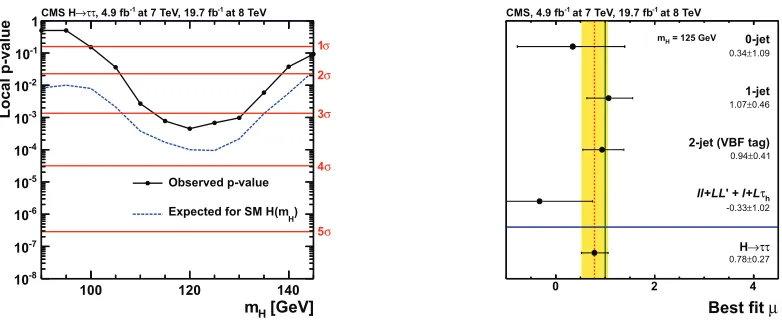
Figure 1: Left: local p-value and significance in number of standard deviations as a function of the SM Higgs boson mass hypothesis for the combination of all decay channels. Right: best-fit signal strength values, for independent categories, formH=125 GeV.
and 19.7 f b−1 at √s=8 TeV [7]. All the di-tau decay channels are used: μμ,eμ,ee,μτ
h (τh repre-senting the hadronic decay of theτ),eτhandτhτh. A categorization based on the number of jets and the boost of the system is applied, to constrain the backgrounds (0-jet category), exploits boost of the Higgs system and the sensitivity to ggH production (1-jet category) and to obtain a high S/B, sensitive to the VBF production mode (2-jets category). To optimize further the signal selection, events are divided in categories based on the lepton pT, di-tau pT, and jet properties. The main backgrounds for this channel are theZ → ττ,Z → ll, W+jets events and QCD processes. Then, for most of the channels, the signal extraction is done with a likelihood fit on the di-tau mass. The VH production mode is also considered by requiring one or two additional electrons or muons compatible with W or Z boson decays. Eight additional channels are considered in this case, based on the decay products of the W or Z boson, and of theτpair.
An excess of events over the background-only hypothesis is observed with a local significance of 3.2 standard deviations atmH=125 GeV, while the expected significance is 3.7 standard deviations and the best-fit value for the signal strength,μ=σ/σS M, is 0.78±0.27 times the SM prediction (see Fig.1), from which it can be conclude that there is evidence of the Higgs boson coupling to theτlepton.
3 Higgs boson decays to
b
b
¯
Through the Higgs boson decays tobb¯, the coupling between the Higgs and the down-type quark
can be probed. Here, the ggH production is not directly considered because of the overwhelming QCD background. The signal topology of the production mechanism is exploited for the main pro-duction mode being the VH mode, and for the VBF mode, which is used separately to add some more sensitivity.
3.1 VH mode
The search is performed using the available 5.1 f b−1at √s=7 TeV and 18.9 f b−1at √s=8 TeV [8].
Figure 2: Left: the expected and observed 95% CL upper limits on the product of the VH production cross section times the H→ bb¯ branching fraction, with respect to the expectations for the standard model Higgs boson. Right: the best-fit value of the production cross section for a 125 GeV Higgs boson relative to signal strength, for partial combinations of channels and for all channels combined (band).
W(lν)H(bb) with l=e,μ,τ. Data control regions are used to normalize the main contributions (V+jets,tt¯ and VV) To increase the background rejection, the resolution on the b-jet pair mass (jets arising from the hadronization of a b-quark) is improve by 15-25% by applying a Multi Variate Analysis (MVA) regression. The event categorization is based on the high boost ( 100 GeV) of the V bosons, with bins inpT(V), and multivariate discriminators are used for signal extraction in 14 regions defined. An excess of events is observed with a local significance of 2.1 standard deviations atmH=125 GeV (the expected significance is 2.1 standard deviations), and the best-fit value for the signal strength is 1.0±0.5 times the SM prediction (see Fig.2), and therefore shows a very good agreement with SM expectations.
3.2 VBF mode
Here, the search is performed with the 19 f b−1recorded at √s=8 TeV [9]. This channel offers a very
peculiar topology: 4 relatively hard jets, 2 central b-jets and 2 light quark jets with a large invariant massmqqand large pseudo-rapidity separationΔηqq. As a consequence, even with few signal events, it is possible to achieve a high signal over background ratio (S/B). A regression on thembb¯ is also
applied, and the event categorization is done in S/B bins using a multivariate discriminator. Finally the signal is extracted with a likelihood fit of thembb¯ spectrum in each bin.
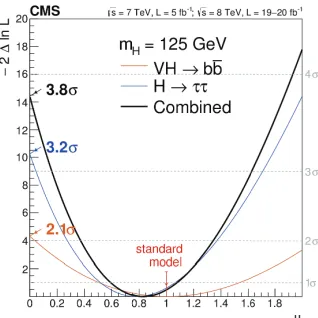
Figure 3: Scan of the profile likelihood as a function of the signal strength relative to the expectation for the production and decay of a standard model Higgs boson,μ, formH=125GeV
4 Fermionic combination
A combination of the Higgs boson decays tobb¯ channel (VH only) and Higgs boson decays toττis performed [10]. This combination results in strong evidence for the direct coupling of the 125 GeV Higgs boson to fermions, with an observed (expected) significance of 3.8 (4.4) standard deviations (see Fig.3).
5 Higgs boson produced in association with a top quark pair
5.1 ttH,H→bb¯: the standard method
The Higgs boson production in association with a top quark pair is of main interest since it can be used to directly probe the Yukawa coupling between the Higgs and the top. This channel having a very
low signal cross section, the decay modesH → ττandH →bb¯ are combined [11]. The dileptonic
and semi-leptonic decay mode oftt¯are used, resulting in complex final states with large values of the number of jets and/or b-jets. It is used to create six categories to improve the signal over background ratio. The main irreducible backgrounds are the top pair production in association with heavy flavour jets (tt+HF) or in association with a Z boson. The signal/background discrimination is done with multivariate discriminators in each event category, using object kinematics, event shape and b-tagging information.
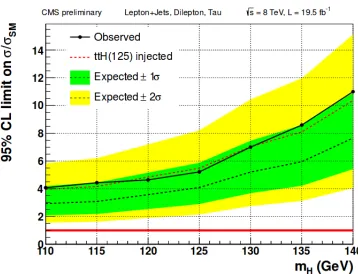
No significant excess of events is observed, and 95% confidence level (CL) upper limits are set on the possible presence of a SM signal. The observed (expected) limit formH=125 GeV at √s=8 TeV is 5.2 (4.1) times the SM prediction (see Fig.4).
5.2 ttH combination
The mentioned fermionic ttH searches from the previous section are combined withH → γγand
H→ Multi−leptons, with the same production mode [12]. The combined observed upper limit on the signal strength parameterμis 4.3 for a Higgs with a mass at 125 GeV, while the expected is 1.8. The signal strength is 2.5+1.1
Figure 4: Using the 2011+2012 datasets, the observed and expected 95% CL upper limits on the signal strength parameter forH→ττandH→bb¯combined.
Figure 5: Left: best-fit values of the signal strength parameter for each ttH channel atmH=125 GeV. Right: 95% CL upper limits on the signal strength parameter for each ttH channel atmH=125 GeV.
5.3 ttH,H→bb¯, using the Matrix Element Method
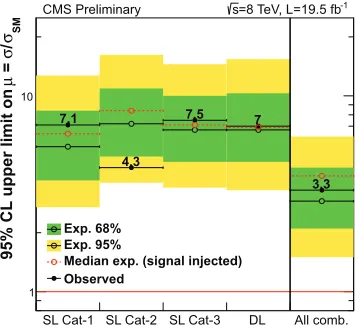
A new analysis is using the Matrix Element Method (MEM) to perform the search of the Higgs produced in association with a top quark pair and decaying into a pair of b-quark [13]. First, a likelihood ratio discriminant is created to distinguish the signal and the tt+HF processes from the top pair production in association with light-flavour jets. Then, the MEM is applied to separate the signal from the tt+HF events: it assigns to each event a weight under the signal and background hypothesis, and this weight is used to build the final discriminating variable,Ps/b, defined as the ratio between the two weights. To improve further the categorization, three categories are build in the semi-leptonic channel, based the W boson reconstruction.
Using the 19.5f b−1available at √s=8 TeV, the observed upper limit on the signal strength parameter
6/&DW 6/&DW 6/&DW '/ $OOFRPE
Figure 6: The 95% CL upper limits on the signal strength parameter for each event category: the 3 categories in semi-leptonic channel and the dileptonic category.
6 Higgs boson decays to first and second generation leptons
6.1 H→μμandH→ee
One of the properties that has to be checked is the couplings to first and second generation leptons. Indeed, the SM Higgs decays to fermions should not be universal. However the branching ratio
for H → μμ is very low (10 times smaller than H → γγ), and even smaller for H → ee. But
the search takes advantage of the clean signature in the detector and the excellent dimuon invariant
mass resolution [14]. It is performed by directly combining the full √s=7 TeV and √s=8 TeV
datasets (5.0+19.7 f b−1), using the ggH and VBF production modes (for the VH and ttH production mode the branching ratio is too small). Events are categorized based on the number or reconstructed jets attempting to separate the gluon-gluon fusion and VBF production components. The signal is extracted by means of a fit to themμμdistribution using signal and background shapes.
Upper limits on the cross section times theH→μμbranching ratio are set. The observed (expected) limit is found to be 7.4 (5.1) times the SM prediction, corresponding to an excess of events with a local significance of 2.8σ(see Fig.7, left part).
ForH→ee, an upper limit of 0.038 pb is set on the cross-section times branching ratio formH=125 GeV at 8 TeV (see Fig.7, right part).
6.2 H→μτ
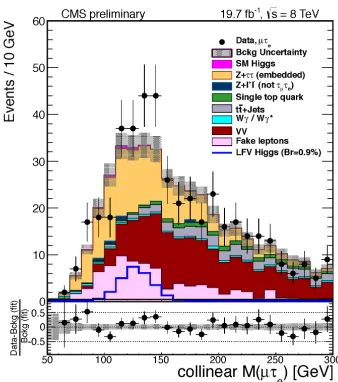
A first dedicated analysis is performed to search for Higgs decay with lepton flavour violation,H→
μτ, using the 19.7f b−1data recorded at√s=8 TeV [15]. The considered tau decays are the hadronic
Figure 7: Left: mass scan for the expected and observed exclusion limits onσ×BR forH→μμfor the combination at √s=7 and 8 TeV. Right: exclusion limits onσ×BR for H→e+e−.
Figure 8: The collinear massMcollinearafter fitting for signal and background for the LFVH → μτ decays.
7 Summary
boson with the ATLAS detector at the LHC",Phys. Lett.B716(2012) 1.
[4] CMS Collaboration, "Measurement of Higgs boson production and properties in the WW decay channel with leptonic final states",JHEP01(2014) 096.
[5] CMS Collaboration, "Measurement of the properties of a Higgs boson in the four-lepton final state",Phys. Rev.D89(2014) 092007.
[6] CMS Collaboration, "The CMS experiment at the CERN LHC",JINST3(2008) S08004. [7] CMS Collaboration, "Evidence for the 125 GeV Higgs boson decaying to a pair of tau leptons",
JHEP05(2014) 104.
[8] CMS Collaboration, "Search for the standard model Higgs boson produced in association with a W or a Z boson and decaying to bottom quarks",Phys. Rev.D89, 012003.
[9] CMS Collaboration, "Higgs to bb in the VBF channel", CMS-PAS-HIG-13-011.
[10] CMS Collaboration, "Evidence for the direct decay of the 125 GeV Higgs boson to fermions",
Nature Physics10(2014) (Advance online publication).
[11] CMS Collaboration, "Search for Higgs Boson Production in Association with a Top-Quark Pair and Decaying to Bottom Quarks or Tau Leptons", CMS PAS HIG-13-019.
[12] CMS Collaboration, "Search for the associated production of the Higgs boson with a top-quark pair", CMS-HIG-13-029.
[13] CMS Collaboration, "Search for ttH events in theH →bb¯ final state using the Matrix Element Method", CMS PAS HIG-14-010.
[14] CMS Collaboration, "Search for the standard model Higgs boson in the dimuon decay channel in pp collisions at √s=7 and 8 TeV", CMS-PAS-HIG-13-007.