Scintillation array of the Experimental Complex NEVOD for
EAS investigations
I.A. Shulzhenko1,a, M.B. Amelchakov1, N.S. Barbashina1, A.G. Bogdanov1, D.S. Brovtsev1, A. Chiavassa1,2,3, N.E. Fomin1, D.M. Gromushkin1, N.N. Kamlev1, S.S. Khokhlov1, R.P. Kokoulin1, K.G. Kompaniets1, O.I. Likiy1, V.V. Ovchinnikov1, A.A. Petrukhin1, O. Saavedra2, V.V. Shutenko1, and I.I. Yashin1
1 National Research Nuclear University MEPhI (Moscow Engineering Physics Institute), 115409 Moscow, Russia 2 Dipartimento di Fisica dell’ Universit`a degli Studi di Torino, 10125 Torino, Italy
3 Sezione di Torino dell’ Istituto Nazionale di Fisica Nucleare – INFN, 10125 Torino, Italy
Abstract. In 2014, the creation of a new cluster type shower array NEVOD-EAS was started around the Cherenkov Water Detector NEVOD and coordinate detector DECOR. The shower array will allow to determine the size, axis position and arrival direction of EAS registered by these detectors. In 2015–2016, the NEVOD-EAS central part, including 4 clusters of scintillation detector stations located on an area of about 104m2, was deployed and started operation. This article presents the description of the NEVOD-EAS
arrangement, detecting elements and data acquisition system, as well as the first results on EAS detection.
1. Introduction
For studying muon bundles in a wide range of zenith angles and energies with the complex of Cherenkov Water Detector (CWD) NEVOD [1,2] and coordinate detector DECOR [3], the method of local muon density spectra (LMDS) [4] has been developed. However, the estimations of primary particle energy using the LMDS technique has rather low accuracy (σ(lg E0)∼0.4). It is due to the
contribution of the extensive air showers (EAS) registered at different distances from the setup to the events with a fixed local muon density.
For an independent estimation of EAS parameters (arrival direction, size, axis position) in the energy range from 1015 to 1017eV using classical technique and, therefore, for calibration of the LMDS method and increasing its accuracy, a new cluster type shower array NEVOD-EAS is being constructed around the NEVOD-DECOR experimental complex.
2. NEVOD-DECOR experimental
complex
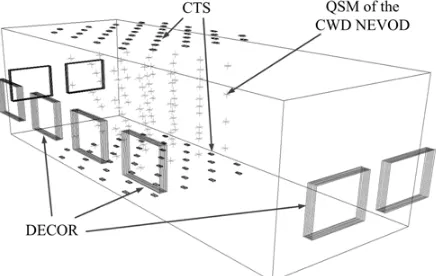
The NEVOD-DECOR experimental complex (Figure1) is a multi-purpose facility for effective registration of almost all components of cosmic rays at ground level. The setup is located in the National Research Nuclear University MEPhI (Moscow, Russia) in a special four-story building with a water reservoir (inner dimensions 9×9×26 m3)
and is equipped with technical and technological systems necessary for the setup operation.
The basic installation of the complex is the CWD NEVOD. Its detecting system represents a spatial lattice of quasi-spherical modules (QSM). Each QSM includes
ae-mail:[email protected]
six PMTs with flat photocathodes directed along the coordinate axes. The lattice of QSMs allows detection of Cherenkov radiation from all directions with practically equal efficiency and is formed by a set of vertical strings each containing 3 or 4 QSMs. The distances between the modules are 2.5 m along the detector, and 2.0 m across it and over the depth. Currently, the detecting system includes 91 QSMs (in total 546 PMTs). The signal read-out is produced from the 12thand 9thdynodes that provides
a wide dynamic range from 1 to 105 photoelectrons and
ensures operation in the calorimetric mode.
To calibrate the QSM photomultipliers during contin-uous experimental runs, the calibration telescope system (CTS) is used. This system contains 40 upper scintillation counters (on the water tank top) and 40 lower counters (on the tank bottom). Counter dimensions are 40×20× 2 cm3. Vertical pairs of counters ensure calibration of PMTs of modules in four surrounding strings. Other combinations allow to obtain calibration curves for various distances from muon tracks.
The coordinate detector DECOR (see Fig. 1) is a system of plastic streamer tube chambers deployed around the CWD NEVOD. It includes eight vertically suspended eight-layer assemblies (supermodules) of such chambers with a total sensitive area of 70 m2. The chambers
contain 16 tubes with 9×9 mm2 inner cross section and 3.5 m length integrated in one PVC box. A special three-component gas mixture (Ar+CO2+n-pentane) provides
operation of chambers in the limited streamer mode. Each layer of chambers is equipped with two-coordinate external strip readout system (256X+256Y channels) that allows to localize tracks with about 1 cm accuracy. The angular accuracy of track reconstruction is better than 0.7◦ and 0.8◦for zenith and azimuth angles, respectively.
EPJ Web of Conferences 145, 07003 (2017) DOI: 10.1051/epjconf/201714507003 ISVHECRI 2016
Figure 1. NEVOD-DECOR experimental complex.
3. NEVOD-EAS shower array
3.1. Experimental arrangement
In 2014, the creation of the NEVOD-EAS scintillation shower array was started. It is organized by the cluster principle and includes 12 independent clusters located around the experimental complex NEVOD-DECOR on the roofs of MEPhI laboratory buildings and on the ground. The layout of the NEVOD-EAS array is shown in Figure2. Each cluster of the array consists of 16 scintillation counters of the EAS electron-photon component particles combined in 4 detector stations placed in the vertices of a rectangle with typical dimensions of about 15×15 m2.
The characteristic distance between the centres of the clusters is about 50 m. The total area of the array is about 2×10⁴m2.
Since the clusters are located not in the same plane, but at different altitudes, new approaches to the EAS detection and organization of data acquisition system, as well as to experimental data analysis have been developed.
3.2. Scintillation counters and detector stations
Scintillation counters of the NEVOD-EAS array (see Fig.2) were previously used in the KASCADE-Grande [5] (Germany) and EAS-Top [6] (Italy) experiments. A counter consists of plastic scintillator NE102A with the dimensions of 800×800×40 mm3 and photomultiplier
Philips XP3462 which are installed inside the pyramidal housing. The distance between the PMT and scintillator is 30 cm. The counter housing provides a possibility to install one additional PMT. The results of studies of the PMT and scintillator characteristics are presented in [7] and [8].
The detector station (DS) (see Fig. 2) of the array includes 4 scintillation counters. Three of the four DS counters are equipped with one (“standard”) PMT for time and EAS particle density measurements. The standard PMT gain is adjusted for every counter in order to obtain the counter response to 1 particle (vertical equivalent muon, VEM) of about 13 pC. That provides a counter dynamic range of up to 100 particles. The fourth DS counter is equipped with two photomultipliers (a “standard” and an “additional” ones). The additional PMT ensures a wide linearity range at high particle densities (∼10000 particles/m2) and has a gain 90 times lower than
the standard one. The response of the additional PMT to 1 particle is about 0.15 pC. In the array, the DS counters
are mounted inside special external housings. The total DS area is about 2.5 m2.
Detector stations also include a PMT power supply based on DC/DC-converter which transforms constant voltage+12 V into high voltage in the range from−100 to −2000 V. For measuring ambient temperature and accounting for temperature effects on the scintillator light yield, the temperature sensor is installed inside the DS housing.
Analog signals from the DS counters are transferred to the cluster Local Post (LP) of primary data processing via coaxial cables.
3.3. DAQ-system
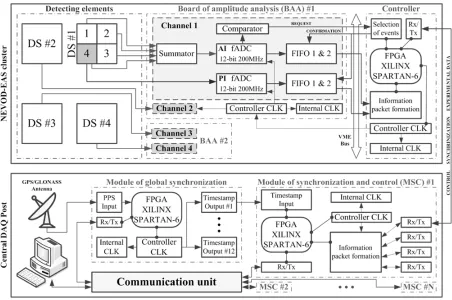
The data acquisition system of the NEVOD-EAS scintillation array is organized by a cluster principle and includes 2 main structural elements: the cluster and the Central DAQ Post (CP). The functional scheme of the NEVOD-EAS DAQ system is presented in Fig.3.
3.3.1. Cluster of the shower array
Each cluster is an autonomous part of the setup which provides EAS registration, selection of events according to triggering conditions (registration thresholds, coincidence multiplicity and time gate) specified at the beginning of the experimental run, digitizing of amplitude information, timestamping of events and data transfer to the CP of the array. Basic elements of the NEVOD-EAS cluster are: the detecting elements (4 DS) and the Local Post of primary data processing.
Analog signals from the cluster detector stations (5 signals–4 from standard PMTs and 1 from additional one–per DS) are fed to the cluster LP. It includes: summator-multiplexor (SM), industrial I/O-module for the SM control and processing of temperature sensors’ data, block of primary data processing (BPDP), some network equipment for communication with CP and several power supplies ensuring operation of all cluster elements. All LP electronics are enclosed inside the water-proof thermally stabilized box.
The BPDP digitizes DS signals, selects events according to various intra-cluster triggering conditions and transmits data to the Central DAQ Post. It includes two 2-channel boards of amplitude analysis (BAA) and a controller based on the FPGA Xilinx Spartan-6 which ensures all processor functions. Each BAA channel has 2 inputs: active (AI) and passive (PI). Signal digitizing is performed using a 12-bit fADC with a sampling frequency of 200 MHz. The registration threshold is set on the AI using 8-bit DAC. When the signal on the AI exceeds the registration threshold, the REQUEST signal is sent to the FPGA. If the number of REQUEST signals from BPDP measuring channels inside the specified time gate fulfils the specified multiplicity, FPGA sends a CONFIRMATION signal to the FIFO buffers of all channels. Then data are timestamped with an accuracy of 10 ns, packed and sent to the CP.
Figure 2. The layout of NEVOD-EAS shower array around the NEVOD-DECOR experimental complex. Left bottom corner: detector station housing and layout of counters inside the detector station. Right bottom corner: scheme of the counter.
Figure 3. Functional scheme of the NEVOD-EAS shower array data acquisition system.
corresponding BAA channel. The additional PMT signal is fed to the corresponding PI of the BAA. The SM provides an opportunity to activate or deactivate defined inputs for measuring response spectra from the selected counter of the DS during the cluster operation monitoring. The SM is controlled using I/O-module which sets the mask of active SM inputs. This module has 8 analog inputs for the temperature sensors data.
All communications with the CP are performed using TCP/IP protocol via the fiber-optical line.
3.3.2. Central DAQ Post
EPJ Web of Conferences 145, 07003 (2017) DOI: 10.1051/epjconf/201714507003 ISVHECRI 2016
Figure 4. Photograph of the 3rdcluster of the NEVOD-EAS array
on the roof of the building of the NEVOD-DECOR experimental complex.
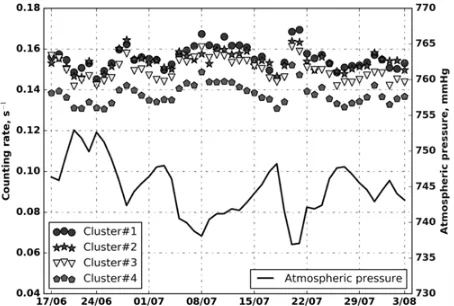
Figure 5. Counting rates of the NEVOD-EAS central part clusters and atmospheric pressure during the experimental run 17/06/16-03/08/16.
and storing. The CP (see Fig. 3) includes: personal computer (PC), GPS/GLONASS antenna, several modules of synchronization and control (MSC), module of global synchronization (MGS) and communication unit providing network connection between all CP elements.
Every MSC has 4 optical interfaces for the network connection to the BPDP of 4 NEVOD-EAS clusters and 1 Ethernet interface for the connection to central PC via the communication unit. At the beginning of an experimental run the specialized software on the central PC sends information packets to the MSC containing values of registration thresholds, coincidence multiplicities and time gates for 4 clusters. Then MSC broadcasts these options to certain clusters which configure their measuring channels and start registration. If one of the clusters registers an event, it sends information on the event time and contents of all ADC FIFO buffers to the MSC. The MSC, in its turn, adds information about the number of triggered clusters to the information packet and sends it to the central PC for processing and storing.
All electronics of the NEVOD-EAS array DAQ-system operate in the synchronous mode at the same clock frequency of 100 MHz. So, the synchronization accuracy of NEVOD-EAS clusters is 10 ns.
Time synchronization of clusters is performed using the global positioning system (GPS/GLONASS) antenna and the MSC and MGS modules. The antenna which is directly connected to the MGS generates the PPS signal with a frequency of 1 Hz. Upon receiving the PPS signal, the MGS send the synchronisation packet
Table 1. Dimensions and coordinates of the clusters of the NEVOD-EAS central part.
Cluster Cluster Coordinates of the No. dimensions, m2 cluster centres, m
X Y Z
1 13.3×12.4 −28.4 −7.8 −7.0 2 13.3×12.4 −28.4 23.8 −7.0
3 25.1×13.5 0.0 0.0 0.0
4 15.0×15.0 33.3 7.8 −14.5
containing the number of cycles of its internal clock to the special interfaces of the MSC modules. The MSC modules compare the obtained value to the number of cycles of their own internal clocks. Then MSC modules send the number of cycles of the MGS internal clock to the BPDP controllers of the clusters which also compare the obtained value to the number of cycles of their own and ADCs’ internal clocks.
If some deviations are revealed during this comparison, all internal clocks of the NEVOD-EAS array DAQ-system are stopped. Upon the next PPS signal from the antenna all clocks are started again in the way described above.
The MSC also allows to measure time of the synchronization packet transmission from the CP to the LP of all clusters via optical cables. This value determines the time shift in the LP local time which had to be accounted for the correction of the cluster event time. All processor functions of the MSC and MGS modules are performed by the FPGA Xilinx Spartan-6.
3.4. Central part of the NEVOD-EAS array
In 2015–2016, the central part of the NEVOD-EAS scintillation array was created and started. The central part includes 4 clusters. Three clusters (1, 2 and 3) are located on the roofs of MEPhI laboratory buildings and the 4thone is on the ground surface. The total area of the
NEVOD-EAS central part is about 104m2. The dimensions
of clusters and their coordinates relative to the center of the roof of the NEVOD-DECOR building are presented in Table 1. The photograph of one of the NEVOD-EAS clusters is shown in Fig.4.
The first continuous experimental run at the central part of the NEVOD-EAS array lasted 47 days (17/06/16– 03/08/16). The triggering condition for all clusters was a 4-fold coincidence of DS during the time gate with a duration of 120 ns. Registration threshold for all detector stations was about 0.5–1.0 particles (VEM). The counting rates of 4 central part clusters and the atmospheric pressure during this run are shown in Fig.5. It is seen that the first 3 clusters have almost the same counting rates while the counting rate of the 4th cluster is a little bit lower. This is
due to its location close to one of the laboratory buildings which acts as a shield for EAS electron-photon component. The clear anti-correlation of the cluster counting rates and the atmospheric pressure can be observed. The estimated barometric coefficient is about–0.8%/mmHg.
3.5. EAS detection
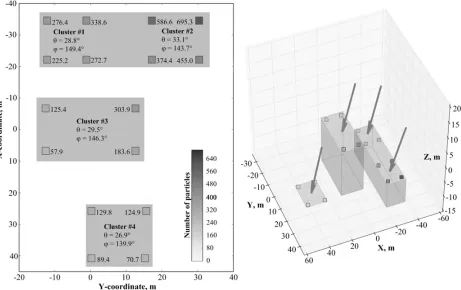
Figure 6. Reconstruction of the NEVOD-EAS array central part response to the extensive air shower.
Figure 7. Reconstruction of the NEVOD-DECOR experimental complex response to the extensive air shower.
showers has been developed. In particular, the EAS arrival direction is determined in the following way. The events in which not less than 3 clusters have been triggered during the time interval of about 0.5µs determined by the characteristic size of the setup (∼100 m) are selected. The intra-cluster triggering condition is a 4-fold coincidence of detector stations within a 120 ns time gate. For each cluster the arrival direction is calculated on the assumption of a flat EAS front. The resulting direction in the event is calculated by averaging directions reconstructed according to the data of triggered clusters.
The number of particles registered by each detector station is determined as the ratio between the DS response charge and its response charge to 1 particle (VEM, ∼13 pC). At high particle densities (>100 particles/m2) the data of the DS additional PMTs are taken into account.
Figure 8. Response of the supermodules of the coordinate detector DECOR to the extensive air shower.
Figure 6 shows an example of the reconstruction of the NEVOD-EAS array central part response to the extensive air shower. Grey rectangles illustrate the cluster locations. Rectangles represent the detector stations. the number of particles registered by each DS is shown by the tone and printed near the rectangles. For all clusters the reconstructed azimuthal and zenith angles of the EAS arrival direction are indicated. The left part of Fig.6is the 3-dimensional view of this event. The arrows correspond to the EAS front arrival direction reconstructed according to the data of each cluster. The highest particle density is observed in the DS #1 of the 2nd cluster. The particle
density decreases in the direction from the 2nd cluster to
the 4thone.
EPJ Web of Conferences 145, 07003 (2017) DOI: 10.1051/epjconf/201714507003 ISVHECRI 2016
reconstruction of the experimental complex response. Crosses and circles represent triggered QSMs and PMTs of the CWD NEVOD, correspondingly. Rectangles are for the triggered counters of the CTS system. Straight lines show the tracks of muons reconstructed according to the data of the coordinate detector DECOR.
Figure 8 shows the response of the DECOR supermodules to this extensive air shower. Dark points represent triggered strips. In the left part of the figure are Y-strips (azimuth angle measurements) of supermodules. In the right part – X-strips (projected zenith angle measurements).
According to the data of the DECOR detector the azimuthal and zenith angles of the considered EAS arrival direction are 144.4◦and 29.5◦, respectively. The results of the arrival direction reconstruction by the 3rdcluster of the
NEVOD-EAS array (ϕ =146.3◦,θ =29.5◦) are in a good agreement with these values.
4. Conclusion
In 2015–2016, the central part of the NEVOD-EAS cluster type shower array which includes 4 independent clusters (in total, 64 scintillation counters) located around the experimental complex of the CWD NEVOD and coordinate detector DECOR at the area of about 104m2
has been created and started.
The distributed structure of the NEVOD-EAS array DAQ-system allows to deploy registering elements of
the setup even at different altitudes and provides implementation of a newly developed cluster approach to the reconstruction of EAS parameters. The first experimental run has proved the possibility of using of such a cluster approach.
This work was performed at the Unique Scientific Facility “Experimental complex NEVOD” with the support of the Ministry of Education and Science of the Russian Federation (grant RFMEFI59114X0002, MEPhI Academic Excellence Project 02.a03.21.0005 of 27.08.2013) and the Russian Foundation for Basic Research (grant 16-29-13028-ofi-m).
References
[1] V.M. Aynutdinov et al., Astrophysics and Space Science 258, 105 (1998)
[2] V.V. Kindin et al., Physics Procedia 74, 435 (2015) [3] N.S. Barbashina et al., Instrum. Exp. Tech. 43, 743
(2000)
[4] R.P. Kokoulin et al., Nucl. Phys. B. (Proc. Suppl.)
196, 106 (2006)
[5] M. Aglietta et al., Nucl. Phys. B (Proc. Suppl.) 16, 493 (1990)
[6] A. Chiavassa et al., 28th ICRC, Tsukuba 2 (2003), p. 992
[7] I.A. Shulzhenko et al., Bull. Russ. Acad. Sci. Phys.
79, 389 (2015)