A Virtual Space-Frequency Matrix Method for Joint
DOA-Frequency Estimation
Ruiyan Du1, *, Fulai Liu1, and Qingping Zhou2
Abstract—The joint direction-of-arrival (DOA) and frequency estimation problem has received significant attention recently in some applications, including pulsed Doppler radar, multipath parameter estimation, etc. This paper presents a novel virtual space-frequency matrix method to estimate the DOA and frequency jointly. Via the temporal smoothing technique, a virtual space-frequency matrix is defined, which includes the information of the incident DOAs and frequencies. Making using of the proposed method, both the frequencies and DOAs can be estimated by eigenvalues and the corresponding eigenvectors of the new defined virtual space-frequency matrix, respectively. Therefore, the pairing of the estimated DOAs and frequencies is automatically determined. Compared with related works, the proposed method can provide superior performance, such as higher estimation accuracy, without the procedure of parameter search or parameter matching. Simulation results are presented to demonstrate the efficacy of the proposed approach.
1. INTRODUCTION
In wireless communications, the joint direction-of-arrival (DOA) and frequency estimation problem of multiple sources has received considerable attention in the field of array signal processing. Many high-resolution algorithms, such as MUSIC-like peak search-based algorithms [1, 2] and the algorithms [3– 5] based on the shift-invariance structure of the array response matrix, have been developed. A two-dimensional (2-D) multiple signal classification (MUSIC)-based algorithm is presented in [1]. This method performs the joint DOA-frequency estimation via high dimensional eigen-decompositions of covariance matrices and 2-D search on the DOA-frequency plane, which results in enormous computations. To alleviate the computational overhead, an FSF-MUSIC method is presented [2], which describes a tree-structured frequency-space-frequency (FSF) MUSIC-based algorithm for the joint DOA and frequency estimation problem. In the presented method, the estimated DOAs and frequencies are automatically paired without extra processing. However, this method employs three 1-D MUSIC-type algorithms, i.e., two F-MUSICs and one S-MUSIC, which is computationally not very attractive since it requires multiple 1-D searches. In order to reduce effectively the computational complexity, several algorithms based on the shift-invariance structure have received much attention. For example, the MR-ESPRIT algorithm is proposed by extending the MR-ESPRIT direction finding algorithm to antenna arrays with multiple baselines [3]. By taking advantage of the temporal smoothing, spatial smoothing, and forward-backward averaging techniques, a C-JAFE algorithm is addressed [4], which can achieve more accurate results than the previous ESPRIT-based techniques. Despite its high-resolution capability, the C-JAFE still involves the joint diagonalization processing apart from the singular value decomposition (SVD) or eigenvalue decomposition (EVD). It is well known that the joint diagonalization processing is a complex nonlinear optimization procedure. In addition, the C-JAFE algorithm needs an extra
Received 29 March 2018, Accepted 17 May 2018, Scheduled 31 May 2018 * Corresponding author: Ruiyan Du ([email protected]).
1 Engineer Optimization & Smart Antenna Institute, Northeastern University at Qinhuangdao, China.2Tangshan Normal University,
pairing procedure to match the separately estimated DOAs and frequencies. The parameter matching makes the joint DOA-frequency estimation more difficult to solve. In order to solve these problems, an effective Unitary-JAFE algorithm is presented [5], where the incoming DOAs and frequencies can be estimated by making use of the real and imaginary parts of the eigenvalues of the space-time factor matrix so that the pairing of the estimated frequency and DOA is automatically determined. Based on FSF-MUSIC, an FSF-ESPRIT algorithm is proposed [6], which is a hybrid of one-dimensional (1-D) ESPRIT and spatial/temporal filtering processes. In other words, two temporal and one spatial 1-D ESPRIT algorithms are employed alternatively to estimate the frequencies and the DOAs, respectively. The estimated frequencies and DOAs are automatically paired without extra computational overhead. A space-time matrix method is proposed [7]. The frequencies and incident angles can be estimated by the eigenvalues and the corresponding eigenvectors of the defined space-time matrix, respectively. Thus, the presented method can automatically determine the paring of the estimated angles and frequencies. However, it needs an extra noise power estimation procedure. By exploiting the multiple delay output, ESPRIT-based joint angle and frequency estimation algorithms are proposed to improve the estimation accuracy [8–10]. By combining the outputs of a uniform linear array (ULA) and delay network, a space-time-Euler-ESPRIT method is presented, which can provide automatically paired frequencies and their DOAs [11].
As stated before, most of the existing joint DOA and frequency estimation methods call for two-dimensional (2-D) search, or multiple 1-D searches, or multiple delay taps, and/or complex pair matching processing, etc. These facts make the joint DOA and frequency estimation problem more difficult to solve. In this paper, an effective virtual space-frequency matrix method is proposed. The 3-factor temporal smoothing technique is utilized to add a structure of the received data model for the implementation of the proposed method based on multiple antennas without delay taps. The proposed approach makes use of the covariance matrices with different virtual delay data to obtain the space-frequency matrix which can avoid the noise power estimation. The rest of the paper is organized as follows. The data model is described in Section 2. Section 3 introduces the presented method. Section 4 shows some simulation results. Finally, the conclusion is given in Section 5.
2. DATA MODEL
Consider a ULA ofM elements equispaced by d. Employing the first element of the ULA as the phase reference, the array manifold can be written as
aM(f, θ) =
[
1, ejµ, . . . , ej(M−1)µ
]T
(1)
where µ = (2πf /c)dsin(θ) with f and θ denoting the frequency and the DOA, respectively. c stands for the velocity of light. dis equal to the interelement spacing.
Suppose that there areq narrowband signalssi(t) (i= 1, . . . , q) simultaneously imping on the ULA
with the ith source having a carrier frequency of fi and a DOA θi. The signal received at the kth
antenna is [4, 5]
xk(t) = q
∑
i=1
ak(fi, θi)ej2πfitsi(t) +wk(t) (2)
whereak(fi, θi) is the antenna response of thekth antenna to the signal from the directionθi, andwk(t)
represents the output of the additive noise of thekth sensor. The observed signals at the ULA can be expressed as
x(t) =As(t) +w(t) (3)
The matrices and the vectors in Eq. (1) have the following forms
x(t) = [x1(t), . . . , xM(t)]T
A = [aM(f1, θ1), . . . ,aM(fq, θq)]
s(t) = [s1(t), . . . , sq(t)]T
wherexk(t) andwk(t) (k= 1, . . . , M) denote the output signal and the additive noise of thekth sensor,
respectively. aM(fk, θk) (k = 1, . . . , q) denotes the steering vector for the kth source, which is defined
by Eq. (1). The superscript (·)T represents the transpose operation. Assume that wk(t) is a complex
Gaussian random process with zero-mean and variance σn2, and the noise wk(t) is uncorrelated with
si(t).
Under the above assumptions, it can be easily seen that E{w(t)wH(t)} = σn2IM, where E{·}
represents the statistical average operation, and the superscript (·)H denotes the Hermitian operation.
IM is theM ×M identity matrix.
Assume that P is the sample rate, which is much higher than the data rate of each source. The data samples at the receiver are
x (n P ) = q ∑ i=1
a(fi, θi)ej(2π/P)finsi
(n P ) +w (n P ) (4)
In matrix form, this can be written as
x
(n
P
)
=AΦns
(n P ) +w (n P ) (5)
where Φ = diag{(ϕ1, . . . , ϕq)} with ϕi = ej(2π/P)fi for i = 1, . . . , q, which includes the frequency
information of the incident signal sources, e.g., we refer to matrixΦas frequency factor matrix and its diagonal element as frequency factor.
Assume that we have collected N samples of the array output x(t) at a rate P into the M×N
data matrix, i.e.,
X (n P ) =A [
s(0),Φs
( 1
P
)
, . . . ,ΦN−1s
(
N −1
P
)]
+W (6)
whereW is a matrix collecting N samples of the M×1 array noise vector.
3. ALGORITHM FORMULATION
To effectively estimate the DOAs and frequencies, a virtual space-time matrix method is proposed by the temporal smoothed technique. We begin the development by the 3-factor temporal smoothed technique for the original data matrix X(Pn). This results in the following data matrix
X3 = A [
s(0),Φs
( 1
P
)
, . . . ,ΦN−3s
(
N−3
P )] AΦ [ s ( 1 P ) ,Φs ( 2 P )
, . . . ,ΦN−2s
(
N −2
P )] AΦ2 [ s ( 2 P ) ,Φs ( 3 P )
, . . . ,ΦN−1s
(
N−1
P )]
+W3 (7)
whereW3 represents the noise term constructed from W in a similar way as X3 obtained from X. Assume that the signals are narrow band, i.e.,s(t)≈s(t+ 1/P)≈s(t+ 2/P). In this case,X3 has the following factorization
X3=A3Fs+W3 (8)
whereFs=
[
s(0),Φs(P1), . . . ,ΦN−3s(NP−3) ]
. A3 is given by
A3 = AΦA
AΦ2
(9)
Define three selection matricesJk (k= 1,2,3) as follows
J1 = [IM,0M×2M]
J2= [0M×M,IM,0M×M]
J3= [0M×2M,IM]
(10)
where0m×n stands for the them×nzero matrix.
Making use of the defined selection matrices in Eq. (10), we can obtain the following equations:
Y1 =J1X3=AFs+J1W3
Y2 =J2X3=AΦFs+J2W3
Y3 =J3X3=AΦ2Fs+J3W3
(11)
then, it can be easily seen that {
R21=E {
Y2YH1 }
=AΦRsAH
R31=E {
Y3YH1 }
=AΦ2RsAH
(12)
where the matrix Rs=E{FsFHs}= diag{(σ12, . . . , σq2)}, in whichσ2k (k= 1, . . . , q) is the average signal
power of the kth signal.
Making use ofR21 and R31, a virtual space-time matrixR is defined as follows
R=R31R†21 (13)
where the superscript (·)† denotes matrix pseudo inverse.
It is clear that the space-time matrixR includes the information of the DOAs and frequencies for all incoming signals. Therefore, we have the following Theorem 1.
Theorem 1. Assume that there are q narrow-band sources, with the complex baseband representations sk(t) (1≤k ≤q) such that thekth source has a carrier frequency of fk and arrives a
ULA from directionθk. If there are no same elements on the diagonal of matrixΦ, andRs is the a full
rank matrix, then, theqnonzero eigenvalues ofRare equal to theqelements on the diagonal of matrix
Φ, and the corresponding eigenvectors are equal to the corresponding column vectors ofAΦ, namely,
RAΦ=AΦ2.
Proof: Under the above assumptions, it is easy to know thatAis a full rank matrix. Furthermore, we can draw a conclusion that rank(R21) = rank(R31) = rank(A) = rank(Rs) =q. Thus, we have the
following equation
R†21=ARs
(
RsAHARs
)−1(
ΦHAHAΦ)−1ΦHAH (14)
where (·)−1 denotes matrix inverse.
From Eqs. (12)–(14), the following equation can be obtained
RAΦ = R31R†21AΦ= (
AΦ2RsAH
)(
ARs
(
RsAHARs
)−1(
ΦHAHAΦ)−1ΦHAH
)
AΦ
= (AΦ2) (RsAHARs
) (
RsAHARs
)−1(
ΦHAHAΦ)−1(ΦHAHAΦ)
= AΦ2. (15)
This concludes the proof.
Remarks:
(1) From Theorem 1, it is easily seen that the array steering matrix A and diagonal matrix Φ can be obtained by computing the eigendecomposition of the space-time matrix R. Then the carrier frequencyfk and incoming DOAθk can be estimated by making use of the kth eigen-pair (λk, ηk)
of the matrixR, that is, the paring of the estimated two-dimensional parameters is automatically determined.
The procedure of the proposed method is concluded as follows.
(1) Collect the data matrix X and construct the 3-factor temporal smoothed matrix X3, according to (7).
(2) CalculateR21and R31 according to (12).
(3) Compute the eigen-pairs (λk, ηk) of the space-time matrix R given by (13), where λk is the kth
eigenvalue of Rand ηk is the corresponding eigenvector, for k= 1, . . . , q.
(4) According to the eigen-pairs (λk, ηk), estimate frequencyfk and DOA θk as follows
{ ˆ
fk= angle(λk)×P/(2π)
ˆ
θk= sin−1
(
angle(ηk2/λk)×c/(2πdfˆk)
) (16)
whereηk2 is the second element ofηk.
4. SIMULATION RESULTS
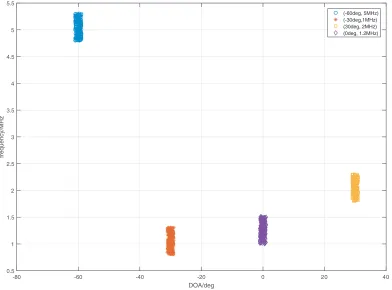
In this section, several simulation results are provided to illustrate the performance of the proposed method. Consider a ULA with M = 7 antenna elements and equispaced by d = 30 m. Assume that there are four far-field equal power signals s1(t), s2(t), s3(t), s4(t) impinging on the antenna array. Their DOAs are θ1 = −60◦, θ2 = −30◦, θ3 = 30◦, θ4 = 0◦, respectively. Their corresponding center frequencies are f1 = 5 MHz, f2 = 1 MHz, f3 = 2 MHz, f4 = 1.2 MHz, respectively. The source signals are narrowband (25 kHz) amplitude-modulated signals. The sampling rate is set to 15 MHz.
-80 -60 -40 -20 0 20 40
DOA/deg 0.5
1 1.5 2 2.5 3 3.5 4 4.5 5 5.5
frequency/MHz
(-60deg, 5MHz) (-30deg,1MHz) (30deg, 2MHz) (0deg, 1.2MHz)
-80 -60 -40 -20 0 20 40 DOA/deg
0.5 1 1.5 2 2.5 3 3.5 4 4.5 5 5.5
frequency/MHz
(-60deg, 5MHz) (-30deg,1MHz) (30deg, 2MHz) (0deg, 1.2MHz)
Figure 2. The scatter of the estimates based on VSTM.
-15 -10 -5 0 5 10 15 20
SNR/dB 0
0.2 0.4 0.6 0.8 1 1.2 1.4 1.6 1.8 2
RMSE/deg
C-JAFE STM VSTM
We use root-mean-square-error (RMSE), which is defined as follows
RMSEf =
v u u tE
{ q ∑
k=1 (
fk−fˆk
)2}
RMSEθ =
v u u tE
{ q ∑
k=1 (
θk−θˆk
)2} (17)
where ˆfk and ˆθk are the estimates offk and θk, fork= 1,2, . . . , q.
For comparison, three algorithms are carried out, including the proposed method, C-JAFE [4], the space-time matrix method [7]. For convenience, the proposed method and the space-time matrix method are named as VSTM and STM, respectively.
Figures 1 and 2 illustrate the scattergrams for joint DOA and frequency estimated by STM and VSTM, respectively, based on 200 independent trials under the hypothesis that signal-to-noise ratio (SNR) is equal to 5 dB. From these figures, it is clear that the proposed method provides a more precise DOA and frequency estimate than the STM.
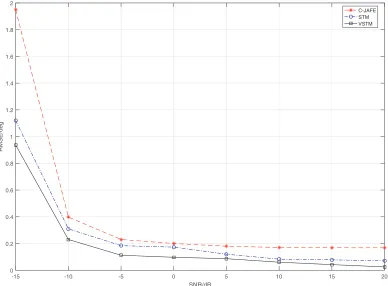
Figures 3 and 4 give RMSEθand RMSEf curves (which are computed by (17)) of the aforementioned
algorithms, respectively, based on 200 independent trials under the hypothesis that SNRs range from
−15 dB to 20 dB, and the number of snapshots is assigned to N = 128. From these figures, it is clear that the proposed VSTM outperforms C-JAFE and STM for DOA and frequency estimation. This is because the proposed virtual space-frequency matrix is estimated by using only the covariance matrices without extra noise power estimation or joint diagonalization.
-15 -10 -5 0 5 10 15 20
SNR/dB 0
0.5 1 1.5 2 2.5 3
RMSE/Hz
× 105
C-JAFE STM VSTM
5. CONCLUSIONS
In this paper, we present a virtual space-frequency matrix method for the joint DOA and frequency estimation problem. The temporal smoothing technique is utilized to add the structure of the received data model such that a virtual space-frequency matrix can be formed without delay taps. Additionally, the proposed approach makes use of the eigenvalues and the corresponding eigenvectors to estimate the frequencies and the DOAs, so that the pairing of the estimated DOAs and frequencies can be automatically determined. Simulation results show that the proposed method has a better performance than C-JAFE and STM.
ACKNOWLEDGMENT
This work was supported by the Natural Science Foundation of Hebei Province (No. F2016501139) and the Fundamental Research Funds for the Central Universities under Grant No. N162304002 and No. N172302002, and the National Natural Science Foundation of China under Grant No. 61501102 and No. 61473066.
REFERENCES
1. Wang, S., J. Caffery, X. Zhou, “Analysis of a joint space-time DOA/FOA estimator using MUSIC,” IEEE International Symposium on Personal, Indoor and Mobile Radio Communications, B138– B142, 2001.
2. Lin, J. D., W. H. Fang, W. Y. Wang, and J. T. Chen, “FSF MUSIC for joint DOA and frequency estimation and its performance analysis,”IEEE Transactions on Signal Processing, Vol. 54, No. 12, 4529–4542, 2006.
3. Lemma, A. N., A. J. Vanderveen, and A. Paulraj, “Joint angle-frequency estimation using multi-resolution ESPRIT,” IEEE International Conference on Acoustics, Speech and Signal Processing — Proceedings, Vol. 4, 1957–1960, 1998.
4. Lemma, A. N. and A. J. Van der veen, “Analysis of joint angle-frequency estimation using ESPRIT,” IEEE Transactions on Signal Processing, Vol. 51, No. 5, 1264–1283, 2003.
5. Liu, F. L., J. K. Wang, and R. Y. Du, “Unitary-JAFE algorithm for joint angle-frequency estimation based on Frame-Newton method,”Signal Processing, Vol. 3, No. 90, 809–820, 2010.
6. Lin, J. D., W. H. Fang, and K. H. Wu, “FSF subspace-based algorithm for joint DOA-FOA estimation,”IEEE International Conference on Acoustics, Speech, and Signal Processing, ii-157-60, 2004.
7. Du, R. Y., J. K. Wang, and F. L. Liu, “ Space-time matrix method for joint angle-frequency estimation,” IEEE International Conference on Communication Technology Proceedings, 2008. 8. Wang, X. D., “Joint angle and frequency estimation using multiple-delay output based on ESPRIT,”
Eurasip Journal on Advances in Signal Processing, 2010.
9. Wang, X. D., X. F. Zhang, J. F. Li, and J. C. Bai, “Improved ESPRIT method for joint direction-of-arrival and frequency estimation using multiple-delay output,” International Journal of Antennas and Propagation, Vol. 2012, No. 1, 1018–1020, 2012.
10. Sun, Z. W., J. F. Li, J. Liu, and X. F. Zhang, “ESPRIT-based joint angle and frequency estimation using multiple delay output,” International Conference on Teaching and Computational Science, 2012.