
SYNTHESIS, CHARACTERIZATION OF COPPER
NANOPARTICLES AND THEIR CATALYTIC
APPLICATION
Niharika Nagar
1, Shikha Jain
2, Vijay Devra
3Department Of Chemistry, J.D.B. Govt. P.G. Girls College, Kota, Rajasthan, (India)
ABSTRACT
In this paper, we report on the synthesis of copper nanoparticles (Cunps) through a single route of chemical
reduction method. The effect of different concentration of reducing agent on the morphology of Copper
nanoparticles was investigated. The synthesized copper nanoparticles were characterized by UV-Visible
spectrophotometer, Fourier Transform Infrared (FTIR) Spectrophotometer, Scanning Electron Microscopy
(SEM), Transmission Electron Microscopy (TEM) analysis. The average size of copper nanoparticles was found
to be 12 nm and spherical in shape at the optimal experimental conditions. The catalysis by colloidal copper
nanoparticles was studied kinetically in the oxidation of L-Valine (Val) by peroxodisulphate (PDS) in acid
aqueous medium. The copper nanoparticles catalyst exhibited very good catalytic activity.
Keywords: Ascorbic Acid, Copper Nanoparticles, Kinetics, L-Valine, Peroxodisulphate.
I. INTRODUCTION
The field of nanocatalysis has undergone an explosive growth during the past decades, both in homogeneous
and heterogeneous catalysis [1, 2]. Since nanoparticles have a large surface to volume ratio compared to bulk
materials, they are attractive to use as catalyst [3, 4]. Metal nanoparticles with high specific catalytic activity are
ubiquitous in modern synthetic organic chemistry during the recent decades [5]. However how to reduce their
dosage is one of the most exciting challenges due to the limiting reserves of noble metals. Some selective
oxidation reactions are reported involving transition metal ions of Ag, Rh, Cr, Ru, Mn etc. are reported to act as
catalyst for amino acids oxidations [6-10] with the emergence of metal nanoparticles possessing appreciable
stability and high surface area per particle, their potential use as catalyst for organic biochemical relevant
reactions [11-12]. Amongst them Copper nanoparticles are paid more attention due to their low cost and easy
availability. Copper nanoparticles have also been considered [13-14] as an alternative for noble metals in many
applications such as heat transfer and microelectronics [15]. In this study, highly stable colloidal dispersion of
copper nanoparticles has been synthesized by chemical reduction method, using ascorbic acid as a reducing
agent as well as capping agent. The particle size has been effectively controlled by the variation of reducing
agent and temperature during the synthesis. The synthesized Cunps were characterized by UV-Visible
The kinetics of the oxidation of inorganic and organic substrates by peroxodisulphate under both catalyzed and
uncatalyzed conditions have received considerable attention [16-17]. The peroxodisulphate ion is one of the
strongest oxidizing agents known in aqueous solution. The standard oxidation reduction potential for the
reaction is estimated to be -2.01V.
2 SO
42-S
2O
82-+ 2e
-The reaction involve this ion are generally very slow in the absence of suitable catalysts [18].-The transition
metal ion catalysis oxidation of amino acid by peroxodisulphate was reported in aqueous acidic medium
[19-21]. The oxidation of amino acids is of the utmost importance, both from a chemical point and in view of its
bearing on the mechanism of amino acid metabolism. It has been observed that there is not enough information
in the literature on the oxidation of amino acid by peroxodisulphate in presence of copper nanoparticles. The
present investigation is a part of a broad programme for study of the catalytic effect of copper nanoparticles on
the oxidation of Valine by peroxodisulphate in acid aqueous media.
II. EXPERIMENTAL
2.1 Material
For the present work, we used analytical grade chemicals such as copper chloride dihydrate (CuCl2.2H2O-97%),
L-ascorbic acid (vitamin C-98%), L-Valine and Peroxodisulphate were obtained from E. Merck. A fresh
solution of peroxodisulphate was prepared before starting the experiments. All chemicals were used as received
without further purification. Double distilled water was employed throughout the study.
2.2 Synthesis Process
The one step synthesis scheme for copper nanoparticles initiates with dissolving copper chloride dihydrate (0.02
mol L-1) in deionized water to obtain a blue solution. L-ascorbic acid (0.01 mol L-1) drop wise added to the aqueous solution of copper salt while vigorously stirring at 353 K in oil bath. With the passage of time, the
colour of dispersion gradually changed from white, yellow, orange, brown finally dark brown with a number of
intermediate stages. The appearance of yellow colour followed by orange colour indicated the formation of fine
nanoscale copper particles from L-ascorbic acid assisted reduction. The resulting dispersion was centrifuged for
15 minutes. The supernatant was placed under ambient conditions for 2 months. The studies were performed at
different concentration of L-ascorbic acid and temperature to investigate the morphology of copper
nanoparticles.
2.3 Instrumentation
UV-Visible spectroscopy from a double beam spectrophotometer (U.V. 3000+ LABINDIA) was used for
preliminary estimation of copper nanoparticles synthesis. Morphological study of the copper nanoparticles was
carried out with scanning electron microscope (SEM) (EVO 18 carlzeiss) and Transmission electron microscope
(TEM) (FEI Techni G2S2 Twin). TEM and SEM images were recorded to confirm size distribution and shape
2.4 Kinetic Study
The reaction was carried out in glass-stoppered Pyrex round bottom flask. Appropriate amount of the amino acid
solution in acidic form, potassium sulphate, and water (to keep the total volume constant for all runs) were taken
in the round bottom flask and thermostatted at 308 K for thermal equilibrium. A measured amount of
peroxodisulphate was rapidly added to the mixture. The progress of the reaction was monitored by iodometric
determination of unreacted peroxodisulphate in a measured aliquot of the reaction mixture at different intervals
of time.
III. RESULTS AND DISCUSSION
3.1 Copper Nanoparticles Characterization Results
In recent years, several studies have shown that optical properties of metal nanoparticles depend upon the
geometry and size, thus the optical response of metal nanoparticles can be control shape and size of metal
nanoparticles [22]. Since surface Plasmon modes of metal nanoparticles like Au, Ag, Cu reside within the
optical region of electromagnetic spectrum [23, 24], optical spectroscopy can be used as primary tool for
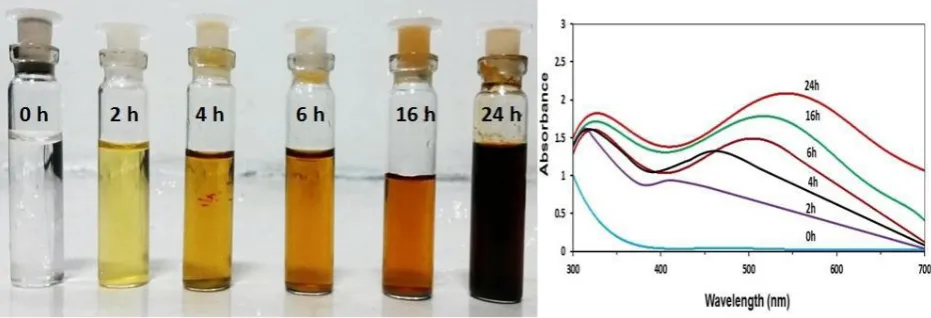
investigation of such nanoparticles. UV-visible spectral profile for copper nanoparticles was recorded with time.
During the synthesis of copper nanoparticles in aqueous solution, the dispersion became colourless when
L-ascorbic acid was added, and gradually turned to yellow, orange, brown and finally change into dark brown
solution. The UV-Visible spectra of samples were recorded at different time intervals for every colour “Fig. 1”.
Fig. 1:
The time evolution of the dispersion photographs and the UV-Visible spectra
The spectacular colour change correlates with large shift of UV-Visible spectra. The first absorption peak of
different curves is at 335 nm corresponding to oxidation product of L-ascorbic acid [25]. The second absorption
peak is increasingly broadening with an increasing concentration of L-ascorbic acid. The absorption peak of
copper nanoparticles has been reported at around 560 nm of UV-Visible wavelength which proves the formation
of copper nanoparticles [26, 27]. In this work, the resulting copper nanoparticles displayed a broadened peak at
550 nm wavelength, indicating the presence of small separated copper nanoparticles, it is well established fact
3.2 Effect of reducing agent concentration
To evaluate the effect of L-ascorbic acid concentration (0.08, 0.09, and 0.10 mol L˗1) on the synthesis of copper nanoparticles were recorded on UV-Visible spectroscopy. The results indicate that a higher L-ascorbic acid
concentration leads to a more effective capping capacity of L-ascorbic acid and then formed smaller Cu
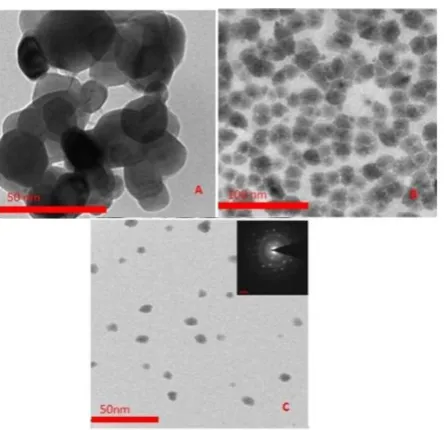
nanoparticles which can also be proved by the TEM images of copper nanoparticles “Fig. 2”. The TEM images
show that the particles are spherical in shape and decrease in particle size with an increase in L-ascorbic acid
concentration. The size of the copper nanoparticles with various concentration (0.08, 0.09, 0.10 mol L˗1) of L-ascorbic acid are 28, 16, 12 nm respectively. The reason is that L-L-ascorbic acid molecules encapsulate Cu+2 and reduce Cu+2 into Cu(0), then oxidation products absorbs on the resulting copper nanoparticles surface preventing the particles from growing further as a result smaller copper nanoparticles obtained. Thus, the number of Cu+2 encapsulated in ascorbic acid molecules decreases with increasing concentration of L-ascorbic acid, leading to
the formation of smaller copper nanoparticles.
Fig. 2: TEM images of copper nanoparticles with variable concentration of L-ascorbic acid: (A)
0.08, (B) 0.09, (C) 0.1 mol L
˗13.3 Stability of nanoparticles
The stability of nanoparticles dispersion is key factor in their application. In this study L-ascorbic acid was used
as both reducing and capping agent without any other special capping agent. The antioxidant properties of
L-ascorbic acid came from its ability to scavenge free radicals and reactive oxygen molecules[29], accompanying
the donation of electrons to give semi-dehydroascorbate radical and dehydroascorbic acid hydration of
2-carbonyl is also reported [30] and finally converted into polyhydroxyl structure through hydrolysis[25].
the reaction can be done without any protective inert gas and the dispersion of copper nanoparticles is stable for
2 months after storage.
3.4 Stoichiometry and Product analysis
Under the kinetic conditions, the reaction was carried out with excess of peroxodisulphate over Valine in
presence of nanoparticles in a thermostat water bath at 308 K for 24 hours. The excess of peroxodisulphate was
determined iodometrically. An addition of 2, 4-dinitrophenyl hydrazine in the reaction mixture yield brown
precipitate of hydrazone derivative of aldehyde [31]. From observations of different sets, the Stoichiometry of
the reaction can therefore be presented by “equation 1”.
+
S
2O
82-+ H
2
O
RCHO + CO
2+ NH
3+ 2HSO
4-
(1)
H
R C COOH
NH
2Copper Nanoparticles
H
+, 308 K
Where R represents (CH3)2-CH-
Ammonia identified by nessler's reagent, brownish color was observed indicating deamination reaction, carbon
dioxide was identified by freshly prepared lime water and the solution turned milky indicating decarboxylation
reaction.
3.5 Peroxodisul phate dependence
Kinetic runs were carried out by varying concentration of peroxodisulphate from 1×10⁻³– 7.5×10⁻³ mol L-1at fixed concentration of [Val] = 5×10⁻² mol L-1, [Cunps] = 1×10⁻⁵ mol L-1 at 308 K temperature. The plot of log [PDS] versus time was linear for each initial concentration of PDS “Fig. 3”, indicating that the reaction is first
order with respect to [PDS].
3.6 Valine dependence
Reaction were carried out at constant concentration of all reactants [PDS] = 5×10⁻³ mol L-1, [Cunps] = 1×10⁻⁵ mol L- 1and by varying initial concentration of Valine from1×10-2 – 7×10⁻² mol L-1 at 308 K temperature. Plot of log kobs versus log [Val] give straight line parallel to log [Val] axis indicating zero order dependence with
respect to Valine “Fig. 4”.
Fig. 4:
First order plots of the variation of Valine concentration at 308 K [PDS]= 5.0×10⁻³ mol L-1, [Cunps] = 1.0×10⁻⁵mol L-1, [Val]1.0×10⁻² mol L-1 = (A) 1.0, (B) 3.0, (C) 4.0, (D) 6.0, (E) 7.03.7 Copper nanoparticles dependence
The effect of copper nanoparticles on the rate of oxidation of Valine has been studied at varying concentration
of copper nanoparticles 1×10⁻⁶ - 1×10⁻⁵ mol L-1 at four different size of nanoparticles (28, 16 and 12 nm), synthesized at four concentration (0.08, 0.09, 0.10 mol L-1) of ascorbic acid respectively, other reactant and reaction conditions were constant. The rate of reaction increases with increasing concentration of copper
nanoparticles. The catalytic activity of copper nanoparticles seems different when concentration of reducing
agent is varied from 0.08 to 0.1mol L-1.The difference in catalytic activity can be attributed to the size variation in the resulting copper nanoparticles. The trend in the calculated rate constant being 12>16>28nm “Fig. 5”. This
effect can be attributed to the nanosize of the particles that as size decreases surface area increases and the active
centre are also increases.
3.8 Temperature dependence
The effect of temperature on the rate of reaction was studied at three temperature 303 K, 308 K, 313 K
respectively at constant concentration of other reaction ingredients. A plot of log k was made against 1/T,
yielded a straight line. The energy of activation (Ea),entropy of activation (ΔS≠), enthalpy of activation (ΔH≠), free energy of activation (ΔG) were obtained 24.69 KJ mol-1, -237.32 JK-1 mol-1, 22.13 KJ mol-1, 95.226 KJ mol -1 respectively. The high positive values of free energy of activation (ΔG) and enthalpy of activation (ΔH)
indicated that the transition state was highly solvated while the negative values of entropy of activation (ΔS)
was suggested the formation of rigid transition state with reduction in the degree of freedom of molecules.
3.9 Mechanism
The definite mechanism of the homogeneous metal nanoparticles catalyzed oxidation is not clear. Although
identify the formation of transition species through certain physical measurements but it is very difficult to
isolate and characterize from homogeneous mixture. Since in the present study, the rate of reaction does not
depend upon the concentration of Valine, oxidative deamination of Valine occurs in presence of
peroxodisulphate only upon addition of copper nanoparticles while peroxodisulphate converted to hydrogen
sulphate ion. The plausible mechanism in support of the observed kinetics is given in “Scheme 1”.
Scheme 1: The plausible route of copper nanoparticles catalyzed oxidation of Valine
IV. CONCLUSION
In the present work, highly stable dispersed copper nanoparticles were synthesized in aqueous medium without
employing any protecting gas. By this green method, synthesis of monodispersed copper nanoparticles (ranging
from 12 – 28 nm) employing by different concentration of reducing agent. L-ascorbic acid is used as both
reducing and capping agent. The synthesized nanoparticles are highly stable and do not show sedimentation
synthesized copper nanoparticles was investigated by the oxidation of Valine in aqueous medium. The size of
copper nanoparticles decreases the catalytic activity of copper nanoparticles increases. The results of this study
indicate that the reaction between Valine and peroxodisulphate in the presence of Cunps was first order.
V. ACKNOWLEDGEMENTS
This work was supported in part by Department of Science and Technology sponsored FIST Laboratory of our
institution for experimental work and University Grants Commission for financial support as JRF.
REFERENCE
[1] J. S. Bradley and G. Scmided, clusters and colloids: from theory to application vch, (New York Cluster
Colloids, 1994).
[2] J. M. Thomas, B. F. G Johnson, R. Raja, G. Sankar and P. A. Midgley, High-Performance
Nanocatalysts for Single-Step Hydrogenations, Accounts of Chemical Research, 36, 2003, 20-30.
[3] S. Bruss, M. A. Gelesky, G. Machado and J. Dupont, Rh(0) nanoparticles as catalyst precursors for
the solventless hydroformylation of olefins, Journal of Molecular Catalysis A: Chemical, 252, 2006,
212-218
[4] A. Firooz, A. R. Mahjouband and A. A. Khodadadi, World Academy of Science, Engineering and
Technology, 5, 2011, 118-120.
[5] S. Jansat, M. Gomez, K. Philippot, G. Muller, E. Guiu, C. Claver, S. Castillon and B. Chaudret, A Case
for EnantioselectiveAllylic Alkylation Catalyzed by Palladium Nanoparticles, Journal of American
Chemical Society, 126, 2004, 1592-1593.
[6] V. Devra and M. B. Yadav, Kinetics and Mechanism of Osmium (VIII) Catalysed Oxidation of Valine
by Hexacyanoferrate (III) in Alkaline Medium, Rasayan Journal of Chemistry, 5, 2012, 67-73.
[7] K. Singh and R. P. Singh, Mechanism of Rh(III) Catalysis in Oxidation of Glutamic Acid by Alkaline
Solution of Hexacyanoferrate(III), Asian Journal of Chemistry, 4, 1992, 508-510.
[8] Bilehal, R. Kulkarni and S. Nandibewoor, Comparative study of the chromium(III) catalysed oxidation
of L-leucine and L-isoleucine by alkaline permanganate: A kinetic and mechanistic approach, Journal
of Molecular Catalysis A: Chemical, 232, 2005, 21-28.
[9] V. Seregar, T. M. Veeresh and S. T. Nandibewoor, Ruthenium (III) catalysed oxidation of L-leucine by
a new oxidant, diperiodatoargentate(III) in aqueous alkaline medium, Polyhedron, 26, 2007,
1731-1739.
[10] B. S. Berlett, P. B. Chock, M. B. Yim and E. R. Stadtman, Manganese(II) catalyzes the
bicarbonate-dependent oxidation of amino acids by hydrogen peroxide and the amino acid-facilitated dismutation of
hydrogen peroxide, Proceedings of National Academy Sciences, 87, 1990, 389-393.
[11] J. Sanathanlakshmi and P. Vankatesan, Kinetic of oxidation of L-leucine by mono- and bimetallic gold
and silver nanoparticles in hydrogen peroxide solution, Chinese Journal of Catalysis, 33, 2012,
[12] X. Huang, I. H. El-Sayed, X. Yi and M. A. El-Sayed, Gold nanoparticles: Catalyst for the oxidation of
NADH to NAD+, Journal of Photochemistry Photobiology B, 81, 2005, 76-83.
[13] N. N. Hoover, B. J. Auten and B. D. Chandler, Tuning supported catalyst reactivity with
dendrimer-templated Pt−Cu nanoparticles, Journal of Physical Chemistry B, 110, 2006, 8606-8612.
[14] Y. Niu and R. M. Crooks, Preparation of dendrimer-encapsulated metal nanoparticles using organic
solvents, Chemistry of Materials, 15, 2003, 3463-3467.
[15] J. A. Eastman, S. U. S. Choi, S. Li, W. Yu and L. Thompson, Anomalously increased effective thermal
conductivities of ethylene glycol based nano fluids containing copper nanoparticles, Journal of Applied
Physics Letters, 78, 2001, 718-720.
[16] W. K. Wilmarth and A. Haim, mechanism of oxidation by peroxodisulphate ion, edited by J. O.
Edwards (Interscience, London, 1961).
[17] A. House, Kinetics and Mechanism of Oxidations by Peroxydisulfate, Chemical Review, 62, 1962,
185-203.
[18] G. Chandra and S. N. Srivastava, Kinetics of Ag (I) ion catalyses oxidation of glycine by peroxy
disulphate ion, Bulletin of Chemical Society, 44, 1971, 3000-3003.
[19] G. Chandra and S. N. Srivastava, Kinetics of Ag (I) catalysed peroxydisulphate oxidation of glycine,
alanine and valine, Indian Journal of Chemistry, 11, 1973, 773-776.
[20] Y. Zelechonok and R. B. Silverman, Silver(I)/Peroxydisulfate-Induced oxidative decarboxylation of
aminoacids: A chemical model for a possible intermediate in the monoamine oxidize-catalysed
oxidation of amine, Journal of Orgenic Chemistry, 57, 1992, 5787-5790.
[21] M. A. A. Khalid, Oxidative Kinetics of Amino Acids by Peroxydisulphate: Effect of Dielectric
Constant, The Arabian Journal for Science and Engineering, 33, 2008, 199-210.
[22] C. Noguez, Surface Plasmons on Metal Nanoparticles: The influence of Shape and Physical
Environment, The Journal of Physical Chemistry C, 111, 2007, 3806-3819.
[23] Chen, N. Alemu and R. L. Johnston, Collective plasmon modes in a compositionally asymmetric
nanoparticles dimer, AIP Advances, 1, 2011, 032134.
[24] S. K. Ghosh, T. Pal, Interparticle coupling effect on the surface Plasmon resonance of gold
nanoparticles: From Theory to applications, Chemical Review, 107, 2007, 4797-4862.
[25] J. Xiong, Y. Wang, Q. Xue and X. Wu, Syntesis of highly stable dispersions of nanosized copper
particles using L-ascorbic acid, Green Chemistry, 13, 2011, 900-904.
[26] S. Kapoor, R. Joshi and T. Mukherjee, Influence of l- anions on the formation and stabilization of
copper nanoparticles, Chemical Physics Letters, 354, 2002, 443-448.
[27] H. X. Zhang, U. Siegert, R. Liu and W. B. Cai, Facial Fabrication of Ultrafine copper nanoparticles in
organic solvent, Nanoscale Research Letter, 4, 2009, 705.
[28] V. Sharma, K. Park and M. Srinivasarao, Colloidal dispersion of gold nanorods: Historical background,
optical properties, seed-mediated synthesis, shape separation and self-assembly, Materials Science and
Engineering R, 65, 2009, 1-38.
[30] R. C. Kerber, As simple as possible, but not simpler- The case of dehydroascorbic acid, Journal of
Chemical Education, 85, 2008, 1237.
[31] Chandra and S. N. Srivastava, Kinetics of Silver (I) ion catalysed oxidation of Glycine by
![Fig. 3: First order plots of the variation of peroxodisulphate concentration at 308 K [Val]= 5.0×10⁻²mol L-1, [Cunps] = 1.0×10⁻⁵ mol L-1, [PDS]×10-3 mol L-1 = (A) 1.0, (B) 2.0, (C) 3.0, (D) 4.0, (E) 5.0, (F) 6.0, (G) 7.5](https://thumb-us.123doks.com/thumbv2/123dok_us/7768623.1278210/5.595.116.481.556.717/fig-order-plots-variation-peroxodisulphate-concentration-val-cunps.webp)
![Fig. 4: First order plots of the variation of Valine concentration at 308 K [PDS]= 5.0×10⁻³ mol L-1, [Cunps] = 1.0×10⁻⁵mol L-1, [Val]1.0×10⁻² mol L-1 = (A) 1.0, (B) 3.0, (C) 4.0, (D) 6.0, (E) 7.0](https://thumb-us.123doks.com/thumbv2/123dok_us/7768623.1278210/6.595.136.460.621.716/fig-order-plots-variation-valine-concentration-cunps-val.webp)
