Article
1
A New Dynamic Programming Method for UAV
2
Image Stitching Using Optical Flow
3
Weilong Zhang1, Bingxuan Guo1,2, *, Ming Li1,2,3, *, Xuan Liao1, Yuan Yao2, Xiongwu Xiao1, Teng
4
Wu 1, and Wenzhuo Li1
5
1 State Key Laboratory of Information Engineering in Surveying Mapping and Remote Sensing,
6
Wuhan University, Wuhan 430079, China; [email protected] (W.Z.); [email protected] (X.L.);
7
[email protected]; [email protected] (T.W.); [email protected] (W.Z.)
8
2 Collaborative Innovation Center of Geospatial Technology, Wuhan University, Wuhan 430079, China;
9
[email protected] (Y.Y.) )
10
3 School of Resource and Environmental Science, Wuhan University, Wuhan 430079, China
11
* Correspondence: [email protected] (B.X.); [email protected] (M.L.); Tel: +86-138-7115-8036 (B.X.);
12
+86-138-7102-9525 (M.L.)
13
Received: date; Accepted: date; Published: date
14
Abstract: Dislocation is one of the major challenges in unmanned aerial vehicle (UAV) image
15
stitching. In this paper, we propose a new dynamic programming for seamlessly stitching UAV
16
images using optical flow. Our solution consists of two steps: Firstly, an image-matching algorithm
17
is used to correct the images so that they are in the same coordinate system. Secondly, a new
18
dynamic programming algorithm is develop based on the concept of a stereo dual-channel energy
19
accumulation using optical flow. A new energy aggregation and traversal strategy is adopted in our
20
solution, which can find a more optimal seam line for adjacent image stitching. Our algorithm
21
overcomes the theoretical limitation of the classical Duplaquet algorithm. Experiments show that
22
the algorithm can effectively solve the dislocation problem in UAV image stitching. Beyond that,
23
our solution is also direction-independent, which has more adaptability and robustness for UAV
24
images.
25
Keywords: UAV image; dual-channel; dynamic programming; seam-line; optical flow
26
27
1. Introduction
28
Image stitching has a long history starting in the early days of computer vision and
29
photogrammetry. With the rise of UAV remote sensing technologies, this research has become
30
paramount to many applications based on UAV survey including 3D reconstruction, ecological
31
farming, disaster emergency management, and photography activity. These are due to UAV remote
32
sensing technologies’ strength in low cost, high speed, and easy access [1–5]. However, its low flight
33
altitude and the camera perspective constraints, the coverage area of a single UAV image is small. In
34
many applications mentioned above, in order to expand the image coverage area to capture more
35
information from the target area, multiple UAV images are collected, leading to the need of stitching
36
multiple images to form a mosaic image. What’s more, high-altitude wind has a significant impact
37
on the UAV platform due to its light weight [6], problems such as irregular image overlapping and
38
uneven image exposure are introduced into the adjacent images. Therefore, images captured from an
39
unstable UAV platform will lead to a vulnerable stitched image with ghosting, blur, dislocation, and
40
color inconsistence. Overall, there are many challenges with the problems about the state-of-the-art
41
image stitching methods.
42
In response to these difficulties, this paper proposed a new algorithm to realize the seamless
43
stitching of UAV images through a comprehensive theoretical analysis of the stitching methods based
44
on dynamic programming and optical flow. The algorithm especially solves the dislocation and ghost
45
problem cause by selecting the optimal seam-line in the building-intensive areas. In this new method,
46
we introduce the optical flow to construct the energy function for seam-line searching, it can better
47
considerate the image structure information into the seam line optimization. Its basic idea is to
48
determine the geometric errors introduced by perspective errors, camera distortions, and radiation
49
errors by analyzing the mapping relationships between the left and right images, then using these
50
errors to aid the seam-line search process.
51
2. Related Work
52
There are various methods for seamless stitching of UAV remote sensing images have been
53
investigated[7–17]. Among them, seam line-based methods are intended to reduce grayscale and
54
geometric differences, they look for the least-cost seam-line in the overlapping region of adjacent
55
images by constructing an energy function. In this paper, we will focus on the seam-line search
56
methods based on dynamic programming and optical flow.
57
A.Methods based on dynamic programming
58
This is a kind of mainstream image stitching methods. These methods in [11–13] focusing on the
59
energy difference between the images and its effect is superior, but there still exists some problems.
60
For example, dynamic programming-based methods in [11-13] adopt Dijkstra’s shortest path
61
algorithm to search for the optimal seam-line, which addresses the ghosting and dislocation problems
62
because of the movements of the objects and registration errors, but it suffers from low search
63
efficiency and complex weight determination. The ant colony method in [14] also is based on dynamic
64
programming, which can evade the area where the color contrast is larger on the image, while it will
65
easily lead the search processing to the local optimum due to its sensitivity to ants’ number. In
66
addition, there are some other methods based on the snake model [15], and some based on
67
morphological model [16, 17]. Although these methods can almost guarantee the consistence of the
68
geometric structure and evade the phenomenon of ghosting in the overlapping regions under certain
69
conditions, they are unable to guarantee that ghosting and seams will be overcame at the same time—
70
especially when there is a significant brightness difference in the adjacent images. Simultaneously,
71
these methods are unable to achieve satisfactory results when there are rich texture structures in
72
image pairs, registration errors, and radiation brightness differences. Furthermore, most of the
73
current seam-line generation methods based on dynamic programming theory rely strongly on image
74
direction that leads to a low robustness with energy functions.
75
B.Methods based on optical flow
76
Optical flow is the pattern of apparent motion of objects, surfaces, and edges in a visual scene
77
caused by the relative motion between an observer and a scene [18-19]. The American psychologist
78
Gibson introduced the concept of optical flow in the 1940s [20]. Sequences of ordered images allow the
79
estimation of motion as either instantaneous image velocities or discrete image displacements [21].
80
David and Weiss introduce gradient-based optical flow [22]. John, David and Steven provide a
81
of measurements [23]. So far, there are many methods to calculate the optical flow, and these methods
83
have great differences. There is still no systematic classification of the existing methods. Here, we
84
divide the optical flow calculation methods into the following four categories: methods based on
85
gradient, methods based on matching, methods based on frequency, and methods based on Bayesian.
86
Among them, because gradient-based methods are simple computation and effective, they have been
87
widely studied. Lucas-Kanade method and Horn-Schunk method are representative methods, they
88
are used to calculate the motion of a partial pixels of images (called sparse optical flow) and the
89
motion of all pixels of images (called dense optical flow), respectively [24-25]. The energy function
90
constructed in this paper needs the optical flow value of each pixel in the overlapping area of adjacent
91
images, so, we use the dense optical flow method to calculate them. In the image stitching, using the
92
methods based on optical flow to estimate the camera’s motion parameters has the following
93
advantages over the methods based on feature matching: do not need to extract image features, are
94
not sensitive to noise, apply to complex scenes, and can do dense optical flow calculation on the entire
95
image without extrapolation of interpolation.
96
However, the methods based on optical flow has some weaknesses. Specifically, Feature
97
matching–based methods can be applied to the adjacent image with large difference and correct mark
98
the corresponding points of adjacent images. The methods based on optical flow assume that the
99
change between images is continuous and the difference between adjacent images is very small,
100
which greatly limits the application of these methods. For UAV image stitching, the difference
101
between adjacent images may be very large due to the fast flight and illumination changes of UAV.
102
Therefore, it is difficult to do UAV image stitching only by the methods based on optical flow.
103
Nonetheless, the optical flow information of pixels in the overlap area of adjacent images can well
104
provide the structural information of the images, which is conducive to search of the optimal
seam-105
line [26].
106
In this paper, the optical flow information of the pixels in the overlapping area of the adjacent
107
images is used to construct the improved dynamic programming energy function, trying to find the
108
best seam-line between the adjacent images and realizing the seamless stitching of UAV images. The
109
reminder of this paper is organized as follows. In Section 3 we explain the methodology of our
110
proposed new method based on Duplaquet’ method in detail. Experiments and results are described
111
and analysis in Section 4. Section 5 discusses and concludes the paper.
112
3. Methodology
113
3.1. Duplaquet’ method
114
In 1958, Bellman proposed an optimization solution that transforms the multi-stage process into
115
a series of single-stage processes, and thus he invented the dynamic programming method [27]. Based
116
on this, Duplaquet proposed a classic method for searching image seam lines. It ensures that the
117
lengths of all alternative seam-lines are equal, and the seam-line with the smallest accumulated
118
energy value is the optimal seam-line. Formula (1) shows the energy criterion defined in the
119
algorithm [28]:
120
where Cdif (x, y) is the mean value of the gray level difference of the pixel in the overlapping areas
121
between adjacent images, Cedge (x, y) is the minimum gradient value of the pixel in the overlapping
122
areas of the image pair, and λ is a weighing factor, which can be used to adjust the proportion of gray
123
difference and structure difference in energy function.
124
125
3.2. Problems Analysis of Duplaquet’s method
126
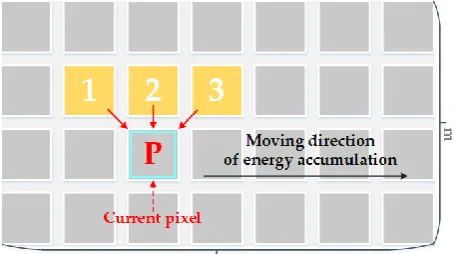
The energy criterion in the Duplaquet’ method only considers the horizontal and vertical
127
gradients, and compares the pixels in three adjacent directions near the current pixel, as shown in
128
Figure 1. P is current pixel, m, n respectively present the pixel width and height of the overlapping
129
area. When the overlapping area has dense high-rise buildings or tall trees, the seam-lines output
130
from the Duplaquet algorithm are likely across the edge of the buildings due to the inconsistent
131
deformation from image point to the roof point. Therefore, it is easy to find the dislocations in the
132
stitched image leading to a large matching error (as in Figure 2).
133
134
Figure 1.The schematic diagram of Duplaquet’s energy criterion.
135
136
Figure 2. The stitching results using the Duplaquet method for two datasets. (a) The experimental
137
result with UAV images shot in Wuhan; (b) The experimental result with UAV images shot in Paris.
138
As shown in Figure 2. There are two experimental results based on the Duplaquet’ method. The
139
seam lines across the houses are prone to ghosting and dislocation in stitched images. In addition,
140
some researchers believe that the energy function is poorly fitted, making it difficult to find the
141
optimal seam-line. For this reason, these researchers attempt to modify the energy function in
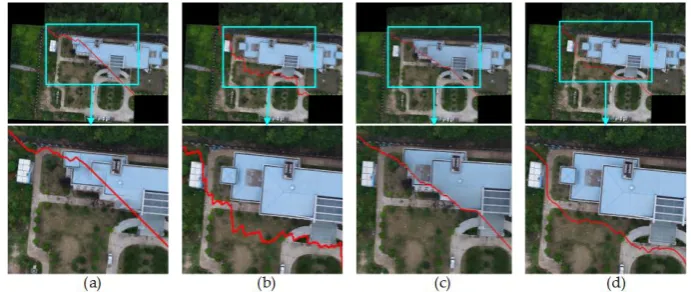
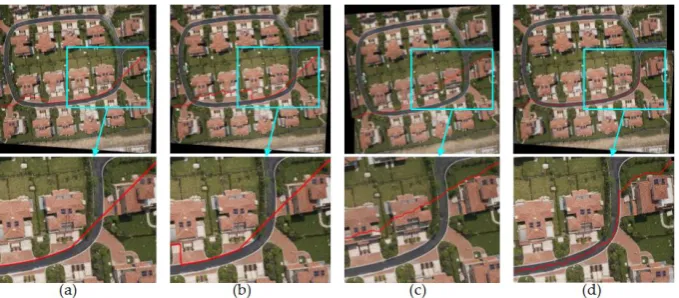
142
dynamic programming; however, they overlook the optimality of the corresponding model. This also
143
the Duplaquet’ method cannot guaranteed to obtain the best seam-line by using the classical Sobel
145
operator to calculate the approximate gradient of the pixels based on the horizontal and vertical
146
templates (Formula 2) without considering diagonal directions in the calculation process [29]. Figure
147
3 is a simulation demonstration of the best seam-line search results under different methods. The red
148
seam-line represents the result of Duplaquet’s method, it not only crosses the edge of the houses, but
149
also deviates from the ideal seam-line.
150
(2)
Specifically, the method of Duplaquet has the following main problems: (1) The gradient
151
guidance direction of the energy function does not support omnidirectional searching. (2) The energy
152
function is direction-dependent; the energy aggregation considers only three directions, and the
153
direction of energy traversal is limited from left to right, as well as from top to bottom. (3) The energy
154
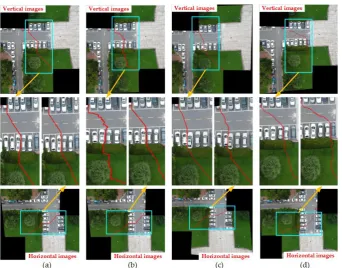
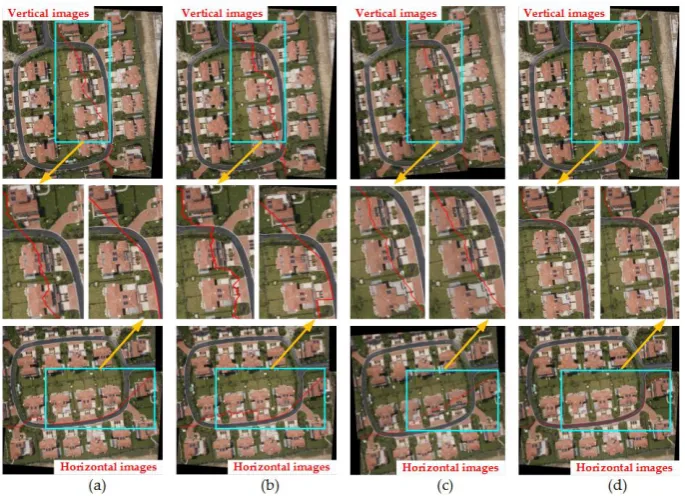
function easy to get a local optimal solution due to the impact of the two factors mentioned above.
155
This will directly lead to the optimal seam-line susceptible to dense buildings.
156
157
Figure 3. The sketch map of search results for best seam-lines.
158
3.3. Our method
159
We developed a new dynamic programming method for UAV image stitching using optical flow.
160
The proposed method searches seam-lines by improving gradient guidance direction, energy
161
accumulation directions (energy aggregation direction, energy traversal direction), and the optical
162
flow value of the pixels in the overlapping area are taken into account.
163
3.3.1. Gradient Calculation
164
The Duplaquet method only considers the horizontal and vertical gradient in the energy
165
criterion; it often fails to obtain the optimal seam-line. In order to solve this problem, we develop a
166
new gradient operator based on the classical Sobel operator, by considering eight directional
167
neighborhood information of current pixel and the similarity of its surrounding structure [30]. The
168
new approach of gradient calculation is as follows:
169
(3)
In order to solve the direction-dependent problem in energy accumulation, we introduce a new
171
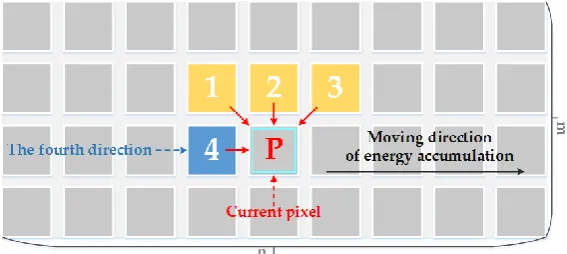
direction in our algorithm, as shown in Figure 4. The algorithm resolves the problem of seam line
172
deviation from the true seam line with an improved strategy of energy aggregation. As shown in
173
Figure 3, the improved purple seam-line 2 is a simulation demonstration result by introduce the
174
fourth direction in energy accumulation. It closer to the ideal seam-line than the red seam-line 1,
175
despite its obvious insufficiency.
176
177
Figure 4. A Schematic diagram of energy accumulation by improving energy guidelines.
178
Not only the directions of energy aggregation, but also the directions of energy traversal affect
179
the optimal solution of the energy function. Therefore, we redefined the energy criterion and added
180
the new aggregate directions to our dynamic programming algorithm with a stereo dual-channel
181
energy accumulation strategy. It improves the searching scheme of optimal seam line based on
182
energy accumulation. As shown in Figure 5, there is a schematic diagram of our optimal seam-lines
183
search strategy, which optimizes the seam-line search criteria by detecting the eight pixels (contain
184
the horizontal direction) surrounding the current pixel.
185
186
Figure 5. Schematic diagram of our search strategy.
187
In Figure 5, P is the current pixel. We redefine the nine related directions surrounding P as
188
follows: 0 (initial invalid direction), 1 (top-left of P for energy channel 1), 2 (top of P for energy channel
189
1), 3 (top-right of P for energy channel 1), 4 (left of P for energy channel 1), 5 (top-left of P for energy
190
channel 2), 6 (top of P for energy channel 2), 7 (top-right of P for energy channel 2), 8 (right of P for
191
energy channel 2). Seam-line searching is an aggregation process of minimum energy. Each
seam-192
line consists of neighborhood pixels with smallest energy value. In our method, the longest seam line
193
is the optimal seam line.
194
3.3.3. Calculation of Optical Flow Value of Pixels in the overlapping Area
195
In this paper, in order to better take into account the image structure information in the
196
overlapping area of the adjacent images, we use the optical flow value of pixels in the overlapping
197
area as a constraint condition for the construction of seam-line energy function. According to Section
198
2 mentioned, this paper will use a dense optical flow method for optical flow calculation. The H-S
199
calculate [25]. The pixel displacement in the overlapping area can be calculated by H-S method.
201
Formula (4) is its objective function.
202
(4)
203
In formula (4), Eflow is the value of optical flow, u and v is the displacement in the x and y axis
204
directions. T is the reference image, I is the current image. λ is a weight factor.
205
3.3.4. The Energy Function
206
Based on the analysis of the theoretical model, we constructed a mathematical abstract
207
expression of the theoretical model. Assuming that image f1 and image f2 are an original image pair
208
to be stitched, the energy function is defined as follows:
209
(5)
In formula (5), B(x, y) determines whether the current pixel P (x, y) is in the boundary of the
210
overlapping area, when B(x, y) =1, it means that it is not in the boundary region, and when B(x, y) =
211
10, it is in the boundary region. δ(*) is the Gaussian smoothing term, which uses the information in
212
the local window to enhance the local influence of the current pixel. f1(∙), f2(∙) are pending images to
213
be stitched. O is the overlapping area. d(*) represents the gradient function of one of the eight
214
directions. N(x, y) is the energy value of the invalid area, which is the constant term, and the value is
215
100 times larger than the maximum value of O. Eflow(x, y) is the optical flow constraint item.
216
3.3.5. Computation Procedure
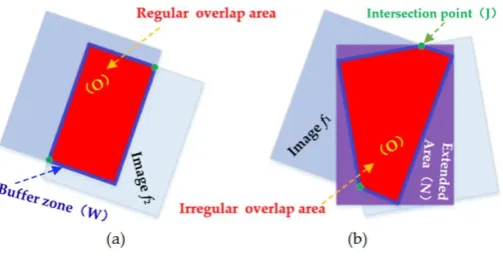
217
Because the overlapping area of adjacent UAV images is often irregular, in order to facilitate the
218
calculation, that need to be handled properly. As Figure 6 shows, the irregular overlapping area is in
219
Figure 6(b), it can be extended to a regular area by using the minimum exterior rectangle of the
220
overlapping area. let’s say that the overlapping area is m * n.
221
222
Figure 6. Processing principle of irregular overlapping area: (a) Regular overlapping area; (b)
223
Irregular overlapping area.
224
The image energy matrix is E, it can be calculated by formula (5). The algorithm procedure is as
225
follows:
226
○1 Extract the corresponding points from the adjacent images in order to correct the left and
227
right pending matching images to the virtual unified reference image, so that images are in the same
228
coordinate system.
229
2
2 2 2 2
,
min flow( , ) ( , ) ( , ) x y x y
u v E u v T x y I x u y v u u v v dxdy
1 2 1 2
0 7 0 7
( , ) ( , )
( , ) ( , )
( , ) (| ( , ) ( , ) |) max ( ( , )) ( ( , ))
( , ) ( , )
k k
k k
x y O x y O
flow
x y O x y O
E B x y f x y f x y d f x y d f x y
○2 Define the overlapping area of the adjacent images to be O, the buffer area of O boundary is
230
W (set its width is 20 pixels, and W is an empirical value, the invalid area is N (extend area), and the
231
boundary intersection J.
232
○3 calculation and filled O, W, N according to formula (3), where W Є [1, 10], the closer to the
233
boundary, the larger the value is, and set N = 100 * max (O), J = −1000 * max (O). At the same time,
234
the optical flow item can be calculated by formula (4).
235
○4 Fill the energy matrix E according to the results of ○3.
236
○5 Reestablish two energy aggregation channels: the C1 and C2 matrices, which have the same
237
size as E; each pair of corresponding elements in these two matrices hold two scalar numbers
238
representing the current aggregation value and the current path direction of the seam-line.
239
○6 For the first row of the matrices C1 and C2 assigned with the first row of E as the initial value,
240
and set them corresponding direction as zero.
241
○7 The energy aggregation channel matrices start to make a difference from the second row,
242
which are divided into two aggregation processes from left to right and from right to left. For the
243
energy aggregation channel C1, its aggregation process is from the left to the right; the current pixel
244
only considers the directions of 1, 2, 3, 5, 6, 7and 4. For the energy aggregation channel C2, its
245
aggregation process is from the right to the left, and the current pixel only considers the directions of
246
1, 2, 3, 5, 6, 7, and 8.
247
○8 When the aggregation is finished, the minimum energy value are found from the last row in
248
C1 and C2 respectively, and then an optimal stitching path is found based on the direction
249
information stored in the matrixes.
250
In order to ensure that the seam-lines start and end at the intersection points, we select two
251
special intersection points that have the smallest energy value (see that in ○3 ), so that the seam-lines
252
can be guided and adsorbed.
253
4. Experiments and Analysis
254
4.1. Experimental Environment and Data
255
To verify the effectiveness of our method (Our-flow-DP), we not only utilized the UAV images
256
from different regions with different flight altitudes and cameras, but also compared the
257
experimental results with the classic Duplaquet’s dynamic programming method using three search
258
directions (Duplaquet3-DP), dynamic programming method based on Duplaquet using four search
259
directions (Duplaquet3-DP), and the dynamic programming methods from OpenCV (OpenCV-DP).
260
In this paper, we used Visual C++ based on OpenCV open source library to program the proposed
261
improvement method. The experimental images are divided into four groups; among them, the data
262
in Figure 7(a) were acquired by Canon IXUS 220HS (Canon, Oita, Japan) in Paris, the height of the
263
UAV was approximately 250 m. The data in Figure 7(b) were acquired by DJ-Phantom4 (DJ,
264
Shenzhen, China) at Wuhan University Square, the height of the UAV was approximately 115 m. The
265
data in Figure 7(c) were acquired by DJ-Phantom4 (DJ, Shenzhen, China) at Hongshan district of
266
Wuhan city, The data in Figure 7(d) were acquired by ILCE-QX1 (Sony, Chonburi, Thailand) in
267
Jiashan county, China, the height of the UAV was approximately 150 m. The experimental computer
268
environment is Windows 7 operating system, CPU: Intel (R) Core (TM) i7-4790, RAM: 32 GB. Figure
269
271
Figure 7. Four groups of experimental UAV images: (a) The first image pair; (b) The second image
272
pair; (c) The third image pair; (d) The fourth image pair.
273
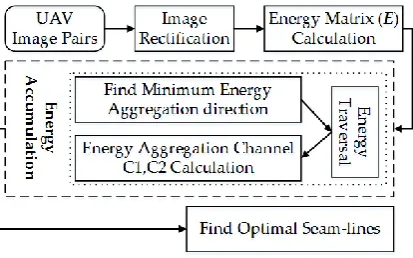
274
Figure 8. A flow chart of our method.
275
4.2. Experimental Results Analysis
276
4.2.1. Comparison of Stitching Results with Four Groups of Image Pairs
277
In order to verify the effectiveness of our proposed method, the methods of Duplaquet3-DP,
278
Duplaquet4-DP, OpenCV-DP, and Our-Flow-DP were used to search the optimal seam-lines of image
279
pairs in Figure 7 with irregular overlapping areas. Figures 9-12 are the respective results. It can be
280
seen from Figures 9-12 that the optimal seam-lines are obviously different with the four test methods.
281
From the local zoom view of Figures 9-12, we can find that the optimal seam-lines searched by
Our-282
Flow-DP are basically following along the road direction, which avoid the ground buildings, this will
283
greatly reduce the probability of dislocation and ghosting because of image geometric errors. The
284
other three methods not only place the seam-lines across the edges of houses, but also presents a
285
ghosting phenomenon. Especially in Figure 9, the other three methods have poor stitching effects due
286
to the dense distribution of buildings and the large changes in height. Furthermore, there was a
287
289
Figure 9. The seam-lines of different search methods for Figure 7(a): (a) Dulapquet3-DP; (b)
290
Dulapquet4-DP; (c) OpenCV-DP; (d) Our-Flow-DP.
291
292
Figure 10. The seam-lines of different search methods for Figure 7(b): (a) Dulapquet3-DP; (b)
293
Dulapquet4-DP; (c) OpenCV-DP; (d) Our-Flow-DP.
294
295
Figure 11. The seam-lines of different search methods for Figure 7(c): (a) Dulapquet3-DP; (b)
296
298
Figure 12. The seam-lines of different search methods for Figure 7(d): (a) Dulapquet3-DP; (b)
299
Dulapquet4-DP; (c) OpenCV-DP; (d) Our-Flow-DP.
300
4.2.2. Comparison of Four Methods under the Condition of Image Rotation
301
Firstly, the images in Figure 7 were rotated from the horizontal to the vertical. Then, we used the
302
four methods to search the optimal seam-lines for vertical and horizontal images respectively. Figure
303
13-16 show the results of them. In Figure 13, 15, 16, the partially enlarged pictures illustrated that the
304
optimal seam-lines searched by Our-Flow-DP had basically no change before and after rotation, they
305
always were good at avoiding the ground building and tall trees in the overlapping areas of adjacent
306
images. In Figure 14, our seam-lines changed a little, but they were less affected by the cars and tall
307
trees in the overlapping area, and the directions and movements of the seam-lines basically stayed
308
the same. In contrast, the seam-lines of the other three methods all crossed the edges of the buildings
309
in different places before and after rotation, and the directions and movements of the seam-lines have
310
an obvious changed in Figure 13, 15, 16. In Figure 14, the seam-lines of Duplaquet4-DP is more
311
susceptible to tall trees than Duplaquet3-DP and OpenCV-DP. From the above results analysis,
Our-312
Flow-DP is more direction independent than the other three methods, and it can best avoid houses
313
and tall trees for the best seam-lines searching when there are a large number of buildings and tall
314
tress distribution in the images, this is crucial for finding the most suitable seam-lines for adjacent
315
images. Therefore, due to the specific improvements to the above issues of dynamic programming
316
mentioned in Section 2.3, our method has advantages in adaptability and robustness for different
317
UAV images. The minimum value of our energy function is almost no relationship to the direction of
318
energy aggregation and traversal, and it can better take into account the structural information of the
319
321
Figure 13. The seam-lines of four search methods for Figure 7(a): (a) Dulapquet3-DP; (b)
Dulapquet4-322
DP; (c) OpenCV-DP; (d) Our-Flow-DP.
323
324
Figure 14. The seam-lines of four search methods for Figure 7(b): (a) Dulapquet3-DP; (b)
Dulapquet4-325
327
Figure 15. The seam-lines of four search methods for Figure 7(c): (a) Dulapquet3-DP; (b)
Dulapquet4-328
DP; (c) OpenCV-DP; (d) Our-Flow-DP.
329
330
Figure 16. The seam-lines of four search methods under different situations for Figure 7(d): (a)
331
Dulapquet3-DP; (b) Dulapquet4-DP; (c) OpenCV-DP; (d) Our-Flow-DP.
332
4.2.3. Efficiency Comparison of Our Energy Accumulation Processing
333
In the previous experimental results, our method found the most satisfying seam-lines.
334
Since Our-Flow-DP is based on the classical Duplaquet method, this section will compare the
335
energy accumulation time efficiency of Duplaquet3-DP, Duplaquet4-DP and Our-Flow-DP.
336
Firstly, we assumed that Our-Flow-DP, Duplaquet3-DP and Duplaquet4-DP could find the same
337
optimal seam-lines. Their time efficiency difference can be quantitatively analyzed from the
338
method’ complexity. In this paper, the direction of energy aggregation form three aggregation
339
directions increased to eight is mainly an improvement. setting that the time complexity of the
340
Dulapquet3-DP is O(z3), the time complexity of the Dulapquet4-DP is O(z4) and Our-Flow-DP
is O(z8), where z is the total number of pixels within the minimum exterior rectangle of the
342
overlapping area, z can be expressed as the product ofm andn, mis the width of the minimum
343
exterior rectangle and n is the length of the minimum exterior rectangle. Both m and n are
344
measured by unit pixel. However, because the local energy minima exists in the energy function
345
of the Duplaquet3-DP and Duplaquet4-DP, their results in a lot of time consumption. Therefore,
346
the above assumption is invalid, that is to say: they can not get the same optimal seam-lines.
347
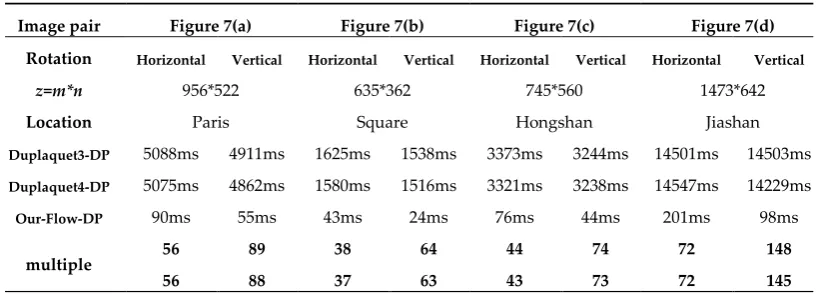
We selected four experimental image pairs in Figure 7 to verify the above conclusions. In
348
order to speed up the calculation, it is generally necessary to zoom the image at a certain scale.
349
So, the size of the overlapping area is not same to the size of the original image overlapping area.
350
The experimental results can be seen in Table 1. The efficiency of our method is more than
37-351
148 times that of the other three methods. It proved the convergence speed of our energy
352
function is faster than others. In addition, it is further point out that the theory and the results of
353
the proposed method are obviously different with the classic Duplaquet method. The theoretical
354
improvement and experimental comparisons have proven that this paper proposed a global and
355
non-direction optimization method, which not only has the best seam-lines, but also has better
356
time efficiency.
357
Table 1. Time efficiency comparison of energy accumulation processing
358
359
5. Conclusions
360
This paper analyzed and evaluated the current mainstream stitching algorithms for the
361
problems of ghosting, dislocation, and seams in UAV image stitching firstly.Then, it selected the
362
essential problems of dynamic programming algorithms for seam line searching, and carried out a
363
detailed theoretical study and a large number of UAV image stitching experimental verifications. At
364
last, this paper developed a new dynamic programming method using optical flow to search the
365
optimal seam lines through several improved key problems of the classical Duplaquet method.
366
Meanwhile, the superiority and efficiency of the method proposed in the paper are verified by the
367
credible experiments of four image pairs with irregular overlapping area. The stitched results are
368
better than the contrast methods. The proposed method is proved to be direction-independent, more
369
efficient, and more robust. However, there are still some problem with our proposed method, we can
370
see in Figure 14. In the future, we will continue to improve our existing deficiencies to achieve a more
371
perfect and robust method of rapid UAV image stitching.
372
Acknowledgments:This study is supported by the national Key Research and Development Program
373
of China (2016YFB0502202), the NSF (91638203), the China Postdoctoral Science Foundation
374
(2017M622520), the Postdoctoral Science Foundation of Hubei (2017Z1), and the State Key Laboratory
375
Research Expenses of LIESMARS.
376
Author Contributions: W.Z. and M.L. proposed the methodology and wrote the paper; X.B. and X.L.
377
conceived and designed the experiments; Y.Y., X.X., T.W. and W.L. performed the experiments..
378
Conflicts of Interest: The authors declare no conflicts of interest.
379
Image pair Figure 7(a) Figure 7(b) Figure 7(c) Figure 7(d)
Rotation Horizontal Vertical Horizontal Vertical Horizontal Vertical Horizontal Vertical
z=m*n 956*522 635*362 745*560 1473*642
Location Paris Square Hongshan Jiashan
Duplaquet3-DP 5088ms 4911ms 1625ms 1538ms 3373ms 3244ms 14501ms 14503ms
Duplaquet4-DP 5075ms 4862ms 1580ms 1516ms 3321ms 3238ms 14547ms 14229ms
Our-Flow-DP 90ms 55ms 43ms 24ms 76ms 44ms 201ms 98ms
multiple 56 89 38 64 44 74 72 148
56 88 37 63 43 73 72 145
References
380
[1] Chen S.; Laefer D.; Mangina E.; Mangina E. State of Technology Review of Civilian UAVs[J].
381
Recent Patents on Engineering, 2016, 10(3): 160-174.
382
[2] Byrne J.; Keeffe E.; Lenon D.; Laefer D. 3D reconstructions using unstabilized video footage from
383
an unmanned aerial vehicle. 2017, 15(3): 1-15.
384
[3] LI, D.; Li, M. Research advance and application prospect of unmanned aerial vehicle remote
385
sensing system, Geomatics and Information Science of Wuhan University. 2014, 39(5): 505-513.
386
[4] Sun H, Li L, Ding X, et al. The precise multimode GNSS positioning for UAV and its application
387
in large scale photogrammetry, Geo-spatial Information Science. 2016, 19(3): 188-194.
388
[5] Zhang, W.; Li, M.; Guo, B.; Li, D.; Guo, G. Rapid texture optimization of three-dimensional urban
389
model based on oblique images, Sensors. 2017, 17(4): 911-916.
390
[6] Li, M.; Li, D.; Fan D. A study on automatic UAV image mosaic method for paroxysmal disaster,
391
International archives of the photogrammetry, remote sensing and spatial information science.
392
2012, B6: 123-128.
393
[7] Wang, W.; Michale, K. A variational approach for image stitching, SIAM J. on Imaging Science.
394
2013, 6(3): 1318-1344.
395
[8] Tao, M.; Johnson, M.; Paris, S. Error tolerant image compositing, International Journal of
396
Computer Vision. 2013, 103(2):178-189.
397
[9] Levin, A.; Zomet, A.; Peleg, S. Seamless image stitching in the gradient domain. European
398
Conference on Computer Vision, Prague, Czech Republic, 2004.
399
[10] Zomet, A.; Levin, A.; Peleg, S.; et al. Seamless image stitching by minimizing false edges, IEEE
400
Transactions on Image Processing. 2006, 15(4): 969-977.
401
[11] Dijkstra, E. A note on two problems in connexion with graphs, Numerische Mathematik. 1995,
402
1(1): 269-271.
403
[12] Davis, J. Mosaics of scenes with moving objects, IEEE Computer Society Conference on
404
Computer Vision & Pattern Recognition, Santa Barbara, USA, 1998.
405
[13] Chon, J.; Kim, H.; Lin, C. Seam-line determination for image mosaicking: A mismatch and the
406
global cost, ISPRS Journal of Photogrammetry and Remote Sensing, 2010, 65(1): 86-92.
407
[14] Zhang, J.; Sun, M.; Zhang, Z. Automated seamline detection for orthophoto mosaicking based on
408
ant colony algorithm, Geomatics and Information Science of Wuhan University. 2009, 34(6):
675-409
678.
410
[15] Gracias, N.; Mahoor, M.; Negahdaripour S.; et al. Fast image blending using watersheds and
411
graph cuts, Image and Vision Computing. 2009, 27(5): 597-607.
412
[16] Bielski, C.; Grazzini, J.; Soille, P. Automated morphological image composition for mosaicking
413
large image data sets, IEEE International Geoscience and Remote Sensing Symposium,
414
Barcelona, Spain, 2007.
415
[17] Soille, P. Morphological image compositing, IEEE Transactions on Pattern Analysis and Machine
416
Intelligence, 2006, 28(5): 673-683.
417
[18] Andrew, B.; John, R. Thinking in perspective critical essays in the study of thought processing.
418
[19] David, H.; Edward, R. Electronic spatial sensing for the blind: contributions from perception.
420
Springer, 1985.
421
[20] Gibson, J. The perception of the visual world. Houghton Mifflin, 1950.
422
[21] Beauchemin, S.; Barron, J. The computation of optical flow. ACM New York. 1995.
423
[22] David, J.; Weiss, Y. Optical flow estimation. Springer, 2006.
424
[23] John, L.; David, J.; Beauchemin, S. Performance of optical flow techniques, Journal of Computer
425
Vision. 1994, 12: 43-77.
426
[24] Lucas, D.; Kanade, T. An iterative image registration technique with an application to stereo
427
vision, Proceeding of Imaging Understanding Workshop. 1981, 120-131.
428
[25] Horn, P.; Schunck, G. Determining optical flow, Artificial Intelligence. 1981, 185-203.
429
[26] Xu, J.; Yuan, F.; Kou, Y. An image mosaic method based on the seamline and dynamic datum,
430
Bulletin of Surveying and Mapping. 2014, 9: 34-37, 42.
431
[27] Bellman, R. On a routing problem, Quarterly of applied mathematics, 1958, 16(1): 87-90.
432
[28] Duplaquet, L. Building large images mosaics with invisible seam-lines, Proceedings of SPIE,
433
1998, 3387: 369-377.
434
[29] Gonzalez, R.; Woods R. Digital image processing, 3nd edition. Beijing: Publishing House of
435
Electronics Industry, 2011.
436
[30] Cheng, X. Research on fast produce of orthophoto with UAV sequence images, Wuhan