ISSN (Print) : 2320 – 3765 ISSN (Online): 2278 – 8875
I
nternational
J
ournal of
A
dvanced
R
esearch in
E
lectrical,
E
lectronics and
I
nstrumentation
E
ngineering
(An ISO 3297: 2007 Certified Organization)
Website: www.ijareeie.com
Vol. 6, Issue 6, June 2017
Power Maximization of a Photovoltaic System
Using Automatic Solar Panel Tracking along
with Boost Converter and Charge Controller
with Software Control
Manojkumar Singh, Dr. Harikumar Naidu, Prof. Pratik Ghutke
PG Student, Department of EE, TGPCOE, Nagpur, India
H.O.D, Department of EE, TGPCOE, Nagpur, India
Assistant Professor (Guide), Department of EE, TGPCOE, Nagpur, India
ABSTRACT: Photovoltaic (PV) cell converts part of the solar energy into electrical energy. The remaining part is converted into heat. This module maximizes the efficiency and increases the life of battery. In this proposed solar panel tracking system ,we have used dual full bridged driver L298 for both the motor tracking and elevation instead of using two no’s of IR2112 IC which reduces the complexity as well as size of the circuit. The energy will be stored in the battery of 12V. Here, the use of LDR sensor for maximum tracking of the solar panel. If its fails automatically then we can control it through laptop/PC.
KEYWORDS: Full bridge driver L298, IR2112, LDR sensor.
I. INTRODUCTION
Solar energy is a valuable form of energy, which has the potential to meet a significant proportion of world energy needs. The major applications of solar energy include solar thermal and solar photovoltaic systems. Solar collectors are designed IO generate thermal energy, however, photovoltaic cell produces electricity directly from solar energy. During photovoltaic energy conversion, thermal energy is also generated which results increase in cell temperature. This is well known fact that the efficiency of PV cells drops as the temperature of cell increases. In several PV panels the heat is removed by heat sinks and is dissipated to the surrounding atmosphere. Another
approach to solve this problem is to cool the PV cells by means of water or anther fluid, thus keeping certain operating temperatures within limits to achieve higher cell efficiency. Many regions of the world suffer from severe shortages of rain and
surface water such as the area of Hail in Saudi Arabia. It depends on underground aquifers for their daily supply. Traditional pumping and irrigation systems, employing diesel engines and electric grid
ISSN (Print) : 2320 – 3765 ISSN (Online): 2278 – 8875
I
nternational
J
ournal of
A
dvanced
R
esearch in
E
lectrical,
E
lectronics and
I
nstrumentation
E
ngineering
(An ISO 3297: 2007 Certified Organization)
Website: www.ijareeie.com
Vol. 6, Issue 6, June 2017
II. PROPOSED WORK
This Project proposes a microcontroller based single axis automatic solar panel tracking control method for keeping the solar panel approximately at right angle with the incident photon for the better performance and maximize the output power of the solar panel. The charge controller with the DC-DC boost converter is used along the automatic tracking system for further enhancing output power under variable isolation conditions and protecting the battery from being overcharged and over discharged condition. The Boost converter is used to overcome the lower output voltage of solar panel for not fulfilling the minimum charging voltage requirement of the battery thus more power extraction is possible from the solar panel to battery. The system includes a photovoltaic array, three LDRs sensor, a PWM controlled Boost converter, charge controller and sensor circuits. This paper discusses the low cost implementation of the whole system in the 8-bit microcontroller using the tools and techniques to generate optimized real time code in C for PIC controller which will demonstrate how maximization of power output is visible and efficient solution for increasing the efficiency of a solar system based on experimental results rather than on mathematical models.
Fig. Block diagram of proposed system
III. DESCRIPTION OF BLOCK
i. PIC Controller PIC16F886:
PIC is a family of modified Harvard architecture microcontrollers made by Microchip Technology. It has Separate code and data spaces (Harvard architecture) also a small number of fixed length instructions. Most instructions are single cycle execution (2 clock cycles, or 4 clock cycles in 8-bit models), with one delay cycle on branches and skips. One accumulator (W0), the use of which (as source operand) is implied (i.e. is not encoded in the op-code). All RAM locations function as registers as both source and/or destination of math and other functions. A hardware stack for storing return addresses. A small amount of addressable data space (32, 128, or 256 bytes, depending on the family), extended through banking. Data space mapped CPU, port, and peripheral registers. ALU status flags are mapped into the data space. There is no distinction between memory space and register space because the RAM serves the job of both memory and registers, and the RAM is usually just referred to as the register file or simply as the registers.
ii. Dual Bridge Driver:
ISSN (Print) : 2320 – 3765 ISSN (Online): 2278 – 8875
I
nternational
J
ournal of
A
dvanced
R
esearch in
E
lectrical,
E
lectronics and
I
nstrumentation
E
ngineering
(An ISO 3297: 2007 Certified Organization)
Website: www.ijareeie.com
Vol. 6, Issue 6, June 2017
Fig. Internal Circuit of L298 Driver iii. Solar Panel:
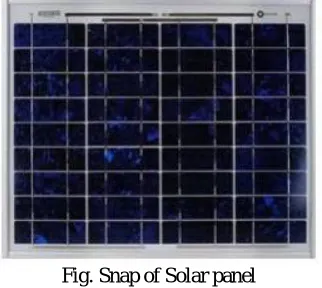
Solar modules provide the energy source to keep battery(s) charged. The number of modules needed depends on site specifics, such as geographic location in the country, site specific needs such as load demand, and available/access to the sun. Figure below is a photograph of a typical solar module. Solar electric modules convert the sun's energy into direct current (DC) electricity. The systems contain a matrix of high performance monocrystalline or multicrystalline modules. The Solar modules are securely attached to the pole with adjustable fasteners to enable tilt alignment to match the latitude at which the module is installed and horizontal adjustment for maximum tracking of the sun.
Fig. Snap of Solar panel
IV. EXPERIMENTAL SETUP & METHODOLOGY
In this proposed solar panel tracking system ,we have used dual full bridged driver L298 for both the motor tracking and elevation instead of using two no’s of IR2112 IC which reduces the complexity as well as size of the circuit. Moreover IR2112 is having low cost and lower power consumption, this L298 is beneficial. Initially the solar panel trap the sun rays and convert them into electrical energy. This energy will be stored in the battery of 12V.The microcontroller continuously monitor the both voltages PV voltage and battery voltage, and maintains the battery voltage almost constant all the time during operation by providing charging current to maintain its nominal voltage. This prevents battery from charging from overvoltage and under voltage. Thus the requirement of under voltage and over voltage protection relay is eliminated and battery voltage is maintain constant.
ISSN (Print) : 2320 – 3765 ISSN (Online): 2278 – 8875
I
nternational
J
ournal of
A
dvanced
R
esearch in
E
lectrical,
E
lectronics and
I
nstrumentation
E
ngineering
(An ISO 3297: 2007 Certified Organization)
Website: www.ijareeie.com
Vol. 6, Issue 6, June 2017
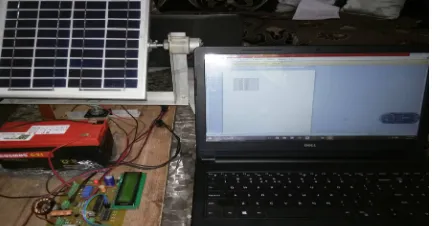
Fig. Hardware module of solar power automatic tracking system
Fig. Hardware module of solar power remotely control tracking system with database saving
V. RESULTS
The experimentation of module done on 25th june 2017 and based on environment situation got the following results for few duration of time.
ISSN (Print) : 2320 – 3765 ISSN (Online): 2278 – 8875
I
nternational
J
ournal of
A
dvanced
R
esearch in
E
lectrical,
E
lectronics and
I
nstrumentation
E
ngineering
(An ISO 3297: 2007 Certified Organization)
Website: www.ijareeie.com
Vol. 6, Issue 6, June 2017
VI. CONCLUSION
By implementing this project, battery continuously receive the charge as it required. Thus a constant battery voltage can be maintained.It can also be controlled through remotely connected PC/Laptop. The real time datacan be continuously monitored and saved for future reference.
REFERENCES
1) M. A. Farahat zagazig university, zagazig, egypt “improvement the thermal lectric performance of a photovoltaic cells by cooling and concentration techniques” IEEE xplore.
2) I. M. Abdel-Halim, H. G. Named and M. A. Al- Ahmar, “Effect of Cell Temperature on The Performance of a hotovolatic Generator I DC Motor System”, Sixth Middle-East Power System Conference (MEPCQN 98), Mansoura niversity, Mansoura, Egypt, Dec. 15-17, 1998, pp. 706 - 710. 3) Ioulia T. Papaioannou, Minas C. Alexiadis, Charis S. Demoulias Member, IEEE, Dimitris P. Labridis
Senior Member, IEEE, and Petros S. Dokopoulos Member, IEEE “Modeling and Measurement of Small Photovoltaic Systems and Penetration Scenarios”. IEEE 2009.
4) Weidong Xiao, Student Member, IEEE, William G. Dunford, Senior Member, IEEE, Patrick R. Palmer, Member, IEEE, and Antoine Capel “Regulation of Photovoltaic Voltage” IEEE TRANSACTIONS ON INDUSTRIAL ELECTRONICS, VOL. 54, NO. 3, JUNE 2007
5) Chihchiang Hua , Chihming Shen “Study of Maximum Power Tracking Techniques and control of DC/DC Converters for Photovoltaic Power System” IEEE 1998.