Resource - Use Efficiency: An Application of Stochastic Frontier
Production Function to Plantain Farmers in Ogun State, Nigeria
Okoruwa V. O.; Sowunmi, F. A.; Ogundele, F. O.; Omigie, C. O Department of Agricultural Economics, University of Ibadan, Ibadan, Nigeria.
Corresponding Author’s email address: [email protected]
Abstract
This study assessed the resource-use efficiency of plantain farmers in Ogun State, Nigeria using the stochastic frontier production function analysis. Primary data were collected from 160 plantain farmers in Abeokuta zone of Ogun State Agricultural Development Programme (OGADEP). The mean efficiencies values for plantain production were 0.835, 0.675 and 0.721 for technical, allocative and economic efficiencies respectively. The return to scale value showed that plantain production was at stage of decreasing positive return to scale. The study also revealed the presence of inefficiency in the resource-use among plantain farmers in the study area (p < 0.05). The distribution of results also showed that the plantain farmers were more efficient in the use of some inputs. Changing the input combinations was observed to increase farm level efficiency. The farmers in the study area therefore need to use available input intensively so as to reduce current inefficiencies significantly.
Keywords: Food security, Plantain farmer, Allocative efficiency, Stochastic frontier, Technical efficiency JEL: D24, D61, Q10
1.0 Introduction
The major challenge facing Nigeria today is that of feeding her teeming population. The challenge remains that of self-sufficiency in food production (Dare, 2008; CBN, 2005). According to Balogun (2001), food insecurity problem is a serious issue in Nigeria and other African countries. The problem of food insecurity in Nigeria arises from the fact that food production is still being carried out largely on subsistence level, with the use of primitive farm implements, increasing population, poor post harvesting technology, lack of proper storage and processing facilities/industries in the country (Dare, 2008). Food insecurity when combined with poverty status has been shown to have a negative and significant effect on Technical Efficiency (TE) in resource utilisation. Poor nutrition, as a result of food insecurity could dampen labour productivity within a household and by extension; low-income status can weaken access to and the efficient use of household resources (Chavas et al., 2005). World Bank survey in 2004 revealed that about 37 percent Nigerians are food insecure.
Studies (Akinseinde, 2006; Ogundari, 2006; Ojo, 2007) attributed the gap between food production and population growth in Nigeria to low productivity of resources being used and technology, arising from shortfall in the essential farm inputs, which necessitates the use of primitive tools. The resultant effect of low-level technology is low yield which is not enough to feed the teeming population; hence the increase in prices of food crops. Other factors accountable for low productivity of resources are poor implementation of government policies; high level of illiteracy among the rural dwellers, especially the farming population; poor quality of planting material and breeding animal stock; and poor pricing policy. Low productivity is also attributed to high poverty rate among food crop farmers. According to Akinyosoye (2005), farming is seen in Nigeria as a harbinger of poverty for most of the participants, particularly the subsistence farmers who barely make enough income to cater for their daily needs. The low productivity has continued to widen the gap between food production and population growth. To bridge this gap, World Bank report (1989), estimated that, agricultural production in Nigeria must grow by at least 4 percent a year. However, Federal Department of Agriculture (1993) proposed an estimated annual average food crops growth rate of 5.9 percent, as being necessary to meet domestic food demand and reduce importation significantly.
Moreover, Amaza and Olayemi (2002) identified low crop yield and productivity of resources utilized as the main constraints to rapid growth in food production in Nigeria. If resources are properly harnessed and efficiently allocated, increase in farmers output from the existing hectares of land being cultivated is achievable. Idiong (2007) noted that productivity of farmers in Nigeria could be raised either by adopting improved production technologies or through improved efficiency in resource utilization or both. He submitted that the low rate of adoption of improved technologies by farmers makes improved efficiency in resource utilization the best option for increased farmers’ productivity in the short-run.
Increase in the prices food crops may not only be attributed low productivity which is positively related to inefficiency in resource utilization, but to high cost of production (increase in cost of agricultural inputs and labour wage due to rural-urban migration) and removal of subsidies on most agricultural inputs. Uduma (2007) revealed that cost of labour account for as much as 60-75 percents of total cost of production. The way forward is to undertake studies on resource use efficiency on food crop production by focusing on food crops that could help mitigate food insecurity and poverty problem in Nigeria. Plantain, according to Schinzl (2003) and Tijani
(1993), is one of such food crops that could fulfill these requirements. This explains the choice of plantain for this study. Resource use efficiency study is in line with ongoing government Agricultural Transformation Agenda (ATA) that is centered on treating agriculture as business rather than development project as it was the case in the past (FMA&RD, 2012). This is in a way to bring about efficient utilization of resources in agriculture; thus moving away from subsistence to commercial farming that will bring about increased productivity and improved farmers’ wellbeing.
Plantain is a food crop believed to have the potential of mitigating the twin problems of food security and poverty. It is regarded as the second cheapest sources of energy after cassava, and having the least cost of production among food crops in terms of per hectare/kilogramme/1000 calories (per caput) (du-Montcel, 1987; Johnston, 1958). Plantain is important in the diet of many Nigeria families. In the urban areas, it is normally eaten in convenient forms like “Dodo” (fried ripe pulp), chip (fried unripe pulp) and as plantain flour (Akinwunmi, 1999). Plantain flour has an advantage over other starchy foods, because it contains protein, mineral and vitamins. Medicinally, it can be used to cure certain ailments like sore throats, tonsillitis, diarrhea and vomiting. Other important plantain products documented includes: Soymusa, “Sekete” local beer and “Boli” roasted plantain, as well as local processed form known as “Dodo Ikire”, a local plantain chips processed from over ripped plantain spiced with hot pepper (Idachaba, 1995; Adetunji and Adesiyan, 2008). In addition, plantain is being used in compounding livestock feeds as an alternative source of energy in some West Africa countries as Cameroon and Ghana (Fomunyam, 1992).
The two-third of the total estimated 12 million metric tons annual production of plantain in Africa comes from West Africa (INIBAP, 2003). Nigeria is regarded as the largest producer of plantain in West Africa, having an annual production of about 2.4 million metric tons. It is also noted that about 49% of farming households in Nigeria produce plantain as main crop (Nweke, 1996). The current level of plantain production in Nigeria has been inconsistent and low, thus allowing for home consumption and local trade but no export (Swennen, 1990; FOS, 1999). According to Echibiri (1996), plantain yield in Nigeria is as low as 15ton/ha as against 26t/ha production in Cameroon.
Despite the export potential and its capability of addressing problems of food insecurity and poverty, there is little literature (s)/studies on resource use efficiency in plantain production except the few ones on technical efficiency and management factors in Oyo state (Awotide and Adejobi, 2006; Awotide et al., 2005); hence, the need for this study. The choice of Ogun state is because of its climatic suitability for plantain production. From the foregoing, the research intends to fill the lacuna in literature on resource use efficiency in plantain production. The need for this research becomes imperative bearing in mind the need to address the problem of food insecurity and poverty. It is expected that the findings of this research will be useful not only to the farmers that are already into plantain production but also those that are planning to go into plantain production by ensuring efficient allocation of resources. The study is also expected to enhance the value chain of plantain production so that employment opportunities will be created in the areas of processing plantain into chips, flour among others as well as supply to eateries in urban centers.
2.0 Theoretical and analytical framework 2.1 Theoretical framework
The modeling, estimation and application of stochastic frontier (SF) production functions to economic analysis has assumed prominence in econometrics and applied economic analysis in the last two decades. Early application of SF to economic analysis include the pioneer seminal work of Farrell (1957), Aigner et al (1977), Meeusen and van de Broeck (1977), Battese et al. (1996), Battese and Corra (1977), Battese and Coelli (1995), Ajibefun and Abdulkadri (1999), Amaza and Olayemi (2002), Helfand (2003), Amos et al. (2004) among others. Much of the earlier empirical measure of production efficiency focused on imperfect, partial measure of productivity, such as yield per hectare or output per unit of labour (Coelli and Battese, 1996). The inherent shortcoming of this method earlier alluded to under theoretical framework provided Farrell (1957) with the impetus for developing a better method of measuring production efficiency, which was mathematical programming method.
Stochastic Frontier (SF) build hypothesized efficiency determinants into the inefficiency error components (Coelli and Battese, 1996), thus, it can simultaneously estimate all the parameters involved in the production function model. This means that SF accounts for random errors and has the advantage of making inference possible (Coelli et al, 2002). However, SF is sensitive to the choice of functional form and that when analyzing the technical and allocative parts of economic efficiency, a dual functional form (that is, Cobb-Douglas) has to be chosen (Johansson, 2005). This explains why Cobb-Douglas functional form is chosen for this study.
2.2 Analytical framework
Generalized log likelihood ratio test is used to evaluate the suitability or otherwise and significance of the adopted functional form, and model employed. It is equally used to affirm or otherwise the null hypothesis that socio-demographic characteristics and improved management practices have no effect on plantain producers’ (in) efficiency (that is, for the confirmation of the presence of inefficiency).
The functional form proposed and used by Ogundele and Okoruwa (2004), and Kareem et al (2008), following Aigner et al. (1977), is specified as:
{
-
ln
-
ln
( )
( )
ln
( )}
...
..(
1
)
i
ilnLi
lnX
2 i 2 1 ¶ el ¶ e p-
+
-
=
=
å
å
or{
LLF
(
Ho
)
LLF
(
Ha
)
}
2
-=
l
(Rezitis, et al., 2003) or ïî ï í ì þ ý ü -= ) Ha ( L ) Ho ( L ln 2 2c
(Battese, et al., 1993) Simply expressed as:[
]}
{
ln
L
(
Ho
)
(
Ha
)
2
)
Ha
(
L
)
Ho
(
L
ln
2
LR
=
-
-î
í
ì
þ
ý
ü
-=
(Ogundari et al, 2006)Log-likelihood LLF (Ho) and LLF (Ha) are the values of the log-likelihood function under the null and alternative hypotheses respectively. λ has asymptotic chi-square distribution or mixed chi-square distribution when the null hypothesis involves λ = 0 (Coelli, 1995), or γ = 0 (Ojo, 2007; Selim, 2007). This implies that there is no inefficiency effect in the production process; a situation that is ably described by Ordinary Least Squares (OLS) model in which there were restrictions.
LLF (Ha) represents the value of the likelihood function for Maximum Likelihood Estimation, in which there are no restrictions, that is, γ ≠ 0, or λ ≠ 0, indicating there was technical inefficiency in the production operations.
The implication of the above exposition is that, any variation in output, according to the OLS model, is due only to stochastic error, whereas, for the Maximum MLE model, variations in output are due to both technical inefficiency effects and random error, thus explaining the sophistication and preference of MLE to OLS in stochastic frontier analysis.
3.0 Methodology
The study was conducted in Ogun State which is located within the rainforest belt of the tropical region in Nigeria. The study covered Abeokuta zone of Ogun State Agricultural Development Programme (OGADEP), which is made up of five local government areas, namely: Abeokuta North, Abeokuta South, Ewekoro, Ifo and Odeda. Abeokuta North, Ewekoro, Ifo and Odeda Local Government Areas were actually considered for this study because of the suitability of their agroclimatic conditions for the cultivation of plantain. Primary data were collected from the population of plantain farmers in the study area. A three-stage sampling technique was used in selecting the respondents. In the first stage, purposive sampling was used to select only local government areas known for farming. Abeokuta south local government area was excluded because of its metropolitan nature. In the second stage, a purposive sampling was used to select seventeen villages that are known for the cultivation of plantain. In the third stage, twelve plantain farmers were randomly selected per village. A total of 204 questionnaires were administered and 160 were returned to time.
Descriptive and stochastic production frontier analyses were employed in this study. The descriptive technique involved the use of simple percentage and proportion/frequency table, mean, standard error and or deviation, among others to profile the characteristics of individual plantain farmers. The study employed a stochastic frontier production function of the type proposed by Battese and Coelli (1995). In this model, a production frontier defines output as a function of a given set of inputs, together with technical inefficiency effects, which define the degree to which plantain farmers fail to reach the frontier because of technical
inefficiencies of production. The model and its estimating form used in determining the effects of inputs on plantain output, as used by Ogundari and Ojo (2007); Umoh (2006); Alene and Hassan (2005) was specified in a linearized form as:
)
2
.(
...
...
U
V
X
ln
ln
Y
ln
i=
b
0+
b
jå
ij+
i-
i Where:Yi is plantain output from farm ith (Kg),
β0& βj are the vectors of parameters to be estimated,
Xi are the inputs used in plantain production,
Vi and Ui represent error term,
X1 represents farm size (Ha),
X2 represents total labour (Man-day),
X3 represents quantity of planting material used (Kg),
X4 represents quantity of fertilizer used (Kg) and
X5 is the volumes of agro-chemical used (Litres).
Total labour concept was used in this study because it was found out that aged farmers are in majority in the study area. The implication is that this group of farmers could not do much of farm work other than supervision and minor farm operation, hence, often time labour are hired. Moreover, in order not to get wrong TE estimate, farm tools expressed in monetary term were omitted as variable. It is important to know that Technical efficiency function (a production model, dealing with physical inputs and output) does not reckon with variable expressed in monetary term. Some of the studies by Nigerians (Amaza and Maurice, 2005; Ogundari and Ojo, 2007; Idiong, 2006; Udoh and Etim, 2007; Ajewole and Folayan, 2008) reviewed in the course of this study, used wrong variable specification in regards to production function by mixing physical value with monetary value of some variables. Also, the number of plantain suckers bought and planted is used as proxy for quantity of planting materials.
Technical Efficiency (TE) of individual farmer, as specified by Ogundari and Ojo (2007); Umoh (2006); Alene and Hassan (2005) is expressed as:
)
3
...(
...
e
)
U
exp(
V
exp
)
,
X
(
f
U
V
exp
)
,
X
(
f
Y
Y
TE
Ui i i i i i i i i i -*b
=
-
=
-b
=
=
The Allocative Efficiency (AE) of individual farmer as specified by Ogundari and Ojo (2007) is expressed as:
)
4
...(
)...
U
exp(
C
Ci
AE
i i=
=
*Economic efficiency (EE) estimated from the Farell (1957) formula specified as:
...(5)
AE...
x
TE
EE
=
To identify the sources of these efficiencies/inefficiencies, which according to Bravo-Ureta and Pinheiro (1997), can be done by investigating the relationship between farm/farmer (socio-demographic) characteristics and the computed TE, AE and EE indices separately. This is aimed at identifying socio-demographic factors affecting production efficiency or possible sources of production inefficiency (ies) in plantain production in the study areas. The inefficiency model that was used is specified thus:
)
6
....(
...
...
e
Z
U
i=
d
0+
d
iå
ij+
i Where:Ui represents the efficiency effect of the ith farm,
δo & δj represent the parameters to be estimated,
Zij represents the vector of socio-economic factors,
ei represents the disturbance term,
Z1 represents the age (years);
Z2 represents the gender (1 = Male; 0 = Female);
Z3 represents the household size;
Z5 represents the experience in plantain production (Yrs);
Z6 represents the off-farm/non-farm activities (1 = If engaged in either or both; 0 = Otherwise);
Z7 represents the extension Contact (1 = respondent had extension contact; 0 = Otherwise);
Z8 represents the access to credit facility (1 = Access to credit; 0 = Otherwise);
Z9 represents the improved management practice (1 = Use of fertilizer and or pesticide; 0 = Otherwise)
and Z2, Z6… Z9 represent the dummy variables.
The error terms in equation (7) are Vi and Ui. The first component of error term, Vi, is a two-sided
conventional random error term that is independent of Ui and assumed to be normally distributed with constant
variance and mean of zero (i.e. N ~ (0,σ2v)). This component is supposed to capture statistical noise (i.e.,
measurement error) and random exogenous shocks such as bad weather and diseases that disrupt production. The second component, Ui, is also a random variable but, unlike Vi, it is only a one-sided variable taking
non-negative values. This term captures technical inefficiency of an urban crop farm in producing output (Osawe et al., 2008).
The following research hypotheses were tested in order to realize the objective of the study. (i) Ho: γ = 0 (Plantain farmers are not resource use inefficient)
H1: γ ≠ 0 (Plantain farmers are resource use inefficient)
(ii) Ho: The functional form (production) used for the analysis is not appropriate.
H1: The functional form (production) used for the analysis is appropriate.
Results and discussion 4.1 Descriptive statistics
Table 1 shows the socio-demographic characteristics of plantain farmers in the study area. The table reveals that majority (49.4%) of the plantain farmers’ falls within the age bracket of 46 – 60years. Also, majority of the respondents are married (87.50%), while male dominates plantain production in the study area (70%). This implies that women in the study area probably considered plantain production too strenuous, hence they engaged in other activities such as processing and marketing along its value chain. The table also shows that most of the respondents (42.5%) had primary school education while 23.8% had no formal education. This indicates low level of education among the plantain farmers in the study area. This might have affected the productivity of the farmers in the study area bearing in mind positive relationship between farmers’ education and productivity as revealed by studies (Reimers and Klasen, 2011; Das and Sahoo, 2012; Awolola, 1991). According to Tijani (2008), low literacy level will not only discourage farmers from adopting new technology but also make it difficult for such farmer to understand and evaluate information on new techniques of farming. However, the negative effect of low level of education may be attributed to few plantain farmers (11.3%) embracing improved management practices. The study reveals that 40% of respondents in the study area had between 11 and 20 years’ experience in plantain production with an average of 16.4years. According to Rougoor et al. (1998) and Tijani (1993), farming experience serves as an indication of the practical knowledge a farmer acquired through trial and error, which will enhance his production efficiency.
More than half of the respondents (53.8%) engaged off/non-farm activities to complement poor returns from their plantain farming. This may not be unconnected with low productivity as a result of inefficiency in resources allocation among other problems of agricultural production in the study area.
Table 1: Socio-demographic characteristics of plantain farmers in Ogun state
Variables Frequency Percentage (%)
Age (Years): 16-30 31-45 46-60 >60 Average age: 48.8yyears Sex: Male Female Marital Status: Married Widow/Widower Divorced Household size: 1-5 6-10 >10
Educational Status (Years): Informal Primary JSS/Modern SSS Tertiary Experience (Years): 1-10 11-20 21-30 >30
Land Acquisition Methods: Inheritance Rent/Lease Purchase Variety of Plantain: Local Hybrid Both 8 51 79 22 112 48 140 16 4 65 91 4 38 68 26 22 6 50 64 27 19 48 66 46 96 28 36 5.0 31.9 49.4 13.8 70.0 30.0 87.5 10.0 2.5 40.6 56.9 2.5 23.8 42.5 16.3 13.8 3.8 31.3 40.0 16.9 11.9 30.0 41.3 28.8 60.0 17.5 22.5
4.2 Summary statistics of estimated models variables
Summary statistics of the variables used for the stochastic function analysis is presented in table 2. The average output of plantain per farmer per year is 919.91kg/ha (1.08ton/ha) with an average of 55.2man-day of labour. This output is below 5-7ton/ha recommended by FAO (2006) for Nigeria. The average farm size of 0.85 ha is above 0.69ha recorded by Amujoyegbe (2012) in forest agroecological zone.
Table 2: Summary statistics of variables of the estimated stochastic production model
4.3 Determinants of plantain output
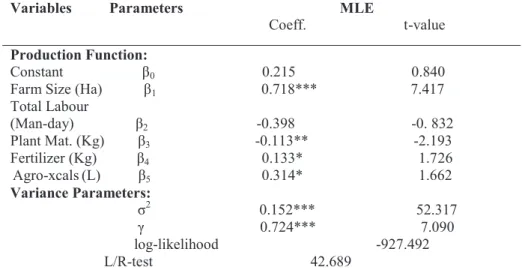
Table 4 shows the estimated coefficients of the production function and their corresponding levels of statistical significance. Four (farm size, quantity of fertilizer, and agrochemical used and quantity of planting material) out of the five variables used in the model are significant. Specifically, farm size, quantity of fertilizer and agrochemicals used showed a positive causal relationship with plantain output. Contrary to a priori expectation, the coefficient of planting material showed a negative relationship with plantain output.
The maximum likelihood estimation (MLE) of the frontier function revealed that s2 and γ are
significant at 1 percent level. The significance of s2 shows the presence of inefficiency effects and random error in plantain production in the study area. The gamma value shows that 72% of the variability in the output of plantain farmers that are unexplained by the function used. This may be attributed to technical inefficiency and random error. The significance of gamma estimate indicates that it is different from one, meaning that the frontier is stochastic (Ajewole and Folayan, 2008).
Table 3 presents the results of null hypotheses, the first being on the appropriateness of the functional form for the estimation of the parameters, while the second hypothesis address the presence of (technical and cost) inefficiency.
Table 3: Generalized likelihood ratio-tests Null Hypotheses L (H0) L (Ha) LR χ2 (7, 5%) Decision
βi = 0 -948.84 -927.49 -0.046 12.59 Accept Ho
γ = 0 0.72 42.69 12.59 Reject Ho
The result affirmed that the functional form (production) used is appropriate for the analysis (p > 0.05). The second hypothesis tested indicates the presence of inefficiency in the use of resources among plantain farmers in the study area (p < 0.05). This calls for concerted effort to see that the problem of inefficiency in the resource – use in plantain production is addressed through policy interventionbased on identified problems.
Output/Input Variables Minimum Maximum Mean
Standard Deviation
Average Revenue (N) 71,500 656,134 385,008.62 238895.7
Average Output per Farmer
(kg) (Q) 130 4205 919.91 767.78
Average Farm Size (Ha) (X1) 0 5 0.85 1.09
Total labour (Man-day)(X2) 15.00 123.00 55.16 24.37
Quantity of planting material
(Kg) (X3) 0.00 180.00 23672.50 20599.38
Quantity of fertilizers used
(Kg) (X4 0.00 650.00 113.22 107.72
Volumes of agro-chemical
Table 4:Maximum likelihood estimate of the stochastic production function for plantain production in Ogun state, Nigeria
Variables Parameters MLE
Coeff. t-value Production Function:
Constant β0 0.215 0.840
Farm Size (Ha) β1 0.718*** 7.417
Total Labour (Man-day) β2 -0.398 -0. 832 Plant Mat. (Kg) β3 -0.113** -2.193 Fertilizer (Kg) β4 0.133* 1.726 Agro-xcals(L) β5 0.314* 1.662 Variance Parameters: σ2 0.152*** 52.317 γ 0.724*** 7.090 log-likelihood -927.492 L/R-test 42.689
Note: ***Significant at 1 percent, **Significant at 5 percent and *Significant at 10 percent. 4.4 Production elasticities and return to scale
Production elasticities indicate the percentage change in output relative to a percentage change in inputs, if other things are held constant. From the nature of the Cobb-Douglas production function fitted, the regression coefficients which is also known to be the estimated parameters of each variable in table 4 is the elasticity of production of the variables.
The estimated elasticities of the explanatory variables show (see table 4) that the farm size, quantity of fertilizer, and agrochemical used and quantity of planting material are positive decreasing functions to the factors, indicating that the variable allocation are in the stage of economic relevance of the production function. The elasticity of planting material used is -0.113. This means that the output of plantain will decrease by 113 percent for every percent increase in planting material. This result, though not expected but an increase in planting material by farmer that is not backed by improved managerial ability may lead to reduction in plantain production. Also the elasticity of quantity of fertilizer and volume of agrochemicals used are 0.133 and 0.314 respectively. All things being equal, this means that one percent increase in quantities of fertilizer and agrochemicals used is expected to raise plantain production by 133percent and 314percent respectively.
Returns to scale (RTS), which is the sum of the coefficients of independent variables (elasticity of production), is shown in table 5. The table reveals RTS of 0.654. This value implies that plantain production in the study area is in stage II of production where production increases at decreasing rate.
Table 5: Elasticity of Production and Returns to Scale Variables Elasticity
Farm Size (Ha) 0.718 Total Labour (Man-day) -0.398 Planting Material (Kg) -0.113 Quantity of Fertilizer used (Kg) 0.133 Vol. of Agro-chemical used (Ml) 0.314 RTS 0.654
Hence, it is advisable, according to Ogundari and Ojo (2007) that production units should maintain current levels of input utilisation, as this will bring about maximum output from a given level of output, ceteris paribus. 4.5 Determinants of resource-use efficiency in plantain production
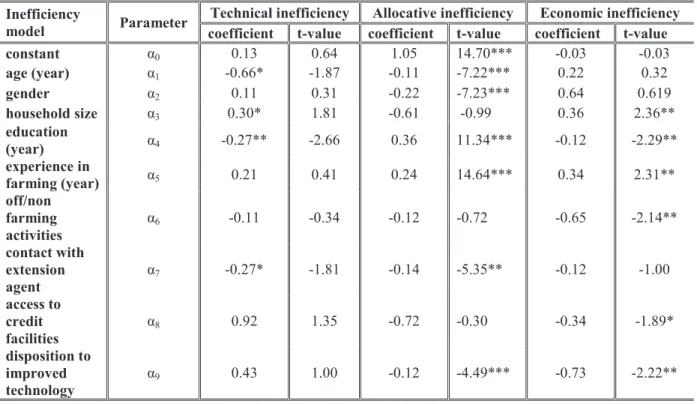
Measure of resource use involves the estimation of technical, allocative and economic efficiency. This was done and the results generated showing the determinants of technical, allocative and economic (in) efficiency are presented in table 6. For technical inefficiency, the coefficients of age (p<0.10), household size (p<0.10), education (p<0.05) and extension contacts (p<0.10) are significant, while only with household has positive coefficient. For the allocative inefficiency model, age, gender, education, experience, extension and improved management are the significant (p<0.01) factors at 1% levels; education and experience positively related to allocative inefficiency. For economic inefficiency, coefficients of education, experience, off/non-farm,
credit and improved management are negatively significant (p<0.05). It is only the coefficient of household size that is positively related to economic inefficiency (p<0.05).
Furthermore, the coefficient of age (year) is negatively related to technical (p<0.10) and allocative (p<0.01) inefficiencies. While the negative relationship between age and allocative inefficiency is in agreement with Okoye et al. (2006) findings, the negative relationship between age and technical inefficiency conforms to Dimelu, et al, (2009) findings. The means that both technical and allocative inefficiencies would reduce as farmers’ age increases. That is, as plantain farmers’ advance in age, inefficiency in resource use decreases and technical efficiency increases, there output is expected to be closer to production frontier. This is contrary to previous findings that as farmers advance in age they tend to be averse to adoption of improved technology, as they would be less energetic to work and would tend to misallocate resources (Ogundari and Ojo, 2007; Idiong, 2005; Ajibefun and Aderinola, 2004). Ike and Inoni (2006) also affirmed that labour productivity decreases with age because of the arduous nature of farm operations, hence aged farmers do not often show willingness to adopt new practices which could raise their overall level of efficiency. Moreover, the positive coefficients (significant) of household size for both technical and economic inefficiencies imply that the inefficiencies increase as household size increases. However, according to Dimelu et al, (2009), large household size serves a ready source of labour for most farm operations. However, this may not be the case where a large proportion of household member are children.
The coefficient of education was found to be negatively related (p<0.01) to technical and allocative inefficiencies. This means, that increase in year of schooling reduces technical inefficiency or it is a factor for increased technical efficiency (Dimelu et al, 2009), whereas it could lead to increase in allocative inefficiency of the farmers. The import of this finding is that plantain farmers with more years of schooling tend to be more technically efficient, presumably due to their ability to acquire technical knowledge or respond promptly to the use of improved technology, such as fertilizer application, use of pesticides and so on, thus making them move close to the frontier output (Amaza and Maurice, 2005). Simply put, education enhances the acquisition and utilisation of information on improved technology by the farmers, as well as their innovativeness (Idiong, 2007). Increased farming experience, according to Khai et al. (2008), may lead to better assessment of importance and complexities of good farming decision, including efficient use of inputs. Table 6 shows that there is a positive relationship between farming experience (year) and allocative (p<0.01) and economic (p<0.05) inefficiencies. These results are in agreement with Khai et al. (2008) findings, meaning that allocative and economic inefficiencies increased with increased years of farming experience. This suggests that older plantain farmers are less efficient, and that being an experienced farmer is not enough to significantly make a farmer to attain higher level of efficiency (Idiong, 2007).
Table 6: Determinants of technical, allocative and economic inefficiencies
Note: ***significant at 1 percent, **significant at 5 percent and *significant at 10 percent Inefficiency
model Parameter
Technical inefficiency Allocative inefficiency Economic inefficiency coefficient t-value coefficient t-value coefficient t-value
constant α0 0.13 0.64 1.05 14.70*** -0.03 -0.03 age (year) α1 -0.66* -1.87 -0.11 -7.22*** 0.22 0.32 gender α2 0.11 0.31 -0.22 -7.23*** 0.64 0.619 household size α3 0.30* 1.81 -0.61 -0.99 0.36 2.36** education (year) α4 -0.27** -2.66 0.36 11.34*** -0.12 -2.29** experience in farming (year) α5 0.21 0.41 0.24 14.64*** 0.34 2.31** off/non farming activities α6 -0.11 -0.34 -0.12 -0.72 -0.65 -2.14** contact with extension agent α7 -0.27* -1.81 -0.14 -5.35** -0.12 -1.00 access to credit facilities α8 0.92 1.35 -0.72 -0.30 -0.34 -1.89* disposition to improved technology α9 0.43 1.00 -0.12 -4.49*** -0.73 -2.22**
The negative sign of farm income coefficient (p<0.05) indicates that any increase in off/non-farm income will result in decrease in economic inefficiency. This may be due to the opportunity such activities afford the farmers to get fund for use on their plantain farms since it is generally difficult for farmers to source for credit. Coefficient of extension contact is negatively correlated with technical (p<10) and allocative (p<0.01) inefficiencies. This result conforms to earlier findings by Ajewole and Folayan (2008) and Obwona (2006). It implies that, farmers that had more extension contact through visitation tend to be less inefficient. Extension contact is known to enhance efficiency through better management and provision of up-to-date information for farmers. This fact is attested to by the negative relationship between coefficient of improved management practices and allocative (p<0.01) inefficiency on one hand and economic (p<0.05) inefficiency on the other hand. The importance of this result is that, as plantain farmers embrace improved technologies it is expected that allocative and economic inefficiencies reduce.
Also, the coefficient of credit accessibility is negatively related to economic inefficiency (p<0.10). The result indicates that as farmers get access to more credit coupled with extension contact, the better efficient they will be. This is because such credit accessibility will enable farmers to make timely purchase of necessary inputs to enhance their production.
4.6 Frequency distribution of farm-specific efficiency levels
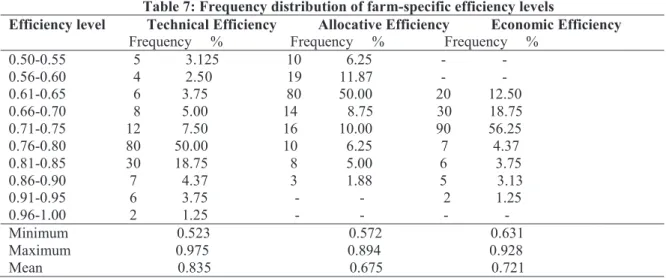
The frequency distribution of technical, allocative and economic efficiency, as shown in table 7, revealed that the predicted farm specific efficiency range between 0.52 and 0.98 with a mean of 0.84 for technical efficiency (TE); 0.57 and 0.89 with a mean of 0.68 for the allocative efficiency (AE). The predicted farm specific economic efficiency (EE) ranged between 0.63 and 0.93 with a mean of 0.72.
Table 7: Frequency distribution of farm-specific efficiency levels
Efficiency level Technical Efficiency Allocative Efficiency Economic Efficiency Frequency % Frequency % Frequency %
0.50-0.55 5 3.125 10 6.25 - - 0.56-0.60 4 2.50 19 11.87 - - 0.61-0.65 6 3.75 80 50.00 20 12.50 0.66-0.70 8 5.00 14 8.75 30 18.75 0.71-0.75 12 7.50 16 10.00 90 56.25 0.76-0.80 80 50.00 10 6.25 7 4.37 0.81-0.85 30 18.75 8 5.00 6 3.75 0.86-0.90 7 4.37 3 1.88 5 3.13 0.91-0.95 6 3.75 - - 2 1.25 0.96-1.00 2 1.25 - - - - Minimum 0.523 0.572 0.631 Maximum 0.975 0.894 0.928 Mean 0.835 0.675 0.721
The allocative inefficiency contributed more to the short fall in plantain production between maximum possible (frontier) level of production and recorded output. Specifically, the result above indicates that 16.5%, 32.5% and 27.9% reduction in plantain production from maximum possible (frontier) output is attributed to technical, allocative and economic inefficiencies respectively.
Moreover, 68.8% of the farmers’ attained technical efficiency that ranges between 0.76 and 0.85, 61.9% attained allocative efficiency of between 0.56 and 0.65, while 87.5% of the farmers recorded an economic efficiency of between 0.61 and 0.75. The implication of this result is that most of the farmers fairly utilized and allocate existing resources in their area for good production.
5.0
ConclusionThe maximum likelihood estimates of the frontier production showed clearly that farm size, planting materials, farm tools, fertilizer and agro-chemicals are the most important inputs in plantain production. The stochastic frontier function estimated for the 160 respondents showed that the mean technical, allocative and economic efficiencies values are 0.835, 0.675 and 0.721. The return to scale value obtained from the study (0.754) showed that plantain production was at stage of decreasing positive return to scale (stage II), which is considered as the stage where resources allocation and production are believed to be efficient.
The study revealed that technical inefficiency is not so much a serious problem to the plantain production compared to allocative and economic inefficiencies. Specifically, allocative inefficiency was found to be negatively related to coefficients of age, gender and improved management practice. On the other hand the coefficients of educational level, off/on-farm, availability of credit and improved management practice were
found to be negatively related to economic inefficiency. This indicated that these factors led to decrease in allocative/economic inefficiency or increase in allocative/economic efficiency. The farm specific resource use efficiency distribution revealed that none of the farms reached the frontier threshold, implying that production could still be increased by 16%.
The elasticities of production for the inputs used are 0.718, -0.398, -0.113, 0.133 and 0.314 for farm size, total labour, quantity of planting material, quantity of fertilizer used and volume of agrochemical used respectively. These low values of below 1, point to relative inelastic response. The farmers could intensify more on the use of fertilizer/agrochemical for more output in plantain.
Stakeholders in plantain production such as the research institution, extension agents, and food processing industries that are making use of plantain should intensify effort in the area of sensitizing farmer with respect to the right level of input combinations that can improve efficiency level of plantain production in Nigeria. This is in order to benefit optimally from the suitability of agroclimatic condition for its production. In addition, the study has shown that extension service, availability of credit, age of farmer and educational level are important determinants of efficiencies in plantain production. The aging of plantain farmers call for serious attention from government by discouraging rural-urban migration through provision of basic infrastructural facilities in the rural area. Plantain farmers’ education should be taken with all seriousness in order to be able to derive maximum benefits from improved technologies. This is because, the appreciation and use of improved technologies of production and marketing increases with the level of education and awareness.
References
Adetunji, M. O. and Adesiyan, I. O. (2008): “Economic analysis of plantain marketing in Akinyele local government area in Oyo state, Nigeria.” International Journal of Agricultural Economics and Rural Development, vol. 1(1), pp. 15 - 21.
Aigner, D., Lovell, C. and Schmidt, P. (1977): “Formulation and estimation of stochastic frontier production function models.” J. Econometrics, vol. 6, pp. 21 - 37.
Ajewole, O. C. and Folayan, J. A. (2008): “Stochastic frontier analysis of technical efficiency in dry season leaf vegetable production among smallholders in Ekiti State, Nigeria.” Medwell Agricultural Journal, vol. 3(4), pp. 252 - 257.
Ajibefun, I. A. and Abdulkadri, O. A. (1999): “An investigation of technical inefficiency of production of farmers under the National Directorate of Employment in Ondo State, Nigeria.” Applied Economics Letters, vol. 6, pp. 111-114.
Akinseinde, A. A. (2006): “Non-farm activity and production efficiency of farm household in Egbeda Local Government Area of Oyo State.” Unpublished M.Sc. Dissertation, Agric. Econs. Department, University of Ibadan, Nigeria.
Akinwunmi, J. A. (1999): “Agricultural economics and marketing.” In Introduction to tropical agriculture. Longman Group Limited.
Akinyosoye, V. O. (2005): Government and agriculture in Nigeria: analysis of policies, programmes and administration. Macmillan Publishers Limited: Lagos, Nigeria.
Alasiri, K. O., Olaniyan, F. O. and Salami, A. (1998): “Growth and yield of plantain as influenced by the application of organic and mineral fertilizer.” Proceedings of the 16th Annual Conference of Horticultural Society of Nigeria, held at UNAAB, on 7th-10th September, 1998, pp. 181-185.
Amaza, P. S. and Maurice, D. C. (2005): “Identification of factors that influence technical efficiency in rice -based production systems in Nigeria.” A paper presented at a workshop on policies and strategies for promoting rice production and food security in sub-Saharan Africa, held in Cotonou (Benin), 7-9 November, 2005.
Amaza, P. S. and Olayemi, J. K. (2002): “Analysis of technical inefficiency in food crop production in Gombe State, Nigeria.” Applied Economics Letter, vol. 9, pp. 51-54.
Amaza, P.S., Onu, J. I., and Okunmadewa, F. Y. (2001): “Identification of factors that influence the technical efficiency of cotton farmers in Nigeria.” Agricultural development Studies, vol. 2(1), pp. 133 - 143. Amos, T. T., Chikwendu, D. O. and Nmadu, J. N. (2004): “Productivity, technical efficiency and cropping
patterns in the savanna zone of Nigeria.” Food, Agriculture and Environment 2 (2): 173 - 176.
Awolola, M. D. (nd): “Education and agricultural development in Nigeria.” Available www.unilorin.edu.ng/.../education/.../education_and_agricultu...
Awotide, D. O and Adejobi, A. O. (2006): “Technical efficiency and costs of production among plantain farmers in Oyo State, Nigeria.” Moor Journal of Agricultural Research, vol. 7(2), pp. 107-113.
Awotide, D. O., Rahji, M. A. Y., Adejobi, A. O. and Bamire, A. S. (2005): “Technical efficiency and management factors in plantain production in humid forest zone of Nigeria: A simulation analysis.” SAJEMS, vol. 8(2), pp. 238-245.
Awoyinka, Y. A and A. E. Ikpi (2005): “Economic evaluation of farm income and technical efficiency of resources in industrial sugarcane production in Jigawa state, Nigeria.” Journal of Rural Economics and Development, vol. 14(2), pp.1-20.
Balogun, E. D. (2001): “Resuscitating agricultural production for exports.” Retrieved on 28/01/2006 from http://www.cenbank.org/out/publications/ocassional
Banker, R. A., Cooper, C. W., and Maindratta, A. (1988): “A comparison of DEA and translog estimates of production frontier using simulated observation from a known technology.” In: Dogramaci, A. and R. Fare (Eds.), Application of Modern Production Theory to Efficiency and Productivity. Boston, Kluwer. Battese, G. E. and Corra, G. S. (1977): “Estimation of a Production Frontier Model: With Application to the
Pastoral Zone of Eastern Australia.” Australian Journal of Agricultural Economics, vol. 21, pp. 169-179.
http://dx.doi.org/10.1111/j.1467-8489.1977.tb00204.x
Battese, G. E., Malik, S. J. and Broca, S. (1993): “Production functions for wheat farmers in selected districts of Pakistan. An application of a stochastic frontier production with time varying inefficiency effects.” The Paskistani Devt. Review, vol. 32 (3), pp. 233-268.
Battesse, G. E and Coelli, T. J. (1995): “A model for technical inefficiency effect in stochastic frontier production for panel data.” Empirical Economics, vol. 20, pp. 325 -345.
Battesse, G. E. (1992): “Frontier production functions and technical efficiency: A
Battesse, G. E., Malik, S. J., and Gil, M. A. (1996): “An investigation of technical inefficiencies of production of wheat farmers in four district of Pakistan.” Journal of Agricultural Economics, vol. 47, pp. 37 - 49. Bravo-Ureta, B. E. and Rirger, L. (1991): “Diary farm efficiency measurement using
Bravo-Ureta, B.E and Pinheiro, E. A. (1997): “Technical, economic and allocative efficiency in peasant farming: evidence from the Dominican Republic.” The Developing Economics, vol. 35(1), pp. 48 - 67.
Central Bank of Nigeria (2005): CBN/NBS Joint Survey. Annual Report and statement of account for the year ended 31st December.
Central Bank of Nigeria. 2004. “Annual Report and Statement of Accounts, for the year ended 31stDecember.” CBN Publication.
Chavas, J. P., Petrie, P., and Roth, M. (2005): “Farm household production efficiency: evidence from the Gambia.” American Journal of Agricultural Economics 87(1):160-179.
Coelli, T. and Battese, G. (1996): “ Identification of factors which influence technical inefficiency of Indian farmers.” Australian J. Agri. Econs., vol. 40, pp.103-128.
Coelli, T. J. (1995): “Recent development in frontier modeling and efficiency measurement.” Australian J. Agri. Econs., vol. 3, pp.219-245.
Coelli, T. J., Rao, P. and Battese, M. (1998): An introduction to efficiency and productivity analysis. Norwell, Massachusetts: Kluwer Academic Publishers.
Coelli, T., Rahman, S. and Thirtle, C. (2002): “Technical, allocative, cost and scale efficiencies in Bangladesh rice cultivation: a non-parametric approach.” Journal of Agricultural Economics, vol. 53, pp. 607-626. Dare, A. 2008. “Assessment of food security situation in Ado-Ekiti, Ekiti state.” Unpublished M.Agric.
Department of Agricultural Economics and Farm Management, University of Agriculture, Abeokuta. Das, A. B. and Sahoo, D. (2012): “Farmers' educational level and agriculture productivity: a study of tribals of
KBK districts of Odisha”. International Journal of Education Economics and Development (IJEED), vol. 3(4).
Dimelu, M.U., Okoye, A.C., Okoye, B. C., Agwu, A. E., Aniedu, O. C., and Akinpelu, A. O. (2009): “Determinants of gender efficiency of small-holder cocoyam farmers in Nsukka agricultural Zone of Enugu State, Nigeria.” Scientific Research and Essay 4(1): 28-32.
du-Montcel, T. H. (1987): Plantain/Banana. Macmillan Publishers Ltd., London and Basingstoke, in collaboration with CTA, The Netherland.
Echibiri, T. O. (1996): “Plantain and Banana Production in Imo State.” In Plantain and Banana: Production and Research in West and Central Africa (R. Ortiz and M.O. Akoroda, eds., pp. 61-62). Proceeding of a regional workshop held at High Rainfall Station, Onne, Rivers State, Nigeria. Organised by IITA, Ibadan, Nigeria.
FAO (2006): “Food and Agriculture Organization. Production Yearbook 2004.” FAO, Rome.
FAOSTAT. (2004 & 2005): “An FAO online statistical data base.” Accessed from htpp://www.fao.org/dorcep/stat, on the 24/08/2005.
Farrell, M. J. (1957): “Measurement of Productive Efficiency.” J. Royal Statistical Soc. Series, vol. 3, pp. 253-290.
Faturoti, B.O., Madukwe, M. C., Tenkouanoand, A., and Agwu, A. E. (2007): “A review of policy acts and initiatives in plantain, and banana system in Nigeria.” African Journal of Biotechnology, vol. 6(20), pp. 2297-2302.
Federal Department of Agriculture (1993): “A workshop on food security and Nigeria agriculture: A national agenda.” Organised by FDA of the Federal Ministry of Agriculture, Water Resources and Rural Development, Abuja, Nigeria.
Federal Ministry of Agriculture and Rural Development (FMA&RD) (2012): Agricultural Transformation
Agenda: Repositioning agriculture to drive Nigeria’s economy. Presentation by Dr. Akinwumi Adesina,
Honourable Minister of Agriculture and Rural Development, November, 2012 Federal Office of Statistics. FOS. 1999. Annual Abstract of Statistics. Lagos.
Fomunyam, R. T. (1992): “Economic aspects of banana and plantain use in animal feeding: the Cameroon experience. In: Roots, tubers, plantain and banana in animal feeding.” FAO, Rome, Italy.
Food and Agriculture Organisation (2005): Special programme for food security: agenda 21. United Nations Conference on Environment and Development. Rome.
Idachaba, F. S. (1995): “Food policy in Nigeria toward a framework analysis.” Agricultural Research Bulletin, vol.77(1).
Idiong, I.C.2007. “Estimation of farm level technical efficiency in small-scale swamp rice production in Cross River State, Nigeria: A stochastic frontier approach.” World Journal of Agricultural Science, vol. 3(5), pp. 653-658.
Ike, P.C., and Inoni, O.E.2006. “Determinants of yam production and economic efficiency among small-holder farmers in southeastern Nigeria.” Journal of European Agriculture, vol. 7(2), pp. 337-342.
International Institute of Tropical Agriculture (IITA-Project Portifolio, 2008). “Project-E-1: Productive plantain system.” Accessed from www.google.com on the 11/08/2008.
International Network for the Improvement of Banana and Plantain (INIBAP) (2003). Annual report 2002. Montpellier, France. 24pp.
International Network for the Improvement of Banana and Plantain (INIBAP) (2000). Organic banana 2000: Towards an organic banana initiative in the Caribbean, (M. Holderness, S. Sharrock, E. Frison and M. Kairo, eds.). Report of the International workshop on the production and marketing of organic bananas by smallholder farmers, held between 31 October-4 November 1999, at Santo Domingo, Dominican Republic.
Johansson, H. (2005). Technical, allocative, and economic efficiency in Swedish dairy farms: the data envelopment analysis versus the stochastic frontier approach. Poster background paper, In XIth International Congress of the European Association of Agricultural Economists (EAAE), Copenhagen, Denmark, August 24-27, 2005, 17p.
Johnston, B. F. (1958): The staple food economies of western tropical africa. FRI Stanford University.
Kareem, R. O., Dipeolu, A. O., Aromolaran and Williams, S. B. (2008): “Economic efficiency in fish farming: Hope for agro-allied industries in Nigeria.” Chinese Journal of Oceanology and Limnology, vol. 26 (1), pp. 104-115.
Khai, H. V., Yabe, M., Yokogawa, H. and Sato, G. (2008): “Analysis of productive efficiency of soybean production in the Mekong River Delta of Viet Nam.” J. Fac. Agr. Kyushu Univ., vol. 53 (1), pp. 271-279. Meeusen, V., and van den Broeck, J. (1977): “Efficiency estimation form cobb-douglas production function
with composed error. Int. Econ. Rev., vol.18, pp. 435 - 444.
Nweke, F. (2004): “New challenges in the cassava transformation in Nigeria and Ghana.” EPTD Discussion Paper No.118, IFPRI, Washington, D.C., USA.
Obwona, M. (2006): Determinants of technical efficiency differentials amongst small-and medium-scale farmers in Uganda: A case of tobacco growers. African Economic Research Consortium Research Paper 152. Nairobi, Kenya.
Ogun State Agricultural Development Programme (OGADEP) (2002) Annual report. Abeokuta, Nigeria. Ogundari, K. and Ojo S. O. (2007): “Economic efficiency of small food crop production in nigeria: a stochastic
frontier approach.” J. Soc. Sci., vol. 14(2), pp. 123-130.
Ogundari, K. and Ojo, S. O. (2006): “An examination of technical, economic and allocative efficiency of small farms: the case study of cassava farmers in Osun State of Nigeria.” Journal of Central European Agriculture, vol. 7(3), pp. 423-432.
Ogundele, F.O. and Okoruwa, V. O. (2004): “A comparative analysis of technical efficiency between traditional and improved rice variety farmers in Nigeria.” African Journal of Economic Policy, vol. 11(1), pp. 91-108.
Ojo, S.O. (2007): “Improving efficiency in food crop production for food security in Nigeria.” Medwell Online Agricultural Journal, vol. 2(1), pp. 9-15.
Okoye, B.C., Onyenweaku, C. E. and Asumugha, G. N. (2006): “Allocative efficiency of small-holder cocoyam farmers in Anambra State, Nigeria.” MPRA Paper No. 17362. Accessed from http://mpra.ub.uni-muechen.de/17362/
Osawe, O. W., Akinyosoye, V. O. and Omonona, B. T. (2008): “Technical efficiency of small scale farmers: An application of the stochastic frontier production function to fish farmers in Ibadan metropolis, Oyo state, Nigeria.” Journal of Economics and Rural Development, vol. 16(1), pp. 71 – 82.
paper/rd/2001/owe-01-9.pdf
Rezitis, A. N., Tsiboukas, K. and Tsoukalas, S. (2003): “Investigation of factors influencing the technical efficiency of agricultural producers participating in farm credit programs: The case of Greece.” Journal of Agricultural and Applied Economics 35(3): 529-541.
Rougoor, C. W., Trip, G., Huirne, R. B. M., and Renkema, J. A. (1998): “How to define and study farmers’ management capacity: theory and use in agricultural economics.” Agricultural Economics, vol. 18, 261-272.
Schinzl, N. (2003): “Plant biotechnology: The future for sustainable banana and plantain production in Africa.” Accessed from www.scienceinafrica.co.za, on the 22nd April, 2008.
Selim, S. (2007): “Labour productivity and rice production in Bangladesh.” Cardiff Economics Working Papers E2007/10. Accessed from www.cardiff.ac.uk/carbs, on the 17th June, 2009.
stochastic frontiers and Neo-classical duality.” American Journal of Agriculture Economics, vol. 73(2), pp. 421-428.
survey of empirical application in agricultural economics.” Agricultural Economics, vol. 7, pp. 185-208.
Swennen, R. (1990): “Plantain cultivation under West Africa conditions: A reference manual.” IITA, Ibadan, Nigeria.pp.24.
Tijani, I. A. (1993): “Economics of plantain production in some parts of Irewole local government of Osun State.” Unpublished B.Sc. Dissertation. Department of Agric. Econs., University of Ibadan, Nigeria. Uduma, U. B. (2007): “Resource-use efficiency in Beniseed (Sesame) production in Nasarawa State, Nigeria.”
M. Agric. Post Data Seminar Presentation. Department of Agricultural Economics and Farm Management, University of Agriculture, Abeokuta, Nigeria.
Umoh, G.S. 2006. “Resource use efficiency in urban farming: An application of stochastic frontier production function.” International Journal of Agriculture & Biology, 8 (1): 38-44.