RESEARCH ARTICLE
Choose the Appropriate Cluster Head for Decrease Energy Consume
in Wireless Sensor Networks Based on Gravitational Emulation Local
Search Algorithm
Mohammadreza Ramzannezhad Ghaleh1, Ali Asghar Rahmani Hosseinabadi2
1Department of Computer, Tamishan University Behshahr, Behshahr, Iran
2Young Researchers and Elite Club, Ayatollah Amoli Branch, Islamic Azad University, Amol, Iran
Abstract:New Wireless Sensor Networks (WSN), is the new generation of real-time embedded systems with limited
computation, energy and storage which have variety usage, especially when that is not possible using traditional networks. Given that, in this networks energy problem is important major challenge, using Clustering model can be considered as a solution to overcome this problem. In this instruction, sensor nodes grouped in a set of cluster and pick out a central node for Cluster Head (CH) node. Choose the appropriate cluster, reduce energy consumption in these networks, as a result increase networks lifetime. Hence, in this study, unlike previous studies, used Gravitational Emulation Local Search Algorithm (GELS), for clustering and select appropriate CH. This method is based on three descriptors of energy, dispersion and centrality of nodes, and simulations indicate, where the CH only selected based on local data set, significantly increase network lifetime.
Keywords:Wireless sensor networks (WSN), Clustering, Cluster head, Lifetime, GELS algorithm
1. Introduction
Wireless Sensor Networks (WSN) are consisting by hundreds or thousands nodes which randomly distributed in faraway or dangerous places. The main responsibility of these nodes is collect data from environment in which they are placed. In fact these nodes have ability to collect data from region that is not possible to get this information from other ways. Every sensor node includes a sensor unit, computing unit, memory unit and wireless communication unit with limited connection bandwidth unit[1, 21-35].
These networks have much benefit for military, medical, and living environment and etc. Changing power resource of these nodes is very difficult or often impossible, when the powers of these nodes are finished. Therefore, the main problem in designing WSN is decrease energy consumption to have longer network lifetime [2, 3]. The main responsibility of WSN is collecting data from environment their placed. Direct data transferring from resources to central node, is expensive and often impossible, because central node always far from resources, and sensor nodes have limited energy power. Hence, use multistep route for routing. Furthermore, there are nodes in route which always busy in data transferring. In other word, havoc and energy discharge and failure in nodes towards to increases. To overcome to this problem, use clustering method. In this structure sensor nodes grouped in some cluster and a central node pick out as Cluster Head (CH) node. Often CH node have energy more than normal nodes and task work of these nodes is collect data from other nodes and then send collected data to central station. If for any reason this node fails, such as increasing time, another CH should be selected[4].
Copyright © 2018 Mohammadreza Ramzannezhad Ghalehet al.
doi: 10.18063/wct.v2i3.744
This is an open-access article distributed under the terms of the Creative Commons Attribution Unported License
(http://creativecommons.org/licenses/by-nc/4.0/), which permits unrestricted use, distribution, and reproduction in any medium, provided the original work is properly cited.
All activities that have been conducted in this regard separated in two group: Frist group are only attention to energy parameter in order to choosing CH[5-8]which is not fine to use them in complex network, because, it might be possible a node with the high power placed in corner of area, and in this case, other nodes have to use more energy power for data transmit. In second group there are nodes that mention more parameters such as distance and movement[36-49]. In this study every node in order to network lifetime optimization knows these elements:
The energy status
Situation which is located.
Centrality of every node to it neighborhood.
Then due to use this information and based of gravitational force algorithm CH will be determined. The results indicate that propose method coin comparison to other algorithms, significantly increase networks lifetime[50-53].
The rest of the paper is organized as follows. Section 2 reviews related works on the subject covered in this paper. The GELS algorithm is introduced in Section 3. The evaluation of the proposed method and simulation results are presented in Section 4 and Section 5 respectively; and finally Section 6 concludes the paper.
2. Related Work
Due to being sensor networks useful, many studies in this case has been accomplished and as a result many clustering algorithms and CH selection has been developed, which can mentioned the following:
LEACH algorithm, which has been introduced in 2000. LEACH is a centrality protocol and self-organizing with dynamic grouping, which is use for randomly energy consumption balancing between nodes. In this case, nodes organized their self into local group and in these groups, one of nodes make responsibility of local station or cluster head. LEACH algorithm, until a specific nodes energy discharged, uses random principle rotation between powerful nodes. In this algorithm, every node, select a random number between 0-1 in every cycle, if random number be lower than standard limitation level, mentioned node choose for this cycle CH[7]. Standard limitation level (1) computed according to:
T n − p
1 − p ∗ r mod1p 0 otherwise
if n ∈ G (1)
P is the possibility of being cluster head, r is current round number, and G is all nodes that weren’t CH in 1/p. because, this algorithm only uses local data, have some problem as followed:
Due to the CH number in every cycle in not determined, it may number of CH in every cycle be different. CH possible placed in corner of area, therefore, other nodes should use more energy for communicate with this CH. Every node in every cycle, have to compute a random number and standard limit generation. LEACH-C algorithm is also a study in this case[6]. In this algorithm, also focus of work has been done. In intensive method all nodes send information to one node, and this node select CH according to collection data which this work causes more energy consumption.
AHP algorithm is one of other related studies[7]. In this algorithm, energy, movement and distance of one node to CH parameters has been mentioned. Work done as intensive and central station that, the node which makes final decision about cluster head.
3. The GELS Algorithm
In 1997, Guided Local Search Algorithm (GLS) algorithm was proposed by Voudouris and Tesang[9]to search and solve complex problems for the first time. In 2004, Webster[10] called this method GELS and was used as a powerful local search algorithm for solving complex problems. The main idea of GELS is based on gravitational force, which causes to attract objects with each other such a way that heavy object has higher gravitational force and attract low weigh objects. The attraction force between two objects depends on the distance between them.
In GELS algorithm, possible solutions in search space are divided to several categories according to their fitness's. Each of these categories named a dimension of the solution and there is initial velocity for them. Equation (2) computes the gravitational force between Current Solution (CU) and Candidate Solution (CA). This force (F) is added to velocity vector in the path of current motion. If velocity exceeds the maximum value (threshold), maximum velocity becomes the current velocity, and if the velocity becomes negative due to this force, the velocity is considered zero[11-14].
2
)
(
R
CA
Cu
G
F
(2)4. Proposed Method
In previous study, CH were distributed selected, therefore energy consumption in great, or selected intensive, because of a node make decision for the entire network, nodes traffic will be increase. Also if this node failed all of network failed by problem one. In this study, we have some step for reduce computation and networks lifetime.
One value determined for minimum being CH energy which any nodes have lower energy not selected in selection for CH candidate.
The node that has the blind spot or a very small number of neighbors that are not candidates for cluster heads, even if you have a lot of energy.
Every node compute chance parameters for itself and this value determined how every node have chance for being CH. Because of increase network lifetime, if two nodes have equal chance and be located in same neighborhood, one of them turned off for increase network lifetime.
In every cycle, every node has standard level for selection, run this algorithm and found a chance value for every selected node. In proposed algorithm, the work method in followed by this way, which, every node know its chance and also know neighborhoods chance value. Every node compares his chance with this information. If being bigger than all, selected for CH, anything else, try being member of CH which have lower distance. The node which be selected for CH, introduced itself to others, so, other nodes try membered cluster which have lower distance to CH. Due to this theory, performance of this algorithm is decentralized and every node makes decision for itself.
In our method, CH selection as decentralized and run based on force gravity. There is many parameters which can used for CH selection, but should know, as the parameters is greater, In this respect, the table rules and therefore increases and this increases the computation time and energy consumption is increased.
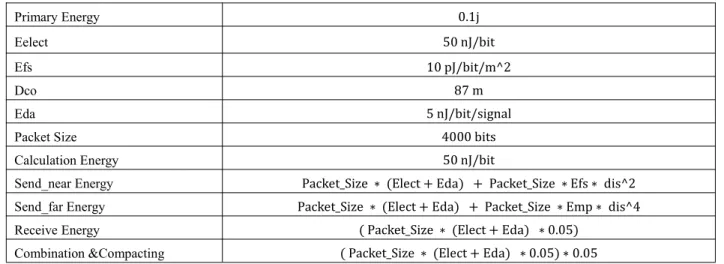
In each round, each node has its own gravitational force and risk parameters describe the three main energy distributions and its centrality to bring their neighbors, then, all nodes in the CH choose the nodes of their position with the company and each of its neighboring nodes that are to be compared. And if the case is better than its neighbors as the cluster heads is introduced. Simulated compared parameters show in Table1.
Table 1. The Value simulation parameters
Primary Energy 0.1j
Eelect 50 nJ/bit
Efs 10 pJ/bit/m^2
Dco 87 m
Eda 5 nJ/bit/signal
Packet Size 4000 bits
Calculation Energy 50 nJ/bit
Send_near Energy Packet_Size ∗ (Elect + Eda) + Packet_Size ∗ Efs ∗ dis^2
Send_far Energy Packet_Size ∗ (Elect + Eda) + Packet_Size ∗ Emp ∗ dis^4
Receive Energy ( Packet_Size ∗ (Elect + Eda) ∗ 0.05)
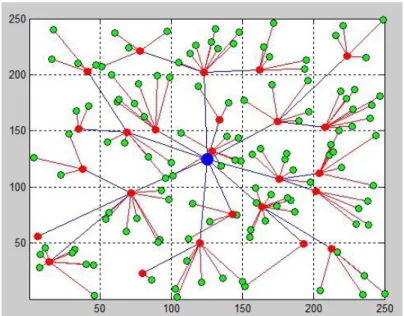
Figure1. A sample of proposed algorithm answer in a 250*250 environment
5. Simulation Result
Simulation conclusion for below problem shows in this section. Implementation in this section is based on C# and programs run with 2.4 GHz-IV and 2GB RAM. For network lifetimes measurements use FND (first node dies)[15] method. In the other word, first node which finish up energy, removed from network.
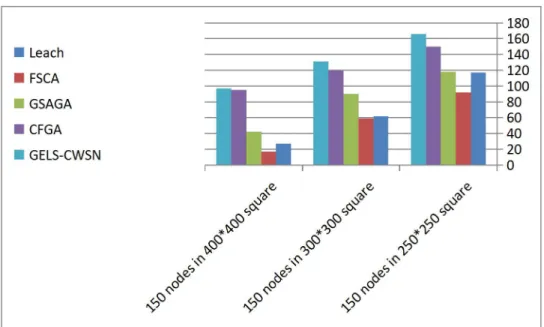
Also said, this algorithm explored if one node, inform of one parameters have good situation, it maybe not good selection for CH, but also as a whole and with respect to all aspects of CH is a good option. So far as has been stated, the goal is to integrate all the parameters and we find that the nodal position, the best position is. It maybe some node have more energy than neighborhoods, But the place is in a position to send their data to the other nodes of the node energy consumption are incurred. So, this makes the probability of the node is reduced. It should be noted that the proposed algorithm reduces the energy consumption and longevity can be seen in the simulation, the execution time of each round algorithm, the algorithm is simple and low overhead in comparison with the other algorithms that simulate have been much less and is very substantial. Table 2 compares the death of first node in the proposed algorithm (GELS_CWSN) compared with LEACH[16], FSCA[17], GSAGA[18, 19]and CFGA[20]shows. Improve the performance of the algorithm increases the network lifetime compared to other methods is shown in Table 2. As can be seen the death of first node in the proposed algorithm compared with other methods has increased.
Table 2. Compare the death of the first node in rounds during the period for algorithms
Network parameters Type of Algorithms
Leach [16] FSCA [17] GSAGA [18, 19] CFGA [20] GELS_CWSN 150 node with network size 250*250 117 92 118 150 166
175 node with network size 300*300 62 59 90 120 131 200 node with network size 400*400 27 17 42 95 97
Figure 2.Comparison Chart of the death of the first node
6. Conclusion
In this paper, the local search algorithm to simulate gravity for reduced energy consumption problem in WSN, by selecting a suitable CH have been used. A new method for calculating competence and evaluate solutions for solving the optimal sensor selection for clustering in WSN is presented. The advantages of this algorithm speed, low implementation time, increase the lifetime of network and reduce energy consumption and optimize the network efficiency is also increased. A new method for calculating competence and evaluate solutions for solving the optimal sensor selection for clustering WSN is presented. The results show the improvement and superiority of the proposed algorithm is compared to the algorithms, the improvement is more evident in larger systems.
References:
1. M. J. Handy, M. Haase, and D. Timmermann, "Low energy adaptive clustering hierarchy with deterministic cluster-head selection", in proc. of 4th International Workshop on Mobile and Wireless Communications Network, 2002: 368-372.
2. A. Elahi, A. R. Hosseinabadi, A. S. Rostami, "Multi-Hop Fuzzy Routing for Wireless Sensor Network with Mobile Sink", International Journal of Scientific & Engineering Research, 2013; 4(7): 2431-2439.
3. H. Tavakkolai, N. Yadollahi, M. Yadollahi, A. R. Hosseinabadi, P. Rezaei, M. Kardgar, "Sensor Selection Wireless Multimedia Sensor Network using Gravitational Search Algorithm", Indian Journal of Science and Technology, 2015; 8(14): 1-6, 2015.
4. Indranil, Gupta, "cluster head election using fuzzy logic for wireless sensor networks", in proc. of the 3rd Annual Communication Networks and Services Research Conference, 2005.
5. A. S. Rostami, H. M. Bernety and A. R. Hosseinabadi, "A Novel and Optimized Algorithm to Select Monitoring Sensors by GSA", International Conference on Control, Instrumentation and Automation (ICCIA), 2011: 829-834. 6. W. Heinzelman, A. Chandrakasan, H. Balakrishnan, "energy-efficient communication protocol for wireless
microsensor networks", in proc. of the 33rd Annual Hawaii International Conference on System Science (HICSS), Maui, HI, .2000
7. W. Heinzelman, A. Chandrakasan, H. Balakrishnan, “An application-specific protocol architecture for wireless microsensor networks,” IEEE Transactions on Wireless Communication, 2002: 660-670.
8. Q. Liang, "clusterhead election for mobile ad hoc wireless network", in proc. of 14th IEEE international symposium on Personal, Indoor, and Mobile Radio Communications, 2003.
9. C. Voudouris, E. Tesang, "Guided Local Search", European Journal of Operational Research, pp. 1-18, 1995. 10. B. Webster, "Solving Combinatorial Optimization Problems Using a New Algorithm Based on Gravitational
Attraction", Melbourne, 2004.
11. A. R. Hosseinabadi, H. Siar, S. Shamshirband, M. Shojafar, M. H. Nizam Md. Nasir, "Using the gravitational emulation local search algorithm to solve the multi-objective flexible dynamic job shop scheduling problem in Small and Medium Enterprises", Annals of Operations Research, 2015; 229(1): 451-474, 2015.
Problem Using the Gravitational Emulation Local Search Algorithm", Neural Computing and Applications, 2018; 29(10): 955-968.
13. A. R. Hosseinabadi, M. Kardgar, M. Shojafar, Sh. Shamshirband, A. Abraham, "GELS-GA: Hybrid Metaheuristic Algorithm for Solving Multiple Travelling Salesman Problem", International Conference on Intelligent Systems Design and Applications (ISDA), 2014: 76-81.
14. A. S. Rostami, F. Mohanna, H. Keshavarz, A. R. Hosseinabadi, "Solving Multiple Traveling Salesman Problem using the Gravitational Emulation Local Search Algorithm", Applied Mathematics & Information Sciences, 2015; 9(2): 699-709.
15. M. J. Handy, M. Hasse, D. Timmermann, "Low energy adaptive clustering hierarchy with deterministic cluster-headselection", in proc. of 4th International Workshop on Mobile and Wireless Communications Network, 2002.
16. W. Heinzelman, A. Chandrakasan, H. Balakrishnan, "An Application-Specific Protocol Architecture for Wireless Microsensor Networks", IEEE Transactions on Wireless Communications, 2002; 1: 660-670.
17. Y. M. Tashtoush, M. A. Okour, "Fuzzy Self-Clustering for Wireless Sensor Networks", International Conference on Embedded and Ubiquitous Computing, 2008.
18. W. Heinzelman, "Application-specific protocol architectures for wireless networks", Ph.D. dissertstion, Mass. Inst. Technol, Cambridge, 2000.
19. S. Hussain, A. W. Matin, O. Islam, "Genetic Algorithm for Energy Efficient Clusters in Wireless SensorNetworks", International Conference on Information Technology, 2007.
20. E .saeedian, M. niazi, M .jalali, "CFGA: Clustering wireless sensor network using fuzzy logic and genetic algorithm", Wireless Communications Networking and Mobile Computing, International Conference, Digital Object Identifier, 2011: 1-4.
21. W. Elsayed, M. Elhoseny, S. Sabbeh, A. Riad, "Self-Maintenance Model for Wireless Sensor Networks", Computers and Electrical Engineering, 2017: 1-14.
22. M. Elhoseny, A. Tharwat, A. Farouk, A. Ella Hassanien, “K-Coverage Model based on Genetic Algorithm to extend WSN lifetime”, IEEE Sensors Letters, 2017; 1(4): 1-4.
23. M. Elhoseny, A. Farouk, N. Zhou, M. Wang, S. Abdalla, J. Batle, “Dynamic Multi-hop Clustering in a Wireless Sensor Network: Performance Improvement”, Wireless Personal Communications, 2017; 95: 3733-3753.
24. M. Elhoseny, X. Yuan, Z. Yu, C. Mao, H. El-Minir, A Riad, “Balancing Energy Consumption in Heterogeneous Wireless Sensor Networks using Genetic Algorithm”, IEEE Communications Letters, 2015; 19: 2194-2197. 25. M. Elhoseny, K. Elleithy, H. Elminir, X. Yuan, A. Riad, “Dynamic Clustering of Heterogeneous Wireless Sensor
Networks using a Genetic Algorithm, Towards Balancing Energy Exhaustion”, International Journal of Scientific & Engineering Research, 2015; 6: 1243-1252.
26. M. Elhoseny, H. K Elminir, A. Riad, X. Yuan, “Recent advances of secure clustering protocols in wireless sensor networks”, International Journal of Computer Networks and Communications Security, Vol. 2, 400-413, 2014. 27. A. Riad, H. K El-Minir, M. Elhoseny, “Secure Routing in Wireless Sensor Networks: A State of the Art”,
International Journal of Computer Applications, 2013; 67.
28. M. Elhoseny, A. Farouk, J. Batle, A. Shehab, A. E. Hassanien, "Secure Image Processing and Transmission Schema in Cluster-Based Wireless Sensor Network", Handbook of Research on Machine Learning Innovations and Trends, Chapter 45, 2017: 1022-1040, IGI Global.
29. W. Elsayed, M. Elhoseny, A. Riad, A. E. Hassanien, "Autonomic Self-Healing Approach to Eliminate Hardware Faults in Wireless Sensor Networks", In the 3rd International Conference on Advanced Intelligent Systems and Informatics (AISI2017). Sept. 2017: 9-11.
30. A. Shehab, M. Elhoseny, A..T. Sahlol, M. A. El Aziz, "Self-organizing Single-Hop Wireless Sensor Network using a Genetic Algorithm: Longer Lifetimes and Maximal Throughputs", In 2017 IEEE Interlational Conference on Intelligent techniques in Control, Optimization and Signal Processing, 2017: 23-25.
31. A. R. Hosseinabadi, N. S. H. Rostami, M. Kardgar, S. S. Mirkamali, A. Abraham, "A New Efficient Approach for Solving the Capacitated Vehicle Routing Problem Using the Gravitational Emulation Local Search Algorithm", Applied Mathematical Modelling, Elsevier, 2017; 49: 663-679.
32. S. M. Bozorgi, A. S. Rostami, A. R. Hosseinabadi, V. E. Balas, “A New Clustering Protocol Based on Renewable Energy and Multi-Hop Routing for Energy Harvesting-Wireless Sensor Networks”, Computers & Electrical Engineering, Elsevier, 2017; 64: 233-247.
33. A. S. Rostami, M. Badkoobe, F. Mohanna, H. keshavarz, A. R. Hosseinabadi, A. Kumar Sangaiah, “Survey on Clustering in Heterogeneous and Homogeneous Wireless Sensor Networks”, The Journal of Supercomputing, Springer, 2018; 74: 277-323.
34. A. S. Rostami, M. Badkoobe, F. Mohanna, A. R. Hosseinabadi, M. Kardgar, V. E. Balas “Imperialist Competition based Clustering Algorithm to Improve the Lifetime of Wireless Sensor Network”, 7th International Workshop in Soft Computing Applications (SOFA 2016), Springer, 2016; 633: 189-202.
Review and Analysis”, 7th International Workshop in Soft Computing Applications (SOFA 2016), Springer, 2016; 634: 96-116.
36. A. Elahi, A. R. Hosseinabadi, A. S. Rostami, "Improving News Document Clustering Based on a Hybrid Similarity Measurement", IEEE International Conference on Intelligent Computing and Intelligent Systems (ICIS), 2011: 1-6.
37. A. R. Hosseinabadi, A. B. Farahabadi, M. S. Rostami, A. F. Lateran, "Presentation of a New and Beneficial Method Through Problem Solving Timing of Open Shop by Random Algorithm Gravitational Emulation Local Search", International Journal of Computer Science Issues, 2013; 10(1): 745-752.
38. A. R. Hosseinabadi, M. R. Ghaleh, S. E. Hashemi, "Application of Modified Gravitational Search Algorithm to Solve the Problem of Teaching Hidden Markov Model", International Journal of Computer Science Issues, 2013; 10(3): 1-8.
39. A. B. Farahabadi, A. R. Hosseinabadi, "Present a New Hybrid Algorithm Scheduling Flexible Manufacturing System Consideration Cost Maintenance", International Journal of Scientific & Engineering Research, 2013; 4(9): 1870-1875.
40. Sh. Shamshirband, M. Shojafar, A. R. Hosseinabadi, M. Kardgar, M. H. Nizam Md. Nasir, R. Ahmad, "OSGA: genetic-based open-shop scheduling with consideration of machine maintenance in small and medium enterprises", Annals of Operations Research, 2015; 229(1): 743-758.
41. H. Tavakkolai, A. R. Hosseinabadi, M. Yadollahi, T. Mohammadpour, "Using Gravitational Search Algorithm for in Advance Reservation of Resources in Solving the Scheduling Problem of Works in Workflow Workshop Environment", Indian Journal of Science and Technology, 2015; 8(11): 1-16.
42. M. N. Nategh, A. R. Hosseinabadi, S. Damavandi, V. E. Balas, "TTGELS: a new approach for solving university exam timetabling problem by using gravitational emulation local search algorithm", International Journal of Computational Systems Engineering, 2016; 2(4): 183-189.
43. E. B. Tirkolaee, M. Alinaghian, A. R. Hosseinabadi, M. B. Sasi, A. Kumar Sangaiah, "An Improved Ant Colony Optimization for the Multi-Trip Capacitated Arc Routing Problem", Computers & Electrical Engineering, Elsevier, 2018: 1-15.
44. A. R. Hosseinabadi, J. Vahidi, B. Saemi, A. K. Sangaiah, M. Elhoseny, "Extended Genetic Algorithm for Solving Open-Shop Scheduling Problem", Soft Computing, Springer, 2018: 1-18.
45. E. B. Tirkolaee, A. R. Hosseinabadi, M. Soltani, A. K. Sangaiah, J. Wang, "A Hybrid Genetic Algorithm for Multi-trip Green Capacitated Arc Routing Problem in the Scope of Urban Services", Sustainability, 2018; 10: 1-21. 46. Sh. Shamshirband, M. Shojafar, A. R. Hosseinabadi, A. Abraham, "A Solution for Multi-objective Commodity
Vehicle Routing Problem by NSGA-II", IEEE International Conference on Hybrid Intelligent Systems (HIS), 2014: 12-17.
47. Sh. Shamshirband, M. Shojafar, A. R. Hosseinabadi, A. Abraham, "OVRP_ICA: An Imperialist-based Optimization Algorithm for the Open Vehicle Routing Problem", International Conference on Hybrid Artificial Intelligence Systems (HAIS), Chapter Springer LNCS, Springer, 2015; 9121: 221-233.
48. Mohamed Elhoseny, Xiaohui Yuan, Hamdy K El-Minir, and AM Riad, “ Extending self-organizing network availability using genetic algorithm”, In 2014 International Conference on Computing, Communication and Networking Technologies (ICCCNT), July 11-13, Hefei-China, IEEE, 2014 (DOI: 10.1109/ICCCNT.2014.6963059)
49. Mohamed Elhoseny, Noura Metawa and Aboul Ella Hassanien, An automated information system to ensure quality in higher education institutions, Proceedings of 12th International Computer Engineering Conference (ICENCO), IEEE, 196 - 201, 2016 (DOI: 10.1109/ICENCO.2016.7856468)
50. Mohamed Abd El Aziz, Ahmed Monem Hemdan, Ahmed A. Ewees, Mohamed Elhoseny, Abdulaziz Shehab, Aboul Ella Hassanien, Shengwu Xiong, Prediction of Biochar Yield Using Adaptive Neuro-Fuzzy Inference System With Particle Swarm Optimization, In 2017 IEEE PES PowerAfrica Conference, June 27-30, Accra-Ghana, IEEE, 2017, Pages 115-120 (DOI: 10.1109/PowerAfrica.2017.7991209)
51. Abdulaziz Shehab, Mohamed Elhoseny, Ahmed.T. Sahlol, and Mohamed Abd El Aziz, Self-organizing Single-Hop Wireless Sensor Network using a Genetic Algorithm: Longer Lifetimes and Maximal Throughputs, In 2017 IEEE Interlational Conference on Intelligent techniques in Control, Optimization and Signal Processing, March 23- 25, 2017, Kalasalingam University-India, IEEE 2017
52. Elhoseny M., Shehab A., Osman L. (2018) An Empirical Analysis of User Behavior for P2P IPTV Workloads. In: Hassanien A., Tolba M., Elhoseny M., Mostafa M. (eds) The International Conference on Advanced Machine Learning Technologies and Applications (AMLTA2018). AMLTA 2018. Advances in Intelligent Systems and Computing, vol 723. Springer, Cham (DOI: https://doi.org/10.1007/978-3-319-74690-6_25)
53. Abdulaziz Shehab, Mohamed Elhoseny, and Aboul Ella Hassanien, An Efficient Scheme for Video Delivery in Wireless Networks, Quantum Computing:An Environment for Intelligent Large Scale Real Application, Springer, 2017.