a
International Journal of Electronics Communication and Computer Engineering Volume 4, Issue 1, ISSN (Online): 2249–071X, ISSN (Print): 2278–4209
Energy Efficient Homogenous Clustering and Cluster
Head Selection Algorithm for WSN
Ganeshayya I. Shidaganti
Deptt., ISE,Sambhram Institution of Technology, Bangalore. [email protected]
Monica R. Mundada
Research Scholar, MGR Educational and Research Institute, Chennai [email protected]Dr. T. Bhuvaneswari
Deptt. Computer Applications, N. N. Govt. College,
Ponneri.
V. CyrilRaj
Deptt. of CSE and IT Dr. M. G. R. University,Chennai
Abstract - Wireless sensor networks (WSNs) are energy
and resource constrained networks, which are made up of small electronic devices called sensor nodes. Each sensor nodes are capable of sensing, computing and transmitting data from one node to another, till to reach base station. Each node monitors physical or environmental conditions, depending on application and communicate with nearby nodes via radio broadcast. Radio transmission and reception consumes a lot of energy in a wireless sensor network (WSN), thus, one of the important issues in wireless sensor network is the inherent limited battery power within the sensor nodes. Therefore, battery power is crucial parameter in the algorithm design in maximizing the lifespan of sensor nodes. Much research has been done in recent years in the area of low power routing protocol, but there are still many design options open for improvement and for further research targeted to the specific applications need to be done.
In this paper, we propose a new approach of an energy-efficient homogeneous clustering and cluster head selection algorithm for wireless sensor networks in which the lifespan of the network is increased by ensuring a homogeneous distribution of nodes in the clusters. In this clustering algorithm, energy efficiency is distributed and network performance is improved by selecting cluster heads on the basis of the residual energy of existing cluster heads, holdback value, and nearest hop distance of the node. In the proposed clustering algorithm, the cluster members are uniformly distributed and the life of the network is further extended.
Keywords—Cluster Head (CH), Wireless Sensor Network (WSN).
I. I
NTRODUCTIONWireless Sensor Network (WSNs) has become active research topics recently in both academic and industry. A wireless sensor network consisting a number of sensor node, called tiny devices and these are working together to detect a region to take data about the environment. After collecting it they process it and then transmit to the base station. Base station provides an interface between user and internet. Basic characteristic of the wireless sensor network are limited energy, dynamic network topology, lower power, node failure and mobility of the nodes, short-range broadcast communication and multi-hop routing and large scale of deployment [1]. The basic components of a node are a sensor unit, an ADC, a CPU, a power unit and a communication unit [2]. Following is a list of wide-ranging scope of WSN applications [3]:
1. Environmental Applications: Forest fire detection, Flood detection, automated agriculture etc.
2. Military Applications: Monitoring enemy forces, monitoring equipment, biological and chemical attack detection etc.
3. Health Applications: Remote monitoring of physiological data, Disease prevention etc.
4. Home Applications: Home Automation, Home Security
5. Commercial Applications: Vehicle tracking, Traffic flow surveillance, Environment control in industrial and official buildings
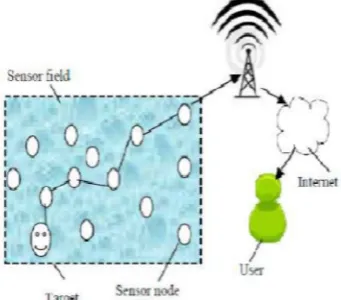
Fig 1 show the basic architecture of the wireless sensor network in which sensor node deployed in the sensor fields and they communicate with each other for collect the information from the environment, or directly send to the base station basically base station act as a gateway. With the help of gateway data is transmitting to the internet. Because users are directly connect to the internet.
Fig.1. Architecture of wireless sensor network A sensor nodes that generates data, based on its sensing mechanisms observation and transmit sensed data packet to the base station (sink). This process basically direct transmission since base station is may located very far away from sensor nodes needs more energy to transmit data over long distances so that better techniques is to have fewer nodes sends data to the base station. These nodes called aggregator nodes in wireless sensor network.
a
Copyright © 2013 IJECCE, All right reserved 71
International Journal of Electronics Communication and Computer Engineering Volume 4, Issue 1, ISSN (Online): 2249–071X, ISSN (Print): 2278–4209
in a sensor network acts as a router [4] inside the network. In direct communication routing protocols (single hop), each sensor node communicates directly with a control centre called Base Station (BS) and sends gathered information. The base station is fixed and located far away from the sensors. Base station can communicate with the end user either directly or through some existing wired network. The topology of the sensor network changes very frequently. Nodes may not have global identification. Since the distance between the sensor nodes and base station in case of direct communication is large, they consume energy quickly. In another approach (multi hop), data is routed via intermediate nodes to the base station and thus saves sending node energy.
In this paper, we propose Energy efficient homogeneous clustering algorithm for WSN. We demonstrate that the homogeneous clustering algorithm extend the lifetime of sensor networks and try to maintain a balance energy consumption of nodes. The paper is organized as follows: Section 2 summarizes the related previous works and their limitations. Section 3 discusses the basic radio energy model. Section 4 describes the proposed homogeneous clustering algorithm with the help of illustrative diagrams. Simulation results are presented in section 5 while conclusions are given in section 6.
II. R
ELATEDW
ORKRouting is a process of determining a path between source and destination upon re-quest of data transmission. A variety of protocols have been proposed to enhance the life of WSN and for routing the correct data to the base station. Battery power of individual sensor nodes is a precious resource in the WSN [5]. For example, the power consumed by a Berkeley mote to transmit 1-bit of data is equivalent to the computation of 800m instructions. When the battery power at a sensor node expires, the node is called as a dead node and the sensor node discontinues its operations in the network.
In general, routing in WSN can be divided into flat-based routing, hierarchical-flat-based routing, and location-based [6] routing depending on the network structure. In flat-based routing, all nodes are typically assigned equal roles or functionality. In hierarchical-based routing, however, nodes will play different roles in the network. In location-based routing, sensor nodes positions are exploited to route data in the net-work.
Hierarchical routing performs energy-efficient routing in WSN, and contributes to overall system scalability and lifetime. In a hierarchical architecture, sensors organize themselves into clusters and each cluster has a cluster head, i.e. sensor nodes form clusters where the low energy nodes are used to perform the sensing in the proximity of the phenomenon. For the cluster based wireless sensor network, the cluster information and Cluster Head (CH) selection are the basic issues. The cluster head coordinates the communication among the cluster members and manages their data [7]. According to the manner the data are collected, cluster based WSNs are classified into three broad categories namely (i) homogeneous sensor
networks, (ii) heterogeneous sensor network, (iii) hybrid sensor network.
In the homogeneous sensor networks, all the sensor nodes and base stations are identical in terms of hardware capability and initial battery power. In this method, the static clustering elects cluster heads (CH) only once for the entire lifetime of the net-work. This results in overload on cluster heads. As proposed in LEACH [4], the role of cluster heads is randomly and periodically rotated over all the nodes to ensure the same rate of dissipation of battery power for all the sensor nodes. Heterogeneous sensor networks, has two or more different types of sensor nodes with different hardware capabilities and battery power are used. The sensor nodes with higher hardware capabilities and more battery power compared to other sensor nodes act as cluster heads and perform as a normal sensor node. In hybrid sensor networks several mobile base stations work cooperatively to provide fast data gathering in a real-time manner.
Low-energy adaptive clustering hierarchy (LEACH) is a popular energy-efficient adaptive clustering algorithm that forms node clusters based on the received signal strength and uses these local cluster heads as routers to the base station [8]. LEACH is an application-specific data dissemination protocol that uses clusters to prolong the life of the wireless sensor network. LEACH utilizes randomized rotation of local cluster heads to evenly distribute the energy load among the sensors in the network [9]. LEACH uses three techniques namely (i) randomized rotation of the cluster heads and corresponding clusters, (ii) localized coordination and control for cluster set-up and operation, and (iii) local compression to reduce global communication. LEACH clustering terminates in a finite number of iteration, but does not guarantee good cluster head distribution and assumes uniform energy consumption for cluster heads.
energy-a
International Journal of Electronics Communication and Computer Engineering Volume 4, Issue 1, ISSN (Online): 2249–071X, ISSN (Print): 2278–4209
efficient clustering protocol, the authors proposes for prolonging the life of the wireless sensor network by dividing the network into clusters. The cluster heads are selected on the basis of primary parameter as hold back period and secondary parameter as the number of hops, to restrict the size of the cluster
III. R
ADIOE
NERGYM
ODELDifferent assumptions have been made by researchers about the radio characteristics, including energy dissipation in transmit and receive modes. We assume that the energy consumption of the sensor is due to data transmission and reception. We use the same radio model as stated in [5], [12] and shown in Figure 2, the energy consumed in transmitting one message of size k bits over a transmission distance d, is given by
Fig.2. First Order Radio Energy Model
Hence, the total energy consumption when sensor receives a message and forwards it over a distance d is given by
IV. T
HEP
ROPOSEDH
OMOGENEOUSC
LUSTERINGA
LGORITHMBasic assumption for the clustering algorithm
• Number of nodes in network are 100 and the base station (BS) is located outside the deployed area and fixed.
• All nodes can send data to BS.
• The BS has the information about the location of each node.
• Data compression is done by the Cluster Head. • Data Compression energy is different from the
reception and transmission.
• In the first round, each node has a probability p of becoming the cluster head.
• A node, which has become cluster head, shall be eligible to become cluster head after 1- 1/p rounds. • All nodes are of same specification.
• All nodes in the network are having the same energy at starting point and having maximum energy. • Each node has same energy Emax and consumes
equal energy for transmission and reception.
• Energy of transmission depends on the distance (source to destination) and data size.
• Nodes are uniformly distributed in network.
A.
Proposed AlgorithmStep#1: In the first round, BS collects information regarding location of all the nodes in the network. Depending on the density and geographical layout of the network, it virtually divides the network into N zones.
Fig.3. Homogeneous Network with 100 nodes and Virtual Distribution of Network into Zones
Step#2: Since we have assumed that initially all the nodes have same maximum energy (Emax), the nodes in each zone have a probability p (1/number of nodes in the zone) of becoming a CH. Hence, from each zone, randomly a cluster head (CH) is selected randomly.
Fig.4. Selected Cluster Heads
= =
Where k=length of the message
d=transmission distance between transmitter and receiver
=electronic energy =Transmitter amplifier =path-loss component(2≤λ≤4)
also, the energy consumed in the message reception is given by =
a
International Journal of Electronics Communication and Computer Engineering Volume 4, Issue 1, ISSN (Online): 2249–071X, ISSN (Print): 2278–4209
efficient clustering protocol, the authors proposes for prolonging the life of the wireless sensor network by dividing the network into clusters. The cluster heads are selected on the basis of primary parameter as hold back period and secondary parameter as the number of hops, to restrict the size of the cluster
III. R
ADIOE
NERGYM
ODELDifferent assumptions have been made by researchers about the radio characteristics, including energy dissipation in transmit and receive modes. We assume that the energy consumption of the sensor is due to data transmission and reception. We use the same radio model as stated in [5], [12] and shown in Figure 2, the energy consumed in transmitting one message of size k bits over a transmission distance d, is given by
Fig.2. First Order Radio Energy Model
Hence, the total energy consumption when sensor receives a message and forwards it over a distance d is given by
IV. T
HEP
ROPOSEDH
OMOGENEOUSC
LUSTERINGA
LGORITHMBasic assumption for the clustering algorithm
• Number of nodes in network are 100 and the base station (BS) is located outside the deployed area and fixed.
• All nodes can send data to BS.
• The BS has the information about the location of each node.
• Data compression is done by the Cluster Head. • Data Compression energy is different from the
reception and transmission.
• In the first round, each node has a probability p of becoming the cluster head.
• A node, which has become cluster head, shall be eligible to become cluster head after 1- 1/p rounds. • All nodes are of same specification.
• All nodes in the network are having the same energy at starting point and having maximum energy. • Each node has same energy Emax and consumes
equal energy for transmission and reception.
• Energy of transmission depends on the distance (source to destination) and data size.
• Nodes are uniformly distributed in network.
A.
Proposed AlgorithmStep#1: In the first round, BS collects information regarding location of all the nodes in the network. Depending on the density and geographical layout of the network, it virtually divides the network into N zones.
Fig.3. Homogeneous Network with 100 nodes and Virtual Distribution of Network into Zones
Step#2: Since we have assumed that initially all the nodes have same maximum energy (Emax), the nodes in each zone have a probability p (1/number of nodes in the zone) of becoming a CH. Hence, from each zone, randomly a cluster head (CH) is selected randomly.
Fig.4. Selected Cluster Heads
= =
Where k=length of the message
d=transmission distance between transmitter and receiver
=electronic energy =Transmitter amplifier =path-loss component(2≤λ≤4)
also, the energy consumed in the message reception is given by =
a
International Journal of Electronics Communication and Computer Engineering Volume 4, Issue 1, ISSN (Online): 2249–071X, ISSN (Print): 2278–4209
efficient clustering protocol, the authors proposes for prolonging the life of the wireless sensor network by dividing the network into clusters. The cluster heads are selected on the basis of primary parameter as hold back period and secondary parameter as the number of hops, to restrict the size of the cluster
III. R
ADIOE
NERGYM
ODELDifferent assumptions have been made by researchers about the radio characteristics, including energy dissipation in transmit and receive modes. We assume that the energy consumption of the sensor is due to data transmission and reception. We use the same radio model as stated in [5], [12] and shown in Figure 2, the energy consumed in transmitting one message of size k bits over a transmission distance d, is given by
Fig.2. First Order Radio Energy Model
Hence, the total energy consumption when sensor receives a message and forwards it over a distance d is given by
IV. T
HEP
ROPOSEDH
OMOGENEOUSC
LUSTERINGA
LGORITHMBasic assumption for the clustering algorithm
• Number of nodes in network are 100 and the base station (BS) is located outside the deployed area and fixed.
• All nodes can send data to BS.
• The BS has the information about the location of each node.
• Data compression is done by the Cluster Head. • Data Compression energy is different from the
reception and transmission.
• In the first round, each node has a probability p of becoming the cluster head.
• A node, which has become cluster head, shall be eligible to become cluster head after 1- 1/p rounds. • All nodes are of same specification.
• All nodes in the network are having the same energy at starting point and having maximum energy. • Each node has same energy Emax and consumes
equal energy for transmission and reception.
• Energy of transmission depends on the distance (source to destination) and data size.
• Nodes are uniformly distributed in network.
A.
Proposed AlgorithmStep#1: In the first round, BS collects information regarding location of all the nodes in the network. Depending on the density and geographical layout of the network, it virtually divides the network into N zones.
Fig.3. Homogeneous Network with 100 nodes and Virtual Distribution of Network into Zones
Step#2: Since we have assumed that initially all the nodes have same maximum energy (Emax), the nodes in each zone have a probability p (1/number of nodes in the zone) of becoming a CH. Hence, from each zone, randomly a cluster head (CH) is selected randomly.
Fig.4. Selected Cluster Heads
= =
Where k=length of the message
d=transmission distance between transmitter and receiver
=electronic energy =Transmitter amplifier =path-loss component(2≤λ≤4)
a
Copyright © 2013 IJECCE, All right reserved 73
International Journal of Electronics Communication and Computer Engineering Volume 4, Issue 1, ISSN (Online): 2249–071X, ISSN (Print): 2278–4209
Step#3: Once the CHs are formed, it broadcasts its identity to all the other nodes in the network to accept its joining request and form actual clusters
Step#4: The nodes which receive the joining request analyses the signal strength of the request signal. Signal strength of the CH request depends on the distance between CH and node, and physical barrier between the CH and node. Depending on the level of the signal each node sends an acknowledgement to the most preferred CH. Each CH waits for the joining request from the nearby nodes. Left out nodes will join to cluster nearby.
Fig.5. Broadcasting of its Identity by Selected CHs to all nodes and Nodes analyzing the signal strength from the
CHs
Step#5: The CH prepares the data sending schedule and sends it to its members within the cluster.
Step#6: The CH receives data from each node, compresses the data and sends it to the BS
Fig.6. Final Cluster Formation
V. S
IMULATIONR
ESULTIn the normal random selection method, number of cluster members is non-uniform resulting in loading of a CH. As a result, the network has to form clusters more frequently. In the new proposed homogeneous clustering algorithm method, since the cluster members are uniformly distributed and thus, the life of the network is more extended. As shown in Figure 7, the battery power consumption for different size of message transmission is
less in the proposed algorithm in comparison of the random selection method.
Fig.7. Power consumption with respect to message size
VI. C
ONCLUSIONIn this paper we have illustrated a homogeneous clustering and cluster head selection algorithm for wireless sensor network that saves power and prolongs network life. The life span of the network is increased by ensuring a homogeneous distribution of nodes in the clusters. A new cluster head is selected on the basis of the residual energy of existing cluster heads, holdback value, and nearest hop distance of the node. The homogeneous algorithm makes sure that every node is either a cluster head or a member of one of the clusters in the wireless sensor network. In the proposed clustering algorithm the cluster members are uniformly distributed, and thus, the life of the network is more extended. Further, in the proposed algorithm, only cluster heads broadcast cluster formation message and not the every node. Hence, it prolongs the life of the sensor networks.
R
EFERENCES[1] Mohammad Ilyas and Imad Mahgoub. (2005). Handbook of Sensor Networks: Compact Wireless and Wired Sensing Systems. CRC Press LLC.
[2] Younis, M.; Youssef, M.; Arisha, K. (October 2002) Energy-aware routing in cluster-based sensor networks. In Proceedings of the 10th IEEE/ACM International Symposium on Modeling, Analysis and Simulation of Computer and Telecommunication Systems (MASCOTS2002), Fort Worth, TX, USA.
[3] Schurgers, C.; Srivastava, M.B. (2001) Energy efficient routing in wireless sensor networks. In The MILCOM Proceedings on Communications for Network-Centric Operations: Creating the Information Force, McLean, VA, USA.
[4] Shah, R.; Rabaey, J. (March 2002) Energy aware routing for low energy ad hoc sensor networks. In Proceedings of the IEEE Wireless Communications and Networking Conference (WCNC), Orlando, FL, USA.
[5] W.R. Heinzelman,A. Chandrakasan, and H. Balakrishnan, (Jan. 2000)“Energy-Efficient Communication Protocol for Wireless Microsensor Networks”, inIEEE Computer Society Proceedings of the Thirty Third Hawaii International Conference on System Sciences (HICSS '00), Washington, DC, USA.
a
Copyright © 2013 IJECCE, All right reserved 73
International Journal of Electronics Communication and Computer Engineering Volume 4, Issue 1, ISSN (Online): 2249–071X, ISSN (Print): 2278–4209
Step#3: Once the CHs are formed, it broadcasts its identity to all the other nodes in the network to accept its joining request and form actual clusters
Step#4: The nodes which receive the joining request analyses the signal strength of the request signal. Signal strength of the CH request depends on the distance between CH and node, and physical barrier between the CH and node. Depending on the level of the signal each node sends an acknowledgement to the most preferred CH. Each CH waits for the joining request from the nearby nodes. Left out nodes will join to cluster nearby.
Fig.5. Broadcasting of its Identity by Selected CHs to all nodes and Nodes analyzing the signal strength from the
CHs
Step#5: The CH prepares the data sending schedule and sends it to its members within the cluster.
Step#6: The CH receives data from each node, compresses the data and sends it to the BS
Fig.6. Final Cluster Formation
V. S
IMULATIONR
ESULTIn the normal random selection method, number of cluster members is non-uniform resulting in loading of a CH. As a result, the network has to form clusters more frequently. In the new proposed homogeneous clustering algorithm method, since the cluster members are uniformly distributed and thus, the life of the network is more extended. As shown in Figure 7, the battery power consumption for different size of message transmission is
less in the proposed algorithm in comparison of the random selection method.
Fig.7. Power consumption with respect to message size
VI. C
ONCLUSIONIn this paper we have illustrated a homogeneous clustering and cluster head selection algorithm for wireless sensor network that saves power and prolongs network life. The life span of the network is increased by ensuring a homogeneous distribution of nodes in the clusters. A new cluster head is selected on the basis of the residual energy of existing cluster heads, holdback value, and nearest hop distance of the node. The homogeneous algorithm makes sure that every node is either a cluster head or a member of one of the clusters in the wireless sensor network. In the proposed clustering algorithm the cluster members are uniformly distributed, and thus, the life of the network is more extended. Further, in the proposed algorithm, only cluster heads broadcast cluster formation message and not the every node. Hence, it prolongs the life of the sensor networks.
R
EFERENCES[1] Mohammad Ilyas and Imad Mahgoub. (2005). Handbook of Sensor Networks: Compact Wireless and Wired Sensing Systems. CRC Press LLC.
[2] Younis, M.; Youssef, M.; Arisha, K. (October 2002) Energy-aware routing in cluster-based sensor networks. In Proceedings of the 10th IEEE/ACM International Symposium on Modeling, Analysis and Simulation of Computer and Telecommunication Systems (MASCOTS2002), Fort Worth, TX, USA.
[3] Schurgers, C.; Srivastava, M.B. (2001) Energy efficient routing in wireless sensor networks. In The MILCOM Proceedings on Communications for Network-Centric Operations: Creating the Information Force, McLean, VA, USA.
[4] Shah, R.; Rabaey, J. (March 2002) Energy aware routing for low energy ad hoc sensor networks. In Proceedings of the IEEE Wireless Communications and Networking Conference (WCNC), Orlando, FL, USA.
[5] W.R. Heinzelman,A. Chandrakasan, and H. Balakrishnan, (Jan. 2000)“Energy-Efficient Communication Protocol for Wireless Microsensor Networks”, inIEEE Computer Society Proceedings of the Thirty Third Hawaii International Conference on System Sciences (HICSS '00), Washington, DC, USA.
a
Copyright © 2013 IJECCE, All right reserved 73
International Journal of Electronics Communication and Computer Engineering Volume 4, Issue 1, ISSN (Online): 2249–071X, ISSN (Print): 2278–4209
Step#3: Once the CHs are formed, it broadcasts its identity to all the other nodes in the network to accept its joining request and form actual clusters
Step#4: The nodes which receive the joining request analyses the signal strength of the request signal. Signal strength of the CH request depends on the distance between CH and node, and physical barrier between the CH and node. Depending on the level of the signal each node sends an acknowledgement to the most preferred CH. Each CH waits for the joining request from the nearby nodes. Left out nodes will join to cluster nearby.
Fig.5. Broadcasting of its Identity by Selected CHs to all nodes and Nodes analyzing the signal strength from the
CHs
Step#5: The CH prepares the data sending schedule and sends it to its members within the cluster.
Step#6: The CH receives data from each node, compresses the data and sends it to the BS
Fig.6. Final Cluster Formation
V. S
IMULATIONR
ESULTIn the normal random selection method, number of cluster members is non-uniform resulting in loading of a CH. As a result, the network has to form clusters more frequently. In the new proposed homogeneous clustering algorithm method, since the cluster members are uniformly distributed and thus, the life of the network is more extended. As shown in Figure 7, the battery power consumption for different size of message transmission is
less in the proposed algorithm in comparison of the random selection method.
Fig.7. Power consumption with respect to message size
VI. C
ONCLUSIONIn this paper we have illustrated a homogeneous clustering and cluster head selection algorithm for wireless sensor network that saves power and prolongs network life. The life span of the network is increased by ensuring a homogeneous distribution of nodes in the clusters. A new cluster head is selected on the basis of the residual energy of existing cluster heads, holdback value, and nearest hop distance of the node. The homogeneous algorithm makes sure that every node is either a cluster head or a member of one of the clusters in the wireless sensor network. In the proposed clustering algorithm the cluster members are uniformly distributed, and thus, the life of the network is more extended. Further, in the proposed algorithm, only cluster heads broadcast cluster formation message and not the every node. Hence, it prolongs the life of the sensor networks.
R
EFERENCES[1] Mohammad Ilyas and Imad Mahgoub. (2005). Handbook of Sensor Networks: Compact Wireless and Wired Sensing Systems. CRC Press LLC.
[2] Younis, M.; Youssef, M.; Arisha, K. (October 2002) Energy-aware routing in cluster-based sensor networks. In Proceedings of the 10th IEEE/ACM International Symposium on Modeling, Analysis and Simulation of Computer and Telecommunication Systems (MASCOTS2002), Fort Worth, TX, USA.
[3] Schurgers, C.; Srivastava, M.B. (2001) Energy efficient routing in wireless sensor networks. In The MILCOM Proceedings on Communications for Network-Centric Operations: Creating the Information Force, McLean, VA, USA.
[4] Shah, R.; Rabaey, J. (March 2002) Energy aware routing for low energy ad hoc sensor networks. In Proceedings of the IEEE Wireless Communications and Networking Conference (WCNC), Orlando, FL, USA.
a
International Journal of Electronics Communication and Computer Engineering Volume 4, Issue 1, ISSN (Online): 2249–071X, ISSN (Print): 2278–4209
[6] J. Al-Karaki, and A. Kamal, (Dec. 2004)“Routing Technique s in Wireless Sensor Net-works: A Survey“, IEEE Communications Magazine, vol 11, no. 6, pp. 6-28.
[7] C.R. Lin, and M. Gerla, (Sept. 1997)“Adaptive Clustering f or Mobile Wireless Net-works”,IEEE Journal on Selected Areas in Communication, vol. 15, no. 7, pp. 11265-1275.
[8] W.R. Heinzelman, A. Chandrakasan, and H. Balakrishnan, (Oct. 2002) “An Application-specific Protocol Architecture for Wireless Microsensor Networks”, IEEE Transactions on Wireless Communications, vol. 1(4).
[9] W.R. Heinzelman, A. Chandrakasan, and H. Balakrishnan, (October 2002)“An Application-Specific Protocol Architecture for Wireless Microsensor Networks” in IEEE Tmnsactions on Wireless Communications, vol. 1(4), pp. 660-670.
[10] Ossama Younis and Sonia Fahmy, (September 2002) “Distributed Clustering in Ad-hoc Sensor Networks: A Hybrid, Energyefficient Approach”.
[11] Ossama Younis and Sonia Fahmy (Oct.-Dec.2004) “Heed: A hybrid, Energy-efficient, Distributed Clustering Approach for Ad-hoc Networks”,IEEE Transactions on Mobile Computing, vol. 3, no. 4, pp. 366-369.
[12] W.R. Heinzelman, A. Chandrakasan, and H. Balakrishnan, (October 2002)“An Application-Specific Protocol Architecture for Wireless Microsensor Networks” in IEEE Transactions on Wireless Communications, vol. 1(4), pp. 660-670.
A
UTHOR’
SP
ROFILEGnaeshayya I. Shidaganti
is native of Hubli, Karnataka, India. He received his BE Degree in Computer Science and Engineering from B.V. Bhoomaraddi College of Engineering and Technology, Hubli, and M.Tech in Computer Science and Engineering from M. S. Ramaiah Institution of Technology, Bangalore, Visvesvaraya Technological University Belgaum. Presently He is serving as Lecturer in the Department of Information Science and Engineering at Sambhram Institution Of Technology, Bangalore.His area of interest is Wireless Sensor Network. Email : [email protected]
Monica R. Mundada
is native Gulbarga, Karnataka, India. She received her BE Degree in Computer Science and Engineering from P. D. A. College of Engineering and M.Tech in Computer Science and Engineering from M.S. Ramaiah Institution of Technology, Bangalore, Visvesvaraya Technological University Belgum.