UNESCO – EOLSS
SAMPLE CHAPTERS
KNOWLEDGE MANAGEMENT: FROM IDEA TO A DISCIPLINE
Robert de Hoog
Faculty of Educational Science and Technology, University of Twente, The Netherlands
Keywords: management fashions, guru approaches, knowledge management, properties of knowledge, knowledge management actions, organizational resources configuration, status of organization, knowledge management simulation
Contents
1. Introduction
2. Characteristic properties of knowledge 3. Management
4. Quality and goals
5. From theory to practice: an example 6. Conclusion
Glossary Bibliography
Biographical Sketch
Summary
Over the last half decade, knowledge management has become one of the major topics of discussion and research. In this role it exhibits many features of previous management ideas that stayed in the limelight for some time, but disappeared into oblivion. This paper argues that in order to prevent knowledge management from becoming just another fashion or buzzword, an effort must be made to turn it into a scientific discipline. The justification for developing such a discipline can be found in several unique properties of knowledge as an organizational resource. These properties, not all of them positive, pose a challenge that calls for a scientific approach instead of guru-like statements. A general framework for the main components of such a discipline is outlined. It is shown how the contributions to this book can be classified following this framework. To illustrate how this general framework can accommodate different theoretical and practical solutions, an example is given of a knowledge management computer based simulation game that operationalizes all components of the framework.
1. Introduction
Karl Wiig, one of the pioneers of knowledge management, sketches in one of his papers a scenario for the adoption of knowledge management methods, practices and technologies. He makes a distinction between several phases a “new” approach will go through:
• Experimental phase. In this phase only developers and suppliers are active. They focus on exploratory ideas, theoretical developments and preparations for delivering services. Trial applications with early adaptors take place.
UNESCO – EOLSS
SAMPLE CHAPTERS
• Promising phase. Trial applications continue and the first important uses in afew other organisations emerge. Suppliers start with somewhat standardized solutions and in the average company gatekeepers become aware.
• Competitive edge phase. There is general use in advanced organisations. Average companies explore potential use, allocate budgets and prepare the first pilots. Suppliers focus on productized solutions with considerable client responsiveness.
• Standard phase. General use everywhere, also roll out in average companies after running pilots. Suppliers offer limited changes on basic solutions. Only sophisticated augmentations will be delivered.
• Outdated phase. A new approach emerges and overtakes the methods, practices and technologies.
He predicts that by 2025 the developers will reach the “outdated” phase and the average company in 2030. By then knowledge management will be integrated in most companies and will be replaced with a new approach. However, this scenario may be a bit too optimistic.
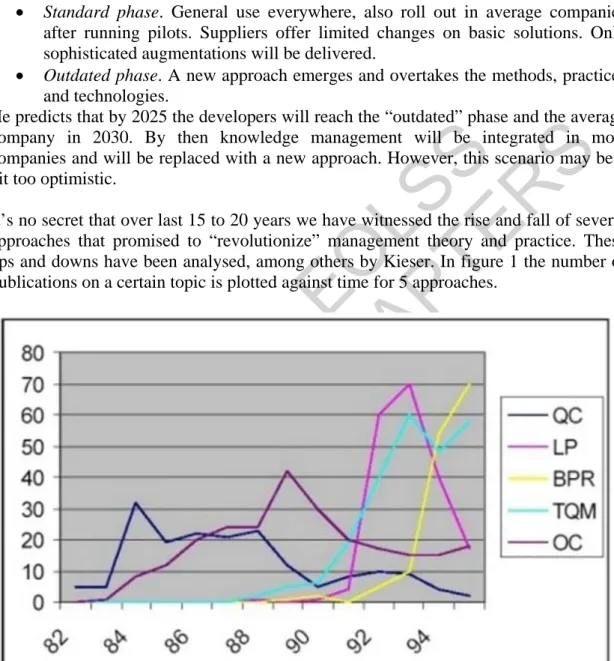
It’s no secret that over last 15 to 20 years we have witnessed the rise and fall of several approaches that promised to “revolutionize” management theory and practice. These ups and downs have been analysed, among others by Kieser. In figure 1 the number of publications on a certain topic is plotted against time for 5 approaches.
Figure 1: Number of publications per year for different management topics QC= Quality Circles (intermediate purple line)
LP = Lean production (light purple line)
BPR = Business Process Reengineering (yellow line) TQM = Total Quality Management (blue line) OC = Organisational Culture (dark purple line)
UNESCO – EOLSS
SAMPLE CHAPTERS
As can be seen in Figure 1, almost all topics exhibit a rise and fall pattern. As the time scale is only to 1995, the “fall” is not (yet?) visible for TQM and BPR. However, a comparable graph compiled by Jackson, running until 1999 suggests that for BPR the high water mark was indeed 1994-1995 and that after this a decline occurred. Figure 1 also shows that the “cycle time” for fashions is around 6-10 years, which is far shorter than predicted by Wiig.
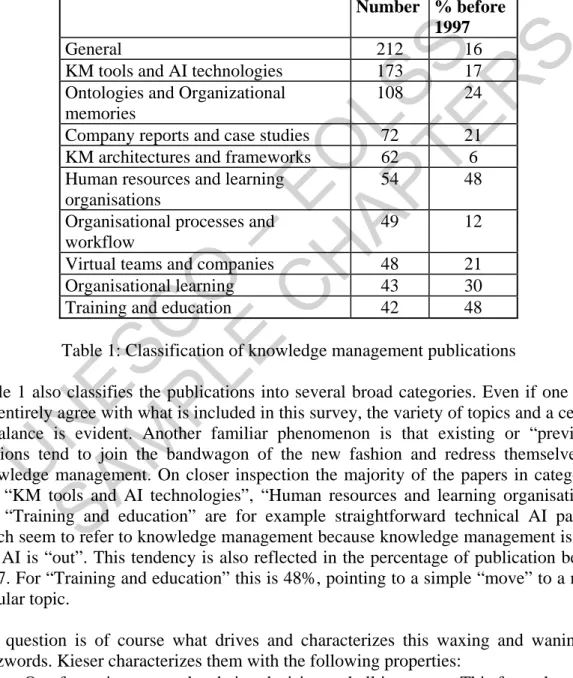
When we take knowledge management we can draw upon an overview of the knowledge management literature, compiled and periodically updated by Eric Tsui, See Table 1. His 2000 overview shows an enormous explosion of publications about knowledge management since the mid 1990’s.
Number % before 1997
General 212 16
KM tools and AI technologies 173 17
Ontologies and Organizational memories
108 24
Company reports and case studies 72 21
KM architectures and frameworks 62 6
Human resources and learning organisations
54 48 Organisational processes and
workflow
49 12
Virtual teams and companies 48 21
Organisational learning 43 30
Training and education 42 48
Table 1: Classification of knowledge management publications
Table 1 also classifies the publications into several broad categories. Even if one does not entirely agree with what is included in this survey, the variety of topics and a certain imbalance is evident. Another familiar phenomenon is that existing or “previous” fashions tend to join the bandwagon of the new fashion and redress themselves as knowledge management. On closer inspection the majority of the papers in categories like “KM tools and AI technologies”, “Human resources and learning organisations” and “Training and education” are for example straightforward technical AI papers, which seem to refer to knowledge management because knowledge management is “in” and AI is “out”. This tendency is also reflected in the percentage of publication before 1997. For “Training and education” this is 48%, pointing to a simple “move” to a more popular topic.
The question is of course what drives and characterizes this waxing and waning of buzzwords. Kieser characterizes them with the following properties:
• One factor is presented as being decisive and all important. This factor has been neglected in the past.
UNESCO – EOLSS
SAMPLE CHAPTERS
• Applying the new principles and ideas is unavoidable, given the new and uniquechallenges.
• The principles put forward will help the organization to achieve highly valued goals.
• Communication about the new principles is most of the time not through explicit instruction but through pointing at remarkable results achieved in high-profile companies.
• The principles are at the same time simple and clear, as well as vague,
contradictory and confusing,
• Applying the principles is very difficult and many organisations fail. However, the ones that succeed, realise “enormous” improvements.
• Most of the time a detailed description of methods and techniques is lacking, which makes applying them without the support of a “guru” or an employee of the guru’s company almost impossible.
To this list two other features are added by Abrahamson:
• a weak theoretical foundation and lack of scientific empirical evidence
• a strong tendency to forget the history of concepts and ideas
A striking, and somewhat depressing, example of a loose attitude towards empirical evidence is provided by Nonaka. Without doubt the most cited knowledge management book is written by Nonaka & Takeuchi. This is mostly based on the successes of Japanese economy in the 1980’s. It’s no secret that this same Japanese economy is in a deep and continuing crisis since the early 1990’s. So when Nonaka’s new book appeared one is very curious about how the author’s will deal with this new evidence. Below I have cited the only place in the book where they refer to this:
“The Knowledge Creating Company might have succeeded in formalizing the generic model of knowledge creation and demonstrating that Japanese companies had become successful, especially in the 1980s, because of their skills and expertise at organizational knowledge creation. Since then, Japanese companies have been faced with the longest and most severe recession in recent history. This could undermine the importance of organizational knowledge creation. We contend, however, that the recent setback of many Japanese companies was due to their limited attention to enabling conditions for organizational knowledge creation. As a result they have failed in creating organizational knowledge consistently”
In scientific parlance this amounts to saying that if you have a theory that predicts certain events, but the events turn out to be different from the ones predicted, the events are to blame.
In my opinion it is necessary to “de guru” knowledge management and turn it into a scientific discipline. In the next sections I will try to sketch a possible foundation for such a discipline. This foundation is based on two cornerstones:
• the characteristic and challenging properties of knowledge as an organisational resource
• the nature of the management process that has to handle this resource I will deal with each of them in turn.
UNESCO – EOLSS
SAMPLE CHAPTERS
2. Characteristic properties of knowledge
The foundation of such a discipline should lie in the peculiar properties of knowledge as a resource, properties that are sufficiently different from those of other resources to warrant the development of a separate approach.
A closer look at those properties show that they are not all favourable, which seems sometimes being taken for granted.
Positive
• Growth through use, instead of being consumed. By applying knowledge agents can increase their knowledge by absorbing new insights or by replacing obsolete knowledge by more up-to-date knowledge. At the same time, using the knowledge does not “destroy” it.
• Non-rival. Knowledge can be used simultaneously in different processes.
• No natural/physical limits. Apart from the energy needed by agents handling knowledge there is no natural or physical limit to the amount of knowledge.
• Free from location and time constraints. Knowledge can be applied anywhere and at any time, when needed. It is only weakly tied to a physical substrate other than the agent that embodies the knowledge.
Negative
• Embodied in agents with a will. Mostly knowledge is embodied in agents with a will of their own: humans. This makes the accessibility and applicability sometimes difficult, as the willingness of these agents is an important factor in using the knowledge.
• Intangible and difficult to measure. W cannot directly point to “knowledge” as physical quantity. And we cannot see it easily we cannot measure it in a straightforward manner. This makes “controlling” it a major challenge.
• Volatile. Apart from the fact that knowledge is often embodied in humans, which are free to leave your organisation, sudden discontinuities in social, scientific and organisational areas can make knowledge obsolete.
• Value paradox. Boisot has pointed out that knowledge suffers from a value paradox. In order to extract value from knowledge we have to codify, abstract and diffuse it. But in this process knowledge will loose it’s scarcity and as a consequence the opportunity to extract value from it.
• Long lead times. Knowledge cannot be conjured out of a hat. Mostly it takes years to build expertise in a certain domain. This requires long term planning[A
telling example comes from the Netherlands. In the 1980’s the Dutch government cut the salary of new teachers in half. As a consequence the inflow of students to teacher educations dropped dramatically. Now, 15 years later there is a large shortage of teachers. To remedy this, many different measures are proposed and implemented (ironically also a substantial increase in salaries), but as it takes at least 8 to 10 years to “build” a qualified teacher, major results are not to be expected before 2010.].
UNESCO – EOLSS
SAMPLE CHAPTERS
As can be easily seen from the two lists above, having knowledge as an organisational resource is mixed blessing, something that is easily overlooked in the current euphoria about knowledge management. Quite some effort is needed to offset the negative features and capitalize on the positive ones. This is precisely the challenge for knowledge management and knowledge management should be judged by its ability to do just that.
- - -
TO ACCESS ALL THE
16 PAGES
OF THIS CHAPTER,
Visit:
http://www.eolss.net/Eolss-sampleAllChapter.aspx
Bibliography
Abrahamson, E. (1991). Management fads and fashions: the diffusion and rejection of innovations. Academy of Management Review, 16(3), 586-612. [One of the first papers dealing with the waxing and waning of management fashions]
Abrahamson, E. (1996). Management fashion. Academy of Management Review, 21(1), 254-285. [Extension of the 1991 paper. Discusses several theories that can account for the fashion phenomenon.]
Boisot, M.H. (1998). Knowledge assets, 284 pp. Oxford University Press, Oxford. [Insightful and penetrating analysis of knowledge from the perspective of economics. Emphasizes importance of knowledge in a sustainable world.]
Collins, D. (2000). Management fads and buzzwords, 413 pp. Routledge, London. [Penetrating analysis of a wide range of management topics. Based on a sociological approach which is rooted in the critical tradition. A strong point is its continuing reference to how work is done, instead of overstylized representations of work in the guru management literature. Complements book by Jackson.]
De Hoog, R., G. van Heijst, R. van der Spek, J.S. Edwards, R. Mallis, B. van der Meij & R.M. Taylor (1999). Investigating a Theoretical Framework for Knowledge Management: A Gaming Approach. In: J. Liebowitz (Ed), Knowledge Management Handbook. CRC Press, Boca Raton, 10-1 - 10-18. [One of the first papers that report on systematic research into a knowledge management game. The game is a paper precursor of KMQuest.]
Edvinsson, L. & M.S. Malone (1997). Intellectual capital, 225 pp. HarperBusiness, NY. [A good overview of how one could use measurable indicators for knowledge management performance. Based on the well known Skandia approach to intellectual capital.]
Jackson, B. (2001). Management gurus and management fashions, 208 pp. Routledge, London. [Analyses management gurus using concepts from rhetorical criticism. Emphasis is on the different themes that are employed by guru-like management authors. Complements the book by Collins.]
Kieser, A. (1997). Rhetoric and myth in management fashion. Organization, 4(1), 49-74.[Investigates publication patterns as indicators of popularity of management topics.]
Nonaka, I. & H. Takeuchi (1995). The Knowledge Creating Company: How Japanese companies create the dynamics of innovation, pp 286. Oxford University Press, New York. [Probably the most cited knowledge management books, in particular the distinction between implicit and explicit knowledge.
UNESCO – EOLSS
SAMPLE CHAPTERS
Quite often it is overlooked that this distinction is only a building block for a more encompassing theory about knowledge creation. This theory is more interesting than the distinction.]Sveiby, K.E. (1997). The New Organizational Wealth. Managing & Measuring Knowledge-Based Assets, 275 pp. Berrett-Koehler, San Francisco. [Sveiby is the pioneer for measuring intangible assets. This book still gives a good overview of his ideas.]
Tiwana, A. (2000). The Knowledge Management Toolkit. Practical Techniques for Building a Knowledge Management System, 608 pp. Prentice Hall, Upper Saddle River, NJ. [Among the enormous pile of books on knowledge management this probably the most practical one. It is rich in advice, guidelines and technologies. May the emphasis on a “knowledge management system” could lead readers into the trap of thinking that it’s all in the “system”.]
Tsui, E. (2000). Bibliography on Knowledge Management V5.0.. To obtain from Eric Tsui (CSC & University of Sydney), e-mail: [email protected]. [A list of publications. Good for reference, even if one does not agree with including all the entries under the flag of knowledge management.]
Van der Spek, R. & R. de Hoog (1995). A framework for a knowledge management methodology. In: K.M. Wiig, Knowledge management methods. Practical approaches to managing knowledge. Schema Press, Arlington TX, 379-393. [Contains a first sketch for a framework that is partly re-used for this paper.]
Von Krogh, G., K. Ichijo & I. Nonaka (2000). Enabling knowledge creation, 292 pp. Oxford University Press, New York. [The follow up of the first book by Nonaka & Takeuchi. As the title indicates, it is more directed towards the contextual factors influencing knowledge creation. This leads to a somewhat less convincing theoretical underpinning and a strong reliance on cases studies.]
Wiig (1997), Knowledge management: where did it come from and where it will go? Expert Systems With Applications, 13(1), 1-14. [Pioneer Karl Wiig gives an overview of the rise of knowledge management since the early 1990’s. Provides also a look into the future of knowledge management.]
Wiig, K.M., R. de Hoog & R. van der Spek (1997). Supporting Knowledge Management: A Selection of Methods and Techniques. Expert Systems With Applications, 13(1), 15-27. [A more elaborate sketch of the framework that is used in this paper.]
Biographical Sketch
Robert de Hoog is Professor of Knowledge Management at the University of Twente and Associate
Professor of Social Science Informatics at the University of Amsterdam, both in The Netherlands. He holds a Ph.D. in Political Science but since the early 1980’s he has worked in the area of human-computer cooperation, in particular decision support systems and expert systems. His research is carried out most of the time in the frame of research and development projects partly funded by the European Union. These projects are characterized by a close cooperation between academia and companies. One of the best known results of these projects is the CommonKADS methodology for expert system development and knowledge modeling. A book about this methodology he co-authored, was published in 2000 by the MIT Press. Since the early 1990’s he has written about knowledge management. Currently he is involved in the EU funded KITS project which is developing an interactive learning and simulation game for teaching knowledge management. He has produced more than 100 papers and books covering a wide variety of topics.