® IEEE 2019
Accepted for the 2019 International Joint Conference on Neural Networks
Not All Adversarial Examples Require a Complex
Defense: Identifying Over-optimized Adversarial
Examples with IQR-based Logit Thresholding
Utku Ozbulak
1,3Arnout Van Messem
2,3Wesley De Neve
1,31Department of Electronics and Information Systems, Ghent University, Belgium
2Department of Applied Mathematics, Computer Science and Statistics, Ghent University, Belgium 3Center for Biotech Data Science, Ghent University Global Campus, Republic of Korea
{utku.ozbulak,arnout.vanmessem,wesley.deneve}@ugent.be
Abstract—Detecting adversarial examples currently stands as
one of the biggest challenges in the field of deep learning. Ad-versarial attacks, which produce adAd-versarial examples, increase the prediction likelihood of a target class for a particular data point. During this process, the adversarial example can be further optimized, even when it has already been wrongly classified with
100%confidence, thus making the adversarial example even more difficult to detect. For this kind of adversarial examples, which we refer to asover-optimizedadversarial examples, we discovered that the logits of the model provide solid clues on whether the data point at hand is adversarial or genuine. In this context, we first discuss the masking effect of the softmax function for the prediction made and explain why the logits of the model are more useful in detecting over-optimized adversarial examples. To identify this type of adversarial examples in practice, we propose a non-parametric and computationally efficient method which relies on interquartile range, with this method becoming more effective as the image resolution increases. We support our observations throughout the paper with detailed experiments for different datasets (MNIST, CIFAR-10, and ImageNet) and several architectures.
I. INTRODUCTION
Even though deep convolutional architectures outperform other models on various image-related problems such as image classification [1], object detection [2], and segmentation [3], it has been shown that these models are not foolproof. A recent development called adversarial examples currently counts as one of the major issues these models are facing. Adversarial examples were first discovered by [4] while searching for intriguing properties of neural networks. Although there is no clear definition ofadversarial example, we will say that a data point is called adversarial if it is perturbed to be misclassified. The earliest methods to generate adversarial examples mostly rely on optimizing an input for a specific target class using a gradient-based algorithm, hence forcing the data point under consideration to be classified in another category [4, 5].
To improve the effectiveness of adversarial example gener-ation, a variety of methods based on different optimization techniques were introduced. Some examples are: finding the closest distance to the decision boundary [6], Fast-Gradient Sign (FGS) [7], Jacobian-based Saliency Maps (JSMA) [8], and the recently introducedCarlini & Wagner attack(CW) [9]. The latter is currently regarded as the strongest attack, given that it can incorporate defense mechanisms into the optimiza-tion procedure, thus making it possible to generate strong adversarial examples that are able to circumvent these defense mechanisms [9].
As attacks get more effective with every study, new defense mechanisms are also introduced to counter them. The intuitive approach of adversarial re-training was the first method tested to prevent this problem [7]. [10] applied adversarial re-training on ImageNet [11] and found that it counters certain attacks. Another mechanism to prevent adversarial examples was intro-duced by [12], showing that network distillation provides some defense against adversarial examples generated with JSMA. [13] suggested extracting a binary threshold from the output of each rectifier layer (ReLU) and utilizing these thresholds with a quantized radial basis support vector machine detector to distinguish adversarial examples from genuine images. The most impactful research on adversarial defense mechanisms has thus far been performed by [14], who showed that none of the proposed defense mechanisms so far are effective against strong attacks and that the properties of currently available defense mechanisms do not scale well to higher resolution images, e.g., from MNIST images to ImageNet images.
[14] further argued that defense mechanisms should be evaluated against strong attacks and that they need to demon-strate that white-box attacks can be prevented. In this context, an attack is said to be white-box in nature if the attacker has access to the specifications of the model (weights and
classes) and is aware of the defense mechanism. However, assuming the attacker has access to both the model and the defense mechanism presents an unfair challenge to the defender. Indeed, the knowledge about the model and the defense mechanism can then be incorporated into an attack, making it possible to generate adversarial examples that have been carefully designed to avoid the defense mechanism under consideration. In their evaluation of defense techniques, [14] put two constraints on the generation of adversarial examples, namely (1) discretization and (2) the amount of perturbation. We believe this approach may lead to results that need to be carefully interpreted because, as we will show in this paper, it is trivial to distinguish natural images from heavily optimized adversarial examples based on logit values. Therefore, we claim that not all adversarial examples necessarily require a complex defense mechanism and that, in fact, a significant number of them can already be detected by analyzing the logits of the prediction.
Contributions:In summary, our work makes the following contributions:
• We discuss the masking effect of the softmax function, hiding the magnitude of the predicted logit value. This observation lays the foundation for a novel technique for identifying adversarial examples, as discussed in more detail in the remainder of this paper.
• We show that attack mechanisms may generate what we callover-optimizedadversarial examples. These adversar-ial examples, which have extremely high logit outputs, can be easily identified when the logits of the prediction are analyzed.
• We introduce a non-parametric method to calculate a logit threshold from training data. This threshold can then be used to identify over-optimized adversarial examples. • When the resolution of an image increases, we show
that the subspace in which adversarial examples can be generated also increases substantially. Furthermore, unlike some of the proposed defense techniques, our method is able to identify more and more adversarial examples as the resolution of the given image increases. We provide evidence for these observations by making use of the MNIST, CIFAR-10, and ImageNet datasets. II. IMPACT OFADVERSARIALOPTIMIZATION ONLOGITS
Methods for adversarial example generation use specific optimization techniques to increase the chance a given input is labeled with the targeted class. Most of the proposed opti-mization techniques are iterative in nature. Indeed, it has been shown that these techniques produce more effective adversar-ial examples with less perturbation, compared to single-step optimization techniques or techniques that facilitate untargeted attacks [15].
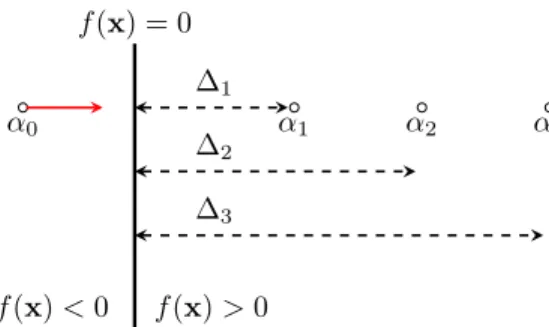
We can simplify the behavior of targeted iterative optimiza-tion techniques as follows: assume that we have an affine clas-sifier in a two-dimensional setting,f(x) :R2→
R, separating the input space into two subspaces f(x)>0 andf(x)<0, with the line f(x) = 0denoting the decision boundary. This
f(x) = 0 f(x)>0 f(x)<0 α0 ∆1 α1 ∆2 α2 ∆3 α3
Fig. 1: An illustration of adversarial examplesα{1,2,3}, derived from an inputα0, for an affine classifier f(x) = 0, and their
respective distances ∆{1,2,3} =d(α{1,2,3}, f) to the decision boundary f.
setting is shown in Fig. 1. Under these circumstances, when the given exampleα0 is iteratively optimized towards f(x)>0,
the distances∆{1,2,3}between the generated adversarial points α{1,2,3}and the decision boundary are increased at each step, with the goal to increase the likelihood that the data point under consideration (that is, α0) is classified asf(x)>0. To
that end, it does not matter whether the attack uses the logits of the model (like CW) or not, given that the overall impact of the optimization techniques used on the logits remains the same. A more detailed explanation of adversarial optimization and its impact on the decision boundary for multi-class classifiers can be found in [6].
In this study, we consider two targeted attacks: (1) Basic Iterative Method [16], a fast attack that arguably generates
weak adversarial examples, and (2) CW, a slow attack that generates strongadversarial examples.
A. Basic Iterative Method
Basic Iterative Method, also referred to as Iterative Fast Gradient Sign (I-FGS), finds its origin in the FGS method proposed in [7]. FGS performs a one-step update on the input along the direction of the gradient:
xn+1=xn−αsign(∇xJ(g(θ,xn)c),
where sign(∇xJ(.)) is the signature of the gradient of the
cross-entropy error function and α is the perturbation multi-plier. This method is characterized as fast since it does not require an iterative approach.
[16] extended FGS into I-FGS, proposing to use a lower value forαand to iteratively update the input image:
xn+1=ClipX,(xn−αsign(∇xJ(g(θ,xn)c).
In the above equation, the clipping function makes sure that the resulting adversarial example is a valid image. Furthermore, the parameter controls the maximally allowed amount of perturbation per pixel.
FGS, along with its extension I-FGS, is one of the most commonly used adversarial attacks to test adversarial defense mechanisms. However, in this study, we opted for I-FGS over FGS because I-FGS is shown to produce stronger adversarial examples [16].
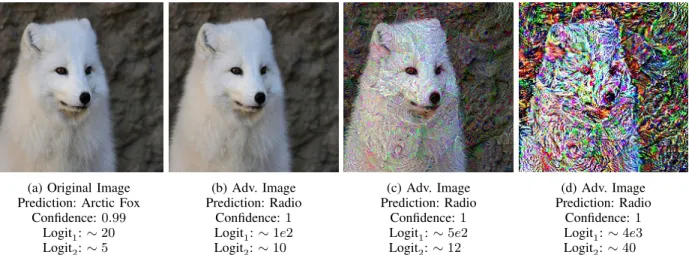
(a) Original Image Prediction: Arctic Fox
Confidence:0.99 Logit1:∼20 Logit2:∼5 (b) Adv. Image Prediction: Radio Confidence:1 Logit1:∼1e2 Logit2:∼10 (c) Adv. Image Prediction: Radio Confidence:1 Logit1:∼5e2 Logit2:∼12 (d) Adv. Image Prediction: Radio Confidence:1 Logit1:∼4e3 Logit2:∼40
Fig. 2: (a) Original image, predicted asarctic foxwith0.99confidence. (b)-(c)-(d) Over-optimized adversarial examples which are predicted with the same confidence but with vastly different logit values by ResNet-50. Logit1 and Logit2 represent the logits of the most likely and second most likely predictions, respectively.
B. Carlini & Wagner Attack
Even though FGS and I-FGS can generate adversarial examples with a high success rate, the main focus of these methods is not to producestrongadversarial examples. In [9], Carlini and Wagner proposed a heavily optimized attack which produces strong adversarial examples that can bypass defense mechanisms easily. In this study, we use the L2 version of
CW, which was also used by Carlini and Wagner to test the robustness of defense techniques [14]. The L2version of CW
is defined as follows:
miminize ||x−(x+δ)||2
2+α `(x+δ),
where this attack attempts to find a small perturbationδthat is sufficient to change the prediction made by the model when it is added to the input, while keeping the L2 distance between
the original image x and the perturbed image x0 = x+δ minimal.
In their original work [9], they discussed multiple loss functions for this kind of attack, and in this study, we use the loss function they preferred in their later work [14] to evaluate multiple defense mechanisms. This loss function`is constructed as follows:
`(x0) = max{max{g(θ,x0)i:i6=c} −g(θ,x0)c,−K} ,
(1) comparing the logit prediction of the target class with the logit prediction of the next-most-likely class. This method can also be tuned using K to adjust the strength of the adversarial example produced. Specifically, as K increases, the confidence of the prediction for the adversarial example also increases. They refer to this kind of adversarial examples as high-confidence adversarial examples.
III. MASKINGEFFECT OF THESOFTMAXFUNCTION When the prediction of a neural network is analyzed, the output is usually represented in terms of probabilities. Such probability is usually referred to as the confidence of the
prediction made. To convert logit values into probabilities, a normalized exponential function called the softmax function P(u)k=
euk PM
m=1eum
is used, whereuis an input vector such thatu= (u1, . . . , uM)T ∈RM andkis the selected index of the vector u[17, 18, 19]. In particular, the softmax function uses the exponential function to squeeze the input values between zero and one in such a way that the output values add up to one. This property makes the softmax function helpful in more easily interpreting the predictions of a neural network, instead of having to rely on the logits, which are more difficult to interpret.
The usage of the softmax function for convolutional neural networks dates back to 1998 [20], soon thereafter becoming a common tool to convert logits into probabilitistic values. However, when investigating adversarial examples, the soft-max function, when used in settings with limited decimal precision, has a major drawback for correctly interpreting the predictions of a neural network: it lacks sensitivity to positive changes in the magnitude of the largest logit. We detailed this discovery and its impact on adversarial examples in a previous study [21].
A. Experimental Results on the Masking Effect of Softmax
To show a practical outcome of the aforementioned limita-tion of the softmax funclimita-tion for neural networks, we present Fig. 4, showing a mock-up two-class classification problem that visualizes the masking effect of the softmax function. A neural network yˆ = g(θ,x) with a single hidden layer and ReLU activations is applied to this problem. The approximate decision boundary is indicated using a dashed line. For those points lying on the orange line (x2 = 0), Fig. 4 displays
both the predicted logit valuemax(g(θ,x))and the predicted outcome probability max(P(g(θ,x))). It can be seen from Fig. 4 that the logit values increase as the distance between the point under consideration and the classification boundary
0
20
40
60
80
100
Iteration
0
5e1
1e2
1.5e2
2e2
2.5e2
Logit Value
0
0.2
0.4
0.6
0.8
1
Softmax Output
Softmax MeanSoftmax 95% Confidence Interval Logit Mean
Logit 95% Confidence Interval
(a) I-FGS
0
20
40
60
80
100
Iteration
0
5e1
1e2
1.5e2
2e2
2.5e2
Logit Value
0
0.2
0.4
0.6
0.8
1
Softmax Output
Softmax MeanSoftmax 95% Confidence Interval Logit Mean
Logit 95% Confidence Interval
(b) CW
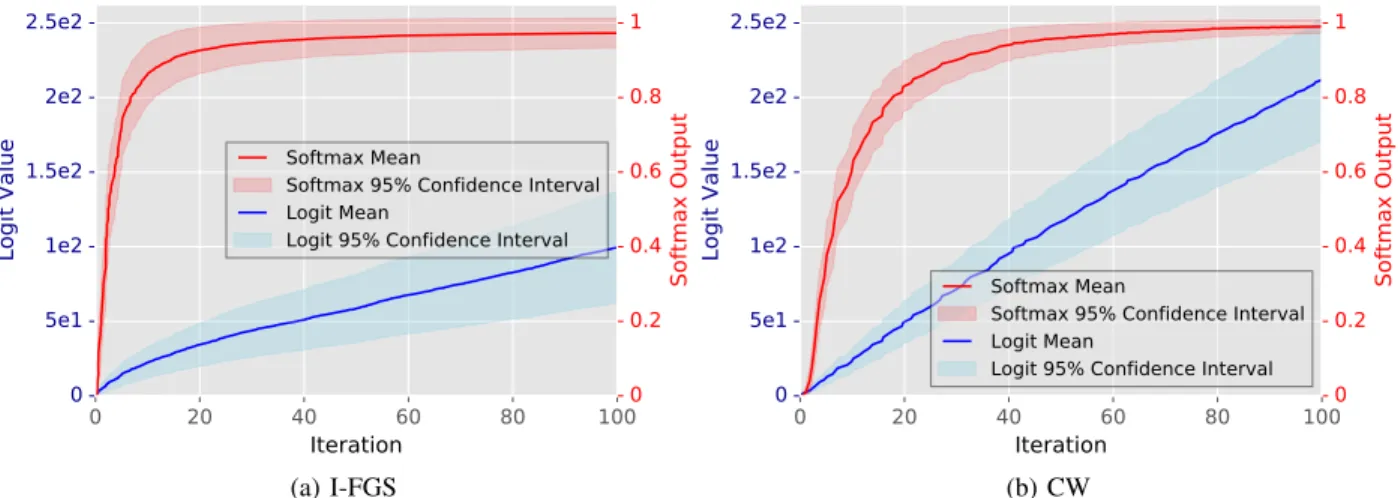
Fig. 3: Highest logit value and corresponding softmax output as a function of the number of iterations when generating adversarial examples with (a) I-FGS and (b) CW. Adversarial examples are tested on ResNet-50 in a white-box setting. Best viewed in color. -10 -7.5 -5 -2.5 0 2.5 5 7.5 10 -4 -2 0 2 4
x
2 -10 -7.5 -5 -2.5 0 2.5 5 7.5 10 x1 0 10 20m
ax
(ˆ
y
)
0 0.5 1 m ax ( P (ˆ y ))Logits (before Softmax)
Prediction Probability (after Softmax)
Fig. 4: A linearly separable two-class classification problem, highlighting the saturation of the softmax output, as opposed to the logit values, which keep increasing. Best viewed in color.
increases. However, the softmax output, after a certain point, remains the same and bounded.
Another demonstration of the aforementioned limitation of the softmax function for natural images can be observed in Fig. 2. In this figure, we provide an original image, classified as arctic fox with a confidence value of 0.99, and three adversarial counterparts, all of which are classified as radio
with a confidence value of1, and where classification is done by a pretrained ResNet-50 [1]. All three adversarial examples have been over-optimized in order to produce increasing logits at each step. However, the softmax output for all of them remains the same, masking the increase in the logit values.
In Fig. 3, we present observations for multiple adversarial examples, showing the mean and the confidence interval of the highest logit value of 1000adversarial examples and their corresponding softmax output. The1000adversarial examples were generated by making use of I-FGS and theL2version of
the CW, using 100 optimization steps in a white-box setting. For I-FGS, we perturb the image one pixel at a time, and for CW, we useK= 40in Eq. 1. The increase in the logit values
for I-FGS is less pronounced than for CW since I-FGS relies on the signature of the gradient, which removes the precision in the perturbation between pixels. On the other hand, the spike in the confidence for I-FGS appears faster than for CW because the latter comes with a multi-class optimization nature and implements an extensive search process. Fig. 3 clearly shows the masking effect of softmax, given that the confidence almost immediately jumps to 100% after only a couple of iterations, making it from this point onwards impossible to differentiate between consecutive adversarial examples, whereas logit values keep increasing over the course of the optimization.
The results provided in Fig. 3 can be generalized to other targeted iterative adversarial example generation methods [5, 9, 4, 8, 16]. These iterative methods make it possible to further optimize an adversarial example (in terms of the logits), even after obtaining full confidence. However, once the prediction confidence is mapped to one, it is impossible to differentiate between the next iterations of the adversarial example based on the softmax output. Indeed, as the corresponding softmax input (i.e., logit values) keeps increasing, the softmax output will remain the same.
We refer the reader to our previous work which details the masking effect of the softmax function in the case of both single-target and multi-target adversarial attacks [21].
IV. IDENTIFYINGADVERSARIALEXAMPLES Targeted attacks, in every form, focus on maximizing an activation; for neural networks, this activation is the logit value for a particular class. Unless this optimization is stuck in a local maximum, we can say that g(θ,xi+1)c ≥ g(θ,xi)c,
wherec is the targeted class. Ifx is a data point that is the subject of box constraints, then this activation can only be maximized up to a certain point. Let xr be a hypothetical
genuine image that achieves the highest logit value for its category in supervised settings. We are interested in finding the numerical value ofg(θ,xr)c, as this will allow us to label
0 5 10 15 20 Logit Value 0 0.05 0.1 0.15 0.2 0.25 Density Training Distribution Test Distribution
(a) Dataset: MNIST Model: LeNet-5 0 10 20 30 40 50 60 Logit Value 0 0.05 0.1 0.15 0.2 0.25 Density Training Distribution Test Distribution (b) Dataset: CIFAR-10 Model: Extended LeNet-5
10 20 30 40 50 60 Logit Value 0 0.05 0.1 0.15 0.2 0.25 Density Training Distribution Test Distribution (c) Dataset: ImageNet Model: VGG-16 10 20 30 40 50 60 Logit Value 0 0.05 0.1 0.15 0.2 0.25 Density Training Distribution Test Distribution (d) Dataset: ImageNet Model: ResNet-50
Fig. 5: Density plots of logit values of the prediction for ten classes, observed for both seen and unseen examples of the (a) MNIST, (b) CIFAR-10, and (c), (d) ImageNet datasets. We used LeNet-5 with ReLU activation [20], Extended LeNet-5 [12, 14], VGG-16 [22], and ResNet-50 [1] to obtain these results. For ImageNet, ten classes were selected randomly. Our models achieved 98%,80%, 70.5%, and77% top-1 accuracy on the respective datasets. These results are comparable to the results presented in [1, 12, 14, 22].
Dataset (Model) 1.5IQR 2IQR 3IQR 4IQR 5IQR kmin
MNIST (LeNet-5) 0.1% 0.004% 0% 0% 0% 2.2
CIFAR-10 (Extended LeNet-5) 1.7% 0.6% 0.07% 0.01% 0% 4.9
ImageNet (VGG-16) 1.1% 0.3% 0.03% 0.004% 0% 4.6
ImageNet (ResNet-50) 0.7% 0.1% 0.009% 0% 0% 3.9
ImageNet (Inception-v3) 1.2% 0.4% 0.07% 0.001% 0% 4.9
TABLE I: Percentage of genuine images incorrectly identified as outliers, as obtained for different values ofkin the following calculation: g(θ,x)> Q? 3+k IQR. Thresholds are calculated from correctly classified training examples for each class and
tested on both training and test examples.kmin is the smallest value ofk needed to ensure that none of the examples in the
training and the test set are incorrectly identified as outliers. any data point that produces a higher logit value than this value as an adversarial example without any further evaluation. To that end, in order to come up with an effective method to estimateg(θ,xr)c, we first analyze the prediction distributions
of genuine images in terms of logit values.
A. Logit Distributions
In order to come up with a robust method for countering adversarial examples (that is, a method that works for all models across all datasets), we first analyze the logit dis-tribution of genuine images. A reoccurring problem in the field of adversarial examples is the usage of low-resolution images to show the effectiveness of a defense mechanism. Indeed, not all of the defense techniques for low-resolution images transfer to high-resolution images [14]. For this reason, we investigate the effectiveness of our method for MNIST, as well as for CIFAR-10 and ImageNet. In this context, we present Fig. 5, which shows the densities of predicted logit values for correctly classified samples of ten classes taken from MNIST, CIFAR-10, and ImageNet, for both training and test datasets. In the case of ImageNet, we present the distribution for both VGG-16 and ResNet-50. We can observe that the distributions of the logit values change between different datasets and between different classes/labels. On top of that, the distributions are vastly different for different architectures (VGG-16 and ResNet-50), even when the same dataset is used.
Keeping the aforementioned observations in mind, we arrive at the following conclusions: (a) the proposed method should be distribution-free so that it can be generalized across multi-ple datasets and multimulti-ple models, and (b) since the distribution of logit values also changes between different classes, the computational complexity of the proposed method should be low.
B. Determining the Threshold
Considering that datasets only contain a limited number of representations (per class), it is highly unlikely that the hypothetical genuine image that attains the highest activation is present in the dataset. However, we can estimate a threshold based on the activations of the observations at hand. A critical point in determining this threshold is to make sure that none of the existing images in the dataset is labeled as adversarial, as it is more important not to cast doubt on good observations than to miss an outlier [23, 24]. The same point is also highlighted by [14] when evaluating defense mechanisms.
As we showed previously, the logit value distributions are vastly different. Hence, when identifying outliers, we want to avoid any method that (implicitly or explicitly) makes assumptions on the data distribution. Therefore, based on the idea of boxplots, we propose using the interquartile range (IQR) to determine the threshold for identifying outliers (i.e., identifying adversarial examples). The IQR is defined as the difference between the 75th percentile (Q3) and the 25th
0
1
2
3
4
5
6
7
8
9
Class/Label
0
10
20
30
40
50
Logit Value
(a) Dataset: MNIST Model: LeNet-5
0
1
2
3
4
5
6
7
8
9
Class/Label
0
50
100
150
200
250
300
350
Logit Value
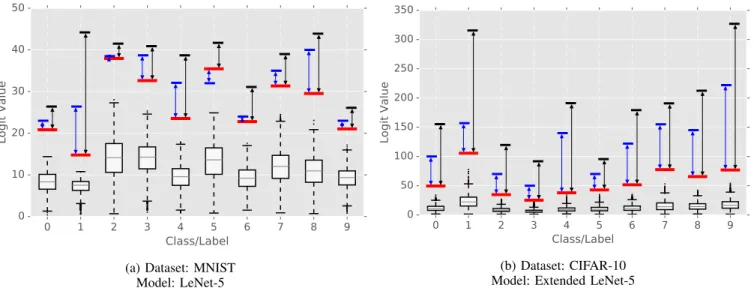
(b) Dataset: CIFAR-10 Model: Extended LeNet-5Fig. 6: Illustration of adversarial subspaces with high logit values for (a) MNIST and (b) CIFAR-10. Logit value distributions of the predictions for the genuine images from the training set are given in the form of boxplots. The calculated thresholds and the highest logit value of the adversarial examples generated with I-FGS and the CW are highlighted as red, blue, and black lines, respectively. The adversarial spaces found using our method are indicated with arrows. Best viewed in color. percentile (Q1):IQR=Q3−Q1. In basic statistical analysis,
outliers are generally defined as those points that lie beyond the whiskers of the boxplot (i.e., belowQ1−k IQRor above
Q3+k IQR). Traditionally, k is set to 1.5 [25], in which
case the outliers are referred to as mild. We are, of course, only interested in large positive outliers. In this context, the authors of [23], [24], and [25] recommend using k = 3 for determiningextremeoutliers (i.e., highly unusual data points). Since we do not exactly know the underlying distribution of the logits, we experiment with different k values.
For each class, we calculateQ3+k IQR as the threshold
from the training sets of the aforementioned datasets and we present the percentage of misidentified images for the test datasets. Specifically, in Table I, we show the percentage of genuine images that are misindentified asoutliers(i.e., adver-sarial examples) by the calculation g(θ,x) > Q? 3+k IQR,
for different values of k. In the case of ImageNet, we present results for three different architectures, namely, VGG-16, ResNet-50, and Inception-V3 [22, 1, 26]. Based on these results, we can observe thatk= 3is mostly sufficient for most of the architectures, as the percentage of misidentified genuine images is, at most, as low as0.07%(this corresponds to only 35images in the test dataset of ImageNet). Nevertheless, it is also reasonable to prefer a threshold that does not reject any
genuine image at all. In that regard, we can easily findkminfor
different datasets and models, given that the proposed method is non-parametric in nature, which makes it straightforward to adopt this method for different problems. Additionally, by using the IQR instead of parameters such as the mean or standard deviation, which are sensitive to outliers and which make implicit assumptions about the underlying distributions, the proposed method is also more robust (i.e., not attracted by outliers). In the next section, we present experiments that
Tusker Hound Flute Poster Mower Towel Radio Lake Corn Tissue
Class/Label
10
010
110
210
310
4Logit Value
Fig. 7: Illustration of adversarial subspaces with high activa-tion for the ImageNet dataset using ResNet-50. Logit value distributions of the predictions for the genuine images from the training set are given in the form of boxplots. The calcu-lated thresholds and the highest logit value of the adversarial examples generated with I-FGS and the CW are highlighted as red, blue, and black lines, respectively. The adversarial spaces found using our method are indicated with arrows. Note that they-axis is log-scaled for clarity. Best viewed in color. show how the proposed method can be effectively used to detect over-optimized adversarial examples.
V. EXPERIMENTALRESULTS
UsingT =Q3+k IQR, we calculated logit thresholds that
do not leave out any genuine images for MNIST, CIFAR-10, and ImageNet, using thekminvalues given in Table I. For each
of MNIST and CIFAR-10; ten randomly selected classes in the case of ImageNet), we generate 500adversarial examples using I-FGS and the L2 version of the CW, totalling up to 5000 adversarial examples for each dataset, with the aim of finding an adversarial example that generates the highest logit value for that class. By doing so, we want to determine the space for which we can identifyalladversarial examples that lie between the proposed threshold and the produced logit limit for the adversarial example generation methods.
Fig. 6 and Fig. 7 show the results obtained for MNIST, CIFAR-10, and ImageNet (with ResNet-50), with the predicted logit values given in the form of boxplots and with the calcu-lated thresholds highlighted with red lines. The adversarial examples that generate the highest logit prediction values are highlighted separately for the two adversarial example generation methods, using a blue line for I-FGS and a black line for CW. We annotate the space between the proposed threshold (red) and the maximum logit value for each adver-sarial example generation method gc(θ,x)> T to show that
we can immediately identify numerous adversarial examples within this space, no matter which method is used to generate these adversarial examples. As expected, for all three datasets, the CW generatesstronger adversarial examples that produce higher logit values than I-FGS.
Note that, as the image resolution increases, the upper limit for the logit values that can be produced by an adversarial example also increases. From MNIST to CIFAR-10, this limit increases by a factor of7, and from MNIST to ImageNet, this limit increases by a factor of200. In the case of the ImageNet dataset, the increase is so high that we present the y-axis of the graph in the base ten logscale for the sake of readability.
A. Feasibility for Higher Resolution Images
As shown by Fig. 6 and Fig. 7, when the resolution of an image increases, the space in which adversarial examples can be generated also increases in a significant way. This property is also highlighted by other studies [27].
Let us define, for a given model, the effectiveness of our method as DAdv= 1 M M X c=1 g(θ,(xAdv)c)c−Tc g(θ,(xAdv)c)c , (2)
where M is the number of classes in the dataset, c is the current target class, (xAdv)c is the adversarial example that
produces the highest logit value when targeting class c, and Tc = (Q3+kmin IQR)c is the calculated threshold for the
targeted class. For each class, we calculate the space between the thresholdTc and the logit value of(xAdv)c and normalize
it by dividing by the length of the total space. This value corresponds to the proportion of the adversarial space for class c with respect to the size of the total target class that we can detect by our method. We then take the average over all classes to get an approximate idea of the proportion of the adversarial space we can detect in function of the total dataset. Thanks to the normalization factor, DAdv will allow
us to compare different dataset/model combinations, where a
Dataset (Model) Image kmin Space Covered
Resolution DAdv∈[0,1]
MNIST (LeNet-5) 1×28×28 2.2 26%
CIFAR-10 (Ext. LeNet-5) 3×32×32 4.9 68%
ImageNet (VGG-16) 3×224×224 4.6 75%
ImageNet (ResNet-50) 3×224×224 3.9 79%
ImageNet (Inception-v3) 3×299×299 4.9 89%
TABLE II: Approximate proportion of the number of adversar-ial examples detected in each dataset (calculated using Eq. 2). higher number indicates a higher effectiveness of detecting adversarial examples.
Applying this formula allows us to construct Table II, which shows the proportion of potential adversarial examples detected. Based on the results presented in Table II, we observe that the proposed method is able to detect more adversarial examples when the resolution of an image is higher.
B. Scalability and Computational Cost
In Section IV-B, we noted that the thresholds must be calcu-lated individually for each class. Naturally, when the number of classes increases, the number of thresholds that must be calculated also increases. However, since these thresholds only need to be calculated and stored once, the computational cost of the proposed method is small; it only requires one full forward pass over the train dataset, after which the thresholds can be used indefinitely.
Another strength of the proposed method is the easiness with which thresholds can be updated. When the size of a training set increases (thanks to an influx of additional data), the thresholds can simply be re-calculated.
C. Defense Against Adversarial Examples
In Section V and Section V-A, we put the emphasis on the number of potential adversarial examples countered using the proposed method. However, only using the proposed method is not a viable option to identify all adversarial examples. This is especially true in white-box settings, for which it is easy to come up with an attack that would bypass our method. Indeed, one can simply introduce a logit constraint when generating adversarial examples, making sure the generated adversarial examples produce lower logit values than the proposed thresholds. Nonetheless, our intention in proposing this method is not to use it as a universal method for detecting all adversarial examples, but rather to add it to a particular defense workflow as a first (and computationally inexpensive) line of defense for identifying adversarial examples, with these adversarial examples producing unnatural logit values that are beyond the reach of any genuine images.
Applying the proposed method ensures that adversarial example generation methods will be limited not only by the amount of perturbation and the discretization constraint, but also by the maximum logit value produced by an adversarial example. This will limit the search space extensively, espe-cially when the resolution of the images under consideration is large, as is shown in Section V-A.
VI. CONCLUSION ANDFUTURERESEARCH In this paper, we established the fundamentals for the use of logit values as an indicator of adversariality. To that end, we first discussed the masking effect of the softmax function, showing that the logit values keep increasing, even after softmax output achieving its maximum value of one during the generation of adversarial examples.
Next, we laid out examples of logit distributions from multiple datasets and showed the need for a distribution-free method to identify adversarial examples, leading to the introduction of a non-parametric and computationally cheap technique for detecting over-optimized adversarial examples. Throughout this paper, we presented experimental results for MNIST, CIFAR-10, and ImageNet, also using different neural network architectures.
The main purpose of the newly introduced defense tech-nique is to further limit the expressiveness of methods for adversarial example generation, not only in terms of pertur-bation amount, but also in terms of logits. This allows our technique to be used as a first line of defense, before triggering a well-rounded one that is more complex in nature. Therefore, future research may focus on investigating the compatibility of our technique with other defense mechanisms that are complimentary in nature.
ACKNOWLEDGEMENTS
The research activities described in this paper were funded by Ghent University Global Campus, Ghent University, imec, Flanders Innovation & Entrepreneurship (VLAIO), the Fund for Scientific Research-Flanders (FWO-Flanders), and the EU.
REFERENCES
[1] K. He, X. Zhang, S. Ren, and J. Sun, “Deep residual learning for image recognition,” in Proceedings of the IEEE conference on computer vision and pattern recog-nition, 2016, pp. 770–778.
[2] J. Redmon, S. K. Divvala, R. B. Girshick, and A. Farhadi, “You only look once: Unified, real-time object detection,”
CoRR, vol. abs/1506.02640, 2015.
[3] O. Ronneberger, P. Fischer, and T. Brox, “U-net: Convo-lutional networks for biomedical image segmentation,” in Medical Image Computing and Computer-Assisted Intervention – MICCAI 2015. Springer International Publishing, 2015, pp. 234–241.
[4] C. Szegedy, W. Zaremba, I. Sutskever, J. Bruna, D. Er-han, I. Goodfellow, and R. Fergus, “Intriguing properties of neural networks,”CoRR, vol. abs/1312.6199, 2013. [5] A. Nguyen, J. Yosinski, and J. Clune, “Deep neural
networks are easily fooled: High confidence predictions for unrecognizable images,” inProceedings of the IEEE Conference on Computer Vision and Pattern Recognition, 2015, pp. 427–436.
[6] S.-M. Moosavi-Dezfooli, A. Fawzi, and P. Frossard, “Deepfool: A simple and accurate method to fool deep neural networks,” inProceedings of the IEEE Conference
on Computer Vision and Pattern Recognition, 2016, pp. 2574–2582.
[7] I. Goodfellow, J. Shlens, and C. Szegedy, “Explain-ing and harness“Explain-ing adversarial examples,” CoRR, vol. abs/1412.6572, 2014.
[8] N. Papernot, P. D. McDaniel, S. Jha, M. Fredrikson, Z. B. Celik, and A. Swami, “The limitations of deep learning in adversarial settings,”CoRR, vol. abs/1511.07528, 2015. [9] N. Carlini and D. A. Wagner, “Towards
evaluat-ing the robustness of neural networks,” CoRR, vol. abs/1608.04644, 2016.
[10] A. Kurakin, I. Goodfellow, and S. Bengio, “Adversarial machine learning at scale,”CoRR, vol. abs/1611.01236, 2016.
[11] O. Russakovsky, J. Deng, H. Su, J. Krause, S. Satheesh, S. Ma, Z. Huang, A. Karpathy, A. Khosla, M. Bernstein, A. C. Berg, and L. Fei-Fei, “ImageNet Large Scale Visual Recognition Challenge,”International Journal of Computer Vision, vol. 115, no. 3, pp. 211–252, 2015. [12] N. Papernot, P. D. McDaniel, X. Wu, S. Jha, and
A. Swami, “Distillation as a defense to adversarial per-turbations against deep neural networks,” CoRR, vol. abs/1511.04508, 2015.
[13] J. Lu, T. Issaranon, and D. A. Forsyth, “Safetynet: Detecting and rejecting adversarial examples robustly,”
CoRR, vol. abs/1704.00103, 2017.
[14] N. Carlini and D. A. Wagner, “Adversarial examples are not easily detected: Bypassing ten detection methods,”
CoRR, vol. abs/1705.07263, 2017.
[15] A. Athalye, N. Carlini, and D. Wagner, “Obfuscated gradients give a false sense of security: Circumvent-ing defenses to adversarial examples,” arXiv preprint arXiv:1802.00420, 2018.
[16] A. Kurakin, I. Goodfellow, and S. Bengio, “Adver-sarial examples in the physical world,” CoRR, vol. abs/1607.02533, 2016.
[17] C. M. Bishop,Pattern Recognition and Machine Learn-ing. Springer, 2006.
[18] I. Goodfellow, Y. Bengio, and A. Courville,Deep Learn-ing. MIT Press, 2016.
[19] J. S. Bridle, “Probabilistic interpretation of feedfor-ward classification network outputs, with relationships to statistical pattern recognition,” in Neurocomputing. Springer, 1990, pp. 227–236.
[20] Y. LeCun, L. Bottou, Y. Bengio, and P. Haffner, “Gradient-based learning applied to document recogni-tion,”Proceedings of the IEEE, vol. 86, no. 11, pp. 2278– 2324, 1998.
[21] U. Ozbulak, W. De Neve, and A. Van Messem, “How the softmax output is misleading for evaluating the strength of adversarial examples,” NeuRIPS 2018, Workshop on Security in Machine Learning, arXiv:1811.08577, 2018. [22] K. Simonyan and A. Zisserman, “Very deep convolu-tional networks for large-scale image recognition,”arXiv preprint arXiv:1409.1556, 2014.
im-plementations of the boxplot,”The American Statistician, vol. 43, no. 1, pp. 50–54, 1989.
[24] F. R. Hampel, “The breakdown points of the mean com-bined with some rejection rules,”Technometrics, vol. 27, no. 2, pp. 95–107, 1985.
[25] J. W. Tukey, Exploratory Data Analysis. Reading, Mass., 1977, vol. 2.
[26] C. Szegedy, W. Liu, Y. Jia, P. Sermanet, S. Reed, D. Anguelov, D. Erhan, V. Vanhoucke, and A. Rabi-novich, “Going deeper with convolutions,” in Proceed-ings of the IEEE conference on computer vision and pattern recognition, 2015, pp. 1–9.
[27] C.-J. Simon-Gabriel, Y. Ollivier, B. Sch¨olkopf, L. Bottou, and D. Lopez-Paz, “Adversarial vulnerability of neural networks increases with input dimension,”arXiv preprint arXiv:1802.01421, 2018.