POUR L'OBTENTION DU GRADE DE DOCTEUR ÈS SCIENCES
acceptée sur proposition du jury: Prof. J.-Ph. Thiran, président du jury Prof. H. Bourlard, Dr S. Marcel, directeurs de thèse
Prof. T. Cootes, rapporteur Prof. J. Kittler, rapporteur
Dr V. Lepetit, rapporteur
Multivariate Boosting with Look-Up Tables for Face
Processing
THÈSE N
O5374 (2012)
ÉCOLE POLYTECHNIQUE FÉDÉRALE DE LAUSANNE
PRÉSENTÉE LE 22 JUIN 2012À LA FACULTÉ DES SCIENCES ET TECHNIQUES DE L'INGÉNIEUR LABORATOIRE DE L'IDIAP
PROGRAMME DOCTORAL EN GÉNIE ÉLECTRIQUE
Suisse 2012
PAR
i
Abstract
This thesis proposes a novel unified boosting framework. We apply this framework to the sev-eral face processing tasks, face detection, facial feature localisation, and pose classification, and use the same boosting algorithm and the same pool of features (local binary features). This is in con-trast with the standard approaches that make use of a variety of features and models, for example AdaBoost, cascades of boosted classifiers and Active Appearance Models.
The unified boosting framework covers multivariate classification and regression problems and it is achieved by interpreting boosting as optimization in the functional space of the weak learners. Thus a wide range of smooth loss functions can be optimized with the same algorithm. There are two general optimization strategies we propose that extend recent works on TaylorBoost and Variational AdaBoost. The first proposition is an empirical expectation formulation that minimizes the average loss and the second is a variational formulation that includes an additional penalty for large variations between predictions.
These two boosting formulations are used to train real-time models using local binary features. This is achieved using look-up-tables as weak learners and multi-block Local Binary Patterns as features. The resulting boosting algorithms are simple, efficient and easily scalable with the avail-able resources. Furthermore, we introduce a novel coarse-to-fine feature selection method to handle high resolution models and a bootstrapping algorithm to sample representative training data from very large pools of data.
The proposed approach is evaluated for several face processing tasks. These tasks include frontal face detection (binary classification), facial feature localization (multivariate regression) and pose estimation (multivariate classification). Several studies are performed to assess differ-ent optimization algorithms, bootstrapping parametrizations and feature sharing methods (for the multivariate case). The results show good performance for all of these tasks.
In addition to this, two other contributions are presented. First, we propose a context-based model for removing the false alarms generated by a given generic face detector. Second, we propose a new face detector that predicts the Jaccard distance between the current location and the ground truth. This allows us to formulate the face detection problem as a regression task.
Keywords:Boosting, look-up tables, multi-block Local Binary Patterns, bootstrapping,
ii
R ´esum ´e
Dans cette th`ese, nous proposons une nouvelle approche pour le traitement du visage impliquant l’apprentisage par dopage (“boosting”) de motifs binaires locaux (LBP). L’approche propos´ee aborde certaines sous-t ˆaches sp´ecifiques en traitement des visages avec un algorithme de “boosting” et un jeux de caract´eristiques identiques. Ceci est en contraste avec les approches standard qui utilisent une vari´et´e de fonctionnalit´es et de mod`eles, comme par exemple AdaBoost, des cascades et des mod`eles d’apparence actifs (Active Shape Models).
Nous proposons un cadre unifi´e pour l’apprentissage par “boosting”. Ce cadre unifi´e couvre la classification multivari´ee et les probl`emes de r´egression, et ceci est r´ealis´e en interpr´etant le “boos-ting” comme une optimisation dans l’espace fonctionel d’algorithmes d’apprentissage faible (“weak learner”). Ainsi, un large ´eventail de fonctions de co ˆut lisses (“smooth loss functions”) peuvent ˆetre optimis´ees avec le mˆeme algorithme. Il existe deux strat´egies d’optimisation g´en´erale que nous pro-posons qui s’´etendent des travaux r´ecents sur TaylorBoost et AdaBoost Variationnel. La premi`ere proposition est une formulation empiriques de l’esp´erance qui minimise la moyenne du co ˆut, et la seconde est une formulation variationnelle qui comprend une p´enalit´e suppl´ementaire pour de grandes variations entre les pr´edictions.
Ces deux formulations sont utilis´es pour entrainer des mod`eles temps-r´eel en utilisant les mo-tifs binaires locaux (LBP). Ceci est r´ealis´e en utilisant des tables de correspondance (look-up tables ou LUT) comme d’algorithmes d’apprentissage faibles et des motifs binaires locaux multi-blocs comme caract´eristiques. Les algorithmes de “boosting” obtenus sont simples, efficaces et facile-ment ´evolutif (“scalable”) avec les ressources disponibles. En outre, nous introduisons une nou-velle m´ethode de s´election des caract´eristiques dites “coarse-to-fine” pour g´erer les mod`eles `a haute r´esolution et un algorithme d’amorc¸age (“bootstrapping”) pour ´echantillonner des donn´ees d’entrai-nement repr´esentative dans de tr`es grandes quantit´es de donn´ees.
L’approche propos´ee est ´evalu´ee pour plusieurs t ˆaches de traitement du visage. Ces t ˆaches in-cluent la d´etection de visage de face (classification binaire), la localisation de caract´eristiques fa-ciales sur le visage (r´egression multivari´ee) et estimation de la pose (classification multivari´ee). Plu-sieurs ´etudes sont effectu´ees pour ´evaluer diff´erents algorithmes d’optimisation, les param´etrages de l’algorithme d’amorc¸age (“bootstrapping”), et les m´ethodes de partage des caract´eristiques (pour le cas multivari´e). Les r´esultats montrent une bonne performance pour toutes ces t ˆaches.
iii En plus de cela, deux autres contributions sont pr´esent´ees. Tout d’abord, nous proposons un mod`ele bas´e sur le contexte pour ´eliminer les fausses alarmes g´en´er´ees par un d´etecteur de visage g´en´erique donn´e. Deuxi`emement, nous proposons un nouveau d´etecteur de visage qui pr´edit la distance de Jaccard entre l’emplacement actuel et la v´erit´e terrain (“ground truth”). Cela permet de formuler le probl`eme de d´etection de visage comme une t ˆache de r´egression.
Mots-cl ´es :Apprentisage par dopage (“boosting”), tables de correspondances (“look-up tables”),
motifs binaires locaux multi-blocs, algorithmes d’amorc¸age (“bootstrapping”), d´etection de visage, localisation de caract´eristiques faciales, estimation de la pose.
iv
Acknowledgements
It is a good morning exercise for a research scientist to discard a pet hypothesis every day before breakfast. It keeps him young.
- Konrand Lorenz,1903-1989
This PhD was an unforgettable experience. There are several people who guide me through this experience. Firstly, S´ebastien and Chris, my supervisor and co-supervisor, have greatly contributed with their constant help and fruitful discussions to polish, improve and crystallize my ideas into this thesis. I would also like to thank Herv´e, my thesis director, and to all the jury members - Prof. Tim Cootes, Prof. Joseph Kittler, Dr. Vincent Lepetit and Prof. Jean-Philippe Thiran.
Then there is the brainstorming group of Niklas, Hugo, Leo and Charles for innumerable discus-sions and bashing of various crazy machine learning and computer vision ideas. A special thanks to Francesco for smoothing my baby steps into machine learning. Nonetheless I would like to thank to all my colleagues and friends from Idiap, especially for the fun mid-day baby-foot sessions and the coffee/tea discussions.
The administrative and technical staff was always prompt to help me whenever needed. I would like to thank for this to all colleagues from Idiap and EPFL, to Nadine, Sylvie, Corinne, Norbert, Frank, Bastien and to all the system guys and the developers.
Last but not the least, I should mention the constant support and encouragement of Corina and of my parents. I cannot thank them enough for all that they have done for me.
Contents
1 Introduction 13
1.1 Objective of the thesis . . . 13
1.2 Motivations . . . 14 1.3 Contributions . . . 15 1.4 Organization . . . 18 2 Related work 21 2.1 Boosting . . . 21 2.1.1 Introduction . . . 22 2.1.2 AdaBoost . . . 22
2.1.3 Boosting as functional gradient descent . . . 24
2.2 Local Binary Patterns . . . 27
2.3 Summary . . . 31
3 A unified framework for boosting look-up tables 33 3.1 Unified multivariate boosting framework . . . 33
3.1.1 Motivation . . . 34
3.1.2 TaylorBoost revised . . . 35
3.1.3 Multivariate TaylorBoost . . . 36
3.1.4 Overall loss functions . . . 40
3.2 Boosting look-up-tables . . . 45
3.2.1 Weak learner selection step . . . 47 1
2 CONTENTS
3.2.2 Line-search step . . . 48
3.2.3 MGradBoost for boosting look-up-tables . . . 49
3.3 Summary . . . 50
4 Efficient boosting 51 4.1 Coarse-to-fine multi-block feature selection . . . 51
4.2 Sampling and bootstrapping training data . . . 56
4.3 Summary . . . 59
5 Application to face detection 61 5.1 Background . . . 61
5.2 Experimental protocol . . . 63
5.2.1 Training and validation protocol . . . 63
5.2.2 Testing protocol . . . 66
5.3 Results and discussions . . . 66
5.3.1 Performance analysis . . . 66
5.3.2 Feature selection analysis . . . 69
5.4 Summary and concluding remarks . . . 71
6 Application to facial feature localization 75 6.1 Background . . . 75
6.2 Experimental protocol . . . 77
6.2.1 Training and validation protocol . . . 77
6.2.2 Testing protocol . . . 79
6.3 Results and discussions . . . 81
6.3.1 Coarse-to-fine feature selection . . . 81
6.3.2 Performance analysis . . . 83
6.3.3 Feature selection analysis . . . 85
6.4 Summary and concluding remarks . . . 86
7 Application to face pose classification 89 7.1 Background . . . 89
CONTENTS 3
7.2 Experimental protocol . . . 90
7.3 Results and discussions . . . 92
7.3.1 Performance analysis . . . 93
7.3.2 Feature selection analysis . . . 93
7.4 Summary and concluding remarks . . . 96
8 Conclusions and future work 97 8.1 Experimental findings . . . 97
8.2 Directions for future work . . . 99
Appendices 103 A Face detection using boosted Jaccard distance-based regression 103 A.1 Objectives and motivations . . . 103
A.2 Related work . . . 105
A.2.1 Boosting . . . 105
A.2.2 Face detection using sliding-windows (SScan) . . . 107
A.3 Proposed approach . . . 108
A.3.1 Features and weak learner . . . 108
A.3.2 Training . . . 110
A.3.3 Jaccard distance . . . 111
A.3.4 Face detection using Jaccard distance-based regression (JScan) . . . 112
A.4 Experiments and results . . . 114
A.4.1 Experimental setup . . . 114
A.4.2 Results . . . 115
A.5 Conclusions . . . 119
B Context-based modelling 123 B.1 Objectives and motivations . . . 123
B.2 Context-based modelling for face detection . . . 125
B.2.1 Sampling . . . 126
4 CONTENTS
B.2.3 Classifier . . . 127
B.3 Experiments . . . 129
B.3.1 Experimental protocol . . . 130
B.3.2 Results and discussions . . . 130
B.4 Conclusions . . . 136
List of Figures
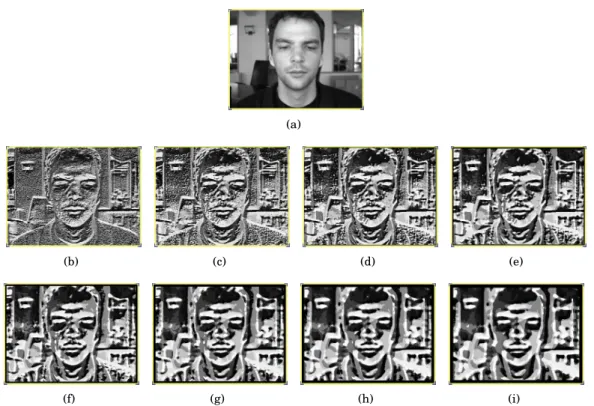
2.1 Illustration of the MB-LBP feature map feature maps for the original image (a). The multi-block patterns have cells of size1×1(b),2×2(c),3×3 (d),4×4 (e),5×5(f), 6×6(g),7×7(h) and8×8(i) respectively. . . 28 2.2 Various multi-block patterns of different cell sizes and at different locations
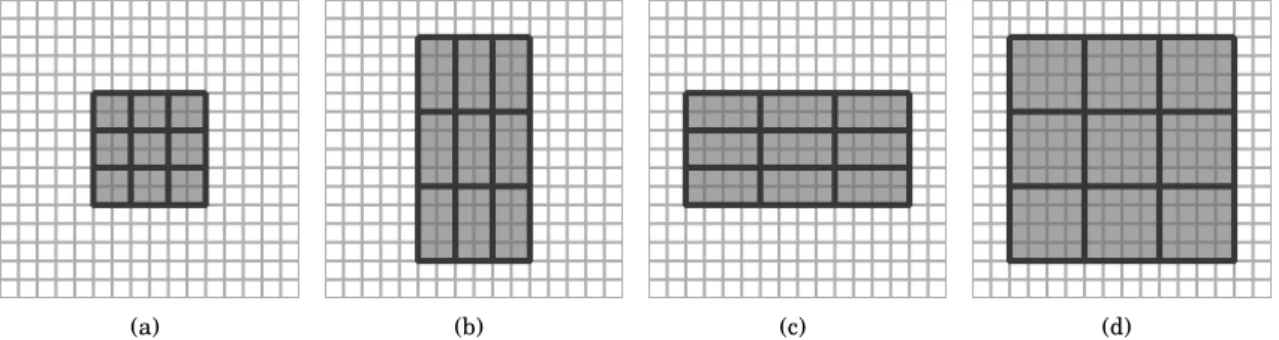
illus-trated on a generic16×16pixel grid. . . 29 2.3 (a) Pixel indexing used for computing LBP and MCT patterns. (b, c, d, e, f) Illustration
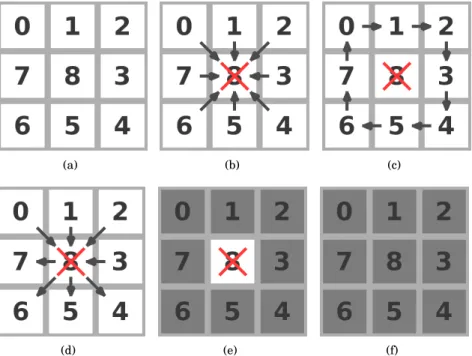
of the pixel (block) comparisons to obtain LBP, tLBP, dLBP, mLBP and MCT patterns respectively. The arrows denote the direction of the comparison. The grey cells are compared with the average within the3×3region, while the white cells are compared with the cell indicated by the arrow direction. . . 30
4.1 Illustration of the proposed coarse-to-fine feature projection. (a) The coarse original multi-block pattern (M Bc). (b) The projected multi-block pattern to twice the
reso-lution (M Bh). (c) The set of additional patterns, constructed by varying the cell size
independently for each axis (MBh). The center of the patterns is displayed with a red
cross, while the upscaled pattern is contoured with a dashed red line. . . 55 4.2 Illustration of the proposed coarse-to-fine feature selection algorithm. The algorithm
maintains a set of features that is initialized with the exhaustive set at the coarsest model resolution. Then iteratively, the feature set is pruned by boosting and projected to twice the model resolution. . . 56
6 LIST OF FIGURES
5.1 Illustration of two typical images to evaluate face detection models. The ground truth face locations are overimposed with green rectangles. . . 62 5.2 Illustration of typical training face images from the XM2VTS (a, b), BANCA (c, d) and
CMU-PIE (e, f) datasets. The ground truth face locations are overimposed with green rectangles. . . 64 5.3 Illustration of splitting of a 1024 look-up-tables model using 3 levels. The sub-window
is rejected as false alarms if the current cumulated level score is negative. If all the levels are passed, the final score is finally thresholded with an optimized value T. The sub-window rejection paths are represented with red, while the sub-window acceptance paths are represented with blue. . . 67 5.4 The face detection FROC curves for the MIT+CMU (a) and the BIOID dataset (b)
using theEPT-BOOTmodel and different number of levels. . . 68 5.5 The face detection FROC curves for the MIT+CMU (a) and the BIOID dataset (b)
using theEPT-BOOTand theEPT-SHOTmodels with 10 levels. . . 69 5.6 The face detection FROC curves for the MIT+CMU (a) and the BIOID dataset (b)
using theEPT-BOOTand theVAR-BOOTmodels with 10 levels. . . 70 5.7 Illustration of some face detection results on the MIT+CMU dataset. The ground
truth face locations are represented with green and the detections with blue. . . 72
6.1 Illustration of two typical images to evaluate facial feature localization models. The ground truth face locations are overimposed with green rectangles, while the ground truth facial features are displayed with blue crosses. . . 76 6.2 (a-e) Illustration of the five frontal and quasi-frontal face poses from the CMU
Mul-tiPIE dataset used for training the facial feature localization models. (f) Enlarged frontal pose to better illustrate the 16 annotated facial features displayed with blue crosses. . . 78 6.3 The cumulated error distribution for the XM2VTS (a, b) and the BIOID (c, d) datasets
using the LEyes setting. The models were trained either using shared (a, c) or inde-pendent (b, d) features between outputs. . . 82
LIST OF FIGURES 7 6.4 The cumulated error distribution for the XM2VTS (a, b) and the BIOID (c, d) datasets
using the LEyes setting. The models were trained either using shared (a, c) or inde-pendent (b, d) features between outputs. . . 84 6.5 The cumulated error distribution for the XM2VTS (a) and the BIOID (b) datasets
using the LMulti setting. The models were trained either using shared or independent features between outputs. . . 84 6.6 Illustration of some facial feature localization results on the BioID dataset using the
LMulti setting. The face detections are represented with blue boxes and the predicted facial feature points with red crosses. . . 87
7.1 Illustration of the 13 face poses to classify: from right profile (a) to left profile (m). We include the pose annotation from the CMU MultiPIE dataset and in brackets the degree of out-of-plane rotation. . . 90 7.2 The confusion matrix for theINDEP-EPT-BOOTmodels on the CMU MultiPIE test
dataset. The poses are arranged from right to left profile, such that the frontal pose is in the middle. . . 92 7.3 Illustration of some face pose classification results on the CMU MultiPIE test dataset:
from right profile (a) to left profile (m). The face bounding box is represented with the blue rectangle. The classified poses are displayed in angles with green if correct and with red if incorect respectively. . . 94 7.4 Illustration of some face pose classification results on the CMU MultiPIE test dataset:
from right profile (a) to left profile (m). The face bounding box is represented with the blue rectangle. The classified poses are displayed in angles with green if correct and with red if incorect respectively. . . 95
A.1 (a) Multi-block MCT feature for image representation. (b) Examples of some patterns that can be obtained by varying the parameterswandh. . . 109 A.2 The logarithmic evolution of the training loss for the face classifier (red) and the
8 LIST OF FIGURES
A.3 The logarithmic ROC curves for the BioID dataset using JScan (blue) and SScan with coarse (magenta) and fine (red) search parametrization. All models were trained us-ing 200 boostus-ing rounds. . . 116 A.4 The logarithmic ROC curves for the BioID dataset using various number of boosting
rounds. The results for JScan are plotted with blue, while for SScan with coarse and fine search parametrization with magenta and red, respectively. . . 117 A.5 Examples of sub-windows(x)processed by the JScan method on the BioID dataset.
The number on the left of the caption(y)is the Jaccard distance and the number on the rightf(x)is the estimated one. . . 119 A.6 Illustration of the detection process with the JScan method for two images (left and
right column respectively). On the first row we display the centres of the initialized detections, while on the second and third rows the refined detections in the first and the second step respectively. . . 120 B.1 Typical face detections using the multiscale approach and the boosted cascade
classi-fier described in (Froba and Ernst, 2004) (without clustering multiple detections nor removing false alarms). . . 124 B.2 Distributions of various features using the full (right column) versus axis (left
col-umn) sampling on XM2VTS training dataset. Cumulative histogram of counts for two axes (y, scale) using axis sampling (a) and full sampling (b). Cloud of points of score standard deviation for 3 axes (x, y, scale) using axis sampling (c) and full sam-pling (d). The ground truth is represented with green, the positive class with blue and the negative with red. . . 132 B.3 Context-based model’s weighted error rate (WER) for the test sets of XM2VTS (a) and
MIT+CMU (b). The default threshold point of the face classifier is represented with dashed red vertical line. . . 133 B.4 The normalized FA (b) on the XM2VTS scenario. The default threshold point is
rep-resented with dashed red vertical line. . . 134 B.5 Normalized FA (top row) and normalized TAR (bottom row) plots on XM2VTS (a, c)
List of Tables
2.1 TheLBP(8,1), the transition LBP (tLBP), the direction LBP (dLBP), the modified LBP
(mLBP) and the MCT (multi-block) operators. The centered pixel is denoted as pc.
The LBP, mLBP, tLBP and dLBP feature set (denoted as EMB-LBP) shall be used throughout this thesis. . . 30 4.1 The number of extended multi-block Local Binary Patterns (EMB-LBP) generated for
various model sizes. The feature redundancy increases fast with the model resolution. 52 5.1 The upper half defines the common parameters for all models, while the lower half
defines the parameters used for training the face models that we evaluate. . . 65 5.2 The number of look-up-table evaluations (and multi-block feature computations) per
sub-window for different number of levels using theEPT-BOOTmodel. . . 67 5.3 The number of boosting rounds and the optimal regularization factorλfor each
boot-strapping step when training theVAR-BOOTmodel. . . 70 6.1 The protocol to split the CMU MultiPIE dataset into training, validation and testing
datasets. . . 78 6.2 The upper half defines the common parameters for all models, while the lower half
defines the parameters used for training the facial feature localization models to eval-uate. . . 80 6.3 The number of features to boost for the exhaustive case (EXH) and the coarse-to-fine
feature selection case (CTF). The last row presents the training speed-up usingCTF
compared toEXH. . . 83 9
10 LIST OF TABLES
6.4 The percentage of samples having the localization error smaller than the given threshold for various models evaluated on the BIOID dataset and the LEyes setting. . 83 6.5 The percentage of samples having the localization error smaller than the given
threshold for various models evaluated on the BIOID dataset and the LMulti setting. 83 7.1 The upper half defines the common parameters for all models, while the lower half
defines the parameters used for training the facial feature localization models to eval-uate. . . 91 7.2 The pose classification average error rate for the boosted models on the CMU
Multi-PIE test dataset. . . 92 A.1 Various loss functions for classification (l1, l2) and regression (l3, l4). . . 107
A.2 The number of processed sub-windows (in thousands) for the BioID dataset using various number of boosting rounds. The JScan speed-up factor is computed relative to SScan (coarse). . . 118
Glossary and acronyms
LUT Look-Up Table
MB Multi-Block
LBP Local Binary Pattern
MCT Modified Census Transform
MB-LBP Multi-Block Local Binary Pattern
MB-MCT Multi-Block Modified Census Transform
EMB-LBP Extended set of Multi-Block Local Binary Pattern
CTFFS Coarse-To-Fine Feature Selection
SHARED Model trained using Shared feature selection
INDEP Model trained using Independent feature selection
BOOT Bootstrapped model
SHOT Boosted model without bootstrapping
EPT Model trained using the Expectation loss formulation
VAR Model trained using the Variational loss formulation 11
Chapter 1
Introduction
Face processing is a mature research field, being under active research for two decades. Great progress has been made, such that successful applications exist on computers or mobile devices. For example, face detection is implemented in video cameras and automatic biometric authentication, surveillance, tracking and security systems have been already deployed successfully. This thesis proposes a novel approach to further improve such systems.
1.1
Objective of the thesis
A typical face processing system usually consists of an ad-hoc mix of features and machine learning algorithms. For example, most successfulface detectorsuse Haar (Viola and Jones, 2001) or Local Binary Patterns (Zhang et al., 2007) as features and boosted cascades trained using a variety of methods. By contrast, facial feature localizationis usually performed using Active Shape Models and Active Appearence Models (Cristinacce and Cootes, 2006, 2007, 2008). The list of successful techniques is definitely not exhausted.
Most of the enumerated methods run in real-time and are robust to some degree of pose and illumination variation. The computational efficiency becomes hard to achieve when several such methods are combined to address specific face processing problems. This is because different classes of features and machine learning algorithms usually require different pre-processing steps which are time consuming.
14 CHAPTER 1. INTRODUCTION
The objective of this thesis is to address the computational efficiency problem of face processing. We propose a unified boosting framework to address several face processing tasks. The boosting framework can be used: i) for multivariate classification and regression tasks, and ii) can efficiently use large amounts of training data and high resolution models. In particular, we present experi-mental results for these face processing tasks: frontal face detection, facial feature localization and pose estimation.
1.2
Motivations
We propose to extend recent work on boosting in two ways. First, we propose a unified boosting framework that can be applied to multivariate classification and regression tasks. Second, we propose an efficient method to sample from large pools of samples and an efficient method to select relevant features for high resolution models.
The first proposal consists of a novel multivariate boosting method for classification and regres-sion problems. Our approach extends recent boosting algorithms such as AnyBoost (Mason et al., 1999b), TaylorBoost (Masnadi-Shirazi, 2010), Empirical Bernstein Boosting (Shivaswamy and Je-bara, 2010) and Variational AdaBoost (Shivaswamy and JeJe-bara, 2011). Similarly, we interpret boosting as a gradient descent algorithm in the functional space of weak learners. Thus a large set of smooth loss functions can be efficiently optimized.
The second proposal consists of a generic method to boost high resolution models using very large pools of samples. First, we introduce a novel coarse-to-fine feature selection method to effi-ciently select generic multi-block patterns (Zhang et al., 2007; Trefny and Matas, 2010). This is particularly useful for high resolution models, when the number of available features is of the order of millions. Second, we present a method to sample representative training data from very large pools of samples, for example of the order of billions. This is achieved in two ways: by uniformly sampling to obtain balanced data and by bootstrapping the training data with the missed predicted samples.
In this work we concentrate on boosting features that result in look-up tables (LUTs). As such, we detail several simple methods of boosting LUTs as weak learners. The optimization algorithm is proven to be scalable with the available computational resources at training time, with respect
1.3. CONTRIBUTIONS 15 to the number of samples (via bootstrapping) and features (via feature selection). At test time, we achieve real-time performance on several face processing tasks, such as: frontal face detection, facial feature localization and pose estimation. This is a step towards a simpler and more homoge-neous face processing system.
1.3
Contributions
The major contributions of this thesis are as follows.
1. We proposeda unified boosting framework to solve multivariate regression and
clas-sification problems. The fundamental idea of this approach is to interpret boosting as a
gradient descent method in the functional space of the weak learners. This way a wide range of smooth loss functions can be iteratively optimized. The extension to multivariate classifi-cation and regression problems becomes natural.
We present a generic boosting framework that requires very few assertions on the loss func-tion to optimize. The assumpfunc-tions are that the loss funcfunc-tion must be smooth and its gradients computable at each boosting round, with respect to the weak learner’s parameters. Using this we formulate two boosting algorithms - the expectation and the variational. Theexpectation
algorithm optimizes the empirical average loss over the samples, while thevariational al-gorithm regularizes the average loss with the empirical variance of the same loss. The latter algorithm penalizes models that have high error variance, for example that perform well for some subset of samples and significantly worse for others.
2. We present an efficient implementation of our unified boosting framework for boosting LUTs. We focus on boosting LUTs because the resulting algorithm is efficient and scalable with the available computational resourses. Also, LUTs are the most efficient weak learners at test time, although they are non-linear and have a significant number of parameters.
Fea-ture selectionis performed while boosting, because each boosted LUT is associated with a
single feature. We also study twofeature sharingmethods for the multivariate case. De-tailed complexity analysis is provided to assert the efficiency of the LUT boosting algorithm. Furthermore, boosting shared features for different outputs is shown to be of equivalent
com-16 CHAPTER 1. INTRODUCTION
plexity as boosting independent features.
3. Another contribution related to the proposed boosting algorithm consists of a generic method for efficiently boosting high resolution models using large pools of sam-ples. This is particularly useful for face processing tasks when either the number of features is unmanageable because we have high resolution models, or because the number of samples to process is very large as we have to simulate minor mis-alignments for each training sample. For the first issue we propose acoarse-to-fineapproach and for the second we propose to use
bootstrapping.
The key idea of the proposed coarse-to-fine multi-block feature selection is to process a small subset of all available features. The algorithm is initialized with the boosted features using a coarse resolution model. Then this subset is iteratively projected and boosted to higher resolutions. Each iteration refines the scale and the size of the current set of features.
The fundamental idea of bootstrapping is to increase the number of training samples at each iteration with the missed predicted samples. At each step, the model is evaluated efficiently on a large pool of samples and an error is computed for each sample. Next, a small fixed number of samples are randomly selected proportionally with this error. The selected samples are also constrained to be balanced: for example, to contain the same number of positive and negative samples for binary classification problems.
4. The proposed boosted models are evaluated on severalface processing tasks. In particular we present real-time frontal face detection, facial feature localization and pose estimation systems. These systems are extensively evaluated using different boosting configurations. To speed-up face detection, we propose to split the boosted model at run-time intolevels. The number of levels influences the evaluation speed; the more, the faster the face detector. This way the background locations are discarded quickly, while the computation is concentrated on the most promising locations. This idea is similar to the successful boosted cascades. The difference is that our models are significantly easier to train than cascades, while experimen-tally performing as fast at test time. We also show experimenexperimen-tally that the proposed models are robust to the number of splits.
1.3. CONTRIBUTIONS 17 the location of several facial features of interest (such as the eyes, nose tip or mouth corners). We use the proposed coarse-to-fine feature selection algorithm to efficiently train these high resolution models. The localization performance is increased by integrating their responses in a local neighbourhood. We propose and evaluate several integration methods.
The pose estimation system classifies a face detection into 13 different out-of-plane poses. We train and evaluate a multivariate classification model to distinguish between these 13 poses. Apart from these primary contributions, there are some secondary contributions of this thesis which are related to the main work. These are as follows.
1. Firstly, we proposed a method to remove false alarms generated by a generic face
detector. We define the context of a detection as the collection of nearby responses, defined in
a tri-dimensional grid of location and scale. Several features are extracted from this collection of responses which are then used to train a linear classifier to distinguish between the context of a false alarm and of a true detection. For example, initial experiments have shown that false alarms have contexts with higher variance of responses and with lower number of accepted responses (above a given threshold) than for the true detections.
Several variations of the proposed system were compared with the given face detector on multiple challenging image datasets. The experimental results have shown that it greatly reduces the number of false alarms, while keeping the detection rate at the same level. 2. Secondly, we proposed a novel face detection method that uses theJaccard similarity index
to guide the detection. A boosted regression model was trained to predict the Jaccard
similarity index (normalized intersection area) between the current location and the true face location. Ideally, the model will predict 1 for locations close to the face and 0 for background locations. This information is used to guide the detection in two steps. The first is to coarsely initialize a set of potential locations and the second to refine the most promising locations -the ones with high scores.
The advantage of such a method is to greatly speed-up the detection. The initial experiments have shown that it is significantly faster than sliding-window approaches. However, the pre-dictions of the Jaccard similarity index are not accurate enough to reach state-of-the-art per-formance in face detection.
18 CHAPTER 1. INTRODUCTION
Related publications:
1. Cosmin Atanasoaei, Christopher McCool and S´ebastien Marcel, “A principled approach to remove false alarms by modelling the context of a face detector”, in proceedings of the British Machine Vision Conference (BMVC), 2010
2. S´ebastien Marcel, Christopher McCool, Cosmin Atanasoaei, Flavio Tarsetti, J. Pes ´an, P. Mate-jka, J. Cernocky, M. Helistekangas, and M. Turtinen, “MOBIO: Mobile biometric face and speaker authentication”, in proceedings of the IEEE Conference on Computer Vision and Pat-tern Recognition (CVPR), 2010
3. J. Parris, M. Wilber, B. Helfin, H. Rara, A. El-barkouky, A. Farag, J. Movellan, M. Santana, J. Lorenzo, M.N. Teli, S. Marcel, C. Atanasoaei, and T. Boult, “Face and eye detection on hard datasets”, in the IEEE IAPR International Joint Conference on Biometrics (IJCB), 2011
Related technical reports:
1. Cosmin Atanasoaei, Christopher McCool and S´ebastien Marcel, “On Improving Face Detection Performance by Modelling Contextual Information”, Idiap Research Report Idiap-RR-43-2010, Idiap Research Institute, December 2010
2. Cosmin Atanasoaei, Christopher McCool and S´ebastien Marcel, “Face detection using boosted Jaccard distance-based regression”, Idiap Research Report Idiap-RR-02-2012, Idiap Research Institute, January 2012
1.4
Organization
The structure of this thesis is as follows.
· Chapter 2 provides a brief overview of the related work to boosting and local binary features. First, we provide an overview of boosting and how it can be viewed as functional gradient descent. Then we describe local binary features including the extended set of local binary patterns.
1.4. ORGANIZATION 19
· Chapter 3 details the proposed boosting approach of look-up-tables. First, we introduce the multivariate boosting framework and a bootstrapping algorithm. Second, we detail the opti-mization algorithms for boosting look-up-tables as weak learners.
· Chapter 4 describes the proposed coarse-to-fine feature selection and the bootstrapping algo-rithms to boost high resolution models using large pools of data.
· Chapter 5 describes the application of the proposed approach to the task of face detection, a bi-nary classification problem. Different features, boosting algorithms and evaluation speeding-up methods are compared with baseline approaches.
· Chapter 6 describes the application of the proposed approach to the task of facial feature local-ization, a multivariate regression problem. The experiments evaluate and compare different features, feature sharing methods and boosting algorithms.
· Chapter 7 describes the application of the proposed approach to the task of face pose classifi-cation, a multivariate classification problem. The experiments evaluate and compare different features, feature sharing methods and boosting algorithms.
· Chapter 8 concludes the thesis with a brief summary of the important contributions made and outlines the potential directions for future work.
· In the Appendices, we describe some of the secondary contributions of this thesis. These include the work on face detection using the predicted Jaccard distance between the current sub-window and the ground truth (Appendix A) and the work on the context-based model for removing false alarms (Appendix B).
Chapter 2
Related work
Most computer vision applications require two key components. The first component is thefeature
extractionthat maps the visual input signal (the pixel values) to a feature space. The features are
usually designed to suppress irrelevant characteristics of the input signal, while enhancing the im-portant characteristics for the task at hand. For example, some features are design to be invariant (or robust) to translation and rotation, illumination variation or to pose variation. The second com-ponent is themodelingwhich consists of training and evaluating a model using machine learning and statistical algorithms. There can also be some post-processing steps which are specific to the application.
This chapter provides an introduction toboosting- as a particular machine learning algorithm, and tolocal binary patterns- as particular features. These two concepts are the building blocks of the proposed approach.
2.1
Boosting
Boosting (Schapire, 2002) is a greedy algorithm for building astrong learneras a linear combina-tion ofweak learnersorhypotheses. This process is done in iterations calledboosting rounds: at each iteration a single new weak learner is chosen and added to the combination. The weak learners can be interpreted as rules of thumb, usually easy and efficient to construct. They are not accurate enough to solve the task at hand, but it is assumed that a more accurate model can
22 CHAPTER 2. RELATED WORK
be built by combining such simple rules. Boosting thus provides an efficient method for building strong learners from many weak learners.
There are several methods to select a new weak learner at each round. This section details some of the most successful boosting methods. Their common idea is that each weak learner is trained to correct the mistakes made by, so as to complement, the previous ones and to focus on the most challenging samples.
2.1.1
Introduction
LetΩ be the input signal space and{(xn, yn)n=1:N} ∈(Ω×R)N a set ofN training samples. The
goal is to build a functionalf : Ω→Rto map the samplesxn to their targetsyn. We refer to this
functional as the strong learner or themodel.
LetL(f)be the criteria (loss function) to choose the strong learner f. Usually, the criteria is a cumulative loss function of the form: L(f) =P
n
l(yn, f(xn)). The base lossl(y, f)is a function that
measures the goodness of the predictionf in matching the targety: l(y, f) : R×R→ R. Clearly the loss must be chosen appropriately to the specific problem to solve. For example, the binary classification task requires the two classes to be separated as far as possible:l(y, f) =l(−yf), while the regression tasks need predictions as close as possible to the target: l(y, f) =1
2(y−f) 2.
Each boosting round r(1 ≤ r ≤ R) selects a new weak learnergr : Ω → R. This is added to
the previously selected weak learners to obtain a better approximation off:f = P
s≤r
gs. In the most
general case the new weak learner is selected to minimize the current cumulative loss:
gr= arg min g∈χ
L(f+g). (2.1)
where χ represent the functional space of the weak learners. Finally, thepredictionconsists of evaluating the functionalf on an unseen samplex∈Ω.
2.1.2
AdaBoost
AdaBoost (Freund, 1995) is the first boosting algorithm that combined weak learners slightly better than random into arbitrarily accurate strong learners. The algorithm was originally proposed for binary classification, with weak learners restricted to the functional space ofg:Ω→ {−1,+1}. The
2.1. BOOSTING 23 targets are also restricted toyn ∈ {−1,+1}. This version is sometimes calledDiscrete AdaBoost
(Friedman et al., 2000), because the weak learners are discrete.
Algorithm 1The boosting algorithm AdaBoost.
1: Given:{(xn, yn)n=1:N} ∈(Ω×R)N, whereyn∈ {−1,+1}
2: Initialize distribution:D1(n) = 1/N
3: forr= 1tor≤Rdo
4: Train weak learner:gr:Ω→ {−1,+1}using distributionDr (Eq. 2.1)
5: Choose:αr=12 log(1−rr)>0 6: wherer=P n Dr(n)1(gr(xn)6=yn) 7: Update:Dr+1(n) =Dr(n) exp(−Zαryngr(xn)) r
8: whereZris chosen such thatDr+1remains a distribution
9: end for
10: return f =sign(P
r≤Rαrgr)
AdaBoost is detailed in Algorithm 1. The algorithm maintains and updates a normalization distribution Dr that associates a weight to each sample, proportional to its importance for the
boosting round r. Initially, each sample has the same weight. The new learnergr is selected to
minimize the weighted mis-classification errorP
n
Dr(n)1(gr(xn)6=yn), where1is the Kronecker
delta function. Then it is scaled withαr, which corresponds to the optimal line-search step in the
direction of gr, while minimizing the exponential lossL(f) = P n
exp(−ynf(xn)). More details are
provided in the next section.
Once gr is selected, the weights are updated based on its performance. If the weak learner
classifies correctly a particular sample n, then the edge must be positive (yngr(xn) > 0) and its
weightDr+1(n)is decreased for the next round. Otherwise, the weight is increased. Thus, the new
weak learners are trained to correct mistakes made by the current model. Each boosting round concentrates the weight distributionDto increasingly harder samples.
The AdaBoost algorithm is clearly independent of the weak learner’s type. Boosted weak learn-ers are usually decision stumps (Viola and Jones, 2001) or decision trees (Friedman et al., 2000). The boosted models can also be further combined in so calledcascades. The most famous example of such a cascade was proposed by Viola and Jones (Viola and Jones, 2001, 2002). Their system was the first real-time face detector. The speed was achieved by combining two key ideas. The first idea is to use Haar-like features, that can be computed at any location and scale in constant time using integral images. The second idea is to classify a sample using a cascade of boosted decision stumps
24 CHAPTER 2. RELATED WORK
of increasing complexity. The evaluation is performed by pruning the response of each boosted classifier, also called a stage, with a threshold. If the response is above the threshold, then the sample is rejected as background; otherwise, the sample is evaluated at the next (more complex) stage. Thus background samples, which account for the vast majority of evaluations, are quickly evaluated and rejected and the system spends more computation only near the face regions.
There are severalextensionsproposed to the AdaBoost algorithm, mostly using different loss functions. The original paper from (Freund, 1995) proposed three other boosting algorithms to solve multi-class classification (AdaBoost.M1,AdaBoost.M2) and regression (AdaBoost.R) problems. These algorithms are motivated from the perspective of achieving arbitrarily small training errors in logarithmic number of rounds. However, the theoretical results are valid for just some particular loss functions and weak learners. This limits the applicability of these boosting algorithms.
Other extensions to AdaBoost consist for example of pruning the weak learners that achieve high error rates, such as FloatBoost (Li et al., 2002), and of balancing the testing time and accuracy, such as WaldBoost (Sochman and Matas, 2005).
2.1.3
Boosting as functional gradient descent
A general motivation for boosting was proposed by several researchers (Friedman et al., 2000; Fried-man, 2001; Duffy and Helmbold, 2002; Mason et al., 1999b). The key idea is to consider boosting as a greedy gradient descent performed in the functional space of the weak learners. Each boosting round is thus a gradient step towards minimizing a loss, usually convex, that matches the predic-tions of the strong learnerf(x)with the targetsy. There are two steps performed at each boosting round:
1. Theselectionof the new weak learner (gr) that locally decreases the loss the fastest:
gr= arg min g
L(f+g), (2.2)
given a small variation . This corresponds to optimizing a local Taylor expansion of the loss (in the functional space of weak learners). The first order approximation gives gradient descent-like algorithms, while second order approximation gives Newton step-like algorithms.
2.1. BOOSTING 25 2. Thescalingof the selected weak learner gr with the factorαr. The strong learner is then
updated as: f ← f+αrgr. The scaling factor is required because the weak learner is only a
local approximation of the loss. There are multiple possibilities to chooseαr, with the most
commonly used being the line-search method:
αr= arg min α
L(f +αgr). (2.3)
However, fixed or decreasing steps are also a valid option. In these cases, the scaling factor can be interpreted aslearning rate.
Formulating boosting as greedy gradient descent has the advantage that it can be used to solve both classification and regression problems in addition to univariate and multivariate problems. Most boosting algorithms can be derived from this interpretation (Masnadi-Shirazi, 2010). For ex-ample AdaBoost (Freund, 1995), Gentle AdaBoost (Friedman et al., 2000) or LogitBoost (Friedman et al., 2000) are instances that use particular loss functions or weak learners.
It is important to state that the weak learner and the scaling factor can be computed simul-taneously or analytically in some cases (e.g. for AdaBoost), but this is not possible without prior knowledge on the loss and the weak learner type. There has also been work where each boosting round is complemented with an additional step that jointly re-optimized all the weak learners. This implies that previous weak learners (relative to the current round) are not fixed anymore. Most rel-evant to this idea is the ShareBoost algorithm (Shalev-Shwartz et al., 2011). There is some other related work on regularizing the loss (Xiang et al., 2009; Culp et al., 2010; Shivaswamy and Jebara, 2010, 2011), boosting structured weak learners (Fei and Huan, 2010) and decision trees (Friedman, 2001), and optimally sharing features for multi-class problems (Torralba et al., 2007).
Next we detail several important boosting algorithms relevant to, and that inspired, our pro-posed framework. All these algorithms are related to one another and use the two gradient steps describe above.
26 CHAPTER 2. RELATED WORK
local loss gradient (Friedman, 2001). The selection step is:
gr= arg min g, X n ∂l(y n, p) ∂p |p=f(xn)−g(xn) 2 , (2.4)
and the scaling step consists of line-search. The original paper describes several applications to different loss functions and makes use of decision trees as weak learners. The authors also introduce ashrinkage factor ν ∈ (0,1]. This changes the update of the strong learner to: f ←f +ναrgr. The shrinkage factor controls the rate of the loss decrease and thus the speed
of learning and implicitly of over-fitting. Thus shrinkage acts as a regularization method.
2. AnyBoostselects the optimal weak learner to point in the direction of the steepest descent
(Mason et al., 2000). The optimal direction is given by the negative functional loss gradient. Generally, the space of weak learnersχmay not contain one pointing exactly in the optimal direction. Thus a relaxation is needed that simply aligns the best new weak learner to the functional gradient:
gr= arg max g
− hOL(f), gi. (2.5)
Here O is the gradient operator and h·,·i is the scalar product operator. No restriction is enforced on the scaling factor. The authors use a small constant, but they also suggest line-search as an alternative. The boosting rounds are stopped earlier if no weak learner can be found to point in the downhill direction of the loss function. Clearly, the AnyBoost formulation is closely related to GradientBoost as both algorithms use the same basic idea.
3. More recently, the TaylorBoost algorithm was introduced (Masnadi-Shirazi, 2010). Each boosting round is explicitly interpreted as optimizing the loss using a local Taylor expansion of order one or two. LetδL(f, g) =hOL(f), giandδ2L(f, g) =h
O2L(f), g2ibe the local variation
ofL, at pointf along directiong. Then the selection step is shown to reduce to:
gr= arg min g
2.2. LOCAL BINARY PATTERNS 27 gr= arg min g − hOL(f), gi 2 hO2L(f), g2i (QuadBoost). (2.7)
The first order algorithm, namedGradBoost, reduces to AnyBoost and GradientBoost. The authors show that AdaBoost is a particular instance of GradBoost. The second order algo-rithm, namedQuadBoost, is a generalization of Newton step-based boosting algorithms such as LogitBoost. Both GradBoost and QuadBoost perform a line-search as the scaling step.
2.2
Local Binary Patterns
In this thesis we shall exclusively use local binary patterns (LBP) and their variations for all face processing tasks. This is because they are efficient to compute and have been proven to perform well for various challenging computer vision applications due to their robustness to illumination varia-tion. Originally proposed for texture classification, the LBP family of features has successfully been applied to other problems such as face and object detection (Froba and Ernst, 2004; Zhang et al., 2007; Trefny and Matas, 2010), facial feature localization (Keomany, 2006) and face recognition (Liao et al., 2007; Tan and Triggs, 2010).
The family of LBP consists of features computed in a local, usually circular, neighborhood. The feature value is a binary code, where each bit is set depending on the comparison result between neighboring pixel values and the center pixel value (Ojala and Pietikainen, 2002).
Originally the LBP codes were proposed for3×3regions and thus had28distinct binary values. They were limited to small regions and could only capture local micro-textures. Thus the LBP was extended to LBP(P,R) where P is the number of points evenly spaced at radius R (expressed in
pixels) from the center pixel. Some of the neighboring points require interpolation (usually linear) because their coordinates may not fall on pixel locations. The number of distinct values is increased to 2P, because there are P comparisons with the center pixel value. Using this formulation an
extended LBP was proposed which captures information at multiple scales by varying the radiusR and from multiple resolutions by varying the number of sampling pointsP. An exhaustive survey on some other LBP extensions was recently published (Huang et al., 2011).
28 CHAPTER 2. RELATED WORK
(a)
(b) (c) (d) (e)
(f) (g) (h) (i)
Figure 2.1.Illustration of the MB-LBP feature map feature maps for the original image (a). The multi-block patterns have cells of size1×1(b),2×2(c),3×3(d),4×4(e),5×5(f),6×6(g),7×7(h) and8×8(i) respectively.
Matas, 2010) extensions of LBP and theModified Census Transform(MCT) (Froba and Ernst, 2004). The MB idea is similar to the LBP(P,R) extended set in that it captures information from
multiple scales, but the neighboring is composed of3×3adjacent rectangular regions centered at the pixel of interest (see Fig. 2.3 (a)). The MCT codes are computed similarly to the LBP, with the difference that the average pixel values are used for comparison instead of the center pixel value in the LBP. Additionally, the MCT codes have an extra bit obtained by comparing the center pixel with the average. Typical MB-LBP feature maps are illustrated in Fig. 2.1. The coloring of the feature maps cannot be interpreted as pixel intensities; the coloring in this images is obtained by scaling the decimal value of the binary codes to the[0,256)range. It can be noticed that the coarseness of the local texture information is directly proportional with the size the cells: the smaller the multi-block cell, the finer the texture. However, the finest multi-multi-block features are also less robust to noise or to various artifacts.
More formally, the MB features are parametrized by the top-left coordinate(x, y)in the patch to process and the sizecx×cyof the rectangular cells of the3×3neighbourhood. Various patterns at
2.2. LOCAL BINARY PATTERNS 29
(a) (b) (c) (d)
Figure 2.2. Various multi-block patterns of different cell sizes and at different locations illustrated on a generic16×16
pixel grid.
multiple scales and aspect ratios can be obtained by varying these parameters (see Fig. 2.2 (b, c, d)). The richness of these patterns results in MB-LBP features outperforming both Haar-like features and LBP codes for the face detection task (Zhang et al., 2007).
Multi-block features can be generated for both LBP and MCT and their extensions. To do this we definepi as the average pixel intensity in the celliusing the indexing presented in Fig. 2.3 (a).
We refer to the centered pixelp8 aspc. Letp¯= 19 P i=0:8
pi be the average pixel intensity in the3×3
region. Then the LBP and the MCT codes are computed as presented in Table 2.1.
Recently, the transition LBP (tLBP) and the direction codes LBP (dLBP) have been proposed (Trefny and Matas, 2010) as extensions to the LBP. Considering the center pixel (region) as the ori-gin, then the tLBP feature encodes circular transitions, while the dLBP feature encodes transitions across all four major directions. The combination of multi-block LBP, tLBP, dLBP and modified LBP (mLBP) encoding is denoted asextended set of local binary patterns (EMB-LBP)(Trefny and Matas, 2010). These LBP variations are illustrated in Fig. 2.3 and defined in Table 2.1.
The EMB-LBP features retain the robustness to illumination variation of the original LBP. The mLBP are more robust to random noise than the LBP, because they are computed by comparing the cells against the average intensityp¯. The multi-block binary patterns are efficient to compute for any position and scale using the integral image (Viola and Jones, 2001). Furthermore, it can be argued that they are more efficient than the relatedLBP(P,R) because no interpolation is needed.
Overall most of the LBP-like features are efficient enough for real-time applications.
In this thesis we shall exclusively use the EMB-LBP features, motivated by both their computa-tional efficiency and superior performance (compared with MB-LBP features) on the face detection and the gender recognition tasks (Trefny and Matas, 2010).
30 CHAPTER 2. RELATED WORK
(a) (b) (c)
(d) (e) (f)
Figure 2.3. (a) Pixel indexing used for computing LBP and MCT patterns. (b, c, d, e, f) Illustration of the pixel (block) comparisons to obtain LBP, tLBP, dLBP, mLBP and MCT patterns respectively. The arrows denote the direction of the comparison. The grey cells are compared with the average within the3×3region, while the white cells are compared with the cell indicated by the arrow direction.
Name Operator Range
LBP P i=0:7 1(pi≥pc)·2i [0,256) tLBP P i=0:7 1(pi≥p(i+1) mod 8)·2i [0,256) dLBP P i=0:3 1((pi−pc)(pi+4−pc)≥0)·22i+1(|pi−pc| ≥ |pi+4−pc|)·22i+1 [0,256) mLBP P i=0:7 1(pi≥p¯)·2i [0,256) MCT P i=0:8 1(pi≥p¯)·2i [0,512)
Table 2.1.TheLBP(8,1), the transition LBP (tLBP), the direction LBP (dLBP), the modified LBP (mLBP) and the MCT
(multi-block) operators. The centered pixel is denoted aspc. The LBP, mLBP, tLBP and dLBP feature set (denoted as EMB-LBP)
2.3. SUMMARY 31
2.3
Summary
In this chapter, we have introduced boosting and local binary patterns, as the machine learning and the features used throughout this work. More specifically, the TaylorBoost algorithm and the MB-LBP features are the building blocks of the proposed framework. Let us summarize some important aspects that our work relies on:
1. TaylorBoost is agenericalgorithm to combine weak learners (hypothesis) into strong learn-ers, that achieve arbitrary accuracy on training samples. The implication is that it optimizes any smooth convex loss with any type of weak learner. Thus it can be used for a wide range of applications, both regression and classification. It is alsoefficientbecause the strong learner is constructed in a greedy fashion, by choosing one weak learner at each boosting round. 2. LBP features arerobustto illumination variation and to random noise in the pixel values.
On the other hand, the MB-LBP features integrates information from multiple scales. Both types of features are alsolocalizedandefficientto compute at any location and scale. These attributes makes them appropriate forreal-time vision applications.
The next chapter presents the proposed framework that extends and combines these ideas. Firstly, we shall extend TaylorBoost to multivariate problems. The new algorithm is detailed for generic empirical expectation (cumulative) losses and variational losses. The variational formu-lation thus generalizes recent work on Expectation Bernstein Boosting (EBBoost) and Variational AdaBoost (VadaBoost). Second, we detail the proposed boosting algorithms to look-up-tables as weak learners. The optimization procedure is analyzed in terms of complexity and efficiency.
Chapter 3
A unified framework for boosting
look-up tables
This chapter details the main contributions of this thesis which is to generalize and combine recent work on boosting. First, we introduce a generalization of the TaylorBoost algorithm to multivari-ate regression and classification problems. The multivarimultivari-ate TaylorBoost is analyzed for both ex-pectation and variational loss formulations, the latter formulation being recently proposed by the EBBoost and VadaBoost algorithms (Shivaswamy and Jebara, 2010, 2011). Second, we detail the proposed boosting algorithms to LUTs as weak learners. We show that LUTs are efficient to boost (train) and to evaluate at test time.
3.1
Unified multivariate boosting framework
This section introduces a general boosting framework to learn multivariate classification and re-gression models. Besides some important advantages detailed below, this framework also extends and connects recent work on boosting, more precisely the TaylorBoost, EBBoost and VadaBoost algorithms.
34 CHAPTER 3. A UNIFIED FRAMEWORK FOR BOOSTING LOOK-UP TABLES
3.1.1
Motivation
A general (unified) boosting framework ideally makes as few assumptions as possible on the loss function to optimize and the type of weak learners. The loss function is usually restricted to be analytic, smooth, convex and differentiable up to second order. This functional space contains a wide range of loss functions, that can be used to solve both univariate and multivariate classification and regression problems. An equally important property of such a boosting algorithm is to be computationally efficient. This implies that the weak learner selection step is efficient, because it is the most expensive step in boosting.
There are several advantages of the proposed boosting framework.
1. It is a unified learning algorithm that simplifies and enforces the comparison of different weak learners (and implicitly different features) and loss functions.
2. Its modular approach makes it easy to change components and to create and to experiment with new models.
3. Particular instances consist of well studied and successful boosting algorithms. Thus the boosting framework is consistent with previously established results for particular tasks. But its applicability can be extended to other tasks, for example multivariate regression problems. The proposed approach extends previous work that proposed TaylorBoost (Masnadi-Shirazi, 2010). TaylorBoost optimizes efficiently any smooth loss function independent of the type of the weak learner. However, it is restricted to single-output (univariate) weak learners and to expecta-tion loss funcexpecta-tions that sum the loss values of the training samples.
The proposed approach circumvents these two limitations. First, we extend the first and second order TaylorBoost formulations, GradBoost and QuadBoost, to multiple-output (multivariate) weak learners. Second, we analyze a different general variational loss formulation that complements the original expectation formulation with the second order statistics of the loss value of the training samples. The multivariate TaylorBoost algorithm with a multivariate variational loss is a general-ization of previous works that proposed the EBBoost and the VadaBoost algorithms (Shivaswamy and Jebara, 2010, 2011). The original work, on EBBoost and VadaBoost, discussed only the binary classification case, while we show in this thesis that it is possible to optimize a more general class
3.1. UNIFIED MULTIVARIATE BOOSTING FRAMEWORK 35 of multivariate losses.
3.1.2
TaylorBoost revised
Here, we present the original TaylorBoost algorithm in detail and introduced earlier in Chapter 2. The weak learnersg and the strong learnerf are univariate. Each boosting round constructs an improved modelf with the goal of minimizing the lossL(f)that measures the goodness of the predictions on the training samples. The loss L(f)is chosen to be differentiable up to the second order.
The key idea is to choose the weak learners that locally decrease the loss the most. The loss is thus approximated locally (at the current estimation of the strong learner) using the Taylor expansion in the functional space of the weak learners:
L(f+g) =L(f) +δL(f, g) +
2
2δ
2L(f, g) +
O(3), (3.1)
whereis the small variation in the direction of the weak learnerg. The derivative of the functional L(f)along the directiongis:
δL(f, g) = ∂L(f+ξg)
∂ξ |ξ=0, (3.2)
while similarly its curvature is defined as:
δ2L(f, g) =∂
2L(f+ξg)
∂ξ2 |ξ=0. (3.3)
It is important to notice that this formulation makes no assumption on how the loss is decomposed over the training samples{(xn, yn)n=1:N}. ClearlyL(f)must be a composition of the loss values for
each sample l(yn, f(xn)). This is in the contrast with the original paper (Masnadi-Shirazi, 2010)
where the loss is the empirical expectation of the loss values over the training samples: L(f) = P
n
l(yn, f(xn)).
Solving 3.1 for different orders of the loss approximation results in different boosting algorithms. GradBoost uses the first order (gradient) approximation, while QuadBoost uses the second order (quadratic) approximation. The two formulations are detailed in Algorithm 2. They differ only in
36 CHAPTER 3. A UNIFIED FRAMEWORK FOR BOOSTING LOOK-UP TABLES
the weak learner selection step. GradBoost is a gradient descent method in the functional space of the weak learners, while QuadBoost is a Newton method. It can be shown that previously pro-posed boosting algorithms, like AdaBoost or LogitBoost, are particular instances of TaylorBoost (Masnadi-Shirazi, 2010). In some cases, depending on the loss function, the scaling factorαrcan be
determined analytically and no line-search iterations are required.
Algorithm 2The boosting algorithm TaylorBoost.
1: Given weak and strong learners:g, f :Ω→R 2: Given differentiable loss:L(f)
3: Initialize model:f = 0
4: forr= 1tor≤Rdo 5: Select weak learner:
6: GradBoost:gr= arg min g
δL(f, g)
7: QuadBoost:gr= arg min g
−[δLδ2L(f,g(f,g)])2
8: Scale weak learner using line-search:αr= arg min α
L(f+αgr)
9: Update strong learner:f ←f+αrgr
10: end for
11: return f
3.1.3
Multivariate TaylorBoost
TaylorBoost can be formulated as a multivariate optimization algorithm where the model predicts O values at a time. In this case, the targets, the weak and the strong learners become vectors of dimensionO, while the base loss is changed similarly to compare multivariate targets and predic-tions. Before detailing these modifications, we arbitrarily denote vectors withzto distinguish from scalarsz.
A specific output is referred with the index 1 ≤ o ≤ O. Thus, the target of the samplen be-comes yn = (yo,n)1≤o≤O. Similarly, the weak and strong responses become g = (go)1≤o≤O and
f= (fo)1≤o≤O, respectively. The base loss changes to comparing vectors as: l(y,f) :RO×RO →R.
In this section, we make no assumption on the specific form of the base loss, except that it must be twice differentiable. Similarly, the overall lossL(f)is an unknown mixture of the base loss values for the training samples.
The weak learners are scaled independently for each output when added to the strong learner. Thus, the strong learner update is performed element-wise: (fo←fo+αo,rgo,r)1≤o≤O. This can be
3.1. UNIFIED MULTIVARIATE BOOSTING FRAMEWORK 37 written more compactly using the Hadamard operator:f←f+αr•gr.
With these notations, we derive the multivariate TaylorBoost algorithm, denoted as
MTaylor-Boost. The weak learner is chosen to optimize the multivariate local Taylor expansion of the loss
withOdimensions:
L(f+•g)≈L(f) +T δL(f,g) +1 2
T
δ2L(f,g), (3.4)
where the vectoris a small variation along directiong. The gradientδL(f,g)is anO-dimensional vector, while the Hessianδ2L(f)is anO×Omatrix. These functional derivatives are defined as:
δoL(f,g) = ∂L(f+ (ξ1−;o)•g) ∂ξ |ξ=0, (3.5) and: δo21,o2L(f,g) =∂ 2L(f+ (ξ 11−;o1)•g+ (ξ21−;o2)•g) ∂ξ1∂ξ2 |ξ1=ξ2=0, (3.6)
respectively. The ocomponent of the gradient quantifies the loss variation, at the limit, when the outputoof the strong learnerfis translated along the direction of the weak learnerg. Similarly, the (o1, o2)measures the loss variation, at the limit, when the two outputso1ando2are modified
simultaneously. The formulations make use of the notation1−;o to denote a vector that has a unit
response for the dimensionoand zero for the other dimensions. This corresponds to the Kronecker delta function with two parameters:
1p;o=δp,o= 1, ifp=o 0, ifp6=o. (3.7)
Depending on the order of the loss approximation, we obtain multivariate versions of GradBoost and QuadBoost denoted asMGradBoostandMQuadBoostrespectively. These two multivariate boosting algorithms reduceexactlyto the associated TaylorBoost formulation of the same order for single-output (univariate) problems. The only difference between MGradBoost and MQuadBoost is the weak learner selection step, similar to the univariate case.
38 CHAPTER 3. A UNIFIED FRAMEWORK FOR BOOSTING LOOK-UP TABLES
MGradBoost
The MGradBoost algorithm chooses the weak learner as:
(∗,gr) = arg min
,g
T δL(f,g), (3.8)
to minimize the first order approximation of the loss. This an undefined optimization procedure, because the stepcan be scaled to achieve arbitrarily low values. We thus fix the step to be unit for each output. Then the optimization procedure becomes:
gr= arg min
g
X
o
δoL(f,g). (3.9)
This formulation can be interpreted as choosing the weak learner that has the highest loss decrease, summed over all the outputs. This is clearly a generalization of GradBoost (see Section 2), because the sum is removed in the case of single output problems (O= 1).
MQuadBoost
The MQuadBoost algorithm chooses the weak learner to minimize the second order approximation of the loss: (∗,gr) = arg min ,g T δL(f,g) +1 2 T δ2L( f,g). (3.10)
This optimization problem is simplified by eliminating the parameter . The optimal solution is achieved when the derivative, with respect to, of the optimization criteria vanishes:
δL(f,g) +δ2L(f,g)∗= 0. (3.11)
The optimal step is then:
∗=−
3.1. UNIFIED MULTIVARIATE BOOSTING FRAMEWORK 39 Then 3.10 reduces to an optimization problem with a single variable:
gr= arg min
g
−δL(f,g)T δ2L(f,g)−1 δL(f,g). (3.13) For the univariate case, the Hessian matrix reduces to the scalarδ2L(f, g), while the gradient is the scalarδL(f, g). In this case equation 3.13 reduces exactly to the QuadBoost formulation. However, in the general multivariate case the Hessian matrix can be inefficient to invert for each boosting round, unless it can be performed analytically for some particular loss functions and weak learners.
MTaylorBoost
Both the first and second order weak learner selection procedures are followed by a multivariate line-search step of the form:
αr= arg min
α
L(f+α•gr), (3.14)
where the vectorαradjusts each output of the selected weak learner to decrease the loss the most.
Then, the strong learner is updated to: f←f+αr•gr.
If no analytic solution can be computed for the optimal line-search steps, a gradient descent method would be typically used. These methods compute at each iteration the gradient of the criteria to optimize, with respect to its free parameters -αin our case. It can be shown that this gradient is: δL(f+α•g,g). This gradient has the same formulation as the one used for the weak learner selection step, but is evaluated at the current estimation of the scaling factorα. Thus, the functional gradient formulation can be re-used once formulated.
Algorithm 3 summarizes the MTaylorBoost method. The algorithm is of little practical interest, unless the loss functions and the weak learners are specified. The following section presents two important overall loss functions and details the boosting steps for these losses. The next section further details the boosting algorithm for LUTs as weak learners. Finally, we describe the binary patterns used for boosting LUTs. Thus, we introduce an efficient boosting framework to be used for a wide range of multivariate classification and regression problems.