Design and Tuning
of an
Evolutionary Multiobjective Optimisation Algorithm
Dissertation
zur Erlangung des Grades eines
D
OKTORS DERN
ATURWISSENSCHAFTENder Technischen Universit ¨at Dortmund am Fachbereich Informatik von
Boris Naujoks Dortmund
Tag der m ¨undlichen Pr ¨ufung: 29. M ¨arz 2011
Dekan: Prof. Dr. P. Buchholz
Gutachter: Prof. Dr. G. Rudolph, TU Dortmund Prof. Dr. Y. Jin, University of Surrey, GB
3
Contents
1 Introduction 5
1.1 Preliminaries . . . 5
1.2 Example and Fundamentals . . . 6
1.3 Overview . . . 8
1.3.1 The basicS-Metric Selection - EMOA . . . 9
1.3.2 Diversity Preservation in Decision and Objective Space . . . 10
1.3.3 Many-Objective Optimisation . . . 10
1.3.4 Stopping Criteria for EMOA . . . 10
1.3.5 Sequential Parameter Optimisation for MCO . . . 11
2 The basicS-Metric Selection - EMOA 13 2.1 An EMO Algorithm Using the Hypervolume Measure as Selection Criterion . . . 16
2.1.1 Introduction . . . 16
2.1.2 The Hypervolume Measure . . . 17
2.1.3 The Algorithm . . . 18
2.1.4 Test Problems . . . 21
2.1.5 Design Optimization . . . 24
2.1.6 Summary and Outlook . . . 28
2.2 Multi-objective Optimisation usingS-metric Selection: Application to three-dimensional Solution Spaces . . . 29
2.2.1 Introduction . . . 29
2.2.2 Previous Work . . . 30
2.2.3 Selection Criteria and EMOA framework . . . 32
2.2.4 Results on Test Problems . . . 36
2.2.5 Design Optimisation . . . 39
2.2.6 Summary and Outlook . . . 41
3 Diversity Preservation in Decision and Objective Space 43 3.1 Pareto Set and EMOA Behavior for Simple Multimodal Multiobjective Functions . . . 45
3.1.1 Introduction . . . 45
3.1.2 Aims and Methods . . . 46
3.1.3 A Simple Test Problem: TWO-ON-ONE . . . 46
3.1.4 Experimental Investigation of Pareto Sets . . . 47
3.1.5 Analytical Derivation of Pareto Sets . . . 50
3.1.6 Behavior of EMOAs on TWO-ON-ONE . . . 51
3.1.7 Summary and Outlook . . . 53
3.2 Capabilities of EMOA to Detect and Preserve Equivalent Pareto Subsets . . . 54
3.2.1 Introduction . . . 54
3.2.3 A test-problem class: SYM-PART . . . 56
3.2.4 Evaluation of Standard EMOA on SYM-PART . . . 60
3.2.5 A Multistart Approach for Pareto Subset Detection . . . 65
3.2.6 Conclusions and Future Work . . . 67
4 Many-Objective Optimisation 69 4.1 Pareto-, Aggregation-, and Indicator-based Methods in Many-objective Optimization . 71 4.1.1 Introduction . . . 71
4.1.2 Benchmark Settings . . . 72
4.1.3 Pareto-based EMOA . . . 73
4.1.4 Aggregation-based EMOA . . . 77
4.1.5 Indicator-based EMOA . . . 80
4.1.6 Summary and Outlook . . . 83
5 Stopping Criteria for EMOA 85 5.1 Online Convergence Detection for Evolutionary Multi-Objective Algorithms Based on Statistical Testing . . . 87
5.1.1 Introduction . . . 87
5.1.2 State of the Art . . . 88
5.1.3 Online Convergence Detection . . . 89
5.1.4 Experiments . . . 93
5.1.5 Conclusion . . . 100
5.2 Online Convergence Detection for Multiobjective Aerodynamic Applications . . . 104
5.2.1 Introduction . . . 104
5.2.2 Online convergence Detection . . . 105
5.2.3 Aerodynamic Applications . . . 108
5.2.4 Airfoil Reconstruction Test Case: NACA . . . 108
5.2.5 Airfoil Pressure Minimization Test Case: RAE . . . 109
5.2.6 Experiments . . . 110
5.2.7 Summary and Outlook . . . 120
6 Sequential Parameter Optimisation for EMOA 121 6.1 Sequential Parameter Optimization for Multi-Objective Problems . . . 123
6.1.1 Introduction . . . 123
6.1.2 Sequential Parameter Optimization . . . 124
6.1.3 Experimental Results . . . 127
6.1.4 Conclusions . . . 137
6.2 Parameter Tuning Boosts Performance of Variation Operators in Multiobjective Opti-mization . . . 139 6.2.1 Introduction . . . 139 6.2.2 Preliminaries . . . 140 6.2.3 Experiments . . . 141 6.2.4 DE vs. SBX on CEC 2007 Problems . . . 141 6.2.5 Conclusions . . . 146
5
Chapter 1
Introduction
The central topic of this thesis is evolutionary multiobjective optimisation (EMO). This term is the link between all the different chapters, one special aspect of EMO is addressed in each chapter. But what does this term mean, what is evolutionary multiobjective optimisation?
1.1 Preliminaries
The by far simplest term within EMO is optimisation. At least it is the simplest part to explain. Each of us once tried to improve something, to get better in some kind of sports, improve some language or writing skills, or learn some musical instrument. All these aspects can be expressed as some kind of optimisation. Mathematically, the most essential aspects within optimisation are a set of feasible solutionsS⊂Rnand a fitness functionf(x)expressing the quality of each solutionx∈S.
Presuming this, an optimisation problem is defined by the task to find the solutionx∗ ∈Ssuch as
f(x∗)≤f(x), ∀x∈S (1.1)
in case of minimisation. The maximisation case is of course defined in an analogous way using ”≥” instead of ”≤” in equation 1.1.
Although explaining or defining optimisation is somehow straightforward, optimisation itself or cor-responding procedures and algorithms are a large and complex area of research over decades. At one end, there are first and second order derivative methods for single variable functions, which are already taught in calculus in school. For a more experienced reader in the field, these may seem simple again. Of course, many different ends exist and at some other end, there are evolutionary optimisation techniques. These are also called evolutionary algorithms (EA)1. Such methods try to mimic the natural process of evolution [Fut90] to improve solutions. The most essential driving force for such algorithms is the repetition and the interaction of the variation of existing solutions and a selection process. The interplay of variation and selection leads to an improvement of solutions over a number of generations. This does not hold necessarily, but in most cases EA have proven to be very competitive, reliable, and robust optimisation methods. This particularly holds for black-box optimisation tasks.
For more details on different methods and aspects of optimisation, of course focussing on stochas-tic techniques, we refer to Schwefel [Sch95]. Advisable, introductory textbooks on EA exist from
1Abbreviations like EMO, EA, EMOA etc. are used in singular as well as their corresponding plural forms throughout
this thesis. To this end, EA might mean a special evolutionary algorithm as well as a set or collection of evolutionary algorithms.
DeJong [DeJ06] and Eiben and Smith [ES03]. Moreover, two journals are most important in the core EA field:
1. Evolutionary Computationjournal by MIT Press and
2. IEEE Transactions on Evolutionary Computationby IEEE Press.
Introductory articles stem from B ¨ack, Hammel, and Schwefel [BHS97] within the IEEE journal as well as by Beyer and Schwefel [BS02] within theNatural Computingjournal by Springer. The latter one has an expanded spectrum in contrast to the above more focussing on EA.
Evolutionary algorithms receive a remarkable research interest that is also reflected in the numer-ous contributions to both of its annual major conferences, i.e.
• IEEE Congress on Evolutionary Computation (CEC), an annual event, which is held every two years in conjunction with the major IEEE conferences on neural networks and fuzzy logic as part of the World Congress on Computational Intelligence (WCCI),
• the Genetic and Evolutionary Computation Conference (GECCO), again an annual conference of the ACM SIGEVO.
Next to these huge events there are at least two high quality events within the field taking place every two years, i.e.
• Parallel Problem Solving from Nature (PPSN) and • Foundations of Genetic Algorithms (FOGA).
1.2 Example and Fundamentals
The missing term in resolving evolutionary multiobjective optimisation ismultiobjective, which is pos-sibly the most complex term inside. One task that accompanied me through the past years working and researching in the EMO field was airfoil design. A special task from this field is utilised to intro-duce multiobjective optimisation.
Consider an aircraft wing with a fixed airfoil. For the normal cruising flight conditions, a lift is needed to counterbalance the weight of the whole aircraft. Of course, this lift should be generated with a minimum of drag to save fuel and move the aircraft. This means saving energy and conse-quently save money as well as protect the environment. However, for special flight conditions, in particular for take-off and landing, other properties of the airfoil are more important. For example, the drag is neglected to receive a certain amount of lift at a special, reduced velocity to provide sta-ble flight characteristics. These conditions obviously yield a trade-off. Different fitness functions can be formulated for the corresponding flight conditions and a good alternative solution for the airfoil is needed.
A common approach to handle this multiobjective optimisation problem is to define target airfoils for the corresponding flight conditions and define fitness functions based on the differences of the current airfoil to these target airfoils.
Examples for such target airfoils are provided in figure 1.1 with an airfoil featuring a high lift value on the left and one featuring a low drag value on the right hand side. The corresponding fitness functions f1,2 are defined based on the pressure coefficients of the target airfoil maximising liftCp,target1 (s), the target airfoil minimising dragCp,target2 (s)and the pressure coefficient of the current airfoilCp(s).
Introduction 7
Figure 1.1: The target airfoils for the NACA redesign test case to be introduced in detail by B ¨ack et al. [BHN+99] and Naujoks et al. [NWBH02, NHZB02]: NACA 0012 featuring a high lift (left) and NACA 4412 featuring a low drag (right). For a better detection of differences within the designs, the thickness (y-component in the figures) of the original airfoil is stretched by a factor of 10.
Here,sis the airfoil arc-length measured around the airfoil and the resulting fitness functions read f1 := Z 1 0 (Cp(s)−Cp,target1 (s))ds and f2:= Z 1 0 (Cp(s)−Cp,target2 (s))ds.
The task of evolutionary multiobjective optimisation algorithms (EMOA) within the context above is to determine all solutions that cannot be improved within one aspect without deterioration with respect to the other aspect. Mathematically, this isPareto-optimisation [Deb01, CVL02], which has become a well established technique for detecting interesting solution candidates for multiobjective optimisation problems. It enables the decision maker to filter efficient solutions and to discover trade-offs between opposing objectives among these solutions.
Provided a set of objective functions f1,...,d : S → R defined on some search space S to be minimised, in Pareto optimisation the aim is to detect thePareto-optimal setM ={x∈S|@x0 ∈S:
x0 ≺ x}. The concept of Pareto dominance relies on a component-wise comparison of vectors. A vectorxis said to dominate a vectory(x≺y), if and only iff(x)is better than or equal tof(y)in all components, i.e.
∀i∈ {1, . . . , d}: fi(x)≤fi(y) and better thanf(y)in at least one component, i.e.
∃j∈ {1, . . . , d}: fj(x)< fj(y).
The Pareto-front is the set f(M) in the objective space. In the airfoil optimisation example from above, all alternative designs, where the lift cannot be increased any further without increasing the drag of the airfoil as well, form this Pareto-front.
A unique measure for the quality of a non-dominated set is the hypervolume measure orS metric [ZT98]. In recent years, this measure is utilised within the selection operator in EMOA in order to find a set of well distributed solutions on the Pareto front [ZK04, EBN05, BNE07, IHR07].
Now that the basics of EMO are explained, two textbooks from the last decade have to be men-tioned. The first and most well-known one is the book of Deb [Deb01] from 2001. The second book
was written by Coello Coello, Van Veldhuizen, and Lamont in 2002, a new, revised edition was re-leased in 2007 [CVL07]. Next to these introductory books on EMOA in general, Coello Coello and Lamont [CL04] collected different applications of these algorithms and published these in a book again.
In addition to major tracks at the annual conference in the evolutionary computation field, there is a special conference series that started back in 2000. It is called the conference on Evolutionary Multi-Criterion Optimization (EMO) and takes place every two years in locations all over the world.
1.3 Overview
The work at hand presents approach and enhancements to evolutionary multiobjective optimisation. It is a cumulative work with each paper included co-authored by me. All these papers have been published at different conferences and all have been peer-reviewed, which is the normal procedure within this research field.
Based on these conference articles, different journal articles have been published. These are not integrated because I preferred to have the original work in here. Moreover, the journal articles are mostly a condensed version of multiple conference articles and I preferred to have the detailed versions integrated.
Due to this thesis being a cumulative work, the nomenclature may change from chapter to chapter, or, but hopefully not, even within one chapter. Moreover, there are different styles of tables, figures etc. throughout the thesis. This is not the normal way a thesis should be presented, but due to the incorporation of different, already published articles. The original layout of tables and figures has intentionally not been changed. Tables and figures may have only been adapted in size to fit adequately in the layout of the thesis. To better distinguish the integrated articles from other text, different fonts have been chosen. Integrated articles are set in LATEX standard font, i.e. Computer Modern Roman, while all other parts are set inHelvetica.
Beside this introduction, the work covers six chapters each but the last one focusing on a special aspect of an approach, which is presented here. While the last section concludes this work and presents an outlook to future research tasks, the five chapters in-between present the real scientific work.
The main approach to evolutionary multiobjective optimisation described here is an EMOA utilising the hypervolume orS-metric within its selection operator mentioned above (cf. 1.2 on page 7). It is calledS-Metric Selection - Evolutionary Multiobjective Optimisation Algorithm (SMS-EMOA).
The SMS-EMOA is introduced and analysed in the following chapter. Differences to alternative approaches are worked out and two as well as three dimensional test cases are handled. While the chapters 4 to 6 all present applications of the new approach, extensions, and add-ons, which go beyond the original definition of the algorithm, chapter 3 is different. After having presented the new approach, a more detailed look is taken at the potential and limitations of such Pareto-based approaches in general. To this end, chapter 3 investigates the correlations between Pareto-sets and Pareto-fronts and analyses the basic behaviour of standard EMO algorithms on special test cases. These test cases are built with respect to different correlations of Pareto-sets and Pareto-fronts that might occur in industrial test cases but have been neglected in standard test case definitions for EMOA until now.
Introduction 9
Chapter 4 comes back to the potential of the SMS-EMOA in contrast to standard EMO algorithms. In the case of three to six dimensions of the objective space, only specialised algorithms are able to provide comparable results to those received with the SMS-EMOA. With increasing objective space dimension, the SMS-EMOA gets more and more superior to well-known, traditional methods. However, the time complexity for the hypervolume calculations should not be neglected.
Chapter 5 presents an extension to EMOA in general, that is tested in particular with the SMS-EMOA. The Online Convergence Detection (OCD) method provides a stopping criterion that suc-cessfully manages the trade-off between wasting computational resources with useless function evaluations and loosing solution quality by stopping an optimisation run too early.
The last scientific chapter 6 applies the Sequential Parameter Optimisation (SPO) framework to EMO algorithms in general and the SMS-EMOA in particular. Next to the general applicability of the framework to EMO algorithms, it is utilised to investigate the influence of different variation operators on the performance of the SMS-EMOA.
Discussing the influence of variation operators in the last chapter, all aspects of an EMOA algo-rithm have been handled within this thesis. The possibly most influential one, the selection operator, is the core of the presented new approach. Moreover, the influence of the fitness function has been discussed in chapters 3 (correlations between Pareto-set and Pareto-front) and 4 (many objective optimisation problems). Last, but not least, a very promising new stopping criterion has been pro-posed (cf. chapter 5). A short overview on the different aspects within each of the following chapters is provided in the following paragraphs.
1.3.1 The basicS-Metric Selection - EMOA
This algorithm was first introduced in a joint work with Michael Emmerich and Nicola Beume. The original idea to use the hypervolume as a selection criterion in EMO the chosen way stems from Michael Emmerich. Back in 2004, indicator-based selection was not known, although rather shortly after the first discussions here, a first article on this was published by Zitzler and K ¨unzli of the Zurich EMOA group [ZK04]. However, the approach followed there was different in many ways.
A basic feature of the SMS-EMOA is its(µ+ 1)-selection scheme, that was proposed by me. The main reason to go for such an unusual selection scheme was the high expected runtime for the hypervolume calculations. The presented selection scheme did not solve the problem, but reduced the necessary calculations for the selection to a manageable minimum. Other important design decisions have been taken by the group of authors. While Michael Emmerich provided the first implementation of the algorithm, Nicola and me experimented on already accessible test functions to receive first results. These results were summarised and compared to the results of well-known alternative algorithms in the first paper published at the Evolutionary Multi-Criterion Optimization (EMO) conference in 2005.
Since I already had a background in aerodynamic applications, the new algorithm was also applied to a test case from this field. The results received were very promising and have been added to the paper above as well. Another, higher-dimensional and more complex test function from the field of aerodynamics was approached in a follow-up paper [NBE05]. This paper focusses on three dimen-sional test problems, which have been added to the collection of available test functions. Moreover, it presents a new approach to efficiently calculate three-dimensional hypervolume contributions, which was developed and implemented by Michael Emmerich.
1.3.2 Diversity Preservation in Decision and Objective Space
Comparing single- and multiobjective evolutionary algorithms, a major difference is the meaning and management of diversity. Within single-objective EA, users try to keep a high diversity in the decision space not to converge to a local optimum too early. Here, Mike Preuss is an expert with a focus on a technique called niching [Pre06]. In multiobjective optimisation, users try to keep a high diversity in the objective space, i.e. a large number of well-spread solutions on the Pareto-front. This way, both species of EA try to keep diversity, but the space where to keep it, decision or objective space, and the methods applied are rather different.
Having discussed these differences, Mike Preuss and I agreed that next to keeping diversity in the objective space in EMO, it is use- and helpful to preserve decision space diversity within EMOA as well. A Pareto-optimal solution from a different region of the search space would be much more valuable for a practitioner than only a very small change within one parameter, that he possibly cannot adjust on his machine in reality. Together with G ¨unter Rudolph we decided to have a more detailed look on situations that might occur. In two successive years we published two papers that build the core of the corresponding chapter 3.
1.3.3 Many-Objective Optimisation
The work of Evan Hughes at the Congress on Evolutionary Computation (CEC) in 2005 mentions the drawbacks of well-known EMO approaches if the number of objectives is increased [Hug05]. This holds, even if the increase is only marginal, i.e. the number of objectives gets larger than three. However, no detailed work focusing on this aspect existed at that time. Hughes himself only compared his new approach to the well-known NSGA-II [DPAM02] and limited himself to only a short number of test functions and experiments [Hug05].
Consequently, the idea for a much more detailed look at the potentials of different methods in this area arised. After some discussions on the topic with Nicola Beume and Tobias Wagner, we decided to compare different EMOA on multiobjective optimisation problems with an objective space dimension of three to six. Tobias provided much of the implementations, all other work was shared between the three authors and the resulting paper was published at the EMO conference in 2007.
1.3.4 Stopping Criteria for EMOA
Within EA, it is always a critical decision, when to stop an optimisation run. On the one hand side, it is not guaranteed that an optimum found is a global one. To this end, only a few more steps of the algorithm could yield great improvements. Contrariwise, spending useless effort and wasting computational resources is not desired, especially when the probability of improvements is very small.
To answer the question, at which generation an EMOA run can or should be stopped, the online convergence detection criterion (OCD) was developed. It goes back to the work of Heike Trautmann, Uwe Ligges, J ¨orn Mehnen, and Mike Preuss at the PPSN conference in 2008, where an offline criterion for convergence detection was presented. This criterion provides useful information when to stop future runs if prior ones have been analysed. The idea to transform this criterion into an online one emerged right after the conference when continuing to discuss the topic with Heike Trautmann. The aim was to analyse performance indicators based on prior generations statistically to decide,
Introduction 11
when the probability for further improvements is too small to justify further evaluations. The realised method was developed in close collaboration with Tobias Wagner again. Heike Trautmann provided methods and know-how from a statistical point of view and I did so from an EA practitioners one. Tobias Wagner was able to provide significant input to both fields.
1.3.5 Sequential Parameter Optimisation for MCO
The idea to transfer the framework of sequential parameter optimisation (SPO) of Thomas Bartz-Beielstein from single- to multiobjective evolutionary optimisation is a rather self-evident as well as very promising one. The latter especially holds for real-world applications, due to the necessity to always yield the best results. The idea for this transfer was first formulated together with Thomas Bartz-Beielstein and Domenico Quagliarella, when discussing possible common research activities. A technical report [BBN04] and a research proposal were formulated and, the last, examined in a positive way.
Simon Wessing started his professional career on the resulting research project implementing the ideas formulated there. We collaborated on the transfer of the SPO framework to multiobjective optimisation tasks and published a first article on this at the 2010 Congress on Evolutionary Compu-tation (CEC). A follow-up article more focussing on the influence of variation operators in EMOA was published in conjunction with Nicola Beume, G ¨unter Rudplph and Simon Wessing, of course.
Concerning the actual work for the contributions, Simon Wessing provided almost all the imple-mentation and experiimple-mentation work. While all other colleagues helped in managing the work and writing the paper, I contributed particularly in providing and introducing the aerodynamic applications.
13
Chapter 2
The basic
S
-Metric Selection - EMOA
TheS-metric or hypervolume measure was introduced by Zitzler and Thiele in 1998 [ZT98, Zit99] as a measure for comparing the results of different EMOA. This is due to its still outstanding property to be a unary measure, which means that changes in the measure can be directly translated to the quality of the corresponding Pareto front approximation. This property, being a great advantage of the measure, is discussed next to some drawbacks of it in the first contribution to be included in this thesis. It stems from the Evolutionary Multi-Criterion Optimization (EMO) Conference in 2005 (cf. pages 16 to 28):
[EBN05] M. Emmerich, N. Beume, and B. Naujoks. An EMO algorithm using the hypervolume mea-sure as selection criterion. In C. A. Coello Coello et al., editors, Evolutionary Multi-Criterion Optimization (EMO 05), pages 62–76. Springer, Berlin, 2005.
Since the measure was used to compare different EMO results, incorporating it in the selection routine of an EA was nearby. However, different aspects, in particular the exponential runtime of the calculation of the hypervolume, had to be addressed. Some other guidelines for the design of the algorithm were to propose a simple and transparent algorithm, which should not be too complex to understand and, maybe more important, to re-implement. Moreover, EA are, by definition, easy to parallelise. This should also hold for the proposed algorithm. As a consequence, it was planned to have the algorithm easily extendible to specific features of applications, like the incorporation of approximate fitness function evaluations.
The last property was already realised in the first article presenting the algorithm. For a two-objective aerodynamic design problem, the SMS-EMOA was tested and approximate fitness func-tions evaluafunc-tions based on Kriging models were incorporated. This was continued with the second article presenting the SMS-EMOA for applications to three-dimensional solution spaces, which also builds the second article integrated in this thesis (cf. pages 29 to 42):
[NBE05] B. Naujoks, N. Beume, and M. Emmerich. Multi-objective optimisation using S-metric selection: Application to three-dimensional solution spaces. In G. W. Greenwood, editor,
Congress on Evolutionary Computation (CEC 05), Piscataway NJ, 2005. IEEE Press.
Within the publications here, it is demonstrated that the approach is of special elegance for the biobjective case, since its implementation is quite simple and the update of the population can be computed in almost linear time. The selection and variation procedures do not interfere with an extra archive and the number of strategy parameters is very low, i.e. the population size and possibly the reference point.
Experiments on standard benchmark problems indicate that the SMS-EMOA is also well-suited for Pareto optimisation with three objectives as well. It clearly outperforms established techniques,
both in convergence and in S-metric values. Examples reveal that results are well-distributed on the Pareto surface, with a focus in the regions around knee points and at the boundaries of the non-dominated front.
In addition, different variants of the selection procedure in the SMS-EMOA have been introduced, e.g. a new scheme, where the rating of a solution depends on the number of solutions that dominate it (cf. section 2.2). All variants led to better results than conventional strategies, indicating that the hypervolume selection mechanism, contained in all of them, performs well regardless of the particular selection scheme.
Besides the comparison on different mathematical test cases, the SMS-EMOA has been tested on challenging real-world applications, namely the optimisation of airfoils for different flight conditions. For a two-dimensional test case, the one introduced in the introduction (cf. chapter 1.2 on page 6) the distribution of solutions could be improved. For a three-dimensional one, solutions that clearly dominate the current best, baseline design have been found.
For these applications Kriging metamodels have been used to reduce the number of (time con-suming) precise function evaluations. Coupling the new algorithm to the metamodel turned out to be rather simple as this was already respected during the design of the algorithm. Here, earlier work on the coupling to other EMOA and the experience gained there was very helpful [EN04b, EGN06]. The results indicate that these techniques can be used to further enhance the performance of the SMS-EMOA in the important area of design optimisation and beyond.
The first article emphasises the correlation to Fleischer’s algorithm [Fle03] for calculating the hy-pervolume of a Pareto-front. However, While [Whi05] found out that the proposed algorithm is faulty and therefore, the polynomial runtime cannot be hold. This is a pity on the one hand side but drew a lot of attention to the problem of hypervolume calculation on the other hand side. To this end, different groups of researchers around the world concentrate on the hypervolume calculation or alternative approximation techniques. Strong theoretical results have been received for exact calculation and very good heuristics as well as approximations have been proposed. For the following paragraphs, it is useful to know the definition of thebigOorLandaunotation (cf. e.g. Knuth [Knu97]) and some classes of computational complexity (cf. e.g. Garey and Johnson [GJ90]).
The most important theoretical results stem from Beume et al. [Beu06, BR06, Beu09, BFLI+09] and Bringmann and Friedrich [BF08, BF09]. Beume et al. [BFLI+09] proved a lower bound for the hypervolume calculation of Ω(mlogm) with mbeing the number of non-dominated points on the Pareto-front that is independent of the dimension of the objective space d. WhileO(mlogm)
algorithms ford= 2(e.g. Knowles et al. [KCF03]) andd= 3(cf. Emmerich and Fonseca [EF11]) are already know, ford >3Beume and Rudolph [BR06] proposed the currently most efficient algorithm for calculating the hypervolume. This algorithm is based on Overmars and Yap’s algorithm for Klee’s measure problem and is O(md/2logm). More generally, Bringmann and Friedrich [BF08] proved that the hypervolume calculation is #P-hard, which means that all hypervolume algorithms have superpolynomial runtime unlessP =N P.
One possible way to avoid such high runtimes is to approximate the hypervolume covered by a Pareto-front. A first Monte-Carlo approach introducing this idea stems from Bader and Zitzler [BZ08, BZ10]. Bringmann and Friedrich [BF08] developed an approximation scheme for the hypervolume indicator that is linear inmandd. More precisely it isO(log(1/δ)nd/2)for an-approximation of the hypervolume with probability1−δ. Nevertheless, according to Bringmann and Friedrich [BF09], approximating the contributing hypervolume of a single point is (still)N P-hard.
The basicS-Metric Selection - EMOA 15
Another possible way to avoid the high runtimes, if not in the worst case behaviour, but at least in experiments, are heuristics. Most heuristic approaches are based on the hypervolume by slic-ing objectives (HSO) algorithm, which was independently developed by Knowles [Kno02] and Zitzler [Zit01]. While et al. [WHBH06] were the first to compare the HSO approach to previous algorithms and found that it runs in two to three orders of magnitude faster for randomly generated and bench-mark data in three to eight objectives.
Bradstreet et al. [BWB08] proposed a fast heuristic for calculating the hypervolume contributions of each non-dominated point. They claim to reduce the runtime of HSO for representative data by 25 to 98% with their approach. Moreover, they presented an update procedure for these contributions to avoid recalculation, if a point is removed from the front. Compared to a full recalculation of the contributions, the update procedure promises a 77 to 99% runtime reduction [BBW09].
Despite the exponential runtime for exact hypervolume calculations, many real-world applications allow only a very limited number of evaluations due to costly fitness function evaluations. In such cases, the fitness function evaluations govern the runtime of the optimisation process. The runtime of the EMOA can almost be neglected and the SMS-EMOA proved to be a competitive optimiser.
Based on the two integrated conference articles, two journal articles have been published by the corresponding group of authors. The first one appeared in the European Journal of Operational Research:
[BNE07] N. Beume, B. Naujoks, and M. Emmerich. SMS-EMOA: Multiobjective selection based on dominated hypervolume. European Journal of Operational Research, 181(3):1653–1669, 2007.
This journal article summarises both conference articles and became the main reference for citing the SMS-EMOA. It was not incorporated into the thesis, because I decided to incorporate the first and more detailed appearance of the algorithm.
The second journal article is a German article that appeared in the at-Automatisierungstechnik
journal, which is a well-known German journal on automation. It defines itself to be a guideline for the transfer of theoretical techniques and potentials to industry.
[BNR08] N. Beume, B. Naujoks, and G. Rudolph. SMS-EMOA: Effektive evolution ¨are Mehrzielopti-mierung.at-Automatisierungstechnik, 56(7):357–364, 2008.
2.1 An EMO Algorithm Using the Hypervolume Measure as Selection
Criterion
This section (pages 16 to 28) is copied verbatim from
[EBN05] M. Emmerich, N. Beume, and B. Naujoks. An EMO algorithm using the hypervolume mea-sure as selection criterion. In C. A. Coello Coello et al., editors, Evolutionary Multi-Criterion Optimization (EMO 05), pages 62–76. Springer, Berlin, 2005.
Abstract
The hypervolume measure is one of the most frequently applied measures for comparing the results of evolutionary multiobjective optimization algorithms (EMOA). The idea to use this measure for selection is self-evident. A steady-state EMOA will be devised, that combines concepts of non-dominated sorting with a selection operator based on the hypervolume mea-sure. The algorithm computes a well distributed set of solutions with bounded size thereby focussing on interesting regions of the Pareto front(s). By means of standard benchmark prob-lems the algorithm will be compared to other well established EMOA. The results show that our new algorithm achieves good convergence to the Pareto front and outperforms standard methods in the hypervolume covered.
We also studied the applicability of the new approach in the important field of design opti-mization. In order to reduce the number of time consuming precise function evaluations, the algorithm will be supported by approximate function evaluations based on Kriging metamod-els. First results on an airfoil redesign problem indicate a good performance of this approach, especially if the computation of a small, bounded number of well-distributed solutions is desired.
2.1.1 Introduction
Pareto optimization [Deb01, CVL02] has become a well established technique for detecting
interesting solution candidates for multiobjective optimization problems. It enables the deci-sion maker to filter efficient solutions and to discover trade-offs between opposing objectives among these solutions. Provided a set of objective functionsf1,...,n :S→Rdefined on some
search spaceSto be minimized, in Pareto optimization the aim is to detect thePareto-optimal setM ={x∈S|@x0 ∈S:x0 ≺x}, or at least a good approximation to this set.
In practice, the decision maker wishes to evaluate only a limited number of Pareto-optimal solutions. This is due to the limited amount of time for examining the applicability of the solutions to be realized in practice. Typically these solutions should include extremal solutions as well as solutions that are located in parts of the solution space, where balanced trade-offs can be found.
A measure for the quality of a non-dominated set is the hypervolume measure or S met-ric [ZT98]. Until now, research mainly focussed on two approaches to utilize the S metric for multiobjective optimization: Fleischer [Fle03] suggested to recast the multiobjective op-timization problem to a single objective one by maximizing the S metric of a finite set of non-dominated points. Knowles et al. utilized the S metric within an archiving strategy for
The basicS-Metric Selection - EMOA 17
EMOA [KC03, KCF03].
Going one step further, our aim was to construct an algorithm in which theSmetric governs the selection operator of an EMOA in order to find a set of solutions well distributed on the Pareto front. The basic idea of this EMOA is to integrate new points in the population, if replacing a member increases the hypervolume covered by the population. Moreover, we aimed at an algorithm that can easily be parallelized and is simple and transparent. It should be extendable by problem specific features, like approximate function evaluations.
Thus, a steady-state (µ+ 1)-EMOA, the so-calledS metric selection EMOA (SMS-EMOA),
is proposed.
Notice that in contrast to Knowles et al. [KCF03], we do not evaluate an archiving operator solely, but the dynamics of a complete EMOA based onSmetric selection. In our opinion, the design of an EA suitable for a given problem or a series of test problems is a multiobjective task again. This way we look at archiving strategies as only one component of the whole EMOA.
The article is structured as follows: The hypervolume or S metric that is used in the selection of our algorithm is discussed first (section 2). Afterwards, the integration in an EMOA as well as some features are described (section 3). Section 4 deals with the performance on several test problems whereas the results achieved on a real world design problem are the topic of section 5, including results with approximate function evaluations. In particular, the coupling of our method to a metamodel assisted fitness function approximation tool is presented here. We close with a summary and an outlook to implied future tasks (section 6).
2.1.2 The Hypervolume Measure
The hypervolume measure orS metric was originally proposed by Zitzler and Thiele [ZT98], who called it thesize of the space covered orsize of dominated space. Coello Coello, Van Veld-huizen and Lamont [CVL02] described it as the Lebesgue measure Λ of the union of hypercubes
ai defined by a non-dominated pointmi and a reference point xref:
S(M) := Λ({[ i
ai|mi ∈M}) = Λ( [
m∈M
{x|m≺x≺xref}). (2.1)
Zitzler and Thiele note that this measure prefers convex regions to non-convex ones [ZT98]. A major drawback was the computational time for recursively calculating the values of S. Knowles and Corne [KC03] estimated O(kn+1) with k being the number of solutions in the Pareto set and n being the number of objectives. Furthermore, an accurate calculation of the S metric requires a normalized and positive objective space and a careful choice of the reference point. In [KC03, KC02] Knowles and Corne gave an example with two Pareto fronts,
A and B, in the two dimensional case. They showed either S(A) < S(B) or S(B) < S(A) depending on the choice of the reference point.
Despite these disadvantages, theSmetric is currently the only unary quality measure that is complete with respect to weak out-performance, while also indicating with certainty that one set is not worse than another [KCF03]. It was used in several comparative studies of EMOA, e.g. [Zit99, DMM03b, DMM03a]. Quite recently, Fleischer [Fle03] proofed that the maximum
ofS is a necessary and sufficient condition for a finite true Pareto front (|P Ftrue|<∞):
P Fknown =P Ftrue ⇐⇒ S(P Fknown) =max(S(P Fknown)). (2.2)
Moreover, he developed a method for computing the S metric of a set in polynomial time:
O(k3n2) [Fle03]. This algorithm led to the efficient integration of the S metric in archiving strategies [KCF03].
In addition, the S metric of a set of non-dominated solutions is suggested as a mapping to a scalar value. Fleischer proposed the use of metaheuristics to optimize this scalar. His idea was to try simulated annealing (SA) resulting in a provable global convergent algorithm towards the true Pareto front [Fle03].
2.1.3 The Algorithm
Our aim was to design an EMOA that covers a maximal hypervolume with a limited number of points. Furthermore, we wanted to diminish the problem of choosing the right reference point. Our SMS-EMOA combines ideas borrowed from other EMOA, like the well established NSGA-II [DPAM02] and archiving strategies presented by Knowles, Corne, and Fleischer [KC03, KCF03]. It is a steady-state evolutionary algorithm with constant population size that firstly uses non-dominated sorting as a ranking criterion. Secondly the hypervolume is applied as selection criterion to discard that individual, which contributes least hypervolume to the worst-ranked Pareto-optimal front.
Details of the SMS-EMOA
A basic feature of the SMS-EMOA is that it updates a population of individuals within a steady-state approach, i. e. by generating only one new individual in each iteration. The basic algorithm is described in algorithm 1. Starting with an initial population of µindividuals, a new individual is generated by means of random variation operators1. The individual enters the population, if replacing a member increases the hypervolume covered by the population. By this rule, individuals may always enter, if they replace dominated individuals and therefore contribute to a higher quality of the population. Apparently, the selection criterion assures that no non-dominated individual is replaced by a dominated one.
Before we will further explicate this selection strategy, we will spend a few more words on the steady-state approach. A steady-state scheme seems to be well suited for our approach, since it can be easily parallelized, enables the algorithm to keep a high diversity, and allows for an efficient implementation of the selection based on the hypervolume measure.
In contrast to other strategies that store non-dominated individuals in an archive, the SMS-EMOA keeps a population of non-dominated and dominated individuals at constant size. A variable population size might lead to single individual populations in the worst case and therefore to a crucial loss of diversity for succeeding populations. If the population size is kept constant, the population may also have to include dominated individuals. In
1
We employed the variation operators used by Deb et al. for their-MOEA algorithm [DMM03a]. These are the SBX recombination and a polynomial mutation operator, described in detail in [Deb01]. We used the implementation available on the KanGAL home page http://www.iitk.ac.in/kangal/.
The basicS-Metric Selection - EMOA 19
Algorithm 1SMS-EMOA
1: P0←init() /* Initialize random start population of µ individuals */
2: t←0
3: repeat
4: qt+1← generate(Pt) /* Generate one offspring by variation operators */
5: Pt+1← Reduce(Pt∪ {qt+1}) /* Select µ individuals for the new population */
6: t←t+ 1
7: until stop criterium reached
order to decide, which individuals are eliminated in the selection, also preferences among the dominated solutions have to be established.
Algorithm 2Reduce(Q)
1: {R1, . . . ,RI} ← fast-nondominated-sort(Q)
2: /* all I non-dominated fronts ofQ */
3: r ← argmins∈RI[∆S(s,RI)] /* detect element of RI with lowest ∆S(s,RI) */
4: Q0 ←Q\ {r} /* eliminate detected element */
5: return Q0
Algorithm 2 describes the replacement procedure Reduce employed. In order to decide,
which individuals are kept in the population, the concept of Pareto front ranking from the well-known NSGA-II is be adopted. First, the Pareto fronts with respect to the non-domination
level (or rank) are computed using thefast-nondominated-sort-algorithm [DPAM02].
Af-terwards, one individual is discarded from the worst ranked front. If this front comprises
|RI|>1 individuals, the individual s∈ RI is eliminated that minimizes
∆S(s,RI) :=S(RI)− S(RI\ {s}). (2.3)
For the case of two objective functions, we take the points of the worst-ranked non-dominated front and sort them ascending according to the values of the first objective function
f1. We get a sequence that is additionally sorted in descending order concerning thef2
val-ues, because the points are mutually non-dominated. Here for RI = {s1, . . . , s|RI|}, ∆S is
calculated as follows:
∆S(si,RI) = (f1(si+1)−f1(si))·(f2(si−1)−f2(si)). (2.4)
Theoretical Aspects of the SMS-EMOA
The runtime complexity of the hypervolume procedure in the case of two objective functions is governed by the sorting algorithm. It is O(µ·logµ), if all points lie on one non-dominated front. For the case of more than two objectives, we suggest to use the algorithm of Fleischer to calculate the contributing hypervolume ∆S of each point (compare [KCF03]). Here, the
runtime complexity of SMS-EMOA is governed by the calculation of the hypervolume and is
O(µ3n2).
The advantage of the steady-state approach is that only subsets of size (|RI| −1) have to be
that the subset which covers the maximal hypervolume compared to all|RI|possible subsets remains in the population (for a proof we refer to Knowles and Corne [KC03]). With regard to the replacement operator this also implies that the covered hypervolume of a population cannot decrease by application of theReduceoperator, i. e. for algorithm 1 we can state the invariant:
S(Pt)≤ S(Pt+1). (2.5)
Note, that the basic algorithm presented here nearly fits into the generic algorithm scheme
AAreduce presented by Knowles et al. [KC03] within the context of archiving strategies. The
archiving strategy calledAASuses the contributing hypervolume of the non-dominated points
to determine the worst and is the most similar one to our algorithm among those presented in [KC03].
Knowles et al. showed that the AAS strategy converges to a subset of the true Pareto
front and therefore to a local optimum of theS metric value achievable with a bounded set of points. A local optimum means that no replacement of an archive solution with a new one would increase the archive’sS metric net value. Provided that the population size in the SMS-EMOA equals the archive size inAAS and only non-dominated solutions are concerned, theAAS strategy is equivalent to our method. If dominated solutions are considered as well,
the SMS-EMOA population contains even more solutions than the AAS archive. Thus, the
proof of convergence holds for our algorithm as well. Knowles et al. analyzed the quality of local optima and remarked in [KC03] that the points of local optima of theSmetric are “well distributed”.
Often stated criticisms of the hypervolume measure regard the crucial choice of the reference point and the scaling of the search space. Our method of determining the solution contributing least to the hypervolume is actually independent from the choice of the reference point. The reference point is only needed to calculate the hypervolume of extremal points of a front and can alternatively be omitted, if extremal solution are to be kept anyway. Furthermore, our method is independent from the scaling of the objective space, in the sense that the order of solutions is not changed by multiplying the objective functions with a constant scalar vector.
Comparison of∆Sand the Crowding Distance
The similarity of the SMS-EMOA to the NSGA-II algorithm is noticable. The main differences between both procedures are the steady-state selection of the SMS-EMOA in contrast to the (µ+µ) selection in NSGA-II and the different ranking of solutions located on the same Pareto front.
We would like to compare the crowding distance measure, that functions as ranking criterion for solutions of equal Pareto rank in NSGA-II, to the hypervolume based measure ∆S. We
recapitulate the definition of the crowding distance: It is defined as infinity for extremal solutions and as the sum of side lengths of the cuboid that touches neighboring solutions in case of non-extremal solutions on the Pareto front. It is meant to distribute solution points uniformly on the Pareto front. In contrast to this, the hypervolume measure is meant to distribute them in a way that maximizes the covered hypervolume.
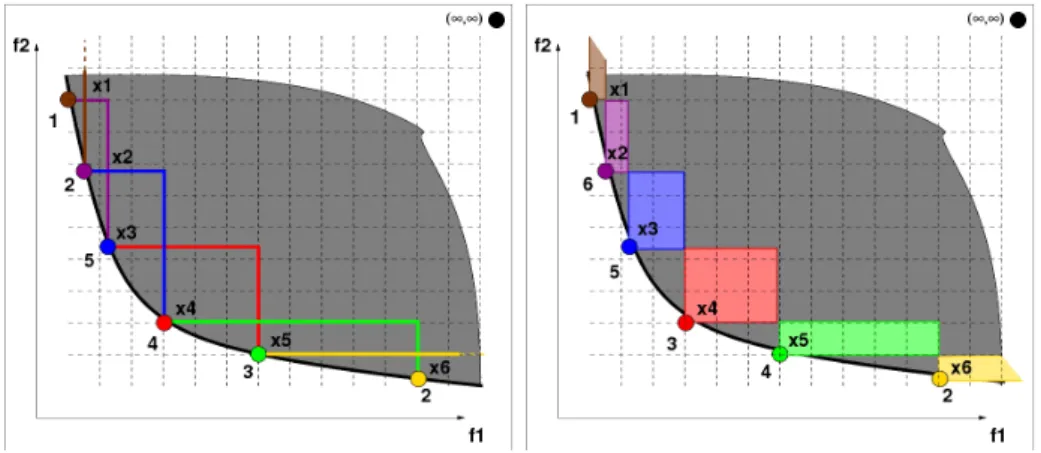
In figure 2.1 a set R of non-dominated solutions is depicted in a two dimensional solution space. The left hand side figure shows the lines determining the ranking of solutions in
The basicS-Metric Selection - EMOA 21
the NSGA-II. The right hand side figure depicts the same solutions and their corresponding values of ∆S(s, R), which are given by the areas of the attached rectangles. Note that for
the crowding distance, the value of a solutionxi depends on its neighbors and not directly on the position of the point itself, in contrast to ∆S(s, R). In both cases extremal solutions
are ranked best, provided we choose a sufficiently large reference point for the hypervolume measure. Concerning the inner points of the front,x5 (rank 3) outperformsx4 (rank 4), if the
crowding distance is used as a ranking criterion. On the other hand,x4 (rank 3) outperforms
x5 (rank 4), if ∆S(s, R) is employed (right figure). This indicates that good compromise
solutions, which are located near knee-points of convex parts of the Pareto front are given better ranks in the SMS-EMOA than in the NSGA-II algorithm. Practically, solutionx5 is
less interesting than solutionx4, since in the vicinity ofx5 little gains in objectivef2can only
be achieved at the price of large concession in objective f1, which is not what is sought to
be a well-balanced solution. Thus, the new method leads to more interesting solutions with fair trade-offs. It concentrates on knee-points without losing extremal points. This serves the practitioner who is mainly interested in a limited number of solutions on the Pareto front.
Figure 2.1: Comparison of crowding distance sorting (left) and sorting by ∆S (right).
2.1.4 Test Problems
The SMS-EMOA from the last section was tested on several test problems from literature. We aimed at comparability to the papers of Deb and his coauthors presenting their -MOEA approach [DMM03b, DMM03a]. That is why we also invoked the variation operators used for that approach. The test problems named ZDT1 to ZDT4 and ZDT6 from [DMM03a, ZDT00] have been considered. For reasons of a clear overview, we copied the results for the hypervolume measure and the convergence achieved in [DMM03a] to table 2.1. This way, we
compared our SMS-EMOA to NSGA-II, C-NSGA-II, SPEA2, and-MOEA.
Settings
We chose the parameters according to the ones given in [DMM03b, DMM03a]. We setµ=100, calculated 20000 evaluations and used exactly the same variation operators as used for the
The hypervolume orS metric of the set of non-dominated points is calculated as described above, using the same reference point as in [DMM03b, DMM03a]. The convergence measure is the average closest euclidean distance to a point of the true Pareto front as used in [DMM03a]. Note that the convergence measure is calculated concerning a set of 1000 equally distributed solution of the true Pareto front. Even an arbitrary point of the true Pareto front does not have a convergence value of 0, unless exactly equalling one of these 1000 points. Thus, the values are only comparable up to a certain degree of accuracy.
Results
The SMS-EMOA is ranked best concerning the S metric in all functions except for ZDT6.
Concerning the convergence measure, it has two first, two second and one third rank. Ac-cording to the sum of ranks of the two measures on each function, one can state that the SMS-EMOA provides best results on all considered functions, except for ZDT6, where it is outperformed by SPEA2. Building the sum of the achieved ranks of each measure shows that our algorithm obtains best results concerning both the convergence measure (with 9) and the S metric (with 6). So in conjunction, concerning this bundle of test problems, the SMS-EMOA can be regarded as the best one.
ZDT1 has a smooth convex Pareto front where the SMS-EMOA is ranked best on the S
metric and near to the best concerning the convergence measure. ZDT4 is a multi-modal function with multiple parallel Pareto fronts, whereas the best front is equivalent to that of ZDT1. On the basis of the given values from [DMM03b, DMM03a], we assume that all algorithms achieved to jump above the second front with most solutions and aimed at the first front, like our SMS-EMOA. The worse values of the other algorithms seem to stem from disadvantageous distributions. ZDT2 has a smooth concave front and the SMS-EMOA covers most hypervolume, despite the criticism that theS metric favors convex regions. ZDT3 has a discontinuous Pareto front that consists of five slightly convex parts. Here, the SMS-EMOA is a little bit better concerning theS metric than the second ranked-MOEA and really better concerning the convergence. ZDT6 has a concave Pareto front that is equivalent to that of ZDT2, except for the differences that the front is truncated to a smaller range and that points are non-uniformly spaced. Here, the SMS-EMOA is ranked second on both measures, only outperformed by SPEA2, which shows apparently bad results on the other easier functions.
The outstanding performance concerning the S metric is a very encouraging result even
though good results seem to be natural because of the use of the S metric as selection
criterion. One should appreciate that our approach is a rather simple one with only one population and it is steady-state, resulting in a low selection pressure. Neither there are any special variation operators fitted to the selection strategy, nor it is tuned for performance in any way. All these facts would normally imply not that good results.
The good results in the convergence measure are maybe more surprising. Especially on the function that are supposed to be more difficult, the SMS-EMOA achieves very good results. A possible explanation might be that a population of well distributed points is able to sample individuals with larger improvement. Further investigations are required to clarify this topic.
The basicS-Metric Selection - EMOA 23
Table 2.1: Results
Test- Convergence measure S metric
function Algorithm Average Std. dev. Rank Average Std. dev. Rank
ZDT1 NSGA-II 0.00054898 6.62e-05 3 0.8701 3.85e-04 5
C-NSGA-II 0.00061173 7.86e-05 4 0.8713 2.25e-04 2
SPEA2 0.00100589 12.06e-05 5 0.8708 1.86e-04 3
-MOEA 0.00039545 1.22e-05 1 0.8702 8.25e-05 4
SMS-EMOA 0.00044394 2.88e-05 2 0.8721 2.26e-05 1
ZDT2 NSGA-II 0.00037851 1.88e-05 1 0.5372 3.01e-04 5
C-NSGA-II 0.00040011 1.91e-05 2 0.5374 4.42e-04 3
SPEA2 0.00082852 11.38e-05 5 0.5374 2.61e-04 3
-MOEA 0.00046448 2.47e-05 4 0.5383 6.39e-05 2
SMS-EMOA 0.00041004 2.34e-05 3 0.5388 3.60e-05 1
ZDT3 NSGA-II 0.00232321 13.95e-05 3 1.3285 1.72e-04 3
C-NSGA-II 0.00239445 12.30e-05 4 1.3277 9.82e-04 5
SPEA2 0.00260542 15.46e-05 5 1.3276 2.54e-04 4
-MOEA 0.00175135 7.45e-05 2 1.3287 1.31e-04 2
SMS-EMOA 0.00057233 5.81e-05 1 1.3295 2.11e-05 1
ZDT4 NSGA-II 0.00639002 0.0043 4 0.8613 0.00640 2 C-NSGA-II 0.00618386 0.0744 3 0.8558 0.00301 4 SPEA2 0.00769278 0.0043 5 0.8609 0.00536 3 -MOEA 0.00259063 0.0006 2 0.8509 0.01537 5 SMS-EMOA 0.00251878 0.0014 1 0.8677 0.00258 1 ZDT6 NSGA-II 0.07896111 0.0067 4 0.3959 0.00894 5 C-NSGA-II 0.07940667 0.0110 5 0.3990 0.01154 4 SPEA2 0.00573584 0.0009 1 0.4968 0.00117 1 -MOEA 0.06792800 0.0118 3 0.4112 0.01573 3 SMS-EMOA 0.05043192 0.0217 2 0.4354 0.02957 2
Figure 2.2: This study visualizes results on the EBN problem family with Pareto fronts of different curvature computed by SMS-EMOA for a 20-dimensional search space.
Distribution of Solutions
In order to get an impression of how the SMS-EMOA distributes solutions on Pareto fronts of different curvature, we conducted a study on simple but high dimensional test functions. The aim is to observe the algorithms behavior on convex, concave and linear Pareto fronts. For the study, we devised the following family of simple generic functions:
f1(x) = ( d X i=1 |xi|)γd−γ, f2(x) := ( d X i=1 |xi−1|)γd−γ, x∈[0,1]d, (2.6)
withdbeing the number of object variables. The ideal criterion vectors for these bicriterial problems (which we will abbreviate EBN) are given by x∗1 = (0, . . . ,0), f(x∗1) = (0,1)T and
x∗2 = (1, . . . ,1), f(x∗2) = (1,0)T. By the choice of the parameter γ the behavior of these functions can be adjusted. Parameterγ = 1 leads to a linear Pareto front, whileγ >1 yields convex fronts andγ <1 concave ones.
Figure 2.2 shows that the solutions are not equally distributed on the Pareto front. The results demonstrate that the SMS-EMOA concentrates solutions in regions where the Pareto front has knee-points and captures the regions with fair trade-offs between different objectives. The regions with unbalanced trade-offs, located on the flanks of the Pareto front, are covered with less density, although extremal solutions are always maintained. On the linear Pareto front the points get uniformly distributed. In case of a concave Pareto front the regions with fair trade-offs are emphasized. These are located near the angular point of the Pareto front. The results can be explained by the way the contributing hypervolume is defined and is discussed in the previous sections.
2.1.5 Design Optimization
A frequently addressed multiobjective design problem is the two-dimensional NACA redesign of an airfoil [NWBH02, EN04b]. Here, two target airfoils are given, each almost optimal
The basicS-Metric Selection - EMOA 25
for predefined flow conditions. A computational fluid dynamics (CFD) tool based on the solutions of Navier-Stokes equations calculates the properties, e.g. the pressure distribution of airfoils proposed by the coupled optimization technique. From these results, the differences in pressure distribution to the target airfoils are calculated and serve as the two objectives to minimize. The computation of objective function values based on CFD calculations are usually very time consuming with one evaluation typically taking several minutes, hence only a limited number of evaluations can be afforded. Here, we allow 1000 evaluations to stay comparable to previous studies on this test problem.
Integration of Fitness Function Approximations
We use Kriging metamodels [SWMW89] as fitness function approximation tools to accelerate the SMS-EMOA. The Kriging methods allows for a prediction of the objective function values for new design points x0 from previously evaluated points stored in a database. Basically, Kriging is a distance based interpolation method. In addition to the predicted value, Kriging also provides a confidence value for each prediction. Based on the statistical assumption of Kriging, the predicted result y(x0) and the confidence value s(x0) can be interpreted as the mean value and standard deviation of a one-dimensional gaussian distribution describing the probability for the ’true’ outcome of the evaluation. We refer to [SWMW89] for technical details of this procedure and the statistical assumptions about the continuous random process that – as it is assumed – generated the landscape y(x).
As Kriging itself tends to be time consuming for a large number of training points, Kriging models are only build from the 2d nearest neighbors of each point, where d denotes the dimension of the search space.
Algorithm 3Metamodel-assisted SMS-EMOA
1: P0←init() /* Initialize and evaluate start population of µ individuals */
2: D←P0 /* Initialize database of precisely evaluated solutions */
3: t←0
4: repeat
5: Draw st randomly out ofPt
6: ai ←mutate(st), i= 1, . . . , λ /* Generate λsolutions via mutation */
7: approximate(D, a1, . . . , aλ) /* Approximate results with local metamodels */
8: qt+1← filter(a1, . . . , aλ) /* Detect ’best’ approximate solution */
9: evaluateqt+1 /* Evaluate selected solution precisely */
10: D←D∪ {qt+1}
11: Pt+1← Reduce(Pt∪ {qt+1}) /* Select new population of µ individuals */
12: t←t+ 1
13: until stop criterion reached
The new method is depicted in algorithm 3. In order to make extensive use of approximate evaluations, it proved to be a good strategy, to produce a surplus ofλindividuals by mutation of the same parent individual. For these new individuals an approximation is computed by means of the local metamodel. The filter procedure selects the most promising solution then. The chosen solution gets evaluated precisely and is considered for theReducemethod in the SMS-EMOA. This ensures that only precisely evaluated solutions enter the populationP and
Figure 2.3: Filtering of approximate solutions: Within the mean value criterion only x3 is
pre-selected while within the lower bound criterion the contributing hypervolume values ofx1 and x3 are computed.
that the amount of approximations employed can be scaled by the user. All precisely evaluated solutions enter a database, so they can subsequently be considered for the metamodeling procedure.
The basic idea of the filter algorithm is to devise a criterion based on the approximate evaluation of a search point. Criteria for the integration of approximations in EMOA have already been suggested in [EN04b]. Here, confidence interval boxes in the solution space were calculated as li = ˆyi−ωsˆi and ui = ˆyi+ωsˆi, i = 1, . . . , n, where n is the number of
objectives and ω is a confidence factor that can be used to scale the confidence level. An illustrative example for approximations with Kriging and confidence interval boxes in a 2-D solution space is given in figure 2.3.
Among the criteria introduced in [EN04b], two criteria seemed to be of special interest: First, the predicted result from the Kriging method, the mean value of the confidence interval box, is considered as a surrogate for the objective function value. This corresponds to the frequently employed approach to use merely the estimated function values as surrogates for the true objective functions and thus ignore the degree of uncertainty for these approximations. The second criterion goes one step further and upvalues those points with a high degree of uncertainty, by using the lower bound edge ˆy−ωˆs of the interval boxes instead of its center
ˆ
y for the prediction. This offers us a best case estimation for the solution.
Both surrogate points are employed to evaluate a criterion based on the S metric that is used for sorting the candidate solutions. For the mean value surrogate this is the most likely improvement (MLI) in hypervolume for population P when selectingx:
MLI(x) =S(Pt∪ {yˆ(x)})− S(Pt) (2.7)
and for the lower bound edge this is the potential improvement in hypervolume (LBI), that reads:
LBI(x) =S(Pt∪ {yˆ−ωsˆ(x)})− S(Pt). (2.8) It may occur that all values of the criterion are zero, if all surrogate points are dominated by the old population. In that case, the Pareto fronts of lower dominance level are considered
The basicS-Metric Selection - EMOA 27
for computing the values of MLI or LBI, respectively.
For the metamodel-assisted SMS-EMOA the user has to choose the parametersω andλ. If the lower bound criterion is used, the choice ofω determines the degree of global search by the metamodel. For high values ofω the search focuses more on the unexplored regions of the search space.
Results
Like on the test problems, the SMS-EMOA provided very good and encouraging results on the design optimization problem. For this test series, we collected five runs for each setting again. We considered SMS-EMOA without fitness function approximation as well as the metamodel-assisted SMS-EMOA with mean value and lower bound criterion as described above.
For reasons of comparability, we utilized a method to average Pareto fronts from [NWBH02]. In short, parallel lines are drawn through the corresponding region of the search space. From the Pareto front of each run, the points with the shortest distance to these lines are considered for the calculation of the averaged front.
Figure 2.4: The left hand side shows three of five runs used for averaging and the corre-sponding averaged front. The right hand side part compares SMS-EMOA without Kriging, using Kriging with lower bound (LB) and mean value (MEAN) criterion, next to NSGA-II using Kriging with lower bound criterion.
In the left hand part of figure 2.4 the different dotted sets describe three of the five Pareto fronts received from the different runs utilizing SMS-EMOA without Kriging. The line repre-sents the received averaged Pareto front. This front is additionally copied to the right hand side figure for the reason of easier comparability. That figure compares the averaged fronts received using SMS-EMOA with and without fitness function approximations. In addition, a prior result, the best one from the investigation presented in [EN04b] coupling metamodeling techniques with multiobjective optimization is also included in the figure. This result stems from NSGA-II runs with Kriging and lower bound criterion within 1000 exact evaluations as well.
The points on the Pareto fronts achieved using fitness function approximations are much better distributed than the ones obtained without. In the left figure, each received Pareto front
is biased towards one special region. In the runs utilizing fitness function approximations no focuses can be recognized. The solutions are more equally distributed all over the Pareto front, with the aspired higher density in regions with fair trade-offs as discussed above. The reason are the thousands of preevaluations that are used to find promising regions of the search space to place exact evaluations. Compared to the results with Kriging the runs without Kriging seem not to tap their full potential due to the too small amount of evaluations.
A clear superiority of the algorithms utilizing metamodels can be recognized. The averaged front without metamodel integration is the worst front all over the search space except for the upper left corner, the extremef2 flank of the front. In most other regions the SMS-EMOA
with lower bound criterion seems to be better than the other algorithms shortly followed by the old results from NSGA-II with lower bound criterion. The SMS-EMOA with mean value criterion yielded the worst front with metamodel integration.
In the extremef2 flank of the front the results seem to be turned upside down. Here, the
averaged front from runs without model integration achieved the best results. The left hand side of the figure, however suggests that this might be an effect of the averaging technique. It seems to be that one run achieves outstanding results here, which leads to an unbalanced average point that is better than the averaged points of the other algorithms. This extreme effect could be avoided by averaging over more than five runs which is a small and statistically not significant number of course.
Notice, that the lower bound approximation technique yielded better results than the mean value approximation again. This was also observed in [EN04b] and seems to be a general achievement, where more attention should be drawn to.
2.1.6 Summary and Outlook
The SMS-EMOA has been devised in this work, which is a promising algorithm for Pareto optimization, especially if a small, limited number of solutions is desired and areas with balanced trade-offs shall be emphasized. The results on academic test problems show that the algorithm is rather competitive to established EMO algorithms like SPEA2 and NSGA-II regarding the convergence measure. It clearly outperforms these methods, if theS metric is considered as performance measure.
Compared to many other EMOA the new approach is simple and efficient for the two objective case. The selection and variation procedures do not interfere with an extra archive and the number of strategy parameters is very low (population size and reference point). Instead of specifying a reference point the SMS-EMOA can also work with an infinite reference point.
The focus of the performance assessment was on the two objective case. We demonstrated for this case that the approach is of special elegance, since its implementation is quite simple and the update of the population can be computed efficiently. Future research will have to deal with the performance assessment for three and more objectives and for constraint problems.
For a real world airfoil design problem Kriging metamodels have been employed to save time consuming precise function evaluations. The results indicate that these techniques can be used to further enhance the performance of the SMS-EMOA.
The basicS-Metric Selection - EMOA 29
2.2 Multi-objective Optimisation using
S
-metric Selection: Application
to three-dimensional Solution Spaces
This section (pages 29 to 42) is copied verbatim from
[NBE05] B. Naujoks, N. Beume, and M. Emmerich. Multi-objective optimisation using S-metric selection: Application to three-dimensional solution spaces. In G. W. Greenwood, editor,
Congress on Evolutionary Computation (CEC 05), IEEE Press, Piscataway, NJ, 2005.
Abstract
TheS-metric or hypervolume measure is a distinguished quality measure for solution sets in Pareto optimisation. Once the aim to reach a highS-metric value is appointed, it seems to be promising to directly incorporate it in the optimisation algorithm. This idea has been imple-mented in the SMS-EMOA, an evolutionary multi-objective optimisation algorithm (EMOA) using the hypervolume measure within its selection operator. Solutions are rated accord-ing to their contribution to the dominated hypervolume of the current population. Up to now, the SMS-EMOA has only been applied to functions with two objectives. The work at hand extends these studies, by surveying the behaviour of the algorithm on three-objective problems. Additionally, a new efficient algorithm for the computation of the contributions to the dominated hypervolume in three-dimensional solution spaces is presented. Different variants of selection operators are proposed. Among these, a new one is presented that rates a solution concerning the number of solutions dominating it. So, solutions in less explored re-gions are preferred. This rating is an efficient alternative to theS-metric criterion whenever a selection among dominated solutions has to be made. Comparative studies on standard benchmark problems show that the SMS-EMOA clearly outperforms other well established EMOA. First results on a challenging real-world problem have been obtained, namely the multi-point design of an airfoil involving three objectives and nonlinear constraints. Not only a clear improvement of the baseline design, but a good coverage of the Pareto front with a small, limited number of points has been achieved.
2.2.1 Introduction
Multi-objective optimisation is getting more and more important in technical optimisation. Decision makers prefer the a posteriori approach actualised by Pareto techniques to the a priori one, the standard over the past years. In Pareto optimisation [CVL02, Deb01], the decision maker is provided a set of equally ranked, non-dominated solutions to choose from, instead of preliminary deciding for weights or search directions before first optimisation runs are performed.
Among the a posteriori approaches, EMOA established themselves in leading position con-cerning research interest and progress. Due to their general applicability and their population based approach of keeping an inherent set of best qualified solutions, they are an eminently suitable method.
New approaches in the EMOA field utilise so called quality indicators for the selection step in the underlying evolutionary algorithm (EA). Quality indicators or performance measures
are functions to map Pareto front approximations to real numbers. Binary quality indicators can be utilised to compare two Pareto front approximations. Examples for such indicators that have been used within the selection of EMOA are the binary additive-indicator or the indicator based on the hypervolume [ZK04]. The first algorithm to incorporate the hyper-volume indicator was ESP (Evolution Strategy with Probabilistic Mutation), proposed by
Huband, Hingston, While, and Barone [HHWB03]. Zitzler and K¨unzli presented a general
indicator-based evolutionary algorithm (IBEA) where different quality indicators can be
in-corporated. A more detailed comparison with the SMS-EMOA (S-metric selection EMOA)
proposed by Emmerich, Beume, and Naujoks [EBN05] is given in the following section. An assumed drawback of the algorithms incorporating quality indicators for selection i