CPB Document
No 141 March 2007
Will corporate tax consolidation improve efficiency in the EU?
CPB Netherlands Bureau for Economic Policy Analysis Van Stolkweg 14
P.O. Box 80510
2508 GM The Hague, the Netherlands
Telephone +31 70 338 33 80
Telefax +31 70 338 33 50
Abstract in English
Consolidation of the tax base in the European Union is expected to curve compliance costs and reduce profit shifting. A number of proposals for consolidation from the European Commission are simulated with the applied general equilibrium model CORTAX. We show that the benefits from consolidation are offset by two weaknesses in the proposals for a common consolidated tax base. Formula apportionment, which is needed to allocate the consolidated taxable profits across jurisdictions, creates new tax planning possibilities for MNEs and allows them to benefit from existing tax rate differentials in the European Union. In addition, it triggers tax competition as member states may attract foreign investment by reducing their tax rates. The second distortion is an unlevel playing field, which is introduced if only part of the firms participate in the consolidation. The gains from consolidation can be fully grasped if it is obliged for all firms and if it is accompanied by a harmonisation of the tax rate.
Key words: corporate tax, consolidation, formula apportionment, European Union, general equilibrium model
JEL codes: H87,H21,H25,F21
Abstract in Dutch
Consolidatie van de belastinggrondslag in de Europese Unie zal leiden tot een verlaging van de administratieve lasten van bedrijven en een vermindering van winstverschuiving. Een aantal voorstellen voor consolidatie van de Europese Commissie worden gesimuleerd met het toegepaste algemeen evenwichtsmodel CORTAX. We laten zien dat de voordelen van consolidatie teniet gedaan worden door twee tekortkomingen in de voorstellen voor een gemeenschappelijke geconsolideerde belastinggrondslag. De verdeelsleutel, die nodig is om de samengevoegde grondslag te verdelen over de lidstaten, introduceert de mogelijkheden voor multinationals om hun Vpb-belastingen te minimaliseren via verplaatsing van productie of verkopen naar lidstaten met lage belastingtarieven. Lidstaten kunnen hierop inspelen door tariefsverlagingen, zodat de trend tot belastingconcurrentie versterkt wordt door consolidatie van de grondslag. De tweede verstoring is ongelijke concurrentie tussen multinationals en
binnenlandse bedrijven, die mogelijk uitgesloten worden van de grondslaghervorming. De voordelen van consolidatie kunnen volledig worden benut als alle bedrijven overgaan op de gemeenschappelijke grondslag en als de belastingtarieven geharmoniseerd worden.
Contents
Preface 7
Summary 9
1 Introduction 13
2 Literature survey on formula apportionment 17
2.1 Tax planning strategies by MNEs 17
2.1.1 Allocation and investment decisions 19
2.1.2 Transfer pricing 20
2.1.3 Financial detour strategies 21
2.2 The design of the apportionment formula by governments 22
2.3 Empirical evidence 23
2.3.1 FA and factor reallocation in the US 23
2.3.2 FA and factor reallocation in Canada 24
2.3.3 Corporate tax analysis in CGE models 25
3 The 2002 Tax Communication 27
3.1 Commentaries on the 2002 Tax Communication 28
3.2 Summary and lessons for the EU 30
4 The CORTAX model 31
4.1 Main features of the model 31
4.2 Households 32 4.3 Firms 32 4.4 Corporate taxation 34 4.4.1 Source principle 34 4.4.2 Residence principle 34 4.4.3 Calibration 34 4.4.4 Formula apportionment 36 4.4.5 Compliance costs 37
4.5 Rest of the government 37
4.6 General equilibrium 38
5 Common consolidated base taxation 41 5.1 Direct effects of consolidation and formula apportionment 42
5.2 Firms 43
5.3 Government 46
5.4 Economy and welfare 48
5.5 Alternative simulations 51
5.5.1 A smaller or broader base 51
5.5.2 Alternative means of financing 51
5.5.3 Less mobile capital 53
6 The choice of the apportionment formula matters 55
6.1 Ireland and Portugal 56
6.2 Formula apportionment in the European Union 59
6.2.1 Tax rate 59
6.2.2 Reallocation 61
6.2.3 Government 62
6.2.4 Economy and welfare 62
7 Does consolidation trigger tax competition? 67
7.1 An example: Germany 67
7.2 CCBT & tax competition 68
7.3 Formula apportionment and tax competition 70
8 Alternative proposals for consolidation 73
8.1 Home state taxation 73
8.1.1 Firms 73
8.1.2 Government 75
8.1.3 Economy and welfare 75
8.2 Compulsory consolidation 76
8.3 European Union Corporate Income Tax 78
9 Conclusion 81
Preface
Member States are free to choose the tax systems that they consider most appropriate and according to their preferences. Yet, differences in corporate tax systems involve large costs, as it prohibits cross-border tax relief and involve large compliance costs for multinational enterprises. In its 2002 Tax Communication, the European Commission proposes consolidation of the corporate tax base as a solution to these problems and a step forward in the functioning of the Internal Market. Commissioner Kovázs (in a speech on April 5, 2006) expects that the Common Consolidated Corporate Tax Base, the most likely means of consolidation, would enhance competitiveness, boost growth and promote the creation of jobs in the EU. With the aim of an applied general equilibrium model of corporate taxation in the European Union, the current paper investigates whether consolidation indeed may deliver these economic benefits. Does it justify EU involvement in corporate taxation?
This report is part of the project on “Tax/benefit systems and growth potential of the EU” (TAXBEN, Project no. SCS8-CT-2004-502639), financed by the European Commission under FP6 of DG Research. The authors thank Peter Sørensen for the kind provision of his OECDTAX software, which has been of great help in developing our CORTAX model. The authors benefited from contributions and comments by Gaëtan Nicodème, Joeri Gorter, Arjan Lejour, Ruud de Mooij and Paul Veenendaal. Discussions in response to presentations at the conference on ’Subsidiarity in Europe’, at the Dutch Ministry of Finance and at the final conference of the TAXBEN workshop in Brussels, in particular by Michel Aujean, director for Analysis and Tax Policies at DG Taxation and Customs Union, are gratefully acknowledged.
Coen Teulings Director
Summary
Companies operating across the internal market are hampered by tax obstacles such as high compliance costs for cross-border operations, transfer pricing and the lack of cross-border loss compensation. These obstacles are inherent in the current system of separate accounting (SA), where the corporate income of foreign subsidiaries of multinational enterprises is treated separately for tax purposes. In its 2002 Tax Communication, the European Commission proposed consolidation of the tax base as an answer to the inherent difficulties of separate accounting and the large compliance costs. The consolidated base has to be apportioned to the member states to guarantee their ability to tax corporate income.
The aim of consolidation is to improve competitiveness in the European Union. Yet, the economic effects of consolidation with formula apportionment are hardly known. This study performs a numerical assessment of the economic effects using the computable general equilibrium model CORTAX. This model is designed to investigate corporate tax base
consolidation in the European Union. The model captures the main features of corporate income taxation in 17 EU member states and the United States. It includes the investment and
labour-demand decisions of both multinational enterprises (MNEs) and domestic firms. Moreover, the model allows for a welfare analysis by considering the optimal response of households to changes in taxes and factor rewards. This welfare analysis answers questions on the efficiency of the corporate income tax system in the European Union and on the distribution of the gains and losses of consolidation.
In a recent communication, the European Commission (2006) reemphasises the need for consolidation and proposes to proceed along the lines of the Common Consolidated Base Taxation (CCBT). This proposal reduces the compliance costs for internationally operating enterprises. In addition, shifting paper profits across jurisdictions becomes meaningless if the tax base is consolidated. Unfortunately, the CCBT not only delivers these gains, but also contains two distortive elements. First, formula apportionment, which is needed to allocate the consolidated taxable profits across jurisdictions, creates new tax planning possibilities for MNEs. Second, an unlevel playing field is introduced if only part of the firms participate in the consolidation.
Formula apportionment creates new tax planning possibilities for MNEs. Tax planning is the ability of firms to minimise their tax obligations by shifting profits or economic activity across jurisdictions. Transfer pricing, the most common means of tax planning in the current system of separate accounting, will become meaningless with the consolidation of the tax base. However, with formula apportionment, the share of the tax base apportioned to each jurisdiction can be influenced by shifting economic activity from one jurisdiction to another. Even though real
economic activity, like production or FDI, can be shifted less easily than paper profits to other member states, its economic impact is larger. The change in the tax planning strategy of MNEs, by reallocation instead of transfer pricing, therefore reduces welfare in the EU.
The second distortion is introduced if the common tax base is optional or if not all firms are allowed to participate. It results in a different treatment of MNEs and domestic firms, if the latter are excluded from the common base and still have to apply to the base of their home country. This creates an unlevel playing field between firms and leads to a reduction of GDP, employment and welfare.
Europe hardly benefits on average from the common consolidated base taxation. The gains from a reduction in compliance costs and the elimination of transfer pricing are offset by the efficiency losses from reallocation. Corporate tax revenues decline on average by about 2% due to the expansion of firms in member states with low tax rates and/or narrow tax bases.
Alternative means of financing have to be found in order to balance the government budget. The resulting gains in GDP and welfare are small, respectively 0.05% and 0.01% of GDP, which shows that the distortions introduced by the CCBT offset the gains from consolidation.
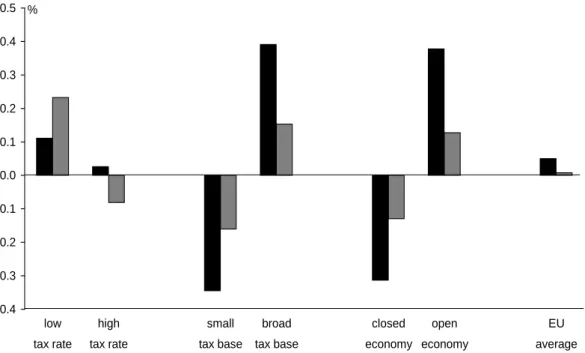
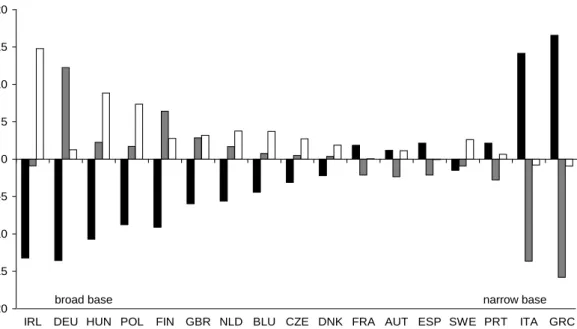
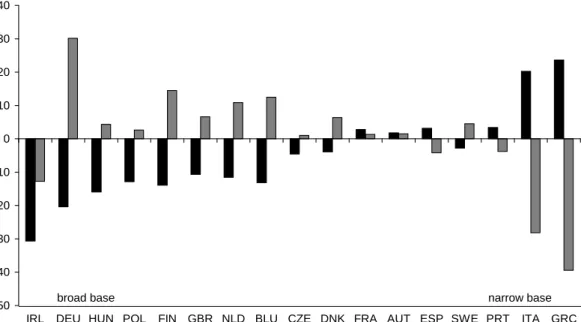
Some member states gain, where others lose, from the consolidation and apportionment of the tax base. First, multinationals in most member states gain from consolidation and from the alternative route for tax planning. This gives them a competitive advantage over domestic firms, which do not benefit from tax base consolidation. Second, governments in countries with a broad tax base lose from consolidation if the common tax base is defined at the current EU average. A broader definition of the tax base generates more corporate tax revenues, but distorts investments. Third, welfare improves in member states with large shares of multinational enterprises, below-average tax rates and/or broader-than-average tax bases. A low tax rate matters, because it makes member states relatively attractive for multinationals. A broad tax base matters, because the common base is less distortive. And the openness of countries matter, because these countries are most sensitive to corporate tax reforms.
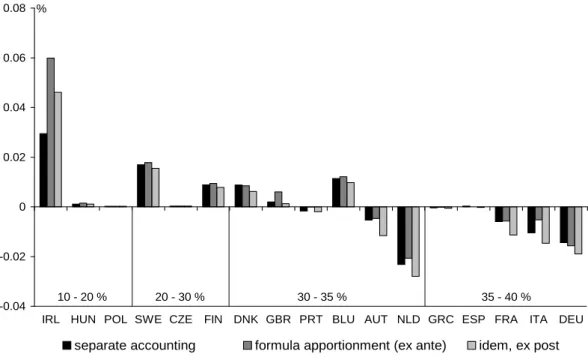
Consolidation intensifies competition in tax rates, which reflects the benefits from having a low tax rate. The switch by multinationals from favourable profit shifting (under separate accounting) to attracting production (with formula apportionment) implies that the gains from unilateral reductions in the tax rate increase. Simulations show that consolidation implies an optimal reduction in tax rates by individual member states of 10 to 20 percentage points.
One of the disadvantages of CCBT, namely the uneven treatment of multinational and domestic enterprises is obviated in the alternative EC-proposal of Home State Taxation (HST). In this proposal, domestic firms and multinational headquarters are treated equally, as they all have to apply to the tax rules of the member state in which they operate. However, unevenness is now created between subsidiaries from different home countries, which again offsets the initial gains from consolidation. The EU on average hardly gains nor loses from HST: welfare is unchanged and GDP declines slightly.
The second disadvantage of CCBT depends on the design of the apportionment formula, but cannot be fully overcome by a proper design. The largest distortions are introduced if apportionment is based on a single production factor, e.g. on employment or on capital. The incentives for reallocation are minimised if the apportionment formula resembles the distribution of corporate income of MNEs and is based on activities which cannot easily be affected by firms. However, even in this best case, formula apportionment generates an efficiency loss for the European Union.
The reason why formula apportionment and its design matters a lot, is the large differences in tax rates in the European Union. These tax differentials trigger tax planning, by reallocation of production or sales to low-tax countries. This tax planning can be tempered, but not eliminated by a proper choice of the apportionment formula. Only the harmonisation of tax rates can undo the incentives for reallocation.
The gains from consolidation can only be fully grasped if it is obliged for all firms and if it is accompanied by a harmonisation of the tax rate. In this far-reaching scenario, known as the European Union Corporate Income Tax, a welfare gain between 0.1% and 0.2% of GDP can be obtained.
1
Introduction
Companies operating across the internal market are hampered by tax obstacles such as high compliance costs for cross-border operations, transfer pricing and the lack of cross-border loss compensation. These obstacles are inherent in the current system of separate accounting (SA), where the corporate income of foreign subsidiaries of multinational enterprises is treated separately for tax purposes. Although SA has been applied in the European Union since decades, changing circumstances have questioned its desirability and practical viability. Indeed, SA was appropriate when most European businesses operated at a national level and when cross-border multinational transactions involved primarily tangible goods. However, increased EU economic integration through the Single Market stimulated many European companies to operate at the EU level. Moreover, the nature of cross-border multinational transactions has changed dramatically. It is ever more frequent that intra-firm transfers involve intangible goods (e.g. copyrights, patents) which are very difficult to price (Martens-Weiner, 2006).
On the one hand, this context has left tax authorities with significant difficulties to apply the separate-entity taxation and the arm’s length principle. On the other hand, multinational enterprises (MNEs) have more ease to apply transfer pricing and other profit shifting techniques in order to reduce their tax payments. As a response to these developments, tax authorities have increased the documentation requirements and penalties to curve MNE profit shifting, which results in high compliance costs for EU companies (European Commission, 2004a).
The European Commission (2002) proposed consolidation of the tax base as an answer to the inherent difficulties of separate accounting and the large compliance costs. Indeed, profit shifting will be meaningless and compliance costs will be reduced substantially if tax bases are
consolidated. In addition, consolidation will facilitate loss-compensation across jurisdictions (Nicodème, 2006).
Harmonisation of the tax rate is considered to be a bridge too far, as it would overrule the primacy of members states in corporate tax policy. As a solution, member states are allowed to tax a fraction of the consolidated base at their own rate. This requires the apportioning of the consolidated base to the member states, presumably with some kind of apportionment formula.
Formula apportionment (FA) is a way to distribute the tax base between the member states. Some measure of economic activity is used to determine which fraction of the consolidated base is generated in each jurisdiction and may therefore be taxed by each tax authority. Among the potential advantages of formula apportionment is that it reduces the ability of MNEs to apply tax planning strategies, i.e. the ability of firms to minimise their tax obligations by shifting profits or economic activity across jurisdictions (Martens-Weiner, 2006; Sørensen, 2004). Transfer pricing is the tax planning strategy most commonly applied in the current system of separate accounting, but will become meaningless with the consolidation of the tax base. However, formula
apportionment opens up new tax planning possibilities for MNEs, as the apportioned share of the tax base to each jurisdiction can be influenced by shifting economic activity from one
jurisdiction to another. By increasing the share of profits in low-tax member states, firms may minimise their tax payments.
The aim of consolidation is to improve competitiveness in the European Union. Yet, the economic effects of consolidation with formula apportionment are hardly known. We can learn from the existing systems in the United States and Canada (Martens-Weiner, 2006). However, economic effects likely depend on both the kind of consolidation and of the economic structure in the EU. For example, tax rate differentials are much larger in the EU, which might have important implications for the economic and welfare effects of formula apportionment.
Additional insights into consolidation and formula apportionment can be gained by theorising on the responses of firms and the implications for government revenues (Mintz and Weiner, 2003; Nielsen et al., 2006). Still, an integrated framework is needed, allowing for numerical
assessments of the economic outcomes of consolidation with formula apportionment in comparison with the current SA system (Devereux, 2004; Gérard, 2002).
This paper applies such an integrated framework, namely the computable general
equilibrium model CORTAX, to consolidation in the European Union. The model is designed to investigate these issues, by including consolidation and formula apportionment in a model which is otherwise extensively based on the model by Sørensen (2004). CORTAX is therefore the first CGE model applied to consolidation and formula apportionment in Europe (see Edmiston (2002) for an application to the United States). With this model, we investigate the economic and welfare effects of reforming the corporate income tax base in the European Union.
Does consolidation improve the economic efficiency in the European Union by reducing corporate tax distortions? This central question will be supplemented with several others. Does it contribute to employment and GDP? How are the gains and losses distributed within member states, between say domestic firms and multinationals, and between firms and households? Finally, consolidation opens up the opportunity for governments to attract foreign investments by cutting tax rates; does consolidation trigger tax competition?
The answers to these questions depend on the type of consolidation and the details of the apportionment formula. We investigate the following alternatives.
The first choice is about the scope and design of consolidation (see section 3 for a detailed discussion of these proposals). Four alternative types of consolidation have been put forward by the European Commission in its 2002 Tax Communication (European Commission, 2002). Currently, the European Commission (2006) seems to favour the option with a common consolidated tax base, to which multinational enterprises may choose to switch. A practical alternative, which does not require the introduction of a common tax base, is home state
taxation, where each enterprise may consolidate its taxable profits according to the rules of its home state. In more far-reaching proposals, consolidation is made compulsory and the common base is applied to domestic firms too.
The second crucial choice is about the apportionment formula, which is needed to allocate profits across jurisdictions. However, formula apportionment opens up new tax planning possibilities for MNEs. Moreover, it might induce strategic behaviour by governments to attract FDI by cutting tax rates (and thus intensifying tax competition) or by affecting the weights in the apportionment formula. Whether or not the European Union should allow for competition in factor weights is an unresolved issue. However, the economic literature has shown that the ability of each jurisdiction to change and strategically determine its factor weights, has in general, negative welfare implications (see section 2.2). For this reason, we investigate the more transparent uniform system, but allow for competition in tax rates.
The relevance of apportionment is acknowledged by the European Commission (2006), but its implementation is left open. In the paper we therefore investigate several alternatives, without pretending to be exhaustive.
The structure of the paper is as follows. Section 2 contains a survey from the theoretical and empirical literature on the pros and cons of formula apportionment. Section 3 summarises the proposals for consolidation by the European Commission, and surveys the commentaries on the 2002 Tax Communication. Section 4 introduces the CORTAX-model and describes in particular how we implement consolidation, formula apportionment and compliance costs in this model.
We then turn to the numerical assessment of consolidation and formula apportionment. Section 5 investigates the switch from the current system of separate accounting to consolidation according to the rules of common consolidated base taxation (CCBT). Section 6 discusses the consequences of the choice of the apportionment formula, within this CCBT-framework. Section 7 turns to the question whether consolidation will intensify competition in tax rates. Section 8 investigates two alternative EC-proposals, namely home state taxation (HST) and European Union Company Taxation (EUCT). Section 9 summarises our main findings.
2
Literature survey on formula apportionment
The current system of corporate taxation in the European Union is known as separate
accounting, where multinational enterprises (MNE) have to file the tax return in every member state separately. Two elements of this system are seen to be detrimental for the well functioning of the internal market. First, the cross-border activities of MNEs have to be valued in order to determine the taxable profits of each MNE in all member states. This valuation allows for tax planning strategies, as MNEs may set high (low) transfer prices for cross-border deliveries towards high-tax (low-tax) countries. Second, the multiple filing involves high compliance costs.
Consolidation of the tax base solves both problems as it adds up all the taxable profits of the MNE (within the EU) into a single base. In the existing consolidated systems of the United States and Canada, and in the proposed system of the European Commission (see section 3, in particular the CCTB-proposal), the consolidated base is apportioned, via some well-defined formula, towards each jurisdiction. In the EU, this would allow the member states to tax their part of the corporate tax base at their own tax rate.1
In the literature that deals with formula apportionment (FA), two topics have received most of the theoretical and empirical analysis: the tax planning strategies employed by MNEs and the strategic decisions to define the apportionment formula by governments. We discuss both issues in turn, and present the available empirical evidence related to the implementation of FA in the US and Canada.
2.1
Tax planning strategies by MNEs
When the corporate income tax (CIT) is not fully harmonised between different jurisdictions (i.e. the tax rates are not equal and/or the tax base is not fully consolidated), MNEs have incentives to apply tax planning strategies. The objective of these strategies is to reduce the total CIT payment of the MNE.
A central concern for tax authorities is the increased difficulty to measure transfer pricing using the arm’s length principle.2These difficulties have increased the scope for tax planning activities by MNEs which is an important distortion under SA. It is expected that tax base consolidation will eliminate the possibility of MNEs to shift profits using transfer pricing mechanisms.
1
Consolidation and formula apportionment are more precisely defined in the box on page 18, which also includes the applications in the US and Canada.
2
Arm’s length pricing means that taxable income of a corporation’s activity in each jurisdiction is based on computing the value of transactions between related affiliates as if they had occurred by independent parties in the market place (Kind et al., 2005).
Consolidation and formula apportionment
Consolidation is the central theme in the EC proposals. It means that similar rules and criteria are implemented to estimate corporate profits between jurisdictions and to obtain the consolidated profits of the MNE.
These consolidated profits might be apportioned to the member states according to well-defined rules. Formally, if these consolidated profits are given byπ, then the tax revenue of each jurisdiction jcan be expressed by:
T Rj=τjφjπ (2.1)
whereτjis the statutory corporate tax rate applied injandφjis the apportionment share of jurisdiction j; i.e. the share of the total corporate tax base assigned to j.The central idea of FA is thatφj reflects the share of corporate income generated by the MNE in each jurisdiction.
The next step is to estimate the shareφof corporate income by relating it to measurable factors related to the input (labour,
capital) or output (sales) of corporate activity. In principle, several formulae can be designed using different combinations of apportionment factors and their respective weights. In practice, there are four countries (i.e. USA, Canada, Switzerland and Germany) that currently apply some kind of FA in their tax system.a
Each province in Canada uses a formula which includes the ratio of the provincial levels of sales Sjand payroll Pjto the national total values (i.e.S, andP). The shares of sales and payroll are equally weighted in all provinces. The fraction of the total tax base accruing to each province can then be expressed as:
φCAj =0.5 Sj S +0.5 Pj P (2.2)
The apportionment formula in the US is extended in two ways. First, it includes a third factor capital (K). In addition, each state (j) can independently choose the weights (fjS,fLj,fKj) they use for each factor. Thus, the apportionment formula is given by: φU Sj =fSj Sj S +fjP Pj P +fKj Kj K where fjS+fPj +fjK=1 (2.3) a
Mintz and Weiner (2003) present a short summary of the FA systems used for each of these countries. However, by far the US and Canadian system have been the most researched. Weiner (1999) presents an in-depth description of the US system, while Mintz and Smart (2004) describe the Canadian system.
Transfer pricing, however, is not the only instrument used by MNEs to reduce tax payments. Gérard (2002, 2006) moves beyond the issue of transfer pricing and incorporates in his analysis these other tax planning strategies. Gérard (2006) classifies all the tax planning strategies into three main groups:
1. Allocation and investment decisions. 2. Transfer pricing.
3. Financial detour strategies.
All these strategies could be used by MNEs if either tax rates or tax bases are not fully harmonised between participating jurisdictions. Moreover, they create distortions of there own on the type of finance, the legal organization, and the location of parents and subsidiaries. Thus, Gérard (2006) argues that only a perfectly integrated tax system can eliminate these distortions. For both the SA and FA system, this is fully achieved only with both tax rate and tax base
harmonization. In this scenario, however, FA is a superior system since it implies a reduction in compliance costs and the possibility of loss compensations between subsidiaries of the same MNE.
We proceed to review the literature that deals with each of these tax planning strategies.
2.1.1 Allocation and investment decisions
When the apportionment formula is not homogenous and/or CIT rates differ among jurisdictions, the CIT can be traduced as excise taxes on the specific factors included in the formula, see box on excise taxes. This implies, for example, that if apportionment is (partly) based on payroll, then the labour demand by MNEs is distorted by differences in the corporate income tax between jurisdictions.
Econometric studies for the United States and Canada, surveyed by Edmiston (2002), reveal that changes in the factor weights significantly influence the demand or supply of that factor. Moreover, he shows that the magnitude and sign of the effect depends on the size, industrial make-up, and levels of statutory tax rates in each jurisdiction. In particular, differences in tax rates between jurisdictions will determine the impact of the factor weights in the apportionment formula on allocation and investment. In the following, we repeatedly return to this factor reallocation as a tax planning device.
Already in the current system of separate accounting, the corporate income tax influences the allocation and investment decisions of MNEs. In a review of the literature, De Mooij and Ederveen (2003) find substantial differences in the empirical methods and data employed by different studies. Thus, they perform a meta analysis to estimate the semi-elasticity of FDI to the CIT rate, and report a value of−2.4 when the average corporate tax rate is used. If the statutory rate is used instead, the value is reduced to−1.2.When FDI data is adjusted to exclude mergers and acquisitions, the elasticities remain high, and increase to−5.7 when only new plants and plant expansions are used instead of total FDI. Therefore, it is clear that CIT policies matter greatly for investment and allocation decisions.
Since differences in CIT rates play such an important role in MNE investment, it is useful to look at tax rate differentials between jurisdictions. Based on the methodology presented by Devereux and Griffith (1999), the European Commission (2002) finds high CIT rate differentials within the EU15. These results are reinforced by Devereux et al. (2004) and Jacobs et al. (2005) who find a large dispersion on the effective tax burdens in the expanded EU25. These significant tax differentials suggest an important potential for production reallocation between member states. Thus, the use of different tax planning strategies by MNEs within the EU can be significant and must be considered while modelling the behaviour of MNEs. In an analytical framework, this is specially true when long-term scenarios are considered, and production factors can reallocate easier.
CIT rate differentials within the US are much smaller than in the EU. The tax differential between the highest and lowest statutory CIT rate in US states is about 8 percentage points,
Excise tax with formula apportionment
The early literature (McLure, 1980; Gordon and Wilson, 1986) already identified the main tax distortions created by FA. Indeed, when the apportionment factors, their weights and/or the CIT rates differ over the different jurisdictions, then the FA can be traduced as excise taxes on the factors weighted in the formula. For example, the excise tax on labourτπLcan be written as (see Bettendorf and Van der Horst (2007) for the derivation):
MPL=w " 1+ τ L π(i) 1−τπf a(i) # (2.4) τπL(i) = fP π(i) w(i)L(i) τπ(i)−
∑
s τπ(s) Lf(i,s) L(i)The first equation shows that the excise tax raises the wage costs by firms (a subsidy will reduce it) by affecting the equality between the marginal productivity of labour,MPL, and the wage rate,w. The second equation relates the excise tax to the deviation of the statutory CIT-rate in the home country or stateτπ(i)to the weighted average of the statutory rate in all countries or states where the MNE is active. This tax gap is weighted with the relative size of consolidated profitsπto
payrollPand the weight on payroll fP. Similar excise taxes can be derived for other apportionment factors.
From these equations, it is clear that the excise taxes (subsidies) in a country or state arise from deviations from the statutory rate from the factor-weighted national average. Only in the case of uniform tax rates and equal apportionment weights (as in Canada) will the factor-specific excise taxes disappear. When this tax rate harmonization is reached, then the FA system will resemble a corporate tax levied at the national level.
In general, these factor-specific distortions create complicated incentive effects for both the MNEs and governments alike. MNEs have incentives to change location and their factor allocation (see section 2.1), while a government has incentives to adjust the weights of the apportionment factors and this in turn, creates strategic interactions with other tax authorities (see section 2.2). However, even when the factor weights are fixed, Mintz (1999) also points out that fiscal externalities will persist when member states can levy different tax rates, credits or surtaxes.
while it is about 30 percentage points in the EU25. These figures indicate that the tax rate differential and levels are significantly different between both regions and tax rate competition is expected to be a more critical issue for the CIT tax reforms of the EU.
2.1.2 Transfer pricing
If there is tax base consolidation and it is compulsory for all MNEs, it is commonly assumed that switching to FA will eliminate the possibility of MNEs to use transfer pricing as a tax planning device. However, to reach this conclusion one has to assume as well, that there is perfect competition in the industries where MNEs operate. Otherwise, Nielsen et al. (2003) and Kind et al. (2005) argue that under conditions of imperfect (oligopolistic) competition, a transition from separate accounting (SA) to formula apportionment (FA) does not eliminate the problem of transfer pricing. In their models it is assumed that transfer pricing is also a strategic device in a Cournot competition setting. In this context, MNEs have incentives to use transfer pricing strategies to improve their competitiveness against rival firms. Therefore, while FA eliminates the profit shifting incentives of transfer pricing, it does not eliminate the strategic competition ones, and the transfer pricing distortions are kept in place.
Both papers do not consider production reallocation or other tax planning strategies. Thus, their models miss much of the interactions between CIT and MNE decisions. Therefore, although they present interesting modelling features for transfer pricing, their analytical framework can only partially evaluate the welfare implications of moving from a SA system to a FA system.
Nielsen et al. (2006) construct a model where, besides the transfer pricing mechanism, MNE headquarters also share a common input with their subsidiaries. Thus, the interaction between transfer pricing costs and CIT rates affects both the input levels of the MNEs and the fiscal spillovers between countries. Under these assumptions, their model shows that a move from SA to FA will not clearly decrease tax distortions nor the fiscal spillovers associated with transfer pricing under SA. In some cases, moreover, the switch to an apportionment formula may even increase the CIT distortions.
Under SA, the interaction between profit shifting and the MNE location is explored in two papers. Mintz and Smart (2004) point out that if the government values both the tax revenues and the real investment of MNEs, then profit shifting may have ambiguous effects on welfare. If there are more possibilities to shift profits between jurisdictions, then MNEs have less incentives to reallocate production. The other paper is by Peralta et al. (2006). They use a fiscal
competition model where the government has two instruments: the CIT rate and the tightness in the control of profit shifting. In this case, tougher transfer pricing rules can be costly for
governments, since MNE can respond by delocalising. Thus, some governments find it attractive to have high CIT rates but lose profit shifting controls.
These papers illustrate that the evaluation of how transfer pricing changes with FA or SA is not enough to provide a complete welfare analysis. The inclusion of production or factor reallocation decisions by MNEs is also needed.
2.1.3 Financial detour strategies
If consolidating profits between different jurisdictions is not compulsory for MNEs, then they can also use financial detour strategies to reduce tax payments. This third tax planning strategy by MNEs consists of establishing an “administrative subsidiary” as a financial centre in a third-party country where profits are not consolidated. This subsidiary, which is usually not directly related to production or sales activities, can be used by the MNE to manipulate and devise complex financial operations involving dividends and interest payments, capital gains and the transfer of business income between different subsidiaries.
When this third strategy is incorporated into the analysis, a better picture of the strategic interactions between CIT and MNE can be obtained. Gérard (2006) uses a multi-stage model to include the three tax planning strategies mentioned before, plus the strategic decisions of governments that maximise welfare. To illustrate his model, he uses a numerical case study, which is later complemented with an analytical model. An important feature of this paper, is that it distinguishes between “paper profits” and “real profits”. In this way he decomposes the MNEs
decisions in two steps. In a first step MNEs make decisions to maximise profits by choosing production and distribution locations. In a second step, other tax planning strategies are employed to minimise their tax payments.
In this more complex, but realistic setting, the welfare implications of moving from FA to SA are conditional on several elements:
• the ease on which the firm can manipulate the chosen formula factors.3 • the integration of the consolidated FA system with the rest of the world. • if the consolidation is made compulsory or not.
Since the EC proposals will most probably not be compulsory, this means that third country detour strategies within the EU will remain a significant source of CIT distortions.
2.2
The design of the apportionment formula by governments
The decision to apply a specific apportionment formula is non-trivial. As a result of the implicit excise taxes on the apportionment factors, tax authorities have incentives to strategically choose these factors and their respective weights. As shown below, the ability of each jurisdiction to change and strategically determine its factor weights, has in general, negative welfare implications.
Based on most of the theoretical models and the empirical results presented above, it is clear that jurisdictions have incentives to unilaterally change their factor weights in order to increase production, investment and/or employment levels. This result has been confirmed by Omer and Shelley (2004) who find that in the US there is substantial interstate competition to attract firms that operate on a national level.
In the US these strategic interactions have developed into a tendency, beginning in about 1980, to place higher weights on the sales factor. Following the insights of Gordon and Wilson (1986), reducing the weights on payroll and property will reduce production costs in that jurisdiction and induce MNEs to reallocate production there.4This mechanism is referred to as the “economic development” incentive of CIT, since reallocation implies increased employment and capital inflows. This effect is confirmed by the empirical review of Edmiston (2002), who reports evidence of a moderate positive production increase associated with changes in the factor weights. Goolsbee and Maydew (2000) present strong empirical results that confirm the
externalities associated with strategic FA. They also point that changes in the factor weights by single States have significant externalities on other States.
This empirical evidence confirms the results of some game theoretical papers. For example,
3
This includes the mobility of MNE activities between jurisdictions.
4
Implicit to this reasoning, is the fact that administratively, sales are taken at their destination, and not at their origin as will be preferred.
Anand and Sansing (2000) deal with the incentives of governments to change weights and the related game theoretical issues. They show that a harmonised apportionment rule will be the cooperative solution, but jurisdictions have strong incentives to deviate from this solution. This creates a typical prisoner’s dilemma situation. Thus, social welfare will be higher when a common formula is employed.
A second issue is whether apportionment should be based on mobile or immobile factors. Two papers shed some light on this issue. Wellisch (2004) demonstrates that when using two apportionment factors, one immobile (labour) and the other mobile (capital), it will be optimal for the government to allocate all the weight to the immobile factor. In this case, the CIT tax is transformed into a labour tax that reduces wages and there will be no incentives for tax
competition between jurisdictions. However, usually the mobility of the apportionment factors is not so clear cut, and he does not consider the case where MNEs can reallocate production to take advantage of factor price differentials.
A related but analytically more complex model is presented by Pethig and Wagener (2003). They analyse how the use of different apportionment formulae affects tax rate competition. In their model different formulae interact with the degree of factor mobility and the properties of the production function. They also find that allocating higher weights to immobile factors is optimal for tax authorities.
2.3
Empirical evidence
We group the main empirical papers into two broad questions:
1. Do variations in the apportionment formula affect investment and employment decisions by MNEs?
2. Do firms use tax planning strategies and shift factors to take advantage of tax differentials under FA?
The first question implicitly assumes a combination of different factor weights and CIT rates between jurisdictions. This set of studies analyses the US experience. On the other hand, the second question analyses tax differentials only when the factor weights are fixed, which is the Canadian FA system. In any case, the empirical evidence points to a positive answer to both questions.
2.3.1 FA and factor reallocation in the US
Weiner (1994) finds no statistical influence on production decisions from the cross-state
variation in the formulae used by the States in 1977. However, when she analyses the changes in the States’ CIT rates and property factor weights between 1982 and 1990, she finds a statistically significant effect on investment spending by State, but the effects are not very large.
Klassen and Shackelford (1998) report a significant negative relation between the sales excise rate (i.e. CIT statutory rate times the sales factor weight) and the location of MNE activities. Gupta and Hofmann (2003) find an elasticity in the range of−0.18 to−0.35, for new capital expenditures with respect to the capital excise rate.
Moreover, Goolsbee and Maydew (2000) present strong empirical evidence supporting that the apportionment formula affects MNEs decisions. In particular, they find a significant reaction of state employment to changes in the payroll weights. A reduction in the payroll weight from 1/3 to 1/4 increases employment by around 1.1%.
2.3.2 FA and factor reallocation in Canada
The Canadian experience, where all Provinces use a formula with common and fixed factor weights,5shows that MNEs still use tax planning strategies to exploit differences in the CIT rates between Provinces. The empirical results by Mintz and Smart (2004), using administrative tax data for Canada, find that the elasticity of taxable income to tax rates is significantly higher for firms able to engage in profit-shifting strategies(4.9)than for other comparable firms(2.3).
Likewise, Weiner (1994) concludes that tax rate competition is highly effective in Canada. Using panel data from 1962 to 1989 she finds that reductions in CIT rates are strongly associated with increases in provincial investment. Moreover, Klassen and Shackelford (1998) find
evidence for both the US and Canada consistent with corporations shifting their tax bases to tax-favourable jurisdictions.
Tax rate competition affects investment in both SA and FA. However, the incentive to re-adjust property shares under FA creates a second effect that is not present with SA. Thus, the standard point of view is that FA increases tax competition between jurisdictions. This view is supported by the models of Gordon and Wilson (1986) and Nielsen et al. (2006). On the other hand, Sørensen (2004) argues that this “secondary” effect under FA is not assured and under some circumstances is not present. For example, Wellisch (2004) points that it does not exist at all in the Canadian formula where there is no property factor.
If all countries applied the same formula, Pethig and Wagener (2003) argue that tax rate competition will generally be stronger if there is a higher weight on the payroll factor, since labour is assumed to be the least mobile factor, compared to property and sales. Finally, Kolmar and Wagener (2004) point that tax rate competition is independent of the tax base under SA, but both the tax base and the formula simultaneously affect tax rate competition under FA.
An important result found by Mintz and Smart (2004) is that since it is not compulsory for Canadian firms to consolidate their accounts, many firms use this loophole to engage in tax planning strategies also employed under a SA system.
5
2.3.3 Corporate tax analysis in CGE models
Edmiston (2002) builds a computable general equilibrium (CGE) model to evaluate the strategic formula apportionment policies in the US. The model was aggregated to eight regions and eight industrial sectors and was calibrated to data from the 1992 US economy. To obtain a short run and a long run scenario, he models the production aggregation function using a CES formulation that includes an elasticity of substitution in the location of production. Since there is a limit to production reallocation, Edminston chooses a higher elasticity for the long run specification (5.0)and assumes that labour is mobile. For the short-run version of the model, labour is geographically immobile and the location elasticity is close to zero(0.3).
Edmiston (2002) applies this CGE model to compare the long-run economic equilibrium when only the sales factor is usedfS
j =1
to a scenario where all factors have equal weight
fSj =fjP=fRj =1/3. Moreover, to assess the strategic gains for each state, he first simulates the case where each region independently moves to fS
h =1, and then, when all regions
simultaneously move in this direction.
He finds support for the economic development effects of strategic weight determination by US regions. In his simulations, when regions act independently and switch from an equal-weight three-factor formula to a single-factor sales formula, net capital inflows, employment and production all increase. In the long run, the percentage change in capital, labour and output is positive for each region, with the average increase being around 1%.
These impacts, however, are conditional on differences in industrial structure, the CIT statutory rates and the size of the US region. Hence, the output increases in a range from 1.4% to 0.2%. In general, small regions with a relatively capital-mobile industrial base and high statutory tax rates gain the most from the move to a single-factor sales formula.
In the case of a simultaneous move of all regions to a single-factor sales formula, there are both winners and losers. However, once a region moves towards a single-factor sales formula, all other regions have an incentive to move in the same direction. This results confirms the
prisoner’s dilemma situation mentioned before.
The magnitude of the economic development gains is much lower in the short run, when labour is immobile. Finally, his simulations show that the revenue impacts are significantly bigger than the economic development gains, especially in the short run.
Although not designed to explicitly deal with FA, Sørensen (2001, 2004) constructs a CGE model of tax competition and coordination: OECDTAX. This model includes profit shifting via transfer pricing assuming SA. Sørensen (2004) estimates the welfare gains from a complete CIT rate and base harmonization in the EU.6He does not consider the consolidation of the tax base,
6
In a recent paper, Sørensen and co-authors (Brøchner et al., 2006) extend the analysis by simulating enhanced cooperation, where only the tax base and rate are harmonised in the euro-area, which sizes down the gains from tax harmonisation.
and therefore does not have to introduce formula apportionment in the model. The welfare gains of harmonisation are just between 0.1 and 0.2%,7where the majority of member states benefits,
but some will lose. Since Sørensen does not consider welfare gains from lower compliance costs, he concludes that only if these costs are significantly reduced, it will be attractive for Member States to seek tax harmonization and give up sovereignty on corporate taxation.
Devereux (2004) also highlights the crucial role that reducing compliance costs can play when assessing the welfare implications of switching to FA. In addition, he discusses the intrinsic problems of analysing equity and efficiency issues in CGE models. He argues that the equity issues are too complicated to analyse and estimate, and thus, should not be taking into account when designing international taxes.
We summarise this section with two concluding remarks. First, the literature emphasises that within a FA system, there still exist tax planning strategies that can be employed by the multinationals. Thus, the distortions associated with these tax planning strategies are still present; unless the shift to FA also includes a compulsory harmonisation of the tax rate and the tax base. As a consequence, there is the possibility that the overall distortions associated with the CIT are greater under FA, than with SA.
Secondly, the design of the specific apportionment formula is crucial for the economic performance of the system. This is a direct consequence of the strategic incentives that governments have to change the formula, combined with the potential distortions induced by profit shifting strategies under FA. Although there is no ideal FA system, the evidence suggests that the option where jurisdictions can independently determine their factor weights should be avoided. Another recommendation is that the factors should be chosen to limit the profit shifting allocation decisions of MNEs. However, there are no clear candidates that can fully achieve this goal.
7
Similar welfare gains are simulated in Copenhagen Economics (2004) with CETAX, which is a slightly adjusted version of OECDTAX. A somewhat larger welfare gain of 0.4%GDP is obtained in a simulation with harmonisation at the equal-weighted rate and base. This unweighted average, however, implies a significant reduction in the CIT-revenues, which reduces the average distortiveness of the CIT.
3
The 2002 Tax Communication
In the 2002 Tax Communication,8the European Commission presents an overview of the current state of the corporate income tax (CIT) system in the EU and proposes several changes to the current system. We describe the main issues included in this report and the reactions it generated in the economic literature.
The European Commission (2002) points to three main reasons for consolidating the tax base for MNEs within the EU.
• Increase economic efficiency, by improving the allocation of capital within the Internal Market. This also entails the ease of cross-border mergers and multinational activities. However, the aim is to balance the trade-off between tax neutrality and other welfare considerations (i.e. equity preferences and the provision of public goods).
• Reduce the compliance costs associated with the existence of 25 separate tax systems in the EU. • Eliminate the transfer price problem. The difficulties to apply the arm’s length principle have
increased the compliance costs for tax authorities and businesses alike; while it facilitates the use of tax planning strategies by MNEs.
The European Commission considers that a comprehensive approach, which provides a single common consolidated tax base for MNEs, is the best way to deal with these problems. Within this comprehensive approach, four alternative schemes are proposed:
1. Home State Taxation (HST): the tax base would be computed in accordance with the tax code of the company’s home state (i.e. where the headquarter is based). This system will be optional for MNEs and the CIT rates will still be determined by each Member State.
2. Common Consolidated Base Taxation (CCBT): this will create new harmonised EU rules for the determination of a single tax base on an European level. It will also be optional and
country-specific CIT rates are applied.9
3. Compulsory Harmonised Corporate Tax Base (CHCTB): a single compulsory EU company tax base and system, as a replacement for existing national systems. This system will be mandatory for all companies, domestic as well as international. However, Member States will still
determine the CIT rates.10
4. European Union Corporate Income Tax (EUCIT): the CIT will be levied at the European level using a new EU tax base and single tax rate. Part or all of the revenue could go directly to the EU. The system will be compulsory, but only for MNEs.
8
European Commission (2002). This document is also referred to as the Bolkestein Report.
9
In a later communication, the European Commission (2006) refers to this proposal as the Common Consolidated Corporate Tax Base (CCCTB).
10
The first three approaches will implement formula apportionment (FA), while it could also be used in the last one. These proposals, in any case, are not strictly defined and some adjustments can (and have to) be made. However, the last two proposals will need the consensus of all Member States, and it is commonly acknowledged that this is very unlikely to happen (Cnossen, 2003). However, it is arguably a less momentous step than the creation of a single European currency (Devereux, 2004).
To clarify the different issues implicit in each proposal, Table 3.1 classifies each proposal by where the tax base and the tax rate will be determined and whether the consolidation is
compulsory or not.
Table 3.1 EC proposals, classification based on where the tax base and tax rate are determined
Tax base
National (optional) EU (optional) EU (compulsory)
National HST CCBT CHCTB
Tax rate
EU EUCIT
3.1
Commentaries on the 2002 Tax Communication
Devereux (2004) presents a detailed analysis of the report. He argues that the report does not consider the interaction between corporate and personal taxes, which can also create significant distortions.11 In general he favours the move towards FA, but concludes that only the CHCTB with a single tax rate will remove all distortions created by the CIT.12In a related paper, Weiner
(2002) also overviews the 2002 Tax Communication and comments on the possible distortions that can be introduced by FA, which we mentioned in the previous section. Thus, she also concludes that most of the distortions can only be eliminated by implementing the harmonised CHCTB proposal. When moving from the current system to an intermediate one with FA, it is not clear what the final efficiency changes will be.
Cnossen (2003) points that the report focuses only on capital allocation distortions between member states, but not within the states. He argues that these within-country distortions are significant and their elimination should be a prerequisite for between-members tax neutrality. He also points to the potential distortions that can be introduced by switching from SA to FA.
Since CCBT and HST are the proposals most likely to be implemented, they have attracted additional attention. Cnossen (2003) first argues that both proposals will reduce cross-border obstacles faced by MNEs, but in turn, this will probably increase tax competition. Secondly,
11Regarding the interaction of CIT with other taxes, Eggert and Schjelderup (2003) find that a FA system is inferior to a
property tax.
12Note that the CHCTB proposal with a single tax rate will be almost equivalent to the EUCIT. The only difference is that
since both systems will operate alongside national tax systems, they could also hamper the functioning of these systems. Finally, since both systems fall short of full tax rate and base harmonization, they also face the prospect of not reducing the CIT distortions currently found under the SA system. When comparing both proposals, Cnossen (2003) points that HST will intensify tax-related competition for headquarters locations. Thus, HST will create additional fiscal externalities not present under CCBT.
Another paper that compares CCBT and HST is Mintz and Weiner (2003). They employ a simple model with two countries and a formula that uses only the share of capital to apportion MNE profits. They find that the capital allocation distortion created by this specific formula can be positive or negative, but will be greater under HST than under CCBT. This result is driven by HST increasing the differentiation in effective tax rates faced by businesses operating in the same country. To sum up, both papers find that HST is inferior to CCBT.
Sørensen (2004) points that moving to a FA system will involve the resolution of important technical issues: how to define a multinational group13, how to choose a specific apportionment
formula and how to measure the factors in this formula. He also includes among the
disadvantages of HST, that it will probably imply a loss of tax revenue from an EU perspective, since MNEs will switch to HST if it implies a lower tax payment. However, HST has the advantage that it could be immediately adopted by the EU governments.
Another potential problem is that switching to a FA system may not be compulsory for all firms and/or Member States. Hence, this situation will not reduce compliance costs as much as in a compulsory system. In addition, it will leave open the possibility for MNEs to apply tax planning strategies between participating and non-participating countries (Martens-Weiner, 2006).14For tax authorities it will also imply the administration of two corporate tax systems, one for the MNEs and one for domestic firms. In turn, this may create distortions between large and small firms within Member States (Sørensen, 2004).
There is consensus, however, to the need for numerical assessments of the economic outcomes under different FA proposals in comparison with the current SA system (Devereux, 2004; Gérard, 2002). The welfare implications of the different efficiency and compliance costs will be very valuable to guide policy makers. Moreover, Gérard (2002) advocates for models that include at least one jurisdiction outside the consolidation region, to assess the flow of funds between the EU and partner countries (e.g. USA). However, a problem with the construction of such numerical assessments stems from the vague nature of the four proposals. In particular, the apportionment formula that will be used is not defined in the 2002 Tax Communication nor in the 2006 Communication on CCCTB (European Commission, 2006). There is no discussion about which factors will be included, which weights are applied; and the possibility or not of member countries to change these weights. All these issues are crucial for the welfare results, and analytically as important as changing from SA to FA itself.
13
In general, there is consensus that the current system should be changed, but the technical and political mechanisms to do so are unclear. Thus, the 2002 Tax Communication is seen as only a first step forward towards CIT consolidation.
3.2
Summary and lessons for the EU
Although the 2002 Tax Communication clearly favours a move from the current SA system to one that uses FA, it does not propose a specific apportionment formula to be applied. Without a clearly defined FA system, the economic and welfare implications of the EC proposals are at best unclear. However, some general conclusions can be drawn.
First, although the EC proposal aims to reduce the efficiency distortions and profit shifting possibilities under SA, it is not clear that moving to FA can actually eliminate these problems. In fact, these distortions might increase under some circumstances. It all depends on the specific FA system implemented. In any case, only when a full tax base and rate harmonization is applied will all the efficiency distortions associated with the CIT disappear.
Second, disregarding the efficiency changes expected to occur when moving from SA to FA, possibly the major advantage of FA is that it creates the possibilities to significantly reduce compliance and administrative costs for businesses and tax authorities (Mintz, 1999). Thus, one important issue insufficiently analysed in the empirical literature, is the relative importance of these compliance and administrative costs with respect to efficiency gains and changes in government revenue.
Third, the main lesson is that the more uniform the apportionment formula the better. It is clear that allowing the member states to choose their own factor weights will be suboptimal for the EU as a whole as it may induce strategic interactions of member states.
The uniform factor weights should be chosen as to be as independent as possible from MNE decisions. However, which specific factors can achieve this is unclear. Classic factors are payroll, property and sales. Alternative suggestions are to use the VAT base or to allow for sector specific factors (Mintz, 1999; Mintz and Weiner, 2003; Hellerstein and McLure, 2004; Sørensen, 2004). In addition, the harmonization of the tax base will be a superior option than allowing member states and MNEs to choose between FA and the current system. Nevertheless, a tax base harmonization will probably be very difficult to implement politically.
To sum up, defining the specific apportionment formula that will be applied is a critical issue that has to be dealt with. In more specific terms, a positive lesson from the US is the need to consolidate the income of affiliated groups of countries (Hellerstein and McLure, 2004). While the Canadian experience shows that even with a harmonised tax base, jurisdictions can still use CIT rates to attract MNE. Thus, in this case the EU as a whole could gain from reduced compliance costs, while Member States will maintain the advantages of setting their own CIT rates (Martens-Weiner, 2006). However, there is also the danger that tax differentials under FA will create their own distortions.
4
The CORTAX model
The proposed reforms of corporate income taxation in the EU are simulated with the general equilibrium model CORTAX. The development of this model is heavily inspired by the
OECDTAX-model of Sørensen (2001). The same model was used in Bettendorf et al. (2006), but extended in three ways for the current study. First, the current model includes the US. In contrast to the European countries, the US applies the worldwide residence-principle for corporate income taxation. The incorporation of the US also allows us to analyse the consequences of a country that does not participate in the shift towards tax base consolidation. Second, a system of tax base consolidation with formula apportionment is specified for the EU-countries. Thirdly, we consider compliance costs arising from company taxation. When separate accounting is no longer obliged for multinationals operational in several jurisdictions, compliance costs are reduced and efficiency gains can be achieved. Simulations with the extendend model can give an indication about the contribution of lower compliance costs to overall welfare effects.
We first describe the main features of the model. Thereafter, the modelling is briefly discussed per sector. Attention is in particular given to the specification of corporate taxation in subsection 4.4 (including a detailed discussion of the main extensions).15
4.1
Main features of the model
• The model includes 17 EU-countries and the US. The EU-countries are the 15 old member states (with BEL and LUX joined) and the three largest new member states (CZE, HUN and POL). • All markets are characterized by perfect competition. Location-specific rents are, however,
introduced so that profits are not zero.
• All countries produce one homogenous good at the exogenous world price (the net supply by the rest of the world (ROW) is assumed perfectly elastic at the given price).
• Two type of assets are traded on the world capital market: bonds and equities. Bonds issued in different countries are considered perfect substitutes, yielding the same given world interest rate. The same holds for equities. An individual country cannot affect world interest rates (the net supply of each asset by ROW is assumed perfectly elastic at the given interest rate).
• We focus on the steady state version of the model. Calculation of the full transition path is beyond the scope of the current project.
15
A detailed technical description of the basic model can be found in Bettendorf and Van der Horst (2006). The extensions are fully explained in Bettendorf and Van der Horst (2007).
4.2
Households
Following the standard overlapping generations model of Diamond, households are assumed to live for two periods.16Household decisions on consumption and labor supply are derived from
the maximization of lifetime utility, which allows for a proper welfare analysis. An individual only works when young. Young households receive labour income (after taxes) and lump sum transfers. The difference between total income and consumption expenditures (including taxes) gives total savings. These savings are invested in bonds and stocks. Since both asset types are considered imperfect substitutes, an investor prefers to diversify his portfolio over both assets. Since older households do no work, consumption in the second period has to be financed by capital income (net of taxes), together with lump sum transfers.
Calibration is in general based on data from 2002.17 Consumption expenditures are taken
from the National Accounts, while labour supply is calculated from data on employment in persons and hours. Values for the main parameters of the household sector are given in Table 4.1.
Table 4.1 Key parameters and (semi-)elasticities for households
Population growth 0.5%
Real return on bonds 2.0%
Real return on equity 4.0%
Rate of time preference 1.0%
Elasticities of substitution
Intertemporal 0.5
Intratemporal (consumption-leisure) 1.0
Bonds-Equity 4.0
Implied (semi-)elasticities Min Max
Labour supply to wage 0.12 0.28
Savings to interest rate 0.35 0.80
4.3
Firms
Two types of firms are distinguished: domestic firms and multinationals. A domestic firm only operates in one country. In each country a representative multinational headquarter is located and each multinational is assumed to own one subsidiary in each foreign country.18The decisions by each firm are derived from maximizing its value.
16Dividing active life in two parts means that a period spans 40 years. We want to express the variables in annual terms
while keeping the model tractable. We therefore impose that behavior is the same in each year of the period when young and when old.
17The assumptions and choices we have made in the calibration procedure are fully explained in Bettendorf and Van der
Horst (2006).
18The location decision of a subsidiary is thus not modelled. In the absence of entry costs, multinationals only decide on
Production in each firm uses three primary factors: labour, (internationally mobile) capital and location specific capital.
Location-specific capital is supplied perfectly inelastically and is internationally immobile. Since its return, being a rent, is part of the corporate tax base, including this type of capital motivates a lower bound on the corporate income tax rate. Fixed income is assumed to accrue to residents of the home country. In this way a tax export channel is incorporated, as host countries impose the corporate income tax on this income flow.
Labour is also assumed internationally immobile, implying that firms have to compete for labour on the local market.
In contrast, capital is perfectly mobile internationally. Although the gross rate of return is fixed at the world capital market, the user cost of capital depends on country-specific corporate and personal taxation systems. Investments can be financed by issuing bonds or by retaining profits (issuing new shares is not allowed). The equity capital of a subsidiary (defined as FDI) is provided by its parent. The optimal financing mix depends on the difference between the cost of debt financing (after corporate taxation) and the required return on retained profits. The latter is determined by the marginal equity holder, which is assumed to live in the home country. As a consequence, the required return on the firms’ equity is determined by the tax rate the domestic household has to pay on equity income. As debt financing is in general tax-favoured, extreme debt positions are avoided by specifying financial distress costs that increase in the debt ratio. Production in a subsidiary needs in addition an intermediate input that is provided by its parent company. A headquarter can charge a price for these inputs that deviates from the real cost. When tax bases are not consolidated, a multinational has an incentive to shift profits to low-tax countries by setting a low transfer price. Profit shifting remains bounded by specifying that a multinational has to incur extra costs when applying transfer pricing. Corporate taxation issues are further discussed in the next subsection.
Table 4.2 Key parameters and (semi-)elasticities of production
Technological growth 1.5%
Economic rate of depreciation 5.0%
Income share of location-specific capital 2.5%
Income share intermediate inputs in subsidiaries 10.0%
Elasticity of substitution
Labour-capital 0.7
Implied semi-elasticities Min Max
Capital stock to statutory CIT − 0.46 0.09
Incoming FDI to statutory CIT − 1.91 − 0.48
Debt to statutory CIT 0.23 0.38
The calibration of the firm sector is summarized in Table 4.2. The capital and labour parameters in the production functions are determined by country-specific labour income shares (corrected for the self-employed). Country-specific TFP-levels are calibrated from figures on GDP per worker. We follow Sørensen (2001) in specifying that domestic firms use location specific capital about twice as much as multinational headquarters (the precise figure is 0.7/0.3). The amount of location specific capital used by each subsidiary is calibrated from data on bilateral FDI-stocks.
4.4
Corporate taxation
We consider two basic principles for taxing corporate income: the source and the residence principle. Next, we explain how we have translated the reform proposals by the EC in terms of the model. In the last subsection, the specification and calibration of compliance costs are described.
4.4.1 Source principle
In the basecase all EU-countries tax corporate income on a source basis. The tax base is defined as the value of output (including the value of intermediate inputs for a multinational
headquarter), minus the wage sum, interest payments on debt and depreciation allowances (minus the value of intermediate inputs for a subsidiary). The tax rules in the EU-countries only differ in the value