DESIGN OF A KINETIC FINNED PROJECTILE USING GENETIC AND SIMPLEX ALGORITHMS
R.Cayzac1, E.Carette1, C.Rivet2 and C.Runde2 1
Giat Industries, Ballistics and Flight Control Department, 7 Route de Guerry, 18023 Bourges Cédex, France
2
Unimeca, Université de la Méditerranée, Technopôle de Château-Gombert, 13453 Marseille Cédex 13, France
A first attempt, based on a genetic multi-objective algorithm MOGA linked up with a simplex method, has been carried out at the
optimization of the tail of an Armour Piercing Fin Stabilized
Discarding Sabot projectile (APFSDS). A design loop, including three semi-empirical aerodynamic codes ROULIS [16, 20], AUBADE [18] and MISSILE [19], and the ModeFRONTIER [2-12]optimization environment, has been developed. The optimization problem required 7 design variables (1 variable to set the longitudinal position of the tail, 3 variables that define the fin plan-form, and 3 variables to set the fin section), 5 associated constraints and 4 primary goals. Design goals (objectives) included the following: maximize the pitch damping moment coefficient, minimize the drag and the Magnus moment coefficients and bound the in-flight steady roll rate. The design space was investigated with 125 generations giving 10625 possible individuals. The convergence of the MOGA design was reached in 121 generations. A Pareto analysis was made and 691 optimal solutions were extracted. Linking this to a simplex method gave a final solution. Strong improvements of the objectives were obtained. In comparison to a reference projectile, the efficiency of the global approach to each goal has been demonstrated. The physical analysis associated with the optimized solutions is also discussed.
DESIGN APPROACH
Genetic algorithms (GA) have been used in many engineering problems with clear advantages over other more traditional algorithms. The major advantage of these techniques is the possibility of carrying out a real multi-objective optimisation
procedure, since traditional optimisation approaches can usually produce only single-objective optimised solutions [1]. First, the genetic multi-single-objective algorithm MOGA method runs and finds multi-objective solutions, then on the basis of the Pareto solutions, a simplex method is initialised and gives a final solution thereby avoiding a possible local optimum by way of a solution.
Design Problem and Assumptions
The angular motion of kinetic projectiles in supersonic in free flight is linked to static and dynamic aerodynamics. The basic idea of the design problem is to control the in-flight motion by optimising the tail. For this study, the projectile was assumed to be a rigid body flying at constant and standard supersonic sea level conditions (Mach = 5.2). It is also assumed that the fuselage and the inertia characteristics of the projectile are constant.
Seven variables govern the projectile tail geometry: 1 variable to set the longitudinal position of the tail on the fuselage (Apex Ap), 3 variables that define the fin plan-form
(root chord Cr, span and leading edge sweep angle Λ, the trailing edge sweep angle
being equal to 0°), 3 variables to set the fin section (fin thickness ef, leading edge bevel
angle βle and leading edge thickness ele). The variation of these variables in the design
space is limited by 5 constraints. These constraints concern the feasibility of the projectile (example: Ap+Cr ≤ L/D, etc.). Two designs of the projectile have been
investigated, one with a tail constituted by 6 fins (called design1) and the other with 5 fins (called design2).
Design Space
The design space domain is indicated in Table 1.
Parameter Minimum Maximum Ap (cal) 20.127 24.307 Cr (cal) 2 6.18 Ct (cal) 0.146 3.312 Λ (deg) 50 73 βle (deg) 1 45 ef (cal) 0.077 0.134 ele (cal) 0.011 0.057
Four Goals
The four goals are the following: maximize the absolute value of the aerodynamic pitch damping moment coefficient Cmq (goal 1), minimize the absolute value of the drag
coefficient (goal 2), minimize the absolute value of the Magnus slope moment coefficient Cnpα(goal 3) and bound the in-flight steady roll rate p (50 revolutions/s < p
< 80 revolutions/s, goal 4). The steady roll rate depends on the aerodynamic roll production and on the roll damping moment coefficients (p = (Clo / Clp).(V∞/D). So as
to evaluate the optimisation, a reference projectile is used (ref in the text). This projectile
is considered to have "good" in-flight aeroballistic behaviour (accuracy, etc.). The tail of this reference projectile is constituted by 6 fins.
ModeFRONTIER Optimisation Environment
For this study we used the software code, modeFRONTIER[2-12]. This is a product of a European Commission ESPRIT project named Frontier, which led to a commercial product developed by the Italian company ESTECO. This software provides an environment dedicated to the set up of design assessment chains and investigation of design spaces. It includes graphical tools for integration of computation loops, allowing complicated logic, and is thus able to address real life cases where conditional process must be ensured. Programming technologies such as Java or XML are used in order to perform remote calculations in heterogeneous environments. Algorithms are provided, and can be combined in order to explore and analyse the design space: design of experiments, response surfaces and optimisation algorithms. Response surfaces can be built using classical methods such as linear or quadratic approximation, local interpolation, or methods like Gaussian processes or neural networks. Optimisation algorithms include classic deterministic local algorithms such as SQP or BFGS and stochastic global technologies like Evolutionary Strategies or Genetic Algorithms, including true multi-objective Genetic Algorithms (MOGA). Algorithms coupling response surface techniques with optimisation technologies are also integrated.
Genetic Algorithm and Evolutionary Approaches
The operators involved in a GA algorithm are selection, crossover and mutation. The GA strategies are based on the methods originated by Schewefel[12] and Rechenberg [13] in the early 60’s.
Simplex Method
The simplex algorithm implemented in modeFRONTIER is based on the Nelder and Mead[14] modified to take into account discrete parameters.
AERODYNAMIC PREDICTION METHODS
To limit computational time and resources, aerodynamic prediction was made using semi-empirical codes. In our case, these methods represent a good compromise between computational cost and accuracy.
Roll Damping and Roll Producing Moment Coefficient Prediction
For the prediction of the roll damping and roll producing moments of projectiles, a semi-empirical code called ROULIS[16, 20] was used. This program is based on simple theories (slender body theory, etc.), CFD Euler computations achieved with the FLU3M code[17] and wind tunnel test results. Validations on many configurations have been performed using this code. The average errors on the rolling moment and on the roll damping moment coefficient prediction are respectively about 20% and 10%.
Magnus Moment Coefficient Prediction
The Magnus moment coefficient is evaluated by a semi-empirical approach using the code called AUBADE[18]. This code is based on an experimental design methodology applied to wind tunnel test results. The Magnus aerodynamic coefficient is obtained from a quadratic polynomial function. The average error on the Magnus moment coefficient prediction is about 25%.
Pitch Damping Moment and Drag Coefficient Prediction
For the prediction we used the semi-empirical code named MISSILE[19]. This is an engineering-level aerodynamic prediction code developed by ONERA over the last 20 years. The configuration geometries considered cover the possible weapon concepts, including spinning artillery shells, multi-fin projectiles, guided missiles (airbreathing or not), or multi-stage launchers.
The methods used are based on simple theories (slender body, linear theory, shock-expansion theory), empirical laws derived from databases, and the equivalent angle of attack concept for non-linear effects.
The prediction methodology employed covers a Mach number range from 0 to 10, angles of attack up to 90 degrees, control deflection up to 30 degrees and arbitrary roll angle. Outputs provided by the code include static and damping aerodynamic coefficients.
The average errors on the pitch damping moment and drag force coefficient prediction are respectively about 5% and 10%.
LINK TO MOGA
The link between the aerodynamic software codes and the genetic multi-objective algorithm MOGA was made very easily using the GUI available in modeFRONTIER.
RESULTS
MOGA Computations, Example of the Design2
The MOGA algorithm is a proprietary implementation of multi-objective genetic algorithms, involving a number of specific features, like directional cross-over, elitism approaches, constraint handling, which enables it to ensure reliability and efficiency in most ranges of applications. It can be tuned towards more specific behaviours as necessary.
The design space was investigated with 125 generations giving 10625 possible individuals. The convergence of the MOGA design was reached in 121 generations. In fine, a Pareto analysis gives 691 optimal solutions.
For the MOGA computations, we chose a probability of directional crossover of 0.5, a probability of selection of 0.05 and a probability of mutation of 0.1, which are the default values, tuned to ensure a widespread search in the design space, and thus robustness (ability to find global optima). A more focused search could have been made by decreasing the mutation rate and increasing the directional crossover coefficient. The initial population, constituted by 150 individuals, was defined using the Sobol algorithm [15]. This algorithm fulfils the design space uniformly. The population was updated at each generation.
Taking into account the multi-objective aspect of the design, we analyse the generation history of each goal.
History Generation of Each Goal for the Design2
Figure 1 presents the aerodynamic pitch damping moment coefficient ratio |Cmq|/|
Cmq|ref,(goal 1), the drag coefficient ratio CA/CAref (goal 2), the relative Magnus third goal
⏐Cnpα⏐/⏐Cnpα⏐ref (goal3) and the relative in-flight steady roll rate p/préf (goal 4) histories
through the designs. Rejected solutions in grey, possible solutions in green and optimized Pareto solutions in red are shown in Figure 1.
Rejected solutions Possible solutionsUOptimized Pareto solutions
Figure 1. Evolutions of |Cmq|/|Cmq|ref (goal 1), CA/CAref (goal 2), |Cnpα|/|Cnpα|ref (goal 3)
and |p|/|p|ref (goal 4) with designs.
Determination of the Pareto Solutions, Example for the Design2
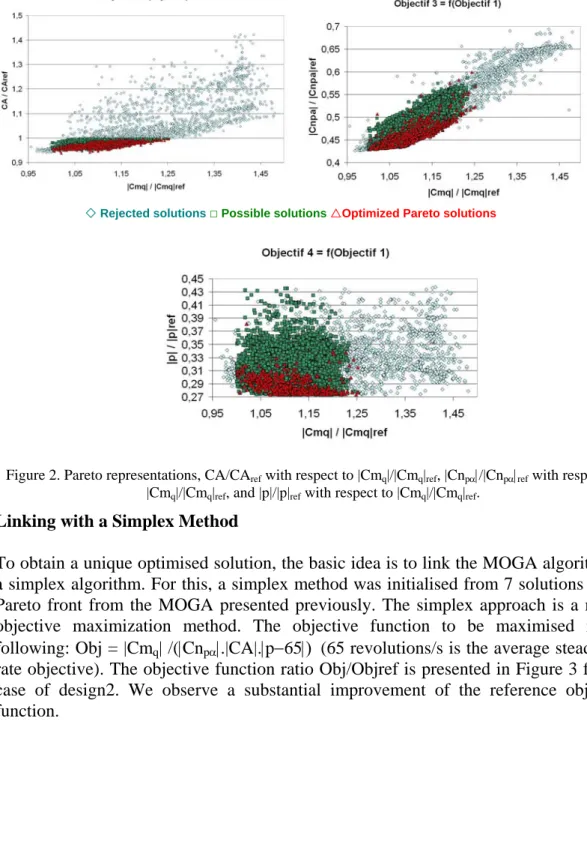
Examples of Pareto front diagrams are given in Figure 2. This Figure presents the evolutions of goal 2 with respect to goal 1 (drag and pitch damping), the evolution of the goal 3 with respect to goal 1 (Magnus moment and pitch damping) and of goal 4
with respect to goal 1 (steady roll and pitch damping). The Pareto Fronts obtained from the MOGA gives an important source of data (in red) available for the determination of optimized solutions.
Rejected solutions Possible solutionsUOptimized Pareto solutions
Figure 2. Pareto representations, CA/CAref with respect to |Cmq|/|Cmq|ref, |Cnpα|/|Cnpα|ref with respect to
|Cmq|/|Cmq|ref, and |p|/|p|ref with respect to |Cmq|/|Cmq|ref.
Linking with a Simplex Method
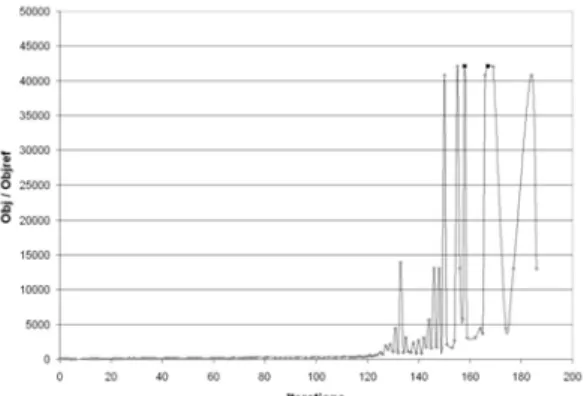
To obtain a unique optimised solution, the basic idea is to link the MOGA algorithm to a simplex algorithm. For this, a simplex method was initialised from 7 solutions of the Pareto front from the MOGA presented previously. The simplex approach is a mono-objective maximization method. The mono-objective function to be maximised is the following: Obj = |Cmq| /(|Cnpα|.|CA|.|p−65|) (65 revolutions/s is the average steady roll
rate objective). The objective function ratio Obj/Objref is presented in Figure 3 for the case of design2. We observe a substantial improvement of the reference objective function.
Figure 3. Final optimisation by the simplex method, Obj/Objref.
Performances of the Optimisation and Representation
Finally, the performances of the MOGA-simplex link, with regard to the reference projectile, are given in Table 2.
Goals Design2 (5 fins) Design1 (6 fins)
|Cmq| + 22 % + 20.6 %
CA -1 % -0.3 %
|Cnpα| - 43 % -17.4 %
P (revolutions/s) 64.9 69
Table 2. Optimization performances
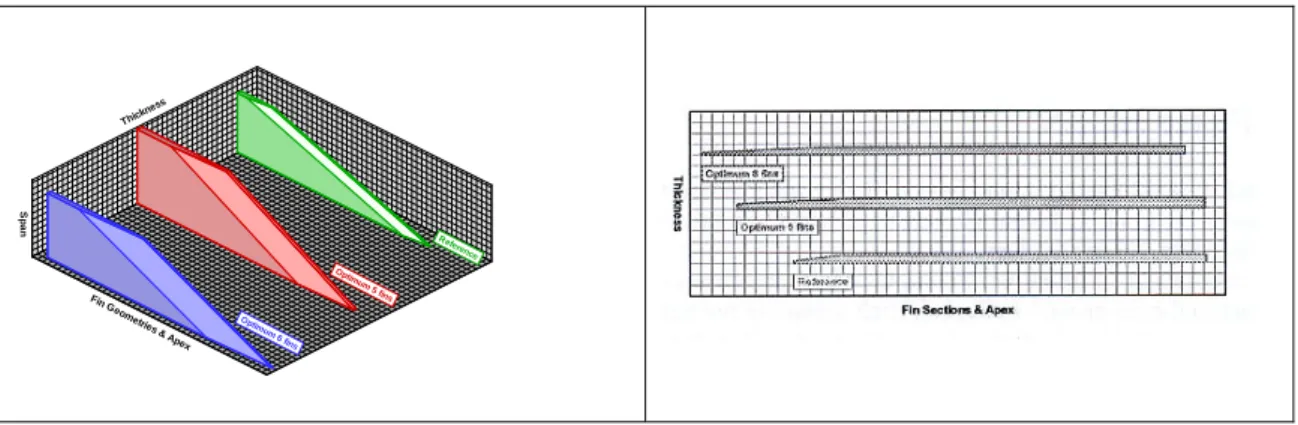
Globally, for the two designs 1 and 2, the MOGA-simplex computations reach all the 4 objectives. In comparison to the reference projectile, the projectile designs obtained, in fine, are presented in Figure 4.
Fin Geomet ries& A pex Thick ness Sp a n Optimum 6 fins Refe rence Optimum 5 fins
Figure 4. Final design of the fins (plan-forms and sections).
Concerning the pitch damping moment coefficient, the objective was mainly reached by an increase of the fin plan-form surface and the change of the longitudinal position of the tail on the fuselage. The slight diminution of the drag coefficient is due, in the case of design1 to the decrease of the relative thickness of the airfoil section (which acts on the wave drag), and in the case of design2 to the smaller number of fins (5 fins). There are two main sources contributing to the Magnus effect: firstly, the interaction between the asymmetric body boundary layer and the fins, and secondly, the spin-induced modifications of the local incidences and of the flow topology. The Magnus goal was reached with a more complex compromise between the fin plan-form geometry, the number of fins and the forward longitudinal position of the tail on the fuselage. The in-flight steady roll rate is a compromise between fin section and fin plan-form. The roll damping moment coefficients is strongly dependant on the fin plan-form. The roll production moment is monitored by the fin section and by the fin plan-form. Finally, the fourth objective was easily attained considering the wide possibility in fin section geometry modifications.
CONCLUSION
A first attempt at the aerodynamic optimisation of the kinetic projectile tail geometry, based on MOGA-simplex approach, has been carried out successfully. The design problem consists of 7 design variables, 5 associated constraints and 4 goals. Final projectile designs were carried out with a substantial improvement in the 4 goals in comparison to a reference projectile. For the prediction of the aerodynamics, the use of semi-empirical codes is well adapted to the large number of evaluations required by genetic algorithms. However, the relatively large errors associated with those methods naturally leads us to improve this optimization approach. The use of more accurate
methods like CFD needs enormous computational time and resources. For this reason, wind tunnel tests are planned for validation purposes.
REFERENCES
[1] Bäck T., Evolutionary Algorithms in Theory and Practice, Oxford University Press, 1996.
[2] Spicer D., Cook J., Poloni C., Sen P., EP20082 Frontier: Industrial Multi-objective Design Optimisation, 13ième
ECCOMAS98, Athens 4-7 Sept. 1998.
[3] Giurgevich A., Mosetti G., Poloni C., Multi-objective Design Optimisation of a Water-Jet Inlet: A Numerical approach and experimental validation, High Speed Marine Vehicles 5th International Symposium, Capri, Italy, 1999. [4] Onesti L., Poian M., Pediroda V., Poloni C., Distributed Computing Solutions for Multidisciplinary Design Optimisation, ECCOMAS2000, Barcelona, Spain, Sept. 2000.
[5] Giensing J.P., Barthelemy J.F.M., A Summary of Industry MDO Applications and Needs, American Institute of Aeronautics and Aerospace, AIAA 4737 1998.
[6] Lovell D., P. Bartholomew P., Progress towards a Multi-Disciplinary Analysis and Optimisation Capability for Air Vehicle Assessment and Design - a UK View, NATO meeting on Aerodynamic Design and Optimisation of Flight Vehicles in a Concurrent Multi-Disciplinary Environment, Ottawa, Canada, 21-22 Oct. 1999.
[7] Moretti G., Spicer D., Sharples N., An MDO Application for a Weapon Released from an Internal Bay, NATO meeting on Aerodynamic Design and Optimisation of Flight Vehicles in a Concurrent Multi-Disciplinary Environment, Ottawa, Canada, 21-22 Oct. 1999.
[8] Stetner M., Haase W., Multi-Objective Aeroelastic Optimisation, NATO meeting on Aerodynamic Design and Optimisation of Flight Vehicles in a Concurrent Multi-Disciplinary Environment, Ottawa, Canada, 21-22 Oct. 1999. [9] Poloni C., Pediroda V., Bucchieri L., Multi Objective Optimization of Turbine Blades by TASCFlow and FRONTIER on a Linux Cluster, CFX User Meeting, Munich, Germany, 29-31 May 2000.
[10] Gramegna N., Bonollo F., Poloni C., MAGMAproject: Feasibility of an Environment for Foundry Process Optimisation, MAGMA User Meeting, Aachen.
[11] Giesing J.P., Barthelmy J.F.M., A Summary of Industry MDO Applications and Needs, American Institute of Aeronautics and Astronautics, AIAA/USAF/NASA/ISSMO, 2-4 Sept.1998.
[12] Schwefel H., Evolution and Optimum Seeking, Wiley Press, New-York, 1995.
[13] Rechenberg I., Evolutionnary Optimierung Technisher Systeme nach Prinzipien des Biologischen Evolution, Fromman-Hozlboog Verlag, Stuttgart, 1973.
[14] Nelder J., Mead R., A Simplex Method for Function Minimization, Computational Journal, Vol. 7, 1965, pp. 308-313.
[15] Sobol I., Die Monte-Carlo Methode, Deutscher Verlag der Wissenschaften, 1991.
[16] Denis P., Champigny P., Cayzac R., Roll Producing Moment Prediction for Finned Projectiles, 19th International
Symposium on Ballistics, Interlaken, Switzerland, May 2001.
[17] Cambier L., Darracq D., Gazaix M., Guillen P., Amélioration Récentes du Code de Calcul d’Ecoulements Compressibles FLU3M, AGARD, Sevilla, Spain, Oct. 1995.
[18] Heddadj S., Carette E., Etude de la Prévision Semi-Empirique de l’Aérodynamique des Projectiles Flèches de Grand Allongement, TR DSAM/DT/BIA/AE/46.02/SH, Giat Industries, France, March 2002.
[19] Denis P ., Le code de Prédiction Aérodynamique MISSILE de l’ONERA, RTO/AGARD Symposium on Missile Aerodynamics, Sorrento, Italy, May 1998.
[20] Denis P., Champigny P., Cayzac R., Carette. E., New Progress in the Roll Producing Moment Prediction for