for Protected Areas
Angeles Mendoza Sammet,Faculty of Environmental Design, University of Calgary, 2102 12 Avenue NN, Calgary, AB, T2N 4X1, Canada; [email protected] Michael S. Quinn,Faculty of Environmental Design, University of Calgary;
[email protected] Introduction
This paper proposes an alternative to evaluating management effectiveness, by accounting separately the management and governance aspects, according to whether achieving the out-come is more in control of the park or the agency. The alternative, called the Ecosystem-based Management System, combines principles from ecosystem-Ecosystem-based management and environmental management systems. It was developed from case studies from Mexico and Canada. The adaptive management review within the EBMS provides effectiveness scores for individual management objectives, components, modules, and the overall park manage-ment. The scores indicate the degree of achievement of expected outcomes for specific objectives, measured through indicators and targets. The EMBS model helps integrate the uniqueness of individual parks and track management effectiveness on the long term for indi-vidual parks and the whole system of parks.
The need for more accountability in natural resources and protected areas management has led organizations, such as the International Union for Conservation of Nature (IUCN), to release frameworks to evaluate management effectiveness (Hockings, Stolton ,and Dudley 2000). However, countries such as Canada and Mexico do not use the framework and park agencies in countries such as Spain and Argentina are adopting ISO standards (ISO 1996, 2000) to improve management or reduce environmental impacts from operations (M. Batiste and M. Di Paola, pers. comm.; PCA 2002).
Park agencies are struggling to evaluate effectiveness because of the diversity of indica-tors involved. Here, we present the model of an ecosystem-based management system for protected areas (EBMS) that combines principles from ecosystem-based management (EBM) and environmental management systems (EMS), approaches adopted to improve manage-ment in natural resource and business organizations, respectively (Mendoza, Quinn, and Thompson 2004). The purpose of the EBMS is to assist parks managers on the planning process and to facilitate the evaluation of management effectiveness through the integration of different types of indicators.
Methods
The design of the ecosystem-based management system model followed four steps: 1. Analysis of strengths and weaknesses of EBM and EMS.
2. Visits to nine case studies to identify criteria for the EBMS (below). 3. Literature and document review.
4. Interviews (56 informants) and document reviews to identify reporting or evaluation requirements and issues.
The case studies were four protected areas in Mexico and five in Canada. In Mexico was Izta-Popo-Zoquiapan National Park (Mexico-Puebla-Morelos); El Pinacate y Gran Desierto de Altar Biosphere Reserve (Sonora); Ría Lagartos Biosphere Reserve (Yucatán); and the Ajos-Bavispe y Buenos Aires Reserve for Protection of Flora, Fauna and Forests (Sonora). In Canada was Grasslands National Park (Saskatchewan), Fundy National Park (New Bruns-wick), Pacific Rim National Park (British Columbia), Point Pelee National Park (Ontario), and Waterton Lakes National Park (Alberta).
Results
Evaluation issues.The issues identified were organized by country, including both specific and general.
Mexico:
• The National Commission of Natural Protected Areas has endorsed the pressure-state-response model (OECD 2003) and the IUCN framework; however, the evaluation sys-tem does not follow them.
• Indicators have been difficult to develop as suggested by the OECD and IUCN. • They mix variables, indicators, and targets, and measure mainly processes or inputs (CONANP 2001, 2006). This may be misleading for evaluating effectiveness of manage-ment or conservation.
• Reporting is based on pre-determined strategic results; however, their use was not clear to staff.
• The results of evaluations de-motivated park staff, who perceived them as not represen-tative of actual achievements.
• The environmental impacts of park operation and maintenance are not evaluated. Canada:
• Parks use indicators of ecological integrity for the state of protected heritage areas report. Some aspects of interest for individual parks are not accounted in this report. • The agency has provided eleven key indicators for environmental management; not all
are relevant or applicable to all parks.
• A challenge is to develop and integrate indicators for different aspects (e.g. social and environmental aspects).
Both:
• Evaluation systems follow a top-down approach (agency to parks), which does not reflect appropriately all the priorities of individual parks.
achievements may not be praised.
• It has been difficult to develop indicators that measure management output or out-comes.
• Evaluation systems do not show conflicts among outcomes of different objectives. • Variations on available information are a challenge, e.g. type of indicators used,
develop-ment stage of the parks, managedevelop-ment categories, or parks’ socio-economic and biophys-ical environment.
There are obstacles to implement the IUCN management effectiveness framework (Hockings, Stolton, and Dudley 2000):
• Governance indicators (e.g. legal status or law enforcement) are part of evaluations; however, park management has no control over those aspects.
• Management plan objectives and targets are not used for evaluation. Management plans are the main accountability tool at park level.
• The indicators evaluate planning, context, input, or process; only two out of thirty eval-uate outcomes.
• Ecological integrity, biodiversity, and conservation outcomes are not considered for evaluation.
The ecosystem-based management system
To overcome these issues, and guide park management evaluation, we propose four princi-ples:
1. Evaluation should focus on what park management commits to achieve (i.e., objec-tives in management plans). Evaluation should reflect achievement of conservation and management goals, expressed through objectives, indicators, and targets. 2. Parks should be evaluated based on elements over which there is management
con-trol. Often, governance aspects are not (fully) controllable by individual parks but by the agencies. Evaluations should reflect that.
3. Evaluations should clearly distinguish among performance, compliance, effective-ness, and efficiency. Effectiveness results from achieving planned outcomes. Perform-ance results from achievement or compliPerform-ance with inputs, outputs, or processes. 4. Protected areas are a tool for sustainable development; therefore, evaluations should
reflect progress in environmental, economic, and social aspects. In addition, these characteristics are desirable for effectiveness evaluation:
• Separate objectives, throughout the management cycle, based on who (the agency or the park) has more control over the planned outcomes.
• Use various types of indicators to track social, economic, environmental, and opera-tional aspects.
bottom-up (park to agency) approaches to acknowledge the uniqueness of each park. • Be able to measure performance or effectiveness according to the indicators used. • Use aggregate indicators to summarize effectiveness in simple measures.
• Identify conflicting objectives or outcomes. • Be compatible with the IUCN framework. Structure
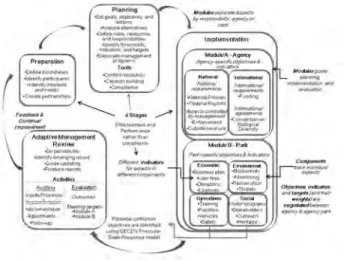
The ecosystem-based management system model (EBMS) follows the stages of the tradition-al management cycle: preparation, planning, implementation, and evtradition-aluation (this last ctradition-alled adaptive management review).
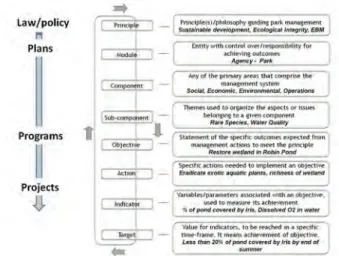
A planning hierarchy guides the management cycle (Figure 1). The higher levels are more general and reflect management principles, policies and regulations (national and inter-national). The lower levels guide implementation and are more park-specific. They relate specific objectives to particular actions, desired targets, and indicators that show progress or success.
Like a decision tree, the hierarchy helps organize objectives into two modules and four components. The modules (Figure 2) separate objectives depending on whether the park or the central agency is the main responsible for the outcome:
• Module A: agency-driven objectives, indicators, and targets:
• Aspects the agency is required to report on for national purposes.
• Aspects the agency is required to report on for international agreements, treaties, and conventions.
• Governance elements.
• Objectives whose achievement is not direct responsibility of park managers and staff. • Module B: park-driven objectives, indicators, and targets:
• Park-driven priorities.
• Park projects with partner organizations.
Figure 1. The elements of the Planning Hierarchy help organ-ize objectives and links them to management principles and/or existing regulations.
• Requirements for reporting to other national or international entities (e.g., park regional stakeholders or foreign funding organizations).
The basic components are social, economic, environment, and operations. There is flex-ibility to incorporate more components or levels if needed (e.g. sub-components). The implementation stage (not discussed here) integrates elements of ISO management systems such as training, communication, documentation, and emergency response (e.g. ISO 1996, 2000).
Adaptive management review
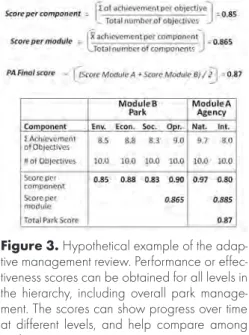
Keeping track of progress is one purpose of evaluations. However, tracking can be difficult if objectives or indicators change. Because of that, the adaptive management review of the EBMS uses scores and aggregates them to summarize effectiveness in single measures calcu-lated with the formulas in Figure 3.
• The elements of the hierarchy (modules, components, subcomponents, or objectives) can be weighted to show their importance at different times or for different parks still allowing comparisons. For example, restoring trails could be a priority after a hurricane for a couple of years only, or a priority for park may be to control illegal activities while for others the priority is to develop visitor programs.
• A reporting period has a target to meet for an objective. The achievement is measured as percentage with respect to the target (0.0 = no progress, 1.0 = target reached). • Scores can be obtained for any element of the hierarchy and for overall management.
They act as benchmarks to track progress at different times for individual parks, for parks within a system, and for the agency.
• Reporting the scores of environmental, economic, and social components aims to show both commitment to sustainability and progress made in those areas. The operations component aims to show both the park’s commitment to and progress toward reducing the impacts of its own operations.
Figure 2.The Ecosystem-based Management System follows the four stages of the management cycle. The modules help organ-ize management objectives and targets according to who has more control over the outcomes. Components separate objectives in four management areas for parks and two for the agency.
• The EBMS measures management effec-tiveness based on outcomes, as defined by Hockings, Stolton, and Dudley (2000). If the indicators measure inputs, outputs, or processes, the scores will measure per-formance.
• The score of the agency module reflects governance and quality of coordination between it at the park.
The weights of the modules can be deter-mined by the proportion of objectives in each one. To facilitate the agency’s accounting, the weights of modules A and B could be constant among the national system or among cate-gories. Agencies and parks should decide which objectives fit into each module, and the weights for different elements in the hierarchy. Over time, the scores can help compare
effec-tiveness on different components for one park, or overall effeceffec-tiveness for various parks. Discussion
To evaluate individual parks and compare among parks in a national system, the EBMS uses scores rather than indicators. The objectives can be ponderated with weighs according to their relevance. The adaptive management review relies on how well the management team has achieved the objectives’ targets instead of relying on specific indicators.
Three factors influence the success when implementing the EBMS: • Commitment to allocate human and financial resources needed.
• Commitment from individual parks, park agencies, and relevant stakeholders to adap-tive management and learning.
• Willingness and flexibility to communicate and negotiate priorities, indicators, and weights.
The EBMS is developed from existing management plans, objectives, and indicators so it does not affect monitoring programs already in place. Although it will likely require more resources and effort than regular top-down approaches, its advantages and benefits for agen-cies and parks would compensate for that:
• Flexibility to update or change objectives and other elements of the hierarchy as they are met, or as parks’ needs evolve, without affecting the meaning and comparability of final scores.
• Inclusion and use of diverse types of indicators (biodiversity, economic, social, etc.).
Figure 3.Hypothetical example of the adap-tive management review. Performance or effec-tiveness scores can be obtained for all levels in the hierarchy, including overall park manage-ment. The scores can show progress over time at different levels, and help compare among parks.
• Separation of park and agency priorities and recognition of park’s achievements in both. • Improvement in governance at park and agency levels and of evaluation’s fairness and
objectivity.
• Emphasis and evaluation of effectiveness and performance rather than compliance. • Encouragement for innovation.
• Engagement of staff in the development and implementation of the EBMS, increasing their trust and motivation.
• Availability of detailed information on the condition and progress of individual parks. • Acknowledgement of aspects not covered by agency’s reporting systems.
• Inclusion of park diversity within a national system, e.g. ecosystems; stages of develop-ment, or categories.
• Consistency with other proposals for evaluation management (e.g. IUCN framework). • Starting point for ISO certifications.
Conclusion
Top-down frameworks for evaluating park management effectiveness often reflect agencies’ reporting priorities. Although they allow national comparisons and reporting; they may overlook some of the priorities or achievements of individual parks. Management effective-ness means delivering outcomes; however, it is often measured through indicators that reflect only inputs or outputs. The ecosystem-based management system suggested here combines agency and park needs (top-down and bottom-up approaches). It evaluates effectiveness or performance according to the type of indicators used. It focuses on the achievement of tar-gets for specific objectives rather than on pre-determined indicators. This gives flexibility to update or modify objectives, indicators, and targets. It reports on sustainability based on the scores of environmental, economic, and social components. The EBMS is seen as more appropriate to reflect the diversity of natural and socio-economic conditions of protected areas within a national system. Although implementing this system requires more effort and coordination, and perhaps a change on institutional culture, it provides more detailed infor-mation. This can help improve planning and management and show achievements in man-agement and conservation goals to all stakeholders.
References
CONANP [Comision Nacional de Areas Naturales Protegidas]. 2001.Programa de Trabajo, Comision Nacional de Areas Naturales Protegidas, 2001–2006.Mexico City, Mexico: Secretaria de Medio Ambiente y Recursos Naturales.
———. 2006.Informe SIMEC 2006.Mexico City, Mexico: Secretaria de Medio Ambiente y Recursos Naturales. On-line at http://www.conanp.gob.mx/dcei/simec/.
ISO [International Organization for Standardization]. 1996.International Standard ISO 14004. Environmental Management Systems—General Guidelines on Principles, Sys-tems, and Supporting Techniques.Geneva, Switzerland: ISO.
———. 2000. International Standard ISO 9000.Quality Management Systems: Fundament-als and Vocabulary.Geneva, Switzerland: ISO.
Assessing the Management of Protected Areas. IUCN Best Practice Protected Areas Guidelines Series, no. 6. Gland, Switzerland: IUCN.
Mendoza, A., M. Quinn, and D. Thompson. 2004. An ecosystem-based management system for protected areas. InMaking Ecosystem Based Management Work: Connecting Mana-gers and Researchers, proceedings of the 5th International Conference on Science and Management of Protected Areas, Victoria, B C., May 11–16, 2003. Wolfville, Nova Sco-tia, Canada.
OECD [Organisation for Economic Co-operation and Development, Environment Direc-torate—State of the Environment Division]. 2003.Using the Pressure-State-Response Model to Develop Indicators of Sustainability: OECD Framework for Environmental Indicators.Paris: OECD.
PCA [Parks Canada Agency]. 2002. National Environmental Management Framework. Internal document. Ottawa, Ontario, Canada.