Alma Mater Studiorum
Universit`
a di Bologna
Dottorato di Ricerca in
Computer Science and Engineering
XXXI Ciclo
Continual Learning with Deep
Architectures
Presentata da
Vincenzo Lomonaco
Supervisore
prof. Davide Maltoni
Coordinatore Dottorato
prof. Paolo Ciaccia
Settore Scientifico Disciplinare
ING-INF/05
Settore Concorsuale
09/H1
“We may regard the present state of the universe as the effect of the past and the cause of the future. An intellect which at any given moment knew all of the forces that animate nature and the mutual positions of the beings that compose it, if this intellect were vast enough to submit the data to analysis, could condense into a single formula the movement of the greatest bodies of the universe and that of the lightest atom; for such an intellect nothing could be uncertain and the future just like the past would be present before its eyes.”
ALMA MATHER STUDIORUM UNIVERSITY OF BOLOGNA
Abstract
Department of Computer Science and Engineering Doctoral Degree
Continual Learning with Deep Architectures
Vincenzo Lomonaco
Humans have the extraordinary ability to learn continually from experience. Not only we can apply previously learned knowledge and skills to new situations, we can also use these as the foundation for later learning. One of the grand goals of Artificial Intelligence (AI) is building an artificial“continual learning” agent that constructs a sophisticated understanding of the world from its own experience through the autonomous incremental development of ever more complex knowledge and skills.
However, despite early speculations and few pioneering works, very little research and effort has been devoted to address this vision. Current AI systems greatly suffer from the exposure to new data or environments which even slightly differ from the ones for which they have been trained for. Moreover, the learning process is usually constrained on fixed datasets within narrow and isolated tasks which may hardly lead to the emergence of more complex and autonomous intelligent behaviors. In essence, continuallearning andadaptationcapabilities, while more than often thought as fundamental pillars of every intelligent agent, have been mostly left out of the main AI research focus.
In this dissertation, we study the application of these ideas in light of the more recent advances in machine learning research and in the context of deep architectures for AI. We propose a comprehensive and unifying framework for continual learning, new metrics, benchmarks and algorithms, as well as providing substantial experimental evaluations in different supervised, unsupervised and reinforcement learning tasks.
Acknowledgements
My interest inArtificial Intelligence bloomed around 2012, when I was only a curious bachelor student at the University of Modena and Reggio-Emilia. During that year I read, almost by chance, the best-selling book“The Singlularity is Near”by Raymond Kurzweil which resonated very much in me. At the time, I was specializing on data management and information retrieval systems as they appeared to be ubiquitously present and fundamental in every computer science application. I soon realized that, in the future of automation and computer science, AI was the next big paradigm shift. From data to information, from information to knowledge,intelligence was the next logical step.
During my master degree at the University of Bologna (Unibo), I started to develop my back-ground in AI with a particular interest and focus on bio-inspired computing, machine learning and computational neuroscience. It is not after long that I discovered in Davide Maltoni the only professor within my university betting on this approach and sharing this perspective. Da-vide was working on this line of research since 2011. In particular he introduced me to Jeff Hawkins’s research and approach masterfully outlined in his book “On Intelligence” which I found fascinating.
I will be forever thankful to Davide, who later become my supervisor and mentor for my master dissertation on hierarchical temporal memories, and later on of my doctoral degree on contin-ual learning, answering thousands of e-mails, helping me with incredibly valuable insights and providing me of a huge amount of time to discuss and develop my research ideas. His exper-tise and almost paternal advice, his passion and dedication have thought me how beautiful and motivating research can be.
I would not lie saying that the PhD was an easy ride. It has been tough, even exhausting at times, but highly rewarding, especially from a human perspective. It would be unfair, indeed, to present this dissertation as the result of my only doing, being it rather the culmination of extensive collaborations and discussions of many talented people who helped me at many different levels throughout my doctoral path.
In primis, I would like to thank my colleagues and friends at the department of computer science and engineering at Unibo: Francesco Gavazzo,Luca Bedogni,Daniel Russo,Saverio Giallorenzo, Abel Garc´ıa Celestr´ın,Yiyi Linares Zaila,Micheal Lodi,Vincenzo Mastroandrea,Federico Mon-tori, Stefano Giovanni Rizzo, Luca Sciullo, Liu Tong, Angelo Trotta, Stefano Pio Zingaro,Zio Felice,Adele Veschetti,Wilson Sakpere,Giacomo Bergami who helped me with their experience and pleasant company almost on a daily basis. A special thanks goes also to my fellow Biolab and SmartCity members: Dario Maio, Antonio Magnani, Luca Calderoni, Lorenzo Pellegrino, Federico Fucci,Annalisa Franco,Raffaele Cappelli,Matteo Ferrara,Alessandra Lumini,Serena Papi,Matteo Golfarelli, to my other collaboratorsLuciano BononiandPaolo Ciancariniand to all the fellow PhD students at UniboLuigi Asprino,Angelo Croatti, Andrea Pagliarani,Alessio Tonioni among others I had the honor to represent in the department council.
After the first 18 months, having laid the foundations of this dissertation, I had the chance to spend six month in the United States as a visiting scholar at thePurdue University under the
supervision of Eugenio Culurciello. Eugenio, with his amazing background and “full-stack” ex-perience in developing cutting-hedge AI systems, hosted me in his laboratory where we explored the application of continual learning to reinforcement learning scenarios. I cannot express my deepest gratitude to Eugenio and the other e-labmembers: Abhishek Chaurasia, Andre Chang, Aliasger Zaidy,Lukasz Burzawa andDawood Sheik who provided me all the help I could ask for and greatly enriched my view on this topic.
At the end of 2017, experiencing first hand the lack of resources and connections within the con-tinual learning community, I started working onContinualAI, a non-profit research organization and open community on the same topic. To my own amazement, the community has grown to date to more than 300 members worldwide with whom I had the pleasure to share countless discussions and insights other than starting meaningful collaborations. I thank them all and in particularKeiland Cooper,Martin Cimmino,Natalia D´ıaz Rodr´ıguez,Timoth´ee Lesort, Gia-como Bartoli,Jidin Dinesh,Michele Cipriano,Manish Agnihotri,German I. Parisi andLorenzo Pellegrini without whom this would have never been possible.
During the writing of this dissertation I also had the chance to visit the Autonomous Systems and Robotics laboratory at EnstaParis Tech in Paris, where under the supervision of David Filliat I could develop my first ideas for applying continual learning in the context of Robotics. David and his group hosted me in their laboratory where I immediately felt at home. Special thanks are due toNatalia Diaz Rodriguez,Timothee Lesort,Daniela Pamplona,Antonin Raffin, Hugo Caselles-Dupr´e, Florence Carton and the many other lab members with whom I had the pleasure to share many happy moments and insightful discussions about AI.
At the end of this path, countless are the people who influenced it. However, it is only right at this point to thank the pioneers and fellow researchers in the field with whom I could share my ideas and discuss about my research: Mark Ring,Marc’Aurelio Ranzato,Marc Pickett,Raia Hadsell, Massimiliano Versace, Subutai Ahmad, German I. Parisi and Gianni De Fabritiis in particular, among many others.
Finally, words cannot describe how grateful I am to all the people who assisted me during my PhD years also outside the university scope. My family, Elisabetta Giubilato, Francesco Lomonaco, Giovanni Lomonaco, Sara Lomonaco and Pietro Lomonaco who have never constrained me and have always been present in times of need; my historical friendsDomenico Ivan Maggiore, Pasquale Grosso, Pierpaolo Del Coco, Ivan Heibi, Stefano Beccaletto, Andrea Motisi, Filippo Maria Di Nardo, Marina Foti and roommatesAlessio Di Luca and Dario Sucameli for giving me so much strength and comfort also outside the university spaces. My friendsMarta Ziosiand Giovanni Gaspare RighifromAI for PeopleandSimone Scardapanefrom theItalian Association of Machine Learning. My love,Viviana Palumbo, who changed my perspective on life as no one could.
Thanks to the thinkers and all the other friends I could not mention in this brief acknowledgment section, who, during my PhD, significantly shaped my professional and personal life and to the many people I crossed paths with, who, simply touching it, made it an unique and wonderful journey.
Contents
Abstract ii
Acknowledgements iii
Contents v
List of Figures viii
List of Tables xii
Abbreviations xiv
Introduction 1
1 Background and Motivation 3
1.1 Natural and Artificial Intelligence. . . 4
1.1.1 Limits and Potentials of Deep Learning . . . 5
1.1.2 Biological Learning Systems. . . 7
1.2 Continual Learning . . . 9
1.2.1 Motivation . . . 9
1.2.2 An Example . . . 14
1.2.3 Brief History . . . 15
1.2.4 Related Learning Paradigms . . . 17
1.2.5 State-of-the-art and Current Challenges . . . 20
1.2.6 Applications . . . 21
2 A Comprehensive Framework for Continual Learning 24 2.1 Formal Definition . . . 25
2.2 Task Notion . . . 26
2.3 Constraints, Relaxations and Desiderata . . . 26
2.4 Scenarios . . . 27
2.4.1 Multi-Task . . . 28
2.4.2 Single-Incremental-Task . . . 28
2.4.3 Multiple-Incremental-Task. . . 28
2.4.4 Update Content Types. . . 29
3 Continual Learning Strategies 30 3.1 Baseline Strategies . . . 32
3.1.1 Naive . . . 32
3.1.2 Cumulative . . . 32
Contents vi
3.2 Rehearsal Strategies . . . 33
3.2.1 Exemplar Stream (ExStream). . . 33
3.3 Architectural Strategies . . . 33
3.3.1 Progressive Neural Networks (PNNs). . . 34
3.4 Regularization Strategies. . . 35
3.4.1 Learning without Forgetting (LWF) . . . 35
3.4.2 Elastic Weights Consolidation (EWC) . . . 37
3.4.3 Synaptic Intelligence (SI) . . . 39
3.5 Hybrid Strategies . . . 41
3.5.1 Incremental Classifier and Representation Learning (ICARL) . . . 41
3.6 Proposed Strategies . . . 42
3.6.1 Semi-Supervised Tuning (SST) . . . 42
3.6.2 Copy-weights with Re-init (CWR) . . . 44
3.6.3 Copy-weights with Re-init Plus (CWR+) . . . 45
3.6.4 Architect and Regularize (AR1) . . . 46
4 Continual Learning Benchmarks and Protocols 48 4.1 Benchmarks . . . 48 4.2 Proposed Benchmarks . . . 53 4.2.1 Seq-NORB . . . 53 4.2.2 Seq-COIL100 . . . 56 4.2.3 Seq-iCubWorld28 . . . 56 4.2.4 CORe50 . . . 57 4.2.5 3D VizDOOM Maze . . . 61
4.3 Training and Evaluation Protocols . . . 63
4.3.1 Metrics . . . 63
4.3.2 Proposed metrics . . . 65
4.4 Learning Dynamics Interpretation . . . 70
5 Experimental Evaluation 73 5.1 Continual Supervised Learning . . . 73
5.1.1 BigBrother . . . 74
5.1.2 Seq-iCubWorld28 . . . 76
5.1.3 iCIFAR100 . . . 77
5.1.4 CORe50 . . . 79
5.1.5 Conclusions . . . 85
5.2 Continual Reinforcement Learning . . . 86
5.2.1 3D VizDOOM Maze . . . 87
5.2.2 Conclusions . . . 90
5.3 Continual Unsupervised Learning . . . 91
5.3.1 Seq-NORB . . . 94
5.3.2 Seq-COIL-100. . . 99
5.3.3 Conclusions . . . 99
6 Conclusions and Future Challenges 102 6.1 Discussion and Conclusions . . . 102
6.2 Open Challenges and Future Potential . . . 103
6.3 Closing Remarks . . . 105
Contents vii
B Further Experiments on NORB 108
B.1 Baseline Accuracy on NORB . . . 108
B.2 Continual Learning on Seq-NORB (Native Object Segregation) . . . 109
C Adapting Pre-trained CNN to Different Input Size 111 D Single-Incremental-Tasks Experiments Details 113 D.1 Implementation Details (Caffe framework) . . . 113
D.2 Architectural Changes in the Models Used on CORe50 . . . 115
D.3 Hyperparameter Values for CORe50 . . . 115
D.4 Hyperparameter Values for iCIFAR-100 . . . 117
D.5 Standard Deviation for CORe50 . . . 119
D.6 Standard Deviation for iCIFAR-100 . . . 120
D.7 On Initializing Output Weight to Zero . . . 120
List of Figures
1.1 “Avion III”built between 1892 and 1897 by Cl´ement Ader, exposed at theMus´ee des Arts et M´etiers in Paris, France. . . 7
1.2 As the dimensionality increases, the space of all the possible input examples increases so fast that the available data become sparse. This sparsity is problematic for any method that requires statistical significance and is often referred to as the “curse of dimensionality”. In the abstract representation the number of examples needed to cover the entire space starts from 5 and ends up with 125 different examples when we increase the number of dimension from 1 to 3. . . 10
1.3 Two examples of knowledgebias on state-of-the-art deep neural networks train on large training sets. On the left four automatically generated images that maximize the acti-vation of thebarbell class for a standard Imagenet classification task are reported. As it is possible to see in the pictures, the notion ofbarbell is biased to include visual features of human arms. On the right, a captioning neural network mistakenly description is reported for an uncommon picture of a flooding which is misunderstood as a beach given the biased over-representation of seaside landscapes in the training set (image originally contained in [Lake et al., 2016]). . . 11
1.4 One of the mistakes made by the Multi-modal Captioning Network firstly proposed by Karpathy and Li [2013]. . . 13
1.5 SpotMini, the new smaller version of the Spot robot from Boston Dynamics weighing around 14 kg [BostonDynamics, 2018].. . . 14
3.1 Venn diagram of some of the most popular CL strategies: CWR [Lomonaco and Maltoni, 2017], PNN [Rusu et al., 2016b], EWC [Kirkpatrick et al., 2017], SI [Zenke et al., 2017], LWF [Li and Hoiem, 2016], ICARL [Rebuffi et al., 2017], GEM [Lopez-paz and Ranzato, 2017], FN [Kemker and Kanan, 2018], GDM [Parisi et al., 2018b], EXSTREAM [Hayes et al., 2018a] and AR1, hereby proposed. Better viewed in color. . . 31
3.2 Depiction of a three column progressive network. The first two columns on the left (dashed arrows) were trained on task 1 and 2 respectively. The grey box labelled
arepresent theadapter layers (more details cab be found in [Rusu et al., 2016a]). A third column is added for the final task having access to all previously learned features. . . 35
3.3 CaffeNet trained by EWC on CORe50 SIT (details on the experiments can be found in Section 5.1.4). The first row shows F values distribution denoting a long tail on the right: considering the logarithmic scale the number of weights associated to highF values taking high values is quite limited. The second row shows the normalized matrix ˆF obtained with averagingFvalues and max clipping to 0.001. Saturation to 0.001 is well evident, but afterB3the fraction of saturated weights is small (about 1/1000). . . 39
3.4 CaffeNet trained on CORe50, SIT setting (more details on the experiments can be found in Section 5.1.4). The first row shows ˆF values distribution obtained by SI on batchesB1, B2 andB3. ˆF values distribution from EWC is reported in the second row for comparison. The shape of the distribution is quite similar, even if in this experiments, the number of SI saturated values is about 10 times lower. . 40
List of Figures ix
4.1 Key architectural differences between MT and SIT scenarios: a disjoint output layer (also denoted as “head”) is used in MT for each independent task, while a single (dynamically expanded) output layer is used in SIT to include all the classes encountered so far. Better viewed in color.. . . 50
4.2 Accuracy results in the MT and SIT scenarios for 5 common CL strategies (NAIVE, EWC, LWF, SI, CWR) after the last training batch. Analogously to [Zenke et al., 2017], this experiment was performed on the first 6 tasks of CIFAR-10/100 split. For both MT and SIT we report the accuracies on the classes of each batch (1,2, . . . ,6) and their average (Avg). CWR is specifically designed for SIT and was not tested under MT. Better viewed in color. . . 51
4.3 Example images of the seven subjects contained in theSetB of the BigBrother Dataset. 53 4.4 One image from each of the 50 objects inNORB dataset. The five rows denotes the
object classes: four-legged animals, human figures, airplanes, trucks, and cars. Objects belonging to the first five columns of the original benchmark are included in the training set, while the others in the test set. Objects are untextured and size normalized so that only shape features can be used for recognition. . . 54
4.5 An example of training sequence of 20 frames (above) and a test sequence (below) with mindist= 4 from the previous training sequence. . . 54
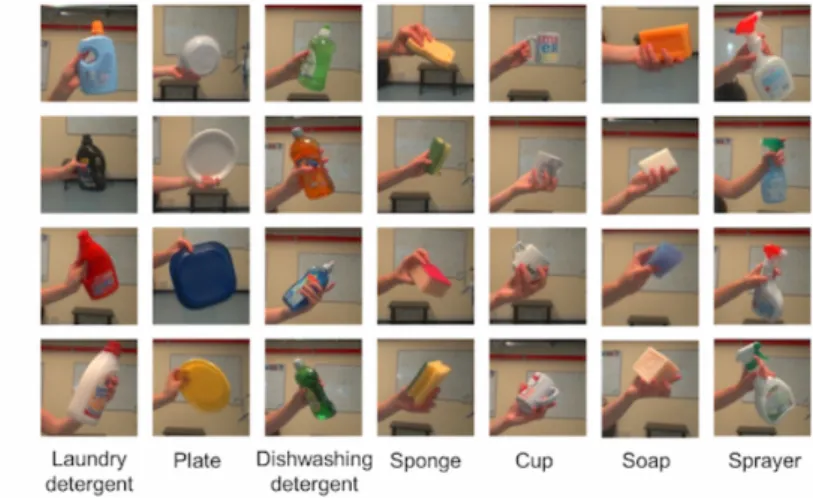
4.6 Example images of the 28 objects (7 categories) from one of the 4 subsets constituting icubWorld28. . . 56
4.7 Example images of the 50 objects inCORe50. Each column denotes one of the 10 categories. . . 57
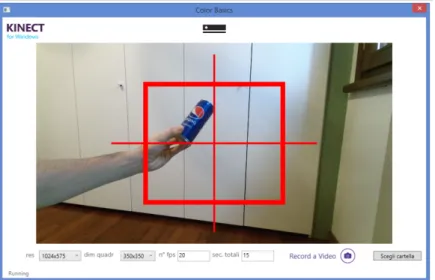
4.8 Acquisition interface: the red box identifies the central region where the operator is required to keep the objects while moving and rotating them.. . . 58
4.9 Example of 1 second recording (at 20 fps) of object #26 in session #4 (outdoor). Note the smooth movement, pose change and partial occlusion. The 128×128 frames here shown have been automatically cropped from 350×350 images based on a fully automated tracker. . . 59
4.10 One frame of the same object (#41) throughout the 11 acquisition sessions. Note the variability in terms of background, illumination, blurring, occlusion, pose and scale.. . . 59
4.11 Mid-VGG classification accuracy (at object level and category level) when clas-sification confidence over more adjacent frames is fused. On the horizontal axis the number of frames fused (temporal window). When end-of-sequence reset is not available using long temporal windows can lead to dangerous drifts (see the orange curve). . . 60
4.12 The 3D maze environment developed with ZDOOM and Slade. On the right an example image from the point of view of the agent is reported. On the right the plenary view of the maze structure is shown. White point on the map represent random spawning points used by the agent during both training and test episodes. Better viewed in colors. . . 61
4.13 The environmental changes for each of scenario (Light, Texture, Object) in the 3D VizDOOM Maze. For all the environments changes are not gradual but happening at three specific points equidistant in time corresponding to the columns in figure. Better viewed in colors. . . 62
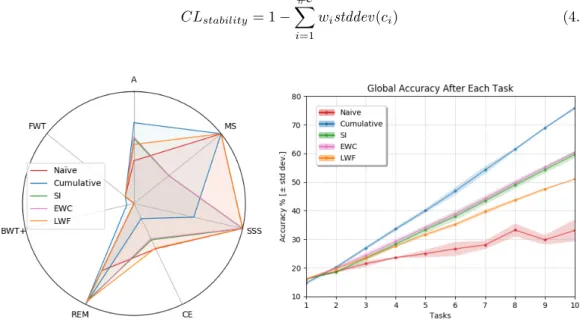
4.14 a) Spider chart: CL metrics per strategy (larger area is better). b) Accuracy per CL strategy computed over the fixed test set. . . 67
4.15 Spider chart with CL metrics showing CL strategies EWC, LWF and SI with their respective lower and upper bound (Naive and Cumulative resp.) as reference baselines (to properly visualize Fig. 4.14). The weight configuration for each criterion used isW1 wherewi=71 for eachwi∈W. . . 69
4.16 Sequence of confusion matrices computed after each training batch for the Naive approach on CaffeNet. On the vertical axis the true class and on the abscissa the predicted class. . . 70
List of Figures x
4.17 Sequence of confusion matrices computed after each training batch (1, . . . ,9) for the LWF approach and CaffeNet. In the first row the approach is properly parametrized (variableλandmapfunction, see Table D.3) and the model is able to continuously learn new classes without forgetting the old ones. In the second we used the sameλi= 0.5 for all the batches: forB2, . . . , B3the regularization is appropriate but for successive batches is too light leading to excessive forgetting. In the third row we used the sameλi = 0.8 for all the batches: forB2, . . . , B6the regularization is too strong and learning of corresponding classes is poor.. . . 70
4.18 Confusion matrices after computed after B8 andB9 for the EWC approach and CaffeNet. As discussed in Section 5.1.4 EWC tends to saturate CaffeNet capacity after the first 5-6 batches. In this specific run the amount of training on the last batch is too high w.r.t. the residual model capacity and the learning result are poor: the sharp vertical band on the right is an alarm signal. . . 71
4.19 Amount of weight changes by layer and training batch in CaffeNet for different approaches. . . 72
5.1 Accuracy results of different parameterizations for the CaffeNet + FT strategy: an example of the impact of the learning rate on the BigBrother dataset, in our continual learning scenario (54 batches). Better viewed in color.. . . 75
5.2 BigBrother dataset (SetB): accuracy of the different strategies during incremental
training (54 batches). Better viewed in color. . . 76
5.3 Average accuracy during incremental training on Seq-IcubWorld28 (9 batches). The bars indicate the standard deviation of the ten runs performed for each strat-egy. The dotted lines denote the cumulative strategies. . . 77
5.4 Accuracy on iCIFAR-100 with 10 batches (10 classes per batch). Results are averaged on 10 runs: for all the strategies hyperparameters have been tuned on run 1 and kept fixed in the other runs. The experiment on the right, consistently with CORe50 test protocol, considers a fixed test set including all the 100 classes, while on the left we include in the test set only the classes encountered so far (analogously to results reported by Rebuffi et al. [2017]). Better viewed in color. 78
5.5 Accuracy results (averaged on 10 runs) for the na¨ıve and cumulative strategies for Mid-CaffeNet and Mid-VGG. Colored areas represent the standard deviation of each curve. Tabular data available athttp://vlomonaco.github.io/core50.. . 80
5.6 Mid-Caffe and Mid-VGG accuracy on NC scenario (average over 10 runs). Cu-mulative and Na¨ıve approach are full depth models, while CWR lacks fc6 and fc7. Colored areas represent the standard deviation of each curve. Tabular data available athttp://vlomonaco.github.io/core50. . . 80
5.7 CWR compared with some variants: FW and CW. Colored areas represent the standard deviation of each curve. . . 81
5.8 Mid-Caffe and Mid-VGG accuracy on NIC scenario (average over 10 runs). Col-ored areas represent the standard deviation of each curve. Tabular data available athttp://vlomonaco.github.io/core50. . . 82
5.9 The graphs show CaffeNet and GoogLeNet accuracy on CORe50 after each train-ing batch (average on 10 runs, with different class ordertrain-ing). Better viewed in color.. . . 84
5.10 Short and long-term moving average (computed over 6 and 50 episodes, respectively) of the average cumulative reward during training in the light scenario. Dotted lines indicate when the environment is changed. In this example, the difference between the short-term and long-term moving average exceed 500 when the environment changes. . 89
5.11 A graphical representation of the 50 “random” dilobe filters at level 1. . . 92
5.12 The CNN used in this work (original LeNet7 adapted to 32×32 inputs). X@Y×Y stands for X feature maps of size Y×Y; (Z×Z) stands for the filters of size Z×Z. . . 93
List of Figures xi
5.13 HTM accuracy on the test set formindist= 1 (a) andmindist= 4 (b). Positions 2, . . . ,10 (x-coordinate) denote the test set accuracy after incremental tuning with batchesBi, i= 2, . . . ,10. Position 1 exhibits the same accuracy for all the update strategies because it denotes the accuracy after supervised training onB1. The bars denote 95% mean
confidence intervals (over 10 runs). . . 95
5.14 CNN accuracy on the test set formindist = 1 (a) andmindist= 4 (b). . . 96
5.15 a) HTM +SST-Aaccuracy on the test set (mindist = 1) for different amounts of wrong labels provided during initial supervised training onB1. b) HTM accuracy on the test set (mindist = 1) for different update strategies on the 50-class problem. 97
5.16 a) HTM accuracy (5-class problem,maxdist = 1) on SST-A and its two variants. b) CNN accuracy (5-class problem,maxdist = 1) on SST-A and its two variants. 98
5.17 HTM and CNN incremental tuning accuracy on COIL-100.. . . 99
B.1 HTM and CNN accuracy on standard normalized-uniformNORBbenchmark. The labels (number of training patterns per class) in the x-coordinate are equispaced for better readability. . . 109
B.2 HTM and CNN incremental tuning accuracy, when splitting class objects as in the original NORB protocol (for each class: 5 objects in the training set and 5 in the test set). No mindist is here necessary between test and training batches because of the object segregation.. . . 109
D.1 Accuracy standard deviation visualization for each strategy and the two models (CaffeNet and GoogLeNet) over 10 distinct runs where the batches order has been randomly shuffled. Averaged values over the batches are also reported. Better viewed in color. . . 119
D.2 Accuracy standard deviation visualization for each strategy over 10 distinct runs where the batches order has been randomly shuffled. Averaged values over the batches are also reported. Better viewed in color. . . 120
List of Tables
2.1 Examples of thetsignal for the three different scenarios: Multi-Task (MT), Single-Incremental-Task (SIT) and Multiple-Single-Incremental-Task (MIT). Notice that a MIT setting requires breaking the constraint definition of SIT but also breaking the constraint definition of MT, i.e., not all the tasks are considered having the same id and not all the task are considered distinct.. . . 28
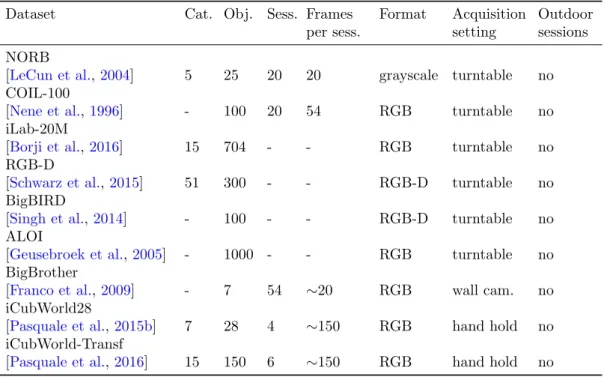
4.1 Categorizations of CL experiments from the recent literature. Most of the bench-marks are based on reshaped versions of well-known vision datasets such asMNIST, CIFAR-10,CIFAR-100, ILSVR2012,CUB-200 and theAtari Games suit for re-inforcement learning. . . 49
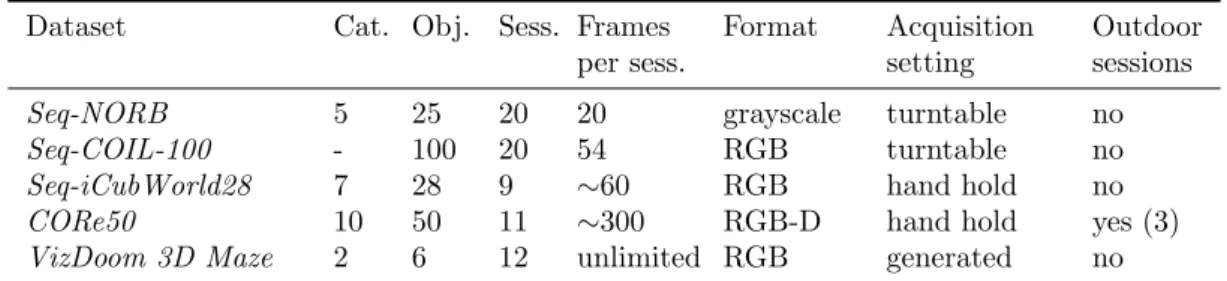
4.2 Comparison of datasets (with temporal coherent sessions) for continual learning. Temporal coherence, often not considered in current continual learning research, constitute a natural property often encountered in real-world settings when learn-ing continually from a stream of data. . . 52
4.3 Original video benchmarks proposed for continual learning with difficult degree of complexity. . . 53
4.4 iCubWorld28 batches size and membership to the original Day. . . 57
4.5 Accuracy of CaffeNet and VGG models (both adapted to size 128×128) onCORe50 for different learning strategies. The test set consists of sessions: #3, #7 and #10; the training set of the remaining 8 sessions. . . 60
4.6 CL metrics andCLscore for each CL strategy evaluated (higher is better). . . 68
4.7 Elements in R accounted to compute the Accuracy (white and cyan elements), BWT (in cyan), and FWT (in light gray) criteria. R∗=Rii,T ri= training,T ei=
test tasks. . . 68
4.8 CLscore andCLstability for all CL strategies according to different weighting
con-figurations Wi = [wA, wM S, wSSS, wCE, wREM+, wBW T, wF W T], where W1 sets
wi =17 for eachwi ∈W. The second setting of a concrete metric weights isW2= [0.4, 0.05, 0.2, 0.1, 0.15, 0.05, 0.05]. A third arbitrary configuration isW3 = [0.4, 0.05, 0.2, 0.2, 0.05, 0.05, 0.05].. . . 69
5.1 Model training on CORe50 by using the whole training set (fusion of all training batches). Models are adapted to work with 128x128 inputs and weights in convo-lutional layers are initialized from ImageNet pre-training. Time refers to a single Titan X Pascal GPU and Caffe framework. . . 83
5.2 Average cumulative reward andA metric result for theLight scenario and the 4 different approaches. . . 89
5.3 Average cumulative reward andAmetric result for theTexture scenario and the 4 different approaches. . . 89
5.4 Average cumulative reward andAmetric result for theObject scenario and the 4 different approaches. . . 90
5.5 Average cumulative reward and A metric result for the All scenario and the 4 different approaches. . . 90
List of Tables xiii
C.1 Accuracy differences between reduced size CNNs (Mid) and the corresponding full-size models on the 50 classes task. All the models have been pre-trained on ILSVRC-2012. SVM training and CNN fine-tuning were performed onCORe50. 112
D.1 Summary of changes w.r.t. the original CaffeNet and GoogLeNet models used in this dissertation. . . 115
D.3 the hyperparameter values used for CaffeNet and GoogLeNet on CORe50. The selection was performed on run 1, and hyperparameters were then fixed for runs 2, . . . ,10. . . 115
D.4 the hyperparameter values used for CifarNet [Zenke et al., 2017] on iCIFAR-100. The selection was performed on run 1, and hyperparameters were then fixed for runs 2, . . . ,10.. . . 117
Abbreviations
AI ArtificialIntelligence
ANN ArtificialNeural Network
BP BackPropagation
CL ContinualLearning
CNN ConvolutionalNeural Network
DL DeepLearing
GIF GraphicsInterchangeFormat
HSR HTMSupervisedRefinement
HTM HierarchicalTemporalMemory
MHWA Multi-stageHubel-WieselArchitectures
LLL LifeLong Learning
MIT MultipleIncrementalTask
ML MachineLearing
MLP MultiLayerPerceptron
MT MultiTask
NC NewIstances
NI NewIstances
NIC NewIstances andClasses
NN NeuralNetwork
PAC Probably ApproximatelyCorrect
RGB RedGreen andBlue
RL ReinforcementLearning
SIT SingleIncrementalTask
STDP Spike-Timing-DependentPlasticity
Poi che spiegat’ho l’ali al bel desio, quanto pi`u sott’il pi`e l’aria mi scorgo,
pi`u le veloci penne al vento porgo: e spreggio il mondo, e vers’il ciel m’invio.
N´e del figliuol di Dedalo il fin rio fa che gi`u pieghi, anzi via pi`u risorgo; ch’i’ cadr`o morto a terra ben m’accorgo:
ma qual vita pareggia al morir mio?
La voce del mio cor per l’aria sento: “Ove mi porti, temerario? china, che raro `e senza duol tropp’ardimento”;
“Non temer,” respond’io, “l’alta ruina. Fendi sicur le nubi, e muor contento:
s’il ciel s`ı illustre morte ne destina”.
Sonetto II: “Poi che spiegat’ho” (ca. 1550) in “Poesie liriche edite ed inedite di Luigi Tansillo”,
pp. 214-17 (F. Fiorentino ed. 1888)
Luigi Tansillo
Introduction
The notion of learning continually from experience has alway been present in AI andMachine Learning(ML) since their births, as justified by an evident observation of our biological counter-parts [Chen and Liu, 2018; Jantke, 1993;Michalski and Larson,1978]. Nevertheless, given the (relatively) limited amount of digital data available up to the last two decade and the complex-ity of the early tackled problems, essentially every machine learning problem could have been framed as a“static” one (i.e. without the need to update the AI system over time).
With the 21st century and the Big Data revolution, this appears to be less and less realistic for an increasingly amount of applications, due to datavolume, variability andvelocity [Laney,
2001]. However, in the first decade of the century, the AI and Machine Learning research community have been focusing on more immediate problems like numerical optimization and ad-hoc feature engineering which were fundamental for scaling up the complexity of AI learning systems to high-dimensional domains like computer vision and speech recognition, among many others [Goodfellow et al., 2016].
After rise of Deep Learning (DL) [LeCun et al., 2015], especially after 2012 and the ground-braking work byKrizhevsky et al.[2012], the increasingly general and robust ability of learning representations from raw data has open the path to a broader range of applications, whose complexity was even unthinkable to tackle a few decades ago. Learning problems are now difficult to encapsulate and isolate into single domains or tasks. In fact, novel learning algorithms, like their biological counterpart, would ideally need access to large volumes of high-dimensional, multi-domain, streaming data from complex and ever-changing environments in order to scale in terms of intelligence [Kaiser et al.,2017] and being able toadapt to new circumstances over time.
This has motivated a renewed and rapidly growing interest in Continual Learning (CL), especially after 2016 [Parisi et al., 2018a]. Unfortunately, current deep learning techniques face today a number of concrete issues in learning over a continuous stream of data [French,1999;Goodfellow et al.,2013;McCloskey and Cohen,1989], with prediction models generally trained only on fixed and representative datasets collected a-priori and whose capabilities are very difficult to efficiently generalize or adapt over time.
In this dissertation, we propose a comprehensive overview on recent advancements in continual learning for deep architectures [Bengio,2009] and a number of original contributions at different levels which can be summarized as follow:
Abbreviations 2
• A Comprehensive framework for continual learning: We formalize what does it mean to learn continually in a machine learning setting, taking into account different for-mulations that have been proposed in the past in order to find a more shared understanding and common ground for the development of novel continual learning algorithms.
• Four regularization strategies: We propose a number of regularization strategies (namely SST, CWR, CWR+ and AR1) especially targeting “Single-Incremental-Task” scenarios, which have had little attention in the recent deep continual learning literature.
• Five novel benchmark for CL: We propose a number of re-designed computer vision benchmarks as well as completely original datasets for assessing different continual learning strategies in various contexts and applications. In particular theSeq-NORB,Seq-COIL100, Seq-IcubWorld28,CORe50 and3D VizDOOM Maze benchmarks are proposed.
• New and comprehensive evaluation metrics: The lack of consensus in evaluating continual learning algorithms and the almost exclusive focus on catastrophic forgetting motivate us to propose a more comprehensive set of implementation independent metrics accounting for different factors we believe have practical implications worth considering in the deployment of real AI systems that learn continually: accuracy or performance over time, backward and forward knowledge transfer, memory overhead as well as com-putational efficiency. We further draw inspiration from standard Multi-Attribute Value Theory (MAVT) [Ishizaka and Nemery,2013] to fuse these metrics into a single CL score for ranking purposes.
• Extensive CL strategies evaluation: We evaluate the aforementioned strategies on the classic and proposed benchmarks for continual learning and we show limits and potentials of state-of-the-art approaches in various supervised, semi-supervised and reinforcement learning settings.
The dissertation is organized as follows. Chapter1 introduces the relative background on bio-logical and artificial learning systems, focusing on continual learning and the main motivation behind it. Chapter2 presents the general (and more formal) framework for continual learning, while Chapter3, one of the most important chapter of the dissertation, describes the most pop-ular continual learning strategies targeting deep architectures. Originally designed strategies are also introduced and explained. In Chapter4, commonly used and newly proposed benchmarks along with their evaluation protocols and metrics are described. Finally, in Chapter 5, an ex-tensive experimental evaluation is conducted, while in Chapter6, conclusions of the dissertation and future challenges of continual learning are discussed.
1
Background and Motivation
“We are not looking for incremental improvements in state-of-the-art AI and neural networks, but rather paradigm-changing approaches to machine learning that will enable systems to continuously improve based on experience.”
– Hava Siegelmann, 2018
Humans have the extraordinary ability to learn continually from experience. Not only can we apply previously learned knowledge and skills to new situations, we can also use these as the foundation for later learning. One of the grand goals of AI is building an artificialcontinual learningagent that constructs a sophisticated understanding of the world from its own experience through the autonomous incremental development of ever more complex skills and knowledge [Ring,1994].
However, artificial learning systems today seems very far from that goal. While during the last few years we have witnessed formidable progress in the context of semi-supervised and reinforcement learning (i.e. being able to operate with less and less direct supervision) with the ability to learn more autonomously [Goodfellow et al., 2016; LeCun et al., 2015; Mnih et al.,
2013], very little has been done in deep learning with the idea of learningcontinuously.
State-of-the-art AI systems still show very limited capabilities in terms ofadaptation,scalability, autonomy, common sense and reasoning [Marcus, 2018; Pearl, 2018]. However, as we will see later on in this chapter, continual learning could be of great value not only for the more intuitive adaptability, but also for the others.
Neural networks and their latest reincarnation in deep learning models already took a loosely inspiration from biological learning systems, especially in their architectures (e.g. the visual hierarchies in the human cortex) [Hubel and Wiesel, 1962; LeCun et al., 2015; Poggio and Riesenhuber, 1999]. However, state-of-the-art training procedures (often gradient based) differ significantly from the little we know about what happens in the brain. Should we take more insights from biology, and if yes, to what extent? In this chapter we will tackle these among many other important questions.
Chapter 1. Introduction 4
1.1
Natural and Artificial Intelligence
Intelligence is a word of multiple facets. Many are the theories developed in the attempt to define what intelligence is and what are its basic principles or core objectives [Russell and Norvig,2016].
Humphreys[1979] in his “The construct of general intelligence” define it as: “The resultant of the process of acquiring, storing in memory, retrieving, combining, comparing, and using in new contexts information and conceptual skills.”
In the book“Dynamic assessments of cognitive modifiability”,Feuerstein[2003] prefers to define intelligence as: “The unique propensity of human beings to change or modify the structure of their cognitive functioning to adapt to the changing demands of a life situation.”
A more focused and concise definition by Sternberg [1982] in his book “Handbook of Human Intelligence” cite as follows: “Goal-directed adaptive behavior.”
While different in terms of style and perspective, a common and central idea can be noticed: the idea of adaptation, the ability to mold our cognitive system to deal with the always changing demanding circumstances [Schulz,2012].
Scalability is one of the most important concept in computer science and, we argue, among the computational principles of intelligence. As we’ll see in the next sections, in CL this idea force us to think at intelligence and develop algorithms which can already deal with real-world computational and memory constraints. If the long-term goal of research in AI is developing machines which are endowed with versatility and common sense, we better make sure they are scalable in terms of intelligence while being sustainable in terms of computational and memory resources [Lake et al., 2016].
Another import characteristic of intelligent agents is autonomy, which can be seen as the ability to learn about the external world without any direct supervision, from an external entity or oracle. While parents teaching in humans and other animals is evidently essential for fast and robust learning, especially in the early stages of life, being able to learn new knowledge and skills through autonomous trials/errors, exploration and reasoning is generally acknowledged as a core property of intelligence [Lake et al.,2016].
Common senseis one of the most debated (and important) concept in AI, consisting of “knowl-edge, judgment, and taste which is more or less universal and which is held more or less without reflection or argument” [van Holthoon and Olson,1987]. It turns out that endowing machines with commons sense, while generally assumed aprioristically for humans, is particularly chal-lenging, implying a number of deeply interconnected abilities that can be developed after years of learning and functioning as the basis for later learning.
Last but not least,reasoning, one of the fist problems tackled in AI and arguably one of the highest demonstration of intelligence, which can be generally thought as the ability to infer new knowledge based on previous knowledge through deduction, induction and abduction rules [Lake et al.,2016].
These, non exhaustive set of abilities are, we believe, of fundamental value for every Intelligent agent, regardless of whether it is natural or artificial.
Chapter 1. Introduction 5
1.1.1
Limits and Potentials of Deep Learning
Artificial Intelligence is conventionally recognized as a field in its own right starting from a workshop at Dartmouth College in 1956. Allen Newell, Herbert Simon, John McCarthy, Marvin Minsky and Arthur Samuel, who became the founders and scientific fathers of AI research were among the organizers. They and their students produced programs that the press described as “astonishing” at the time [Russell and Norvig, 2016] and were related essentially to reasoning skills like solving the game of checkers, proving basic algebra theorems or speaking English [Samuel,1959].
By the middle of the 1960s (especially in the U.S.), research was heavily funded by the Depart-ment of Defense and laboratories had been established around the world. However, despite the initial excitement and overoptimistic predictions, progress rapidly slowed down and in 1974, in response to the criticism of Sir James Lighthill and ongoing pressure from the US Congress to fund more productive projects, both the U.S. and British governments (two of the leading coun-tries in Computer Science and AI technologies) cut off funding for exploratory research in this area. The next few years would be later recognized as an“AI winter”, a period when obtaining funding for AI projects was difficult and research progresses were moderate.
In the early 1980s, AI research was revived by the commercial success ofExpert Systems [Liao,
2005], a form of AI programs that simulated the knowledge and analytical skills of human experts based onsymbolic approaches [Russell and Norvig,2016]. It was only in the last decade of the 20th century and early years of the next that the more analytical approaches of statistical machine learning started to gain real traction due to its increasing applicability to real-word, industrial problems.
However, much of these techniques were conceived ad-hoc for each separate task they were aimed at solving. More general learning methods, like the successful Support Vector Machines (SVM) algorithms and related kernel methods [Steinwart and Christmann, 2008], were used only in conjunction with specific“features extraction” techniques, especially for more complex, high-dimensional problems such as object recognition in computer vision.
This also lead to the development of a rich set of techniques in machine learning to directlylearn the best representations for solving specific tasks eliminating the need for manual feature engi-neering (which also required substantial domain expertise). This sub-field of machine learning is often called“Feature Learning” or“Representation learning” [Goodfellow et al.,2016]. Deep Learning can be seen as part of this broader family, but it takes its specific characterization in the idea of learningdeep hierarchies (many subsequent layers) of learned representation, which turned out to be fundamental, especially for high dimensional raw data like images in computer vision [Bengio, 2009; Goodfellow et al., 2016]. But maybe more importantly of the notion of depth for learning representation, deep architectures have opened the door to the concept of end-to-end learning, i.e. the idea of assembling parameterized functional blocks and optimizing them homogeneously (often with gradient-based methods) from input raw data to output. On one hand, this means a great comeback of the connectionists theory of intelligence (and much nearer to biology as we will see in the next section). On the other hand, it has enormous practical
Chapter 1. Introduction 6
implications. It means that with a single, elegant and homogeneous algorithm we can now tackle (in principle) every learning problem and without any human expert intervention.
Multi-modal andmulti-task algorithmic integration has never been easier and numerous are the attempt combining more than one domain at tackling complex tasks such as image captioning [Karpathy and Li, 2013], bimodal speech recognition [Hannun et al., 2014;Hinton et al., 2012] and syntheses [Simonyan et al., 2016], and many other more specific applications. However, despite this great advancement and great practical success of deep learning, much of its early progress was still in the supervised domain. This is why much of the recent efforts of the AI community have been devoted for enhancing deep learning in the unsupervised and reinforcement learning context with many impressive progresses [Mnih et al.,2013;Wang and Gupta, 2015]. But now we could certainly ask ourselves: can current deep learning approach be the answer for improving our intelligent agents with respect to the five biggest manifestation of intelligence we outlined in the previous section?
Recent advancements in reinforcement and unsupervised learning can be surely seen as major steps ahead in the autonomy of AI agents, and progresses in this areas seems to have not slowed down yet. The other properties, instead, seems to be far ahead for current deep learning techniques to grasp. For adaptation, even though in the past it has been tackled repeatedly over time and with different degree of success, very little has been done after the deep learning revolution [Long et al.,2015;Yosinski et al.,2014]. Only in recent years, after 2016, the focus of the community has started to value this attribute but with very limited success and underlining an evident need for novel approaches in this area [Parisi et al.,2018a]. The same could be said for scalability. Current deep learning algorithms are rarely considered as efficient and scalable with respect to biological systems, especially considering multi-domain, high-dimensional data streams, context in which, for example, the human brain excels [Marcus,2018].
Since a big part of Common sense can be simply considered as the ability to “contextualize” information, we can safely affirm that deep learning has contributed significantly with this re-spect. In fact, being able to train a single model in a multi-modal and multi-task fashion and taking into account temporal dependences is surely something possible to tackle only thanks to deep learning [Kaiser et al., 2017]. However, long-term temporal dependences and efficient memory management more in general constitute a difficult challenge for current learners abilities. Finally reasoning, understandably constitutes one of the more difficult challenge for analytics approaches such as deep learning [Pearl,2018]. Despite early attempts in recent years [Andreas et al., 2015; Santoro et al., 2017], we can still consider complex reasoning at a whole different level of complexity from what can be tackled today by deep learning algorithms.
Hence, current deep learning approaches seem to be insufficient for tackling many of the biggest questions in AI that still remain open. In which direction should we move to improve our ability to tackle them? Can we find (again) some inspiration from our biological counterpart? In the following sections we will try to answer to these questions.
Chapter 1. Introduction 7
1.1.2
Biological Learning Systems
Reverse engineering and uncovering the principles of intelligence from complex biological systems is a hard task. Our current understanding of animal brain circuits is, in fact, still very limited. This is due not only to the narrowness of our technologies for observing and recording the information signals flowing into this systems at the synapses level [Seymour et al., 2017], but also for the immense complexity of it and from which intelligent behaviors seem to emerge almost magically.
Many discussion and debates about the right level of abstraction and how much inspiration to take from biology have always been central to the world of AI [Lake et al., 2016; Russell and Norvig,2016], but, after the deep learning revolution, this discussion has been particularly revitalized. This because, as already discussed in the previous section, deep learning can be already seen as loosely inspired by the human brain, where hierarchies of more and more abstract concepts have been demonstrated repeatedly, especially in the visual brain areas [Poggio and Riesenhuber,1999].
On the other hand, taking inspiration from biology may not always be beneficial. An classic example often cited for appreciating this counter argument is the history of the early flying machines of the 19th century. In the Mus´ee des Arts et M´etiers, in Paris, is still possible to see the majestic primitive steam-powered aircraft “Avion III” built between 1892 and 1897 by Cl´ement Ader (see Fig. 1.1). This aircraft prototype had a bat-like configuration, with biologically inspired wings and bone structures. Yet, it was unable to fly due to its weights. It was only in 1903 that the Wright brothers, after figuring out the principles of aerodynamics built the first successful powered airplane [Anderson Jr. et al.,1999]. Now we can fly over continents in a matter of ours, something which has never been achieved by any biological system before.
Figure 1.1: “Avion III”built between 1892 and 1897 by Cl´ement Ader, exposed at theMus´ee des Arts et M´etiers in Paris, France.
Nevertheless, many scientists are starting to raise concerns about the future of of back-propagation and gradient-based optimization techniques, the most successful and go-to learning algorithms
Chapter 1. Introduction 8
for current deep learning research, which suffer from severe limitations and open questions, es-pecially in terms of efficiency and scalability. It is ironic that G. Hinton, one of the fathers of deep learning and among the authors of back-propagation [David E. Rumelhart et al.,1986], is also one of its harshest critic today, suggesting to“throw it all away and start again” [LeVine,
2017].
Spike-Timing-Dependent Plasticity (STDP), which is believed to be the main form of synaptic change in neurons [Gerstner et al., 1996], relates the expected change in synaptic weights to the timing difference between post-synaptic spikes and pre-synaptic spikes and it’s considered to be extremely efficient (since local) and effective. Although it is the result of experimental observations in biological neurons, its interpretation, as part of a learning procedure that could explain learning in deep networks, remains unclear. In particular: (1) the back-propagation computation (coming down from the output layer to lower hidden layers) is purely linear, whereas biological neurons interleave linear and non-linear operations, (2) if the feedback paths known to exist in the brain (with their own synapses and maybe their own neurons) were used to propagate credit assignment by back-propagation, they would need precise knowledge of the derivatives of the non-linearities at the operating point used in the corresponding feed-forward computation on the feed-forward path, (3) similarly, these feedback paths would have to use exact symmetric weights (with the same connectivity, transposed) of the feed-forward connections, (4) real neurons communicate by (possibly stochastic) binary values (spikes), not by clean continuous values, (5) the computation would have to be precisely clocked to alternate between feed-forward and back-propagation phases (since the latter needs the former results), and (6) it is not clear where the output targets would come from [Bengio et al.,2015].
Many other solutions have been tried over the years [Cui et al.,2015;Ghosh-Dastidar and Adeli,
2009] but the question stays open: is this a feature worth integrating and pursuing in our future learning algorithms?
Nevertheless, synaptic plasticity is not the only brilliant feature we envy biological learning systems to posses. Efficientmemory management is another issue for deep learning and many attempts has been made over the recent past for tackling the problem of factual learning and long-term memory [Graves et al.,2014;Weston et al., 2015].
The recent complementary learning systems (CLS) theory [McClelland et al., 1995], explains how the complex interplay of hippocampal and neocortical functionality is crucial to concur-rently learn regularities (statistics of the environment) and specifics (episodic memories). Both brain areas are known to learn via hebbian and error-driven mechanisms [O’reilly and Rudy,
2001]. In the neocortex, feedback signals will yield task-relevant representations while, in the case of the hippocampus, error-driven modulation can switch its functionality between pattern discrimination and completion for recalling information [O’reilly, 2004]. Memory consolidation is also known to happen at various levels (other than at the synapses level) and at different timescales [Benna and Fusi,2016;Clopath,2012].
All these complex features of our brain we do not fully understand, are there for a reason or are just a product of a random evolutionary process? No one knows the answer to these questions
Chapter 1. Introduction 9
but a deep understanding of our biological learning system will sure be of great help moving towards strong artificial intelligence systems.
1.2
Continual Learning
Continual Learning is based on the simple, yet fundamental idea of learning continually over time [Chen and Liu, 2018; Ring, 1994; Thrun, 1996]. The basic intuition is that data are not aprioristically available, like generally assumed in machine learning research, but only in a time-delayed fashion. Acknowledging the dynamical nature of data with its volume, variety and velocity is, indeed, at the core of continual learning. This methodologically means focusing on learning techniques that can efficiently handle a possible unlimited stream of high-dimensional ever-changing data withinbounded computational and memory resources, in order to maximize a pre-defined measure of performance at each point in time.
These, often ignored, real-world constraints put an hard limit to theoretically learnable problems. Indeed, intuitively, ifAis aProbably Approximately Correct (PAC) learnable problem [Haussler,
1990] (i.e. we can reach an adequate level of performances in polynomial time), this may still not be learnable in practice if data are only available in small (under representative) portions over time (with an unknown idle time between them).
Moreover, being able to learn efficiently without access to future data (and possibly past data) pose a number of new challenging questions like the stability-plasticity dilemma, well-know to both artificial and biological learning systems [Mermillod et al., 2013]. Being able to integrate new knowledge, preserving the old one with the final objective of a greater generalization over time is not a straightforward process.
Nevertheless, continual learning may bring us surprisingly near to biological learning systems, which are known to cope with similar constraints and share the same goals. In the following sections, we will take a deeper look at continual learning, better motivating its necessity both from a theoretical and practical point of view, looking at what has been done over the past and discussing major challenges and opportunities ahead.
1.2.1
Motivation
Let us now contextualize the impact of continual learning with respect to the five characteristic traits of intelligence we discussed above.
The ability to adapt and generalize to new circumstances and environments is strictly related to the ability of learning continuously. In fact, adaptation may be framed as the ability to contextualize and specify already learned behaviors but also facing very different situations and data we have never seen before and from which we need to learn new behaviors, improving our ability to face them if encountered again in the future [Chen and Liu,2018].
Adaptation capabilities may be useful for many circumstances. The simplest scenario would be the one in which input and output data distributions are invariant but new data become
Chapter 1. Introduction 10
available over time. A considerable amount of real-world applications (e.g. recommendation or anomaly detection systems), which are supposed to process a constant flow of new data over time, may benefit from learning continually to adapt and refine the prediction model and, in the end, improve the global performance of the model. On the same line of reasoning, only a relative modest amount of problems (also very constrained and well defined a priori) would not benefit from new data which becomes available later in time.
However, nowadays, for most of the practical or commercial deep learning application, re-training the model from scratch with the data accumulated over time is still a viable option. The challenge arises in scenarios which keep changing over time. This is where continual learning may have a profound impact and other techniques are facing strong issues. Most of the time, it is very hard to collect a large and representative dataset a priori, but it can be even impossible when the“semantics” of these data keeps changing over time (i.e. we are actually solving a different task, known as“concept drift” [Gepperth and Hammer, 2016]). For example, we can think to a reinforcement learning system in a complex environment in which the reward function keeps changing based on a hidden variable we can not observe nor model.
Adapting with respect to a continuous stream of data is also deeply connected with learning from non i.i.d. training data [Gepperth and Hammer, 2016; Hayes et al., 2018b; Pentina and Lampert, 2015]. Even tough this is fairly common if not the rule in nature, this assumption has always been present in machine learning and generally overcome by randomly shuffling data (after they have been collected) so that they are independent and identically distributed (i.i.d.). However, this assumes that possibility of collecting a big and representative dataset a-priori, which may be not realistic.
Figure 1.2: As the dimensionality increases, the space of all the possible input examples increases so fast that the available data become sparse. This sparsity is problematic for any method that requires statistical significance and is often referred to as the “curse of dimensionality”. In the abstract representation the number of examples needed to cover the entire space starts from 5 and ends up with 125 different examples when we increase the number of dimension from 1 to 3.
Indeed, as we would like to tackle more and more complex problems, we are subject to what is known in literature as the “curse of dimensionality”. The expression, coined by Richard E. Bellman in the context of dynamic optimization, refers to the fast increase in the data space volume when the dimensionality of the problem increases, hence making exponentially harder to collect a representative dataset covering the entire space of possibilities (see Fig.1.2). Con-tinual learning, is not a solution to this issue but rather a methodological approach to tame its
Chapter 1. Introduction 11
catastrophic implications. Like natural intelligence we do not expect to learn, once and for all, a definitive and perfect model of the universe, but rather to learn useful sub-spaces of it, only when we need them, trying to better consolidate and generalize our knowledge and skills over time.
Figure 1.3: Two examples of knowledgebias on state-of-the-art deep neural networks train on large training sets. On the left four automatically generated images that maximize the activation of thebarbell class for a standard Imagenet classification task are reported. As it is possible to see in the pictures, the notion ofbarbell is biased to include visual features of human arms. On the right, a captioning neural network mistakenly description is reported for an uncommon picture of a flooding which is misunderstood as a beach given the biased over-representation of seaside landscapes in the training set (image originally contained in [Lake et al.,2016]).
“All models are wrong but some are useful”is a well-known aphorism in the statistics and machine learning community, and firstly introduced byBox[1979], essentially emphasizing the fact that every model is a biased simplification or approximation of reality. In Fig. 1.3 two examples of knowledge bias on state-of-the-art deep neural networks are reported. Even though trained on millions of images, the networks show a knowledge bias that is directly related to the bias present in the data. In the first example (on the left) of a standard classification task with 1000 classes, four automatically generated images that maximize the activation of the barbell class are reported. As it is possible to see in the pictures, the notion ofbarbell is biased to include visual features of human arms as most of the images present in the training set related to this class [Russakovsky et al.,2015]. On the right, instead, a captioning neural network mistakenly description is reported, where an uncommon picture of a flooding is misunderstood as a beach given the biased over-representation of seaside landscapes in the training set. These are just two examples of specific sub-volumes which are not well-represented despite the breadth of the training datasets.
Hence, how can we ensure that our artificial systemsscalein terms of intelligence (while process-ing more and more data) and are efficient (i.e. maintaining computational/memory bounded) like our brain? This is critical in nature since the more efficient is the process of learning, the faster we can adapt to new circumstances and memorize important information which may be useful for survival. The same can be said about machine intelligence.
One of the key hallmark of continual learning is to process data only once without the need of storing them for later re-processing [Parisi et al., 2018a]. Like biological systems storing
Chapter 1. Introduction 12
perception data (given their high-dimensionality and noise rate) would be impossible to maintain and process cumulatively on a long time scale. The continual learning approach may be more appropriately interpreted as a learning system whichfilters perception data and retain only the most important information.
While is not clear if in the future the growth in computational power will exceed the growth in data production rate, it is a possibility worth considering. A study conducted by Reinsel et al.[2017] pointed out that by 2025, data generation rate will grow from the 16 ZB per year (zettabytes or a trillion gigabytes) we register today, to 160 ZB. The projections estimate that only between the 3% and 12% of the total amount of data produced we will be storable. This would mean that continual learning may not only constitute a more scalable and efficient solution but the only possible way of learning. On the other hand, even without considering futuristic scenarios, data may be not storable due to legal, security or privacy obligations. For these data, which we can callephemeral, the idea of not storing data is not only motivated by reasonable efficiency assumptions but actually demanded by the application itself.
However, continual learning is not only about data that cannot be stored. The same problem can arise with very big dataset for which the cost of recovering and re-processing the same data multiple times may be too high. An example may be the difficulty on training an object classifier on datasets like ImageNet [Russakovsky et al., 2015] for which memory on common GPU hardware is generally insufficient to contain the whole training set and a moving data from the hard disk to the GPU is a strict bottleneck. In this case, being able to process data once (or less times as possible) would greatly improve learning efficiency and reduce computation time. With high-dimensional and high-velocity streaming data (around 25% of the global datasphere in 2025 [Reinsel et al.,2017]) the problem appears even clearer since it would become impractical or even impossible to keep the data in memory and re-training the entire prediction model from scratch as soon as a new piece of data becomes available. CL is ideal for streaming perceptual data since it embeds the idea of continually updating the model with the new available data. Of course, in a supervised setting it would be very hard to couple real-time perception data with a supervised signal (i.e. labels), however, in an unsupervised, semi-supervised or reinforcement setting learning continually becomes quickly more appealing.
If we do not have a single stream of perception data but many of them coming from different sensors (with different input modalities) and at the same time we would like to tackle multiple tasks, continual learning may become even more interesing solution. Kaiser et al.[2017], from Google Brain, recently shown for the first time that is possible to learn, with a single deep learning model, very different tasks in very different domains (live vision and language) and with many input modalities. The model has been trained on a composition of huge training sets for each of the task considered. Updating such a model may be practically impossible in a reasonable amount of time, especially in real-world applications and with current DL techniques since requiring to re-train the entire model from scratch as soon as a new piece of data is available from one of the many input streaming sources.
Chapter 1. Introduction 13
Yet, we regard at multi-modal and multi-task Learning as essential ingredients towards the creation of strong AI systems, endowing machines withcommon sense and basic, implicit, “rea-soning”skills. In Fig. 1.4a very famous and somehow hilarious mistake made by anAutomatic Image Captioning system [Karpathy and Li,2013] based on state-of-the-art deep learning tech-niques is reported.
Figure 1.4: One of the mistakes made by the Multi-modal Captioning Network firstly
pro-posed byKarpathy and Li[2013].
In this case, the Multi-Modal Recurrent Neural Network (RNN), based on the training set composed of multiple<image, caption>pairs, had wrongly identified thetoothbrush as baseball bat. However, why this mistake arouse hilarity and amazement from a human perspective? Possibly because, as humans, we regard at the concept of a child holding the weight of a baseball bat be highly unlikely. As we regard as unlikely that an object of that relative dimension could be identified as a baseball bat.
We argue that all these basic inferences (which can be intended as a simple version ofreasoning) could be also a identified as a good portion of what we have defined ascommon sense. In fact, if in the same system, other than just captioning images, we would have also trained the model to evaluate more precisely the age of a person in the picture and trying to infer the weight/size of each particular object in a scene, disambiguating the toothbrush from the baseball bat would have become much easier, since the co-occurrences of a very young boy holding that weight and an object of that relative size being classified as a baseball would be much less frequent. Of course, for even more complex tasks, multiple input modalities are also needed (e.g. disambiguating type of birds based on visual but also auditory cues).
Hence, we believe, multi-modal/multi-task learning could really have a strong impact on the creation of smarter AI systems but only if enabled through continual learning algorithms, which essentially makeasynchronous,alternate trainingof such tasks possible, updating the model on the real-time data available from one or more streaming sources in a particular moment. Finally, while not at its core definition we could also consider continual learning as a matter of interest forreasoning. In fact, even if reasoning is generally focused on the idea of inferring new knowledge from data, this process can rarely considered as static [Pham and Dimov,1970;
Chapter 1. Introduction 14
a continual reasoning process but also the consolidation and integration of knowledge which is one of the core aspect of state-of-the-art research in continual learning today.
Even considering the young and unripe state of continual learning research today, we believe that early results shown by the research community in recent years and in this dissertation, point it out as a direction worth pursuing in the integration of the most characteristic traits of intelligence in our future AI systems.
1.2.2
An Example
Figure 1.5: SpotMini, the new smaller version of the Spot robot from Boston Dynamics
weighing around 14 kg [BostonDynamics,2018].
An example of the real need of a continual learning system can once again be made in the context of robotics [Thrun and Mitchell, 1995]. As shown by Thrun[1996] in is doctoral dissertation real-world embedded robotic settings, are in strong needs of learning over time, specializing and adapting their behaviors locally (operating off-line) and efficiently, depending on the specific tasks and environment in which they are supposed to operate.
Indeed, is it clear that in this scenario, collecting data beforehand which can be representative for all the possible situations and tasks she may encounter is rather difficult if not impossible. Giving the high-dimensional, multi-modal and streaming nature of the perceptual data which will flow through the robot sensors and cameras (valued around 50 GB/s for humans [Dispenza, 2008]), with state-of-the-art hardware capabilities, would be impossible other then incredibly inefficient to think of collecting all the data during the day (around 4,320 TB) and re-training the entire robotic brain from scratch each night with the accumulated data acquired until then (especially if we want her to stay in its environment indefinitely). Indeed, just after a week we would already have encountered around 30,240 TB of data from which to train our model the following night. This is why learning continually and adaptively about the external world in this setting may be not only practical but essential: what are needed are scalable and efficient techniques which (as for biological learning systems) can learn online for the autonomous incremental development of ever more complex skills and knowledge.
![Figure 3.1: Venn diagram of some of the most popular CL strategies: CWR [ Lomonaco and Maltoni, 2017], PNN [Rusu et al., 2016b], EWC [Kirkpatrick et al., 2017], SI [Zenke et al., 2017], LWF [Li and Hoiem, 2016], ICARL [Rebuffi et al., 2017], GEM [Lopez-paz](https://thumb-us.123doks.com/thumbv2/123dok_us/9951335.2487823/47.893.317.620.129.454/figure-diagram-popular-strategies-lomonaco-maltoni-kirkpatrick-rebuffi.webp)