Advertising bans
∗Massimo Motta†
Universitat Pompeu Fabra First draft: October 1996 This version: January 1997
Abstract
I show that an advertising ban is more likely to increase - rather than decrease - total consumption when advertising does not bring about a large expansion of market demand at given prices and when it increases product differentiation (thus allowing firms to command higher prices). In this case, the main impact of a ban on advertising is to reduce equilibrium prices and thus increase demand. I argue that this is more likely to happen in mature industries where consumer goods are ex-ante (i.e. without advertising) sim-ilar and advertising is of the ’persuasive’ type. The ban is the more likely to increase profits of the firms the weaker the ability of advertising to expand total demand and the less advertising serves to induce product differentia-tion.
JEL Numbers: K2, L13, L66, M37.
Keywords: Advertising, bans, product differentiation, regulation, tobacco, alcohol.
∗I would like to thank H. Fickel and H. Savelkouls for stimulating discussions, A.
Ciccone, A. Holly, A. Irmen, J. Markusen, M. Polo, K. Stahl and T. Von Ungern-Sternberg, as well as seminar audiences at Universities of Lausanne, Mannheim, Louvain-la-Neuve for their comments on a first draft, and the DEEP-HEC at the University of Lausanne for hospitality. I acknowledge partial financial support from the Spanish Ministry of Education through DGICYT grant PB92-1037.
†Correspondence to Massimo Motta, Department of Economics, Universitat Pompeu
1
Introduction and summary
In many countries, complete bans or restrictions on advertising for products which are often thought of as dangerous or associated to health problems (such as tobacco and alcoholic drinks) have been advocated. This has led a number of national governments, especially in OECD countries, to ap-prove regulations which prevent producers and retailers from advertising such goods or which restrict their advertising activities to certain media (for instance by prohibiting television and radio commercials).
The rationale behind such limitations on advertising is that advertising raises aggregate demand. By banning or limiting advertising, the desired reduction of consumption would be obtained.
Yet, there is very little evidence that advertising has a positive impact on the total demand for the goods advertised, either in general or more specifically in industries which are more frequently targeted by regulations, like tobacco and alcoholic drinks. Duffy (1996) surveys most of the empirical works on the effect of advertising on tobacco consumption (among others, see Baltagi and Levin (1986), Duffy (1987), Hamilton (1972), Johnston (1980), McGuiness and Cowling (1975, 1980), Radfar (1985)) to conclude that such effect is generally small and/or non significant. Among the most recent studies, the estimates by Nelson and Moran (1995) suggest that the main effect of alcohol advertising is to reallocate brand sales with small or no effect on total consumption.
Some attention has also been devoted to the impact upon aggregate de-mand of the advertising bans introduced in several countries. The results are surprising. Schneider, Klein and Murphy (1981) find that the 1971 US
ban on broadcast advertising of tobacco products hasincreased consump-tion, an effect already predicted by Hamilton’s (1972) study (but see Baltagi and Levin (1986) for a different view). Hamilton (1977) studies the effect of advertising bans in several countries to find no evidence that they decrease cigarette consumption. Stewart (1993) analyses data of tobacco consump-tion in OECD countries for the period 1964-1990. He estimates a model of per-capite tobacco consumption and finds that the dummy coefficient for the advertising bans introduced in six OECD countries is positive (even though not statistically significant). Duffy’s (1996) survey of studies on advertising bans concludes that they are an ineffective policy instrument since they do not manage to reduce consumption.
Even if the evidence that bans increaseconsumption is not conclusive, the very possibility that an increase rather than a decrease of demand may follow the introduction of advertising restrictions is puzzling. The explana-tions given by the authors who have found a positive effect of a ban upon consumption do not always appear convincing.
Hamilton’s (1972) work on the US suggests that this result is due to the fact that by banning broadcast advertising on cigarettes, the anti-smoking publicity has been reduced as well. Actually, the Fairness Doctrine obliged broadcasters to give a proportion of the time devoted to cigarette advertising to anti-smoking advertisers for them to air their health warnings (usually the proportion was roughly one third). Because of the banning of advertising by cigarette producers, the anti-smoking lobbies have lost the implicit subsidies which allowed their intensive campaigns about the danger of tobacco con-sumption. Since Hamilton finds that anti-smoking publicity is more effective in reducing consumption than advertising in increasing it, a plausible story
for the positive effect of the ban on aggregate demand in the US is given. Schneider et al. (1981) also suggest that the broadcasting ban brought about a decrease in advertising expenditures of the firms, which in turn led to lower cigarette prices and to an increase in demand.
To explain the positive effect of bans on tobacco consumption in OECD countries, Stewart (1993) argues that by banning advertising one also elimi-nates the space which is devoted to the health warning (no Fairness Doctrine exists in the countries he studies). This way, consumers would not be re-minded of the danger of smoking (see also Duffy (1996) for a similar view). However, this argument disregards the fact that health warnings usually ap-pear on the cigarette packets as well, so it is hard to believe that it gives a plausible explanation to the findings that the ban increases consumption.
The industrial organisation theoretical literature does not seem to offer much more guidance to understand the effects of advertising bans. To the best of my knowledge, no paper exists which focuses on this issue. How-ever, some light can be shed by looking at existing papers on the effects of advertising on prices and welfare. Broadly speaking, there are two dif-ferent categories of advertising that can be labelled, somewhat arbitrarily, informative and persuasive1.
Advertising is informative when consumers get to know the existence of firms and their products or the prices they set. Its main effect is to foster competition, since it allows comparative shopping and therefore tends to reduce perceived product differentiation created by lack of information (see for instance Grossman and Shapiro (1984)). As a result, advertising would 1See Tirole (1988), section 7.3. Obviously, it is often difficult to assign real world
tend to decrease prices (it might also lead new consumers, otherwise un-aware of the goods, to buy them), while an advertising ban would increase prices and decrease consumption. Indeed, there exists some evidence that this may happen in some sectors. Benham (1972) and Benham and Ben-ham (1975) find that in the US States where advertising for eyeglasses or optometric visits is not allowed, prices for eyeglasses and visits are higher than in States where such restrictions do not exist. 2 A similar study, with more ambiguous results, has been carried out by Stephen (1994) who looks at the conveyancing fees charged by solicitors in Scotland before and after de-regulation of advertising in such field.
These empirical studies show that in the market for professional services a ban on advertising tends to decrease demand. None the less, the informa-tive character of advertising messages in those sectors should be emphasised. There, the main role of advertising is to inform consumers of the existence of certain sellers and of the prices they charge. Given their informative nature, advertising messages are also mainly local (for instance they can be found on local newspapers, radios, televisions).
However, such circumstances hardly describe advertising in general. For instance, advertising for consumer goods such as drinks and cigarettes is usually done at the national level, focuses on the images associated with certain brand names, and hardly mentions prices. This type of advertising is of a ”persuasive” nature and its likely effects on prices are the opposite than those of informative advertising. Persuasive advertising increases brand 2Kwoka (1984) also finds that advertising does not lead to any decrease in the quality
of the services provided by professionals in such industry. This was the main argument invoked by professional associations to justify the necessity of advertising bans.
recognition, enhances loyalty towards the firm’s products and therefore in-creases product differentiation and allows firms to enjoy more market power. Hence, it raises equilibrium prices. This would in turn reduce consumption, unless advertising might also shift outward the aggregate demand function for any given level of prices. A priori, therefore, the effect of persuasive advertising upon total demand is ambiguous.
Dixit and Norman (1978) analyse the welfare effects of advertising within an oligopolistic model where firms choose advertising and output simulta-neously. They assume that advertising increases prices3 (i.e., advertising is ’persuasive’) and find that the sign of the impact of advertising upon consumption cannot be established a priori. 4
Friedman (1983) models advertising expenditures as a capital invest-ment, with the stock of advertising determining the goodwill level of a firm, which in turn affects demand. He also explicitly accounts for the external-ities that advertising by a firm can have on its rivals. The sign of these externalities affects the desirability of a ban from the point of view of the firms. For instance, when advertising by a firm just shifts consumers to it from rivals without attracting new consumers into the market, advertis-ing expenditures resemble a prisoner’s dilemma game, and an advertisadvertis-ing ban would benefit the firms. In Friedman’s model an advertising ban either decreases or leaves unchanged aggregate consumption. The different result 3In their model, the assumption that advertising decreases the firm’s elasticity of
de-mand guarantees that it raises equilibrium prices.
4Dixit and Norman do not analyse the impact of advertising on firms’ profits but
they find that advertising is socially excessive. This is mainly because a firm decides on advertising expenditures by looking at its own profitability only and disregarding the possible negative externalities imposed upon rivals.
obtained by Friedman mainly depends on the fact that, unlike Dixit and Norman, advertising has a weaker impact on prices.5 As I argue below, the
effect of advertising on prices is crucial to determine the impact of a ban upon consumption.
In this paper I try to investigate more deeply the effects of advertising bans on consumption. Unlike Dixit and Norman, I do not take sides with respect to the question on whether advertising is informative or persuasive and allow for advertising to be of either type (it can either decrease or increase prices for any given level of aggregate demand). Indeed, I show in section 2 that the expected effects of an advertising ban depend on the type of advertising under consideration.
In section 2, I use a general model to study the marginal effect upon demand of advertising expenditures, under both monopoly and oligopoly. Advertising has two main effects on market demand. One effect is direct and I label it expansion effect. It determines the extent to which advertising attracts new consumers into the market (or expands demand of existing consumers) for any given prices. The other effect is indirect and I call it price effect of advertising. It measures how advertising impinges upon prices, for any given level of demand. In turn, the change in prices will affect demand.
When advertising decreases prices, and can therefore be likened to ”infor-mative advertising”, both effects have the same sign. Indeed, the expansion effect is non-negative by definition,6 while the reduction in price caused by
5Section 4 of this paper deals with a model which is inspired by Friedman (1983).
There I show the role played by the ”price effect” of advertising in determining the overall impact of the ban.
advertising would also increase demand. One can therefore conclude that a ban on advertising would unambiguously decrease aggregate consumption.
When advertising raises prices, as one would expect in the case of ”per-suasive advertising”, the net effect upon consumption is a priori ambiguous. The expansion effect is still non-negative, but the price effect works in the opposite direction. Advertising leads to an increase in prices - ceteris paribus - and via this channel it decreases demand. It is the relative magnitude of the two effects which determines the net impact of advertising on consump-tion. In particular, one would expect a ban to decrease consumption when the expansion effect is small (advertising does not attract new consumers in the market) and when the price effect of advertising is strong (for instance, when advertising increases the perceived degree of product differentiation between competing products).
The marginal analysis carried out in section 2 gives many insights as to the economics of advertising bans. However, it is not the most proper instrument to study the effects of a complete ban which implies discrete, rather than marginal, changes in the level of advertising made by the firms (aggregate demand might be a non-monotonic function of advertising). For this reason, in sections 3 and 4 I specialise the analysis and propose two oligopolistic models of persuasive advertising where the effects of an adver-tising ban can be analysed in detail. The examples provide an illustration of the importance of the two effects mentioned above. Also, by resorting to such examples I will be able to give a full characterisation of the equilibrium and in particular to analyse what is the likely effect of a ban on the profits of the firms in the industry.
In the example given in section 3, advertising increases the degree of product differentiation and thus the price effect of advertising is quite strong. I formulate a new model which accounts for the extent to which advertising also expands aggregate demand. It turns out that there exists a critical threshold value of the expansion effect of advertising below which this effect is dominated by the price effect. In other words, the lower the direct impact of advertising upon demand and the more likely that the ban increases con-sumption via a price reduction caused by less product differentiation. Given that advertising has a key role in relaxing market competition and allowing firms to charge higher prices, an advertising ban has in general a negative effect upon firms’ profits. Only in the rather extreme circumstances where firms are selling products which are ex-ante - that is, even in the absence of any advertising - highly differentiated (which implies that advertising is less useful to relax market competition) and where the expansion effect is extremely small (that is when advertising tends to attract only consumers which previously patronised rival products) does the ban increase firms’ profits.
I believe that the model presented in section 3 illustrates the current views of practitioners about advertising bans. Indeed, the most widespread view in tobacco firms seems to be that an advertising ban would lead to a price war, thus hurting the firms but at the same time increasing consump-tion. In a recent interview, a Philip Morris’ manager has been quoted to say: ”Like most consumer goods, cigarettes are marketed on image...If you take away that marketing tool, take away the manufacturer’s ability to compete on image, then price will become the main factor in seizing market share”7.
In a less colourful way one might rationalise these views by saying that an advertising ban would prevent firms from creating perceived product differ-entiation thus making them unable to keep high prices, which in turn might stimulate aggregate demand. This outcome is captured by the example I propose in section 3.
Section 4 provides an example where advertising increases the consumers’ willingness to pay for the good advertised but does not modify the degree of product differentiation between the competing goods. As a result, the price effect of advertising is less strong than in the previous model and it never dominates the expansion effect. This results in the ban never in-creasing consumption. However, the magnitude of the expansion effect still plays an important role, since the fewer new consumers are attracted into the market by advertising the less effective the ban in reducing aggregate consumption. In the extreme case where advertising just shifts consumers among firms without attracting new demand, the ban does not change total consumption at all. The impact of the ban upon firms’ profits depends on the expansion effect as well. The stronger the negative externality imposed by a firm’s advertising on rival firm’s demand the more likely that the ban results in higher profits for the firms. This situation is similar to a prisoner’s dilemma game and the ban acts as a device which allows the firms to reduce expenditures which they would not unilaterally decrease otherwise.
It has been suggested that this situation occurred at the time of the introduction of the US ban of broadcasting advertising by tobacco firms. According to many observers, prior to the ban tobacco firms had been in-volved in heavy expenditures in cigarettes advertising which in the mature US market did not have the effect of increasing demand but just shifted
market shares from one firm to the others. The ban acted as a credible commitment for the firms to reduce advertising and to shift away from a Pareto inferior equilibrium from the point of view of the industry. This view is confirmed by the fact that the firms did not oppose to the broad-casting ban and that their profits and their share prices strongly increased after the ban.8
In the European Union, the tobacco producers have been lobbying hard against the imposition of a ban. This can be due to either of the following reasons. One is that producers have in mind a situation like the one depicted in the section 3 model, where advertising allows firms to relax product mar-ket competition. The other is that section 4 model describes the industry but spillovers across firms are positive rather than negative, which amounts to saying that market demand is perceived as still expanding.
Section 5 concludes the paper with a short summary, a discussion of the results obtained, and comments upon possible extensions.
2
Advertising and quantities. The general model
In this section, I analyse the marginal effects of advertising on aggregate demand. First, I study the case of a multi-product monopolist as a bench-mark case. Then, I turn to the case of an oligopoly. In both cases I assume that firms choose advertising levels in the first stage of the game, and prices in the second stage. This is to represent the idea that advertising is usually associated to a particular marketing strategy which is a longer-run variable
than market decision variables such as pricing of products. 9 In both cases the utility function of the representative consumer is given by:
U =y+φ(q1, ..., qn;I1, ..., In), (1)
where y is a composite good, qi is the i-th good whose market we want
to study andIi is the investment in advertising of the i-th good. From the
maximisation of the utility of the consumer we obtain the following system of inverse demand functions:
pi =
∂φ(q1, ..., qn;I1, ..., In)
∂qi
, i= 1, .., n. (2)
We also assume that it is possible to invert this system so as to obtain the direct demand functions as follows:
qi =f(p1, ..., pn;I1, ..., In), i= 1, .., n, (3)
where ∂qi
∂pi <0.
I limit my attention to the case of demand substitutes, and therefore assume that ∂qi
∂pj >0, withj 6=i. Throughout the paper I also assume that
∂qi
∂Ii ≥0,whereas
∂qi
∂Ij can be either positive or negative.
2.1 Multi-product monopoly
Consider a monopolist who is producing n goods at zero production costs and faces a cost function of advertisingC(Ii) identical for each good, without
9In the case of a monopolist, it makes little difference to assume that decisions are
sequential rather than simultaneous. It is not so, in general, when oligopolistic firms are analysed.
joint economies for advertising. Its profit function is: ΠM = n X i=1 pi(I)qi(p(I),I)− n X i=1 C(Ii), (4)
wherep and Iare respectively the vector of prices and the vector of adver-tising levels, and wherepi(I) is already written as a function of advertising
levels to take into account the profit-maximising choice of price by the mo-nopolist for given advertising levels. The momo-nopolist’s optimal choice with respect to the advertising level of thei-th good is given by (for the envelope theorem): dΠM dIi = n X k=1 pk ∂qk ∂Ii − dC dIi = 0. (5)
If we focus on the symmetric case wherepi=pj =p, the above condition
can be written as p(Pnj=1∂qj
∂Ii) =
dC
dIi and shows that a necessary condition for the monopolist to advertise product i is that the overall impact on ag-gregate demand be positive. In other words, for any given price level, the increased demand for goodi should outweigh the possible reduction in the total demand for all the other goods sold by the monopolist (Pnj=1∂qj
∂Ii >0). We can now turn to the effects of advertising on total demand. Define total demand as:
Q=
n
X
i=1
qi(p(I),I). (6)
The marginal effect on total consumption given by an additional unit of advertising on goodiis given by:
dQ dIi = n X j=1 ∂pj ∂Ii ( n X k=1 ∂qk ∂pj ) + n X j=1 ∂qj ∂Ii . (7)
In the symmetric case, this expression can be re-written as: dQ dIi = ( n X j=1 ∂pj ∂Ii )( n X k=1 ∂qk ∂pj ) + n X j=1 ∂qj ∂Ii . (8)
The overall impact of advertising on total consumption is given by two effects. The first effect consists of theprice(or indirect) effect of advertising. For any given level of aggregate demand, increasing the level of advertising affects equilibrium prices (Pnj=1 ∂pj
∂Ii) which in turn modifies demands for the goods (Pnk=1∂qk
∂pj).
The second effect is given by theexpansion (or direct) effect of adver-tising. For any given level of prices, increasing the level of advertising affects the total demand faced by the monopolist (Pnj=1 ∂qj
∂Ii).
I assume that the own price effect on demand is stronger than the cross-effect, so thatPnk=1∂qk
∂pj <0,a standard assumption. Since from the profit-maximising conditions of the monopolist the second term in the sum above is positive, it is straightforward to see that a sufficient condition for dQdI
i to be positive is thatPnj=1 ∂pj
∂Ii is negative. In other words, if advertising tends to lower the prices of the goods sold by the monopolist, then it will certainly increase demand.10
If instead advertising tends to increase the equilibrium prices of the goods sold, then the effect on aggregate demand is a priori ambiguous. Total quan-tity increases with an additional unit of advertising only if the direct effect given by the expansion of demand at given prices more than compensates the indirect effect brought about by the price increase.
10This also implies that advertising may be profitable not because it lowers the
elas-ticity of demand, but because it raises the level of demand. This point has been rightly emphasised by Becker and Murphy (1993, p.955).
The sign of the term Pnj=1 ∂pj
∂Ii is reminiscent of the distinction between informative and persuasive advertising. When this term is negative, adver-tising lowers prices in the market, which is also the effect one would expect from informative advertising. When the term is positive advertising tends to raise prices, as persuasive advertising would be likely to do. Admittedly, this is a rather crude way to express informative and persuasive advertising. For instance, one might want to associate them with some explicit features in consumers’ preferences rather than in the reduced form they appear here. None the less, I will often use the terms ”informative” and ”persuasive” advertising in the sense described above throughout the paper, mainly for evocative reasons.
Note also that the sign of each derivative needs not be the same. For instance, advertising by firm i might raise its own price (∂pi/∂Ii) while
lowering rivals’ prices (∂pk/∂Ii, fork6=i). We assume that the effect on the
own price is stronger than the cross effects, so that the overall price effect takes the sign of the own price effect.
To conclude, even under monopoly it is conceivable that a (marginal) restriction on advertising could expand total demand. As just discussed, this occurs when advertising is mainly made to increase the willingness to pay of consumers (persuasive advertising) but has little impact on the aggregate demand of consumers at given prices.
2.2 Oligopoly
I now turn to the case of an oligopolistic industry withnfirms whose demand schedules are given above. For simplicity, assume that thenproducts enter the demand function of consumers in a perfectly symmetric way, and that
the firms have identical technologies. Like for the monopoly case, I assume away production costs for simplicity and without major consequences for our qualitative results. The profit function for thei-th firm is given by:
Πi=pi(I)qi(p(I),I)−C(Ii), (9)
where pi(I) is the equilibrium price for given vector of advertising levels.
The first-order conditions of the profit-maximising problem of the firms are:
dΠi dIi =pi( ∂qi ∂Ii +X j6=i ∂qi ∂pj ∂pj ∂Ii )−dC dIi = 0. (10) Whereas a necessary condition for the monopolist to advertise was that advertising increased aggregate demand at given prices, an oligopolist might advertise even when there is no direct effect on own demand (∂qi/∂Ii = 0),
provided thatPj6=i ∂qi
∂pj
∂pj
∂Ii >0.
To find the total effect of advertising by firmion aggregate consumption, let us study the sign of:
dQ dIi = ( n X j=1 ∂pj ∂Ii )( n X k=1 ∂qk ∂pj ) + n X j=1 ∂qj ∂Ii , (11)
where the assumption of symmetry has been used. This expression is fun-damentally the same as for the multi-product monopolist, even though the direct effect on aggregate demand can be nihil under oligopoly. Indeed, a firm might decide to advertise even when Pnj=1 ∂qj
∂Ii = 0, since it does not take into account the possible negative externalities imposed on the other firms. 11
11I disregard the possibility that advertising decreases aggregate demand for given price
Since Pnk=1 ∂qk
∂pj < 0 (own effects are stronger than cross effects), it is straightforward to see that ifPnj=1 ∂pj
∂Ii ≤0 then
dQ dIi ≥0. If instead Pnj=1∂pj
∂Ii > 0, the sign of
dQ
dIi is indeterminate. In this case, the overall effect on quantity depends on the extent to which the direct (expansion) effect on aggregate demand is stronger than the indirect effect via prices.
To conclude this section on the marginal effects of advertising, we draw three main conclusions.
• When advertising has the effect of lowering prices for any given level of market demand (”informative advertising”) it has the unambiguous effect of increasing aggregate consumption.
• When advertising has the effect of increasing prices for any given level of market demand (”persuasive advertising”), its effect on aggregate consumption is a priori ambiguous. In particular, the larger the di-rect effect (that is the larger the expansion of market demand at given prices) and the lower the impact of advertising on prices for given de-mand, the more likely that advertising raises aggregate consumption. • Other things being equal, it is less likely that aggregate consumption decreases with advertising (that is, it is less likely that a ban raises total demand) when products are sold by a monopolist than when they are sold by oligopolistic firms. This is because the latter would not internalise the negative externality that advertising might impose on
features of rival products. It might be that some consumers who cease to patronise the rival good do not switch to the advertising firm’s products.
other firms’ demands.12
Despite these reasonably general conclusions, the analysis above fails to be complete for at least two reasons. First, it considers marginal changes of advertising, while an advertising ban involves discrete changes. Second, it says very little about the effects that an advertising ban might have on the firms’ profits. This is an important topic, since it has been suggested that the advertising game has often the features of a prisoners’ dilemma game (see for instance Scherer (1980)), whereas one can often observe that companies and trade associations are the main opponents of advertising bans. It would then be useful to understand the impact of bans upon industry profits.
In the next two sections, I specialise the analysis and resort to two models to tackle the limitations of the general model set up above. Both models present some novelty. In particular, they are constructed to illustrate the importance of the expansion and price effects of advertising whose key role is showed to be crucial from the general analysis conducted in the present section.
Because of the results obtained above, I shall focus in the remainder of the paper on the more interesting cases of oligopoly and ”persuasive advertising” (advertising raises prices).
3
First example: advertising increases product
dif-ferentiation
In this section I proceed to formulate a simple new model to study the issues raised above.
3.1 Demand and advertising functions
To keep the formalisation in the simplest possible terms, I focus on a duopoly example. The generalisation tonfirms would be straightforward. The utility of the consumer is given by the following quadratic function in the style of Shubik and Levitan (1980) and Singh and Vives (1983):
U =y+a(q1+q2)−b1 q2 1 2 −b2 q2 2 2 −gq1q2, (12) where the parameters b1, b2 and g are affected by advertising as described
below. The inverse demand functions are therefore:
pi =a−biqi−gqj, a >0; bi> g >0; i, j= 1,2;i6=j. (13)
From which one can obtain the direct demand functions:
qi =
a(bj −g)−bjpi+gpj
bibj−g2
, i, j= 1,2;i6=j. (14) Note that at the symmetric equilibrium (bi = bj;pi = pj) aggregate
demand can be written as:
Q=q1+q2 = 2(a−pi)
bi+g
The analysis in the previous section has shown that the extent to which an investment increases aggregate demand for any given price level is crucial for the determination of the effect of advertising bans upon consumption. Hence, one would like to have a parameter which measures such an effect. To do so, assume that the investment affects the demand parameters in the following way:
bi= ¯b+lIj; g= ¯g−Ii−Ij; Ii <g/¯ 2; l∈[0,2]; i, j= 1,2;i6=j.
(16) In the symmetric case Ii = Ij = I the impact of an increase of the
common level of advertising on aggregate demand at given prices is given by:
∂Q
∂I =
2(a−pi)(2−l)
(¯b+ ¯g+lI−2I)2 ≥0. (17)
The parameterlis therefore an inverse measure of the ”expansion effect” of advertising upon aggregate consumption, since ∂Q∂I is decreasing with l. When l = 0, advertising expenditures give rise to the maximum expansion of market demand. Whenl= 2, such an effect is completely absent. In this extreme case, advertising has the effect of increasing the degree of product differentiation without modifying the demand of consumers at given prices (of course, market demand can still be indirectly affected via price changes). Note also the particular way in which advertising modifies own and rival firm’s demand. Advertising by firm i shifts outwards the own demand (g
decreases) but it also affects firm j’s demand. This shifts outwards because of the reduction of g but also rotates inwards around its intercept because
of the increase in parameterbj. The magnitude of the latter effect depends
on the parameter l. The higherl the more important the inward rotation in firm j’s demand associated to a given outward shift in firm i’s demand. Accordingly, higher values oflentail a lower expansion of aggregate demand. Note however that the investment always contains an element of posi-tive externality, since advertising reduces the parametergand increases the parameter bj, thus increasing the index of product differentiation which is
given byP D= bibj
g2 and raising prices for both firms. 13 14 Therefore, (¯b/g¯)2 denotes the ex-ante degree of product differentiation, that is differentiation in the absence of any advertising.
Note also that advertising by a firm tends to decrease the elasticity of demand of both firms around a symmetric equilibrium. Indeed, it can be checked that for p1 =p2 =pand I1 =I2 =I:
∂²i ∂Ii = −(¯b+ ¯gl−lI)p (¯b−g¯+ 2I+lI)2(a−p) <0; ∂²i ∂Ij = −(¯b+lI)p (¯b−¯g+ 2I+lI)2(a−p) <0. (18) The fact that advertising by a firm reduces the elasticity of demand of 13Note that in the standard Hotelling model of product differentiation it would be
impossible to carry out the same analysis I am doing here, since demand is perfectly inelastic to prices and market demand is given. In such a model I could not identify a parameter which measures the (direct) expansion of market demand caused by advertising, nor I could account for the indirect effect on demand via prices.
14To my knowledge, the most similar treatment to the one proposed here are to be
found in Cabrales and Motta (1996) and Rosenkranz (1996). In both papers, firms invest to diminish the parameterg, giving rise to a pure externality effect. The main difference is that here advertising also affects the parameterbj, which allows me to control for the
expansion effect of demand. See also Vives (1990) for investments which modify demand parameters in the linear demand model.
the rival mainly depends on the increase in product differentiation caused by advertising. Owing to the increase in product differentiation, advertising always increases prices. Indeed, the term ∂pi
∂Ii +
∂pj
∂Ii which determines the sign of the price effect of advertising is always positive whatever the level of the parameterl.
3.2 The game
Firms play a two-stage game. In the first period they simultaneously choose the levels of advertising. In the second period, they simultaneously choose prices. We look for the sub-game perfect Nash equilibrium.
It is straightforward to compute the equilibrium prices, quantities and profits at the last stage of the game as follows:
p∗i = a(2bibj−big−g 2) 4bibj−g2 ; (19) q∗i = abj(2bibj−big−g 2) (bibj −g2)(4bibj −g2) ; (20) Π∗i = a 2b j(2bibj−big−g2)2 (bibj−g2)(4bibj −g2)2 ; i, j= 1,2;i6=j, (21) where bi, bj and g are functions of advertising levels Ii and Ij as assumed
above.
The equilibrium of the whole game is found by solving dΠ∗i
dIi −
dC(Ii)
dIi = 0. To obtain internal solutions in the intervalI ∈[0,g2¯), I assume that the ad-vertising cost function has the following properties: dC(Ii)
dIi ≥0; dC(Ii) dIi (Ii = 0) = 0; C(Ii = 0) = 0; limIi→¯g/2C(Ii) =∞; limIi→g/2¯ dC(Ii) dIi =∞.
Before characterising the equilibrium, however, let us study the ag-gregate quantity sold in the market. By focusing on the symmetric case
Ii = Ij = I and bi = bj = b and substituting p∗i in the expression of total
consumption one obtains:
Q(I) = 2ab
(b+g)(2b−g) =
2a(¯b+lI)
(¯b+ ¯g+I(l−2))(2¯b−g¯+ 2I(l+ 1)). (22) Since our objective is to study whether an advertising ban reduces or increases aggregate consumption, it is useful to define the function ∆Q ≡ Q(I)−Q(I = 0), where Q(I = 0) = (¯b+¯g)(2¯2a¯bb
−g)¯ is the total quantity sold
under a complete advertising ban.
The sign of ∆Q is crucial to understand the effect of a ban upon con-sumption. To study its sign, write the functionI∆Q=0 which solves ∆Q= 0
as:
I∆Q=0 =
2¯b2(l−1) + ¯g(4¯b+ ¯gl)
2¯b(2 +l−l2) . (23)
It is straightforward to check the following:
• Remark 1. At l = 0, I∆Q=0 = −(¯b−2¯g), which is non-negative for
¯b≤2¯g.
• Remark 2. Atl= 2,I∆Q=0 → ∞.
• Remark 3. The functionI∆Q=0 is increasing in the plan (l, I), since: ∂I∆Q=0
∂l =
6¯b2−4¯b¯g+2¯g2−4¯b2l+8¯b¯gl+2¯bl2+¯g2l2
2¯b(2+l−l2)2 >0.
• Remark 4. In the plan (l, I) the function I∆Q=0 shifts to the right
Indeed: ∂I∆Q=0
∂¯b =−
2¯b2(1−l)+¯g2l
2¯b2(2+l−l2) is negative on all the relevant domain, since the functionI∆Q=0 makes sense only for l∈[0,1− ¯g¯b). Outside
this interval, a firm’s advertising expenditures I would exceed ¯g/2, which is excluded by assumption.
Also: ∂I∆Q=0
∂¯g =−
2¯b+¯gl ¯
b2(2+l−l2) >0.
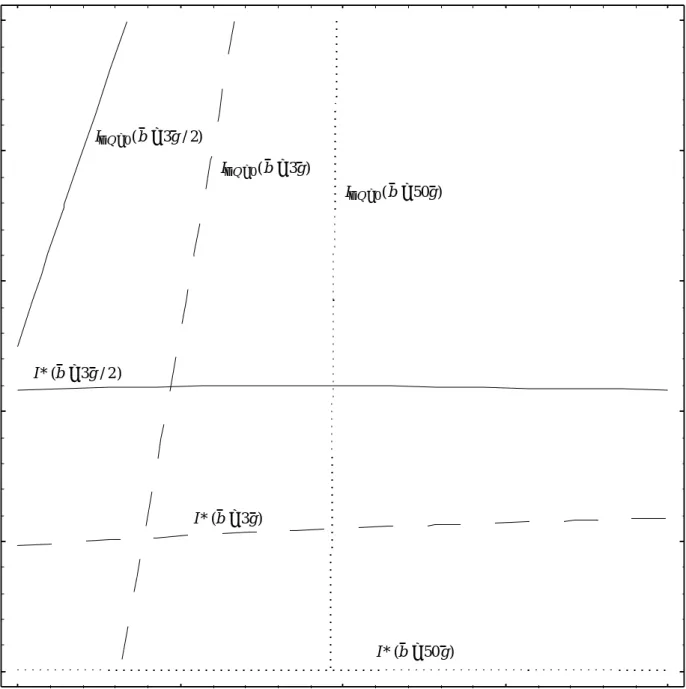
The curveI∆Q=0 is drawn in Figure 1 for given values of the parameters
¯b and ¯g. The figure also shows that higher (lower) values of ¯b (¯g) holding fixed the other parameter would shift the curve to the right.
This figure helps us understand the effects of a ban. Imagine for instance that the equilibrium valueI∗lies to the right of the curveI∆Q=0. This would imply thatQ(I∗)< Q(0). In other words, the ban would increase aggregate consumption. One can then apply the same argument to interpret remarks 1 and 2 above.
Remark 2 tells us that no matter which equilibrium level of advertising occurs at equilibrium whenl= 2, that is when advertising does not have any effect on aggregate consumption for given price levels, an advertising ban would always increase aggregate consumption. This is because whatever
I∗ will always fall in the area where the inequalityQ(I∗)< Q(0) holds. Remark 1 is of less straightforward interpretation, since the position of the curve atl= 0 depends on the values of the parameters ¯band ¯g. We can identify two cases:
• ¯b >2¯g.
In this case the equilibrium level of advertisingI∗ >0 would always fall in an area where Q(I∗)> Q(0).Hence, an advertising ban would certainly reduceconsumption.
• ¯b≤2¯g.
Here we have two possibilities: either the actual equilibrium valueI∗
lies above the curve I∆Q=0, in which case a ban reduces aggregate
consumption; or it lies below the curve, in which case a ban increases aggregate consumption. This uncertainty can be resolved only by find-ing the actual equilibrium valueI∗.15
The previous analysis confirms the role played by the direct effect of ad-vertising on market demand expansion (inversely related to the parameter
l) in determining the sign an advertising ban has upon aggregate consump-tion. As a first result, we have seen that when l is large enough (that is, when the expansion effect of advertising is weak enough) an advertising ban increases consumption. To complete our analysis, let us turn to the study of equilibrium advertising expenditures.
3.3 Specifying the cost function: Equilibrium solutions
To find the solutions of the whole game I assume the following cost function:
C(Ii) =k(− 1 ¯ g/2 + 1 (¯g/2)−Ii − Ii (¯g/2)2), k≥0. (24)
This function satisfies the properties required above for getting interior solutions in the interval 0≤Ii<¯g/2.
With such a cost function (but also with other simpler convex functions) solutions can be found only with the help of a computer programme. Figure
15However, note that for ¯b→¯gone has I
∆Q=0 →g/¯ 2. This means that when goods
are ex-ante homogenous the locus of the equilibrium levels of advertising will always lie below the curveI∆Q=0.
1 illustrates the symmetric equilibriumI∗ as a function ofl.16
The curves have been drawn for values of ¯b as specified in the figure, and for the following values of the parameters: ¯g = 2 (so that advertising investments are normalised to be between 0 and 1), k = 1, a= 10. I hold these values fixed for all the numerical solutions without any major loss for the analysis. Indeed, ¯gaffects the results only when it changes with respect to ¯b, so that the effect of a decrease in ¯g upon the equilibrium solutions is identical to the effect of an increase in ¯b. The parameterkenters multiplica-tively the cost function, and its effect on the equilibrium level of advertising is therefore straightforward: whenkrises, marginal costs of advertising also rise, and the locus of the equilibrium points shifts downwards. As for pa-rameter a, it enters multiplicatively the gross profit function. An increase inawould therefore shift the equilibrium locus upwards.
A priori, it is not clear what is the effect of an increase in l upon the equilibrium values of advertising. On the one hand, an increase inl means that fewer new consumers are attracted into the market, which lowers the incentive to invest in advertising. On the other hand, l is also a measure of the negative externality imposed upon the rival firm. Other things being 16By resorting to numerical solutions one can also check that a firm never has the
incentive to deviate from the candidate solution by choosing not to advertise:πi∗(Ii∗, Ij∗)>
ˆ
πi(0, Ij∗). To understand why this outcome is not surprising one might think of what
happens in a Hotelling-type model. There, firms located at the centre would move towards the extreme of the line to relax market competition independently of the position of the rival, although by doing so individual demand may decrease. In the model presented here, not only there is the incentive to advertise to relax competition, but also by doing so there is no adverse effect on individual demand. In fact, whenl >0, advertising expenditures improve the competitive position of the firm.
equal, a higherl means that an additional unit of advertising expenditures entails a wider inward rotation of the demand curve of the rival. This creates a stronger incentive to invest since it increases profitability. This ambiguity is reflected in the fact that I∗ is negatively sloped for ex-ante more similar goods (¯b closer to ¯g) but positively sloped when goods are already highly differentiated in the absence of advertising.
An increase in ¯bmakes the curve shifts downwards. This is because for any given ¯g, a higher ¯b implies a rise in the ”ex-ante” index of product differentiation (i.e. the degree to which products are differentiated when advertising does not exist). In turn, this reduces the incentive to increase product differentiation and therefore lowers the optimal value of investment in advertising. Likewise, when ¯g decreases with respect to ¯b, this increases ex-ante differentiation and creates less incentive to spend in advertising to further differentiate the competing brands.
This result clearly contrasts with the well-known Dorfman-Steiner (1954) theorem, according to which advertising increases with the firm’s market power. Here it is the opposite, since firms advertise precisely to increase their market power, and such an incentive is the stronger the lower the mar-ket power they have (that is, the more homogenous the goods).17
The intersection between the curvesI∗ andI∆Q=0, which occurs atl= ˜l
(see Fig. 1) is crucial:
• If ˜l <0, a complete advertising ban increases aggregate consumption ∀l.
• If ˜l≥0, then:
– Forl∈[0,˜l] a complete ban decreases aggregate consumption. – Forl∈(˜l,2] a complete ban increases aggregate consumption. Indeed, for l ∈ [0,˜l], the equilibrium level of advertising lies above the curve I∆Q=0, implying that Q(I∗) is bigger than Q(0). That is, the total
quantity sold at the unconstrained equilibrium is larger than is the total quantity sold under a ban on advertising. For l ∈ (˜l,2], the opposite hap-pens.
The figure also illustrates that when the ex-ante degree of product dif-ferentiation rises (¯b increases with respect to ¯g), the intersection between the two curves moves to the right. This means that it is less likely that an advertising ban has the undesired effect of increasing total consumption when products are ex-ante differentiated. Instead, products whose different brands are hardly distinguishable in the absence of labeling and brand-name fidelity are more likely than others to be associated with a rise in consump-tion after an advertising ban. 18
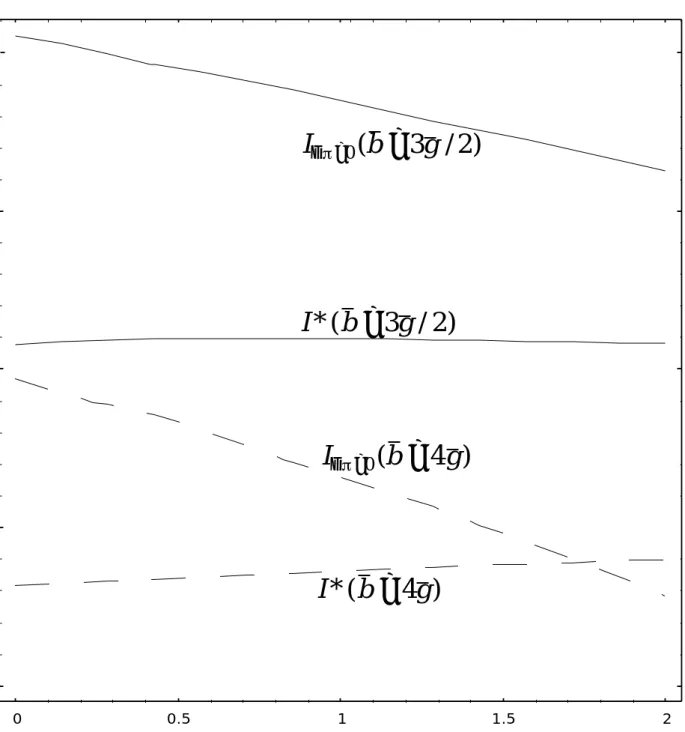
To find the effect of the bans on profits, I follow a similar procedure as the one used to uncovering the effect upon consumption. Define the function ∆π ≡ π(I)−π(0), where π(I) is a firm’s profit at a symmetric level of advertising expenditures and π(0) a firm’s profit under a ban. By substitution into the second stage profit, this function can be written:
18Cigarettes and colas would probably be good examples of ”ex-ante” homogenous
prod-ucts. Results of blind-tests usually show that consumers are unable to make out their favourite brand from rival ones.
∆π= a 2(¯b+lI)(¯b−g¯+I+lI) (2¯b−¯g+ 2I+ 2lI)2(¯b+ ¯g−2I+lI)− 8kI2 ¯ g2(¯g−2I)− a2¯b(¯b−g¯) 4¯b3−3¯b¯g2+ ¯g3. (25) Figure 2 draws the function I∆π=0 in the plan (l, I). Below the curve,
π(I) is higher thanπ(0). Above it, the opposite. The same figure also shows the locusI∗of the equilibrium solutions of the game. For low values of ¯bwith respect to ¯g, the curveI∆π=0 lies above the equilibrium schedule, implying
that firms are always worse off under an advertising ban. It is only when ¯b becomes very high relative to ¯g that the ban might give higher profits to the firms. However, this occurs only for relatively high values of l, that is when the expansion effect is low enough. Said otherwise, an advertising ban might be beneficial to the firms only if they produce goods which are already highly ex-ante differentiated and if advertising expenditures are not likely to increase aggregate demand but rather to shift consumers across firms.
The intuition for this result is as follows. Advertising in this model plays a twofold role. First, it relaxes market competition between firms. Second, it increases aggregate demand at given prices. When products are already highly differentiated, there is little benefit from advertising as a way to relax market competition. When aggregate demand reacts little to advertising and mainly reshuffles market shares between firms, advertising expenditures are collectively damaging. The combination of these two elements gives the result above.19
19If advertising expenditures affected demand parameters as b
i = ¯b+lIi, then the
business-stealing effect of advertising would disappear, and the positive price externality would be dominant. In this case, it is possible to show that the ban still increases con-sumption in a similar way as showed here but the firms’ profits would never increase under
4
A second example
In this section, I study a model - inspired by Friedman (1983) - where advertising raises the willingness to pay of consumers without affecting the degree of product differentiation between goods. I keep the example as close as possible to the previous one but some changes are necessary. Assume the following utility function:
U =y+a1q1+a2q2−b( q2 1 2 + q2 2 2 )−gq1q2. (26) The inverse demand functions are:
pi =ai−bqi−gqj, ai >0; b > g >0; i, j= 1,2;i6=j. (27)
Direct demand functions are given by:
qi =
aib−ajg−bpi+gpj
b2−g2 , i, j= 1,2;i6=j. (28)
At the symmetric equilibrium (ai = aj;pi = pj) aggregate demand is:
Q=q1+q2 = ab+gi−pi.
Assume that advertising expenditures affect demand parameters as fol-lows:
ai = ¯a+Ii+eIj; e∈[−1,1]; i, j= 1,2; i6=j. (29)
In the symmetric case Ii =Ij =I the parametere is a direct measure
of the ”expansion effect” of advertising upon aggregate consumption, since
∂Q
∂I = ¯b21+e−g¯2 ≥0. Note that fore=−1 one has a case of perfect ”business-stealing”, since a firm’s advertising attracts to it only consumers who would otherwise buy from the other firm.20
An additional unit of advertising expenditure by firm i shifts outward the own demand curve while the externality upon the rival firm depends on whether e > 0 (firm j’s curve shifts outwards) or e < 0 (the curve shifts inwards).21
Advertising decreases the firm’s own demand elasticity around a sym-metric solution, since ∂²i
∂Ii =−
b(b−eg)p
(b−g)2(¯a+I+eI−p)2 <0.However, the impact of advertising by firm i upon the elasticity of the rival is a priori ambiguous, since: ∂²i
∂Ij =−
b(eb−g)p
(b−g)2(¯a+I+eI−p)2, which is positive fore > g/b. In particular, when e <0 advertising makes the rival firm’s demand more elastic.
Firms play the same two-stage game as in the previous section. They simultaneously decide advertising expenditures at the first stage and prices at the second. Equilibrium values at the last stage are given by:
pi = 2aib2−ajbg−aig2 4b2−g2 ; qi = b(2aib2−ajbg−aig2) 4b4−5b2g2+g4 ; i, j = 1,2;i6=j; (30) whereai, aj are functions ofIi and Ij as assumed above.
Since the profit function is quadratic in Ii, assume a cubic cost function
of advertising: Ci = kI
3 i
3 . The net profit function at the first stage of the
game is therefore: 20I disregard e <
−1 which would imply that advertising hurts the rival more than it benefits the advertising firm.
πi=b (2b2−g2−bg)2(¯a+I i+eIj)2 (b2−g2)(4b2−g2)2 −k I3 i 3 . (31) The only meaningful symmetric solution to the first-order conditions is easily found as:
I∗= b(2b 2 −g2−bge)(1 +e) (2b−g)2(2b2+ 3bg+g2)k+ p 2¯ab(2b−g)2(2b2+ 3bg+g2)k(2b2+ 3bg−bge) +b2(2b2−g2−bge)2(1 +e)2 (2b−g)2(2b2+ 3bg+g2)k . (32) It can be checked that the second order conditions are satisfied at I =
I∗. Note that the equilibrium level of advertising investment raises with ¯
a and decreases with k since the former increases marginal revenue from advertising and the latter increases the marginal cost of it. How equilibrium advertising varies with respect to the expansion effect parametereand the degree of product differentiationb/g is less straightforward.
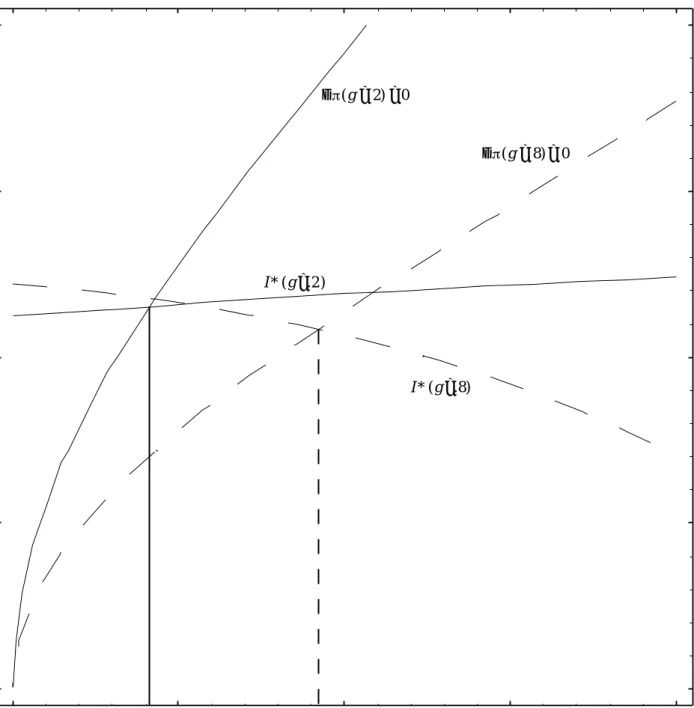
A rise in e has two effects. First, it implies that an additional unit of advertising expands market demand more strongly. On the other hand, however, it also implies that there is a higher positive spillover on the rival firm’s demand. While the former effect increases the incentive to invest, the second decreases it. Nevertheless, advertising is discouraged by the exis-tence of a positive spillover only to the extent that firms are supplying close substitutes (in the extreme case where g = 0 the goods are independent: firms do not care if their advertising benefits the rivals). Therefore, the more differentiated the goods (the lower g with respect to b) and the less important the discouraging effect of the spillovers with respect to the effect of expanding demand at given prices. As a consequence, the I∗ scheduled is positively sloped for low values of g and negatively sloped for relatively high values of g. This is also illustrated by Figure 3.
As for the relationship between advertising restrictions and consumption, the following result holds true in this model:
• Remark 5An advertising ban always decreases consumption. • Proof. Define ∆Q ≡ Q(I)−Q(0), where Q(I) is quantity sold at a
symmetric choice of advertising (and price) levels (not necessarily the equilibrium values). It is easy to check that:
∆Q = (2b2bI(1+e)2+bg−g2) ≥ 0 for e ≥ −1. This means that independently of the expansion effect, the quantity supplied under the ban is always (weakly) lower than the quantity supplied under any positive level of (symmetric) advertising expenditures.
The result above contrasts with the one obtained in the previous section where advertising bans might or not have increased consumption according to the magnitude of the expansion effect of advertising upon demand. Two remarks are useful to better understand this result and reconcile it with the result obtained in the previous section.
Firstly, the expansion effect still plays a role here, because the effec-tiveness of an advertising ban in discouraging consumption is dependent on the parameterewhich measures the expansion effect of advertising at given prices. Indeed, in the extreme case where e = −1, the ban does not have any effect on aggregate demand.
Secondly, the preliminary analysis carried out in section 2 has empha-sised the relevance of the price effect of advertising and this is the main element of explanation of the two different results. In the model analysed in section 3, advertising had a strong impact upon prices since it increased
product differentiation. Advertising had some features of a public good for the industry as a whole since it allowed products to be perceived as distinct and firms to command higher prices. In the model dealt with in this section, this feature disappears and the price effect of advertising becomes smaller as e decreases, implying that the lower the market expansion effect of ad-vertising the lower the price effect as well. This can better understood by analysing the price effect of advertising as expressed in section 2. The sign and magnitude of the price effect depend on∂pi/∂Ii+∂pi/∂Ii, which in this
model is given by:
∂p1 ∂a1 ∂a1 ∂Ii +∂p1 ∂a2 ∂a2 ∂Ii +∂p2 ∂a1 ∂a1 ∂Ii + ∂p2 ∂a2 ∂a2 ∂Ii =(1 +e)(2b 2−g2−bg) 4b2−g2 . (33)
The magnitude of this effect rises with e. In particular, when e = −1 advertising increases own prices by exactly the same amount as it decreases the rival’s price. In this extreme case, therefore, advertising does not affect equilibrium prices at all at any symmetric equilibrium. This explains why the ban does not increase consumption even in the extreme situation where there exists only business stealing, with no expansion effect of advertising (e=−1).
Figure 3 illustrates the effects of an advertising ban upon the firms’ profits. Two pairs of curves are drawn for each of two different values of the parameter g. The curve I∗ shows the equilibrium levels of investments in advertising. The curve ∆π = 0 illustrates the locus of the points for which the profit under a symmetric advertising level is equal to the profit under a ban. Formally:
∆π=π(I)−π(0) = b(b−g)(¯a+I(1 +e)) 2 4b3−3bg2+g3 −k I3 3 − ¯ a2b(b−g) 4b3−3bg2+g3. (34)
Above the curve ∆π = 0 the profits earned by firms investing a common levelI of advertising is lower than under a ban which imposesI = 0. Below the curve, the opposite occurs. The value ˆeat which the two curves intersect is the critical threshold value. Fore∈[−1,eˆ] the firms would gain from the imposition of an advertising ban. Fore∈(ˆe,1], their profits would decrease under a ban.
An implication of this model is that if firms said that the only effect of advertising is to move market shares across firms without affecting total demand, then this situation is described bye=−1. Hence, we would fall in an area where the firms’ profits increase with the ban: they should be the keenest group in advocating an advertising ban.22
When product differentiation rises (b/g increases) the intersection point ˆ
emoves to the left, thus leaving a narrower interval for which the ban would benefit the firms. The opposite occurred in the model presented in section 3.
Comparing these results with those obtained in section 3, two points can be noted. The first is that in both models the expansion effect plays a role in determining the effects of a ban upon profits. Indeed, the stronger the expansion effect of advertising (the lowerlin the previous model; the higher
ein the present one) the more likely that the firms would oppose to a ban. 22Although less clearcut, the previous section model also implied that if advertising is
of the ”business-stealing” type (l closer to 2) then the ban is more likely to raise profits of the firms.
The second is that - as stressed above - advertising is related to product differentiation in a different way in the two models. In the first one adver-tising is carried out to increase product differentiation and it is the more beneficial the less (ex-ante) differentiated the goods. In the second model, the effect is inverted, since the higher product differentiation the higher the profitability of advertising expenditures, as can be seen from the upward shift in the schedule ∆π = 0 as g decreases. 23 Unlike the first model, this is consistent with the Dorfman-Steiner’s condition: here market power increases the marginal revenue from advertising, thus raising the incentive to engage in such expenditures.
In turn, the different way in which advertising affects product differenti-ation explains the different results as to the desirability of the ban from the point of view of the firms when ex-ante product differentiation rises.
5
Conclusions
The main object of this paper has been to analyse the impact of an adver-tising ban on total consumption. A general model has served to emphasise that two effects are crucial in determining such an impact. The first ef-fect relates to the extent to which advertising expands aggregate demand at given prices. The second consists of the way in which advertising affects prices for any given level of demand. In particular, an advertising ban is more likely to increase total consumption when advertising expenditures 23Note that the effect of product differentiation upon equilibrium advertising levels was
ambiguous because firms take into account the marginal effect of advertising upon own profits only. Ex-post, though, a firm benefits from the spillover of advertising carried out by the rival firm.
do not expand the total market but rather shift market shares across firms; and when prices increase in a considerable manner due to advertising. When advertising decreases prices, as is the case for informative advertising, a ban would always decrease consumption.
I have then proceeded to illustrate these main findings with the help of two specific duopoly models which have also allowed me to discuss the effects of an advertising ban upon the profits of the firms. I have showed that a ban might increase firms’ profits, and that this is more likely to occur when the expansion effect of advertising is weak enough (that is, when advertising mostly redistributes market shares among firms). Although I believe that these findings are quite general there are a number of features in this paper which are admittedly special and which would deserve some comments.
• Entry. Throughout the paper I have considered only the case of an exogenously given number of firms 24. However, one might be
interested in studying how the ban affects the number of firms which would coexist in the industry at equilibrium. Dixit and Norman (1978) have found that it is not possible to establish a priori whether more advertising allows more or fewer firms to operate in the industry. In general, I would expect the answer to depend on a number of variables, among which the relative importance of the expansion and price effects mentioned above.
• Asymmetry. I have not departed from the assumption of symme-try, which is very convenient but also very strong. Again, I feel that 24In the specific models of section 3 and 4 I have analysed a duopoly but the results
many insights would still apply to a situation where firms differ in their technologies and initial market positions. However, there are a number of interesting issues which arise under asymmetry and which only an accurate analysis might properly address. In particular, it would be interesting to understand which kind of firms is more likely (if at all) to benefit from the introduction of a ban. An interesting application could be given by the tobacco industry in the European Union. In many countries tobacco has been heavily regulated and state monop-olies have existed for a long time. If outsiders can gain market shares mostly or uniquely through advertising, and if big multinationals are more efficient in their advertising activities than the local monopolies (in terms of the models above, the incumbent would have a higher advertising cost parameterk than the entrants), then the ban would protect the state monopolies (insiders) and hurt the big multinational firms (outsiders). 25
• Quantity competition. In the paper I have focused on price com-petition, both in the general model and in the specific examples. This allowed me to illustrate the expansion and price effects of advertis-ing more neatly. None the less, the basic insights of the analysis can be reproduced in a model where the firms’ strategic variable at the product market competition stage is quantity rather than price. Al-though I do not reproduce them for shortness, it is easy to check that 25This argument has been suggested by commentators who noted that strict bans were
enforced in Portugal, Italy and France, where state monopolies are strong. This might also imply that the true government objective would not be a decrease in consumption, but for instance a welfare function where the national profits have a considerable weight.
the qualitative results obtained in the models proposed in sections 3 and 4 still hold good under the hypothesis of quantity competition.
26 Furthermore, there would have been no reason to suspect that
the mode of market competition sensitively affects the result. Indeed, Dixit and Norman (1978) find that advertising does not necessarily increase quantity in a model where firms compete on quantities. • Partial equilibrium. By focusing on a partial equilibrium model,
I cannot capture the effects of a ban on other sectors. In particu-lar, some commentators (and lobbyists) claim that a ban would have the strongest effects upon newspapers, radio and television channels whose revenues are highly dependent on the advertising space sold to the firms. Neither this, nor other general equilibrium effects can be captured in the framework of analysis proposed here.
• Advertising as capital assets. The best way to describe advertis-ing expenditures is possibly in lookadvertis-ing at them as investments which contribute to create a stock of goodwill. Within this perspective, an advertising ban would not have an immediate effect upon consumption and profits, since the willingness to pay of consumers would decrease only over time. This should obviously taken into account in an empiri-cal work. Although the paper does not account for the delayed impact of a ban, it does capture the long-run effects of it. The formulation proposed here would be equivalent to the comparative statics between 26Details are available from the author upon request. One of the advantages of the
mod-els presented above is that it is possible to analyse both price and quantity competition, a property not always shared by many models of product differentiation.
long-run equilibria in a more sophisticated model where advertising acts as a capital asset.
• Switching costsFor many products such as tobacco and alcohol it is conceivable that advertising is mostly directed towards young people who are not usual consumers. This would amount to assuming that there are two generations of consumers, one which has already con-sumed the good in the past and incurs costs of switching from a brand to another; and a second generation which has no switching costs. Some of these effects are partly captured by the model presented here. In particular, the magnitude of the expansion effect is related to the importance of the generation of ”new” consumers. However, the full consequences of such a framework of analysis could be properly inves-tigated only within a model where switching costs, or the existence of two generations with differing preferences, are rigorously modeled. • Welfare. Throughout the paper I have focused on the effects of an
advertising ban on total consumption. This is partly to avoid the is-sue of how advertising enters the utility functions of consumers,27but
also because it does seem a real concern for governments that total consumption of certain goods such as tobacco and alcohol should be reduced. In many circumstances reduction of consumption is the main objective of a government, and this can be rationalised by assuming a welfare function where negative externalities due to consumption of the product play a determinant role. In many other cases, governments are probably maximising an objective function where externalities are 27See Dixit and Norman (1978) for such an analysis.
just one of the terms along with consumer surplus, tax revenue con-siderations and profits of the domestic firms.
• Taxes and other instruments. Even considering that externali-ties are judged so important by the government for the reduction in consumption to dominate any other term in the welfare function, my analysis has been restrictive in that I have considered just one of the many instruments available to a government which wants to reduce consumption. For instance, a consumption tax increase might be the best instrument to meet such a goal. However, higher taxes often en-courage contraband. Insofar as smuggling from neighbouring countries might be increased by a tax level beyond a certain threshold, it is pos-sible that this introduces cheaper units of the good in the market, thus countering the reduction in consumption. The same is true for total prohibition on consumption of a given good which might stimulate the existence of a parallel market on which the authorities have little control. These are also interesting issues which should be analysed in a formal framework.
6
References
Baltagi, B.H. and D. Levin (1986) Estimating dynamic demand for cigarettes using panel data: the effects of the bootlegging, taxation and advertising reconsidered. Review of Economics and Statictics, 6, 148-155.
Becker, G.S. and K.M. Murphy (1993) ”A simple theory of advertising as a good or bad”,Quarterly Journal of Economics, 108, 941-64.
Journal of Law and Economics, 15, 337-52.
Benham, L. and A. Benham (1976) ”Regulating through professions: A perspective on information control”, Journal of Law and Economics, 18, 421-447.
Cabrales, A. and M. Motta (1995) ”Country asymmetries, endogenous product choice and the speed of trade liberalisation”, CEPR Discussion Paper No. 1326, London.
Dixit, A. and V. Norman (1978) ”Advertising and welfare”,Bell Journal of Economics, 9, 1-17.
Dorfman, R. and P.O. Steiner (1954) ”Optimal advertising and optimal quality”, American Economic Review, 44, 826-36.
Duffy, M. (1987) ”Advertising and the intre-product distribution of de-mand. A Rotterdam model approach”, European Economic Review, 31, 1051-70.
Duffy, M. (1996) ”Econometric studies of advertising, advertising restric-tions and cigarette demand: A survey”, International Journal of Advertis-ing, 15, 1-23.
Friedman, J.W. (1983) ”Advertising and oligopolistic equilibrium”,Bell Journal of Economics, 14, 464-73.
Grossman, G.M. and C. Shapiro (1984) ”Informative advertising with differentiated products”, Review of Economic Studies, 51, 63-81.
Hamilton, J.L. (1972) ”The demand for cigarettes: advertising, the health scare, and the cigarette advertising ban”, Review of Economics and Statistics, 54, 401-11.
Johnston, J. (1980) ”Advertising and the aggregate demand for cigarettes: a comment”, European Economic Review, 14, 117-25.