Secure Cloud Storage Scheme Based On Hybrid
Cryptosystem
Atanu Basu
ERP System, Indian Institute of Technology, Kharagpur - 721302.
E-mail : [email protected]
Indranil Sengupta
Department of Computer Sc. & Engg
Indian Institute of Technology, Kharagpur 721302.
E-mail : [email protected]
Abstract
This paper presents a secure cloud storage scheme based on hybrid cryptosystem, which consists of Elliptic Curve Cryptography (ECC), Ad-vanced Encryption Standard (AES), and one-way hash function. Here, the data owner exports large volume of encrypted data to a cloud storage provider. The exported encrypted data is over-encrypted by the cloud storage provider, and the data is sent to the requesting user. An existing hybrid cryptosystem based dynamic key management scheme with hier-archical access control has been incorporated in our scheme. The key management scheme groups users in various security classes, and helps to derive eciently, as well as directly the secret keys of the lower or-der security classes. The incorporated key management scheme in our proposed scheme incurs low computational, communication, and storage overheads for key generation, and derivation purposes. The security anal-ysis, and the simulation results run on the AVISPA tool (formal security verication tool) show that the proposed scheme is protected from the adversaries. This scheme is useful in `owner-write-users-read' application areas, and the end users may use resource-constrained wireless mobile devices securely in this proposed scheme.
1 Introduction
and are stored in cloud storage. The end users having dierent access rights read the information securely. The subscribed readers with dierent access rights of a digital library access the contents of a digital library, and the owner of the digital library creates, updates the contents of the digital library hosted on a cloud storage. The research work of a various research groups of a research project, which are located in dierent countries of the world can be outsourced to a cloud storage. The scientists of the research groups with dynamic security clearance can access information of the cloud securely.
When data is outsourced to a cloud storage, it is a matter of concern that the outsourced data may be compromised. Also, due to increasing recent trend of using mobile devices by the users, any cloud storage scheme should support the use of mobile devices. This motivates us to design a secure lightweight cloud storage scheme, which supports the use of mobile devices by the users.
The objective of the work is to propose an ecient secure cloud storage scheme for `owner-write-users-read' application areas, and the end users are capable to use resource-constrained wireless mobile devices in secure manner.
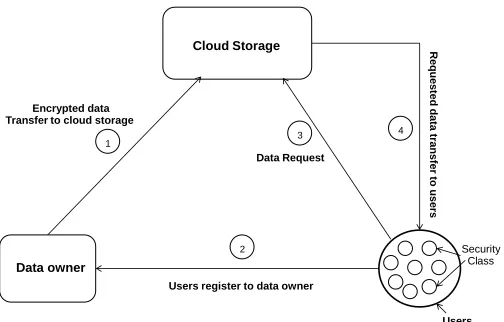
In this proposed scheme, the data owner encrypts huge volume of data, and outsources it to a cloud storage. A new user registers to the data owner. The data owner sends the list of valid registered users to the cloud storage provider. When a valid end user requests data to the cloud storage, the cloud storage over-encrypts [6] the requested data with the dynamic session key, and exports it to the end user. The end user decrypts the received data, and gets the requested data. Our proposed hybrid cryptosystem based dynamic key management scheme with hierarchical access control [5] is incorporated into this cloud storage scheme. In this key management scheme, the users of the higher order security class can access the data of the lower order security classes through derivation of the keys of the lower order security classes directly. In this `owner-write-users-read' application areas, the end users can securely access the required data with their resource-constrained mobile devices, whereas the revoked users are not able to access any updated data. The pictorial diagram of the scheme is shown in Figure 1.
Data owner
Data Request
3
Cloud Storage
Encrypted data Transfer to cloud storage
1
R
eq
u
es
ted
d
at
a
tr
an
sf
er
to
u
se
rs
4
Sequence of steps - 1,2,3, 4
Users Security Class
Users register to data owner
2
Figure 1: Proposed cloud storage scheme
2 Related works of cloud storage schemes
In this section, we have discussed recent secure cloud storage schemes.
Vimercati et al. [8] proposed the merging of authorizations, as well as en-cryption of data, and exports the encrypted data to the cloud storage. This allows incorporation of access control with the exported data, while the data owner needs not be involved with the incorporation of access policy. The data owner uses the BEL (Base Encryption Layer) to the exported data, and the cloud storage server uses SEL (Surface Encryption Layer) termed as over-encryption [6] to the exported encrypted data. The end users use two decryption keys, SEL decryption key, and BEL decryption key for decryption of the requested data. When there are any change of access right of any user or any updation of the data is required, the over-encryption [6] is conducted to the requested data. This scheme is not free of collusion.
over-encryption [6] to the requested data using one time keypad, and transfers the requested data to that end user. But, the data owner may use the lazy revocation [7] technique when any cloud service provider denies to do the over-encryption. The end user derives large number of keys from a root key to decrypt blocks of encrypted data. This scheme is suitable for wireless mobile devices. But, the problem with the scheme is that the data owner will have to be online always for providing access certicates to the requesting users.
Yu et al. [10], and Sahai et al. [11] proposed their revocable cloud storage scheme based on ABE (Attribute Based Encryption). Though the ABE based schemes support ne grained access control, but in these schemes the secret keys of the users, and the ciphertext grow proportionally with increase in the number of associated attributres.
Chen et al. [4] proposed a secure cloud storage scheme based on Bell-LaPadula security model with user revocation feature eciently. Here, users can upload their own data to the cloud storage, and users have read, and write access to their data. But, a user in higher order security class will have to derive key of any user in lower order security class with O(d) complexity, where d is the distance (node count) between two users who are in the same predecessor-successor chain. This indicates that the key derivation mechanism of this scheme has the scalability problem when the associated users are in long predecessor-successor chain.
3 Related Works of key management schemes with
hierarchical access control
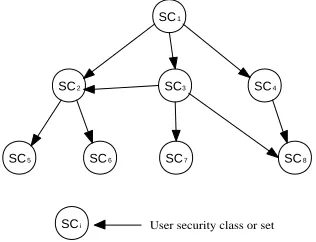
The key management schemes [15, 16, 17, 18, 19, 20, 21, 22, 23, 24] with hier-archical access control describe computation of key of lower level security class from higher level security class of same predecessor-successor chain. But, the key computation of higher level security class from lower level security class of same predecessor-successor chain is not possible. We consider the user set SC is grouped into disjoint sets, i.e. SC = {SC1, SC2,. . . ,SCn}, considering total
number of security classes is n. The security classes are arranged into hierarchi-cal structure as per the security clearance as shown in Figure 2. The security keys corresponding to the security classes are SK = {SK1,SK2,. . . ,SKn}. The
security classes are partially ordered by a binary relation `≤'. If the security classesSCj ≤SCi, i, j ∈n, then the users in security classSCican only access
information of the users in security classSCj. The derivation of secret keys of
successor security classes are computed through direct computation or through iterations considering available public information or tokens.
between nodes v and w. This indicates that the node v cannot directly compute key of node w, and the scheme is not scalable.
We have applied our secure dynamic key management scheme with hierar-chical access control [5] to this proposed cloud storage scheme. This scheme [5] is an improvement of Wu et al. [24] scheme. The redundant computations have been excluded, and the scheme emerges as more computationally ecient, takes less storage space compared to Wu et al. [24], and Nikooghadam et al. [23] schemes. This scheme uses hybrid cryptosystem, i.e. Elliptic Curve Cryp-tography (ECC) [25, 26, 27], AES [28], and one-way hash function [28] for the key generation, and key derivation purposes. The users of the scheme [5] with proper security clearance can directly compute keys of the lower order security classes with the help of public parameters. This key management scheme su-ports dynamic features (addition, deletion of security classes, establishment of new relationship among security classes, generation of new security keys), and the scheme is secure in random oracle model, as well as prevents attacks from adversaries.
1 SC
2
SC SC3 SC4
5
SC SC6 SC7 SC8
i
SC User security class or set
Figure 2: Hierarchical tree for user classes
4 System, network and adversary models
In this section, system, network and adversary models are described in which the proposed scheme works.
4.1 System and network models
The system model of the scheme as shown in Figure 1 consists of three compo-nents−Data Owner (DO), Cloud Storage (CS), and end user (Uv). They are
described below in brief.
generates secret keys of the security classes, and publishes public keys, public parameters of the security classes.
b) Cloud Storage (CS) : The CS stores huge amount of data as requested by the DO. It is assumed that the CS is honest but curious entity, and faithfully transfers data to theUv as requested by theUv.
c) End user (Uv) : The valid end userUv or reader requests data to the CS.
The communication between the DO, and the CS is done through a secure communication channel. TheUvmay be connected to the DO or the CS through
wired or wireless medium using public channel. The Uv may use
resource-constrained wireless mobile device.
4.2 Adversary model
The various types of active, and passive adversaries or attackers are considered in this scheme. The adversaries capture or modify data of the DO, CS, and the
Uv.
Any adversary or intruder may mount impersonation attack between the DO, and the CS, as well as between the DO, and theUv.
Any adversary may also capture, and modify transmitted data through re-play attack.
5 Proposed cloud storage scheme
The ECC public key cryptography is used in this scheme as the ECC is suitable for use in resource-constrained devices [27, 33] eciently. The proposed cloud storage scheme is discussed in detail below.
5.1 Setup phase
The following steps are followed by the DO, CS, andUv.
Step 1 : All the users U = {Uv} where v = {1, 2, . . . ,N } registers to the DO
where N is the total number ofUv. All theUvs are grouped into dierent
disjoint security classes as per their hierarchy, i.e. SC = {SCi} where
1≤i≤n.
Step 2 : The DO randomly selects ECC private keyP riDOfrom the nite eld
and generates ECC public keyP ubDOasP riDO.G. The CS also randomly
selects ECC private key P riCS from the nite eld, and generates ECC
public keyP ubCS asP riCS.G. Similarly, eachUvselects ECC private key
P riv from the nite eld, and generates ECC public keyP ubvasP riv.G.
The CS, andUvs transfer their public keys to the DO.
Step 4 : The DO selects secret key SKi (128-bit) for each security class SCi
where SK = {SKi} where 1≤i≤n, and computes ECC point Zi =
P riDO.Qi for each SCi (1≤i≤n).
Step 5 : Subsequently, the DO computes symmetric keyCKifor each security
classSCi is shown below.
CKi = H([Qi]x ||[Zi]x),
where CKi (128-bit) is computed through one-way hash operation (H())
after the concatenation of x-coordinates of the public key Qi, and the
ECC pointZi for each security class SCi. The related public parameters
mi,j of each security class are computed as per its security clearance as
described in [5] as mi,j = ECKi[SKj] for each security class SCi. The
procedure to generate mi,j for eachSCi are repeated as per the security
clearance for1≤j≤n. The parameterECKi[SKj] signies that the AES
symmetric encryption (ECKi) is applied on theSKj of theSCj.
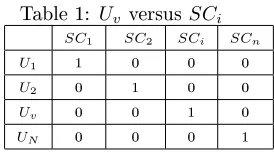
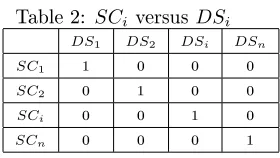
Step 6 : Two access control matrices (Table 1 and Table 2) are created by the DO. Table 1 shows relationship betweenUv, andSCi. Table 2 shows
rela-tionship betweenSCi, andDSi. The parameter `1' in the tables indicates
existence of relationship, and the parameter `0' indicates non-existence of relationship between the entities.
Step 7 : The DO initiates mutual authentication protocol, i.e. follows mod-ied version of well-known Needham-Schroeder authentication protocol [29, 12] while initiating communication between the DO, and CS. The DO performs encryption of each data setDSiwith the corresponding keySKi
of the security classSCi, and sebsequently exports encrypted data to the
CS as shown below.
DO→CS :ESKi[DSi].
Step 8 : The DO publishesp, q,G,P ubCS,P ubDO,P ubv,mi,j, one-way hash
function H (). It removes security keys SKis, and encryption keys CKis
of the security classes.
Table 1: Uv versusSCi SC1 SC2 SCi SCn
U1 1 0 0 0
U2 0 1 0 0
Uv 0 0 1 0
Table 2: SCiversusDSi DS1 DS2 DSi DSn
SC1 1 0 0 0
SC2 0 1 0 0
SCi 0 0 1 0
SCn 0 0 0 1
5.2 Data access mechanism of the users
When aUv tries to access data of the DO, the following steps (Step 1 - 5) are
followed
-Step 1 : WhenUv initiates to access data of DSi, Uv requests to the CS as
shown below.
Uv →CS :P ubCS[Uv, RD, RI],
the information [Uv, RD,RI] is encrypted with the public key of the CS.
The replay attack is prevented by the increment of the request index (RI)
each time for next requested data (RD) ofUv.
Step 2 : The CS decrypts request sent by theUv by using private keyP riCS
of the CS. The CS veries whether the Uv, and its request are valid or
not. The CS also checks Uv belongs to whichSCi from Table 1. It also
veries whether the correspondingSCi has access permission to theDSi
from Table 2.
Step 3 : After checking validity of the request ofUv, the CS randomly selects
any element from nite eld, and generates session keySesv (160-bit) for
the Uv using H (). The CS encrypts Sesv with public key P ubv of that
particularSesv, and sends it to thatUv.
CS→Uv : P ubv [Sesv]
Step 4 : The CS over-encrypts RD withSesv of thatUv, and sends it to the
Uv as shown below.
CS→Uv : [Sesv ⊕ESKi[RD]].
The above XOR (⊕) operation is performed betweenSesv (160-bit), and
each 160-bit block ofESKi[RD].
Step 5 : TheUv after receiving the data, decrypts the over-encrypted
cipher-text through the XOR operation using theSesvand subsequently decrypts
the data with the SKi. Now, Uv gets the RD. It should be mentioned
here that eachUv who is inSCi retrieves the security keySKi from
cor-respondingmi,j through derivation of the keyCKias described in Step 5
Any revokedUv with the retainedSKi may eavesdrop or sni updated data
destined for another Uv of the sameSCi. The over-encryption technique
pre-vents the revoked Uv to access the updated data. This technique also helps
protection of data, as the users may switch among the security classes.
The integrity of the received data may be veried by the Uv through the
integrity checking schemes [30, 31, 32].
The pictorial diagram of key generation and derivation of the DO, CS and the users are shown in Figure 3.
T D
PriDO Є [1, q – 1] PubDO = PriDO.G
Prii Є [1, q – 1] Pubi = Prii.G
1
2
SCi spublishes n
no. of Pubi
SC SCi
SKi Є GF(p) where SKi is 128 bit Zi = PriDO.Pubi CKi = H([ Pubi]x ǁ [Zi]x) where CKi is 128 bit mi,j = ECK [SKj] DO
Publishes mi,j,PubDO,Pubi
Zi = Prii.PubDO CKi = H([Pubi]x ǁ [Zi]x) SKj = DCK [mi,j]
i
Steps of computation
i 4
3
5
1 2 3 4 5 6 6
T D
CS 7
Element Є GF(p)
Sesv = H(Element) where Sesv is 160 bit Computes Pubv[Sesv]
CS transfers Pubv[Sesv] to
user (v) of a security class 8
7 8
Figure 3: Pictorial diagram of key generation & derivation
6 Performance analysis
The computational and overhead storage overheads of the proposed scheme are due to generation of keys, and storage of keys respectively. The communication overhead of the scheme is due to transfer of keys to the CS, and theUv. The
computational overhead also depends on number of encryption, and decryption of data requested by theUv to be performed by the DO, CS and theUv. Here,
for performance analysis, and comparison purposes, it is considered that the elliptic curve is dened over the nite eld GF(pm) where p = 2, and m =
163-bit which provides enough security in practical scenario.
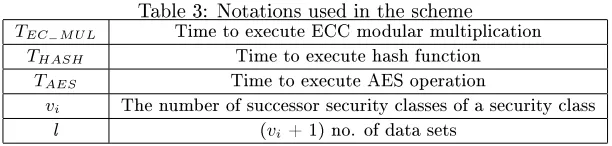
The notations used for performance analysis and comparison purposes are shown in Table III.
6.1 Computational overhead
TDO (computational overhead in the DO) : This is due to generation of ECC
Table 3: Notations used in the scheme
TEC−M U L Time to execute ECC modular multiplication
THASH Time to execute hash function
TAES Time to execute AES operation
vi The number of successor security classes of a security class
l (vi + 1) no. of data sets
numbers of security classes, generation of(vi + 1) numbers ofmi,j public
pa-rameters for each security class as per security clearance of each security class, and generation of session keys of N numbers ofUv. Then,TDO
= Time required for generation of [P ubDO + (n no. of CKi +mi,j of the SC )
+ (N no. of session keys)]
=TEC−M U L+ (n.TEC−M U L+ n.THASH +
Pn
i=1(vi + 1).TAES) + N.THASH]
= (n + 1).TEC−M U L + (n + N ).THASH +
Pn
i=1(vi + 1).TAES.
TCS (computational overhead in the CS) : This is due to time required for
generation ofP ubCS
=TEC−M U L.
TUv(computational overhead in theTUv) : The computational overhead in the
Uv as a member of a secuirty class,TUv
= Time required for generation of [P ubv + derivation ofCKi]=TEC−M U L + [TEC−M U L +THASH +TAES]
= 2.TEC−M U L +THASH +TAES.
6.2 Storage overhead
SDO (storage overhead of DO) : The DO stores its own ECC private key
(163-bit), secret key (SKi) and encryption key (CKi) of the n security classes,
current session key (Sesv) of the N number ofUv. Then,SDO
= [163 + n.128 + n.128 + N.160]-bit
SCS (storage overhead of CS) : This is due to storage of own ECC private key
(163-bit), and N no. of session keys. = [163 + N.160]-bit
SU (storage overhead ofU) : AnyUv as a member of a security class stores own
ECC private key (163-bit), session key and maximum (vi+ 1) security keys,SU
= [163 + 160 + (vi + 1).128]-bit
= [128.vi + 451]-bit.
6.3 Communication overhead
The communication overheads of the DO, CS and theUv have been considered
taking into account the overhead of transferring keys only.
The DO transfers the session keys (Sesv)to the N users and to the DO.
CDO (communication overhead in DO)
= N.(160 + 160)-bit = N.320-bit.
CCS (communication overhead in CS) : This is due to transfer of ECC public
key having x and y coordinate. = 2.163
= 326-bit.
CUv (communication overhead inUv) : This is due to transfer of public key to
the DO and downloading of (vi + 1) no. of mi,j
= [2.163 + (vi + 1).128]-bit
= (vi.128 + 454)-bit.
7 Security analysis
The proposed scheme is based on the hybrid cryptosystem, which includes robust secure cryptographic primitives AES, ECC, and one-way hash function. It is assumed that the key stores of the DO, CS, and theUvwill not be compromised
by the adversaries.
As the exported data to the CS is kept encrypted during the operation of the scheme, the adversaries (active or passive) cannot compromise the exported data. The CS cannot decrypt or modify any encrypted data because the CS does not have any secret key for decryption of data.
TheUv always receives any data in encrypted form. Any revoked Uv from
the same security class cannot eavesdrop any updated data destined for theUv
as the data for eachUvis over-encrypted by eachUv's unique session key by the
CS. So, any active or passive adversary cannot compromise any data of theUv.
7.1 Security analysis using AVISPA tool
In this section, rst a brief discussion of the AVISPA tool [12, 13, 14] has been provided. After that, a brief description of the proposed scheme's HLPSL code (AVISPA's high level language code), which has been run on the AVISPA tool is described. Subsequently, the simulation results of the proposed scheme has been expalined.
7.1.1 Brief description of the AVISPA tool
where any intruder (active or passive adversary) can eavesdrop any transmit-ted message, mount masquerading (impersonation attacks), and replay attacks (modify or inject any message), but follows perfect cryptography, i.e. the in-truder cannot break the cryptography. A high-level language HLPSL (High Level Protocol Specication Language) is a exible, expressive, modular, and role based formal language, which is used on the AVISPA for specifying protocols, and their security properties. The HLPSL code consists of two parts -`role' and `goal' sections. The -`role' section of HLPSL code denes action of any entity of the proposed scheme, and is described by some states.
7.1.2 AVISPA in our proposed scheme
-The verication process of the AVISPA helps to check whether our proposed scheme is protected from any intruder attack, or not.
Our proposed scheme is dened in HLPSL code of the AVISPA framework, which contains `role' sections of the DO, CS, and theUv. Each `role' section contains
modied version of Needham-Schroeder [29, 13] authentication protocol, which is used for mutual authentication between the DO, CS, and theUv. The `goal'
section shows the intended authentication verication between the DO and the CS, the CS and theUv.
The modied version of Needham-Schroeder [29, 13] authentication protocol, which is used for mutual authentication between the DO and the CS has been discussed below
-1. DO→PKs[IDv, Na]→CS
(Encrypted with the public key PKs of the CS) 2. CS →PKv[IDs, Na, Nb]→DO
(Encrypted with the public key PKv of the DO) 3. DO→PKs[IDv, Nb]→CS
(Encrypted with the public key PKs of the CS)
where IDv and IDs are identication numbers of the DO, and the CS respec-tively. The numbers Na, and Nb are the `nonce' generated by the DO, and the CS respectively.
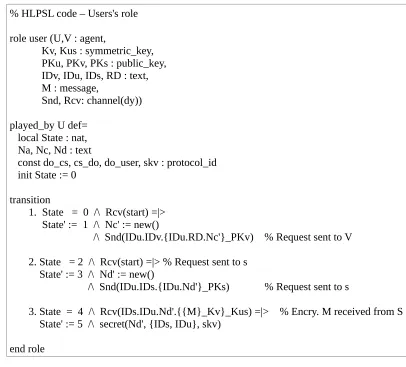
The `role' sections of the DO, CS and Uv are shown in Figure 4, Figure 5,
and Figure 6 (end of the paper).
Figure 4 shows the `role' played by the DO. The states 0 to 4 of Figure 4 shows Needham-Schroeder authentication protocol, and state 5 shows message transfer from the DO to the CS. The state 6 shows request message from the
Uv.
Figure 5 shows the `role' played by the CS. The states 0 to 1 of Figure 5 shows Needham-Schroeder authentication protocol, and state 3 shows message received by the CS, which was sent by the DO. The state 4 shows request message from theUv. The state 5 shows requested message transfer from the
CS to theUv.
Figure 6 shows the `role' played by the Uv. The states 0 to 3 of Figure 6
message received from the CS.
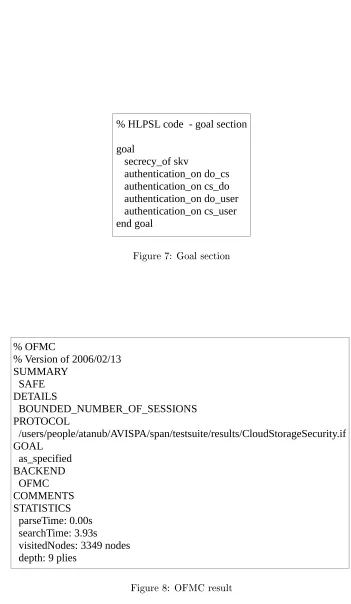
The `goal' section in Figure 7 shows required authentication between the DO and the CS, the DO and theUv, the CS and theUv.
7.1.3 Simulation result
-The simulation results of the OFMC, and SATMC backend independent com-ponents of AVISPA tool are shown in Figure 8 and Figure 9 respectively. The simulation results show that the proposed scheme is `SAFE', i.e. it prevents attacks from the intruders, and the scheme is protected from the replay attack, as well as the man-in-the-middle attack.
The security analysis of the scheme, and the simulation results of the AVISPA tool show that the proposed cloud storage scheme is secured from the adver-saries.
8 Comparison with other schemes
Here, the proposed scheme is compared with Wang et al. [9] scheme, and Chen et al. [4] scheme. The key derivation mechanism of the key management protocol, and the user revocation mechanism, which are incorporated in secure cloud storage scheme incur major costs in computational overhead of the cloud storage scheme.
The computational overhead of key derivation for Wang et al. [9] scheme is due to one-way hash operation [22], and symmetric key encryption opera-tion. Here, the computational overhead for key derivation is O(d), where d is the distance between predecessor, and succesor nodes. The scheme uses over-encryption technique for preventing access of data to revoked users. Any end user stores two secret keys for data decryption.
The computational overhead of key derivation for Chen et al. [4] scheme is also due to one-way hash operation [22], and symmetric key encryption opera-tion. Here, also the computational overhead for key derivation is O(d), where d is the distance between predecessor, and succesor nodes. The scheme uses proxy re-encryption technique for preventing access of data to revoked users. Any end user stores one secret key for data decryption.
The computational overhead of key derivation for our proposed scheme is O(1), i.e. derivation takes constant time. Here, the predecessor node directly derives the key of the successor node. The scheme uses over-encryption tech-nique for preventing access of data to revoked users, and the end user stores two secret keys for data decryption. The proposed scheme is suitable for end users to use resource-constrained wireless mobile devices as the scheme requires less computational, and storage overheads to access data.
Table 4: Comparison of various schemes with our proposed scheme
Wang et al. [9] Chen et al. [4] Proposed scheme
Computational cost O(d) O(d) O(1)
(Key derivation)
Revocation mechanism Over-encryption Proxy Re-encryption Over-encryption
Applicable to lightweight Yes Yes Yes
Mobile device (Yes/No)
Number of decryption 2 1 2
keys required
9 Conclusion
In the proposed cloud storage scheme, it has been shown that the data requested by the end users are served to them using over-encryption by the cloud stor-age provider after proper authentication from the data owner, where the data owner already had sent the data to the cloud storage provider in encrypted form. All the required secret keys are generated, and distributed by the data owner to the corresponding users. It has been shown that the incorporation of the hybrid cryptosystem based key management scheme with hierarchical access control enhances the eciency of the proposed cloud storage scheme. The hybrid cryptosystem uses secure lightweight ECC, AES, and one-way hash primitives. The scheme is secured against the adversaries as validated through formal verication tool AVISPA, and the end users of the scheme may use wire-less resource-constrained mobile devices.
References
[1] CSA (Cloud Security Alliance): Security Guidance for Criti-cal Areas of Focus in Cloud Computing V2.1. (October 2009). http://www.cloudsecurityalliance.org.
[2] Mell P., Grance T.: The NIST Denition of Cloud Computing Version 15., Information Technology Laboratory, NIST (National Institute of Standards and Technology), (October 2009). http://csrc.nist.gov/groups/SNS/cloud-computing.
[5] Basu A., Sengupta I.: Improved Secure Dynamic Key Management Scheme with Access Control in User Hierarchy. In: 2nd IEEE conference on Digital Information and Communication Technology and it's Applications (DIC-TAP), IEEE Computer Society, pp. 220-225 (2012).
[6] Vimercati S., Foresti S., Jajodia S., Paraboschi S., Samarati P.: Over-encryption: management of access control evolution on outsourced data. In: International Conference on Very Large Databases, pp. 123-134 (September 2007).
[7] Kallahalla M., Riedel E., Swaminathan R., Wang Q., Fu K.: Plutus: Scal-able secure le sharing on untrusted storage. In: 2nd Conference on File and Storage Technologies (FASTâ03), USENIX, Berkeley, CA, pp. 29-42 (2003).
[8] Vimercati S., Foresti S., Jajodia S., Paraboschi S., Samarati P.: A data out-sourcing architecture combining cryptography and access control. In: ACM workshop on Computer Security Architecture, ACM, pp. 63-69 (November 2007).
[9] Wang W., Li Z., Owens R., Bhargava B.: Secure and ecient access to outsourced data. In: ACM workshop on Cloud Computing Security, ACM, pp. 55-66 (2009).
[10] Yu, S., Wang, C., Ren, K., Lou, W.: Achieving secure, scalable, and ne-grained data access control in cloud computing, Proc. of the IEEE In-ternational Conference on Computer Communications (INFOCOM), IEEE Computer Society, pp. 534-542 2010)
[11] Sahai, A., Seyalioglu, H., Waters, B. : Dynamic credentials and ciphertext delegation for attribute-based encryption, Proc. of Safavi-Naini, R.(ed.) CRYPTO 2012, LNCS, vol. 7417, pp. 199-217, Springer, Heidelberg, (2012) [12] AVISPA Project. AVISPA protocol library, http://www.avispa-proect.org. [13] Armando A., Basin D., Boichut Y., Chevalier Y., Compagna L., Cuellar J., Drielsma P.H., He'm P.C., Kouchnarenko O., Mantovani J., M'dersheim S., Oheimb D. von ao, Michael R., Santiago J., Turuani M., Vigan L., Vigneron L.: The AVISPA tool for the automated validation of internet security protocols and applications. In: CAV 2005, pp. 281-285 (2005). [14] Vigano L.: Automated Security Protocol Analysis With the AVISPA Tool.
In: 21st Mathematical Foundations of Programming Semantics (MFPS'05), pp. 61-86 (May 2006).
[16] Akl S., Taylor P.: Cryptographic solution to a problem of access control in a hierarchy, ACM Transaction on Computer Systems, ACM, 1(3), 239-248 (1983).
[17] Chang C., Hwang R., Wu T.: Cryptographic key assignment scheme for access control in a hierarchy, Information Systems, Elsevier, 17(3), 243-247 (1992).
[18] Shen V., Chen T.: A novel key management scheme based on discrete logarithms and polynomial interpolations, Computers & Security, Elsevier, 21(2), pp. 164-171 (2002).
[19] Chang C., Lin I., Tsai H., Wang H.: A key assignment scheme for control-ling access in partially ordered user hierarchies. In: 18th IEEE International Conference on Advanced Information Networking and Applications (AINA 2004), IEEE Computer Society, Fukuoka, Japan, pp. 376-379 (March 2004). [20] Jeng F., Wang C.: An ecient key-management scheme for hierarchical access control based on elliptic curve cryptosystem, Journal of Systems and Software, Elsevier, 79(8), 1161-1167 (2006).
[21] Chung Y., Lee H., Lai F., Chen T.: Access control in user hierarchy based on elliptic curve cryptosystem, Information Sciences, Elsevier, 178(8), 230-243 (2008).
[22] Atallah M., Blanton M., Fazio N., Frikken K.: Dynamic and ecient key management for access hierarchies, ACM Transactions on Information and System Security, ACM, 12(3), 1-43 (2009).
[23] Nikooghadam M., Zakerolhosseini A., Moghaddam M.: Ecient utilization of elliptic curve cryptosystem for hierarchical access control, Journal of Systems and Software, Elsevier, 83(10), 1917-1929 (2010).
[24] Shuhua W., Kefei C.: An Ecient Key-Management Scheme for Hier-archical Access Control in E-Medicine System, Journal of Medical Sys-tems, Springer, DOI: 10.1007/s10916-011-9700-7, Published online on 2011, 36(4), 2325-2337 (2012).
[25] Hankerson D., Menezes A., Vanstone S.: Guide to Elliptic Curve Cryptog-raphy, Springer (2004).
[26] Certicom Research: SEC 1: Elliptic Curve Cryptography, Standards for Ecient Cryptography 1, working Draft, Version 1.9, (August 22 2008). [27] Vanstone S.: Elliptic curve cryptosystem - The Answer to Strong, Fast
Public-key Cryptography for Securing Constrained Environments, Infor-mation Security Technical Report, Elsevier, 12(2),78-87 (1997).
[29] Needham R., Schroeder M.: Using Encryption for Authentication in Large Networks of Computers, Communications of the ACM, ACM New York, USA, 21(12), 993-999 (1978).
[30] Xie M., Wang H., Yin J., Meng X.: Integrity auditing of outsourced data. In: International Conference on Very large Data Bases (VLDB 2007), ACM, pp. 782-793 (2007).
[31] Goodrich M., Papamanthou C., Tamassia R., Triandopoulos N.: Athos: Ecient authentication of outsourced le systems. In: International con-ference on Information Security, LNCS, Springer-Verlag Berlin Heidelberg, pp. 80-96 (2008).
[32] Bowers K., Juels A., Oprea A.: HAIL: A High-availability and Integrity Layer for Cloud Storage. In: 16th ACM Conference on Computer and Com-munications Security, ACM, pp. 187-198 (2009).
[33] Wong D., Fuentes H., Chan A.: The performance measurement of cryp-tographic primitives on palm devices. In: 17th Annual Computer Security Applications Conference (ACSAC 2001), IEEE Computer Society Wash-ington, DC, USA, pp. 92-101 (2001).
% HLPSL code
% DO authenticates CS
% CS authenticates DO
% DO sends encrypted message M, i.e. ({M}_Kv}) to CS where Kv is the symmetric key of DO
known to DO & requesting user
% CS receives encrypted message M, i.e. ({M}_Kv}) from DO
% Requesting user authenticates to DO and requests message to DO
% CS sends over-encrypted ({{M}_Kv}}_Kus}) message to user where Kus is the session key of
CS & user.
% User receives over-encrypted ({{M}_Kv}}_Kus} message from CS
% DO's role
role do (V, S : agent,
Kv : symmetric_key,
PKu, PKv, PKs : public_key,
IDv, IDs, IDu, RD : text,
M: message,
Snd, Rcv: channel(dy))
played_by V def=
local State : nat,
U : agent,
Na, Nb, Nc : text
const do_cs, cs_do, do_user, skv : protocol_id
init State := 0
transition
1. State = 0 /\ Rcv(start) =|>
State' := 1 /\ Na' := new()
/\ Snd(IDv.IDs.{IDv.Na'}_PKs) % Na' sent to S
/\ secret(Na', {IDv, IDs}, skv)
/\ witness(IDv, IDs, do_cs, Na')
2. State = 2 /\ Rcv({Na'.Nb'.IDs}_PKv) =|> % Nb' received from V
State' := 3 /\ Snd({Nb'}_PKs)
/\ request(IDv, IDs, Nb')
3. State = 4 /\ Snd(IDv.IDs.Na'.{M}_Kv) =|> % Encry. M sent to S
State' := 5 /\ secret(Kv, {IDv, IDs})
4. State = 6 /\ Rcv(IDu.IDv.{IDu.RD.Nc}_PKv) =|> % Request received from U
State' := 7 /\ secret(Nc', {IDv, IDu}, skv)
/\ witness(IDv, IDu, do_user, Nc')
%HLPSL code – CS's role
role cs (S,V : agent,
Kv, Kus : symmetric_key,
PKs, PKv : public_key,
IDu, IDv, IDs : text,
M: message,
Snd, Rcv: channel(dy))
played_by S def=
local State : nat,
U : agent,
Na, Nb, Nd : text
const do_cs, cs_do, do_user, cs_user, skv : protocol_id
init State := 0
transition
1. State = 0 /\ Rcv(IDv.IDs.{IDv.Na'}_PKs) =|> % Na' received from V
State' := 1 /\ Nb' := new()
/\ Snd({Na'.Nb'.IDs}_PKv)
% Nb' sent to V
/\ Rcv({Nb'}_PKs) % Nb' received from V
/\ secret(Nb', {IDv, IDs}, skv)
/\ witness(IDv, IDs, cs_do, Nb')
2. State = 2 /\ Rcv(IDv.IDs.{M}_Kv) =|>
% Encry. M received from V
State' := 3 /\ secret(Kv, IDv)
3. State = 4 /\ Snd(IDu.IDs.{IDu.Nd'}_PKs) =|> % Request received from U
State' := 5 /\ secret(Nd', {IDs, IDu}, skv)
/\ witness(IDs, IDu, cs_user, Nd')
4. State = 6 /\ Snd(IDs.IDu.Nd'.{{M}_Kv}_Kus) =|> % Encry. M sent to
U
State' := 7 /\ request(IDs, IDu, cs_user, Nd')
end role
% HLPSL code – Users's role
role user (U,V : agent,
Kv, Kus : symmetric_key,
PKu, PKv, PKs : public_key,
IDv, IDu, IDs, RD : text,
M : message,
Snd, Rcv: channel(dy))
played_by U def=
local State : nat,
Na, Nc, Nd : text
const do_cs, cs_do, do_user, skv : protocol_id
init State := 0
transition
1. State = 0 /\ Rcv(start) =|>
State' := 1 /\ Nc' := new()
/\ Snd(IDu.IDv.{IDu.RD.Nc'}_PKv) % Request sent to V
2. State = 2 /\ Rcv(start) =|> % Request sent to s
State' := 3 /\ Nd' := new()
/\ Snd(IDu.IDs.{IDu.Nd'}_PKs) % Request sent to s
3. State = 4 /\ Rcv(IDs.IDu.Nd'.{{M}_Kv}_Kus) =|> % Encry. M received from S
State' := 5 /\ secret(Nd', {IDs, IDu}, skv)
end role
% HLPSL code - goal section
goal
secrecy_of skv
authentication_on do_cs
authentication_on cs_do
authentication_on do_user
authentication_on cs_user
end goal
Figure 7: Goal section