1
Leverhulme Microfinance Research Project
Executive Briefing Paper 2: January 2010
Collaborative Models in BWDA-BFL and their Self-Help Groups in India
Ana Marr and Cornell Jackson
Collaborative relationships between stakeholders in the microfinance market and amongst members of Self-Help Groups (SHGs) in India are complex and reflect the potential for achieving financial sustainability and poverty reduction. As part of the Leverhulme-funded research project “Optimising the Dual Goals of Microfinance” this briefing paper presents preliminary results of field research undertaken in Tamul Nadu during July 2009.1 A major finding is the high level of dependence of the focal microfinance institution on a public funding organisation in the region and the degree of involvement by group leaders in the SHGs.
The microfinance institution in India
Bullock-Cart Workers Development Association (BWDA) is the project’s focal microfinance institution, which was founded as an NGO in 1985 and created an associated microfinance
institution (MFI) in 2003 named BWDA Finance Ltd (BFL). BFL is registered as a non-banking financial company (NBFC) in India which is regulated by the Reserve Bank of India. It works in the state of Tamil Nadu and the union territories of Pondicherry, Andaman and Nicobar Islands. BWDA started forming SHGs among the female family members of bullock cart workers in 1988 and started doing microfinance in 1999. It has spun off its microfinance operations into BFL since 2003.
BWDA had around 21,000 SHGs in 2009, which, given that each SHG has around 20 people, means that BWDA-BFL have over 400,000 clients. In the past few years, male SHGs have been formed. The male SHGs are about 10% of the total. On CGAP’s MIX Market website, it is reported that BFL’s operational self-sufficiency was 117.24% in 2008. This ratio divides all the revenues by all the costs incurred which effectively means it had a profit margin of 17.24%. Its loan portfolio at risk rate in 2008 was 1.65%, which makes its loan repayment rate 98.35%.
Two aspects of collaboration were analysed: (1) between BWDA-BFL and its shareholders and (2) among members of SHGs of BWDA-BFL, based on field research.
Financial, service and informational relationships
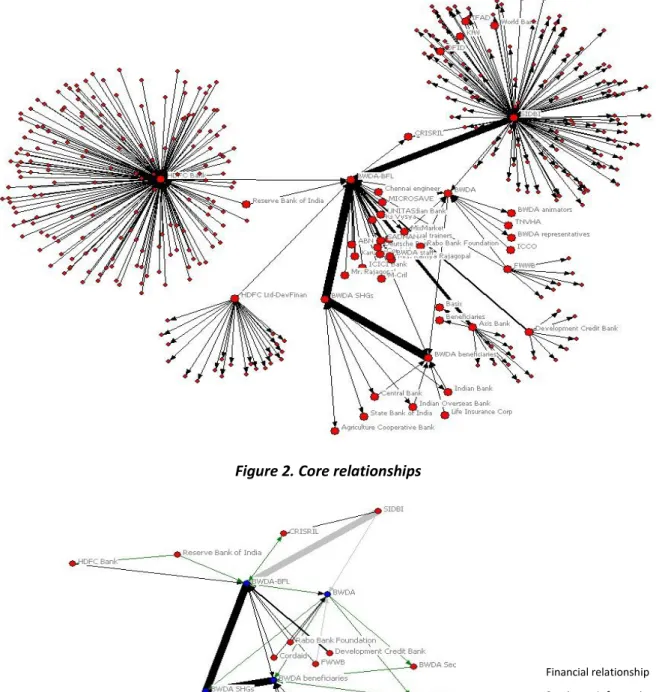
At an institutional level, interviews were carried out with the focal MFI and their partners, be they financial, service or information providers, in order to determine the degree of interaction and the level of financial flows. Figure 1 depicts the complete set of relationships and highlights the more intense relationships. It can be noted that BWDA-BFL is at the centre of the network and interacts with five key partners, i.e. SIDBI, HDFC Ltd Dev Finance, Axis Bank, FWWB, and Development Credit Bank, which have their own relationships with other MFIs. SIDBI and Development Credit Bank are government development banks, while HDFC and Axis are commercial banks. Figure 2, meanwhile, presents the core of the network, showing the intense relationship that exists between BWDA, BFL
1 The research methodology followed during fieldwork included semi-structured interviews with 178 SHG
2
and their beneficiaries, but also the strong relation with SIDBI with whom the MFI has multiple types of interaction, e.g. financial, service and informational. The backbone of the core is the large flow of funds from SIDBI to BWDA-BFL, while the key financing role of BFL to SHGs remains evident although there is a significant support in capacity building to SHGs from BWDA.
Figure 1. Financial, service and informational relationships2
Figure 2. Core relationships
2
The network maps were generated by Bruce Cronin based on author’s field data. The types of relationships are: financial = loans and shares; services = capacity building and training; and informational = reports about the status of the MFI and its final clients.
Financial relationship Service or Informational Both
2 core 3 core
3
Self-Help Groups
A sample of 10 SHGs was interviewed. All of these were among of the best groups in the area, graded by BFL as grade “A”. Of these 10 SHGs, 9 were female and 1 was male which is representative of the gender divide among BWDA/BFL SHGs. The SHGs were both rural and urban-based in the cities of Villupuram, the headquarters of BWDA, and Pondicherry and the rural areas around and between the cities. They were asked about their relationships with other SHG members and the financial, social and other relationships formed over the years. Overall, 178 SHG members were interviewed.
SHG Collaborative Models
To measure the relationships within each SHG, each member was asked the following questions: o Who are the most important members of the self-help group?
o Which members of the self-help group do the most work?
There were some interesting results from the above questions. Three examples of these are discussed below:
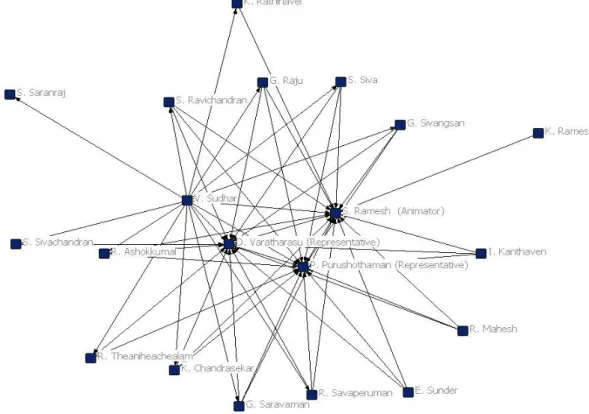
Naraiyur SHG 1 (Male) – Figures 3 shows a core/periphery structure where the core is formed by the three leaders of the SHG. Almost everyone points to the three leaders as the ones who are the most important and who do the most work. These three leaders together formed the SHG, to prove that the SHG concept could also work for men. It is obvious from the sociogram that if anything happens to the animator, either representative could step in. Note that the direction of the arrows is
important. V. Sudhar and R. Savaperuman appear to be part of the core. However, while they point to everyone else, no-one is pointing back to them as they are to the three leaders.
Thiruvalluvar Nagar 2 SHG – Figure 4 shows a completely different network. Almost everyone is pointing to the animator Geetha as the answer to the 2nd question. This is a 2-mode ego network. An ego network is where all of the relationship is focused on the person at the core of the network. A 2-mode ego network is an ego network where a few of the relationships are among those on the periphery. It is easy to imagine that if Geetha disappeared, this SHG would have considerable problems. It also reflects the fact that Geetha is so effective as an SHG leader that others come to her to help solve their problems. The village has asked her to lead protests to get the local
government to resolve problems. She admits that this causes stresses and strains, especially with her husband asking when she would have time for the family.
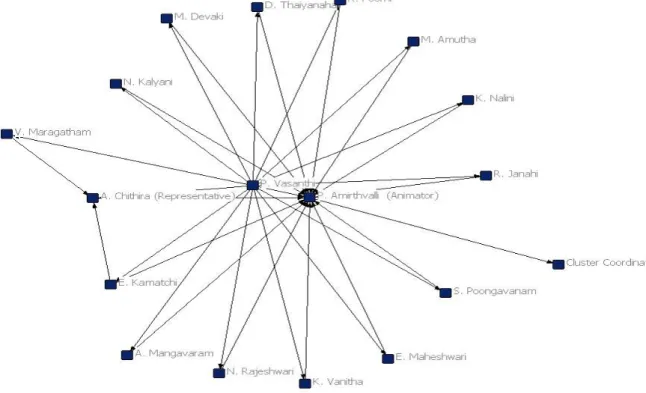
Thathampalayam 3 SHG - Figure 5, is a 2-node ego network similar to Figure 4. However, the difference with this SHG is this is the only SHG where the answer to the 2nd question is pointing to someone outside the SHG. The story is that the animator for this SHG is illiterate and had trouble keeping the books of the SHG. She had her literate son keep the books for the SHG. However, the son died and the animator became very dependent on the cluster coordinator to keep the books. The cluster coordinator is a BFL employee who coordinates and monitors a number of SHGs in the same area. For this reason, the animator pointed to the cluster coordinator as the one doing the most work for the SHG.
4
Figure 3. Naraiyur I SHG (Male): Which members of the self-help group do the most work?
5
Figure 5. Thathampalayam 3 SHG - Which members of the SHG do the most work?
Non-SNA Data and Correlation Analysis
Some of the interesting correlations found in the interview data are as follows:
o The number of SHG members who feel better off since joining the SHG is strongly correlated with the number of members who feel their SHG is financially sustainable (0.735) and the number of loans the SHG receives from BFL (0.786). Since most members defined SHG financial sustainability as ‘having enough capital for their needs’, having access to capital when needed may make these members feel better off. The stronger correlation with # BFL loans the SHG gets rather than # SHG loans may be because of the higher status of BFL among SHG members.
o The number of SHG members who feel their SHG is financially sustainable has a strong negative correlation with the number of members using moneylenders (-0.656) and the number of bank loans a SHG receives (-0.611). If members believe that there is enough capital in the SHG to meet their needs, it lessens the need for members to use
moneylenders and for the SHG to borrow from the bank
o There is a strong negative correlation between the number of SHG members who buy land and those who spend money educating their children (-0.735). This may be because members have only enough money to spend on one of these items but not both.
o There is a strong correlation between the number of SHG members who paid to educate their children and the total satisfaction score for the SHG. This may be because achieving something that has high cultural value increases the satisfaction with the SHG.
Conclusion and next steps
Our preliminary findings suggest that there is a strong dependence by the focal MFI on a major government funding institution which could make the MFI vulnerable to sudden changes in public sector policies, although more detailed analysis is needed of the precise strength of relationships with partners. In the SHGs under study, it is interesting to note that collaborative models can be as diverse as the number of SHGs and hence further investigation is needed in both accounts in order to help establish sustainable models that could also lead to greater social impact.