* Corresponding author. ORCID ID: 0000-0002-6510-7613
Determinant of using clouds based systems with dual factor theory
approach
Nindia Nur Arifiana Putri
a*, Rosidi
b, Zaki Baridwan
ca,b,c Accounting Department, University of Brawijaya, Kota Malang, Jawa Timur 65145, Indonesia
ARTICLE INFO
Article history: Received 17 July 2019
Received in revs. form 22 Sept. 2019 Accepted 05 October 19
Keywords: Inhibitor and enabler dual factor theory TAM
JEL Classification: L19
A B S T R A C T
This research is the use of cloud-based regional information management system (IT) by applying existing theories. The purpose of this study is to investigate enablers and inhibitors including the dual factor theory of the use of cloud-based regional management information systems. This research directly empirical tests in Jember Regency, include: IT infrastructure problem variables on the perceived of usefulness, IT infrastructure problem variables on the perceived ease of use, IT infrastructure problem variables on the use of cloud-based regional management information systems, perceived usefulness of cloud-based regional management information systems and perceived ease of use of using regional management information systems cloud based. The sample selection technique in this study uses purposive sampling and data analysis uses multiple regression. The data that has been analyzed using smart PLS version 2. The results show, first the IT infrastructure problems negatively affect the perceived usefulness. Second, IT infrastructure problems negatively affect perceived ease of use. Third, IT infrastructure problems negatively affect the use of cloud-based regional information systems. Fourth, perceived usefulness has a positive effect on the use of cloud-based regional information systems. Fifth, the perceived ease of use for the use of cloud-based regional information systems.
© 2019 Bussecon International Academy. Hosting by SSBFNET. All rights reserved. Peer review under responsibility of Bussecon International Academy & SSBFNET.
Introduction
The technology-based information system used by governments today in the international world is known as e-Government. Based on a global perspective, the United Nations (UN) assesses the implementation of e-government in several countries, called the E-Government Development Index (EGDI). The assessment covers 3 dimensions, namely online service index (OSI), telecommunication infrastructure index (ITI), and the human capital index (HCI).
Based on the Survey (2018) in 2018 the EGDI dimension of Indonesia was ranked 107th. In detail, the EGDI, OSI, ITI, and HCI assessments of Indonesia received scores that could be said to be below the average in the Southeast Asian region, EGDI with a number of 0.5258, OSI with the number 0.5694, TII with the number 0.3222, and HCI with the number 0.6857. The ranking position is still far compared to Southeast Asian countries such as Malaysia (48th), Singapore (7th), Philippines (75th), and Brunei Darussalam (59th), Thailand (73rd). and Vietnam (ranked 88). Through the EGDI, Indonesia still needs more efforts to improve and enhance the implementation of e-government in Indonesia.
One form of e-government in Indonesia that is the Regional Management Information System its use is required by all regional apparatus organizations in Indonesia. Clouds-based Regional Management Information System (SIMDA) is used and implemented in only 4 districts out of 29 districts in the East Java Region. The use of Clouds-based Simda was adopted from BPKP, which is a Financial-Based Regional Management Information System (SimdaKeu) and PT Lawang Sewu, which is a Clouds-based information system. However, the current condition of the Jember Regency Government using the Clouds-based Regional Management
Research in Business & Social Science
IJRBS VOL 8 NO 6 ISSN: 2147-4478
Available online at www.ssbfnet.com Journal homepage: https://www.ssbfnet.com/ojs/index.php/ijrbs
Information System was adopted by BPKP and PT. Lawang Sewu experienced several obstacles, including: First, some regional apparatus organizations present invalid inventory load data (incompatible between goods management data with accounting data. Second, technical and system factors such as some accrual-based accounts cannot enter accrual journals into cloud-based system, so it does not appear in accrual-based financial statements Third, there are still a number of regional organizations of the Jember Regency that experience data input errors into the system Fourth, several regional organizations of the Jember Regency within the system present depreciation expenses that are not in accordance with Fifth Inventory Card (KIB) Fifth, some Jember Regency organizations in the system have not presented fixed assets according to the inventory inventory card (KIB) and the presentation of other assets has not been fully supported by details
Many researchers have conducted research related to factors that influence the use of the system, especially the regional management information system. Research conducted by Maksum et al. (2017), Purwitasari Mega and Pratomo (2015), Kim et al. (2009) explain partially or simultaneously perceptions of usefulness and perceived ease of usehave a positive effect on system use. However, research conducted by Rudini (2018), Rahadi (2007), Nurhayati et al. (2015) shows the perceived usefulness of use and apology that does not affect the acceptance of technology. These results are due to differences in the characteristics of information technology users, one of which is the behavioral aspect. Behavior towards individuals is influenced by the user's perception of information technology, one of which is the behavioral aspect.
The behavior is influenced by the user's perception of the technology theoretically described by experts in IT developers as users and its effect on the use of computers. This is consistent with what was stated by Davis et al. (1989), that based on the behavioral aspects of the user (user) also affects the perception and attitude in accepting the use of technology. The research study has indirectly tested the enablers factor, namely the variable of perceived usefulness (usefulness) and ease of use (ease of use) which are the two main constructs in TAM theory. Based on this research study, it can be concluded that the researcher only raised the TAM variable which only tested the form of user acceptance of the system but, had not tested the inhibitor factors or some variables that could cause system rejection.
This research is a development of individual perception research using a system with dual factor theory and combining models in previous studies that tested this, namely research conducted by Cenfetelli & Schwarz, A. (2011) and Dharmalingam & Kannabiran (2012). The uniqueness of this research lies in the use of dual factor theory, namely by using variables: first, the problem of IT infrastructure on the two main constructs in TAM theory, namely the perceived usefulness and ease of perception, and secondly the problem of IT infrastructure on the use of systems, especially regional management information systems. Dual factor theory and the use of these variables have not been found in similar studies related to the use of systems in Indonesia, especially public organizations, namely regional management information systems. Furthermore, the instrument that has been modified in this study uses instruments developed by Henderson III et al. (2016). In contrast to previous studies, researchers added the variable usability perception and perceived ease of useas an independent variable on system use. This user feels there is no socialization which is intended so that users benefit more from the system, especially regional management information systems in order to facilitate the work, especially making, managing, and analyzing financial statements.
Empirical evidence in this research is expected to be beneficial for the Jember Regency Government as an analyst and system developer. This study has two contributions, namely theoretical contributions and practical contributions. The theoretical contribution to this research is to provide additional empirical evidence of dual factor theory, namely the problem of IT infrastructure as an inhibitor, and the two main constructs in TAM, namely the perceived usefulness and perceived ease of use as enablers of system use. This research also provides additional insight for academics and develops new models of adding IT infrastructure problem variables to the two main constructs in acceptance perception (TAM), namely perceived usefulness and perceived ease of use of regional management information systems. The practical contribution of this research is that it can be used as an evaluation of the regional organization of Jember Regency in order to optimize the use of SIMDA in optimizing technological infrastructure in the use of SIMDA so that in the future it can be achieved the preparation of better regional financial reports. This research also provides input to PT Lawang Sewu to increase the capacity of IT infrastructure, especially the cloud system of the Jember Regency Government. In this study the dual factor theory is used as a reference to answer research problems. Dual factor theory is a theory that can accommodate the variable use of information systems. Cenfetelli (2004) argues that, adoption of technology use is predicted by enablers, while rejection of technology use is predicted by inhibitors. Dual factor theory states that factors in the use of both positive and negative systems need to be explored for several reasons. First, there are negative beliefs or perceptions that inhibit the use of the system. Second, dual factor theory shows that inhibitors and enablers are used as independent variables. Third, the perception of inhibitors and determinants of success (enablers) have different antecedent effects and consequences. Previous theories have only focused on positive perceptions of system use or adoption. In this study using the perceived usefulness and ease of perception that can encourage the use of the system. However, this theory, can better explain the user's positive and negative perceptions of the use of the system. In this study there are 5 types of problems. First, whether the problem of IT infrastructure affects the perceived usefulness. Second, whether the problem of IT infrastructure affects the perceived ease of use. Third, Does the problem of IT infrastructure affect the use of simda. Fourth, whether the perceived usefulness affects the use of simda. Fifth, does perceived ease of use affect the use of simda.
Literature Review
Inspirational Motivation
Definition of Inhibitor and EnablerPerception is a key that affects general user behavior, intentions, and user behavior towards a system. The core of information systems research is the design and function of a system that encourages or inhibits users (Benbasat & Zmud, 2003). Cenfetelli (2004) concludes and coined the term enablers and inhibitors, which refer to behavioral perceptions. Enablers and inhibitors are external perceptions about system attributes that influence the adoption decision and the decision to reject the system. The term enabler refers to external perceptions about the design and function of a system that can drive usage. Cenfetelli (2004) has other unique perceptions, for example negative perceptions that can hinder use, for example an unreliable system or provide irrelevant information. Inhibitors and enablers are considered as someone's perception of the attributes of a system that has a consequential effect on the decision to use the system. The design, development and function of a system is usually intended to get a positive perception of the use of technology-based systems. The unique negative attribute on the other hand comes from errors, errors, or other negative things. The presence of an inhibitor can result in system rejection, which is caused by several factors such as the individual, environment, system design and function
Dual Factor Theory
This dual factor theory was discovered by Cenfetelli (2004). Enablers or factors that encourage the use and adoption of the system, but studies that discuss more interesting about the causes of a system are rejected are still very rare (Cenfetelli, 2004). This factor is known as inhibitors (inhibitors) which is a factor that inhibits the use of the system. Cenfetelli (2004) argues that in general perception is a key that influences the behavior and desires of a user.
Dual factor theory has been used by several researchers such as Herzberg (1966), Lewicki et al. (1998). Cenfetelli (2004) revealed that the adoption and use of the system can be called enablers, while the rejection of the system is also called inhibitors. This research uses perceptions of uses and perceptions of convenience that can encourage the use of the system or are categorized as enablers. Cenfetelli (2004) states that there are factors that inhibit the use of systems or inhibitors. This research is categorized as inhibitors namely IT infrastructure problems.
Technology Acceptance Model (TAM)
The technology acceptance model, or TAM, was introduced by Davis (1989). The TAM model is one of the models created to analyze and understand the determinants of technology acceptance and use in individuals. The TAM model uses TRA (Theory of Reasoned Action) as a starting point for starting theory.
The TAM model has two main constructs, namely perceived usefulness and perceived ease of use. Perceived usefulness (perceived usefulness), can be interpreted as the level of individual trust that by using technology-based systems, performance will increase. While ease of use (perceived ease of use), can be interpreted as the level of individual trust that by using a technology-based system, will free them from effort or can be said to facilitate their work (Davis, 1989)
According to the dual factor theory perspective, TAM focuses on positive user perceptions related to system use, for example perceptions of usability and perceptions of ease (Cenfetelli, 2004; Bhattacherjee, A. & Hikmet, 2007). So it can be concluded that the perceived ease of use and perceived usefulness is based on enablers in the use of the system.
Relationship between IT Infrastructure Problem with Perceived usefulness and Perceived ease of use
IT infrastructure is defined as a combination of a single unit of hardware, software, networks and facilities, including information technology and equipment needed to develop, check, deploy, monitor, control, or support IT services. IT infrastructure is also related to humans, processes and documentation (storage) (Roush, 2017). Cenfetelli (2004) outlines the dual factor theory, in the journal Cenfetelli (2004) states that any factors that can inhibit the use of the system are classified as inhibitor factors. One of the inhibitors, namely the IT infrastructure problem, Cenfetelli (2004) revealed in quadrant III that high inhibitors and low enablers will negatively affect the perceived usefulness and perceived convenience.
Dharmalingam & Kannabiran (2012) found that IT infrastructure problems had no effect on the system. Furthermore, Henderson III
et al. (2016) revealed that system problems are also known as object based inhibitors. This type of problem gives the user a sign that something is wrong with the information system, because the user has a direct interaction with the system (Henderson III et al,2016). Theory from Cenfetelli (2004) used by Henderson III et al. (2016), and finally Henderson III et al. (2016) concluded that IT infrastructure problems can negatively affect the use of information systems: this is due to several reasons, such as slow system response, difficulties in extracting data. Henderson III et al. (2016) examined the same theme using TAM theory and found the results of research that IT infrastructure problems (system problems) negatively affected perceptions of ease and perceived usefulness. Based on the description of the theory and some of the findings above, the hypothesis of this study is as follows:
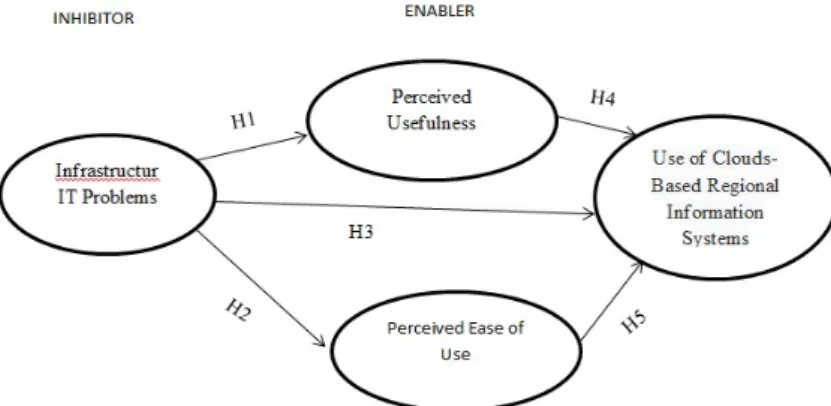
H2 : IT Infrastructure Problems negatively affect the perceived ease of use
Relationship between IT Infrastructure Problems and the Use of Clouds-Based Regional Management Information Systems Johnson (2010) states that the lack of IT infrastructure such as a bad internet connection, and the problem of software and hardware problems is a barrier factor (inhibitor) in the use of IT. Mpofu, C. & Watkiens-Mathys (2011) confirm that poor technological infrastructure and lack of user capacity are obstacles to IT use at MSMEs. The research results of Braun and Davis (2003) also found that there were only users (auditors) who used the system (audit information system). The research also found that the incompatibility of data contained in the database with the actual data, and the problem of network connectivity became one of the problems that caused inefficient use of information systems.
Cenfetelli & Schwarz (2011) discusses the continuation of dual factor theory, in the journal Cenfetelli and Scharwz (2011) ask more questions about why users decide not to use the system? To answer this question, the researchers conducted empirical tests on the effect of several inhibitor factors on system use. The dual factor theory proposed by Cenfetelli (2004) is a theory which states that the use of the system is not only the enabler factor that has an influence, but the inhibitor factor is also present and influential. One of the inhibitors that influences the use of the system is the problem of IT infrastructure. Cenfetelli & Schwarz (2011) found that inhibitors have a negative effect on intention to use. Based on the description of the theory and some of the findings above, the hypothesis of this study is as follows:
H3: IT Infrastructure Problems negatively affect the use of Clouds-Based Regional Management Information Systems
Relationship between Perceived usefulness, Perceived ease of use and Use of Clouds-Based Regional Management Information Systems
The perceived usefulness and perceived ease of usewas first put forward by Davis (1989) explaining the TAM theory. Cenfetelli (2004) classifies it as an enablers factor, because these two variables are considered to be able to encourage the use of the system. Cenfetelli & Schwarz (2011) states that enablers are not opponents of inhibitors, but these two factors can be present simultaneously at the same time (coexist). Research from Cenfetelli & Schwarz (2011) which examines the effect of perceived usefulness and ease of perception variables on the use of a system, using dual factor theory as a theory that accommodates these variables. Cenfetelli and Schwarz (2011) find these two enablers variables can encourage the use of IT.
Hsieh et al. (2014) found that perceived usefulness and perceived ease of use have a positive effect on behavioral intention to use. Rudini's research (2018) found perceptions of usefulness influenced the implementation of Regional Management Information Systems (SIMDA) and perceived ease did not affect the implementation of Regional Management Information Systems (SIMDA). Free from research conducted by Purwitasari Mega & Pratomo (2015) found that perceptions of usability and perceived ease have a positive effect on the actual usage system. Based on the description of the theory and some of the findings above, the hypothesis of this study is as follows:
H4: Perceived Usefulness has a positive effect on the use of cloud-based regional management information systems H5: Perceived ease of use has a positive influence on the use of cloud-based regional management information systems
Based on the hypotheses described, a research model in the form of figure one that presents the IT infrastructure problem variables, perceived usefulness, perceived ease and use of cloud-based regional management information systems can be presented.
Research and Methodology
Types of researchThis study uses a quantitative approach and is explanatory because this study explains the relationship between variables through hypothesis testing and in general the data presented in the form of numbers that are calculated through statistical tests. The method used in this study is a survey method, conducted to sample members in a population, followed by primary data collection using a questionnaire (Sekaran&Bougie 2016).
Population and Sample
The population in this study were employees of regional apparatus organizations involved in Jember Regency's financial management consisting of 6 Charts, 9 Parts, Inspectorate, Satpol PP, 3 Regional Hospitals, 21 Offices, Secretariat and 31 Districts, so that the total regional apparatus organizations were obtained from Jember Regency is 73 regional apparatus organizations. The sampling technique in this study is to use a purposive sampling method with the type of sample selection based on certain considerations or criteria (Sekaran & Bougie 2016). In this study the sample criteria determined were: First, the Head of the Office / Agency / Institution of Jember Regency as a budget user. Secondly, the head of the financial organization of the Jember Regency regional apparatus as a financial administration officer. Third, employees of the accounting department at each regional apparatus organization in Jember Regency. The total sample is 219 people.
Operational Research Variables
IT Infrastructure Problems are user problems related to the operation of information systems, in this case include software and hardware connected to cloud-based regional management information systems. The indicator used is an indicator developed by Henderson et al. (2016), as for the indicators include: there are interference with the system (bugs), the response of the internet that connects to the system is very slow, the system does not function and does not work well when operated, and the system is not able to provide adequate documentation for users
The perceived usefulness in this study shows the individual's perception that by using the regional management information system that exists in each organization the regional apparatus can provide benefits to its work. This variable shows the usefulness perceived by the user is measured by 4 indicators, which were adopted by Venkatesh & Davis (2000) and Henderson et al. (2016) namely: improving performance, increasing productivity, enhancing effectiveness and being useful.
Perceived ease of use in this study shows the individual's perception that by using the existing regional management information system each regional apparatus organization is easy if used in its work. This variable shows the ease of use of information technology perceived by users, measured by 5 indicators adopted by Davis (1989) and Henderson et al. (2016) that is easy to learn, easy to do tasks, interactions, user skills and easy to operate.
The use of cloud-based regional management information systems is defined as the real use or acceptance of the use of information technology both individually and collectively which is mandatory. This variable is measured by using 4 indicators namely the use is required, based on responsibility, frequency of use, and the use of the daily time system. This indicator was developed by researchers based on the indicators used by Moore & Benbasat (1991), Venkatesh & Davis (2000), and Livari (2005).
Result and Discussion
Characteristics of RespondentsThe number of questionnaires distributed was 219 people. The number of questionnaires filled out was 200 people. The number of questionnaires that could not be processed was 19 people. Confirmation in the collection of questionnaires carried out 3 times. Based on the survey results the majority of respondents were men by 60 percent with an age range of 20 to 30 years by 80 percent. Educational background is accounting for 25 percent, information systems by 55 percent and law by 20 percent. The majority of respondent's formal education is S1 by 80 percent.
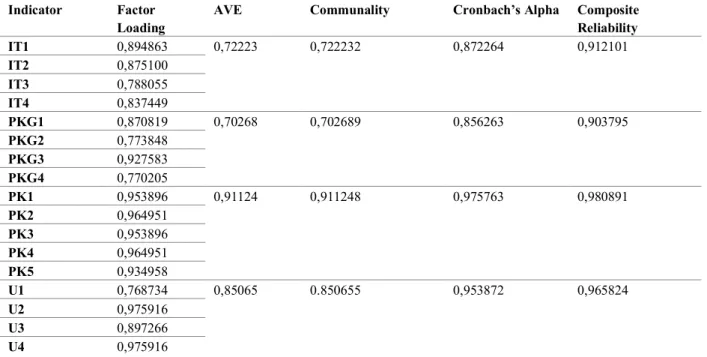
Table 1 shows the factor loading value of all constructs more than 0.7, while the Average Variance Extracted (AVE) and Communality values are more than 0.5. In addition, the AVE root value is more than the correlation of latent variables. Cronbach’s Alpha value is more than 0.6 and composite reliability value is more than 0.7. Therefore, it can be concluded that all indicators in this research instrument are valid and reliable, so that hypothesis testing can be done
The value of R2 in this study was 0.732. This value explains that the variation in construct changes in perception about the use of cloud-based regional management information systems can be explained 73 percent in the construct of IT infrastructure problems, human resource competency problems, perceived usefulness and perceived convenience. While 27 percent is explained by other constructs outside this research model.
Table 1: Value Factor Loading, AVE, Communality, Cronbach’s Alpha and Composite Reliability
Indicator Factor
Loading
AVE Communality Cronbach’s Alpha Composite
Reliability IT1 0,894863 0,72223 0,722232 0,872264 0,912101 IT2 0,875100 IT3 0,788055 IT4 0,837449 PKG1 0,870819 0,70268 0,702689 0,856263 0,903795 PKG2 0,773848 PKG3 0,927583 PKG4 0,770205 PK1 0,953896 0,91124 0,911248 0,975763 0,980891 PK2 0,964951 PK3 0,953896 PK4 0,964951 PK5 0,934958 U1 0,768734 0,85065 0.850655 0,953872 0,965824 U2 0,975916 U3 0,897266 U4 0,975916
Note: IT: Infrastructure IT Problems; PKG: Perceived Usefulness; PK: Perceived Ease of Use; U: The Use of Regional Management Information Systems Based on clouds
Table 2: Hypothesis Testing Results
Hypothesis Original Sample T-Statistics Result
Problem Infrastructure IT Perceived Usefulness -0.8253 16.6817 H1 = Accepted
Problem Infrastructure IT Perceived Ease of use -0.0634 6.3735 H2 = Accepted
Problem Infrastructure IT The use of simda based on
clouds -0.9895 5.8183 H3 = Accepted
Perceived Usefulness The use of simda based
on clouds 0.0545 2.4787 H4 = Accepted
Perceived Ease of use The use of simda based
on clouds 0.0149 2.8879 H5 = Accepted
The Relationship between IT Infrastructure Problems and Perceived usefulness
IT Infrastructure Problems negatively affect the Perceived usefulness, and Perceived Ease of Use. The results of this study support Henderson III et al.. (2016), Dharmalingan & Kannabiran (2012) and Johnson (2010). Several studies conducted obtained empirical evidence that IT infrastructure problems negatively affect the perceived usefulness. This empirical evidence has the implication that in every Jember Regency regional apparatus organization there is an IT infrastructure problem in the system, so there is no perceived usefulness for users (employees) in each Jember Regency regional organization in using clouds-based regional management information systems. Inadequate IT infrastructure services are a major obstacle in the issue of IT infrastructure in Jember Regency. Most IT infrastructure problems in every Jember Regency device organization such as the system experiencing bugs (bugs) when used, hardware (laptop used error) does not work and does not function as it should then there is no perception of employees in each Jember Regency device organization in the usability. These findings are also in line with the dual factor theory proposed by Cenfetelli (2004) in the IV quadrants of high inhibitors and low enablers. In this condition, bad hardware such as laptops often results in errors connecting to the system, especially cloud-based regional management information systems, which will hamper the employees in every organization in the Jember Regency in their perceived usefulness.
Relationship between IT Infrastructure Issues and Perceived ease of use
Based on the results of hypothesis testing, it can be concluded that the second hypothesis is accepted. This means that the higher the IT infrastructure problems in the system, especially the regional management information system, the lower the perception of the ease of users to use the system. These results are consistent with research conducted by Braun and Davis (2003), Brooks and Lanza (2006) and Henderson III et al.. (2016).
Several studies conducted obtained empirical evidence that IT infrastructure problems negatively affect the perceived ease of use. This empirical evidence has the implication that in every Jember Regency regional apparatus organization there is an IT infrastructure
problem in the system, so there is no perceived ease of use for users (employees) in each Jember Regency regional organization in using cloud-based regional management information systems. Cenfetelli (2004) emphasized on IV quadrant which is a condition of high inhibitors and low enablers. In these conditions, the higher the poor technology infrastructure that connects the system will have minimal specific features and functions, so that the chance of acceptance perception, namely the perceived ease of use, is very low. In this case the problem of IT infrastructure that has not yet been fixed will be difficult (not easy) for employees in each Jember Regency regional organization. IT infrastructure problems such as the very slow response of the system, difficulties in extracting data can hamper employees in every organization of the Jember Regency in perceived ease of use.
Relationship between IT Infrastructure Problems and the Use of Clouds-Based Regional Management Information Systems IT Infrastructure Problems negatively affect the use of cloud-based Simda. The results of this study support the research of Dharmalingan & Kannabiran (2012), Cenfetelli & Schwarz (2011), and Braun and Davis (2003). In its application and usage of simda based on website clouds, simda BPKP and simda clouds PT Lawang Sewu often occur website errors and in the process of maintenance. Simda Clouds and Simda BPKP always connect and depend on the internet, but wifi connectivity often occurs slowly (long loading) in use. Computers in the case of cloud-based government sector systems there are still many disturbances such as users entering data into the system several times, this is caused by system errors and a very slow internet connection. In other words, poor and malfunctioning in the system, no consideration is given to user needs, so users can prevent the use of cloud-based regional management information systems.
Relationship between Perceived Usefulness and the Use of Clouds-Based Regional Management Information Systems Perceived usefulness has a positive effect on the use of clouds-based regional management information systems (SIMDA). The results of this study support in the study of Cenfetelli & Schwarz (2011), Hsieh et al. (2014), Purwitasari Mega & Pratomo (2015), and Wibowo (2012). The use of simda based on clouds in the Government of Jember Regency wants clouds based simda to be able to provide benefits to him in his work. In this case, the user wants a cloud-based simda that can increase productivity, performance and effectiveness at work.
Based on some of the literature above it can be concluded that the usefulness of the use of information technology can be known from the confidence of employees in each organization in the Jember Regency in information technology to decide the acceptance of information technology, with one belief that the use of information technology has a positive contribution for its users (employees in each organization of devices Jember Regency area). Employees in every Jember Regency regional organization trust and feel that using a computer is very helpful and enhances the performance achieved, or in other words the person believes in the use of information technology (Clouds-based Regional Management Information System) has provided benefits to the work and achievement of its performance.
In this context, employees in each organization in the Jember Regency are considered to have a positive perception of the system because employees in each organization in the Jember Regency have a high level of understanding of the information system. In addition, the system also has a good quality system so that this perception encourages users to use the system.
Relationship between Perceived Ease of Use and Use of Clouds-Based Regional Management Information Systems
Henderson III et al. (2016) found that perceived ease of use has a significant effect on system adoption. Furthermore, Hsieh et al.
(2014) found that perceived ease of use has a positive effect on system use. Kim et al. (2009) got the same research results as previous studies, namely, perceived usefulness and perceived ease of use directly affect system usage.
In the journal Cenfetelli (2004) classified as quadrant I, which is a condition where the factors of high enablers and low inhibitors, in this condition employees in every regional apparatus organization in Jember Regency will adopt the system in a sustainable manner. The system is in a condition that is easy to understand, flexible, and then easy to use, and can meet the needs and desires of the user, so employees in each organization in Jember Regency feel that the system will be very easy to use, so this has an impact on the adoption and use of the system sustainably.
Conclusions
Overall, the findings in this study explain the use of cloud-based regional management information systems with a dual factor theory approach. This research model, based on dual factor theory that the category of inhibitors is IT infrastructure problems. In addition, the categories included in the enabler are perceived usefulness and perceived convenience.
This study explains that inhibitors and enablers in the use of cloud-based regional information systems (SIMDA). The number of IT infrastructure problems such as systems experiencing bugs (bugs) when used, the response of the internet network that connects the application system is very slow when used, the hardware (hardware) and software (software) that connects to the application system does not function and does not work as it should can inhibit and prevent users in the perceived usefulness, perceived ease and use of cloud-based regional management information systems (SIMDA). The Jember Regency Government must be able to minimize the problems that exist in every Jember Regency regional organization especially the IT infrastructure problem. This can be done so that in the use of cloud-based regional management information systems run smoothly, well and there are no obstacles at all.
While in the category of enablers, the perceived usefulness and perceived ease of use. In this context, the user is considered to have a positive perception of the system because the user has a high level of understanding of the information system. In addition, the system also has a good quality system so that this perception encourages users to use the system. This is driven by the user's belief that by using information systems their work can increase.
Suggestions and input for future researchers because this research is still less than perfect. First, collecting data through a questionnaire takes a very long time because at the time of the distribution of the questionnaire at the beginning of the month there was an inspection (inspection) from the Supreme Audit Agency (BPK). Second, the object in this study is only one location, namely Jember Regency so this research is still less than perfect and it is recommended for further researchers to add more than one research location.
References
Benbasat, I. and Z. R. W. (2003). The Identity Crisis Within IS Discipline: Defining and Communicating The Discipline’s Core Properties. MIS Quarterly, 27(2), 183–194.
Bhattacherjee, A. and Hikmet, N. (2007). Physicians’ Resistance Toward Healthcare Information Technology: A Theoretical Model and Empirical Test. European Journal of Information Systems, 16, 725–737.
Braun, R.L. and Davis, H. E. (2003). Computer-Assisted Audit Tools and Techniques: Analysis and Perspectives. Managerial Auditing Journal, 18(9), 725–731.
Brook, B. D., and R. L. (2006). Why Companies Are Not Implementing Audit, Antifraud and Assurance Software and How to Fix it. Cenfetelli, R. T. (2004). Inhibitors and Enablers as Dual Factor Concepts in Technology Usage , 5(11), 472–492.
Cenfetelli, R. T., and Schwarz, A. (2011). Identifying and Testing the Inhibitors of Technology Usage Intentions, 22(4), 808–823. Chin, W.C. and Todd, P. A. (1995). On the Use, Usefulness and Ease of Use of Structural Equation Modelling in MIS Research: A
Note of Caution. MIS Quarterly, 19(2), 237–246.
Davis, F. D. (1989). Perceived Usefulness , Perceived Ease of Use , and User Acceptance of Information Technology, (October). https://doi.org/10.2307/249008
Dharmalingam and Kannabiran. (2012). Enablers and inhibitors of advanced information technologies adoption by SMEs An empirical study of auto ancillaries in India. Enterprise Information Management.
https://doi.org/10.1108/17410391211204419
Henderson III, David. L., Marianne Brandford., Amr Kotb. (2016). Inhibitors and Enablers of GAS Usage: Testing the Dual Factor Theory, 30(3), 135–155. https://doi.org/10.2308/isys-51388
Herzberg, F. I. (1966). Work and The Nature of Man. Oxford, England: World. Hertanto, Eko. (2017). Teori Kompetensi Manajemen Sumber Daya Manusia.
Hsieh, P., Lai, H., and Ye, Y. (2014). Patients’ Aceeptance and Resistance Toward The Health Cloud : An Integration of The Acceptance.
Kim, H., Mannino, M., and Nieschwietz, R. J. (2009). International Journal of Accounting Information Systems Information technology acceptance in the internal audit profession : Impact of technology features and complexity. International Journal of Accounting Information Systems, 10(4), 214–228. https://doi.org/10.1016/j.accinf.2009.09.001
Kim, H., Kotb, A., & Eldaly, M. (2016). The Use of Generalized Audit Software by Egyptian External Auditors: The Effect of Audit Software Features. Journal of Applied Accounting Research, 17(4), 456–478.
Lewicki, R.J., Mcallister, D.J. and Bies, R. J. (1998). Trust and Distrust: New Relationship and Realities. Jounal Academy of Management Review, 3(23), 438–458.
Livari, Juhani. (2005). An Empirical Test of The Delone-McLean Model of Information System Success. Database for Advances in Information Systems Spring 36, no. 2: 8
MacGregor, R.C. and Vrazalia, L. (2005). A Basic Model of Electronic Commerce Adoption Barriers: A Study of Regional Small Business in Sweden and Australia. Journal of Small Business and Enterprise Development, 12(4), 510–527.
Maksum, Umar., Zaki Baridwan., & Imam Subekti (2017). The Determinant of Acceptance of SIMDA ( Information System of District Management ) Implementation on the Government of Batu City, 1(71), 298–320.
Mohd, Y., Muhammad, Z., Zahari, Mohd Salehuddin Mohd. (2009). Individual Differences , Perceived Ease of Use , and Perceived Usefulness in the E-Library Usage. Computer and Information Science, 2(1), 2–9.
Moore, G. C., I. Benbasat. 1991. Development of an instrument to measure the perceptions of adopting a innovation. Information Systems Research 2 (3): 192-222
Mpofu, C. and Watkiens-Mathys, L. (2011). Understanding ICT Adoption in The Small Firm Sector in Southern Africa. Journal of Systems and Information Technology, 13(2), 179–199
Nurhayati, N. and M. (2015). User participation on system development, user competence and top management commitment and their effect on the success of the implementation of accounting information system, 3(2), 56–68.
Packalen, K. (2010). ICT Capabilities and Possibilities in Micro-Finance in the Alands Archipelago. In 23rd Bled e-Conference on Trust, Slovenia.
Purwitasari Mega dan Dudi Pratomo. (2015). Pengaruh Perceived Usefulness dan Perceived Ease Of Use Terhadap Actual System Usage, e-Proceeding of Management, 2(3), 3213–3220.
Rahadi, D. R. (2007). Peranan teknologi informasi dalam peningkatan pelayanan di sektor publik. Seminar Nasional Teknologi,
2007(November), 1–13.
Ramayah, T. (2006). Doing e-research with e-library: Determinants of perceived ease of use of e-library. International Journal of Technology, Knowledge and Society, 1(4), 39–57.
Rudini, Ahmad. (2018). Analisa Pengaruh Persepsi Kegunaan dan Persepsi Kemudahan Terhadap Penerimaan Penerapan Sistem Informasi Manajemen Keuangan Daerah (SIMDA) Pada PemerintahDaerah Kabupaten Kotawaringin Timur. Jurnal Penerapan Ilmu Manajemen dan Kewirausahaan. 3(1), 76–84.
Survey,U.N.E.-G. (2018). E-Government in Support of Sustainable Development.
Thompson, Ronald L, Haggings, Christoper A., and Howell, J. M. (1991). Personal Computing: Toward a Conceptual Model of Utilization. MIS Quarterly, 125–143.
Venkatesh, V and Davis, Fred, D. (2000). A Theoretical Extension of the Technology Acceptance Model : Four Longitudinal A Theoretical Extension of the Technology Acceptance Model : Four Longitudinal Field Studies. Management Studies, 27(3), 186–204. https://doi.org/10.1287/mnsc.46.2.186.11926
Wang, Y. (2002). The Adoption of Electronic Tax Filling System: AN Empirical Study. Government Information Quarterly, 20, 333–352.
Wibowo, A. (2012). Kajian Tentang Perilaku Pengguna Sistem Informasi dengan Pendekatan Technology Acceptance Model (TAM). Jurnal Akuntansi, Fakultas Teknologi Informasi.