Waste
Management
Productivity
Commission
Inquiry Report
No. 38, 20 October 2006© Commonwealth of Australia 2006
ISSN 1447-1329 ISBN 1 74037 208 5
This work is subject to copyright. Apart from any use as permitted under the Copyright Act 1968, the work may be reproduced in whole or in part for study or training purposes, subject to the inclusion of an acknowledgment of the source. Reproduction for commercial use or sale requires prior written permission from the Attorney-General’s Department. Requests and inquiries concerning reproduction and rights should be addressed to the Commonwealth Copyright Administration, Attorney-General’s Department, Robert Garran Offices, National Circuit, Canberra ACT 2600.
This publication is available in hard copy or PDF format from the Productivity Commission website at www.pc.gov.au. If you require part or all of this publication in a different format, please contact Media and Publications (see below).
Publications Inquiries: Media and Publications Productivity Commission
Locked Bag 2 Collins Street East Melbourne VIC 8003 Tel: (03) 9653 2244 Fax: (03) 9653 2303 Email: [email protected] General Inquiries: Tel: (03) 9653 2100 or (02) 6240 3200 An appropriate citation for this paper is:
Productivity Commission 2006, Waste Management, Report no. 38, Canberra.
JEL codes: H, Q, R.
The Productivity Commission
The Productivity Commission, an independent agency, is the Australian Government’s principal review and advisory body on microeconomic policy and regulation. It conducts public inquiries and research into a broad range of economic and social issues affecting the welfare of Australians.
The Commission’s independence is underpinned by an Act of Parliament. Its processes and outputs are open to public scrutiny and are driven by consideration for the wellbeing of the community as a whole.
Information on the Productivity Commission, its publications and its current work program can be found on the World Wide Web at www.pc.gov.au or by contacting Media and Publications on (03) 9653 2244.
IV TERMS OF REFERENCE
Terms of reference
WASTE GENERATION AND RESOURCE EFFICIENCY IN AUSTRALIA
Productivity Commission Act 1998
I, PETER COSTELLO, Treasurer, pursuant to Parts 2 and 3 of the Productivity Commission Act 1998, hereby refer waste generation and resource efficiency in Australia to the Commission for inquiry and report within twelve months of receipt of this reference. The Commission is to hold hearings for the purpose of the inquiry.
Background
Australians generate solid waste at a high rate compared with most other OECD countries. Technologies and processes to avoid, reduce and recover waste are generally not used as extensively in Australia as in some other OECD countries. Non-optimal levels of waste represent lost value and opportunities, while imposing undesirable economic and environmental costs on society. The objective of this inquiry is to identify policies that will enable Australia to address market failures and externalities associated with the generation and disposal of waste, including opportunities for resource use efficiency and recovery throughout the product life-cycle (from raw material extraction and processing, to product design, manufacture, use and end of life management).
The inquiry will cover resources associated with solid waste, including: municipal waste (eg household collections, electrical and consumer items,) commercial and industrial waste, and, construction and demolition wastes. It will not cover wastes that exhibit hazardous characteristics and pose an immediate and unacceptable risk of harm to human beings or the environment.
Scope of the Inquiry
In undertaking this inquiry, the Commission is to examine ways in which, and make recommendations on how, resource efficiencies can be optimised to improve economic, environmental and social outcomes. This will include an assessment of opportunities throughout the product life cycle to prevent and/or minimise waste generation by promoting resource recovery and resource efficiency.
TERMS OF REFERENCE
V The Commission is to examine and report on current and potential resource efficiency in Australia, having particular regard to:
1. The economic, environmental and social benefits and costs of optimal approaches for resource recovery and efficiency and waste management, taking into account different waste streams and waste related activities;
2. Institutional, regulatory and other factors which impede optimal resource efficiency and recovery, and optimal approaches to waste management, including barriers to the development of markets for recovered resources;
3. The adequacy of current data on material flows, and relevant economic activity, and how data might be more efficiently collected and used to progress optimal approaches for waste management and resource efficiency and recovery;
4. The impact of international trade and trade agreements on the level and disposal of waste in Australia; and
5. Strategies that could be adopted by government and industry to encourage optimal resource efficiency and recovery.
The Commission is also requested to report on: the effectiveness of performance indicators to measure efficiency of resource recovery practices; the effect of government and commercial procurement practices on optimal resource recovery; and the impacts of government support to production and recovery industries.
In undertaking the inquiry, the Commission is to advertise nationally inviting submissions, hold public hearings, consult with relevant Australian Government, State and Territory agencies, local government and other key interest groups and affected parties.
The Commission is to provide both a draft and a final report. The Government will consider the Commission’s recommendations and its response will be announced as soon as possible after the receipt of the Commission’s report.
PETER COSTELLO 20 October 2005
CONTENTS VII
Contents
Terms of reference IV
Abbreviations and explanations XV
Glossary XX
Key points XXIV
Overview XXV
Findings and recommendations XLV
1 Introduction 1
1.1 Scope of the inquiry 2
1.2 Policy background 11
1.3 Conduct of the inquiry 13
2 Waste management in Australia 15
2.1 Trends in waste generation and disposal 16
2.2 Comparisons with other countries 36
2.3 The waste management industry 42
3 Government policy responses 45
3.1 National policy responses 46
3.2 State and Territory Government waste minimisation strategies 50
4 The costs and benefits of waste management 61
4.1 Taking a net community benefits approach 62
4.2 Waste collection 65
4.3 Waste disposal 68
4.4 Municipal recycling and resource recovery 79
VIII CONTENTS
5 The case for government intervention 93
5.1 Government intervention and market failure 94 5.2 Environmental and social impacts of waste disposal 96
5.3 Upstream environmental impacts 97
5.4 Sustainability issues 105
5.5 Government delivery of waste services 114
5.6 Other arguments for government intervention 116
6 A waste policy framework 125
6.1 Policy principles 126
6.2 Policy coordination 138
7 The waste hierarchy and target setting 143
7.1 The waste hierarchy 144
7.2 Targets 147
8 Regulation 159
8.1 Principles of good regulation 160
8.2 Waste avoidance and resource recovery 163
8.3 Waste collection and transport 166
8.4 Waste sorting, treatment and processing 169
8.5 Waste disposal 173
8.6 Litter and illegal dumping 201
9 Market-based instruments 219
9.1 Landfill levies 220
9.2 Unit pricing of waste disposal 228
9.3 Advance disposal and recycling fees 234
9.4 Deposit-refund schemes 238
9.5 Subsidies 246
9.6 Tradeable property rights 254
10 Extended producer responsibility and product stewardship 259
10.1 What are EPR and PS? 260
10.2 Why not just target final consumers? 261
10.3 Potential models for implementing EPR and PS 262
CONTENTS IX 10.5 When is EPR or PS likely to deliver a net benefit? 273
10.6 Problems with specific schemes 288
10.7 Reforming the policy-making process 306
11 Government information provision and procurement practices 313
11.1 Information and moral suasion instruments 314
11.2 Government procurement programs 328
12 Institutional and regulatory impediments to waste management 335
12.1 Are governance arrangements adequate? 336
12.2 Who should be responsible for waste management? 339 12.3 Improving waste definitions and classifications 352
12.4 Other regulatory impediments 361
12.5 International agreements 368
13 Performance measurement 375
13.1 What are performance indicators? 375
13.2 Performance indicators for waste management policy 378
13.3 Improved data collection 385
14 The main issues and the way forward 391
14.1 The objectives and focus of waste management policy 391 14.2 The Commission’s preferred policy framework 393
14.3 Adjustment issues 394
14.4 Role of the Australian Government 396
14.5 Concluding remarks 397
A Conduct of the Inquiry 403
B Environmental and other externalities associated with waste 419 C Case studies of three Australian product stewardship schemes 457
D EPHC National Waste Framework 471
X CONTENTS
BOXES
1.1 Potentially hazardous wastes that might be found in municipal solid
waste 6
1.2 Private and external costs and benefits 9
2.1 Problems with Australian recycling data 22
2.2 Commodity markets and recovered resources 25
2.3 The Plastics and Chemicals Industries Association’s reports on
plastic recycling in Australia 28
2.4 Problems with Australian landfill data 31
3.1 Net benefits in the National Waste Minimisation and Recycling
Strategy 47
3.2 National policy making bodies 50
3.3 Objectives of selected legislation relating to waste avoidance and
resource recovery 52
3.4 Examples of the waste hierarchy in practice 54
3.5 State and territory targets for waste 57
4.1 Steps in a risk assessment 64
4.2 The Kwinana industrial area 91
5.1 Types of market failure 95
5.2 Examples of policies that can be used to address upstream
environmental impacts 99
5.3 Long-term costs and benefits of landfill regulations in the US 111
6.1 Policy assessment criteria 127
6.2 Definitions of resource efficiency 135
6.3 Benefits of decentralised versus uniform government action 139 6.4 Suggested changes to the EPHC National Waste Framework 142 7.1 The NSW Independent Inquiry into Alternative Waste Management
Technologies and Practices 153 8.1 General principles for designing and assessing regulation 161 8.2 Advantages and disadvantages of different regulatory forms 162 8.3 Recycled-content legislation — the US experience 164 8.4 Financial assurances for landfills in Victoria 182 8.5 Key results of the cost–benefit analysis of NSW Landfill
Management Guidelines 187
CONTENTS XI
8.7 NSW landfill audit results 193
8.8 Sustainability guide for ‘energy-from-waste’ practices 199 9.1 Different types of household variable pricing schemes 228 9.2 Advance disposal and recycling fee schemes in Australia 235 9.3 Container deposit legislation in South Australia 239 9.4 Subsidies for kerbside recycling in Victoria 247 9.5 Examples of projects supported by the Victorian Market
Development program 250
9.6 Cooperative Research Centre for Waste and Pollution Control 253
9.7 UK Landfill Allowance Trading Scheme 255
10.1 Potential policy instruments for EPR and PS schemes 266 10.2 Criteria that governments use for EPR and PS schemes 270 10.3 The National Packaging Covenant’s overarching targets 289 10.4 The consultation RIS for the National Packaging Covenant 292 10.5 Claims about other tyre-related market failures 303 10.6 The NSW Government’s selection of products for its EPR priority
statements 307
11.1 The plastics identification code 322
11.2 Australian Government green procurement policies 329
11.3 ECO-Buy 330
12.1 Participants’ views on siting waste disposal and resource recovery
facilities 341 12.2 Examples of regional land-use planning and approval arrangements 343
12.3 Metropolitan Waste Management Group 348
12.4 Regional waste management groups 350
12.5 The definition of waste 353
12.6 Classification of hazardous and other waste in New South Wales and
Victoria 354 12.7 Participants’ views about processes for gaining regulatory exemption
for recovered resources 359
12.8 Hazardous waste criteria for exporting electronic equipment 370
13.1 Features of good performance indicators 377
13.2 OECD waste prevention prerformance indicators 380
14.1 Staging the reforms 395
C.1 Targets in Australia’s newsprint stewardship agreement 468
XII CONTENTS
FIGURES
1.1 Disposal, recycling and externalities in the product life cycle 3
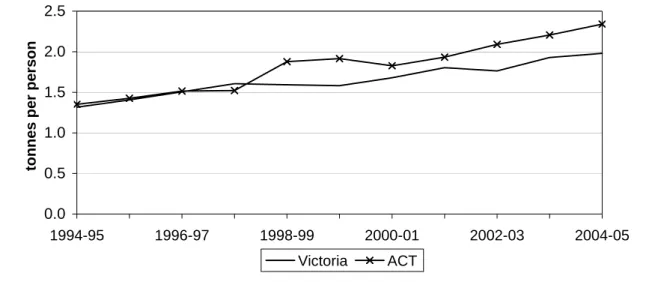
2.1 Waste generation in Victoria and the ACT 18
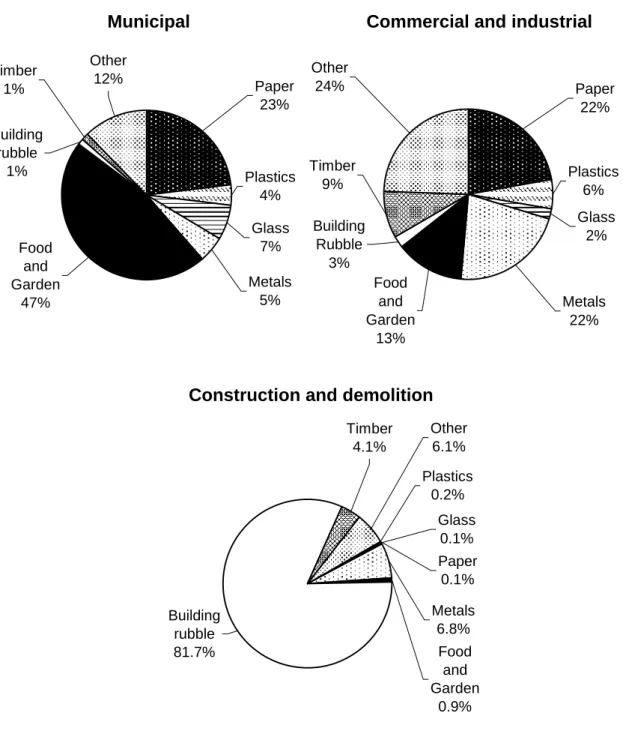
2.2 The composition of waste generated in Australia, 2002-03 19
2.3 Recycling rates in Victoria and the ACT 23
2.4 The composition of recycling in Australia, 2002-03 27 2.5 The recycling and landfill disposal of waste in Victoria, 2002-03 27 2.6 The export of recyclable material from Australia 29 2.7 Landfill disposal rates in Victoria and the ACT 32 2.8 The composition of waste disposed to landfill in Victoria, 2002-03 33 2.9 The composition of litter in Australia, 2006 35 2.10 Municipal waste generation in Australia and selected OECD
countries, 2003 37
2.11 The composition of municipal waste generated in Australia and
selected OECD countries, 2002 39
2.12 The treatment of municipal waste in Australia and selected OECD
countries, 2003 40
2.13 Distribution of total revenue in the Australian waste management
industry, 2002-03 43
8.1 Elements of landfill design 180
8.2 Consumption of HDPE retail carry bags, 2002–2005 208 8.3 Consumption of HDPE retail carry bags by source, 2005 210 B.1 Sources of environmental costs and benefits of kerbside recycling
estimated by Nolan-ITU and SKM Economics 450
C.1 Subsidy payments and volumes recycled under the Product
Stewardship for Oil Program, 2004-05 459
TABLES
2.1 Solid waste generation in Australia, 2002-03 17
2.2 Recycling rates in Australia, 2002-03 22
2.3 Landfill disposal rates in Australia, 2002-03 30 3.1 Key legislation and selected waste minimisation strategies 51 4.1 Average landfill gate fees in Australian cities, 2003-04 69
4.2 Estimated costs of ‘best-practice’ landfill 70
4.3 Estimated net external costs of greenhouse gas emissions from waste
CONTENTS XIII 4.4 Estimates of the external costs of properly-located, engineered and
managed landfills, per tonne of waste 76
4.5 Average materials recovery facility (MRF) sorting costs 80 4.6 Average financial costs of waste management in a major
metropolitan centre with high costs of landfill 87 5.1 Selected Australian commodity statistics, 2004 103 5.2 Trends in economic demonstrated resources, Australia 112 6.1 Potential environmental impacts of different types of waste in
landfill 133 8.1 Legislation, regulations and guidelines relating to landfills 175 8.2 Allen Consulting Group’s assessment of potential HDPE-bag
policies, 2005–2016 215
9.1 Australian landfill levies in 2006 220
10.1 Australian examples of EPR and PS schemes, by administrative
structure 264 10.2 Examples of EPR and PS schemes, by key policy instrument 267 10.3 Products targeted under the NSW Government’s EPR policy 269 14.1 Summary of main issues and the way forward 398
A.1 Submissions received 404
A.2 Visits 412
A.3 Initial public hearings – participants 413
A.4 Draft Report public hearings – participants 415 B.1 Nolan-ITU estimates of the environmental benefits of the UR-3R
process over landfill waste disposal, by impact category 426 B.2 Estimated external costs of greenhouse gas emissions from waste
sent to landfill, dollars per tonne of waste 431 B.3 Estimates of the external costs of properly-located, engineered and
managed landfills, per tonne of waste 441
B.4 Emissions of carbon dioxide from thermal treatment of municipal
solid waste 442
B.5 Estimated net external costs of greenhouse gas emissions from
sending municipal waste to an energy-from-waste facility 443 C.1 Subsidy rates under the Product Stewardship for Oil Program 458 C.2 Annual reporting requirements of the National Packaging Covenant 464
ABBREVIATIONS AND EXPLANATIONS
XV
Abbreviations and explanations
Abbreviations
ABARE Australian Bureau of Agricultural and Resource Economics ABS Australian Bureau of Statistics
ACCC Australian Competition and Consumer Commission ACCI Australian Chamber of Commerce and Industry ACOR Australian Council of Recyclers
ADAA Ash Development Association of Australia
ADF Advance disposal fee
AEBN Australian Environment Business Network
AEEMA Australian Electrical and Electronic Manufacturers’ Association
AELA Australian Environmental Labelling Association AFGC Australian Food and Grocery Council
AGO Australian Greenhouse Office AIG Australian Industry Group
AIIA Australian Information Industry Association ALGA Australian Local Government Association ANRA Australian National Retailers Association
ANZECC Australia and New Zealand Environment and Conservation Council
ARA Australian Retailers Association ATIG Australian Tyre Importers’ Group
AWD Australian Waste Database
XVI ABBREVIATIONS AND EXPLANATIONS
BCA Business Council of Australia
BIEC Beverage Industry Environment Council
BRSD Business Roundtable on Sustainable Development CDL Container deposit legislation
CEC Commission of the European Communities
CESA Consumer Electronic Suppliers Association
C&D Construction and demolition C&I Commercial and industrial
COAG Council of Australian Governments
CRT Cathode-ray tube
CSIRO Commonwealth Scientific and Industrial Research Organisation
DAFF Department of Agriculture, Fisheries and Forestry (Australian Government)
DAIS Department of Administrative and Information Services (South Australia)
DEC Department of Environment and Conservation (New South Wales)
DEFRA Department for Environment, Food and Rural Affairs (United Kingdom)
DEH Department of the Environment and Heritage (Australian Government)
DEST Department of the Environment, Sport and Territories (Australian Government)
DITR Department of Industry, Tourism and Resources (Australian Government)
DOFA Department of Finance and Administration (Australian Government)
DPIWE Department of Primary Industries, Water and Environment (Tasmania)
DSD Duales System Deutschland
ABBREVIATIONS AND EXPLANATIONS
XVII DUAP Department of Urban Affairs and Planning (New South
Wales)
DWLBC Department of Water, Land and Biodiversity Conservation (SA)
EPA NSW Environment Protection Authority, New South Wales EPA NT Environment Protection Agency, Northern Territory EPA Queensland Environmental Protection Agency, Queensland EPA SA Environment Protection Authority, South Australia EPA Victoria Environment Protection Authority, Victoria
EPHC Environment Protection and Heritage Council EPR Extended producer responsibility
EU European Union
FCAI Federal Chamber of Automotive Industries FSANZ Food Standards Australian and New Zealand HDPE High density polyethylene
HIA Housing Industry Association
IC Industry Commission
KPI Key performance indicator
LCA Life cycle assessment
LDPE Low density polyethylene MBA Master Builders Australia
MBT Mechanical biological treatment
MGB Mobile garbage bin
MRF Material recovery facility
MSW Municipal solid waste
MWAC Municipal Waste Advisory Council (Western Australia) NARGA National Association of Retail Grocers of Australia NEPC National Environment Protection Council
NEPM National Environment Protection Measure
NIMBY Not in my backyard
XVIII ABBREVIATIONS AND EXPLANATIONS
NKRS National Kerbside Recycling Strategy NPC National Packaging Covenant
NPCC National Packaging Covenant Council
NPCIA National Packaging Covenant Industry Association NPI National Pollutant Inventory
NSESD National Strategy for Ecologically Sustainable Development NSW DLG NSW Department of Local Government
NWMRS National Waste Minimisation and Recycling Strategy OECD Organisation for Economic Cooperation and Development OH&S Occupational Health and Safety
ORR Office of Regulation Review
PACIA Plastics and Chemicals Industry Association
PAEC Public Accounts and Estimates Committee (Victoria)
PC Productivity Commission
PCA Packaging Council of Australia PET Polyethylene terephthalate
PNEB Publishers National Environment Bureau PRO Producer responsibility organisation
PS Product stewardship
PSA Product Stewardship Australia PSO Product Stewardship for Oil
PVC Polyvinyl chloride
RIS Regulation impact statement
UR-3R Urban Resource – Reduction, Recovery and Recycling WCRA Waste Contractors and Recyclers Association of New South
Wales
WMAA Waste Management Association of Australia
WMAA NTCOR Waste Management Association of Australia, National Technical Committee for Organics Recycling
WMB Waste Management Board (Western Australia) WSN Waste Services New South Wales
ABBREVIATIONS AND EXPLANATIONS
XIX
WTO World Trade Organisation
WWF Worldwide Fund for Nature (also known as World Wildlife Fund)
Explanations
Billion The convention used for a billion is a thousand million (109). Findings Findings in the body of the report are paragraphs
highlighted using italics, as this is.
Recommendations Recommendations in the body of the report are highlighted using bold italics, as this is.
XX GLOSSARY
Glossary
Alternative waste technology (AWT)
Any technology that is applied to mixed waste other than traditional methods such as disposal to landfill. AWT facilities typically recover some dry recyclables and treat organic waste by fermentation or other process.
Aquifer A body of permeable rock that is capable of storing quantities of water.
Biogas A combustible gas derived from the anaerobic
decomposition of biological material.
Comingled recyclables
A mix of different types of recyclables that are separated from mixed waste and placed in a single container for collection.
Composting Biological decomposition of solid organic materials by micro organisms.
Disposal Any method of dealing with waste that permanently removes it from human contact. This includes landfilling and thermal treatment.
Dry recyclables Recyclables other than food waste, organic waste from gardens and other wet material. Includes plastics, metal, glass and paper.
Extended producer responsibility (EPR)
An environmental policy approach in which a producer’s responsibility for a product is extended to the post-consumer stage of a product’s life cycle. There are two related features of EPR policy: (1) the shifting of responsibility (physically and/or economically; fully or partially) upstream toward the producer and away from municipalities; and (2) to provide incentives to producers to incorporate environmental considerations in the design of their products.
GLOSSARY XXI
Final cover The final layer of material used to cover a landfill site after it has ceased receiving waste.
Fly ash Fine airborne particulates carried out of an incinerator, boiler, or furnace in the flue gas after the combustion of solid fuel, for example coal, and expelled as noncombustible airborne emissions or captured by some means before it reaches the mouth of the chimney.
Gasification Exposing waste to temperatures over 800 degrees Celsius in an oxygen-restricted environment. The waste breaks down to gases that are used as a fuel source.
Groundwater Water naturally stored underground in aquifers, or that flows through and saturates soil and rock, supplying springs and wells.
Illegal disposal Littering or illegal dumping.
Illegal dumping Deliberate dumping of waste in an illegal manner. Usually involves relatively large quantities of waste (compared to litter).
Incineration A treatment technology involving destruction of waste by controlled burning at high temperatures.
Landfill A designated area (usually a pit) into which solid waste is placed for permanent burial.
Landfill liner Impermeable layers of heavy plastic, clay and/or gravel that protect against groundwater contamination through downward or lateral escape of leachate.
Leachate Liquid that has passed through solid waste, and may have become contaminated with metallic, organic and inorganic compounds and toxins.
Litter Waste that is improperly disposed of outside of the regular disposal system.
Materials recovery facility
Facility that separates mixed dry recyclables into individual materials to be made available for further processing.
XXII GLOSSARY
Product stewardship
An approach which recognises shared responsibility for the environmental impacts of a product throughout its full life cycle, including end of life management, and seeks to reduce adverse impacts and internalise unavoidable costs within the product price, through action at the point(s) in the supply chain where this can be most effectively and efficiently achieved.
Putrescrible waste Waste that readily decomposes. Includes food waste and organic waste from gardens.
Pyrolysis Exposing waste to temperatures over 800 degrees Celsius in the absence of oxygen. The waste breaks down to gases that are used as a fuel source.
Recycling The recovery of used products and their use as raw materials in the manufacture of new products, which may or may not be similar to the original.
Resource efficiency Value added per unit of resource input.
Resource recovery The process of extracting a material or energy from a waste stream. It includes reuse (using the product for the same or different purpose without further manufacture), recycling and the recovery of energy from waste.
Shredder floc Mainly non-metallic material that is left over from the metal shredding process that is applied to end-of-life vehicles, white goods and some appliances.
Virgin materials Any basic materials for industrial processing that have not been previously used.
Waste Anything that is no longer privately valued by its owner for use or sale and which is, or will be, discarded.
Waste
management
Management of the collection, recovery and disposal of wastes, including options for waste reduction.
WASTE MANAGEMENT
XXIV
Key points
• State and territory waste management policies contain some inappropriate and inconsistent objectives. These have led to some jurisdictions adopting unrealistic, and potentially very costly, waste minimisation targets.
• These policies are giving rise to some unsound interventions including:
– using landfill levies to achieve waste diversion targets and raise revenue;
– subsidising waste recovery options, such as alternative waste technologies, that are costly and have questionable environmental benefits; and
– introducing mandatory product stewardship or extended producer responsibility schemes, where disposal problems have not been adequately demonstrated.
• Waste management policy should be refocused on the environmental and social impacts of waste collection and disposal, and supported by more rigorous cost–benefit analysis, if it is to best serve the community.
• As a general rule, policy makers should not use waste management policies to address upstream environmental impacts. Where warranted, these are much more effectively and efficiently addressed using direct policy instruments, and often already are.
• Directly addressing relevant market failures and distortions throughout product life cycles will assist markets to achieve the right balance between waste avoidance, resource recovery and disposal.
• Regulation of disposal has improved considerably in recent years, and where complied with, appears to have been very effective. However, compliance with landfill regulations could be improved considerably.
• Waste disposal fees should be based on the full social, environmental and financial costs involved. For landfills, this will require:
– tightening regulatory compliance so that landfill gate fees include the costs of the regulatory measures needed to address disposal externalities; but
– abolishing landfill levies (taxes) as these are not based on legitimate costs.
• Basic forms of pay-as-you-throw pricing for kerbside waste and recycling services, should be more widely adopted, with information on the actual costs for these services better communicated to households.
• In most large urban centres, for reasons of scale and planning (as with sewage and electricity), managing waste disposal is no longer best handled by local governments.
• The Australian Government should play a leadership role in facilitating (relevant) reforms, and where appropriate, developing sound, nationally consistent waste management policies.
OVERVIEW XXV
Overview
The amount of waste we generate, and its actual or potential impacts on the environment, have long been matters of concern to governments and the community generally. In recent times, increasing emphasis has been given to resource recovery — including reusing, recycling and extracting energy from waste. Ambitious targets are being set, and more advanced (but more costly) approaches to recovering waste are being promoted.
Against this backdrop, the Australian Government asked the Productivity Commission to undertake an inquiry into waste generation and resource efficiency. The focus has been on solid, non-hazardous wastes including: municipal waste; commercial and industrial waste; and construction and demolition waste.
The terms of reference are broad, but in essence ask the Commission to advise on strategies to address market failures associated with the generation and disposal of waste. In this context, market failure includes, but is not necessarily limited to, externalities. Externalities are the unintended costs and benefits of an activity that are experienced by people or organisations other than those directly involved in that activity. For example, a landfill may leak, causing damage (a negative externality) to a valued environment.
The Commission’s charter and the terms of reference require that a communitywide approach be taken that considers all of the financial, environmental and social costs and benefits of different strategies (box 1). This approach necessarily challenges notions of waste being inherently bad and recycling being inherently good. Policies that minimise waste are not costless and more recycling is not always a better thing. As we try to recycle more and more waste, diminishing returns set in, costs rise, and the potential for perverse environmental outcomes increases.
For example, it might be possible to collect and recycle virtually all glass containers used in Australia. But after taking into account all of the costs and benefits — financial, social and environmental — this will simply not be justifiable for all locations and circumstances.
The question policy makers must then answer is whether the community has reached a suitable balance between waste avoidance, resource recovery and waste disposal, and if not, what governments might usefully do to redress the imbalance.
WASTE MANAGEMENT
XXVI
Box 1 Waste policy should maximise net community benefits not resource efficiency
The Commission’s approach to this inquiry has been guided by the terms of reference and its charter as set out in the Productivity Commission Act 1998. These require that all costs and benefits of different policy options for addressing market failures be considered, and that government intervention be considered only if it produces net benefits to the community.
Another way of putting this is to say that government intervention should aim to assist markets to maximise the returns from using all resources — land, raw materials, energy, labour and capital. This requires that no other combination of resource use could lead to a higher level of community wellbeing. This approach recognises that scarce resources have alternative valuable uses, and may yield greater returns to the community in other areas, such as education, health or other environmental projects. Environmental and social issues can be brought into this framework by giving appropriate recognition to relevant externalities. For example, the costs of disposing of waste to landfill include the owner’s costs of operating the landfill (a private financial cost). But they might also include environmental costs (such as possible impacts on the community from any contamination of groundwater), and social costs (such as loss of amenity for people living nearby during the operational phase of the landfill). The private (nonfinancial) costs and benefits that people might experience through participating in recycling activities should also be considered.
All of these costs and benefits should be brought together in a social cost–benefit framework, and quantified wherever possible. This will assist decision makers to identify the policy option that maximises net benefit to the community, including impacts on the environment.
An alternative approach that many people have been promoting is that waste policy should maximise resource efficiency. Resource efficiency is used in the terms of reference and is often interpreted as maximising the returns from using one or more natural resources (raw materials and energy). For the economy as a whole, it is sometimes expressed in terms of gross domestic product per unit of natural resource input.
This concept has intuitive appeal — maintaining living standards while decreasing our call on natural resources would surely be a good thing. But resource efficiency has some major limitations as a practical policy tool. The most substantial of these is that it only focuses on part of the picture, the natural resource or resources in question. Maximising the return to these inputs without any regard to the amount of other inputs, such as labour or capital (or indeed other natural resources that might be left out of the initial consideration), will not give the best returns to the community. This is why the net benefit from all resources is a better measure of the return to the community generally, and why policy should focus on maximising net community benefits, not resource efficiency.
OVERVIEW XXVII
What is waste and how much do we produce?
Waste can be defined as any product or substance that has no further use or value for the person or organisation that owns it, and which is, or will be, discarded. But what is discarded by one party may have value for another. Thus, a broad approach to defining ‘waste’ can include products that are recoverable by others.
In 2002-03, Australia generated approximately 32.4 million tonnes of solid waste. Approximately 27 per cent of this came from municipal sources, 29 per cent from the commercial and industrial sector, and 42 per cent from the construction and demolition sector. Waste recovered for recycling in 2002-03 was approximately 15 million tonnes, almost half of the total generated in that year.
The wide variety of wastes covered, the varying composition of waste streams, and the different environmental impacts of different types of wastes, add a layer of complexity to the policy issues. A tonne of broken clay bricks has quite different impacts on the environment to a tonne of putrescible household waste. To adapt an old catchcry — ‘wastes ain’t wastes’.
How big a problem is waste?
Waste is perceived to be a problem for many reasons, but the three reasons most often cited are that: waste disposal can harm the environment and human health; space for landfills is claimed to be becoming scarce; and waste is the end product of a life cycle process that can have upstream environmental and resource depletion implications (figure 1). Some people also take an essentially moral view of waste generation, arguing that it is symptomatic of wasteful and undesirable overconsumption.
Unintended environmental and social costs of waste disposal
The main method of waste disposal in Australia is landfill. This can cause environmental and social externalities through leachate discharges, gaseous emissions, loss of visual amenity, foul odours, and harbouring of disease-carrying pests. The main alternative is incineration, which if not properly controlled, can produce toxic emissions. Other externalities arise through illegal dumping and littering.
WASTE MANAGEMENT
XXVIII
Figure 1 Disposal and recycling in the product life cycle
This diagram is a simplified representation of what can happen in a product’s life cycle, from the time natural resources are mined (in the case of nonrenewable resources) or harvested (in the case of renewable resources), through the stages of processing, manufacturing, distribution (including wholesaling and retailing activities) to where it is consumed. Waste can be generated at all points in the life cycle, not just in the post-consumer phase. It can be either disposed or recovered in some way (represented here as recycling).
The diagram also shows that environmental and other externalities can occur at each stage in a product’s life cycle. From a waste management perspective, downstream externalities are those that might arise from disposal or recycling (including the waste collection and transport associated with these activities). Upstream externalities occur prior to the point at which waste is generated. For example, the ‘externalities’ boxes on the left hand side of the diagram indicate the externalities that might occur upstream of, or prior to, final consumption.
Mining and harvesting Processing Manufacturing Distribution Consumption Waste Waste Waste Waste Waste Recycling Disposal Externalities Externalities Externalities Externalities Externalities Externalities Externalities Reuse
OVERVIEW XXIX It is difficult to generalise about the extent of the externalities associated with landfills. Some pollutants can be persistent and have the potential to be harmful if they escape. But not all wastes cause problems in disposal. Most construction and demolition waste is relatively inert, and hence does not give rise to many emissions. What is clear is that the environmental impacts of modern landfills (that is, those that are properly located, engineered and managed) are much lower than old landfills.
The Commission has reviewed the available estimates and considers that, where such modern landfills include gas capture and electricity generation, the externalities are likely to be no more than $5 per tonne of waste. Without gas capture, the external costs could be up to $24 per tonne for wastes with high levels of organic content, due mainly to the costs of greenhouse gas emissions. Inert wastes appear to produce negligible externalities in landfill.
Availability of landfill space
It is sometimes argued that Australia is running out of suitable space to use as landfills, and hence landfilling is an unsustainable practice. Typically, landfills have used old quarry or mine sites in or near urban areas. Generally speaking, Australia is creating new holes faster than we are filling old holes with waste. But it is where those holes are located, and their geological suitability for landfills, that are the crucial issues. Overlaying this are the concerns of many people about having a landfill in their ‘backyard’.
The Commission considers that these issues are not insurmountable and can be addressed for the most part through the market and appropriate planning frameworks. To the extent that landfill space near an urban area becomes scarce, rising gate fees will make it financially worthwhile to transport the waste further afield, thus opening up possibilities for new landfills, and encouraging more recycling.
Upstream issues
Avoiding waste, or increasing the amount of waste recovered, can have environmental impacts in the product life cycle upstream from where it is created (figure 1). These can be grouped into two main categories: environmental externalities avoided, and sustainability issues. Externalities associated with the harvesting of renewable resources, and the extraction of minerals, can include greenhouse gas emissions, water and air pollution, landscape degradation, and loss of biodiversity. Sustainability concerns include the equity considerations of
WASTE MANAGEMENT
XXX
consuming resources today that might not be available for future generations (box 2), and managing resource depletion.
Box 2 Ecologically sustainable development policy considerations Sustainable development is generally interpreted as ‘development that meets the needs of the present without compromising the ability of future generations to meet their own needs’ (World Commission on Environment and Development, 1987, p. 43). Similar approaches have been adopted in Australia. In 1992, Australian governments endorsed the National Strategy for Ecologically Sustainable Development, an objective of which is to enhance individual and community wellbeing by following a path of economic development that safeguards the welfare of future generations.
The issue of sustainability is complicated by the diversity of things we pass on to future generations. These include:
• human capital — knowledge and understanding;
• man made capital — economic and social infrastructure; and
• natural capital — biodiversity, renewable and nonrenewable resources and ecological integrity.
Additions to, or conservation of, any of these types of capital are likely to contribute to sustainability (or at least improve the endowment we pass on to future generations). To some extent it might be possible to substitute one type of capital for another. Thus, sustainability might be achieved even where some nonrenewable resources become heavily depleted. However, some natural resources, such as clean air and water, are not readily substitutable.
Apart from these essential resources, we do not know with any precision what the resource needs of future generations will be, so it is difficult to know what needs to be conserved. Further complicating this issue, it is likely that technological change will mean that we will be able to do more with less, and we might be able to switch our dependence on some non-renewable resources to other non-renewable, or renewable resources. And as known reserves become scarce, prices will rise, stimulating exploration and development of new reserves, greater recycling, conservation through greater efficiency of use, and the development of substitutes (where this is possible). Besides, the economically-recoverable amount of the sorts of natural resources typically recovered for recycling — such as iron, aluminium, copper, and silica — has tended to increase over time, not diminish.
Further issues arise in considering who should be asked to make sacrifices for the welfare of future generations: the more advanced economies that currently account for a high proportion of resource consumption, or the less developed economies for whom economic growth is a means of lifting current standards of living from much lower levels.
To the extent that there is a case for intervention, such upstream issues are best addressed as directly as possible, not through waste management policy. Using
OVERVIEW XXXI waste management policy to address these issues is likely to be inefficient and ineffective. For example, the kerbside recycling of steel cans might lead to a small decrease in the domestic demand for steel (and hence iron ore), and less environmental externalities from mining and processing. But it is likely to be far less effective than applying direct policy instruments to address particular upstream problems. This is especially the case where the problems are specific to particular mine sites or practices. In addition, any benefits from curbing domestic consumption would be illusory if the iron ore conserved were redirected to exports, as is likely for a major minerals exporter such as Australia.
Taking indirect action through waste management policy also presumes that direct actions are not being taken, or that the upstream externalities that have not been addressed are substantial. Yet with the exception of a comprehensive response to greenhouse gas abatement, a host of existing policies already address directly most known upstream externalities occurring in Australia. If greenhouse gas abatement is the major unresolved issue, and resource recovery reduces greenhouse gas emissions, some cautious downstream intervention — such as subsidies for kerbside recycling — might be justifiable. However, government intervention to address climate change would be more effectively and efficiently achieved through a comprehensive national approach. Once this were done, any downstream interventions predicated on greenhouse gas benefits would need to be re-examined and, where relevant, removed.
The rate at which we deplete nonrenewable resources is a concern to many people. Yet increasing scarcity will induce rises in prices that dampen demand and encourage exploration for new supplies and substitution to other materials. It also makes recycling more attractive. Such dynamic responses mean extraction rates for nonrenewable resources should be left largely to markets to determine, provided all relevant market failures and distortions have been addressed. The Commission considers that waste policies are unlikely to be an effective way of addressing ‘resource scarcity’ issues.
The Commission is not recommending that market failures further upstream in the product life cycle should be ignored. Quite the contrary — direct intervention at various points throughout the product life cycle should be continued and where necessary supplemented by additional measures. This would help ensure that product prices reflect all relevant costs. Complemented by awareness raising campaigns that help consumers make more informed choices, this will also help address concerns about over-consumption.
WASTE MANAGEMENT
XXXII
Targets and the waste hierarchy
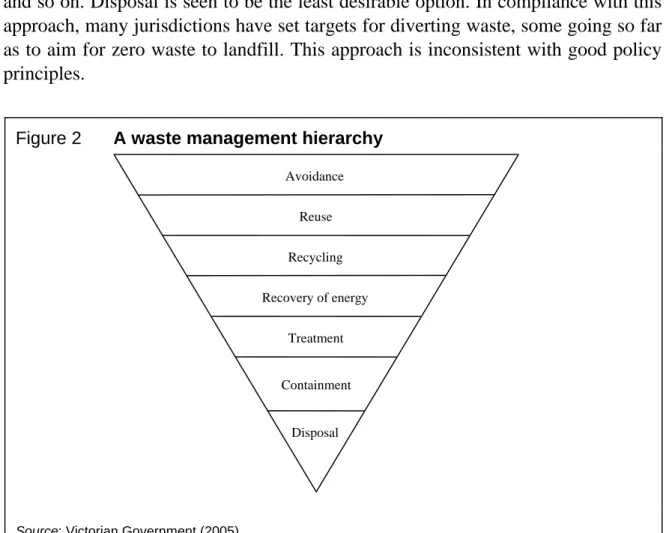
Many State and Territory Governments have developed waste management strategies based around the concept of the waste hierarchy (figure 2). Under this approach, waste avoidance is argued to be preferable to reuse, reuse to recycling, and so on. Disposal is seen to be the least desirable option. In compliance with this approach, many jurisdictions have set targets for diverting waste, some going so far as to aim for zero waste to landfill. This approach is inconsistent with good policy principles.
Figure 2 A waste management hierarchy
Source: Victorian Government (2005).
Although target setting may be a useful way of improving performance where targets relate to sound policy objectives, have been rigorously set, and clear lines of accountability can be established, these conditions are inherently difficult to achieve with respect to waste diversion. In practice, waste diversion targets have tended to be set using technical and other criteria that are highly unlikely to maximise net benefits to the community. A better approach would be to address all relevant market failures and allow the market to establish the most appropriate balance between disposal and resource recovery.
Similarly, waste management options should not be dictated by the simple priorities suggested by the waste hierarchy. High order options in the hierarchy may not necessarily be better than lower order options, once all of the costs and benefits to
Avoidance Recycling Recovery of energy Treatment Reuse Containment Disposal
OVERVIEW XXXIII the community have been considered. Policy makers and regulators might profess to use the waste hierarchy as a broad framework, but in practice it appears to have had an inordinate influence on waste management policy.
Some jurisdictions have been (directly and indirectly) subsidising the installation of alternative waste technology facilities (for municipal waste) as a means of achieving their targets, despite the dubious net environmental benefits of such facilities. Waste management policy should aim to achieve the best possible outcomes for the community, not prescribe one technical solution at the expense of others. Yet jurisdictions’ adherence to the waste hierarchy and waste diversion targets can favour policy options that have higher net costs to the community than other alternatives.
Choosing good policy instruments
A variety of policy instruments have been used in different jurisdictions, with varying degrees of success. These include regulation, pricing measures (including landfill levies), and extended producer responsibility or product stewardship schemes.
Regulation of disposal has tightened considerably
The regulation of landfills has tightened considerably in recent times (though more could be done to enforce existing standards). While landfill operators have some freedom to design their landfills to most efficiently meet licensing requirements, jurisdictions often also prescribe certain features drawn from ‘best practice’ guidelines. Prescription has the advantages of clarity and certainty, but it can stifle innovation and impose additional costs. It would be more appropriate to consider landfill proposals on how they would reduce the risk of adverse outcomes to acceptable levels, rather than require particular features. Furthermore, it is crucial that regulatory solutions are tailored to match the circumstances of particular landfills, and that they only address the externalities produced by the landfill, not upstream issues.
Currently, some environmental regulators require that landfills install gas capture systems. These systems can have many benefits, including reducing greenhouse gas emissions, the risks of fires and explosions, and unpleasant odours. While landfill gas capture might prove to be one of the more cost-effective greenhouse gas abatement options, this would best be judged within the framework of a comprehensive national greenhouse response. Regulatory requirements to install such systems should be reviewed, whenever this occurs.
WASTE MANAGEMENT
XXXIV
Given that most externalities emanating from modern, fully-complying landfills seem to have reached acceptably low levels, any further tightening of the regulations would need to be carefully evaluated.
The other main alternative for disposing of some wastes — incineration — is also tightly regulated, and in some Australian jurisdictions effectively banned altogether. Although capital intensive, incineration can be combined with energy recovery facilities and appropriate flue gas treatment to provide an environmentally acceptable alternative to landfill. In Europe, where incineration is common, regulations require the use of technologies that have effectively eliminated damaging levels of pollution. Lifting the effective bans on the use of incineration of certain wastes in Australia, while insisting on appropriate performance standards, would appear to be long overdue.
Other waste management regulation is designed to limit processes, and sometimes products themselves. Foreshadowed regulation to reduce the use of plastic shopping bags is one example. Governments should ensure that any such regulation is likely to deliver a greater net benefit to the community — including impacts on the environment — than other policy options. But, based on evidence available to the Commission, the case for proceeding with the phase out of plastic bags appears particularly weak. A more cost-effective approach to addressing the underlying issues of concern would be to target plastic-bag litter directly.
Getting prices right will help
If the prices for waste disposal, virgin materials, and manufactured goods reflected the full costs involved — including environmental and social externalities — markets would be the best way of determining the appropriate mix of resource recovery and disposal. Where these externalities have been addressed through regulation or market-based instruments, costs would already be internalised in the prices of goods and services (including landfill gate fees). Such pricing would also allow consumers’ willingness to pay for recycling and waste services to be gauged directly. But further refinement of waste disposal price signals is not straightforward.
Varying charges according to the amount of waste can be difficult
Many firms arrange their own waste disposal services and pay according to how much they generate. In contrast, most households are charged a flat annual fee and, therefore, have no incentive to reduce the amount of waste they dispose (until they have filled their bin). This may exacerbate the extent of any downstream disposal externalities.
OVERVIEW XXXV Some local governments have introduced a modest degree of variability into their charging arrangements. The most simple of these involves an additional fee for the use of a larger than standard bin. Broader adoption of these pay-as-you-throw approaches is warranted, where this is cost effective. More explicit cost-based charging arrangements for kerbside recycling would also be appropriate.
Cost recovery has not been fully implemented
Cost recovery means setting disposal fees to cover the financial, environmental and social costs. However, this depends on levels of compliance, which for some landfills are relatively poor. State and Territory Governments should do more to ensure that all landfills comply with appropriate environmental licence conditions, and that government-owned landfills adopt sound charging policies. This would also promote competitive neutrality between government and private sector providers.
Landfill levies
Most Australian jurisdictions impose a levy on waste disposed to landfill, which users must pay in addition to gate fees. In some cases, levies vary according to the type of waste and location. The primary purpose of levies now seems to be to discourage waste being sent to landfill, and thus to support the achievement of waste diversion targets. Levies are also used in some cases for raising revenue, with some or all of the revenue hypothecated (earmarked) for environmental projects. Levies might encourage waste diversion from landfills and achievement of targets, but unless based on the environmental and social externalities of the landfill, will send the wrong price signals to users. Their use as revenue raising devices is not supported, nor is hypothecation to particular expenditure programs. Hypothecation introduces rigidities into public sector financing and is rarely warranted.
Basing levies on the environmental and social externalities of the landfill would be very difficult to achieve in practice. Externalities vary according to location, the type of waste and how the landfill is constructed and managed. Varying the levy to account for these differences with any precision is virtually impossible, and would also encourage evasion by waste disposers to gain the cheapest disposal option. The practical response might be to average the levies across all landfills (or a class of landfills), but this would give no incentive to improve landfill practices. To the extent that regulation and other policies already address externalities, levies duplicate existing costs. No matter how they are set, landfill levies increase the incentive to illegally dump waste — a serious problem in some locations.
WASTE MANAGEMENT
XXXVI
On balance, the Commission does not favour the use of landfill levies, but rather regulation that reduces externalities to acceptable levels, and better enforcement. In this way, gate fees can internalise the environmental and external costs that would otherwise occur, and hence provide appropriate price signals to landfill users.
Kerbside recycling
Kerbside recycling is undoubtedly valued by many households, yet it almost invariably increases the financial costs of waste management. A substantial environmental return would often be necessary if it were to achieve net benefits for the community.
The support for kerbside recycling, and resource recovery generally, stems in part from the alleged upstream benefits. But while some upstream issues warrant intervention, these would be more effective and efficient if undertaken directly, not through waste management policy. Furthermore, some commonly quoted assessments of the upstream benefits of kerbside recycling are, in the Commission’s view, greatly exaggerated.
Care also needs to be taken in the design and application of kerbside recycling if it is to achieve the best returns to the community. Taking a harder nosed approach to restricting the items collected might be appropriate. For example, glass is a marginal proposition in comingled collection systems, due to a combination of its relatively low value, its high sorting costs, its inertness in landfill and its contaminating influence on other recyclables. In some locations, far from markets and processing opportunities, undertaking any kerbside recycling is probably not worthwhile, even after accounting for all of the environmental benefits.
Household support for kerbside recycling needs to be tested through more explicit cost-based charges, and informed through better education and awareness raising.
Extended producer responsibility and product stewardship schemes
As noted earlier, policy makers have increasingly turned to approaches that target producers, or distributors, of products that are deemed to be problematic for one reason or another. These are called extended producer responsibility (EPR) or product stewardship (PS) schemes.
EPR and PS schemes (which generally require producers to take more responsibility for end-of-life disposal or recovery) can include a variety of policy instruments, such as take-back schemes, advance disposal fees, deposit refunds, and awareness raising. Typically, EPR and PS schemes involve separating the target product from the waste stream it is found in (for example, mobile phones in municipal solid
OVERVIEW XXXVII waste), and using dedicated means for its disposal or recovery. To fund this, levies are often used.
Some EPR and PS schemes operate on a voluntary basis, but increasingly they are being implemented through co-regulation. In this model, industry is charged with the task of developing a ‘self-regulatory’ scheme, and the Australian, State and Territory Governments back this with regulation that picks up free riders, effectively making participation mandatory. The Australian Government and relevant industry groups have been keen to ensure that policy develops on a more coordinated basis where national issues are at stake.
A number of schemes already exist or are in the pipeline. One of the most notable is the National Packaging Covenant (NPC). Others include an existing waste oil scheme and foreshadowed schemes for televisions and tyres. Like the NPC, it is understood that these new schemes will be introduced via a National Environment Protection Measure, and implemented by the jurisdictions through regulations. The proliferation of EPR and PS schemes is a concern, because, among other things:
• there is little evidence to suggest that the problems to which many of these schemes are being directed are sufficient to justify the costs of intervention;
• they are vulnerable to the influence of vested interests; and
• financial incentives in some schemes appear to be based on the waste hierarchy, not net benefits to the community.
Further mandatory schemes should only be introduced where a net benefit to the community can be demonstrated and other policy options would not deliver a greater net benefit. These conditions are unlikely to be satisfied unless:
• there are considerable benefits to the community from avoiding the product’s inappropriate disposal, possibly because it is hazardous;
• the parties that need to be targeted to make the requirements effective can be readily identified and held accountable; and
• compliance can be readily monitored and enforced.
The effectiveness of the NPC will be reviewed in 2008, with some parties already calling for it to be substantially strengthened and/or extended. The Commission considers that the nature of this review should be changed to focus on the costs and benefits of various options, including not continuing with the NPC.
To ensure future schemes have a sound basis, the Commission recommends two reforms. First, policy objectives should be reformulated to focus on reducing risks — to human health, the environment and social amenity — from waste to
WASTE MANAGEMENT
XXXVIII
acceptable levels. Waste avoidance and resource recovery may be outcomes of achieving this objective, but they are not objectives justifying government intervention in their own right. Second, there should be a requirement that, before intervening, governments consider the findings of an independent review of a product’s alleged adverse impacts. The review should define exactly what the problem is, attempt to quantify its magnitude, and describe what actions might address the problem. It should also make a preliminary assessment of the likely costs and benefits of intervention.
As part of good regulatory practice, the effectiveness and efficiency of all existing schemes should be reviewed as a matter of course.
The role of local government is changing
The role of local government in waste management is changing, particularly in large urban areas. Technical, regulatory and policy developments mean that waste management and recycling facilities are becoming bigger and more sophisticated. These developments are exacerbating planning and operational issues for all but some of the larger local governments.
Local governments in urban areas are increasingly forming partnerships to jointly negotiate with suppliers of waste services, but this is not without its problems. Not the least of these is that it does nothing to resolve the tensions between local governments over where such facilities should be located. In some states, regional approaches have been adopted, but if these do not have appropriate expertise or capital backing, and are unable to address the ‘not-in-my-backyard’ reactions to planning issues, they can prove little more effective. To address these issues, State and Territory Governments should consider:
• declaring major waste and resource recovery facilities to be projects of state or regional significance, where this is not already the case; and
• passing the responsibilities for waste disposal to appropriately-constituted regional waste authorities, particularly in those larger urban centres where the majority of local governments do not have the scale or resources to efficiently and effectively handle such roles.
Some regulations impede resource recovery
Inconsistencies in the regulatory requirements of the states and territories are creating problems for industry and discouraging resource recovery. In particular, differences in definitions, waste classification systems and exemption processes mean that some materials are being more heavily regulated in some jurisdictions
OVERVIEW XXXIX than others. Greater coordination of classification and exemption systems, and less reliance on prescriptive definitions is required.
Another impediment is that some product standards and government purchasing practices continue to favour the use of virgin over recycled products. Some jurisdictions have made welcome improvements to product standards, adopting a performance-based approach. But old habits die hard, and many participants argued there was still room for improvement.
Role for the Australian Government
While states and territories hold most of the policy levers in waste management, the Australian Government has significant coordinating and leadership roles to play. It also has the crucial power to levy indirect taxes — a virtual necessity in implementing most mandatory EPR and PS schemes. The Commission considers that the Australian Government could play a more significant role by:
• supporting research into the significant externalities caused by waste disposal;
• playing a leadership role in the development of EPR and PS schemes by insisting on clear objectives, and that thorough identification of the problem precedes the development of such schemes;
• ensuring rigorous adherence to its regulatory impact assessment guidelines (and encouraging states and territories to do likewise);
• working with states and territories to develop and implement consistent waste classification systems and databases;
• refining information, education and awareness programs to help ensure the community is well informed about the costs and benefits of waste management options, particularly with respect to issues of community concern and misunderstanding (such as energy-from-waste options); and
• ensuring that upstream market failures that concern waste policy makers are reviewed by other relevant ministries, and where appropriate, addressed directly.
Concluding remarks
Waste management policy should primarily be focused on reducing social and environmental risks from waste collection and disposal to acceptable levels. The Commission considers that policy makers have become distracted by the pursuit of other, waste hierarchy inspired, objectives — such as minimising waste and conserving resources — and given insufficient regard to whether their interventions would actually lead to net benefits to the community.
WASTE MANAGEMENT
XL
Directly addressing relevant market failures and distortions throughout product life cycles will assist markets to determine the right balance between waste avoidance, resource recovery and disposal. Waste management policy can play its role in this process, but it should not be used to indirectly address upstream environmental and social issues. Many of these impacts may warrant intervention, but these would be (and often already are) much more effectively and efficiently addressed using direct policy instruments.
Unfortunately, much waste management policy in Australia has been initiated with insufficient consideration of all of the likely financial, environmental and social costs and benefits. Waste disposal problems, and community support for the remedies proffered, are too often simply asserted, rather than demonstrated. Many interventions have certainly gone too far. In particular, landfill levies, direct and indirect subsidies for alternative waste technology facilities, and some EPR and PS schemes, are not justified.
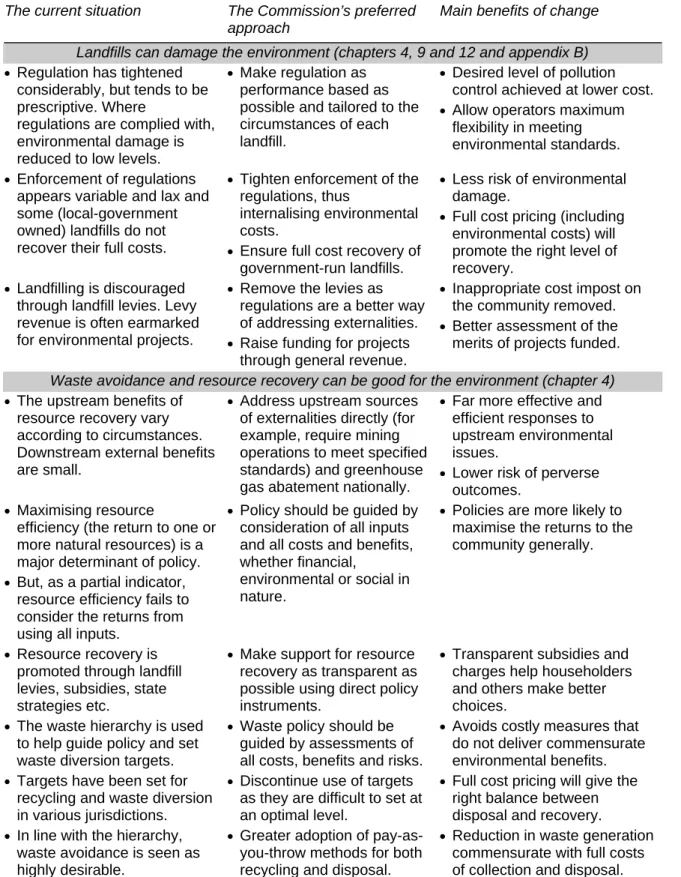
The reforms the Commission is proposing will help achieve a more appropriate balance between waste avoidance, resource recovery and disposal by, among other things: requiring a more rigorous approach to identifying environmental problems; tightening regulatory compliance; and reinforcing the roles of prices and awareness raising in assisting the community to make more informed choices (table 1).
As in other areas of environmental policy, the way forward is not always intuitively obvious. But what is clear is that simple rules such as ‘recycling is good, more is better’, are no substitute for sound policy-making procedures. Policy makers and community attitudes need to be guided by open and rigorous analysis of costs, benefits and risks, if waste management policy is to best serve the community.