1
How perceptions of empowerment and commitment affect job
satisfaction: a study of managerial level effects
Kirsten Rae
Griffith University, Brisbane, Australia
Abstract
This study examines factors that affect an employee’s level of job satisfaction. Understanding job satisfaction is important because it has implications for positive or negative workplace outcomes. This study examines the main effect of the association between a manager’s level of psychological empowerment, organisational commitment and job satisfaction, and the interaction effect of these associations moderated by the level of the manager’s position within the organisation. Specifically, the managerial employee’s level of job satisfaction is examined because managerial perceptions may have flow-down effects throughout an organisation. A sample of 301 Australian chief financial officers (CFOs), human resource (HR) managers and chief executive officers was surveyed. The results of the regression analyses revealed partial support for the main effects of the associations between managers’ perceptions of organisational commitment, psychological empowerment and job satisfaction, as well as how the association is moderated by managerial level. The findings of the study show that CFOs and HR managers sought autonomy to have job satisfaction, while all three managerial levels sought affective commitment to be able to experience job satisfaction. Keywords: Job satisfaction Organisational commitment Affective commitment Psychological empowerment Managerial
2 Introduction
Job satisfaction is an important part of an employee’s working life experience. Its importance is linked to an employee receiving sufficient intrinsic and extrinsic rewards to encourage the employee to remain in their workplace and continue to spend a large amount of time fulfilling their duties. Often, intrinsic rewards lead to a greater sense of job satisfaction, fulfilment and job retention than extrinsic rewards of pay and benefits (Randolph & Johnson, 2005). Simply stated, job satisfaction is the degree to which one likes their job (Spector, 1985). The importance of job satisfaction can be seen as a pivotal factor that may affect a variety of key workplace outcomes. For example, high levels of job satisfaction have been associated with outcomes such as increased job performance (Karatepe, 2012) and organisational citizenship behaviours (Paillé, 2011). Alternatively, job dissatisfaction is considered to be associated with problems including absenteeism, tardiness, strikes, turnover intention and staff turnover (Paillé, 2011; Yücel, 2012; Aydogdu & Asikgil, 2011). While the outcomes of job satisfaction are outside the scope of this study, these key workplace performance outcomes highlight the importance of research into the factors that affect job satisfaction.
The purpose of this study is to examine which components of psychological empowerment and of organisational commitment are associated with job satisfaction, and whether these associations differ across different managerial position or role levels.1 There has been substantial research and literature written about factors (e.g. relationships with colleagues, working conditions, and pay and bonuses) that may affect job satisfaction (Pelit et al., 2011; Jehanzeb et al., 2012). However, empirical evidence from two meta-analysis studies has found strong support for the association between employees’ perceptions of their organisational climate (which includes employees’ psychological empowerment and organisational commitment) and job satisfaction (Carr et al. 2003; Parker et al., 2003). This means that a weighty body of evidence identifies the perceptual variables of empowerment and commitment as key factors that have an impact on job satisfaction. Recent evidence maintains support for a strong association between an employee’s perception of empowerment and their job satisfaction (Jehanzeb et al., 2012). Psychological empowerment, according to Spreitzer (1995), comprises competence, impact, autonomy and meaning. However, prior studies have been inconsistent with their definition of psychological
1
The human resource management literature (particularly the practitioner literature) has used managerial position and managerial role interchangeably. For this study, the meaning of the terms follows the literature.
3
empowerment, and therefore, many studies have not investigated how dimensions of psychological empowerment are associated with job satisfaction.
There is also support for an association between organisational commitment and job satisfaction (Carson et al., 1999; Shih & Pearson, 2012; Slack et al., 2010). Organisational commitment comprises affective (positive emotion) commitment and continuance commitment (a sense of necessity of commitment) (Meyer & Allen, 1997). However, many of these studies have not examined how individual components of each of these two constructs are associated with job satisfaction.
Also, prior research for the association among these variables has focused only on one level of management (e.g. Carson et al., 1999). For organisations to enhance job satisfaction levels, it is important to have not only a deeper understanding of how empowerment and commitment affect job satisfaction, but also how empowerment and commitment within different managerial levels of the organisation will lead to increased job satisfaction. This knowledge should enable organisations to target specific components of empowerment and commitment for different managerial levels to increase their job satisfaction.
Therefore, the objectives of this study are to identify which of the four components of psychological empowerment and which of the two components of organisational commitment affect job satisfaction and whether these associations vary depending on the managerial level of the employee. If managerial level moderates the association between empowerment, commitment and job satisfaction, then organisations will be able to focus specifically on the components that lead to job satisfaction for each managerial level.
Background
Since two meta-analysis studies found strong support for the association between organisational climate (including psychological empowerment and organisational commitment) and job satisfaction (Carr et al., 2003; Parker et al. 2003), it seems appropriate to base the current research on such variables. This study focuses specifically on psychological empowerment and organisational commitment and job satisfaction, as well as examining whether a manager’s positional level has any impact on the relationship between these variables. Psychological empowerment is a construct that encompasses an employee’s perception of their degree of autonomy, their ability to have influence in the workplace, their sense of self-competence and their ability to find meaning in the work that they do. Organisational commitment is an employee’s sense of being committed to their organisation:
4
where affective commitment includes the positive feeling of attachment to their organisation, while continuance commitment includes a desire to remain a member of their organisation out of a sense of necessity.
Psychological empowerment and organisational commitment were selected as variables of interest because they are key motivators that have a powerful influence on an individual’s behaviour in the workplace (Spreitzer, 1995; Meyer & Allen, 1997). These variables have been the focus of many organisational behaviour studies (Carr et al., 2003; Parker et al., 2003). For example, autonomy may be increased by allowing employees’ roles to include responsibility for a greater part of their work role and the discretion to solve the problems arising from each activity under their responsibility. Also, organisational commitment may be enhanced through providing employees with communication about how their organisation has engaged with the local community (in which the employees live) to improve outcomes for society.
Managerial level is introduced as a moderating variable in this study because the association between empowerment, organisational commitment and job satisfaction may be affected by the structure of the job role in managerial positions. According to the structural job role approach (Yoon, 2001), structural features, including job features such as autonomy, competence and variety (which is similar to meaning), are considered to enhance empowerment outcomes. That is, structural features within a manager’s position may affect opportunities in jobs in that they directly generate proactive behaviour. Yoon’s (2001) structural approach suggests that it is the empowerment-related structural features of a job that directly increase employees' proactive behaviours.
The other reason that managerial level is introduced as a moderating variable in this study is because of the implications for managers based on agency theory. Managers are considered to be agents for organisations when they are not owners of organisations but hold powerful positions within organisations. In these power positions they have the opportunities to potentially place their own self-interests as a higher priority than the interests of their organisations. When this happens, organisational resources are not used in their most efficient and effective way. Agency theory postulates that the separation of ownership and management functions is the basis for the principal/agent conflict, where managers may pursue their own self-interest at the expense of the principal’s interests (Jensen & Meckling, 1976). While the current study does not test the agency relationship, the findings of the study
5
could have implications for an organisation. If managers have greater job satisfaction because they feel more empowered and committed, it implies that they may be less likely to waste resources due to managerial self-interest behaviours.
Psychological empowerment and job satisfaction
Studies have examined the association between psychological empowerment and job satisfaction with varying results (Pelit et al., 2011; Jiang et al., 2011; Carless, 2004). Job satisfaction was examined within the context of operational employees (Pelit et al., 2011), but psychological empowerment (which is considered to have four dimensions (Spreitzer, 1995)) was often averaged into a single variable, precluding any examination of which dimensions are associated with job satisfaction (e.g. Pelit et al., 2011; Jiang et al., 2011). For example, Jiang et al. studied employees and their immediate supervisors. They also measured empowerment as a single variable construct, preventing the ability to determine which dimensions of psychological empowerment affect job satisfaction.
A study by Carless (2004) examined the job satisfaction of customer service (call centre and administration) staff using the four dimensions of empowerment. Carless found significant associations between competence, meaning and impact (but not autonomy) dimensions and job satisfaction and therefore only partial support for empowerment and job satisfaction. Also, a study of part-time, temporary workers examined the same associations (Dickson & Lorenz, 2009) and found only an association between impact and meaningfulness and job satisfaction. However, Dickson & Lorenz’s study failed to differentiate between the different types of employee roles (temporary, part-time or non-standard) to determine any moderating effects.
Despite these prior psychological empowerment studies finding an association between empowerment and job satisfaction, they did not examine how managerial level may moderate job satisfaction because they collected their sample from employees at the lower levels of the organisation who perform more of the routine roles. Although it is important to understand the moderating role of operational level employees and job satisfaction, it is also important to understand the moderating role of the managerial level, because managers set the tone for much of the organisation’s culture and climate that may bring job satisfaction. The study will contribute by enhancing knowledge of the effect of managerial level on job satisfaction. This evidence may assist organisations to make internal changes that lead to significant improvements in the level of job satisfaction of managerial staff that should have subsequent flow-on effects for the remaining members of the organisation.
6
In summary, these prior studies described above show that there are mixed findings about the association between the dimensions of psychological empowerment and job satisfaction. There may be two reasons for such mixed results. First, there has been an inconsistent approach to examining psychological empowerment; some studies have treated it as a one-dimensional variable and others as a multi-one-dimensional variable. Second, studies have collected data from samples of similar employee levels within organisations and not across differing employee levels. Since managers assist in setting the organisational tone, an examination across different managerial levels may assist in explaining the nature of the association between psychological empowerment and job satisfaction, as suggested by Yoon’s (2001) structural approach. However, little is known about which components of empowerment and commitment are most strongly associated with job satisfaction and whether these associations vary across differing managerial levels. An understanding of the factors affecting job satisfaction may subsequently contribute to enhancing organisational outcomes centred on accountability and performance (Karatepe, 2012).
Organisational commitment and job satisfaction
A sense of organisational commitment may develop early in an employee’s role in their organisation. It was suggested by Matthieu (1991) that development of organisational commitment is possible during the initial entry into the organisation and may lead an employee to interpret this as job satisfaction.
Organisational commitment studies have examined the relationship between organisational commitment and job satisfaction with inconsistent results (Farkas & Tetrick, 1989; Currivan, 1999; Huang & Hsiao, 2007).2 It would appear that the results of these prior studies have been contingent on other factors. For example, organisational commitment studies have examined factors such as organisational climate and culture, national culture and organisational support with mixed findings (Peterson et al., 2003; Tanriverdi, 2008). A study by Tanriverdi examined both affective and continuance commitment. However, other studies have examined organisational commitment as a singular dimension (Farkas & Tetric, 1989; Currivan, 1999; Peterson et al., 2003; Huang & Hsiao, 2007; Malik et al., 2010). Also, an unexplored factor that could influence the findings may be the level of management, which may affect job satisfaction of managers and, subsequently, subordinate employees. Many of these studies have collected data from unskilled, operational as well as from technically
2 While the majority of studies have analysed organisational commitment as a consequence of job satisfaction,
Huang and Hsiao’s (2007) results found that there is also a valid significant association where job satisfaction is a consequence of organisational commitment.
7
skilled staff (but not managerial staff). Others have simply categorised employees without identifying the effect of how the categories affect the association between commitment and job satisfaction (Carson et al., 1998; Carson et al., 1999; Peterson et al., 2003).
These organisational commitment studies examined commitment among medical librarians, I.T. professionals and I.T. operational employees. Such studies sampled technical, professional and operational staff, but did not sample managerial staff. Findings by Carson et al. (1998) showed that nursing supervisors viewed their level of job satisfaction with team cooperation as being better than perceptions of the same team cooperation situations that were experienced by operational-level nursing staff and nurse’s aides. This indicates that there may be differences in job satisfaction perceptions between employee levels that remain unexplored. Interestingly, Peterson et al., found that line workers (performing roles in the business’s core operations) in unskilled labour job roles showed higher levels of commitment than did employees in administrative staff roles, and that such commitment of unskilled labourers was conditional on management’s clarity of performance measurement, job roles and planning.
The above findings show that the association between organisational commitment and job satisfaction is unclear due to the inconsistent examination of the variable ‘organisational commitment’ (some studies used a one-dimensional organisational commitment and not the two dimensions). Furthermore, an examination of how managerial level affects the association between the different dimensions of organisational commitment and job satisfaction is warranted.
In summary, there is substantial literature on psychological empowerment and also organisational commitment, which are two key recurring themes associated with job satisfaction (or dissatisfaction). However, there are inconsistent or partial prior findings between these two key recurring themes and job satisfaction or dissatisfaction. These inconsistent results of positive or negative consequences for employees, and also for their organisation, warrant further investigation of the dimensions of psychological empowerment and organisational commitment and job satisfaction so that some insight can be gained into these associations. Greater knowledge of such associations may assist organisations to develop more efficient ways to enhance their managers’ job satisfaction, which is of importance to academia as well as for practical application in business. Also, the lack of research into the effect of managerial level on the associations between psychological empowerment and organisational commitment and job satisfaction, given the importance of
8
the job satisfaction, is justification for further examination. Although outside the scope of this study, Karatepe (2012) found an association between high levels of job satisfaction and increased job performance, which highlights the benefits for organisations. Therefore, identifying how dimensions of psychological empowerment and organisational commitment affect job satisfaction may lead to managers performing additional useful tasks to help their organisation succeed. For example, a highly satisfied manager may work more than the expected number of hours, or attempt to achieve organisational goals more efficiently so the organisation can achieve higher profits.
Hypotheses development
The recent studies mentioned in the introduction indicated that many factors are associated with job satisfaction. However, the majority of the job satisfaction literature is focussed around the behavioural and applied psychological variables such as psychological empowerment and organisational commitment (Pelit et al., 2011). Nevertheless, it is unclear from the mixed results from this prior research which dimensions of psychological empowerment and of organisational commitment are associated with job satisfaction. Therefore, it appears appropriate to examine how a manager’s perception of the degree of psychological empowerment dimensions provided by their workplace and a manager’s perception of their degree of organisational commitment dimensions may be a key determinant of their sense of job satisfaction.
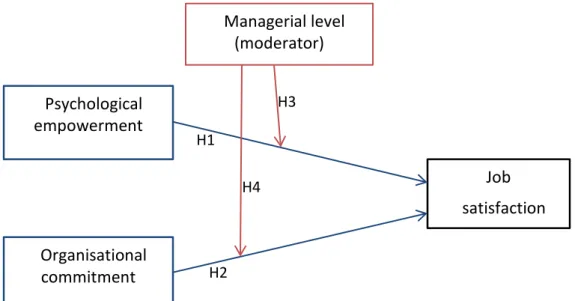
The model proposed for the current study examining the association between manager’s perception of the degree of their psychological empowerment dimensions and a manager’s perception of the degree of their organisational commitment dimensions and their job satisfaction is shown in Figure 1 below. The model examines the main effects of the association between the abovementioned variables, and then examines how each association is moderated by managerial level. When the relationships are moderated, it will be possible to determine which managerial levels and which dimensions of psychological empowerment and of organisational commitment combine to provide the greatest sources of job satisfaction for managerial employees.
9
Figure 1: The model of organisational commitment, psychological empowerment and job satisfaction—moderated by managerial level.
Psychological empowerment dimensions and job satisfaction
Many studies (e.g. Pelit et al., 2011; Jiang et al., 2011; Carless, 2004) have shown a significant association between psychological empowerment and job satisfaction. These empirically tested quantitative studies examining psychological empowerment and job satisfaction showed a positive significant association between the two variables. Although these studies found that an association exists between these two variables, few of these studies have examined psychological empowerment through all of its four dimensions, or the degree to which each dimension is associated with job satisfaction. Only the study by Carless examined each of the four dimensions of empowerment and found partial support for the association between the dimensions of psychological empowerment and job satisfaction, but senior management’s perceptions were not included in the results of the study.
Therefore, the following hypothesis is provided to examine the association of managers’ perceptions about all four dimensions of psychological empowerment and job satisfaction.
Hypothesis 1: There is a positive significant association between each dimension of a manager’s psychological empowerment (autonomy, impact, competence and meaning) and their level of job satisfaction.
Psychological empowerment Organisational commitment Job satisfaction Managerial level (moderator) H1 H2 H3 H4
10
Organisational commitment dimensions and job satisfaction
Job satisfaction literature that relies on the behavioural and applied psychological streams of research has suggested factors such as organisational commitment to explain an association with job satisfaction. Prior evidence provides mostly positive but also some mixed results about the association between organisational commitment and job satisfaction (Carson et al., 1999). Most findings support a positive association between organisational affective commitment and job satisfaction (Farkas & Tetrick, 1989; Currivan, 1999; Huang & Hsiao, 2007) but often find no association or a negative association between organisational continuance commitment and job satisfaction.
Organisational commitment includes concepts about work-based attitudes or beliefs that indicate the extent to which an individual identifies with, or feels an attachment to, a particular organisation (Steers, 1977). Organisational commitment characterises the employee’s relationship with the organisation; and it inculcates blending employees’ individual values with those shared by their organisation, their desire to remain involved with and exert effort for the organisation and their willingness to remain working for their organisation (Meyer & Allen, 1997; Mowday et al., 1979). Therefore, when organisational commitment results in employees remaining with their organisation because they have a high level of job satisfaction, the organisation is expected to gain benefit from such commitment. It has been suggested that organisational commitment forms as employees begin working in their chosen work environment; the employee then feels satisfied based on the extent of organisational commitment that they hold after being awarded the job position (Matthieu, 1991). Job satisfaction may develop further when the committed employee strives for and achieves certain goals (and, perhaps, is commended for such achievement). The employee may reflect on their work achievements and feel a sense of satisfaction. This type of organisational commitment is called affective commitment (Meyer & Allen, 1997).
Another type of organisational commitment is called continuance commitment, which is commitment experienced by employees when the costs of leaving the organisation outweigh those of maintaining their current organisational membership (Meyer & Allen, 1997). Both Kalbers & Fogarty (1995) as well as Yousef (2000) found a significant negative association between continuance commitment and job attitudes in the workplace, while Ketchand and Strawser (1998) found that continuance commitment was unrelated to job attitudes.
11
Therefore, when a manager has affective commitment to their organisation, their feeling of connection to the organisation’s purposes and goals is expected to lead to a feeling of satisfaction about participating in their job role. However, when a manager has continuance commitment to their organisation, its association with job satisfaction is unclear. Consequently, while managers with affective commitment to their organisation’s purposes and goals are likely to be relatively concerned about what they can contribute to their organisation through their feeling of job satisfaction, it is unclear how managers with continuance commitment will behave based on their feeling of job satisfaction. Evidence by Poznanski and Bline (1997) and Lund (2003) found that organisational commitment precedes job satisfaction. Therefore, the following hypothesis is advanced to enable an examination of the association of perceptions about the types of organisational commitment dimensions and job satisfaction.
Hypothesis 2: There is a positive significant association between the dimensions of a manager’s affective commitment and continuance commitment and their level of job satisfaction.
Moderating effect of managerial level on psychological empowerment dimensions
Prior studies have varied in their support for an association between psychological empowerment and job satisfaction (Pelit et al., 2011; Jiang et al., 2011; Carless, 2004). In addition to these prior studies using inconsistent treatment of psychological empowerment as one-dimensional or multi-dimensional variables, this variation may be due to these studies collecting data from employees at differing organisational levels. Different situational experiences in the workplace may be due to differences in organisational climate or due to the employee’s different managerial level within the organisation’s functional areas (Mowday
et al., 1982; Meyer & Allen, 1991). Additionally, there may be variation in leadership styles of managers who are required to supervise the staff of different functional areas, where some managerial styles may be more effective for certain functional areas (Turner et al., 2009). For example, managers who supervise a group of highly skilled professional staff may need different leadership styles for such staff to feel committed and empowered compared with the leadership styles required for managers who supervise unskilled workers in a manufacturing or service setting.
12
Failure to consider the different levels of management, or the interaction effect that these different organisational levels and psychological empowerment dimensions may have on job satisfaction, may confound prior research results. Inconsistent prior findings may be due to lower-level employees having a different sense of empowerment compared to the middle-level and senior-middle-level managers or chief executive officers (CEOs) within an organisation. However, except for Carson et al. (1998),3 no empirical study has been found that examined whether managerial level acts as a moderating variable with the psychological empowerment dimensions on job satisfaction. Consequently, this study focuses on the interaction effect of managerial level within an organisation and psychological empowerment dimensions on job satisfaction. It is important to identify how managerial level affects the empowerment dimensions and its interaction effect on job satisfaction because of the identified subsequent effect on job satisfaction.4 Managerial level is also examined because job satisfaction might be unequally perceived at different managerial levels within an organisation due to different situational experiences within the workplace.
An examination of how managerial level interacts with psychological empowerment dimensions and affects job satisfaction could be an important indicator of how an organisation may specifically and purposefully tailor its systems, procedures and policies to enhance job satisfaction at each organisational level. That is, according to Yoon’s (2001) structural approach, an organisation may specifically design their systems, procedures and policies to enhance perceived empowerment to improve job satisfaction. In this way, job satisfaction may be achieved in different ways for different levels of managers through the interaction effect of manager’s level and the dimensions of psychological empowerment. Finally, prior research has grouped employees together when analysing the association between psychological empowerment and job satisfaction (Pelit et al., 2011; Jiang et al., 2011). Although the sample used by Carless (2004) was derived from employees across various levels of the organisation, there is no evidence that Carless selected respondents from senior managerial positions to gain their perceptions of how they are empowered in their organisations. Consequently, additional evidence is necessary to determine whether interaction effect of manager’s level and the dimensions of psychological empowerment on
3
Carson et al., (1998) collected data from nursing supervisors. They did not assess these supervisors’ perception of their own job satisfaction but their perception of operational staff’s level of job satisfaction.
4 Although outside the scope of this study, it is important to identify that the subsequent effect of job satisfaction has been found to be increased performance (Karatepe, 2012) and organisational citizenship behaviours (Paillé, 2011), and may have top-down effects on subordinates, and may also permeate throughout the organisation.
13
job satisfaction may provide some explanation for the inconsistent findings for the empowerment to job satisfaction relationship in prior studies. This suggests the third hypothesis.
Hypothesis 3: There is a positive significant association between each dimension of a manager’s psychological empowerment (autonomy, impact, competence and meaning) and job satisfaction, moderated by managerial level.
Moderating effect of managerial level on organisational commitment dimensions
Different situational experiences and managerial styles in the workplace may be more effective in certain functional areas for employees to feel committed (Mowday et al., 1982; Meyer & Allen, 1991; Turner et al., 2009). Many studies have identified various moderating factors that may affect job satisfaction (e.g. Carr et al., 2003; Parker et al., 2003) but only Carson et al. (1998) has examined the impact of an employee’s position or level in relation to its impact on job satisfaction, but not managerial level and organisational commitment on job satisfaction.
Prior evidence about the association between organisational commitment and job satisfaction provides mostly positive, but also some mixed results (Farkas & Tetrick, 1989; Carson et al., 1999; Currivan, 1999; Huang & Hsiao, 2007). Some of these mixed findings may be explained by managerial level because managers at different levels, who are responsible for how well their departments function, may experience commitment based on their workplace goals, situations and pressures, which may subsequently affect their level of job satisfaction. However, these studies have not separated the respondents into the level of their position within the organisation, but rather have grouped all employees together for their analysis. Therefore, no study to date has examined the moderated effect of managerial level and organisational commitment (affective or continuance commitment) on job satisfaction. Consequently, it is important to determine the moderated effect of managerial level and which types of organisational commitment have the greater impact on job satisfaction.
It is specifically important to identify the managerial level and organisational commitment interaction effect on job satisfaction because there may be a flow down effect to employees who are subordinate to that manager. Managerial commitment and job satisfaction may potentially lead to a better organisation climate if the sense of commitment and job satisfaction permeates throughout the entire organisation. If the association between
14
organisational commitment and job satisfaction differs between manager levels, evidence identifying which managers experience the greatest level of job satisfaction will be useful because it may allow organisations to develop specific resources that facilitate the appropriate organisational commitment dimensions for each managerial level that is associated with job satisfaction. This suggests the fourth hypothesis:
Hypothesis 4: There is a positive significant association between both dimensions of a manager’s organisational commitment (affective commitment and continuance commitment) and their level of job satisfaction, moderated by managerial level.
Research method
The sample frame used for this study comprised Australian private sector organisations that consisted of medium to small publicly listed companies and private, unlisted companies. Companies were selected based on their capacity to employ 250 or more staff.5 The dataset of companies consisted of a sample of managers from 1602 companies within industries such as manufacturing, retail, service and mining. The final number of participants for the study comprised 301 managers within Australian companies.
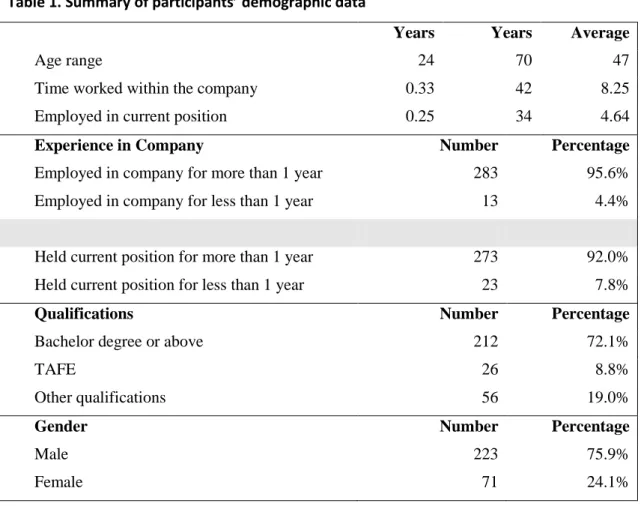
The demographic information of the managers who participated in the study is summarised in Table 1. Demographically, the managers in the study reported ages ranging from 24 years to 70 years. In total, 294 managers chose to report their gender, comprising 223 (76%) male and 71 (24%) female. On average, managers had worked for their company for a mean number of 8.25 years (with a range of 4 months to 42 years) and they had been employed in their position for a mean of 4.64 years (with a range of 3 months to 34 years). An overwhelming majority of managers reported being employed by their organisation for greater than one year (283 managers or 96%), while 273 managers (92%) had held their position for more than one year. Because of the low number of respondents who had worked for less than one year, these respondents were not excluded from the sample.6 The 294 managers from these organisations held various formal qualifications, with 212 (72%) holding a bachelor degree or above, 26
5 Initially, a sample of organisations was selected that regularly employed 100 or more staff members. However,
a closer investigation of the middle management positions listed by organisations with 100 to 250 employees revealed that many of the smaller firms did not indicate the employment of a human resource manager or financial controller position, which were key job roles targeted for survey completion in the current study. Therefore, it was considered appropriate to select organisations with 250 or more employees, as these
organisations more consistently indicated holding such management positions within their organisational ranks. Prior management accounting studies have reported to have surveyed companies employing 200 or more employees (Hall, 2008; Lillis, 2002, 2010).
6 Iverson (1996) found that employees who held their position for a relatively short time tend to have greater
acceptance of organisational change, which is also positively associated with organisational commitment. Such factors may tend to compensate for lower levels of experience.
15
(9%) holding a TAFE-level certificate, while 56 respondents (19%) held either no formally recognised qualification or some other form of qualification.
Table 1. Summary of participants’ demographic data
Years Years Average
Age range 24 70 47
Time worked within the company 0.33 42 8.25 Employed in current position 0.25 34 4.64
Experience in Company Number Percentage
Employed in company for more than 1 year 283 95.6% Employed in company for less than 1 year 13 4.4%
Held current position for more than 1 year 273 92.0% Held current position for less than 1 year 23 7.8%
Qualifications Number Percentage
Bachelor degree or above 212 72.1%
TAFE 26 8.8%
Other qualifications 56 19.0%
Gender Number Percentage
Male 223 75.9%
Female 71 24.1%
To identify how the term ‘managerial level’ was defined for the study, participants who took part in the research were managers who held one of three types of managerial positions. The three types of managers that were asked to participate in the study were either human resource managers, chief financial officers or CEOs. The number or managers in each type of managerial position are listed in Table 2.
Table 2: Number of managers for each managerial type
Type of manager Number included in the study
Chief financial officer 108
Human resource manager 70
16 Testing for bias within the sample
The independent variables of the study were examined to determine whether there were differences based on organisational size, where size was measured using the number of employees because the employees’ managerial level was a key focus of the current study. First, the number of employees was converted to the natural log of the number of employees in SPSS, to deal with the positive skew of the data.7 Then the data were examined to determine the existence of bias between large and small companies. Companies were divided into large versus small. When testing all of the independent variables of the study, no significant difference between large companies and small companies was revealed.
The data were also tested to determine bias based on the type of industry. An industry’s business activities were categorised as either manufacturing or non-manufacturing types of industry. The results showed no significant differences for each of the independent variables, indicating that these results may be generalised across manufacturing and non-manufacturing industries.
Non-response bias
A non-response bias test was undertaken using the early and late responses received from participants (as suggested by Oppenheim (1966)). Answers to the questionnaire provided by early respondents with those made by late respondents were compared with each other. The survey instruments were mailed to participants. The first 20% of surveys that were received within the first two weeks of being mailed out were included in the group of ‘early’ responses, while the last 20% of responses received were noted as ‘late’ responses. T-tests revealed that there were no significant differences between any of the independent variables of the study.8
Survey administration
A questionnaire survey was developed for this study, along with a postcard system. The postcard system allows participants to indicate independently that they had responded to the
7 This is consistent with Dossi and Patelli (2010) who measured subsidiary size using the natural logarithm of
the total number of employees in the subsidiary company.
8 To ensure that there was no bias in the results due to the respondents working in different job positions, the
first 20% and the last 20% of respondents who identified themselves as being CFOs were included in the analysis. Similarly, the first and last 20% of HRM and CEO respondents were included for testing whether there was any non-response bias. The respondents comprised 60 early respondents (20 from each of CFO, HRM and CEO) and 60 late respondents. Huang (1992) used the top and bottom 20% of the mean days for return of the completed questionnaire for the early and late respondents.
17
survey, while maintaining anonymity relating to their responses.9 Completion and return of the questionnaire indicated consent that the participant agreed to take part in the study. Response rate
Managers from a total of 1602 companies were asked to participate in the survey.10 Eighty managers stated that they declined to participate in the survey. A total of 317 managers returned their surveys for inclusion in the study, which represents an initial response rate of 20%. Of the returned surveys, 16 respondents provided incomplete responses, which could not be used for valid statistical analysis and, consequently, were discarded. Thus, the final number of useable responses received amounted to 301 participants providing a final response rate of 19% as seen in Table 3.
Table 3. Participants’ response rates
Number Percentage Number of surveys sent, less number returned
unclaimed 1602 100.0%
Number of responses returned 317 19.7%
Number of useable responses 301 18.7%
Variable measurement
Psychological empowerment measures
Psychological empowerment has been identified as comprising four dimensions. These are competence, autonomy (self-determination or choice), impact (influence) and meaningfulness (Thomas & Velthouse, 1990; Spreitzer, 1995). These four constructs are defined and described in the following way. Competence is an employee’s feelings of empowerment by identifying their feelings of competence to be able to complete their work accurately and knowledgeably. Autonomy is the employee’s sense of being delegated choice or autonomy in the way they carry out their work role, which allows an employee a sense of self-determination. The construct of impact makes an employee feel empowered when they have ability to influence people, or influence decisions and situations in their work environment. Finally, meaningfulness of the work makes an employee feel that they are able to create a
9 The postcard system allows the respondent to nominate that they have completed a questionnaire for the study.
The postcard indicating the respondent’s name is posted in a separate envelope from the envelope containing the questionnaire, keeping the questionnaire responses anonymous.
10
Letters of invitation for 456 companies of the 2058 letters sent to companies were returned unclaimed and were not included in the study.
18
product or service that provides an outcome that has meaning because for the employee the outcome has value.
The survey instrument used to measure the competence dimension of psychological empowerment described above is adapted from Spreitzer (1995) and Gist (1987). The remaining three dimensions, self-determination (autonomy), impact (influence) and meaningfulness were used by Spreitzer (1995), but originated from other instruments.11 All four measures of empowerment have been used in management accounting research that examines performance measurement systems and employee performance (Hall, 2008; Drake
et al., 2007).
Each participant was asked to rate their perceived level of psychological empowerment using a 7-point Likert-type scale anchored at both ends with 1 = strongly disagree to 7 = strongly agree. Each participant answered several items in the questionnaire concerning each dimension of empowerment: competence, autonomy, influence and meaningfulness.
Four factors emerged following an orthogonal Varimax rotated factor analysis for the twenty-three-item instrument. Together, the four factors explain 76.82% of the total variance. The KMO measure of sampling adequacy was 0.913, which is well above the required level of 0.6, and Bartlett’s test of sphericity was significant (p < 0.001), confirming the suitability and validity of the data for factor analysis. The internal reliability measures for these four factors were consistently very strong, with Cronbach Alpha results for competence at 0.928; autonomy at 0.913; impact at 0.938; and meaningfulness at 0.945.
Organisational commitment measures
Organisational commitment has been conceptualised as an ‘affective attachment’ to the organisation (Meyer & Allen, 1984) and is considered to be characterised by shared values held between the individual and their organisation, a desire to maintain membership with their organisation and a willingness to exert effort on behalf of the organisation (Mowday et al., 1979). Organisational commitment was originally conceptualised as a three-component model, as devised by Meyer and Allen (1997), comprising affective, normative and
continuance commitment.
The measure of normative commitment is not used for the present study because Randall (1990) suggested that normative commitment may be highly correlated to both attitudinal and
11
The extent of psychological empowerment experienced by the employees was measured by a twelve-item instrument validated by Spreitzer, which requires responses to a seven-point scale.
19
affective commitment. Consequently, Meyer and Allen’s two-component model (affective and continuance commitment) is used to measure organisational commitment in this current study.12 The two-component model of organisational commitment has been used in accounting research to examine how an employee’s level of organisational commitment affects various facets of employee behaviour in an accounting environment (see Smith & Hall, 2008; Viator & Pasewark, 2005; Fogarty & Kalbers, 2006).
Organisational commitment was measured by assessing respondents’ perceived level of organisational commitment on a 7-point Likert-type scale anchored at both ends, where 1 = strongly disagree and 7 = strongly agree. The survey instrument included several items regarding each of the two dimensions of organisational affective and continuance commitment. The results show that two factors emerged from an orthogonal Varimax rotated factor analysis. Together, both factors explain 53.95% of the total variance. The Kaiser-Meyer-Olkin (KMO) measure of sampling adequacy was 0.828, which is greater than the required level of 0.6, while Bartlett’s test of sphericity was significant, confirming the suitability and validity of the data for factor analysis. The measure of internal reliability for both factors was strong, with the Cronbach Alpha for affective commitment being 0.818, and for continuance commitment being 0.797. Z-scores were constructed for the two factors of organisational commitment to enable regression analysis of the variables of the study.
Managerial level
The construct of managerial level was categorised into three levels of management. The three levels that were identified for managers to hold for the current study were (1) human resource managers, (2) chief financial officers or chief accountants and (3) chief executive officers. Each participant had to indicate which of these categories they fell into for their responses to be included in the analysis.
Job satisfaction
The dependent variable, job satisfaction, was measured using a single item measure, which asked respondents to rate their level of job satisfaction on a Likert-type scale of 1 to 7. Similar to previous items of the survey instrument, the Likert-type scale was anchored at both ends, where 1 = strongly disagree and 7 = strongly agree.
12
This two-factor model was used in accounting research by Fogarty and Kalbers (2006) in their study of the behavioural consequences of internal auditor burnout.
20 Regression diagnostics
Linearity, homoscedasticity, independence of residuals and normality
Homoscedasticity and independence of residuals assumptions can be checked by observing the standardised residual plot for each of the factors of the independent variables. The probability plot of the standardised residuals indicated that points are independent and are not related to each other, and follows the cumulative probabilities for each factor. Also, there is no fanning out or other systematic behaviour of the residuals, which means there is no violation of the homoscedasticity assumption (Pedhazur, 1997). Thus, there is no violation of the assumptions of independence of residuals or homoscedasticity for the dataset of the study. The assumption of linearity can be checked by observing the scatterplot of the independent variables of the study. This plot exhibits a random scatter of points, around the line of best fit, indicating that the data appear to be normally distributed and linear in nature, showing no violation of the assumptions for regression analysis.
Normality within the data of the regression model may also be checked by looking at a histogram or a normal probability plot of the residuals (Pedhazur, 1997). The normal probability plot appears normally distributed, indicating that there is no violation of the assumption for normality, and the regression analysis is subsequently valid and robust for the range of data contained in this data set.
Results
The results of the analysis indicating the association between psychological empowerment, organisational commitment and job satisfaction, moderated by managerial level are described in this section. Firstly, the results of the un-moderated main effects of the association between psychological empowerment and job satisfaction, and organisational commitment and job satisfaction will be discussed. These results relate to Hypotheses 1 and 2. Secondly, the results of the association between psychological empowerment, organisational commitment and job satisfaction, moderated by managerial level will be discussed, which pertain to Hypotheses 3 and 4.
The variables for this study’s model were tested using Ordinary Least Squares (OLS) regression analysis. Two of the independent variables, psychological empowerment and organisational commitment, were measured using a multiple-item instrument. These two measures were factor analysed, and Z-scores were then generated for use in the regression analysis. The research hypotheses aim to identify differences between psychological
21
empowerment, organisational commitment and job satisfaction, and whether managerial positional level influences that association.
Accordingly, the first regression equation is written to reflect the main effects of the association between the dimensions of psychological empowerment and job satisfaction, and also organisational commitment and job satisfaction:
Equation 1: Hypotheses 1 and 2 (main effects):
Y = β0 + β1X1 + β2X2 + β3X3 + β4X4 + β5X5 + β6X6 + ε Where: Y = job satisfaction β0 = constant X1 = affective commitment X2 = continuance commitment X3 = competence X4 = autonomy X5 = impact X6 = meaningfulness ε = error variable
The second regression equation is written to reflect the moderated associations between the dimensions of psychological empowerment and job satisfaction, and also organisational commitment and job satisfaction and the moderating effect of managerial level:
Equation 2: Hypotheses 3 and 4 (moderated associations):
Y = β0 + β1X1 + β2X2 + β3X3 + β4X4 + β5X5 + β6X6 + β7X1ML1 + β8X1ML2 + β9X1ML3 + β10X2ML1 + β11X2ML2+ β12X2ML3+ β13X3ML1 + β14X3ML2 + β15X3ML3 + β16X4ML1 + β17X4ML2 + β18X4ML3 + β19X5ML1 + β20X5ML2 + β21X5ML3 + β22X6ML1 + β23X6ML2 + β24X6ML3 + ε Where: Y = job satisfaction β0 = constant X1 = affective commitment X2 = continuance commitment X3 = competence X4 = autonomy X5 = impact X6 =meaningfulness
ML1 = chief executive officer ML2 = chief financial officer ML3 = human resource manager
22
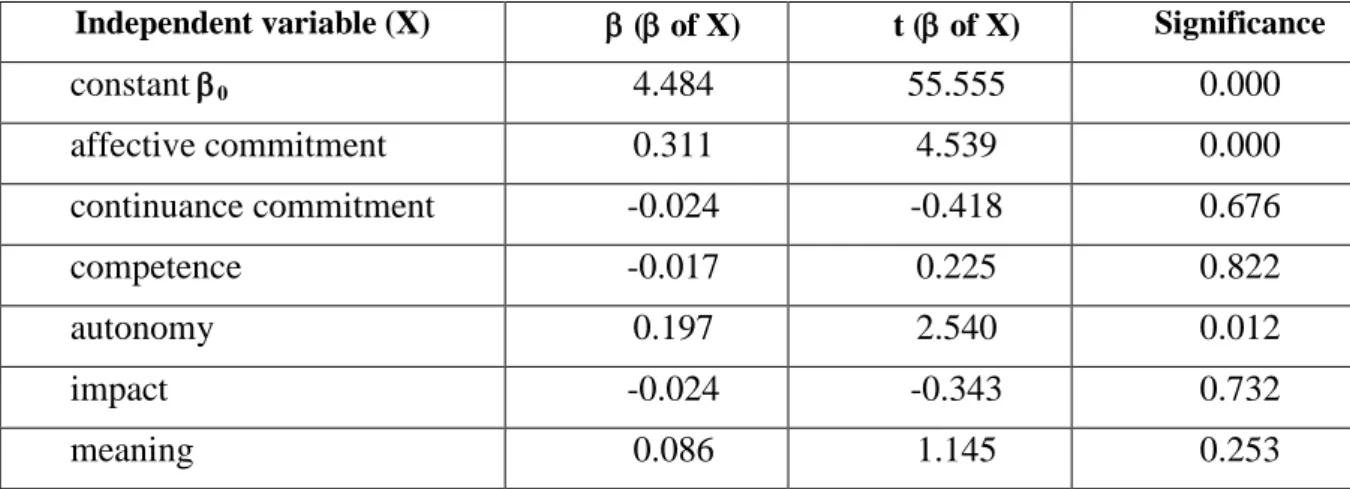
The results of the regression analyses for the first equation testing Hypotheses 1 and 2 are shown in Table 4 below. These results relate to the main effects of the association between organisational commitment and job satisfaction, and psychological empowerment and job satisfaction. The standardised coefficients of the β-values and their corresponding t-values and significance levels are shown in Tables 4 and 5.
The overall model for Equation 1 is significant with an F value of 12.151; P = 0.000. The Adjusted R2 value is 0.193 or 19.3%, which means that 19.3% of job satisfaction is explained by organisational commitment and psychological empowerment.
Table 4. Results for the main effects of the association of organisational commitment and psychological empowerment
Independent variable (X) β (β of X) t (β of X) Significance
constant β0 4.484 55.555 0.000 affective commitment 0.311 4.539 0.000 continuance commitment -0.024 -0.418 0.676 competence -0.017 0.225 0.822 autonomy 0.197 2.540 0.012 impact -0.024 -0.343 0.732 meaning 0.086 1.145 0.253
The results of the regression analyses for Hypothesis 1 reveal partial support for the associations between the dimensions of psychological empowerment and job satisfaction. Specifically, there is a significant association between the autonomy dimension of psychological empowerment and job satisfaction (β = 0.197; p = 0.012). However, no significant association was found between the other empowerment dimensions: competence, influence, meaningfulness and job satisfaction.
Regression analyses for Hypothesis 2 reveal that the main effects of the association between organisational commitment and job satisfaction are also partially supported. Specifically, there is a significant positive association between the affective commitment dimension of organisational commitment and job satisfaction (β = 0.311; p < 0.001). However, there is no significant association between continuance commitment and job satisfaction, and the results show a negative or inverse sign for the association with continuance commitment.
23
An examination of the moderating role of managerial level is made to determine whether working as a human resource manager, chief financial officer or chief executive officer affects the association between psychological empowerment or organisational commitment and the level of job satisfaction.
24
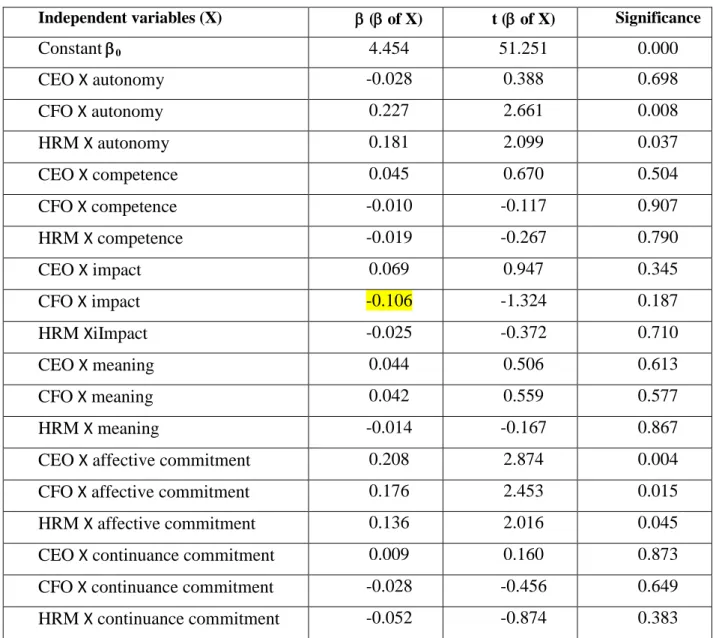
Table 5. Results for the moderating effect of managerial level on organisational commitment and psychological empowerment
Independent variables (X) β (β of X) t (β of X) Significance
Constant β0 4.454 51.251 0.000 CEO X autonomy -0.028 0.388 0.698 CFO X autonomy 0.227 2.661 0.008 HRM X autonomy 0.181 2.099 0.037 CEO X competence 0.045 0.670 0.504 CFO X competence -0.010 -0.117 0.907 HRM X competence -0.019 -0.267 0.790 CEO X impact 0.069 0.947 0.345 CFO X impact -0.106 -1.324 0.187 HRM XiImpact -0.025 -0.372 0.710 CEO X meaning 0.044 0.506 0.613 CFO X meaning 0.042 0.559 0.577 HRM X meaning -0.014 -0.167 0.867
CEO X affective commitment 0.208 2.874 0.004
CFO X affective commitment 0.176 2.453 0.015
HRM X affective commitment 0.136 2.016 0.045
CEO X continuance commitment 0.009 0.160 0.873 CFO X continuance commitment -0.028 -0.456 0.649 HRM X continuance commitment -0.052 -0.874 0.383
The results of testing Hypothesis 3 show partial support for the association between psychological empowerment and job satisfaction, moderated by managerial level. Specifically, there is a significant positive association between the autonomy dimension of psychological empowerment and job satisfaction for chief financial officers (β = 0.227; p = 0.008). That is, chief financial officers perceive significantly greater job satisfaction when they are given greater levels of autonomy. Similarly, the results show a significant positive association between autonomy and job satisfaction for human resource managers (β = 0.181; p = 0.037). This indicates that human resource managers feel a greater sense of job satisfaction when they are given greater levels of autonomy in their workplace. However, none of the managerial levels perceived a significant association between any of the other
25
dimensions of empowerment (competence, influence and meaningfulness) and job satisfaction.
The results of testing Hypothesis 4 show full support for the association between affective commitment and job satisfaction, moderated by managerial level. There are significant positive associations between the affective commitment dimension of organisational commitment and job satisfaction for each of the three managerial levels: chief executive officer (β = 0.208; p = 0.004), chief financial officer (β = 0.176; p = 0.015) and human resource manager (β = 0.136; p = 0.045). That is, when each manager has a greater level of affective commitment for their organisation, they feel a greater sense of job satisfaction. The results also reveal that there are no significant associations between continuance commitment and job satisfaction for any of the three managerial levels.
In summary, the results of investigating Hypothesis 1 show overall support for an association between autonomy and job satisfaction. However, the results of testing Hypothesis 3 show that the association between autonomy and job satisfaction is particularly important for chief financial officers and human resource managers rather than for chief executive officers. Also, while the results of testing Hypothesis 2 show overall support for an association between affective commitment and job satisfaction, the results of testing Hypothesis 4 reveal that each specific managerial level feels a connection between affective commitment and increased job satisfaction, but no statistically significant sense of continuance commitment and job satisfaction.
Conclusion and discussion
The results of testing the hypotheses of this study indicate that it is important for chief financial officers and human resource managers to be given a considerable degree of autonomy in their work roles so that they can feel a sense of job satisfaction in the workplace. The result for chief financial officers is consistent with case study findings of big accounting firms by Covaleski et al. (1998), who found that accounting firm partners were unwilling to discard their professional autonomy for the greater good of the firm that wanted to change procedures due to a change in strategy. They found that when the firm required professional accountants to give up their autonomy over the way they conducted their basic activities, the accountants resisted such control over their activities. In essence, the case study observations concluded that accountants did not desire to work as practice partners, but as autonomous
26
professionals. Also McCue and Gianakis (1997) found that financial officers who held a professional approach or attitude were more likely to cope with the ever-increasing need for sophistication of techniques used in the workplace and experience job satisfaction. The professional approach may have been largely due to these financial officers perceiving a greater degree of autonomy compared with those financial officers who did not perceive having sufficient autonomy to use the new techniques to provide the information that they required for decision making. The results of the current study add to these prior research results by showing that when chief financial officers have more autonomy, they perceive greater job satisfaction.
Moye and Henkin (2006) found no association between empowerment and various employee levels moderated by their degree of managerial trust, yet when they examined the association between each component of empowerment they found a significant moderated association between autonomy (self-determination) and trust. However, their study examined lower levels of employees rather than managers.
The result for human resource managers identifying autonomy as a key determinant of job satisfaction is consistent with Guest (1995), who argued that autonomy and self-determination rather than hierarchy and managerial control are the main characteristics of human resource management. A descriptive study by Mamman and Rees (2004) showed human resource managers rating eight ways that they felt rewarded in their work, including two financial and six non-financial rewards (including autonomy). Their results showed that the single, most important reward for human resource managers was autonomy. Also, autonomy has been positively associated with perceived organisational effectiveness (Zellars & Fiorito, 1999). The results found by Mamman and Rees, and Zellars and Fiorito indicated that human resource managers perceive a real need for autonomy in their workplace and their job role, but they did not assess whether this subsequently leads to job satisfaction. Therefore, the results of the current study indicating that autonomy subsequently provides human resource managers with job satisfaction adds to prior findings by showing that in the presence of autonomy, human resource managers have a greater level of job satisfaction.
The results for chief executive officers show that they do not feel a significant need for autonomy in their work roles compared to the other two levels of management. The results for chief executive officers may seem surprising, but perhaps the non-significant results indicate that chief executive officers do not feel a need to be given greater autonomy because
27
their role, by definition, already holds the greatest degree of autonomy compared with any of the other work roles.
Surprisingly, none of the other dimensions of psychological empowerment in the study were related to a manager’s sense of job satisfaction. This means that neither competence, influence in the workplace, meaningfulness in the type of work done or the outcomes of managerial decision making provide any of the three managerial levels with a strong sense of job satisfaction.
The results testing the main effects of the association between organisational commitment and job satisfaction show that only affective commitment has any significant association with job satisfaction, which is consistent with past research findings (Farkas & Tetrick, 1989; Currivan, 1999; Huang & Hsiao, 2007). However, continuance commitment shows a non-significant negative associated with job satisfaction, consistent with Ketchand and Strawser’s (1998) results. When examining the moderating role of managerial level, there is a significant positive association between affective commitment and job satisfaction for every level of management, indicating that it is very important for all managerial employees to feel affective commitment toward their organisation to derive a sense of job satisfaction in their work role.
The results showing the association between continuance commitment and job satisfaction for each managerial level reveal non-significant negative associations for human resource managers and for chief financial officers, which is not surprising in the light of the results seen in Hypothesis 2.13 Continuance commitment indicates that a respondent has a sense of needing to continue in their current employment due to feeling that it is too difficult to find similar work elsewhere. Thus, a negative expression of continuance commitment indicates a feeling of not needing to continue in one’s current employment due to difficulties finding similar work elsewhere, but feeling confident to leave current employment if it is unsuitable, indicating that human resource managers and chief financial officers feel confident of being employed elsewhere.
Overall, the results suggest that when managers have affective commitment and feel that they have autonomy, at each managerial level they experience greater job satisfaction. This indicates that job satisfaction is lower when organisations deal with the agency problem by decreasing the degree of managerial autonomy. Therefore, if an organisation finds that job
28
satisfaction may act as an informal mechanism that reduces the agency problem (i.e. where satisfied managers seek to provide organisational gain and do not use information asymmetry for personal gain), then they may consider increasing the level of managerial autonomy in situations where such managers also demonstrate affective commitment for their organisation.
Limitations and future direction
The limitations of this study relate to the usual caveats that arise from using cross-sectional survey data collected through questionnaires completed by individuals in a workplace setting.
A limitation of the study arises because the moderating variable of managerial level is divided into only three parts. That is, there are many more positional levels within an organisation than human resource manager, chief financial officer and chief executive officer. Other managerial positions were not examined within this study, and so there may be different perceptions held by managers who work in different occupational managerial roles such as the perceptions of the production manager or the marketing manager. Also, lower level employees were not surveyed in the study; but they, too, may hold different perceptions of empowerment and commitment compared to those of the three managerial levels surveyed in this study.
The model may be underspecified as there may be additional variables that contribute to a manager’s job satisfaction, which exist concurrently with psychological empowerment and organisational commitment. As identified in the introduction of this paper, there are many variables associated with job satisfaction which may directly, or indirectly, mediate or moderate the level of job satisfaction that a manager experiences. For example, future research could focus on the association between organisational commitment, psychological empowerment and outcome variables such as employee productivity, absenteeism or turnover intention.
Finally, a longitudinal study could be used in future research to capture any cyclical nature of the variables. In this way, a longitudinal study could help determine whether, for example, organisational affective commitment leads to job satisfaction, which leads to greater affective commitment, and so on. Similarly, it has not been identified if there is a longitudinal, cyclical association between psychological empowerment and job satisfaction.
29 References
Aydogdu, S. and B. Asikgil (2011) “An Empirical Study of the Relationship among Job Satisfaction, Organizational Commitment and Turnover Intention”, International Review of Management and Marketing, Vol. 1, No. 3, pp. 43–53.
Carless, S. A. (2004) “Does Psychological Empowerment Mediate the Relationship between Psychological Climate and Job Satisfaction?” Journal of Business and Psychology, Vol 18, No. 4, pp. 405–425.
Carr, J. Z., Schmidt, A.M., Ford, J. and R.P. DeShon (2003) “Climate Perceptions Matter: A Meta-analytic Path Analysis Relating Molar Climate, Cognitive and Affective States, and Individual Level Work Outcomes”, Journal of Applied Psychology, Vol. 88, No. 4, pp. 605– 619.
Carson, K. D., Carson, P.P., Roe, C.W., Birkenmeier, B.J. and J.C. Phillips (1999) “Four Commitment Profiles and Their Relationships to Empowerment, Service Recovery, and Work Attitudes”, Public Personnel Management, Vol. 28, No.1, pp. 1–13.
Carson, P.P., Carson, K.D., Yallapragada R. and C.W. Roe (1998) “Nursing Supervisors' View through Rose-colored Glasses: An Overestimation of Employees' Positive Attitudes”,
The Health Care Supervisor, Vol. 16, No. 4, pp. 68–74.
Covaleski, M. A., Dirsmith, M. W., Heian, J. B. and S. Samuel (1998) “The Calculated and the Avowed: Techniques of Discipline and Struggles over Identity in Big Six Public
Accounting Firms”, Administrative Science Quarterly, Vol. 43, No. 2, pp. 293–327. Currivan, D.B. (1999) “The Causal Order of Job Satisfaction and Organisational
Commitment in Models of Employee Turnover”, Human Resource Management Review, Vol. 9, No. 4, pp. 495–524.
Dickson, K.E. and A. Lorenz (2009) “Psychological Empowerment and Job Satisfaction of Temporary and Part-time Non-standard Workers: A Preliminary Investigation”, Institute of Behavioral and Applied Management, Vol. 10, No. 2, pp. 166–191.
Dossi, A. and L. Patelli (2010) “You Learn from what You Measure: Financial and Non-financial Performance Measures in Multinational Companies”, LongRange Planning, Vol. 43, No. 4, pp. 498–526.
Drake, A. R., Wong, J. and S.B. Salter (2007) “Empowerment, Motivation and Performance: Examining the Impact of Feedback and Incentives on Non-management Employees”,
Behavioral Research in Accounting, Vol. 19, pp. 71–89.
Farkas, A. J. and L.E. Tetrick (1989) “A Three-wave Longitudinal Analysis of the Causal Ordering of Satisfaction and Commitment on Turnover Decisions”, Journal of Applied Psychology, Vol. 74, No. 6, pp. 855–868.
Fogarty, T.J. and L.P. Kalbers (2006) “Internal Auditor Burnout: An Examination of
Behavioral Bonsequences”, Advances inAccounting Behavioral Research, Vol. 9, pp. 51–86. Guest, D. (1995) Human Resource Management, Trade Unions and Industrial Relations, in J. Storey (ed.), “Human Resource Management: A Critical Text”, London: International Thomson Business Press, pp. 110–141.
Gist, M. (1987) “Self-Efficacy: Implications for Organisation Behaviour and Human Resource Management”, Academy of Management Review, Vol. 12, No. 3, pp. 472-485. Hall, M. (2008) “The Effect of Comprehensive Performance Measurement Systems on Role Clarity, Psychological Empowerment and Managerial Performance”, Accounting, Organizations and Society, Vol. 33, No. 2-3, pp. 141–163.