RESEARCH ARTICLE
NEW ALGORITHM CONCEALS SECRET MESSAGE BASED ON THE INTERNET OF THINGS (IOT)
1, *
Dr. Shatha Habeeb Jafer,
1Dr. Maisa'a Abid Ali, K. and
2Sanaa Ali Jabber
1Computer Sciences, University of Technology, Iraq
2College of Economic and Administration, Al-Muthanna University, Iraq
ARTICLE INFO
ABSTRACT
The Internet of things (IoT) is a network of physical objects, devices, vehicles, buildings, and other items embedded with electronics, software, sensors, and network connectivity that enable these objects to collect and exchange data. When IoT is augmented with sensors and actuators, it can communicate through direct integration of the physical world into computer-based systems, resulting in improved efficiency, accuracy, and economic benefit. This paper offers a new algorithm to hide secret message text from objects or sensors in any media, such as images, text, audio, and video. It uses hidden secret messages in digital images, sending this ‘stego image’ across networks to the server, where the stego image is saved. The hidden secret message in the image is implemented in three steps. In the first step, a watershed filter is applied on a colour image of any size or format. In the second step, a random secret key is generated. Finally, in the third step, the secret message (text) is converted to binary bits, where one bit is hidden in each pixel in the watershed image in least significant bit (LSB) using a secret key and then is saved on the server. The secret key is a random matrix to locate each hidden bit.
*Corresponding author: Dr. Shatha Habeeb Jafer
Copyright © 2019, Shatha Habeeb Jafer et al. This is an open access article distributed under the Creative Commons Attribution License, which permits unrestricted use, distribution, and reproduction in any medium, provided the original work is properly cited.
INTRODUCTION
The evolution of the Internet of things (IoT) has been initiated by the demand of big companies that stand to highly profit
from the vision (Madakam et al., 2015). The capacity to code
and path objects has allowed corporations to become more efficient and fast operations, while allowing them to minimise mistakes, prohibit stealing, and combine complicated and soft organised systems via the IoT (Davies, 2015). The IoT is a technology revolution that represents the outlook of computers and telecommunication, and its evolution relies on the invention of dynamic techniques in numerous significant fields from nano technological areas to wireless sensors. The IoT can be categorised into three categories: (1) people to people, (2) people to instruments/ things, and (3) things/instruments to things/instruments, interacting through the Internet. Data can be concealed in the IoT, using a hidden secret message in images across the IoT (Patel, 2016).
INTERNET OF THINGS
There is no singular definition available for the IoT that is universally accepted by users. In actuality, many sets of
communities involving ‘academicians, researchers,
practitioners, innovators, developers and corporate people’ have defined the term, although its first use is attributed to Kevin Ashton, an expert on digital invention (Drucker, 2015; Hopah and Vayvay, 2018).
The IoT is a new model shift in the IT ring. The Internet is a
global system of interconnectedcomputernetworksthatusethe
Internet protocol suite (TCP/IP) to serve billions of users
worldwide. It is a network of networks that depends on millions of local, global, academic, business, and government networks from private to public that are linked via a wide matrix of electronic, wireless, and optical networking
technologies (Madakam et al., 2015; Drucker, 2018; Abd
Elnapi, 2018).
STEGANOGRAPHY
Digital steganography is the technique and science of concealed connections. A steganographic system embeds secret information in public media to avoid the notice of an eavesdropper (Ismaeel Ibraheem Al-Farraji, 2017; Kumar Sahu and Sahu, 2016). A secure digital connection is a constant concern. Cryptography and steganography are outstanding areas in secure digital connections. It is very hard to imagine that a picture is doing the task of a messenger (Kumar Sahu and Sahu, 2016). Steganography is a section of information-hiding technology that includes applications for protection versus revelation and protection versus elimination, such as ‘copyright protection for digital media, watermarking, fingerprinting and data embedding’ (Pund-Dange and Desai,
2017; Kuo et al., 2015).
ISSN: 0976-3376
Vol. 10, Issue, 03, pp.9528-9532, March,Asian Journal of Science and Technology 2019ASIAN JOURNAL OF
SCIENCE AND TECHNOLOGY
Article History:
Received 28th December, 2018
Received in revised form
15th January, 2019
Accepted 07th February, 2019
Published online 30th March, 2019
Key words:
Internet of things, Steganography, Secret message, Random secret key, Image processing, Watershed filter.
Citation:Dr. Shatha Habeeb Jafer, Dr. Maisa'a Abid Ali K. and Sanaa Ali Jabber, 2019. “Social networking sites the philosophy of changing human
RELATED WORK
In 2014, Kumar, Mishra, and Sharma proposed a system for encryption and decryption of colour images based on RGB to obtain the desired security from various types of attacks. This system uses a random matrix affine cipher (RMAC) combined with discrete wavelet transformation (DWT). This system can bevery efficiently and securely used for transmitting co image data without being seen by an attacker
2014). In 2014, Tukiwala and Degadwala
technique summary by joining the features of ciphering and concealing. Ciphering, using adjusted ASCII transformation and mathematics jobs, includes transforming the secure letter into an unprintable shape of the same volume, such as the main letter of any status. Information hiding thereafter uses a multilevel 2D DWT to embed this cipher data into concealing media using high-frequency coefficients of every distance at each level of a 2D Haar DWT to conceal the presence of the information. Lastly, execution may be measured using the ‘statistical parameter peak signal noise ratio (PSNR) and Mean Square error (MSE)’. The outcome of this technique
all three aspects for hidden data: ‘capacity, security and robustness’ (Tukiwala and Degadwala, 2014).
and Kani proposed a system that encrypts a portion of a secure
image into n shares with decryption performed by a certain
number of portions (k) or more. The secure data can be
restored by anyone who receives at least k portions. The secret
image is undetectable if less than k-1shares are superimposed.
Colour visual cryptography (VC) is used to create a colour halftone image by encrypting the secure colour image. The outcome provides improved reconstructed image quality compared with previous methods. In addition, it make obvious and higher compared to all types of colour images (Haritha and Kani, 2015).
PROPOSED SYSTEM HIDING IN INTERNET OF THINGS
This paper presents a hidden secret message text from an object or sensor (IoT) in an image. The sender can send and save this stego image to the server, whereas the receiver can recover the secret message using a random secret key. This proposed method can be used with two primary algorithms, an embedded algorithm and an extraction algorithm, as shown in Figure 1.
Figure 1. The two steganography algorithms: (a) embedded algorithm (b) extracted algorithm
Figure 2 illustrates the embedded and extraction algorithms in IoT in the proposed system in detail.
The implementation system for hidden secret message text from sensors in the IoT uses three main steps as follows.
First step: Apply watershed filter on the colour image step uses a colour image of any size or format, and the watershed filter is applied on the colour image to transform the In 2014, Kumar, Mishra, and Sharma proposed a system for s based on RGB to obtain the desired security from various types of attacks. This system uses a random matrix affine cipher (RMAC) combined with discrete wavelet transformation (DWT). This system can bevery efficiently and securely used for transmitting colour
image data without being seen by an attacker (Kumar et al.,
Tukiwala and Degadwala suggested a technique summary by joining the features of ciphering and concealing. Ciphering, using adjusted ASCII transformation includes transforming the secure letter into an unprintable shape of the same volume, such as the main letter of any status. Information hiding thereafter uses a multilevel 2D DWT to embed this cipher data into concealing ients of every distance at each level of a 2D Haar DWT to conceal the presence of the information. Lastly, execution may be measured using the ‘statistical parameter peak signal noise ratio (PSNR) and Mean Square error (MSE)’. The outcome of this technique supplies all three aspects for hidden data: ‘capacity, security and ). In 2015, Haritha and Kani proposed a system that encrypts a portion of a secure shares with decryption performed by a certain ) or more. The secure data can be portions. The secret 1shares are superimposed. (VC) is used to create a colour halftone image by encrypting the secure colour image. The outcome provides improved reconstructed image quality compared with previous methods. In addition, it makes obvious and higher compared to all types of colour images
PROPOSED SYSTEM HIDING IN INTERNET OF THINGS
This paper presents a hidden secret message text from an object or sensor (IoT) in an image. The sender can send and save this stego image to the server, whereas the receiver can recover the secret message using a random secret key. This proposed method can be used with two primary algorithms, an embedded algorithm and an extraction algorithm, as shown in
Figure 1. The two steganography algorithms: (a) embedded thm (b) extracted algorithm
Figure 2 illustrates the embedded and extraction algorithms in
implementation system for hidden secret message text from sensors in the IoT uses three main steps as follows.
step: Apply watershed filter on the colour image: This
step uses a colour image of any size or format, and the watershed filter is applied on the colour image to transform the
image to a grey-scale image. As shown in Figure 3, it will be used to hide the secret message.
Figure 2. Steganography system: (a) embedded algorithm, (b) extraction algorithm
(a)
Figure 3. Applied watershed filter on a colour image: (a) original image and (b) watershed
scale image. As shown in Figure 3, it will be secret message.
Figure 2. Steganography system: (a) embedded algorithm, (b) extraction algorithm
(b)
Second step: Generated random secret key: This step generates a random secret key via MATLAB programming, which is in a 4×4 matrix, as follows:
0.9649 0.4854 0.9157 0.0357
0.1576 0.8003 0.7922 0.8491
0.9706 0.1419 0.9595 0.9340
0.9572 0.4218 0.6557 0.6787
(1)
Multiplying the random matrix in matrix (1) by10 results in the following matrix:
9.6489 4.8538 9.1574 0.3571
1.5761 8.0028 7.9921 8.4913
9.7059 1.4189 9.5949 9.3399
9.5717 4.2176 6.5574 6.7874
(2)
The approximation for the random matrix in matrix (2) is as follows:
10 5 9 0
2 8 8 8
10 1 10 9
10 4 7 7
(3)
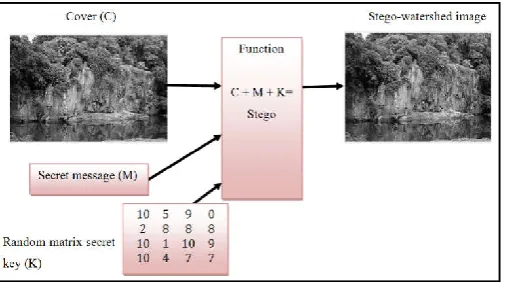
The final matrix in matrix (3) is a random secret key, and each element is found in one location in the watershed image to hide one bit in binary form of the secret message in the least significant bit (LSB).
Third step: Steganography watershed image on the server: This step hides the secret message text from the sensor in the image. It can be used to convert the text of the secret message to binary form using ASCII. Each character in the secret message is represented by8bits, and each bit is added in the LSB for each pixel in the watershed image. Each element selected from the random secret key is located in Equation (3). The watershed image with the concealed random secret key and secret message becomes as tego-watershed image, as shown in Figure 4.
Figure 4. Steganography system for stego-watershed image in IoT
This is sent to the server and remains saved on the server (IoT).When the receiver triesto recover the secret message from the server, it can be used as a random secret key.
Embedding process
Embedding algorithm
Process:
Input: Original image, watershed filter, secret message, sensor, secret key.
Output: Stego-watershed image in server Initial:
A= Load the original image. B= Load the watershed filter. C= Obtain the watershed image. D= Load the random matrix secret key. E= Stego-watershed image.
F= Save the stego-watershed image on the server (IoT). Step 1: Load the original image in A.
Step 2: Apply the watershed filter in B. Step 3: Find the watershed image in C.
Step 4: Select the location to hide the secret message from the random matrix secret key in D.
Step 5: Embed the secret message from the sensor inside the watershed image (cover) in the LSB using the secret key to obtain the stego-watershed image in E.
Step 6: Result saved (save stego-watershed image on the server) in F.
End
Extraction Process
Extraction algorithm
Process:
Input: Stego-watershed image, server, secret key. Output: Secret message.
Initial:
A= Load the stego-watershed image from the server. B= Extract the stego-watershed image.
C= Load the random matrix secret key. D= Extract the binary secret message. E= Secret message
Step 1: Load the stego-watershed image from the server in A. Step 2: Extract the stego-watershed image in B.
Step 3: Find the location from the random matrix secret key in C.
Step 4: Extract the binary secret message from the LSB in the stego-watershed image in D.
Step5: Put the resulting secret message in E. End
TEST RESULTS
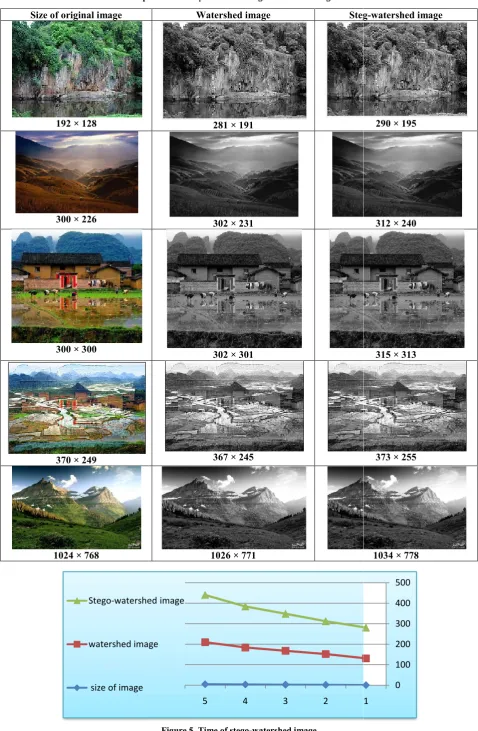
Table 1. Implementation system of the st
Size of original image
192 × 128
300 × 226
300 × 300
370 × 249
1024 × 768
Stego-watershed image
watershed image
size of image
Implementation system of the stego-watershed image on a server
Watershed image Steg
281 × 191
302 × 231
302 × 301
367 × 245
1026 × 771
Figure 5. Time of stego-watershed image
1 2
3 4
5 watershed image
watershed image
watershed image on a server
Steg-watershed image
290 × 195
312 × 240
315 × 313
373 × 255
1034 × 778
0 100 200 300 400 500
CONCLUSION
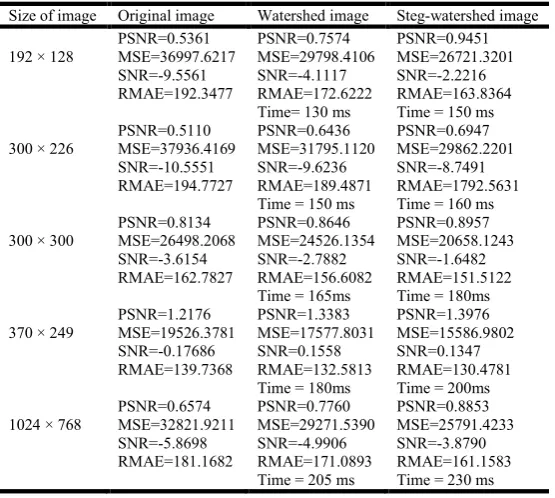
This paper offers a new algorithm in IoT to conceal a secret message on the server on the Internet and networks. This algorithm is fast because it uses a watershed filter and a random matrix secret key. The watershed filter converts the colour image to a grey image to hide a secret message where it cannot be seen by the human eye. The secret message cannot be discovered by attackers during transmission on the server, whereas the secret message remains saved on the server for a long time, and the secret message cannot be discovered by an unauthorised person for access or change. It can allow restoration of the secret message from the server by only an authorised person, the owner of the random secret key. The algorithm is efficient, robust, transparent, and highly secure. The PSNR increases, whereas the MSE decreases, but the SNR and RMAE decrease in the original image, watershed image, and stego-watershed image.
REFERENCES
AbdElnapi, N.M.M., N.F. Omran, A.A. Ali, and F.A. Omara, 2018. A Survey of Internet of Things Technologies and
Projects for Healthcare Services, International Conference
on Innovative Trends in Computer Engineering
(ITCE2018), pp. 48-55.
Davies, R. 2015. The Internet of Things Opportunities and Challenges, European Parliamentary Research Service. Drucker, P. F. 2015. Internet of Things: Position Paper on
Standardization for IoT Technologies, IERC, book.
Haritha, P.G. and M.M. Kani, 2015. A New Visual
Cryptography Technique For Color Images, International
Journal For Trends in Engineering and Technology, Vol.
4,No. 2, ISSN: 2349-9303.
Hopah E. and O. Vayvay, 2018. Internet of Things (IoT) and its Challenges for Usability in Developing Countries,
International Journal of Innovation Engineering and
Science Research, pp. 6-9.
Ismaeel Ibraheem Al-Farraji, O. 2017. New Technique of
Steganography Based on Locations of LSB, International
Journal of Information Research and Review, Vol. 04, No.
01, pp. 3549-3553.
Kumar M., D.C. Mishra, and R.K. Sharma, 2014. A First Approach on an RGB Image Encryption, Optics and Lasers in Engineering Vol. 52, pp. 27-34.
Kumar Sahu A. and M. Sahu, 2016. Digital Image Steganography Techniques in Spatial Domain: A Study,
International Journal of Pharmacy & Technology, Vol. 8,
No. 4, pp.5205-5217.
Kuo W.C., S.H. Kuo, and L.C. Wuu, 2015. Multi-bit data
hiding scheme for compressing secret messages, Applied
Sciences, Vol. 5, No. 4, pp. 1033-1049.
Madakam S., R. Ramaswamy, and S. Tripathi, 2015. Internet
of Things (IoT): A Literature Review, Journal of Computer
and Communications, 3, pp. 164-173.
Patel K. K. and S. M. Patel, 2016. Internet of Things-IoT:
Definition, Characteristics, Architecture, Enabling
Technologies, Application & Future Challenges,
International Journal of Engineering Science and
Computing, Vol. 6, No. 5. DOI 10.4010/2016.1482
Pund-Dange S. and C.G. Desai, 2017. Data hiding technique
using Catalan-Lucas number sequence, Indian Journal of
Science and Technology, Vol. 10, No. 4, pp. 1-6.
Tukiwala A.F. and S.D. Degadwala, 2014. Data Hiding in Image UsingMultilevel 2-D DWT and ASCII Conversion and Cyclic Mathematical Function based Cryptography,
International Journal of Computer Applications, (0975–
8887) Vol. 105, No. 7.
Table 2. Measurement of the implementation for stego-watershed images
Size of image Original image Watershed image Steg-watershed image
192 × 128
PSNR=0.5361 MSE=36997.6217 SNR=-9.5561 RMAE=192.3477
PSNR=0.7574 MSE=29798.4106 SNR=-4.1117 RMAE=172.6222 Time= 130 ms
PSNR=0.9451 MSE=26721.3201 SNR=-2.2216 RMAE=163.8364 Time = 150 ms
300 × 226
PSNR=0.5110 MSE=37936.4169 SNR=-10.5551 RMAE=194.7727
PSNR=0.6436 MSE=31795.1120 SNR=-9.6236 RMAE=189.4871 Time = 150 ms
PSNR=0.6947 MSE=29862.2201 SNR=-8.7491 RMAE=1792.5631 Time = 160 ms
300 × 300
PSNR=0.8134 MSE=26498.2068 SNR=-3.6154 RMAE=162.7827
PSNR=0.8646 MSE=24526.1354 SNR=-2.7882 RMAE=156.6082 Time = 165ms
PSNR=0.8957 MSE=20658.1243 SNR=-1.6482 RMAE=151.5122 Time = 180ms
370 × 249
PSNR=1.2176 MSE=19526.3781 SNR=-0.17686 RMAE=139.7368
PSNR=1.3383 MSE=17577.8031 SNR=0.1558 RMAE=132.5813 Time = 180ms
PSNR=1.3976 MSE=15586.9802 SNR=0.1347 RMAE=130.4781 Time = 200ms
1024 × 768
PSNR=0.6574 MSE=32821.9211 SNR=-5.8698 RMAE=181.1682
PSNR=0.7760 MSE=29271.5390 SNR=-4.9906 RMAE=171.0893 Time = 205 ms
PSNR=0.8853 MSE=25791.4233 SNR=-3.8790 RMAE=161.1583 Time = 230 ms