THE ROLE OF EMAIL IN IMPROVING TASK PERFORMANCE AMONG THE
EXECUTIVES IN MALAYSIA
Narges Baninajarian Department of Communication,
Faculty of Modern Languages and Communication, University of Putra Malaysia
Email: [email protected]
Zulhamri Abdullah Department of Communication,
Faculty of Modern Languages and Communication, University of Putra Malaysia
Jusang Bolong Department of Communication,
Faculty of Modern Languages and Communication, University of Putra Malaysia
ABSTRACT
As new technologies that support managerial communication became widely used, the question of how they influence task performance increases in importance. This study aims to examine the role of email in improving task performance. Specifically, this study attempts to look at how email richness and ease of use can affect task performance. The results of this study revealed that the executives experienced moderate to high level of task performance while using email. The results also showed that the executives perceived email in moderate to high level in richness while they perceived email as an easy to use communication medium. Perceived email richness and perceived email ease of use had a positively significant relationship with task performance. However, the positive correlation coefficient values indicated that the increase in email richness and ease of use perception generates an increase in task performance.
Keywords: task performance; media richness; email use and email ease of use
1. INTRODUCTION
Organizational communication involves the intersection of two notions, organization and communication. Human beings organize in the simplest sense to get things done. One of the factors playing a key role in every organizational activity and process is communication. Employees interact with others to interpret the environment, coordinate activities, resolve problems, establish goals, make decisions, and disseminate rules and instructions (Daft et al., 1987a). Traditionally, employees have relied on face-to-face communication, phone, or written correspondence to communicate with their co-workers and managers. But today with the development of computers, virtual forms of communication are becoming more widespread (Zumd et al., 1990). Managers in the private industry and governmental organizations have improved greatly to incorporate these new and advanced communication technologies into the workplace (Harrison, 1997). The effects of these new communication technologies in organizations can be classified to three levels (Bouwman et al., 2005):
Effects at an individual level which considers the individual employee and his task. It reflects the degree to which the tasks of individual members of an organization can be made more (or perhaps less) efficient. Effects at an organizational level refer to the importance of these new communication technologies to the
organizational structure within and between organizations in terms of efficiency, effectiveness and innovation.
Effects at the level of the environment within which organizations operate and the relationships between organizations and their environment.
objective for a developed-nation status while moving towards the formation of civil society (Raman and Yap, 1996). A civil society in the context of IT will guarantee that all Malaysians have access to information and learning through the established info-structure for personal, organizational, and national development. The national response to creating the IT waves of change in Malaysia was the formulation of National Information Technology Agenda (NITA) and the development of Multimedia Super Corridor (MSC) and its associated applications and programs. The MSC is a Greenfield corridor of 15 km width by 50 km length that connects Kuala Lumpur City Centre (KLCC) and the Kuala Lumpur International Airport (KLIA). The corridor covers two new smart cities being developed Putrajaya and Cyberjaya (Osman, 2008). With IT and multimedia evolving at high speed, MMU is strategically placed within the MSC to capture and capitalize continual technology transfer from external industries and to create new inventions, innovations, and technologies to benefit the nation. However, the assessment of communication media use in these organizations will provide information for policy makers in formulating policies to develop Malaysia into an information and knowledge-based society.
According to Suh (1999), among several theories that try to explain how different communication media affect task performance, the media richness theory (MRT) is one of the most frequently cited one. This theory proposes that different communication media use in organizations can affect task performance. MRT initially addressed traditional media such as face-to-face and telephone, but recently it has been extended to comprise electronic means of communication. Communication media differ in the richness of the information processed. The more a medium integrates feedback capability, language variety, and personal focus, the richer it is. In this theory, face-to-face communication is considered the richest medium; telephone, email, and written correspondence follow face-to-face communication in descending order (Suh, 1999); and task performance improves when employees use richer media for equivocal tasks and leaner media for unequivocal tasks (Daft and Lengel, 1986; Daft et al., 1987b).
Electronic mail, in particular, has become more useable and widespread in every organization. Email expands the communication capabilities available to employees and in some cases replaces traditional media such as paper documents, telephone calls, and face-to-face communication. When the medium’s capabilities are rich enough to meet communication requirements, email can offer rapid, easy intra-organizational communication and coordination (Rice and Bair, 1984).
The aim of this study is to investigate the roles of email at an individual level and also attempts to determine the relationship between email richness, email ease of use and task performance among executives in Malaysia.
2. LITERATURE REVIEW Media use in organization
Media choice theories have been used mostly in organizational communication studies. Media choice theories can be categorized into three groups:
User’s individual experience and perceptions affect choice based on task-media fit (Technology Acceptance Model).
User’s rational choice based on task-media fit (Media Richness Theory)
User’s choice based on media characteristics influence the degree to which communicators perceive each other
Technology Acceptance Theory argues that perceived usefulness and ease of use are key factors in user’s acceptance of technologies. Perceived usefulness has been described as user’s subjective perception of computer’s ability to increase job performance when completing a task. Perceived ease of use is also person’s subjective perception of computer system’s effortlessness (Davis, 1989).
The theoretical importance of perceived usefulness and perceived ease of use as determinants of user behavior is indicated by several various researches. The impact of perceived ease of use and usefulness on internet banking utilization was suggested by the work of Wang et al. (2003). Using the technology acceptance model as a theoretical framework in this study, perceived ease of use and perceived usefulness are assumed to be fundamental in determining the acceptance and use of various IT such as internet banking. The findings of this study strongly supported the appropriateness of using extended Technology Acceptance Model (TAM) to understand task performance enhancement of internet banking.
usefulness, specifically, performance-related outcome expectations, personal-related outcome expectations, and intrinsic motivation and the associations of these three aspects with perceived ease of use. The results revealed that perceived ease of use influences dimensions of perceived usefulness positively and consequently improves students’ performance in the course.
Robey (1979) found that performance dimension is correlated with two objective measures of system usage (perceived ease of use and perceived usefulness). Further, Robey (1979) speculates that use of an information system depends on the user's perception of its impact on his/her task performance and performance is the consequence of extrinsic and intrinsic rewards.
Media Richness Theory is arguably the most influential theory of media use in the organizations and information sciences (Markus, 1994). It was originally developed, using “traditional” media (i.e. face-to-face meetings, written correspondence, and telephone calls), to scrutinize the relationship between the content of managerial communication and media selection (Daft et al., 1987b).
It declares that organizational employees try to decrease ambiguity through media selection. Ambiguity reduction is influenced by medium’s characteristics which are: capacity of (a) facilitating feedback, (b) communicating multiple cues, (c) using natural language and (d) presenting personal focus (Schmitz and Fulk, 1991). Finally, the theory is concerned with identifying the appropriate medium for dealing with uncertainty and equivocally. This theory suggests that communication media can be ranked on a richness continuum based on their ability to handle equivocality and uncertainty. Rich media (face-to-face and telephone) are proposed to be suitable for resolving equivocal situations, while lean media (written documents) are proposed to be more suitable for reducing uncertainty (El-Shinnawy and Markus, 1997).
Some support exists for the media richness theory. Trevino et al. (1990) found that the rank order of media richness is as same as media richness theory predictions. The participants in this study reported that rich media would be useful for highly equivocal messages and lean media for low ambiguity messages. They argue that individual differences influence media choice only under conditions of low message equivocality. They found when equivocality is high; a richness imperative masks the influence of individual differences.
In an exploratory study, media richness theory is presented as a theoretical approach for understanding media choice processes during managerial communications. Daft et al. (1987a) interviewed 65 managers about communication consequences which lead face-to-face, telephone, electronic mail, and written media choices. The findings of this study showed that managers preferred to use face-to-face communication for ambiguous messages in content and symbolic reasons, whereas telephone and electronic mail were selected in situational determinants.
In contrast, some studies showed conflicting evidence about the media richness theory. Fulk and Ryu (1990) examined richness rating for all media from 65 petrochemical researchers. They found that electronic mail was ranked much lower on the richness continuum, below formal written documents. And also the midrange media were clustered close together on the continuum.
Markus (1994) investigated about the power of media richness theory among 375 managers. The findings of this study showed that managers used email more and differently than the theory predicted; but they perceived various media in ways that were consistent with MRT.
Understanding the role of individual differences in managers’ media choice behavior has been the focus of some recent researches. Trevino et al. (1990) found that the rank order of media richness among 91 employed graduated business school students is as same as media richness theory predictions. The participants in this study reported that rich media would be useful for highly equivocal messages and lean media for low ambiguity messages.
In a study of media use, managerial communication analyzed with data from 94 managers (Russ et al., 1990). The results illustrated that managers were more likely to use face-to-face communication for highly equivocal communications and written media for unambiguous communications. Also for managers with higher level positions, the relationship between media richness and message equivocality is stronger to achieve mutual understanding.
ranked much lower on the richness continuum, below formal written documents. And also the midrange media were clustered close together on the continuum.
The question of how and why managers, especially senior managers, use new technologies is the focus of some studies. Markus (1994) investigated about the power of media richness theory among 375 managers. The findings of this study showed that managers were used email more and differently than the theory predicted; but they perceived various media in ways that were consistent with MRT.
In a study of how and why individuals in different job categories and organizational levels use different media, Rice and Shook (1990) studied media included face-to-face, meetings, memos/letters, telephone and electronic mail in organizations. They found that in contrast to media richness theory upper level managers did not necessarily use electronic mail less than did lower-level respondents.
The social presence theory or the degree to which social cues are passed on a particular channel has provided the basis for numerous studies on the relationship between computer-mediated communication and tasks. Social presence theory focuses on the extent to which communicators perceive each other to be psychologically present during an interaction, and the varying degrees of social presence expressed by different types of communication media and the use of these media for different types of tasks. Instead of focusing on tasks, this theory focuses on the effect of colleagues to find out the use of information technologies (Rice, 1993).
According to Rice (1993), Social Presence Theory stated that media characteristics such as sociability, warmth, and sensitivity influence the degree to which communicators perceive each other to be psychologically present during an interaction. On scales of social - unsociable, personal - impersonal, and sensitive - insensitive of social presence; face-to-face communication, audio and video (e.g., teleconferencing), telephone, audio, and print documents were ranked from highest to lowest degrees respectively.
Another important factor of this theory is the task perspective. Highly interpersonal tasks involve higher degrees of social presence than routine tasks. Fulk and Steinfield (1990) found that managers preferred face-to-face communication to videoconferencing for tasks that required a high degree of interpersonal involvement such as negotiation and persuasion.
Schmitz and Fulk (1991) looked at the social influence from colleagues on the use of email and found that the degree of perceived richness of email varied across individuals can predict email assessment and usage. This study also revealed that social relationships among colleagues influenced the use of email. To the extent that email overcame physical, temporal or organizational boundaries, email users were likely to communicate more about work-related topics and might communicate more outside of formally prescribed roles.
The distinction between task and social uses of email has been studied extensively. Steinfield (1986) investigated the uses of electronic mail in an organizational setting. Results of this study demonstrate that people use electronic mail for a number of socio-emotional purposes in addition to the more standard task-related applications. A number of attributes of email, including its asynchronous, textual, and permanent nature, make it quite appropriate for exchanging Information, particularly, when the information is complex. Focusing on the impact of email on the communication, Sherblom (1988) found that people used email for both social and tasks communication and that they used it more for task purposes than for personal and social purposes. They used electronic mail for exchanging information, asking questions, and exchanging opinions more frequently.
However, Ku’s study (1996) found that electronic messages were not widely used for socioemotional purposes but were certainly more common among certain groups. Messages that were relevant to socioemotional contents were generally avoided in downward and diagonal communication. Upper managers tended to use electronic messages for routine tasks. When time pressure was involved, electronic messages would be used for complex tasks. Younger employees who had worked for the organization for a shorter period of time and were holding lower level jobs were more likely to communicate socioemotional content via electronic messages. These people were less often involved in the decision-making process and felt they did not make effective decisions.
Task performance and media usage
(Trevino et al., 1990). Lengel and Daft (1988; pp.229) stated that “Effective communication depends on the selection of a medium that has the capacity to engage both the sender and receiver”. Communication satisfaction of sender and receiver(s) is another factor of performance.
Media richness theory argues that leaner media decelerate communication and decision making procedure for equivocal tasks and richer media offer excess cues and information for unequivocal messages (Lengel and Daft, 1988). Also this theory contends that communication fails, when a lean medium for equivocal communications or a rich medium is used for unequivocal communication. In consensus change, MRT asserts that richer media improve understanding and lead to greater consensus change for higher equivocal tasks than for lower equivocal tasks.
In media richness theory, the selection of the medium and the determination of satisfaction with it, are based on user perceptions. Communication satisfaction covers many different emotional responses and behaviors, such as agreement in thinking, cooperativeness, sensitivity to partner, and openness (Downs and Hazen, 1977; Hoskins, 1983). These behaviors tend to occur more frequently in richer contexts and are more likely to develop within face-to-face communication than between participants linked by leaner media (Dennis et al., 1999).
Understanding the impact of media use on task performance, Dennis et al. (1999) studied the effects of media richness on decision making in two-person teams using one form of new media (computer- mediated communication). Results of this study support media richness theory only for all female teams. Matching richness to task equivocality only resulted in better performance for all female teams. For remaining teams, using richer face-to-face communication did not improve performance to a greater extent for more equivocal than less equivocal tasks.
Kahai and Cooper (2003) argued that CMCS can change communication process and outcomes in organizations. This study tested the effect of CMCS on decision quality in terms of media richness theory. In this study, social perceptions, message clarity, and ability to evaluate others mediated the effects of cue multiplicity and feedback immediacy on decision quality. They found that effects of richer media on decision quality can be more considerably positive when participants’ task-related knowledge is high.
3. HYPOTHESIS
For studying the relationships between independent variables (perceived email richness and perceived email ease of use) and dependent variable (task performance), we tested the following hypothesizes:
H1: There is a significant positive relationship between perceived email richness and task performance among executives.
H2: There is a significant positive relationship between perceived email ease of use and task performance among executives.
4. RESEARCH FRAMEWORK OF THE STUDY
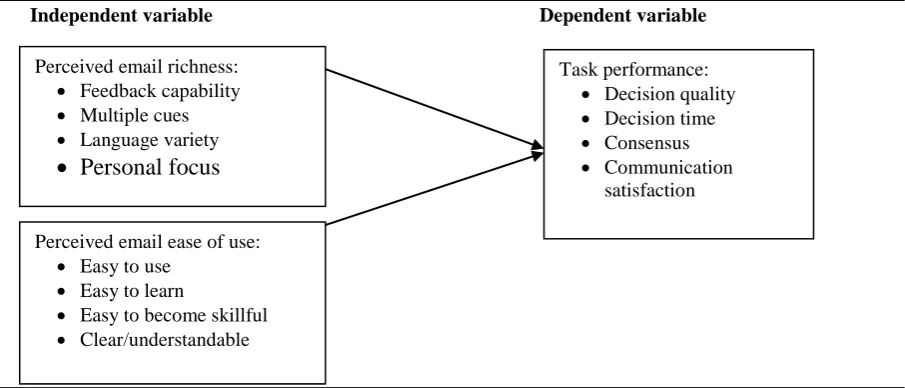
Based on theories and the review of previous literature, the following research framework as presented in Figure 1 is offered. The research framework illustrates the overall relationships between the independent variables and dependent variable of the study. The independent variables are perceived email richness and perceived email ease of use; while the dependent variable is interpersonal relationship.
The first independent variable is perceived email richness. This variable divided to four dimensions which are feedback capability, multiple cues, language variety, and personal focus. Based on media richness theory, these four factors influenced media richness. The second independent variable is perceived email ease of use which included easy to use, easy to learn, easy to become skillful and clear/understandable dimensions.
Finally, the dependent variable is task performance which divided to decision quality, decision time, consensus, and communication satisfaction dimensions.
Perceived email richness: Feedback capability Multiple cues Language variety
Personal focus
Task performance: Decision quality Decision time Consensus Communication
satisfaction
Perceived email ease of use: Easy to use
Easy to learn
Easy to become skillful Clear/understandable
Independent variable
Dependent variable
Figure 1: Research Framework of the Study
5. RESEARCH METHODOLOGY Research design
This study used a survey design to explain the roles of email in improving task performance among Multimedia University executives in Malaysia in November 2008. According to Babbie (2007), survey research is the best method available to collect original data for describing a population too large to observe directly. A survey is also an excellent vehicle for measuring attitudes and orientations in a large population. Reinard (2001) further added that a survey is an empirical study that uses questionnaires or interviews to discover descriptive characteristics of phenomena.
In relation to this, self-administered questionnaires were employed as an instrument for data collection. Questionnaires were developed to examine the two areas for which email use might be though to have effects on task performance: perceived email richness and perceived email ease of use. All items used a five-point Likert scale, while 1 represented strongly disagree and 5 strongly agree.
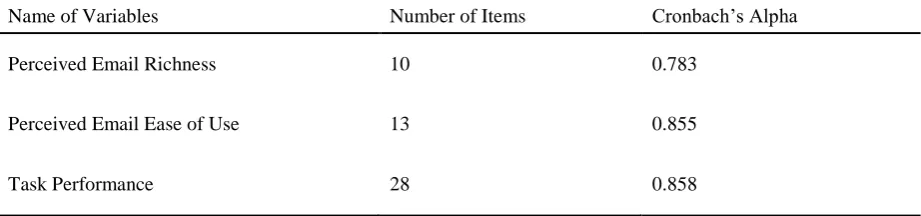
All items were pilot tested using a sample of thirty executives. Cronbach’s Alpha was measured for each variable used in this study to get reliability coefficient. The results from pre-test indicated that the scale was reliable with the Cronbach’s Alpha value of 0.914 (Table 1).
In total, the questionnaire had over sixty items, examining also the respondents’ characteristics and email usage pattern. The items in questionnaire were adopted from previous studies and refined to adopt the respondents of this study.
Population and sample
The population of this study comprised of all academic and non-academic executives who use email in their activities in workplace from all faculties and divisions in this university. They were selected because all were involved in decision making and also had MMU email. The purposive sampling method was used in this study to select the individuals to be included in the sample. Therefore, according to purposive sampling, the sample of this study was chosen based on two criteria: 1) all individuals were academic and non-academic executives; 2) the sample used MMU email in their activities in workplace. The total number of population of this study was 596 executives. The sample (239 executives) was taken from a total of 596 executives which is about 40% of the total population.
Data analysis
After data collection, a number of procedures were carried out to organize the data such as systematically enter them in the computer and accurately score the data. The data which was collected for this study consisted of nominal and ordinal data. Gender, race, and position were measured in nominal data, while ordinal data were collected for age, education, and work experience. Perceived email richness, perceived email ease of use, and task performance were summated scores from Likert’s scale that were treated as ordinal data.
for Social Sciences (SPSS) version 16.0 for windows. Descriptive statistics and correlation were used to analyze the data with regard to the objectives of the study.
The descriptive statistics such as frequency and percentages were used to determine the characteristics of the respondents. They also described the level of perceived email richness, ease of use, and task performance.
Before measuring the relationship between variables, it was needed to test the normality of data. One-Sample Kolmogorov-Smirnov and Shapiro-Wilk tests were used to test whether the sample mean followed a normal distribution. The result indicated that the p-value of variables was less than 0.05 level of significance. So the normality assumption was rejected. With the assumption that the sample is a non-normal distribution the Spearman’s Rho Correlation was used to determine the direction and strength between dependent variable and independent variables.
6. FINDINGS AND DISCUSSION Profile of respondents
As shown in Table 2, from a total of 239 respondents who participated in this study, more than half of them (56.9%) were male while the rest (43.1%) were female. In terms of race, majority of the participants (68.2%) were Malays and 18.4% were Chinese. Only 10% of the respondents were Indian and the rest (3.3%) belonged to other nationality such as Australian and Cuba.
According to the age-groups, slightly near half of respondents (49.0%) were in 31 – 40 age-group, while 28.9% of the respondents were in the 30 and below age-group. Results also showed that 20.5% of the respondents belonged to the 41 – 50 age-group while 1.7% of the participants belonged to the 51 and above age-group. In short, majority of the respondents in this study were young male Malay executives, aged between 31- 40. The 239 respondents included executives. Based on organizational chart, executives include associate professor, lecturer, assistant general manager, manager, assistant manager, instructional designer, multimedia designer, and system analyst. According to the results, slightly more than one third of the respondents that is 34.3% were lecturer, 27.2% were assistant manager, 14.2% were manager, 7.9% were instructional designer, 6.7% system analyst, 4.2% multimedia designer, 2.5% were assistant general manager, 1.7% were associate professor while the rest (1.3%) were senior manager.
The total of 63.6% of the respondents had over 5 years work experience while 25.5% had below 3 and 10.9% between 3 to 5 years work experience. For educational attainment, 38.5% had master degree, 29.7% had bachelor degree, and 26.4% had PhD. Only 2.9% and 2.5% of the respondents had certificate and diploma respectively.
Level of task performance
Based on the first objective of the study, from the total of 239 respondents, slightly over half of the respondents (50.2%) felt that they experienced moderate level of task performance when using email within the organization while less than half of them (47.7%) felt high level of task performance. Only 2.1% of them experienced low level of task performance (Table 3). Media richness theory contends that leaner media slow down communication and decision making for equivocal tasks and that richer media provide excess cues and information for unequivocal messages, increasing decision time (Lengel and Daft, 1988). Also this theory argues that communication fails when a lean medium for equivocal communications or a rich medium is used for unequivocal communication. Based on MRT, face-to-face communication was ranked the richest as it allows rapid mutual feedback, permitting messages to be reinterpreted, clarified, and adjusted immediately. Written communication fell lowest on the scale. Feedback is slow, only textual information is conveyed, voice cues are absent, and visual cues are limited (Daft et al., 1987b). According to previous studies, electronic mail has been placed between telephone and written communication media on the media richness scale (Schmitz and Fulk, 1991 and Markus, 1994). But in this finding, using email as a lean medium (based on MRT) does not seem to be the reason for lower level of task performance.
Extent of perceived email richness
The ranking of media in terms of richness has been extended to new electronic communication media such as email. Based on past studies, email has been rated as falling somewhere between the telephone and written communication (Daft et al., 1987a; Markus, 1994 and El-Shinnawy and Markus, 1997). Consequently, the findings of this study do not support previous findings that reported the email is perceived low in richness whereas in this study more than one third (39.7%) of the respondents perceived email high in richness.
Extent of perceived email ease of use
The result for third objective of this study showed that from the total of 239 participants, more than half (52.7%) of them perceived email ease of use in a high level, while slightly less than half (43.5%) of them perceived moderate level of email ease of use (Table 3). This finding is in line with the findings by Straub, Keil, and Bernner (1997) that tested technology acceptance theory in Japan, Switzerland, and the United States (U. S.) among employee of three different airlines. They discovered that TAM holds for both the U. S. and Switzerland, but not for Japan. The results showed that the respondents perceived email as an easy to use communication medium across all cultures.
Hypothesis testing
Perceived email richness and task performance
The first hypothesis of this study was that there is a positive significant relationship between perceived email richness and task performance. The results of this study indicated that perceived email richness had a positively significant relationship with task performance (Table 4). The finding of this study was inconsistent with previous studies which reported that using computer-mediated communication lead to lower task performance for the negotiation task (Dennis and Kinney, 1998; Menecke et al., 2000).
Perceived email ease of use and task performance
Finally, the second hypothesis of this study suggested that there is a positive significant relationship between perceived email ease of use and task performance among email users. Result indicated that perceived email ease of use influenced task performance and that the increase in email ease of use perception generates an increase in task performance (Table 4). Past studies confirmed this finding that reported ease of use had correlation with task performance. This study declares that the increase in ease of use perception cause higher level of task performance in an organizational setting (Steinfield, 1986).
7. CONCLUSIONS AND IMPLICATIONS
Media richness theory has long argued that an effective manager should choose such a rich medium as face-to-face interaction for communicating equivocal information. MRT urged organizations to be cautious when considering adoption of computer-mediated communication such as electronic mail systems. They believe that mediated communication cannot compensate for the power of face-to-face communication for resolving equivocal tasks such as decision making. In keeping with this advice, many managers may believe they need to bring employees together to resolve dilemmas and make decisions. But the results of this study challenge media richness theory. This study showed that the respondents perceived email to be moderately high rich medium. The present study has confirmed that email richness and email ease of use have positively significant relationship with task performance. It is indicated that the increase in email richness and email ease of use perception generates an increase in task performance. In terms of email richness, the findings of this study challenges previous studies. It can be concluded that the respondents of this study perceived email as a rich medium and it is a convenient way for them to make decisions. But in contrast, for email ease of use, as previous studies, the more email is perceived easy to use causes the increasing in task performance.
The findings of the present study also has confirmed that technology acceptance model which declared the increase in technology ease of use for users leads to higher level of task performance and user satisfaction. The results of this study showed that individuals experienced moderate to high level of task performance when use email. However, based on MRT email lacks nonverbal cues and fast feedback capability. But, the findings of this study showed that the lack of nonverbal cues and slow feedback in email does not seem to be the reason for lower task performance.
Collectively, the results of this study challenge media richness theory. This study showed that the respondents perceived email as moderately rich. This finding might provide theoretical extension to the media richness theory. This would suggest that using email could replace other communication media such as face-to-face for decision making.
Implications
foreign-owned and home-owned Malaysian companies focused on multimedia and communication products, solutions, services; and research and development. With such status, therefore, email as a new communication technology will provide an alternative for decreasing the cost of communication and increasing productivity and efficiency. Therefore, this study will offer better understanding for Malaysian policy makers to formulate strategies in using new communication media such as email to affect organizational communication and consequently organizational performance.
Email has clearly achieved the most widespread acceptance in workplace. Organizations need to formulate strategies to consider the impacts of new communication technologies on organizational communication. Efforts to understand these effects will provide organizations to improve productivity, efficiency, and performance. Besides that, organizations should encourage their employees’ especially managerial level to communicate and socialize through email because using email provide them rapid exchange of information, development of relationships, liberation from time and space constraints, and also economic advantages.
Effects of technology use on task performance in organizations are dependent on task characteristics and communication media characteristics (Suh, 1999). This study showed that Computer-mediated text might be rich enough even for the negotiation task. It took more time, but it is the cheapest method to communicate at distance. Therefore, appropriate training and courses need to be conducted to reduce the problems and improve efficiency and effectiveness.
REFERENCES
1. Babbie, E. (2007). The practice of social science. Belmont, CA: Thomson Wadsworth.
2. Bouwman, H., Hoof, B. V. D., and Wijngaert, L. V. D. (2005). Information and communication technology in organizations. London: SAGE publications.
3. Daft, R. L. and Lengel, R. H. (1984). Information richness: A new approach to managerial behavior and organization design. Research in Organizational Behavior,6, 191-233.
4. Daft, R. L. and Lengel, R. H. (1986). Organizational information requirements, media richness and structural design. Management Science, 32(5), 554-571.
5. Daft, R. L., Lengel, R. H. and Tervino, L. K. (1987a). Message equivocality, media selection, and manager performance: Implications for information systems. MIS Quarterly,11(3), 355-366.
6. Daft, R. L., Lengel, R. H. and Tervino, L. K. (1987b). Media symbolism, media richness, and media choice in organizations. Communication Research,14(5), 553-574.
6. Davis, F. D. (1989). Perceived usefulness, perceived ease of use, and user acceptance of information technology. MIS quarterly, 13(3), 319-340.
7. Dennis, A. R. and Kinney, S. T. (1998). Testing media richness theory in the new media: The effects of cues, feedback, and task equivocality. Information Systems Research, 9(3), 256-274.
8. Dennis, A. R., Kinney, S. T. and Hung, Y. C. (1999). Gender differences in the effects of media richness.
Small Group Research, 30(4), 405-437.
9. Downs, C. W. and Hazen, M. D. (1977). A factor analytic study of communication satisfaction. Journal of Business Communication, 14(3), 63-73.
10. El-Shinnawy, M. and Markus, M. L. (1997). The poverty of media richness theory: Explaining people’s choice of electronic mail vs. voice mail. International Journal of Human-Computer Studies, 46(4), 443-467.
11. Fulk, J, Schmitz, J, and Steinfield, C. (1990). A social influence model of technology use. In J. Fulk and C. Steinfield (Eds). Organizations and communication technology (pp. 117-140). New York: Sage. 12. Fulk, J. and Ryu, D. (1990). Perceiving electronic mail systems: a partial test of the social information
processing. In Te' eni, D. 2001. Review: A cognitive-affective model of organizational communication for designing it. MIS Quarterly,25(2), 251-312.
13. Fulk, J. and Steinfield, C. (1990). Organizations and communication technologies. Newbury Park, CA: Sage.
14. Harrison, L. D. (1997). Media Use and Performance in Air Force Organizations: Testing the Value of Media Richness Theory. Unpublished Master’s thesis, Air Force Institute of technology. Ohio, USA. 15. Hoskins, C. (1983). Psychometrics in nursing research: Construction of an interpersonal conflict scale.
Research in Nursing and Health,4(2), 243-249.
16. Kahai, S. S. and Cooper, R. B. (2003). Exploring the core concepts of media richness theory: The impact of cue multiplicity and feedback immediacy on decision quality. Journal of Management Information Systems,20(1), 263-299.
17. Ku, L. 1996. Social and nonsocial uses of electronic messaging systems in organizations. Journal of Business Communication,33(3), 297-325.
19. Markus, M. L. 1994. Electronic mail as the medium of managerial choice. Organization Science, 5(4), 502-527.
20. Mennecke, B. E., Valacich, J. S. and Wheeler, B. C. (2000). The effects of media and task on user performance: A test of the task-media fit hypothesis. Group Decision and Negotiation,9(6), 507-529. 21. Osman, M. N. (2008). Development of the Malaysian ICT policies: An analysis on the MSC
implementation strategies. In M. N. Osman, S. Z. Omar, H. Hassan, and N. Ismail (Eds.), Dimensions of communication: Malaysian experience, 1-19. Serdang: Penerbit Universiti Putra Malaysia.
22. Raman, K. S. and Yap, C. S. (1996). From a resource rich country to an information rich society: An evaluation of information technology policies in Malaysia. Information Technology for Development: 7(3), 109-131.
23. Reinard, J. C. (2001). Introduction to communication research. 3ed, Boston: McGraw-Hill.
24. Rice, R. E. (1993). Media appropriateness: Using social presence theory to compare traditional and new organization media. Human Communication Research,19(4), 451-484.
25. Rice, R. E. and Bair, J. H. (1984). The new media: Communication, research, and technology. Newburry Park CA: Sage publications.
26. Rice, R. E. and Shook, D. E. (1990). Relationships of job categories and organizational levels to use of communication channels, including electronic mail: A meta-analysis and extension. Journal of Management Studies,27(2), 195-229.
27. Robey, D. (1979). User attitudes and management information system use. Academy of Management Journal,22(3), 527-538.
28. Russ, G. S., Daft, R. L. and Lengel, R. H. (1990). Media selection and managerial characteristics in organizational communications. Management Communication Quarterly,4(2), 151-175.
29. Saade, R. G. (2007). Dimensions of perceived usefulness: Toward enhanced assessment. Decision Sciences Journal of Innovative Education,5(2), 289-310.
30. Schmitz, J. and Fulk, J. (1991). Organizational colleagues, media richness, and electronic mail.
Communication Research,18(4), 487-523.
31. Sherblom, J. (1988). Direction, function, and signature in electronic mail. Journal of Business Communication,25(4), 39-54.
32. Steinfield, C. W. (1986). Computer-Mediated Communication in an Organizational Setting: Explaining Task-Related and Socioemotional Uses, In M. J. McLaughlin (Ed.), Communication Yearbook (pp. 777- 804). Newbury Park, CA: Sage.
33. Straub, D., Keil, M. and Bernner, W. (1997). Testing the technology acceptance model across cultures: A three country study. Information and Management, 33(1), 1-11.
34. Suh, k. S. (1999). Impact of communication medium on task performance and satisfaction: An examination of media-richness theory. Journal of Information and Management, 35(5), 295-312. 35. Trevino, L. K., Lengel, R. H., Bodensteiner, W., Gerloff, E. A. and Muir, N. K. (1990). The richness
imperative and cognitive style: The role of individual differences in media choice behavior.
Management Communication Quarterly:4(2), 176-197.
36. Wang, Y. S., Wang, Y. M., Lin, H. H. and Tang T. I. (2003). Determinants of user acceptance of internet banking: An empirical study. International Journal of Service Industry Management, 14(5), 501-519.
37. Zumd, R. W., Lind, M. R. and Young, F. W. (1990). An attribute space for organizational communication channels. Information Systems Research,1(4), 440-461.
Table 1: Number of Items and Reliability Coefficient of Variables in Pre-test of Study (n=30)
Name of Variables Number of Items Cronbach’s Alpha
Perceived Email Richness 10 0.783
Perceived Email Ease of Use 13 0.855
Table 2: Distribution of Respondents by Selected Demographic Characteristics
Characteristic Frequency Percentage
Gender
Male 136 56.9
Female 103 43.1
Race
Malay 163 68.2
Chinese 44 18.4
Indian 24 10.0
Others 8 3.3
Age (years)
30 and below 69 28.9
31 – 40 117 49.0
41 – 50 49 20.5
51 and above 4 1.7
Position
Associate professor 4 1.7
Lecturer 82 34.3
Assistant general manager 6 2.5
Senior manager 3 1.3
Manager 34 14.2
Assistant manager 65 27.2 Instructional designer 19 7.9 Multimedia designer 10 4.2
System analyst 16 6.7
Work experience (year)
Less than 3 61 25.5
3 – 5 26 10.9
Above 5 152 63.6
Educational attainment
Certificate 7 2.9
Diploma 6 2.5
Bachelor 71 29.7
Master 92 38.5
PhD 63 26.4
Table 3:The Level of Task Performance, Perceived Email Richness, and Perceived Email Ease of Use
Level Freq Percentage
Task performance
Low Moderate High
9 104 126
3.8 43.5 52.7
Perceived email richness
Low Moderate High
10 134 95
4.2 56.1 39.7
Perceived email ease of use
Low Moderate High
9 104 126
3.8 43.5 52.7
Table 4: Spearman’s Rho Correlation between Independent Variables (perceived email richness and perceived email ease of use) and Dependent Variable (task performance)
Task Performance
rs p
Perceived Email Richness 0.55 0.00