http://www.sciencepublishinggroup.com/j/ijics doi: 10.11648/j.ijics.20180302.11
ISSN: 2575-1700 (Print); ISSN: 2575-1719 (Online)
Theoretical Re-Study on One-Way Barcode Communication
Between Networks and Its Application Prospects
Fuxu Yang
1, *, Luqiang Yang
21
Jiujiang Municipal Office of State Administration of Taxation, Jiujiang, China
2
School of Television Arts, Communication University of Zhejiang, Hangzhou, China
Email address:
*Corresponding author
To cite this article:
Fuxu Yang, Luqiang Yang. Theoretical Re-Study on One-Way Barcode Communication Between Networks and Its Application Prospects. International Journal of Information and Communication Sciences. Vol. 3, No. 2, 2018, pp. 19-25. doi: 10.11648/j.ijics.20180302.11
Received: June 26, 2018; Accepted: July 19, 2018; Published: August 16, 2018
Abstract:
Information communication between networks is greatly growing, and its security becomes more important. In this article, a new way of network security communication, namely bar code communication was investigated. It used the general principle of the computer to quantify the information and generate the barcode instantly, and it was showed by using the micro-display. Then the micro-camera is used to identify the barcode on the display to restore the original information in the optical principle. Faster and more efficient communication technologies, such as the principle of macro wireless communication technology, can receive complete information to achieve the purpose of information transmission. The bar code information communication method was one-way and irreversible, and it was safe and can ensure communication security between networks. It is the fourth communication method different from wired, wireless and medium modes: one-way bar code communication mode (referred to as “one-way communication”).Keywords:
Network, OBC, Barcode, Prospect1. Introduction
Strictly speaking, barcode communication has existed since John Kermode, the odd "whimsical" American inventor, created the first barcode in the Westinghouse laboratory, which was only used in mail sorting at that moment. This invention, however, was later improved and widely employed in people's daily life and work, and has spread from complex single use at the beginning, to today's vast modern application. This paper proposes, in view of the high security requirements for network-based communication, the use of OBC to transmit between networks relatively fixed (standard, content, time, etc.) messages. In particular, when government departments, social groups and economic organizations have to publish any information of fixed content in a timely way, fixed standard and fixed format, and wired networks, wireless networks and media copies may not be safe enough for such purposes: this kind of communication will ensure safe transmission. OBC refers to a special way of communication
to transmit messages between networks by employing basic principles of computer application, optical principles of barcode technology (e.g., RFID technology) [1-3], and micro-range wireless communication (e.g., NFC technology) [4-7]. This method is safe, reliable and practical, and addresses the concerns of government departments, social groups, and economic organizations about communication security.
2. Basic Concepts
2.1. Communication
Communication refers to the exchange and transmission of information between persons, or between humans and the nature of that transmission through a certain action or medium. In a broad sense, it may be that two or more parties, in need of information, voluntarily adopt any method or medium to transfer messages from one party to any other party, accurately and safely [8]. In short, the process of message transmission is the transmission or exchange of information from one point to another through a certain medium. The purpose is to realize information transmission or exchange; in other words, communication is the transmission or exchange of information in some way between different subjects. In this sense, any transmission or exchange of information from one subject to another, regardless of the method or way of communication employed, is "communication". Now, signals passing through channels could be languages, sounds, words, images or data, constituting multimedia communication. With wired and wireless communication facilities, integrated with communications in the broad sense, e.g., television and computer networks, have now developed information ports and high-speed channels. Thanks to the use of single-photon and optical amplifiers, communication rates can be raised to 2Mbps or even higher. It's safe to say, the communication rate, in the future, may be something we cannot predict or describe now.
2.2. Barcode Communication
Barcode communication refers to a special way of communication to transmit messages between networks or subjects, by employing basic principles in computer application and optical principles of barcode technology. It is a communication method that uses an RFID reader to read and collect barcode information, and verify that information artificially [2]. Barcode, generally speaking, refers to a one-dimensional code and a two-one-dimensional code. The most common application of this one-dimensional code communication in our daily life is the barcode scanner to check goods in the supermarket, and the two-dimensional code is used in train ticket management, vehicle management and hospital lab report management, etc [9].
The highest requirement for communication is accurate, fast and efficient. In comparison with one-dimensional code communication, two-dimensional code communication, obviously, enjoys more advantages. In general, barcode communication in this paper refers to two-dimensional code communication. Of course, with the development of science and technology, surely there will be a three-dimensional code, four-dimensional code and other multi-dimensional codes, even color codes, color codes or multi-dimensional color codes, and their corresponding "barcode communication".
2.3. One-Way Barcode Communication
One-way Barcode Communication (OBC) refers to a special way of communication, by using basic principles of computer application to turn messages into barcodes in batches, in a quantitative and instantaneous way. These are then shown, in batches, on a fixed micro display, recognized and translated back to the original messages, in batches, by a micro camera (micro reader) and computer software employing optical principles (i.e., RFID technology [10]), and then, send a receipt message via a separate, faster and more efficient way of transmission (e.g., NFC technology in micro-range wireless communication) to feed back the integrity of the messages. This communication method is called one-way communication to distinguish it from simplex communication. The transmission rate of the main channel is not faster than that of the auxiliary feedback channel, and the two channels must be different, and the transmission volume of the former is usually much higher than that of the latter.
2.4. OBC Between Networks
OBC Between Networks refers to a communication method that employs barcode technology to conduct one-way communication between networks. In particular, one network (Network A), through software and barcode technology, turns the messages to communicate into barcodes, and shows such barcodes on a micro display that can be identified by a micro camera; another network (Network B) uses a micro camera to identify at a proper range the barcodes on Network A's micro display, and translates through software the barcode information into the original uncoded messages (e.g., RFID). At the same time, micro-range NFC technology is employed to feed back receipt of the messages; and vice versa. This process is inter-network barcode communication.
3. Basic Contents
3.1. Basic Principles
such as wireless light wave transmission [11], MEMS optical switch or logic gate circuit technology may also be adopted in accordance with the actual situation [12, 13]. In a word, only "Yes" and "No", i.e., "1" and "0", are continuously and orderly fed back by means of wireless technology.
3.2. Communication Principles
(a) Instant. The preset message to communicate must be instantly transmitted in batches, and in a timely and quantitative way, just like what we do to upload or download data in daily life, which is a "seamless connection".
(b) Accurate. The preset data to transmit must be, from one point to another, "copied" completely, error-free, precisely, efficiently, and in batches.
(c) Integrity. Integrity literally means the quality of being honest and having strong moral principles, but here it is defined as true and faithful. That is, the entire process of transmitting the preset data from one subject to another complies with the following "basic assumptions". In fact, this is also the axiom of our data communication community: the industry's "backdoor" (intentional) or "bug" (unintentional). Here, only the "backdoor" concern is addressed.
(d) One-way Communication. This communication method transmits the preset data information in one direction and in batches from one point to one or more points, and at the same time feeds back the received information in a different and irreversible way (the feedback information is "Yes", and "No" to represent in "1" and "0", nothing more).
3.3. Basic Features
The features of this communication method include: (a) One-way Communication. Obviously, the above-mentioned transmission can only be from one network
(Network A) to another network (Network B). Reverse transmission of the information is impossible, i.e., the information cannot be transmitted from Network B to Network A. In order to transmit information from Network B to Network A, an identical system must be established in the opposite direction to realize communication. The photoelectric system of the camera is irreversible.
(b) Safety. Analysis shows that this type of communication is realized through the micro camera's photoelectric transmission, and we know from common sense that photo-electricity is irreversible, therefore, the communication, is safe under these assumptions.
(c) Uniqueness. At present, information communication methods between networks mainly include wireless communication (wireless network protocol), wired communication (network protocol) and media. This communication method is the fourth, i.e., OBC. This method uses the photoelectricity from the micro camera to translate the barcode generated in the barcode generator, back to the original uncoded message, restores through software (i.e., RFID technology), consolidates and publishes such messages. Therefore, it's not the wired, wireless or media communications, and should be named as a fourth type of communication: OBC. Its application principles include not only computer principles (the computer barcode generation system), but also the optical principle (the barcode identification system, i.e. RFID technology) and micro-range wireless technology principle (the feedback system, i.e. NFC technology).
(d) Comparison of major communication methods
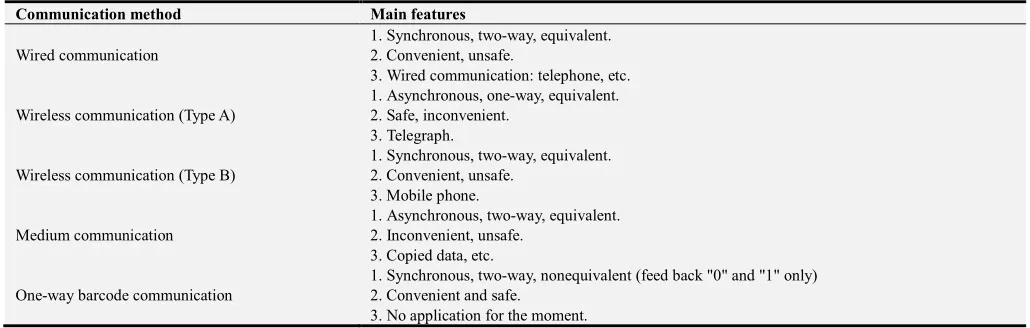
At present, there are three major communication methods: wired, wireless and medium communication. OBC is the fourth. Their main features are given below (Table 1):
Table 1. Comparison of existing communications' main features.
Communication method Main features
Wired communication
1. Synchronous, two-way, equivalent. 2. Convenient, unsafe.
3. Wired communication: telephone, etc.
Wireless communication (Type A)
1. Asynchronous, one-way, equivalent. 2. Safe, inconvenient.
3. Telegraph.
Wireless communication (Type B)
1. Synchronous, two-way, equivalent. 2. Convenient, unsafe.
3. Mobile phone.
Medium communication
1. Asynchronous, two-way, equivalent. 2. Inconvenient, unsafe.
3. Copied data, etc.
One-way barcode communication
1. Synchronous, two-way, nonequivalent (feed back "0" and "1" only) 2. Convenient and safe.
3. No application for the moment.
3.4. Basic Assumptions
The elemental theory that this paper studies is based on the assumption that the system maker must not intentionally sabotage or pirate the information in communication. That is, the designer of the barcode generation and identification systems does not have the intention to sabotage or pirate the
3.5. Basic Framework
3.5.1. Components
Theoretically, the elemental components in this paper include mainly "three hards and two softs" [14]. "Three hards" refer to one micro display, one micro camera (equivalent to "reader", i.e., RFID) and one set of simple micro-range wireless feedback system (NFC) of the barcode generated and displayed, making standard and relevant protocols of which conform to the corresponding RFID and NFC. The "two softs" are the typical barcode generation system and barcode identification system. They are:
Network A: a micro display (Figure 1), a wireless receiver for information feedback (the receiving unit of micro-range wireless feedback system, i.e., the receiving CPU of NFC, Figure 2) and a set of barcode generation systems (i.e., related systems and shared hosts).
Figure 1. Image of Micro-display.
Figure 2. Image of NFC's receiving CPU.
Network B: a micro camera (similar to a reader. Figure 3), a wireless transmitter for information feedback (emitting unit of the micro-range wireless feedback system: firm label with message "1" and "0", i.e. the emitting unit of NFC. See Figure 4) and a set of barcode identification systems (i.e., related systems and shared hosts).
Figure 3. Image of NFC micro camera.
Figure 4. Image of NFC emitting unit.
Others: Network A is connected to the final message emitting network, and Network B is connected to the final message receiving network and auxiliary fittings, etc., (the insulated housing, corresponding weak current wire and VGA/USB interface. See Figures 5-8).
Figure 6. Image of Weak current wire.
Figure 7. Image of VGA interface.
Figure 8. Image of USB interface.
3.5.2. Architecture Diagram
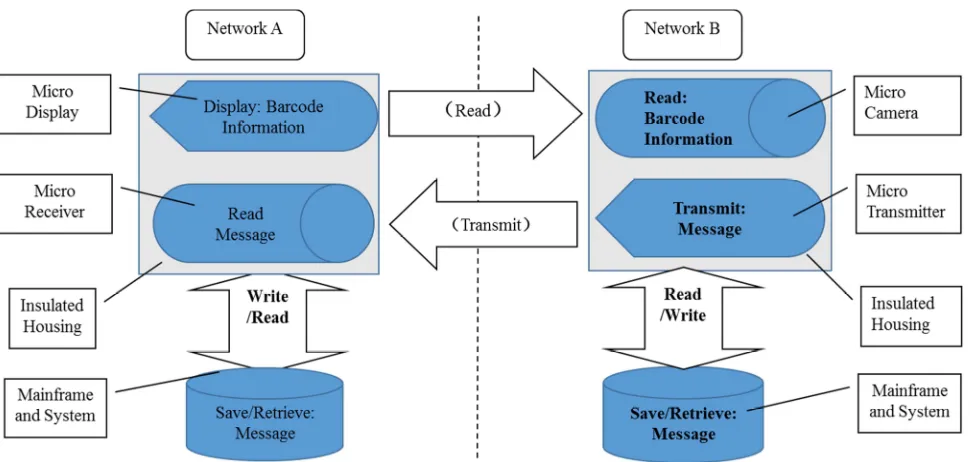
The basic architecture is given below (Figure 9).
Figure 9. Inter-network communication architecture diagram.
3.6. Data Flow Chart
3.6.1. Working Principle
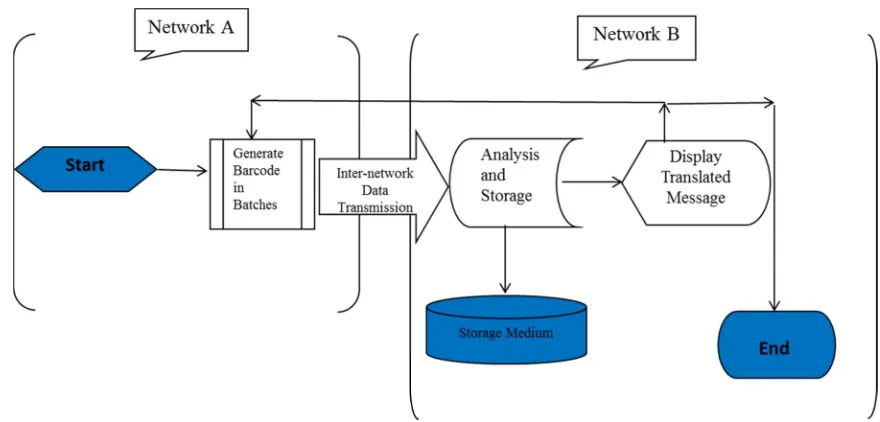
The working principle of the elements studied in this paper is: when Network A transmits data in one direction to Network B, on one hand, the barcode generation system is installed on Network A terminal to turn the preset messages into barcodes in suitable batches (quantity, frequency and time) and show the same on the micro display; on the other hand, the barcode identification system and micro camera (i.e., micro reader) are installed on Network B terminal, point the micro camera's photoelectric beam at the barcode on Network A's micro display, instantly translate the preset
messages through the barcode identification system into the original uncoded messages in suitable batches (quantity, frequency and time) (RFID technology, store the messages in Network B terminal, and, at the same time, feed back receipt by a separate, faster and more efficient way of communication (e.g., micro-range wireless communication NFC). Then, proceed to the next message transmission until the required quantity of messages are all transmitted. Obviously, this is a one-way communication (both photoelectric transmission and wireless technology are one-way operations), and thus safe.
3.6.2. Data Flow Chart
Figure 10. Inter-network communication data flow chart.
3.7. Scope of Application
As one-way communication is very safe, it is suitable for those institutions to regularly publish a fixed quantity of certain information that is classified according to the laws, regulations and rules. It is safe, accurate, efficient and cost effective. This communication method features high transmission efficiency, long service life after a one-time investment, and eternal safety if regularly maintained. Suitable users include government departments such as taxation authorities, industrial and commercial administrations, police, procuratorate and court, social groups and various economic organizations. Therefore, it is of high realistic importance to study one-way communication in today's fast development of information technology.
4. Significance of Studies
4.1. Widening of Inter-Network Communication Method
Generally speaking, communication modes mainly include simplex communication, half duplex communication, full duplex communication and modern communication. Modern communication includes postal service, telephone, fax, satellite telephone, telegraph and data communications. Modern communication, from another perspective, can be divided into wired communication, wireless communication and medium communication. OBC does not belong to any of these three types of communication, i.e., it's not wired, wireless, nor medium communication, and should be named OBC, as the fourth type of communication.
4.2. Assured Communication Safety Under Conditions
From the architectural diagram and data flow chart of barcode communication, the most remarkable feature is that this method utilizes the photoelectricity of the micro camera
to effect information communication, which is, obviously, one-way transmission, irreversible and relatively safe. The premise is, of course, that it complies with the basic assumptions. Otherwise, there might be a potential safety hazard in its information communication.
4.3. Assured Inter-Network Information Communication in Batches
The analysis above shows, we can carry out large-scale one-way information communication between networks so long as the hardware and system are good enough, "seamless connection" is achieved, and the information content of the communication can be updated instantly.
5. Application Prospects
The invention of Inter-network One-way Barcode Communication (OBC) provides us with a safe, brand-new way of message publication. In reality, it enjoys vast prospects [15, 16].
5.1. One-Way Data Acquisition
5.2. One-way Data Publication
It provides a brand-new, safe way to publish or provide information for relevant departments, in particular government departments (such as taxation authorities, industrial and commercial administrations, police, procuratorate, court, etc.), that shall, according to the laws, regulations and rules, publish information regularly (fixed interval, quantity, content and standard), or, in case of special departments, provide leaders' query ports with relevant information. In the past, paper tables, reports, Excel spreadsheets and Word documents were usually adopted by government departments to publish the required information, or to provide leaders' port with information. If this project is implemented, we can provide relevant detailed information on a regular basis in accordance with the requirements of government departments to publish information, or to provide information to leaders' query ports, and ensure timely and safe information communication.
5.3. Strong Scalability
It can be fused with relevant communication safety equipment, network communication equipment in particular, such as firewalls and gateways. When such communication safety equipment is installed, with this OBC module at the front or rear end, network communication protection acquires one more layer of safety, the security level of network communication is improved, and therefore, more security guarantee is achieved! Obviously, the market prospect in this respect is very broad!
6. Conclusion
"OBC" is a one-way fixed message transmission method based on barcode information, and uses computer software and photoelectric identification (equivalent to "reader") principles. This paper is a theoretical discussion and study of this one-way communication method in work, life and barcode knowledge. More detailed physical studies will be conducted in the future.
After receiving barcode information, this paper will feed back a recommendation for using micro-range wireless communication (NFC). It's possible and feasible, both in theory and in practice. In actual implementation, however, there might be some minor problems at the operational level, which, so far as the current development level of technology is concerned, are absolutely sure to be solved.
References
[1] Klaus F. (Germany), Translated and edited by Chen D. (2001). Radio Frequency Identification (RFID) Technology-Principles and Applications of Radio Influence Transponders and Non-contact IC Cards (Second Edition), Publishing House of Electronics Industry, Beijing, pp. 129-156.
[2] Muyumba T.and Phiri J. (2017). A Web based Inventory Control System using Cloud Architecture and Barcode Technology for Zambia Air Force. International Journal of Advanced Computer Science and Applications, 8: 132-142.
[3] Zhang B. S., Ren K., Xing G. L., Fu X. W. and Wang C. (2016). SBVLC: Secure Barcode-Based Visible Light Communication for Smartphones. IEEE Transactions on Mobile Computing, 15: 432-446.
[4] Wang M., Qu W., Qu W. (2017). NFC Technology Principles and Applications, Chemical Industry Press, Beijing, pp. 1-113.
[5] Gope P., Amin R., Islam S. K. H., Kumar N. and Bhalla V. K. (2018). Lightweight and Privacy-Preserving RFID Authentication Scheme for Distributed IoT Infrastructure with Secure Localization Services for Smart City Environment. Future Generation Computer Systems-the International Journal of Escience, 83: 629-637.
[6] Chang B., Cheng Y., Chen B., Zhang F. W., Zhu W. T., Li Y. J. and Wang Z. (2018). User-Friendly Deniable Storage for Mobile Devices. Computers & Security, 72: 163-174.
[7] Tizyi H., Riouch F., Tribak A., Najid A. and Mediavilla A. (2018). Microstrip Diplexer Design Based on Two Square Open Loop Bandpass Filters for RFID Applications. International Journal of Microwave and Wireless Technologies, 10: 412-421.
[8] Fan C. (2014). Communication Principle, National Defense Industry Press, Beijing, pp. 1-36.
[9] Chinese Product Coding Center. (2007) Two-dimensional Barcode Technology and Application, China Metrology Press, Beijing, pp. 29-280.
[10] NTT Comware Corporation, Kase Ichirou (Japan), Translated by Zheng W. (2007). The Current Situation and Development Trend of Radio Frequency Identification (RFID), Post and Telecom Press, Beijing, pp. 1-82.
[11] Lei Y. (2016). Security & Photoelectrical Information - Fundamentals of Security Monitoring Technology, Publishing House of Electronics Industry, Beijing, pp. 241-244.
[12] Zhang X., Huang R., Liu X. (2005). Introduction to Microelectronics, Peking University Press, Beijing, pp. 267-299.
[13] Kang H., Zou S., Qin Z. (2005). Fundamentals of Electronic Technology, Higher Education Press, Beijing, pp. 93-101.
[14] Yang F., Yang L., (2018). One-way Communicator and Communication Method, China Patent: CN207427485U.
[15] Chen Q., Huang W., Zhang W. (2005). Radio Frequency Identification (RFID) Technology and Application Prospect. Barcode and Information System, 5: 38-40.