SERA: A Circular Path Clustering Approach For
Wireless Sensor Network
Muthumayil K, R.Bhaskaran,R.Sudha, J.V.Anchitaalagammai
Abstract: Wireless Sensor Network (WSN) follows many-to-one traffic model and uses multi-hop transmission method. It compromises any node and reduces the network lifetime. Providing both security and energy for sensor nodes are essential issues. Nowadays various techniques attracted more research attention since it provides solution for any one of the issues as security or energy efficiency. In this paper a secured energy efficient routing algorithm-[SERA] is proposed for providing secured communication along with energy efficiency for WSN. SERA consists of two works: (1) Key distribution management and elliptical curve cryptography algorithms for providing node and data level security, (2) Circular path clustering and shortest routing for improving energy efficiency. The network performance is measured on both energy and security of the nodes in this work. Security is provided at the node level and SERA is analyzed in terms of energy consumption, delay, remaining energy, and packet drop ratio.
Index Terms: Clustering, Energy, Throughput, Network Lifetime, Security
—————————— ——————————
1.
INTRODUCTION
Networks are classified into several types based on the behavior and functionality of the nodes. WSNs [1–2] are used in a diversity of real-time-applications. Present progress in wireless communication, computing techniques and technologies with micro-electronics enables the speedy improvement of small, low-budget, and various types of sensor nodes. These sensor nodes are deployed based on the applications and they collect and disseminate the data to base station. WSN can be laid out with many sensor nodes that work locally as well as globally based on the application. Also these small devices are multifunctional devices; it carries out restricted, specific observable and sensitive tasks [3]. WSNs can be applied broadly in various fields like surveillance, monitoring, healthcare, target-tracking and military etc. [4]. Power of the node [5] is a leading research anxiety and thought-provoking challenge for designing routing protocols of WSN. Each stand-alone sensor node commonly has restricted power supply. Since every network has large amount of nodes, replacing or recharging the batteries of the sensor nodes is a difficult task. In addition, long distance based information transmission among sensor nodes and base station increases the energy consumption. Nodes nearer to the base station forwards all the data thus it consumes more energy than other nodes. These nodes become bottleneck nodes known as hot spots. These kinds of situation can be rectified in WSN to reduce energy consumptions. Multi-hop transmission is followed in WSN. The intermediate node among source to base station or source to any other sink node can be compromised or it can act itself as a malicious node [6]. To avoid sending or receiving data through a malicious node, a key distribution based node authentication is applied. During transmission the data is encrypted using ECC method. Various random key generations, dynamic key generation, key distribution, public key infrastructure [7][8] are already available for node authentication and authorization for data transmission in a network. This paper is constructed as follows: Nodes are created and deployed randomly in the specific fields.
KDM generates a unique random key that is allocated for each node during node deployment. Due to improvement of energy efficient, the nodes are clustered using CPC methodology. Since many paths are available between source and destination, a shortest path is chosen in terms of distance and remaining energy of the intermediate nodes. Communication among nodes is started by verifying the node identity and assigned key of each node. Then the data is encrypted and transferred at the end of source node. Some investigations and evaluation are made in terms of network life time, security and energy consumption using NS-2
For understanding the paper clearly the notations used in this paper are described down.
Symbols Description
Network Region Size Cluster Head Base Station Distance
Elliptical Curve Cryptography Wireless Sensor Network Mobile Ad-hoc Network Bit-Error-Rate
Frequency
Discrete Logarithm Problem
2 RELATED
WORK
In [9], the researchers have developed two routing protocols namely Spiral Mobility based on Optimized Clustering (SMOC) routing protocol and the Multiple sink-based SMOC (M-SMOC) routing protocol for large-scale WSNs. In their proposed model of SMOC, a single mobile sink with a fixed spiral pattern is moving in the sensor field to collect data from distributed sensor nodes in the network, while in the case of M-SMOC, four mobile sinks are deployed in the sensor field for data extraction from sensor nodes. Initially, when the nodes are deployed, the sink starts cluster formation. All the clusters are formatted in the order of the center, and in this way, the sink can visit them in a spiral pattern. They have taken the energy holes problem that always occur in WSNs because of unbalanced energy distribution. They are created in areas far from the sink in WSN. They considered mobility based sink ————————————————
All the authors are currently working in PSNA College of Engineering
2412
routing protocols to minimize the energy consumption since sink covers the sensor field. Optimal mobility pattern is required to overcome the energy holes for prolonging the network lifetime. Different ranges of clusters create variation in the topology in simulations. Cluster heads are chosen to receive data from the sensor nodes and transmit them to the sink. Cluster heads are reducing the overhead produced within clusters. They considered network lifetime, network stability, packet drop ratio, packet delivery ratio, end-to-end delay, average energy consumption, network connection time and the impact of different heterogeneity levels as the performance parameters. Clustering in wireless ad hoc networks is used to organize a network since the dynamic and mobile nature of the topology. They [10] proposed a self-organizing based clustering method using zone-based group mobility (SOCZBM) to improve the energy consumption and network lifetime also improving scalability and stability of the network. They utilized a bio-inspired behavioral study of birds flocking for the formation and maintenance of clusters in mobile ad hoc networks. According to these rules the geographical space around each bird can be distributed as three zones. The attractiveness behavior between birds can be represented as attractive zone, the ability to repel each other in order to avoid collision can be summarized as repulsive zone and bird's alignment with neighbors can be considered as orientation zone. The authors discussed the requirements to develop an efficient clustering environment in MANET. They are:1) Optimal Cluster head selection. 2) Neighborhood detection. 3) Node alignment with their neighborhood. 4) Minimum and maximum threshold distance between nodes for node connectivity. A dynamic cluster size management scheme is followed in SOCZBM. Clustering algorithms for WSN grow in numbers because of optimizing the energy consumption due to limited resources. Two-layer topology is popular for clustering approaches in sensor networks. Lower layer nodes communicate with the cluster heads and CH nodes communicate with the base station or sink. They [11] developed a joint design of sensor node clustering and data recovery. WSN is organized in a two-layer topology with the clustering algorithm and data recovery happened through the two-layer structure. They have taken energy efficiency and data forecasting accuracy into investigation. Energy efficiency has been achieved by reducing distances among nodes in the cluster. Data forecasting accuracy has been improved by increasing the correlation among the cluster nodes. The operation of the clustering algorithm is divided into multiple rounds where each round has two phases: one for cluster head selection and another for cluster formation. The location and residual energy of the nodes were used to reduce the energy consumption of data transmission in the cluster head selection phase. Data correlation was used in data formation phase to increase the correlations among the nodes. The base station chose the cluster heads in a centralized way to make the distribution of cluster heads reasonable. On the contrary, the clusters formation is totally distributed and each node has its own choice to improve the forecasting accuracyA QoS-aware and heterogeneously clustered routing (QHCR) protocol was developed [12]. It is an energy efficient routing protocol for heterogeneous WSNs to support the delay sensitive, bandwidth hungry, time-critical, and QoS-aware applications. It not only conserves the energy but also provides the dedicated path for real-time and delay sensitive applications. It minimizes the delay for delay sensitive applications by having different
3 SYSTEM
MODEL
3.1 Basic Assumptions
It is considered that a WSN comprises of ‗N‘ sensor nodes with base station. Every cluster consists of sensor nodes. There are number of clusters in each of the circular paths. Nodes are placed in the circular path based clusters as seen in figure 2. Each sensor is assigned with unique identification number generated by KDM. The basic assumptions are as follows:
1. BS is centered for all clusters/nodes and it has sufficient energy
2. ‗N‘ nodes distributed randomly in a circle region with radius R using CPC.
3. Nodes can obtain their location information.
4. Path can be chosen based on distance and energy level of the nodes in the route.
5. Each CH gathers and aggregate data packets from its cluster nodes. CH to BS transmission happens directly or via other intermediate CH nodes by choosing a shortest path.
3.2 Network Construction
Initially network G has N number of nodes created dynamically and they are placed at random locations within the network that is shown in figure 2. During the creation and placement of each node, an identifier (ID) and key is allocated for them. For generating a unique dynamic key distribution management (KDM) method is used in this work. Distributed Management
3.3 Distributed Management
KDM provides a dynamic key for every node to communicate with the other nodes and CH for security. The key of each node is compared at two check points that is during (i) clustering (ii) data transformation. The KDM randomly generates a key for each node and assigns to the nodes by (1) when the nodes enter into the network and is stored in the key table as shown in Table-I.
(1)
Table-I: Key Table
Node –ID Key Public Key
N1 N0001 *******
N2 N0002 *******
: :
: :
: :
Nn N000n *******
3.4 Energy Model
For transmitting -bit data in distance, the radio expansion can be written as:
Where,
or
The Energy taken for transmitting a data packet purely depends on the encoding, modulation, spreading of signal, amplifier energy, distance among the sender and the receiver with the acceptable BER. During the data packet reception the
radio expanded into . Also the data
aggregation process consumes the energy . The
energy taken for energy computation process is very less and it can be omitted.
4 CIRCULAR
PATH
CLUSTERING
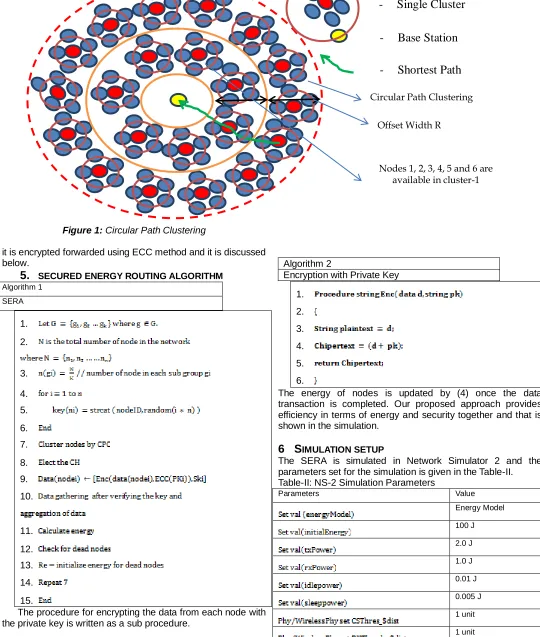
A wireless sensor network can be laid out as a directed graph G having N number of Nodes. The network G is divided into K number of equal size area and it can be written as K*K. All the nodes are placed randomly in each subarea in an equal manner to balance the communication, time and data that is depicted in figure.1.The entire network is clustered; clusters are placed in a circular path and the cluster head elected using traditional LEACH. During the clustering and cluster placement the node‘s ID and key are verified. As shown in figure.2 six nodes are grouped as a cluster. One node is selected as a cluster head among six nodes. To improve the energy efficiency in terms of distance among all nodes, the distance among any two nodes in each cluster is assumed
as . Here becomes 0, when the optimal
radius cluster is equal to . If the distance of any two nodes is longer than , the sensing field generates blind spots. The cluster head within a cluster‘s side length is , and the area of each cluster is . So the optimal clusters are selected for discovering and transmitting data in an optimal route. Since base station interfaces the sensor network to the external world, compromising a significant number of them can render the entire network useless. Aggregation points are trusted components only in certain protocols. Aggregation points are often regular sensor nodes and it is possible that opponents may try to install malicious aggregation points or attempt to compromise the node into aggregation point. Hence aggregation points may not be reliable. As there is an aggregation among the trustful nodes, the KDM will distribute dynamic key for all the nodes. Consequently, all the nodes have their own ID and a key with them. Once the keys are assigned to all the nodes, the circular path clustering method clusters the nodes in the sub-region of the network G in accordance with the assigned node ID. It is assumed that the BS is placed at center of the for security. The verified nodes gets approved by BS and clustered otherwise the node will be eliminated from the network. network and the nodes are placed around it in a circular way after clustering. The clustered nodes [cluster] are placed in a clock wise direction, and all clusters have equal number of nodes. The number of nodes that can be placed within a region is calculated by Equation (2).
(2)
2414
that the nodes are trustworthy. If any node is found without a key or with a conflicting ID, the node will get rejected from the region. After successful clustering, the nodes are placed in their corresponding region is N/K. In the initial phase, the middle number of the node ID is elected as CH, because the nodes are placed according to the node ID in an ascending order. For example in the center region there are 5 nodes placed, where the starting node ID is 0 and the final node ID is 4, in total 5 numbers of nodes. Now the CH is
(3)
In the same manner, the CH is elected in all the regions in the network in the initial phase by using (3). There are some parameters and their values initialized. Since the distance between the s and the is equal, the distance is treated as 1unit.
The node‘s state changes according to their activities that are; transmission, reception, idle or sleep mode and wake up. In
general, a node may consume more energy for transmission and reception and less while at idle mode or sleep mode. The quantity of energy consumed in each state is in descending order.
(4)
Using (4) the current energy consumption for transmitting the data packets after one round for node is calculated. The CH of each region gathers the data from the cluster nodes aggregates them and then sends it to the next nearest CH or directly to BS. While data is passed from node to CH and CH to BS, encrypted by ECC algorithm and decrypted at a particular place.
, SKi (5)
In (5), is the receiver node and is sender node. Enc is the function encrypting the data from with private key generated by ECC. The ECC method generates a private Key for each node, with their coordinates combined with a public key. The public key is a random number and unique
for each user. After receiving the data, BS calculates the private key of the user by coordinates and public key of that particular node.
Once the initial round is over, the second round starts with the CPC picking the next CH for each region based on energy consumption. The CH can be selected by (6). The CH is picked according to the maximum current energy of the node.
(6)
Figure 1: Circular Path Clustering
it is encrypted forwarded using ECC method and it is discussed below.
5.
SECURED ENERGY ROUTING ALGORITHMAlgorithm 1 SERA
1.
2.
3.
4.
5.
6.
7.
8.
9.
10.
11.
12.
13.
14.
15.
The procedure for encrypting the data from each node with the private key is written as a sub procedure.
Algorithm 2
Encryption with Private Key
1.
2.
3.
4.
5.
6.
The energy of nodes is updated by (4) once the data transaction is completed. Our proposed approach provides efficiency in terms of energy and security together and that is shown in the simulation.
6 S
IMULATION SETUPThe SERA is simulated in Network Simulator 2 and the parameters set for the simulation is given in the Table-II. Table-II: NS-2 Simulation Parameters
Parameters Value
Energy Model 100 J 2.0 J 1.0 J 0.01 J 0.005 J 1 unit 1 unit
-
Single Cluster
-
Base Station
-
Shortest Path
Circular Path Clustering
Offset Width R
2416 False
1000m x 1000m 1 to 15 m/s
Two-ray ground reflection
250 m 20 to 1000 802.11
CBR, 100 to 500 50
100 s Random Upto 5% 2
The SERA is simulated in NS2. The network area size is 1000 x 1000 and the number of nodes increased for simulation as 20, 40, 60, 80 and so on, and the front end of the simulation is written in TCL and backend coding is done in .cc code. The Figure-1 shows that the network is deployed with 20 numbers of nodes and how the nodes are named and communicating with each other. During the communication SERA functionality is defined and malicious node is also detected by checking the trust value of the nodes.
6.1 Performance Evaluation
Security analysis is done for SERA in terms of two goals, one is the capability of BS to detect the malicious node by verifying the node‘s ID. The other is by verifying the key shared by the source node for encryption, decryption of transmitted data packets. The ID, shared keys are only known to the corresponding nodes that is cluster node and base station. The participating nodes and transmitting nodes should be
authenticated by verifying their ID, Key and before entering into data transmission. According to the above analysis SERA is easy and very simple to implement and provides strong protection for sensor nodes and restrict the malicious nodes by verifying personal information of the nodes.
6.2 Comparison Analysis
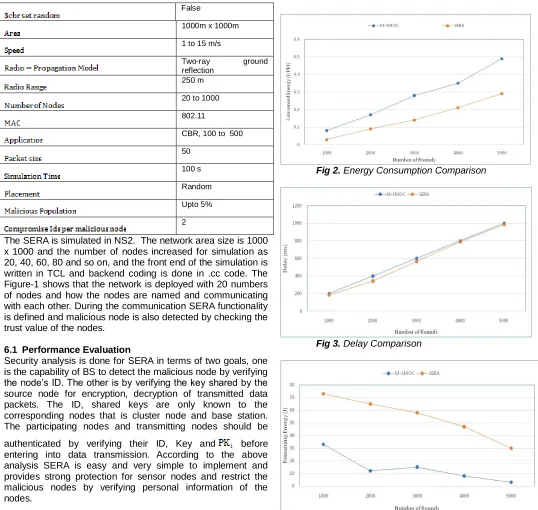
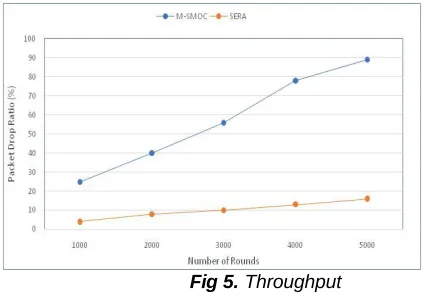
The simulation results of SERA are compared with M-SMOC [9]. SERA are analyzed through energy consumption, delay, remaining energy and packet drop ratio against number of rounds. There are 200-1000 sensor nodes clustered and deployed in a uniform manner within a specified area. The corresponding parameters used in NS2 configuration are given in Table-II. Simulations are carried out for different scenarios with various rounds and various nodes distributed with different locations where the distance among the nodes is also getting vary. It is considered that the packet size, number of nodes, locations and distance among nodes are changed under IEEE 802.11 standard. Under these constraints, packet transmission rate, loss rate, energy consumption according to packets, pending packets are verified in the simulation. We evaluate energy consumption, delay, remaining energy and throughput against number of rounds.
Fig 2. Energy Consumption Comparison
Fig 3. Delay Comparison
Fig 4. Remaining Energy Comparison
used for transmission at each round. The throughput is constant in some of the existing methods due to fixed number of nodes in the network and fixed number of nodes in a route. But in SERA, N determines the cluster size, number of intermediate clusters and number of packets transmitted with delay at each round.
Fig 5. Throughput
7 CONCLUSION
In this paper SERA model is introduced for secured transmission with energy efficiency. It is very much important in WSN to achieve energy, delay with security kind of performance metrics in a better manner. SERA provided different scenarios like the number of nodes are different in each round for evaluating the performance. In various scenarios, SERA resulted in minimized energy consumption of IEEE 802.11 standard WSN networks with taking a optimum delay. Also SERA elected the nodes before and during data transmission by verifying the nodes are trustable node or not. SERA trust the nodes after mutual key verification among pair of nodes. the Data is encrypted for transmission combined with node‘s trust.
REFERENCES
[1] M. Li and Y. Liu, ―Rendered path: range-free localization in an
[2] Isotropic Sensor Networks with Holes,‖ Proceedings of the ACM Mobile Com, Published in IEEE/ACM Transactions on Networking(TON), vol. 18, No.1, pp. 320–332, 2010.
[3] Y. Ouyang, Z. Le, J. Ford, and F. Maked on, ―Priva Sense:Providing privacy protection for sensor networks,‖ The ACM Conference on Embedded Networked Sensor Systems (SenSys ‗07),vol. November 2007, no. Sydney, Australia.
[4] J.Wang, I. J. de Dieu, A. De Leon Diego Jose, S. Lee, and Y.-K.Lee, ―Prolonging the life time of wireless sensor networks via hot spot analysis,‖ in Proceedings of the 10th annual International Symposium on Applications and the Internet (SAINT‘10), pp. 383–386, Seoul, Korea, July 2010.
[5] Akyildiz, I.F.; Su, W.; Sankarasubramaniam, Y.; Cayirci, E. Wireless sensor networks: A survey. Comput.Netw. 2002, 38, 393–422.
[6] A. S. K. Pathan and C. S. Hong, ―SERP: Secure energy- efficient routing protocol for densely deployed wireless sensor networks,‖ Annals des Telecommunications/Annals of Telecommunications, vol. 63, no. 9-10, pp. 529–541, 2008.
[7] Y. Wang, B. Ramamurthy and X. K. Zou, ―The Performance of Elliptic Curve Based Group Diffie-Hellman Protocols for Secure Group Communication over Ad Hoc Networks,‖ IEEE International Conference on Communication, Vol. 5, 2006, pp 2243-2248.
[8] WEI Chu-yuan, ―A Hybrid Group Key Management Architecture for Heterogeneous MANET‖, 2010 Second IEEE International Conference on Networks Security, Wireless Communications and Trusted Computing pp 537- 540.
[9] Shushan Zhao, Robert Kent and AkshaiAggarwal, ―A Key management and secure routing integrated framework for Mobile Ad- hoc Networks‖, Ad Hoc Networks 11(2013), Elsevier, pp 1046-1061, 2013. [10]Muhammad Asad , Yao Nianmin and Muhammad
Aslam, ―Spiral Mobility Based on Optimized Clustering for Optimal Data Extraction in WSNs,‖ MDPI Technologies,Vol.6, No.35, pp.1-21,March 2018.
[11]Farooq Aftab, Zhongshan Zang and Adeel Ahmad, ― Self- Organizing based Clustering in MANETs Using Zone Based Group Mobility, ―IEEE Access, Vol.5, pp.27464-27476, 2017.
[12]Xuan Liui, Jun Li, Zy Dong, and Fei Xiong, ―Joint Design of Energy-Efficient Clustering and Data Recovery for Wireless Sensor Networks‖, IEEE Access, Vol.5,pp.3646-3656, 2017.
[13]Muhammad Amjad, Muhammad Khalil Afzal, Tariq Umer, and Byung-Seo Kim, ― QoS-Aware and Heterogenity Clustered Routing Protocol for Wireless Sensor Networks‖, IEEE Access, Vol.5, pp.10250-10262. 2017.
[14]Wenbo Zhang, Ling Li, Guangjie Han and Lincong Zhang,―E2HRC: An Energy-Efficient Heterogeneous Ring Clustering Routing Protocol for Wireless Sensor Networks‖, IEEEAccess, Vol.5, pp.1702-1713, 2017.
[15]Zhihua Zhang, Hongliang Zhu, Shoushan Luo, Yang Xin, and Xiaoming Liu, ―Intrusion Detection based on State Context and Hierarchical Trust in Wireless Sensor Networks‖, IEEE Access,Vol.5, pp.12088-12102, 2017.
[16]Muthumayil K, PSNA College of Engg.& Tech., [17]R.Bhaskaran, PSNA College of Engg.&Tech., [18]R.Sudha, PSNA College of Engg.&Tech.,