Optical binding of two cooled micro-gyroscopes
levitated in vacuum
Y
OSHIHIKOA
RITA,
1,2,6E
WANM. W
RIGHT,
1,3 ANDK
ISHAND
HOLAKIA1,3,4,51SUPA, School of Physics & Astronomy, University of St Andrews, North Haugh, St Andrews KY16 9SS, UK 2Molecular Chirality Research Center, Chiba University, 1-33 Yayoi-cho, Inage-ku, Chiba-shi 263-0022, Japan 3College of Optical Sciences, The University of Arizona, Tucson, Arizona 85721-0094, USA
4Graduate School of Engineering, Chiba University, 1-33 Yayoi-cho, Inage-ku, Chiba-shi 263-0022, Japan 5e-mail: [email protected]
6e-mail: [email protected]
Received 29 January 2018; revised 4 June 2018; accepted 13 June 2018 (Doc. ID 320932); published 26 July 2018
Coupling between mesoscopic particles levitated in vacuum is a prerequisite for the realization of a large-scale array of particles in an underdamped environment as well as potential studies at the classical–quantum interface. Here, we demonstrate for the first time, to the best of our knowledge, optical binding between two rotating microparticles mediated by light scattering in vacuum. We investigate autocorrelations between the two normal modes of oscillation determined by the center-of-mass and the relative positions of the two-particle system. The inter-particle coupling, as a consequence of optical binding, removes the degeneracy of the normal mode frequencies, which is in good agreement with theory. We further demonstrate that the optically bound array of rotating microparticles retains their optical coupling during gyroscopic cooling, and exhibits cooperative motion whose center-of-mass is stabilized.
Published by The Optical Society under the terms of theCreative Commons Attribution 4.0 License. Further distribution of this work must maintain attribution to the author(s) and the published article’s title, journal citation, and DOI.
OCIS codes:(140.7010) Laser trapping; (350.4855) Optical tweezers or optical manipulation.
https://doi.org/10.1364/OPTICA.5.000910
1. INTRODUCTION
A central theme in levitated optomechanics is the trapping and control over all the degrees of freedom of mesoscopic particles levitated in vacuum. Such particles offer unprecedented opportu-nities for studies at the classical–quantum interface, enabled by the absence of direct dissipation and any physical contact. One of the primary goals is to bring an optically levitated particle to the quantum ground state by cooling its center-of-mass (CoM) motion via the light momentum transfer from the incident light field to the trapped particle [1–3]. Though yet to be attained, recent advances have shown a number of cooling mechanisms at play, and sub/millikelvin temperatures have been reached [4,5]. Importantly, such nano- and micromechanical oscillators exhibit high quality (Q)-factors, offering a force sensitivity of 20 zN Hz−1∕2, which is sufficient to sense ultra-weak interactions,
such as non-Newtonian gravitational forces [6,7].
While the majority of studies have focused on linear optical momentum transfer through radiation pressure, we have previ-ously shown the transfer of spin angular momentum (SAM) to a trapped birefringent microparticle,“vaterite”in vacuum record-ing rotation rates of up to 10 MHz [8]. By including the rota-tional degrees of freedom, we have observed the effective cooling of microparticles through the gyroscopic effect in the absence of any“active”feedback method [8], in contrast to other recent stud-ies [4,5]. Furthermore, a nanomechanical rotor with remarkably
high-Q has been demonstrated by optically levitating a silicon nanorod and periodically driving its rotation with circularly polarized (CP) light [9]. The nanorod’s motion is frequency locked to the periodic drive, resulting in ultra-stable rotations, with a stability close to that of the drive [10].
For a number of key studies, such as multiparticle entangle-ment and vacuum friction [11,12], the ability to individually trap, move, and rotate multiple particles at close proximity from one another in vacuum is essential with complete freedom over the transfer of both linear and SAM to each individual particle and ability to vary the inter-particle spacing. Recently, we have demonstrated the appropriate geometry for such a system using a spatial light modulator (SLM) [13]. By trapping and rotating two vaterite microparticles, we observed intensity modu-lation of the scattered light at the sum and difference frequencies with respect to the individual rotation rates. However, the key step is to conclusively demonstrate that the two particles interact and that their dynamical motion is inherently linked through a process known as optical binding [14–17]. This is what we present here with clear evidence of the optical coupling (binding) of two such trapped particles in vacuum, each acting as a har-monic oscillator. In our particular study, we make use of two ro-tating vaterite microparticles placed in close proximity to one another.
The reason to explore the optical binding of rotating aniso-tropic vaterite particles is twofold: first, if the particles are non-rotating, the resulting light scattering, which generally contains isotropic and anisotropic contributions, and associated optical binding will be anisotropic and depend on the relative orientation of the axes of the two birefringent particles (see
Supplement 1, note S1 and Fig. S1, andVisualization 1). In con-trast, for rotating particles, the anisotropic contribution of the scattered light can vanish upon temporal averaging, so that the particles act effectively as isotropic particles from the perspective of optical binding (seeSupplement 1, note S1 and Fig. S2, and
Visualization 2). Treating the rotating particles as effectively iso-tropic is valid as long as the rotation frequency far exceeds the frequencies associated with the effective optical binding. Second, a rotating body offers inertial stiffness, so the particles act as micro-gyroscopes, which prevents the particle instabilities that have been typically observed in optical traps operating at low pressures [7,18]. This allows us to operate in vacuum without a need for active feedback schemes.
Although considerable effort has been made in developing op-tically coupled oscillators [19,20], such studies to date are based on a clamped resonator, which imposes limits to thermalization and routes for decoherence. In this paper, we demonstrate optical binding between two rotating vaterite microparticles at close proximity and levitated in vacuum. The aerodynamic cross-cou-pling is greatly diminished when the mean-free-path (λmfp) of the
surrounding gas molecules becomes larger than the particle size and approaches the inter-particle separation. At this gas pressure, the cross-coupling is entirely mediated by light scattering. We in-vestigate autocorrelations between the two normal modes of oscillation, which are determined by the CoM and the relative positions of the two-particle system. Our theoretical model pre-dicts that the coupling removes the degeneracy of the normal mode frequencies, which are measured by experiment and deter-mine the cross-force coefficient. Furthermore, the optically bound array of rotating microparticles exhibits cooperative motion whose CoM is stabilized by gyroscopic cooling. Such an optically coupled and cooled array of micro-gyroscopes in levitated opto-mechanics may provide a future route for exploring multiparticle entanglement and quantum friction.
2. METHODS
A. Sample Preparation
The synthesis of vaterite crystals and the protocol for micropar-ticle levitation are described elsewhere [21,22]. Vaterite is a pos-itive uniaxial birefringent material with a spherical morphology. The particles have a mean radius of2.2μm0.02μm(2σ) and a surface roughness of 27.6 nm (2σ).
B. Experimental Setup
We trap and rotate two vaterite microparticles with two CP beams (continuous wave 1070 nm) in air (∼103 mBar). A holographic
optical tweezers based on an SLM allows individual intensity con-trol and three-dimensional positioning of two traps. Independent polarization control of traps is also achieved by generating beams of orthogonal polarization states that are subsequently combined at a polarizing beam displacer (PBD, Thorlabs, BD27) [13]. Crucially, the magnitude of the trapping forces in the lateral di-rection (xyplane) is much larger than the optical binding forces to
assure the particles do not escape from their traps. The trap stiffnessκ, however, is small enough to analyze the optical binding strengthξ. In order to meet these criteria, the optical power is maintained at a low level 25 mW, which is measured at the back aperture of the microscope objective (transmission 58% at 1070 nm) and is equally shared between the two trap sites, throughout the measurements. The chamber pressure is gradually reduced from atmospheric pressure to 10−2 mBar, so that both
particles are rotating at rates (≥20 kHz), greater than their trap frequencies (∼0.66 kHz).
C. Detection Scheme
In order to simultaneously record the CoM positions of two par-ticles, we use a fast CMOS camera (Mikrotron, EoSens MC1362) with a frame rate of 3493 fps synchronized with nanosecond laser pulses of 532 nm. This allows obtaining stroboscopic images of the two fast-rotating particles over a period of 1 s with a band-width of 1747 kHz, which is greater than the trap frequency typ-ically ∼0.66 kHz (see Visualization 3 rendered at 25 frames/s (fps) from 3493 fps). CoM positions of each particle are sub-sequently analyzed at each frame to determine the two normal modes of oscillation. While the CMOS camera captures the trans-lational motion, fast photodiodes (Thorlabs Inc., DET10C, InGaAs) are used to record the forward scattered light intensity from the two particles with a bandwidth>500 kHz. This allows tracking their rotational and translational motion simultaneously when reducing the chamber pressure. Due to the rotational Doppler effect, we observe modulation frequencies at twice the rotation rates, 2fr1 and 2fr2, of each particle [8]. In practice, fr1 and fr2 are also detected because of the variation in the
photodiode signal induced by a small optical asymmetry on any given particle.
3. THEORY
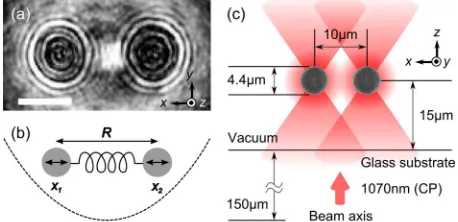
In order to model the correlated motion between two optically bound microparticles, we employ the theoretical approach of Meiners and Quake [23] and Bartlettet al.[24], which includes the hydro-/aero-dynamic coupling between the particles, and we extend the theory to include the optical coupling between the par-ticles in the underdamped case [25]. The optical binding scheme is shown in Fig.1, where the two identical spheres (with mass ofm
and radius ofa) are levitated by a pair of trapping beams propa-gating along thezaxis. Transverse optical binding (along thexaxis) perpendicular to the trapping beams is assumed to arise from the light scattering by the two particles, which causes the radiation pressure from one particle to the other and modifies each trapping potential. The spheres of radiusaare taken to have an equilibrium particle separationR, and we label the deviations of the sphere cen-ters from their equilibrium positions along thexaxis byxjtwhere j1,2refers to each of the particles.
mA11 d 2
d t2
x1 x2 d d t x1 x2
A11 A12
A12 A11
f
1t−κx1ξx2
f2t−κx2ξx1
, (1)
where A111∕6πμa and A12 1∕4πμR are the
longi-tudinal mobility factors withμthe residual gas viscosity. Here,
fjtare noise sources with correlation functions
hfjti 0, (2)
hfiτ1fjτ2i 2δijλjkBTδτ1−τ2, (3)
which represent the fluctuating forces acting on the microparticles due to Brownian and other noise sources, e.g., beam pointing fluctuations, at effective temperatureT.
The force terms proportional to the spring constantκ≥0 re-present the direct force on a chosen sphere when that sphere is displaced while the other sphere is held fixed, and the force terms proportional to ξ describe the cross-force that arises on the chosen sphere at its equilibrium position when the other sphere is displaced. The force acting on a given sphere, e.g., sphere 1, is composed of two components along thex axis: a gradient force directed towards the beam focus, and a cross-force arising from the scattered light field caused by sphere 2 (see Fig.1). Thus, the cross-force coefficient ξ is positive when longitudinal optical binding arises from the inter-particle scattering of the two spheres at close proximity. Balancing of these two forces (gradient and coupling) results in the equilibrium separation for the two opti-cally binding spheres. If sphere 2 is displaced from its equilibrium position, the scattered light field amplitude produced by sphere 2 will be modulated. Consequently, sphere 1 will move its position to equilibrate the gradient and scattering forces along thexaxis. The cross-force thus tends to correlate the motions of the two spheres.
To proceed, we introduce the normal mode coordinates for the CoM and the relative motion as X1 1∕
ffiffiffi
2 p
x1x2 and
X2 1∕
ffiffiffi
2 p
x1−x2. Based on the Langevin equations of
motion for small amplitude sphere displacements, including the inertial terms for the underdamped case, we obtain the common harmonic oscillator form
d2X
j
d t2 Γ
d Xj
d t ω
2 jXj
F
j
mA11
, j1,2, (4)
where the damping coefficient Γ1∕mA11, and the oscillator
frequencies
ω2 1ω20
1− ξ κ
1ϵ, (5)
ω2 2ω20
1 ξ κ
1−ϵ, (6)
with ω2
0κ∕m, and ϵA12∕A113a∕2R. The theory
developed here should be valid if the microparticle rotation rates are much larger than these oscillation frequencies ω1,2. These
equations indicate that in the underdamped case, the two normal modes will experience the same damping but have different oscillation frequencies. In the extreme underdamped regime
Ωj≫Γ∕2, we can approximateΩjωj, which leads to the
cor-relation functions
hXjt1Xjt2i
λjkBT
m2A2
11Ω2jΓ
cosΩjjt1−t2je−Γjt1−t2j, (7)
where the frequenciesΩjand the damping rateΓmay be
deter-mined from the experiment. Dividing Eqs. (5) and (6), and using
Ωjωj applicable to the low pressures of the experiment, and
rearranging, we obtain ξ κ
1ϵ∕1−ϵ−Ω2 1∕Ω22 1ϵ∕1−ϵ Ω2
1∕Ω22
: (8)
Thus, determining the normal mode frequencies from the experi-ment allows us to calculate the ratioξ∕κ, and hence the cross-force coefficient ξifκis measured for a single trapped particle.
4. RESULTS AND DISCUSSION
In practice, when two particles are trapped and rotating in vac-uum at the same optical power, the rotation rate of each particle can be different, depending on the particle size and mass, which alters the axial position of the particle along the beam axis. This variant modulates the optical torque as well as the Stokes drag torque acting on each particle, which yields different rotation rates typically within a factor of two. The beam separationRcan be as small as 6.4μm, which equates to a distance of 2μm between the equators of the two particles, without loss of either of the particles from their trap sites at atmospheric pressure. This minimum distance, however, is dependent on the damping rate of the residual gas molecules. In order to avoid a loss of particles in vacuum, the beam separation is controlled within a range of 8μm≤R≤11μm. See Section 2 (Methods) for details.
[image:3.612.55.284.52.163.2]Visualization 3[rendered at 25 fps from a measured frame rate at 3493 fps] shows two trapped vaterite microparticles (a2.2μm) with R9.8μm at a vacuum pressure of 0.081 mBar. These particles are co-rotating at a rate≥20 kHz. Fig. 1. Schematic showing the two normal modes of the bound array.
A. Cross-Force Constant
Figure 2(a) shows the two normal modes of X1 1∕pffiffiffi2x1x2 and X2 1∕
ffiffiffi
2 p
x1−x2 for the CoM
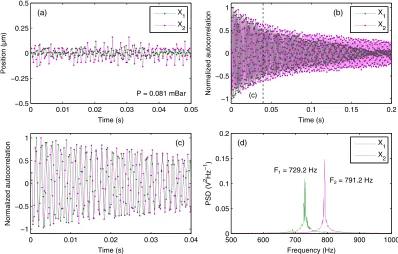
(green) and the relative motion (red) of the two particles trapped with an inter-particle separationR9.8μmat a chamber pres-sure P0.081 mBar, at which pressure λmfp 0.428 mm of
the residual gas molecules is more than two orders of magnitude greater than the particle radiusaand the separationR. At this gas pressure, aerodynamic coupling between the two particles is pro-gressively diminished, and optical coupling is the primary cause of binding. Autocorrelation functions of each normal mode are com-pared in Fig.2(b), where they decay at nearly the same rate but exhibit different oscillation frequencies [Figs.2(c)and2(d)]. The power spectra of each autocorrelation functionX1 andX2
indi-cate their normal mode frequencies of F1729.2 Hz and F2 791.2 Hz, respectively. It is rather straightforward to obtain ξ∕κ by substituting these frequencies in Eq. (8), where Ωj 2πFj (j1,2), which yields ξ∕κ0.40. This means that
the binding force constant is 40% of the trap stiffness of each particle.
B. Trap Stiffness
Based on the equipartition theorem, the trap stiffness of each par-ticle is obtained byκkBT∕hσ2i, wherekB is the Boltzmann
constant, T the temperature, and hσ2i the mean square
displacement orσthe standard deviation of the particle position distribution.Supplement 1, Fig. S3(a) shows the CoM position fluctuations of x1 (green) and x2 (red) from their equilibrium
positions, where we obtain σ1 34.4 nm and σ2 42.4 nm
for each particle (see also Supplement 1, note S2). Previously, we have determined the absorption coefficient of vaterite, which is1.59×10−5for a particle with a radius of 0.42μm, which leads
to the temperature rise of 4.2°CW−1 [22]. It is reasonable
to assume that T 296 K kept at room temperature, given the optical power of ∼7 mW at each trap site. Substituting σ andT, we obtainκ13.51 pNμm−1 andκ
22.30 pNμm−1,
respectively. Asξ∕κ0.40in this experimental system, the bind-ing force coefficient for each particle is ξ11.4 pNμm−1,
and ξ20.92 pNμm−1.
C. Rotational Dynamics
By trapping and rotating two vaterite particles in close proximity in vacuum, we have observed inter-particle interactions, in the form of sum and difference frequency mixing, encoded onto the scattered light originating from the rotation of each particle [13]. As the particles rotate, their form asymmetries and optical anisotropies modulate, at the rotation frequency and its harmonics, the incident light field akin to a macroscopic Raman effect. Multiple scattering between the two particles fur-ther delivers a heterodyne signal, which displays the variety of parametric resonances that are observed in the previous experiment [13].
Figure3(a)shows the power spectral density (PSD) of the in-cident light field scattered by two rotating microparticles with
R9.8μmatP0.081 mBar. We identify all the individual frequencies of rotational and translational motion of each particle with the aid of stroboscopic images acquired by the fast CMOS camera [see Subsection 2.C (Detection Scheme)]. It is evident that rotational frequenciesfrj≥20 kHzare more than 30 times
larger than the translational frequenciesfj≥0.66 kHz. In such
case, the anisotropic light scattering due to birefringence is time-averaged, and the particles are effectively isotropic from the view-point of optical binding (seeSupplement 1, note S1 and Fig. S2). Figure3(b)shows an expanded view of the power spectrum in the frequency range from 10 kHz–100 kHz showing the rotational
0 0.01 0.02 0.03 0.04 0.05
−0.5 −0.25 0 0.25 0.5
Time (s)
P
os
it
ion
(µm
)
P = 0.081 mBar X
1
X2
(a)
0 0.01 0.02 0.03 0.04
−1 −0.5 0 0.5 1
Time (s)
Normalized autocorrelation
(c)
0 0.05 0.1 0.15 0.2
−1 −0.5 0 0.5 1
Time (s)
Normalized autocorrelation
X
1
X2
(b)
(c)
500 600 700 800 900 1000
0 0.05 0.1 0.15 0.2
Frequency (Hz)
PSD (V
2Hz
−
1)
X
1
X
2
(d)
F1 = 729.2 Hz
F2 = 791.2 Hz
Fig. 2. Two normal modes of the bound array and each autocorrelation function. (a) Position fluctuations for the CoM normal mode X1 1∕
ffiffiffi 2
p
x1x2, and the relative normal mode X2 1∕
ffiffiffi 2
p
[image:4.612.106.504.451.705.2]frequenciesfr1,fr2of each particle and their second harmonics
2fr1, 2fr2 and the difference frequency generation (DFG)
sig-nal2jfr1−fr2j.
We further investigate a series of power spectra obtained from two rotating microparticles at different residual gas pressures in the range of 100 mBar–10−2 mBar, which is corresponding
to the damping coefficientsΓP 8πμPr3. Here, μP
de-notes the viscosity and is measured using a single vaterite particle with the same radius (a2.2μm), rotating at a terminal rate frP. At this rotation rate, we have μPfrP frPairμPair with μPair 18.2×10⁻⁶ Pas the viscosity of
air. Figure 3(c) shows the rotational mode frequencies of the two particles, namely,fr1,fr2,2fr1, and 2fr2, and the DFG
signal 2jfr1−fr2j, all of which are tracked at each power
spectrum at different damping coefficients, and are increasing at the same rate as the chamber pressure is reduced.
D. Aerodynamic Coupling
The DFG is determined by the relative rotation rate of the two particles. If the particles are independent of each other and their rotation rates are dependent solely on the damping rate Γ of the surrounding gas molecules, the normalized DFG signal 2jfr1−fr2j∕fˆr, wherefˆr fr1fr2∕2is the mean rotation
rate, must be constant over anyΓ. The deviation from a constant value indicates inter-particle interactions such as binding [13]. Figure3(d)shows the normalized DFG (blue circles) and the ratio of the cross-force coefficient ξ to the trap stiffness κ (orange circles) over a wide range ofΓ. Interestingly, there appears a kink at a pressure around 1 mBar in the normalized DFG. This is due
to mechanical couplings between the translational and rotational degrees of freedom of the trapped particles when the rotational frequency frj is resonant with the fundamental trap frequency fj(a driven oscillator resonance) and with the second harmonic
2fj(a parametric resonance), wherej1,2denotes the
individ-ual particles [8]. In this regime, both traps are unstable (i.e.,T ≫
296 K whileκj1,2 remains the same) due to these resonant
ex-citations of the trapped particles. Beyond this transition,ξ∕κ de-creases from 0.43 to 0.40 with a decrease inΓfrom10−4 pNμms
to10−6 pNμms(over two orders of magnitude).
In Eq. (8),ξ∕κdepends both on the aerodynamic coupling (ϵ) and the optical binding (Ω1∕Ω2) terms. It is assumed in the theory that the two particles have the same massmand hence the same value of Γ1∕A11, which results in a constant value of ϵ3a∕2R. However, this is not the case in general, as
m1≠m2, which leads to slightly different damping rates Γj
m∕mj∕A11in Eq. (8), wherej1,2, and the mass is redefined
as m m1m2∕2, and would reflect the weak dependence
ofξ∕κonΓ. In the underdamped case, however, it is possible that ϵcan be negligible, andΩ1∕Ω2determines the total binding force.
Assumingκremains constant over theΓrange examined, the frac-tional change inξ∕κindicates a weak dependence ofξon the aero-dynamic coupling through residual gas molecules.
Although relatively minor compared to optical coupling, the rate of the aerodynamic coupling clearly depends onΓ. We fur-ther investigate the change in the relative position of the two trapped particles at differentΓto understand its mechanical effect (seeSupplement 1, note S3 for details).Supplement 1, Figs. S4,
(a) (b)
[image:5.612.108.506.48.311.2](c) (d)
Fig. 3. Rotational and translational dynamics andξ∕κof two rotating particles witha2.2μmand withR9.8μmatP0.081 mBar. (a) Power spectrum of the two rotating particles exhibiting their translational and rotational mode frequencies. (b) An expanded view in the frequency range of
S5 indicate that the mean particle separation R9.8μm changes within a range 9.65μm≤R≤9.9μm over pressures from sub-atmospheric 100 mBar to 10−2 mBar. Intriguingly, R
exhibits its maximum at around 1 mBar, at which pressure both traps are in the parametric resonance regime. Beyond this pres-sure, the mean R decreases as the aerodynamic coupling or binding diminishes with the further decreasing Γ, where λmfp ≫a≈R.
E. ξ∕κand Particle Displacement
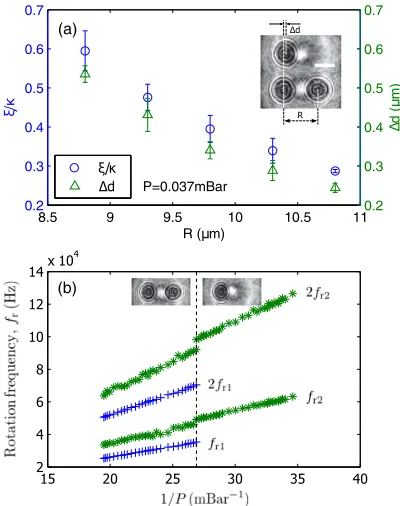
Optical binding can exhibit a long-range interaction force be-tween microparticles [26]. It is intriguing to determine ξ∕κ as a function of the inter-particle separationR. In this experiment, the chamber pressure is maintained at 0.037 mBar while changing the inter-particle separation in the range of 8.8μm≤R≤
10.8μmby modulating the lateral position of one of the trapping beams using an SLM. Figure4(a)showsξ∕κ(blue circles) and the particle displacementΔd(green triangles) at different particle sep-arationsR. By assuming that the trap stiffnessκremains constant for small displacementsΔd, the cross-force constantξdecays with the particle separationR, which is the same behavior as observed forΔd. It is evident that the particle displacementΔd increases with the binding force constantξ. Here we note thatξakin toκis not the force per se but the spring constant for the cross-force for small displacementsΔd from a stable equilibrium inter-particle separation Re and is always a positive quantity with units of
pNμm−1.ξ∕κdoes not oscillate with Ras the equilibrium
sepa-rationReis changed. In contrast, the restoring force is measured
for small displacementsΔdonly from a certain equilibrium
inter-particle separation Re where the force is zero. In this case, the
restoring force oscillates withΔddue to the lateral optical binding force [27].
The particle displacement induced by optical binding can alter the optical torque on the rotating particles. Figure 4(b)
shows the rotation frequencies of fr1,2fr1 and fr2,2fr2
of each particle, depending on the residual gas pressure. These rotational mode frequencies scale inversely with the gas pressure
P [8,28]. When one of the rotating particles leaves the trap at
P0.037 mBar, the rotation rate of the remaining particle has increased by 2.73 kHz (5.9%) from fr246.39
0.05 kHz2σ to fr20 49.120.05 kHz2σ. This is due
to the fact that the remaining particle has restored its original po-sition at the center of one of the trapping beams, where the field strength is larger than that at the position of the particle by the presence of the other particle. It is evident that the rotational and translational degrees of freedom of the trapped particles are coupled to the modified light field due to optical binding.
F. Gyroscopic Cooling and Optical Binding
Previously, we have demonstrated that rotational degrees of free-dom of a levitated microparticle can offer a unique potential for cooling itself without any active feedback scheme [8], in contrast to previous experiments [4,5]. Akin to the motion of a spinning top, a rotating body offers inertial stiffness, which prevents the body from drifting from its desired orientation. As a result, this rotating sphere acts like a micro-gyroscope, stabilizing itself around the axis of rotation, in effect cooling the sphere to 40 K with respect to its CoM, where the CoM temperature T is deduced from the particle’s Brownian dynamics.
We now progress to investigate if two rotating and optically bound particles may be cooled co-operatively as a two-particle sys-tem and still retain their optical coupling. We study the integral of the PSD Sf of the forward scattered light from the two trapped and rotating particles, which is measured by the fast photo-diodes [see Subsection2.C(Detection Scheme)]. This quantity is proportional to the mean square displacement of the particlehσ2i
and depends only upon trap stiffnessκand temperatureT [8]:
Z ∞
−∞Sfdf hσ
2i kBT
κ . (9)
This is a well-established means of determining κ and T [8]. Crucially, the trap stiffness κ linearly scales with optical power
P, which is maintained at 25 mW (shared by the two traps) throughout this experiment while reducing the residual gas pres-sure from atmospheric prespres-sure 103 mBar to 10−2 mBar. The
CoM motionT of the two-particle system is calibrated by asso-ciating with the integral of the PSD measured at normal temper-ature (296 K) and pressure (103 mBar) or at NTP.
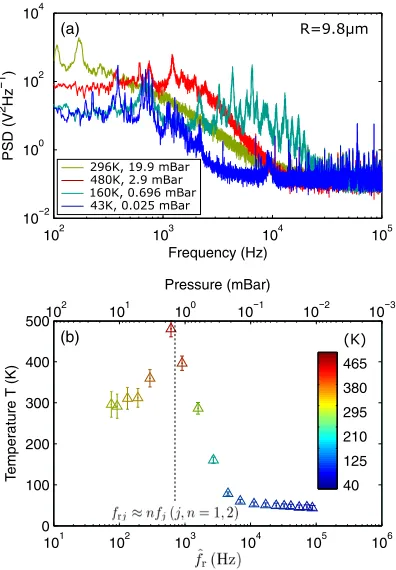
Figure5(a)shows a series of power spectra of the incident light field scattered by two rotating particles (with an inter-particle sep-arationR9.8μm) measured at different residual gas pressures, each of which presents different rotation rates and PSDs. We monitor the CoM motionT of the two-particle system by inte-grating the PSD as a function of the mean rotation rate of the two particles [see Fig.5(b)]. Due to parametric resonances, the two-rotating-particle system is heated up to 480 K (or becomes unstable) at around a pressure of 1 mBar [8]. Importantly, rota-tion stabilizes the traps and maintains the particles within their traps through this resonant transition. Beyond these resonances,
8.5 9 9.5 10 10.5 11
0.2 0.3 0.4 0.5 0.6 0.7
R ( m)
/
0.2 0.3 0.4 0.5 0.6 0.7
d (
m)
P=0.037mBar
(a)
(b)
[image:6.612.68.268.398.651.2]T is seen to decrease, reaching a minimum value of 43 K at a mean rotation rate of fˆr87 kHz corresponding to a back-ground pressure of 10−2 mBar. This is a similar cooling rate
for a single rotating particle [8].
One can understand the cooling of the two-rotating-particle system as the composition of the two individual rotating particles, which are individually cooled due to the gyroscopic effect. However, these two particles are no longer individual, as they are optically bound and exhibit cooperative motion. This repre-sents the first demonstration of a multi-particle system whose CoM motion is cooled via the gyroscopic effect. We note that it is possible to perform the experiment at a lower pressure down to10−3 mBarwith the current system [13], where optical binding
and gyroscopic cooling will be maintained. Beyond that pressure, however, thermal nonlinearities may lead to particle instability, or heating may lead to particle loss [7]. This may limit the gyro-scopic cooling (T ≥40 K) and may require a feedback scheme for further cooling [4,29]. A more detailed future study will ex-plore the interplay between binding and cooling of two or more microparticles to see the exact influence of each particle upon the other.
G. Electrostatic Forces
Finally, we briefly discuss electrostatic forces between charged microparticles compared to optical binding forces. Dielectric microparticles levitated in air/vacuum typically carry one to three elementary charges [30]. Here, we assume that the same number
ofN electronsN e are evenly distributed on the surface of each vaterite microparticle (a2.2μm) with an inter-particle separa-tion R9.8μm. In an exaggerated case with N 10, the Coulomb force between two microparticles is 0.23 fN. We have measured the mean binding force constantξˆ1.16 pNμm−1
0.05 pNμm−12σ[see Subsection4.B(Trap Stiffness)] and the
particle displacement Δd 0.33 μm0.03μm2σ [see Fig. 4(a)] for R9.8μm, which yields 0.38 pN 0.05 pN2σ. This optical binding force is more than three orders of magnitude larger than the Coulomb force (0.23 fN) between particles, carrying 10 charges each. Thus, the electro-static forces are negligible in the present regime.
5. CONCLUSIONS
Optical binding of mesoscopic particles levitated in vacuum can pave the way towards the realization of a large-scale quantum bound array in cavity-optomechanics. Here we have demon-strated for the first time, to the best of our knowledge, an optically bound array of two micro-gyroscopes mediated by light scattering in vacuum. We have investigated autocorrelations between the two normal modes of oscillation, which are determined by the CoM and the relative positions of the two rotating microparticles. The inter-particle coupling removes the degeneracy of the normal mode frequencies, which is underpinned by theory. Furthermore, the optically bound array of two rotating microparticles exhibits cooperative motion whose CoM is stabilized by gyroscopic cooling.
We note that there are a number of experiments that our work can facilitate, which can be performed without the preparation of the particle in the quantum ground state. Quantum (or vacuum) friction is a prominent example of such a study [12]. Such an optically bound and cooled array of micro-gyroscopes may pro-vide a platform for exploring multiparticle dynamics in under-damped systems close to the classical–quantum boundary.
Funding. Engineering and Physical Sciences Research Council (EPSRC) (EP/030017/1, EP/J01771X/1).
Acknowledgment. We thank Prof. Takashige Omatsu at Chiba University for useful discussions and Dr. Stephen Simpson and Professor Pavel Zemánek at ISI, Brno, Czech Republic for discussions on modeling of the experiment. The re-search data supporting this publication can be accessed athttps:// doi.org/10.17630/e6274faf-89b3-4d84-aa7d-30f68b7d5414.
SeeSupplement 1for supporting content.
REFERENCES
1. P. F. Barker,“Doppler cooling a microsphere,”Phys. Rev. Lett.105, 073002 (2010).
2. A. D. O’Connell, M. Hofheinz, M. Ansmann, R. C. Bialczak, M. Lenander, E. Lucero, M. Neeley, D. Sank, H. Wang, M. Weides, J. Wenner, J. M. Martinis, and A. N. Cleland,“Quantum ground state and single-phonon control of a mechanical resonator,”Nature464, 697–703 (2010). 3. J. Chan, T. P. M. Alegre, A. H. Safavi-Naeini, J. T. Hill, A. Krause, S.
Gröblacher, M. Aspelmeyer, and O. Painter,“Laser cooling of a nanome-chanical oscillator into its quantum ground state,”Nature478, 89–92 (2011).
4. T. C. Li, S. Kheifets, and M. G. Raizen,“Millikelvin cooling of an optically trapped microsphere in vacuum,”Nat. Phys.7, 527–530 (2011).
(a)
[image:7.612.71.269.47.332.2](b)
5. J. Gieseler, B. Deutsch, R. Quidant, and L. Novotny,“Subkelvin paramet-ric feedback cooling of a laser-trapped nanoparticle,”Phys. Rev. Lett.
109, 103603 (2012).
6. G. Ranjit, M. Cunningham, K. Casey, and A. A. Geraci,“Zeptonewton force sensing with nanospheres in an optical lattice,” Phys. Rev. A
10593, 053801 (2016).
7. J. Gieseler, L. Novotny, and R. Quidant,“Thermal nonlinearities in a nanomechanical oscillator,”Nat. Phys.9, 806–810 (2013).
8. Y. Arita, M. Mazilu, and K. Dholakia,“Laser-induced rotation and cooling of a trapped microgyroscope in vacuum,” Nat. Commun. 4, 2374 (2013).
9. S. Kuhn, P. Asenbaum, A. Kosloff, M. Sclafani, B. A. Stickler, S. Nimmrichter, K. Hornberger, O. Cheshnovsky, F. Patolsky, and M. Arndt,“Cavity-assisted manipulation of freely rotating silicon nanorods in high vacuum,”Nano Lett.15, 5604–5608 (2015).
10. S. Kuhn, A. Kosloff, B. A. Stickler, F. Patolsky, K. Hornberger, M. Arndt, and J. Millen,“Full rotational control of levitated silicon nanorods,”Optica
4, 356–360 (2017).
11. A. Manjavacas and F. J. G. de Abajo, “Vacuum friction in rotating particles,”Phys. Rev. Lett.105, 113601 (2010).
12. R. K. Zhao, A. Manjavacas, F. J. G. de Abajo, and J. B. Pendry,
“Rotational quantum friction,”Phys. Rev. Lett.109, 123604 (2012). 13. Y. Arita, M. Mazilu, T. Vettenburg, E. M. Wright, and K. Dholakia,
“Rotation of two trapped microparticles in vacuum: observation of optically mediated parametric resonances,”Opt. Lett.40, 4751–4754 (2015).
14. K. Dholakia and P. Zemanek,“Colloquium: gripped by light: optical binding,”Rev. Mod. Phys.82, 1767–1791 (2010).
15. M. Guillon and B. Stout,“Optical trapping and binding in air: imaging and spectroscopic analysis,”Phys. Rev. A77, 023806 (2008).
16. S. Maayani, L. L. Martin, and T. Carmon,“Optical binding in white light,” Opt. Lett.40, 1818–1821 (2015).
17. O. Brzobohatý, T.Cižmár, V. Karásek, M.ˇ Šiler, K. Dholakia, and P. Zemánek,“Experimental and theoretical determination of optical binding forces,”Opt. Express18, 25389–25402 (2010).
18. J. Millen, T. Deesuwan, P. F. Barker, and J. Anders, “Nanoscale temperature measurements using non-equilibrium Brownian dynamics of a levitated nanosphere,”Nat. Nanotechnol.9, 425–429 (2014).
19. Y. L. Li, J. Millen, and P. F. Barker,“Simultaneous cooling of coupled mechanical oscillators using whispering gallery mode resonances,” Opt. Express24, 1392–1401 (2016).
20. R. Madugani, Y. Yang, J. M. Ward, V. H. Le, and S. Nic Chormaic,
“Optomechanical transduction and characterization of a silica micro-sphere pendulum via evanescent light,”Appl. Phys. Lett.106, 241101 (2015).
21. Y. Arita, A. W. McKinley, M. Mazilu, H. Rubinsztein-Dunlop, and K. Dholakia,“Picoliter rheology of gaseous media using a rotating optically trapped birefringent microparticle,” Anal. Chem. 83, 8855–8858 (2011).
22. Y. Arita, J. M. Richards, M. Mazilu, G. C. Spalding, S. E. S. Spesyvtseva, D. Craig, and K. Dholakia,“Rotational dynamics and heating of trapped nanovaterite particles,”ACS Nano10, 11505–11510 (2016).
23. J. C. Meiners and S. R. Quake,“Direct measurement of hydrodynamic cross correlations between two particles in an external potential,”Phys. Rev. Lett.82, 2211–2214 (1999).
24. P. Bartlett, S. I. Henderson, and S. J. Mitchell,“Measurement of the hydrodynamic forces between two polymer-coated spheres,” Philos. Trans. R. Soc. London A359, 883–895 (2001).
25. N. K. Metzger, R. F. Marchington, M. Mazilu, R. L. Smith, K. Dholakia, and E. M. Wright,“Measurement of the restoring forces acting on two optically bound particles from normal mode correlations,”Phys. Rev. Lett.98, 068102 (2007).
26. M. Mazilu, A. Rudhall, E. M. Wright, and K. Dholakia,“An interacting dipole model to explore broadband transverse optical binding,” J. Phys.24, 464117 (2012).
27. M.-T. Wei, J. Ng, C. T. Chan, and H. D. Ou-Yang,“Lateral optical binding between two colloidal particles,”Sci. Rep.6, 38883 (2016).
28. Y. Arita, M. Chen, E. M. Wright, and K. Dholakia,“Dynamics of a levitated microparticle in vacuum trapped by a perfect vortex beam: three-dimensional motion around a complex optical potential,”J. Opt. Soc. Am. B34, C14–C19 (2017).
29. F. Monteiro, S. Ghosh, E. C. van Assendelft, and D. C. Moore,“Optical rotation of levitated spheres in high vacuum,”Phys. Rev. A97, 051802 (2018).